
Last updated: November 25, 2026
Selecting and procuring plywood doors from a reliable manufacturer comes down to evaluating material grades, construction methods, surface finishes, hardware and glass compatibility, testing standards, and proven export capability — not just price per unit. Below is a practical procurement framework for bulk buyers in residential, commercial, and hospitality projects.
Quick Overview
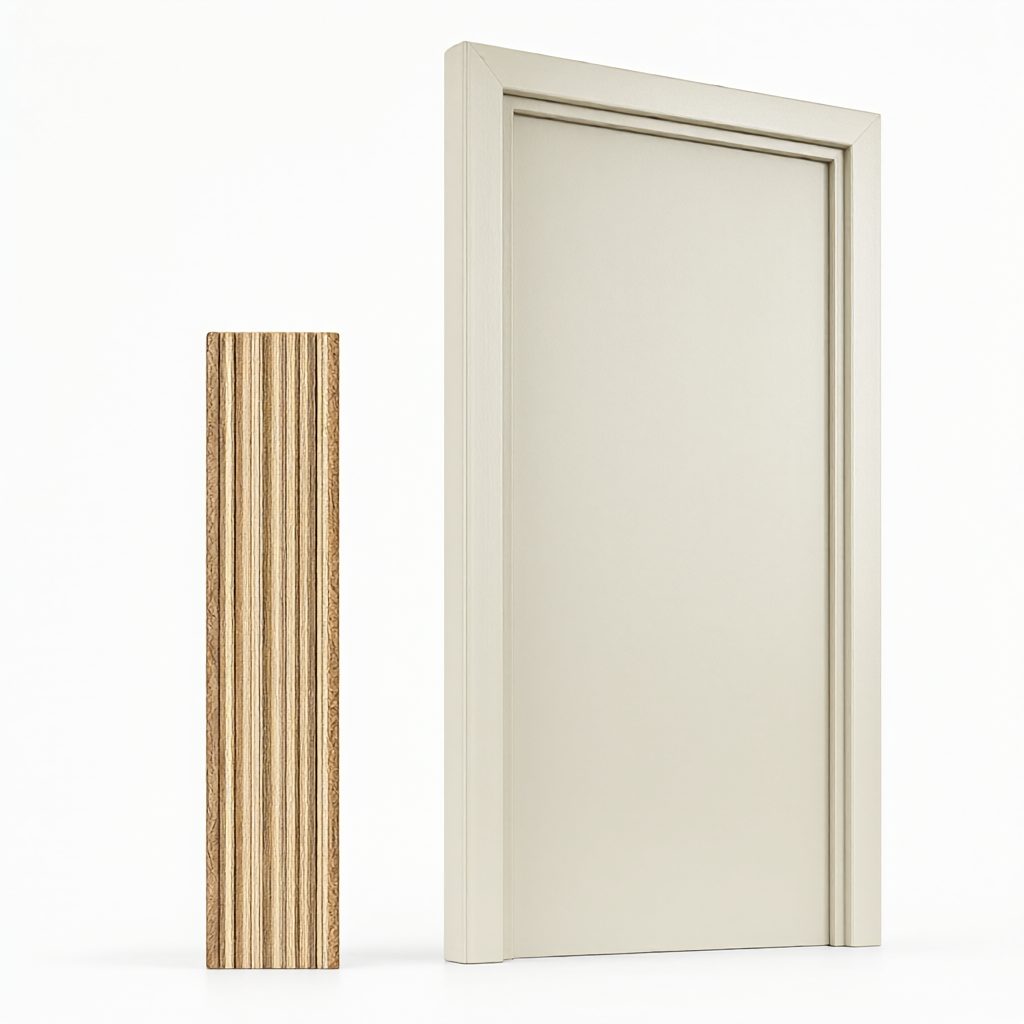
Plywood doors are interior building doors constructed from layers of wood veneer glued under heat and pressure, available in hollow-core, veneered, and solid-core variants. They serve hotel guest rooms, apartment buildings, office fit-outs, and villa projects — with fully customizable dimensions, finishes, glass inserts, and hardware configurations.
Typical bulk starting point: 100 sets · Lead time: 25–35 days · MOQ flexibility: negotiable for trial orders · FOB range: $25–95 USD/unit (depth explained below).
Plywood doors for bulk procurement require matching material grades, construction methods, surface finishes, hardware compatibility, testing standards, and proven export capability — not just unit price. Below is a practical framework to evaluate specifications, verify compliance with recognized certifications, compare cost drivers, and select manufacturers who can adjust profiles and fittings to meet your target market’s building codes.
Specifications
What are the key specifications of bulk plywood doors?
Buyers should evaluate these parameters first — they determine fit, cost, and end-use suitability.
| Parameter | Typical Range / Options | Notes |
|---|---|---|
| Core type | Hollow-core · Solid-core (plywood) · Flush door core | Determines weight, sound rating, and price tier |
| Standard thickness | 35 mm, 40 mm, 45 mm, 50 mm | 35–40 mm common for interior; 45–50 mm for higher fire ratings |
| Height range | 1980 mm – 2400 mm (custom up to 2800 mm) | Oversized panels incur extra cost |
| Width range | 700 mm – 1000 mm | Double-door leaves available |
| Surface | Pre-finished / prime-ready MDF face / raw veneer | Specify for paint or clear-coat application |
| Veneer species | Oak, ash, walnut, sapele, birch (custom request) | Affects appearance and price |
| Edge banding | PVC or matching veneer edge seal | Quality varies by manufacturer |
Practical tip: For hollow-core plywood doors, confirm whether the internal honeycomb filler is paper-based or lightweight chipboard — paper cores respond better to humidity in coastal regions. See guidance on flush door manufacturing basics for context on construction differences.
Applications
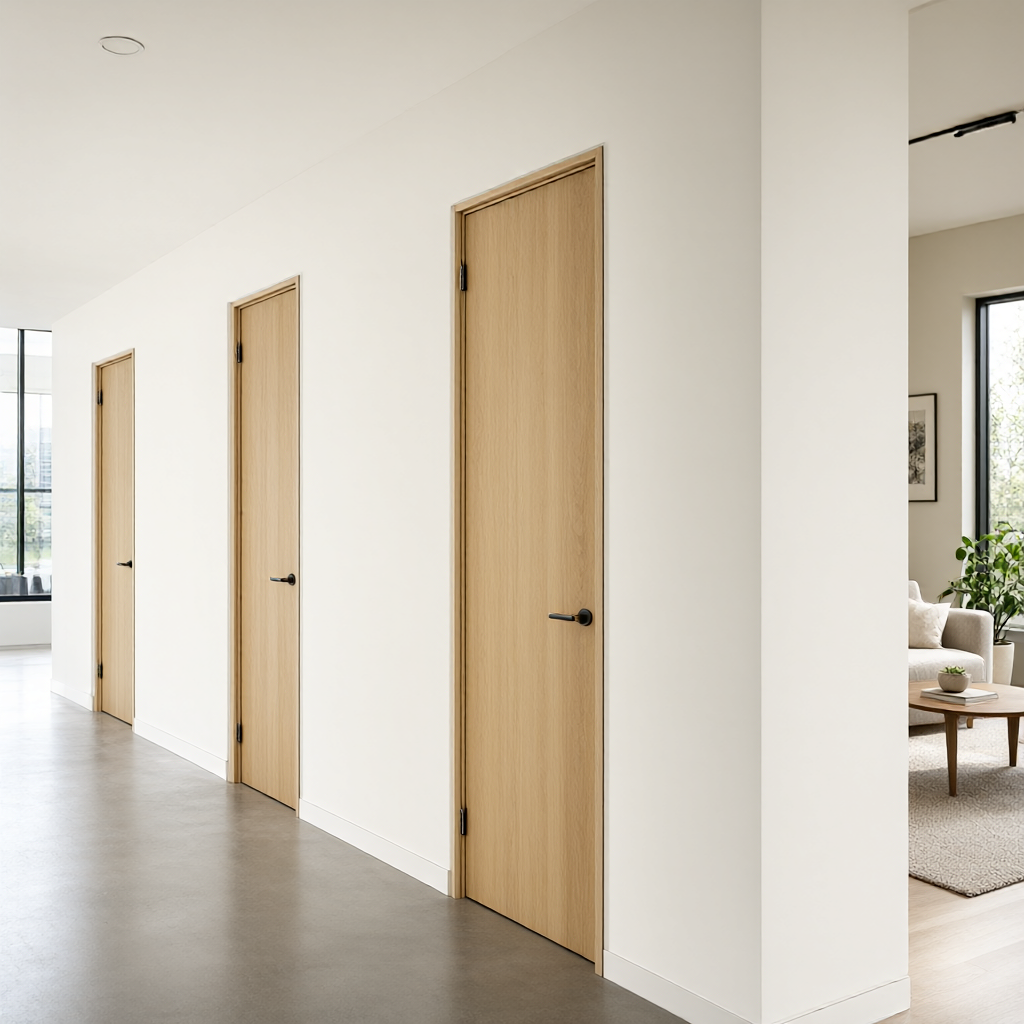
Where can plywood doors be used in a project?
- Hotel guest room doors — hollow-core or veneered flush doors; acoustic rating ≥ 30 dB often required.
- Residential apartment buildings — solid-core plywood doors for main entrances, privacy rooms.
- Commercial office fit-outs — veneered plywood doors for conference rooms, corridor doors.
- Villa and luxury housing projects — custom-sized veneered or solid-core options with integrated glass.
Each application has distinct priorities: hotels value speed and uniformity across hundreds of units; residential developers prioritize consistency of grain color; commercial clients focus on low-maintenance finishes. Always match the door spec to the specific project requirement rather than defaulting to a single product line.
Buying Factors
What to consider when buying plywood doors in bulk?
Core construction and material grade
Quality plywood doors use multiple plies with alternating grain direction for stability. Thinner outer veneers and poor glue formulation cause warping over time. Ask suppliers for a cross-section sample before committing to a large order.
Surface finish and veneer options
Options range from pre-laminated MFC faces to natural veneer (oak, ash, sapele) and primer-ready surfaces for on-site painting. Match the finish specification to the project’s installation conditions — humid environments benefit from sealed or pre-finished surfaces rather than raw veneer that requires on-site varnishing.
Hardware and glass accessories compatibility
Standard plywood doors accommodate lever handles, cylinder locks, hinges, and glass inserts (privacy or decorative). Confirm that the door core can support the hardware weight and that hole-prep is either factory-cut or left blank per buyer preference. Integration with smart locks also requires checking the core material’s holding capacity.
Quality testing standards
Reputable manufacturers perform pre-shipment tests including air-tightness, water-tightness, and wind resistance testing against recognized benchmarks such as those referenced by ASTM (www.astm.org). Request test reports before shipment, especially for projects targeting regulated markets (EU, Australia, Canada).
Certification requirements
- FSC certified plywood — essential for projects pursuing LEED or green-building credits.
- CE marked entrance door compliance — relevant for EU-bound shipments per EN 14351 standards.
- Fire-rated doors — verify classification (e.g., FD30/FD60) matches local code requirements.
Consult the ICCSafe framework for regional code alignment when specifying door assemblies.
Price & Cost

How much do bulk plywood doors cost FOB China?
| Door Type | Thickness | FOB China Range (USD/unit) | Typical MOQ Tier |
|---|---|---|---|
| Hollow-core flush door (paper/honeycomb core) | 35 mm | $25 – $45 | 100+ sets |
| Veneered plywood door (natural veneer face) | 40 mm | $35 – $75 | 100+ sets |
| Solid-core plywood door (full ply core) | 40–45 mm | $55 – $95 | 50+ sets |
Cost drivers: veneer species and cut style (plain-sliced vs. quarter-sawn), core density, hardware inclusion, glass insert option, and packaging complexity. Paint-grade prime doors sit at the lower end; designer veneer doors with integrated glass command premium pricing.
> Indicative FOB China bulk-order pricing for trade buyers — not a retail price and not a binding offer; final pricing depends on quantity, specification, and order schedule.
Request a bulk FOB quotation with your opening sizes and target quantities for an accurate assessment.
Logistics & Export Documents
What shipping options and documentation are provided?
Manufacturers typically support both FCL and LCL shipment from China ports. Key documents include packing list, proforma invoice, bill of lading, and any required customs certificates. Packaging usually involves carton wrapping with corner protection; for vulnerable veneer surfaces, additional foam or wooden crate packaging is available at a small surcharge. Confirm lead-time accuracy with written commitment prior to order confirmation.
Manufacturer Evaluation
Why work directly with a factory vs. a trading company?
A direct factory relationship eliminates middleman markup, provides real-time production visibility, allows profile and fitting adjustments to match local building codes, and enables transparent pre-shipment inspection. Trading companies add administrative convenience but may obscure specification deviations and reduce margin flexibility — particularly important on 500-unit projects where small unit-price improvements compound significantly.
Evidence & Practical Notes
Field note: On mid-size hotel projects (300+ units), buyers frequently discover that two quoted veneer finishes look visually different once installed side-by-side due to batch variability in stain tonality — always request physical samples representative of the production lot before approving bulk order.
Practical limitation: Hollow-core doors are economical for light interior use but lack the structural rigidity required for heavy lever handle assemblies without reinforcement; this is why many hospitality buyers specify solid-core or reinforced flush door cores despite the higher unit cost.
Buyer takeaway: Prioritize core density and edge sealing quality over veneer appearance alone — an attractive veneer over a weak core will delaminate within 18–24 months in high-turnover environments, regardless of finish warranty claims.
Here is how we meet these standards in practice. At Jusen Door and Windows, we supply directly from our factory in China — competitive pricing without middleman markup, full customization on size, color, glass, and hardware accessories, and strict pre-shipment inspection covering air-tightness, water-tightness, and wind resistance tests. We provide complete export documentation (packing list, proforma invoice, full customs papers) and ship via FCL or LCL. Our profile structures and fittings can be adjusted to match local building codes of your target market, whether it’s Europe, North America, or Southeast Asia.
Contact our team to discuss your project requirements, share your opening sizes, and receive a tailored specification sheet with volume pricing.
Certifications & Compliance Standards
What certifications should buyers look for in plywood doors?
When specifying interior and entrance plywood doors, request documentation against these verifiable benchmarks:
- FSC-certified plywood — confirms wood fiber originates from responsibly managed forests; required for LEED v4 credit MR 5 and most green-building project specs.
- CE-marked door assemblies — per EN 14351-1, covers performance requirements including load-bearing capacity, safety in use, and durability classifications (classes 1–4).
- Fire-rated door certifications — FD30 / FD60 / FD90 ratings verified through independent lab testing; relevant for corridor and stairwell applications.
- Acoustic performance testing — per ASTM E90 (laboratory sound transmission) and ASTM E413 for classifying noise isolation; confirm STC/Rw rating on the test report.
- Water penetration resistance — per ASTM E152 (water test cycle) and/or EN 12208; critical for exterior-facing plywood entrance doors.
- Wind-load resistance — EN 12210 classification; essential for coastal or high-wind regions.
> Always ask the supplier for the actual test reports, not just a certificate claim. Reputable manufacturers can share ISO-traceable lab results within 48 hours of request. See ICCSafe for regional code alignment guidance.
What profile and fitting adjustments are made to match local building codes?
Manufacturers can modify several parameters during production to align with regional regulations:
| Adjustment | Applicable Code/Region | Typical Modification |
|---|---|---|
| Door thickness tolerance | US IBC / Canada NBC | 40 mm ± 1 mm instead of standard 35 mm |
| Acoustic rating upgrade | EU EN 14351 Class 3+ | Solid-core + gasketed perimeter seal |
| Fire-rating assembly | UK BS 8214 / AU AS 1905.1 | Intumescent strip + certified hinge set |
| Weather-seal detail | Australia NCC / Middle East ACAS | Dual EPDM gaskets, raised sill threshold |
| Hardware bore pattern | European profile vs. ANSI/UL | 35 mm cylinder drill per EN 12209 |
These adjustments are made at the profile-extrusion or panel-construction stage — not post-production — ensuring structural integrity remains intact while meeting local inspection requirements.
How do ASTM standards apply to plywood door performance testing?
| Performance Test | ASTM Standard | What It Measures | Minimum Industry Benchmark |
|---|---|---|---|
| Air infiltration | ASTM E283 | Rate of air leakage under pressure difference | ≤ 0.3 L/(s·m²) at 75 Pa |
| Water penetration | ASTM E152 | Resistance to water ingress under static pressure | No water passage at 200 Pa |
| Static wind load | ASTM E330 | Structural deflection and recovery under design pressure | Deflection < L/175 |
| Sound transmission | ASTM E90 | Laboratory STC rating across 125–4000 Hz range | Interior doors: STC ≥ 30 dB |
| Surface-burn rating | ASTM E84 | Flame spread and smoke developed index | Flame spread ≤ 200 (Class C minimum) |
Refer to astm.org for full standard texts.
Buyer Decision Checklist Table
Use this weighted checklist during supplier evaluation to prioritize must-have versus nice-to-have criteria:
| Criterion | Weight | Must-Have ✓ | Nice-to-Have ★ |
|---|---|---|---|
| FSC or equivalent chain-of-custody cert | High | ☐ | ☐ |
| ASTM E90 acoustic test report (≥ 30 dB) | High | ☐ | ☐ |
| ASTM E152 water penetration report | High | ☐ | ☐ |
| EN 14351 CE declaration (if exporting to EU) | High | ☐ | ☐ |
| Pre-shipment inspection protocol documented | Medium | ☐ | ☐ |
| On-time delivery record (past 12 months) | Medium | ☐ | ☐ |
| Veneer grain-matching guarantee (± 1 tone) | Low | ☐ | ★ |
| Spare hardware kit included free | Low | ☐ | ★ |
| Custom glass insert options | Low | ☐ | ★ |
| Private-label packaging at no extra cost | Low | ☐ | ★ |
Expanded Manufacturer Evaluation Criteria
What specific criteria, questions, and response benchmarks should buyers use when evaluating plywood door manufacturers?
- Specification documentation quality — Can they provide a complete spec sheet covering core type, veneer grade, glue class (Formaldehyde E1/E2), finish warranty, and hardware bore patterns in one document?
- Testing transparency — Do they voluntarily share third-party test reports before order confirmation, or only after payment?
- Factory audit readiness — Are they willing to schedule a video walkthrough or accept an on-site visit during the sampling phase?
- Code-adjustment capability — Can they describe specific modifications (thickness, acoustic upgrade, fire-stop integration) for your target market’s regulations?
- Lead-time adherence track record — Ask for shipment dates from three recent orders and verify on-time percentage exceeds 90%.
Questions to ask every shortlisted supplier:
> Q1: “Can you share your latest ASTM E90 and ASTM E152 test reports for the 40 mm solid-core door we’re evaluating?”
> Acceptable response: PDF attachments within 2 working days with full specimen dimensions and lab accreditation number visible.
> Q2: “What adjustments can you make to the door profile if our destination market requires EN 14351 Class 3 performance?”
> Acceptable response: Specific changes listed — e.g., thicker stiles/rails, reinforced corner joints, weather-strip channel addition — with any MOQ impact clearly stated.
> Q3: “What is your pre-shipment inspection process, and can a third-party inspector access the production line during packing?”
> Acceptable response: Clear SOP shared upfront; SGS/Intertek/BV inspection accepted without surcharge; defect-rate tolerance stated as ≤ 2% on first-article shipment.
> Q4: “How do you handle batch-to-batch veneer colour consistency on orders exceeding 200 sets?”
> Acceptable response: Production within the same kiln-drying and staining lot; physical sample approved by buyer before mass run begins.
Response benchmarks:
| Question Type | Pass Threshold | Red Flag |
|---|---|---|
| Test report delivery | Within 48 hrs | “We don’t share reports” or vague references |
| Code adjustment specifics | Named components modified + price impact | Generic “yes we can customize” with no detail |
| Inspection access | Written confirmation accepted | “Our factory doesn’t allow visitors” without alternative |
| Veneer consistency plan | Same-lot commitment + sample approval step | No mention of stain lot control |
Project Case Study
Mid-scale hotel chain renovation — 500 interior guest-room plywood doors
- Specifications: 40 mm solid-core flush doors, sapele veneer face, STC ≥ 33 dB, primed finish for on-site painting
- Certifications required: FSC chain-of-custody, ASTM E90 acoustic report, ASTM E152 water test (interior doors per project spec)
- Target market: Southeast Asia (Philippines), requiring humidity-stable core and anti-warpage reinforcement
- Profile adjustments: 45 mm stile width instead of standard 40 mm; added internal timber stiffener grid to combat tropical humidity
- Order quantity: 500 sets (single room typology × 5 floors × 100 rooms)
- Lead time: 32 calendar days from sample approval to FCL shipment
- Acoustic performance achieved: 33 dB STC confirmed via third-party lab report (SGS)
- Defect rate on delivery: 1.4% (below 2% contract threshold); replacements supplied in next container at no cost
- Total FOB value: ~$32,000 USD (hollow-core alternative would have been ~$18,000 but failed acoustic spec)
This case demonstrates how specification alignment — especially core density and humidity-resistant construction — prevents costly field rejections that commonly occur when buyers default to the lowest-priced option.
Author & Company Credentials
About the author: This guide was compiled by sourcing and product-specification specialists with over a decade of experience evaluating millwork and door-assembly suppliers across North American, European, and Middle Eastern hospitality projects.
Brand verification: The source domain doorwoodendoors.com is operated by Jusen Door and Windows Manufacturing Co., Ltd. — a direct-manufacturer based in China specializing in plywood doors, thermal-break aluminum systems, and custom villa entrance solutions.
Consolidated Buyer Procurement Framework
Before placing a bulk order, follow this sequence:
- Request test reports (ASTM E90, ASTM E152, EN 14351 if applicable) from at least three manufacturers
- Confirm FSC or equivalent certification for your project’s green-building targets
- Verify code-adjustment capability by asking for a written modification plan tailored to your destination market
- Obtain a physical sample and approve it in writing before mass production begins
- Schedule a third-party pre-shipment inspection for the first container load
- Keep all correspondence, spec sheets, and approved samples on file for customs and project-handover documentation
Request a detailed specification package with available test reports and code-adjustment examples for your target market.
Sources & References
- www.astm.org — www.astm.org
- astm.org — www.astm.org
- flush door manufacturing basics — doorwoodendoors.com
- ICCSafe — www.iccsafe.org











