Technical Resource Center · Hardware & standards

Door Hardware Grades:ANSI/BHMA Grade 1, 2 & 3cycle counts by product family, traffic maths, finish codes and what the grade does not promise

Grade 1 on a hinge means 2,500,000 cycles. Grade 1 on an exit device means 500,000, run against a preloaded door. Same three words, entirely different machines — which is why “commercial grade” on a submittal is not a specification. Work out the traffic, pick the standard, then buy the grade.

LWReviewed by Leon WuFounder & Export Manager · 20 years in door manufacturingUpdated November 12, 202615 min read
10
A156 product families
3
performance grades
2.5M
Grade 1 hinge cycles
16
answered questions
The 30-second answer
Grade 1
institutional · egress · rated doors
2.5M hinge / 1M lock cycles
Grade 2
offices · multi-family · light commercial
1.5M hinge / 400k lock cycles
Grade 3
residential interiors · light duty only
350k hinge / 200k lock cycles
The grade benchset traffic · get grade
Product family

G1
G2
G3
Traffic · cycles / day
01 · THE BASICS

A grade is a tested performance level inside one standard — not a universal number.

“ANSI Grade 1” only means something after you name the standard. ANSI/BHMA writes the A156 series, one standard per product category, and each defines its own Grade 1/2/3 criteria. Hinges, locksets, exit devices, closers and deadbolts all carry different cycle counts at the same grade.

✦

Grade is per product family

A156.1 hinges, A156.2 bored locks, A156.3 exit devices, A156.4 closers — each with its own Grade 1/2/3 numbers, each tested its own way.

✦

Traffic decides, not the brochure

Cycles per day × 365 × design life, plus 25% margin. That total picks the grade — not the brand, not the price.

!

Grade 1 is not high security

Durability and tested strength, yes. Restricted keyways and drill resistance are a separate decision.

!

Finish is a grade too

A156.18 codes carry corrosion testing. 626 on brass is not 652 on steel, however alike they look on day one.

Rule of thumb — 25/day light · 100/day moderate · 250/day heavy · 500/day severe · 1,000/day extreme.
✓

Six different things people call “the grade”. Grade asks how durable and abuse-resistant the product is under its standard. The listing asks whether it is approved for the rated assembly. The function asks how it locks and latches. The finish asks how it resists corrosion. The security rating asks how it resists attack. The warranty asks what the maker promises. None of them answers the others.
02 · THE THREE LEVELS

Grade 1, Grade 2, Grade 3 — side by side.

The grade is a performance level inside a specific A156 standard. The words “Grade 1” are always the top of that standard, but the numbers behind them change completely from hinges to exit devices.

Grade 1 Heavy duty / institutional
Cycle thresholds — 2.5M hinges · 1M bored & mortise locks · 500k exit devices · 2M closers
Door weight — Rated for the heaviest leaves in the family — commonly up to 125 lb for locksets
Strength — Highest bolt, latch, impact, torsion and load requirements
Finishes — Full A156.18 finish range, including plated and stainless; longest corrosion exposure
Where it belongs — Main entrances, egress routes, hospitals, schools, transit, retail, every fire-rated assembly in practice
Cost — Highest first cost, lowest cost per cycle over 20 years
What it is not · Not a security rating: Grade 1 says nothing about restricted keyways, drill resistance or key control.
Grade 2 Light commercial / heavy residential
Cycle thresholds — 1.5M hinges · 400k bored locks · 250k exit devices · 1M closers
Door weight — Mid-range leaf weight, typically up to about 100 lb
Strength — Reduced but still tested bolt, impact and load requirements
Finishes — Same finish codes available; some exotic finishes only offered at Grade 1
Where it belongs — Offices, multi-family unit entries, hotel back-of-house, light-traffic interiors
Cost — The best value point on most interior schedules
What it is not · Not acceptable where the specification, the code or the traffic demands Grade 1 — check all three.
Grade 3 Residential / light duty
Cycle thresholds — 350k hinges · 200k bored locks · 100k exit devices · 500k closers
Door weight — Light leaves, typically up to about 75 lb
Strength — Minimum tested requirements — functional, not institutional
Finishes — Limited finish range; plated finishes wear through fastest here
Where it belongs — Interior residential doors, closets, low-traffic storage, light-duty partitions
Cost — Lowest first cost, and the highest replacement frequency on any commercial door
What it is not · Never specify on an egress route, a rated door, or any opening used by the public.
03 · THE A156 SERIES

Ten standards, ten different Grade 1 numbers.

The A156 series assigns each product category its own standard, its own test and its own Grade 1/2/3 cycle counts. This is the table that settles every “is that really Grade 1?” argument.

Product family Covers Grade 1 Grade 2 Grade 3 Notes & legacy figures
Butts and hinges
ANSI/BHMA A156.1
Full mortise, half mortise, ball-bearing and swing-clear butts 2,500,000 1,500,000 350,000 Older references quote 1,000,000 / 500,000 / 250,000 — editions differ.
Also tested for static load (door weight), operational torque, pin withdrawal and lateral load resistance.
Bored & preassembled locks and latches
ANSI/BHMA A156.2
Cylindrical lever sets, knob sets, tubular latches, entry functions 1,000,000 400,000 200,000 Frequently still published as 800,000 / 400,000 / 200,000, and in some older material as 250,000 for Grade 1.
The Grade 1 requirement covers far more than cycles: bolt strength, impact, torsion, finish and door-weight limits.
Mortise locks and latches
ANSI/BHMA A156.13
Mortise locksets, mortise deadlocks, mortise latchsets 1,000,000 800,000 800,000 Some references list Grade 2 at 400,000 and Grade 3 at 200,000 for mortise products.
Mortise bodies carry the highest security and strength requirements of any lock family; Grade 1 is the specification default for institutional work.
Exit devices (panic hardware)
ANSI/BHMA A156.3
Rim, mortise, vertical rod and surface exit devices 500,000 250,000 100,000 Earlier editions required 250,000 cycles for Grade 1.
The cycle test is run with the door preloaded — a harsher condition than an unloaded test, and the reason exit-device numbers look small.
Door closers
ANSI/BHMA A156.4
Surface, concealed, top-jamb and floor-mounted closers 2,000,000 1,000,000 500,000 Consistent across recent editions.
Grade 1 is the practical minimum on any fire-rated or main-egress opening.
Auxiliary locking devices / deadbolts
ANSI/BHMA A156.5
Deadbolts, surface bolts, auxiliary deadlocks, keylocks 250,000 150,000 100,000 Residential deadbolt programmes are often certified separately, with a security grade in addition to the durability grade.
Security testing here covers sawing, prying, impacting and bolt strength — not only cycle life.
Self-closing hinges
ANSI/BHMA A156.17
Spring hinges and self-closing butts 1,000,000 500,000 250,000 Published figures vary by edition and manufacturer.
Where a self-closing hinge is the fire-door closing device, it must carry the listing for the assembly rating.
Continuous (piano) hinges
ANSI/BHMA A156.26
Full-length geared and continuous hinges 1,000,000 500,000 250,000 Verify against the current edition and the manufacturer’s certification.
Chosen for abuse resistance and heavy leaves rather than for cycle life alone.
Electrified locking systems
ANSI/BHMA A156.25
Electric strikes, electrified mortise locks, electrified levers and trim 250,000 250,000 100,000 Electrified products are also tested for electrical endurance, fail-safe/fail-secure behaviour and duty cycle.
Always confirm the mechanical grade of the host lock as well — an electrified trim on a Grade 3 body is still a Grade 3 opening.
Power assist & low-energy operators
ANSI/BHMA A156.19
Power-assist and low-energy automatic opening devices 250,000 250,000 100,000 Safety behaviour — obstruction detection, closing force and speed — is tested alongside durability.
Full power-operated pedestrian doors fall under A156.10; low-energy operators under A156.19.
Cycle counts are the durability headline; every standard also tests strength, torque, finish and the product’s own special conditions.
“Grade 1 = 1,000,000 cycles.”
That is the bored-lock number under A156.2. Closers test to 2,000,000; exit devices to 500,000 preloaded; deadbolts to 250,000.
Ask which standard and edition the number comes from.
“Grade 1 is always 2,000,000 cycles.”
2,000,000 is the closer threshold under A156.4. Exit devices and deadbolts have much lower cycle thresholds at Grade 1.
A cycle number without a product category is not a specification.
“Grade 1 hinges are better than Grade 1 locks.”
The two are tested against different criteria. Grade compares a product to its own standard, not to another category.
Compare products within a category, never across standards.
“Grade 1 means it is fire-rated.”
Grade measures mechanical durability. A UL or Intertek listing proves fire performance of the complete assembly.
Grade and listing are separate requirements. Most rated hardware is both.
“This product is Grade 1” (no standard cited).
Without a standard, a grade claim cannot be verified or compared.
Require the standard, the tested cycle count and the certification source.
04 · THE TEST BENCH

What is actually tested behind the grade.

The cycle number is the headline, but a Grade 1 product must also survive loads, torque, impacts, corrosion and the security suite — all in one test programme, all verified by a third party.

TEST 01
Cycle (durability) test
The headline number. One cycle retracts the latch or operates the device, opens the leaf, closes it and releases. The sample must complete the grade’s cycle count without structural failure, without parts working loose, and within the permitted wear limits.
What it proves: how long the product lasts under normal use.
TEST 02
Operational torque and force
How much effort it takes to operate. Locks are tested for the torque needed to retract the latch and turn the key; hinges for free-swinging rotation under load; closers for the opening force they impose. A product that lasts a million cycles but is stiff to use will fail accessibility review.
What it proves: usability, and the ADA 5 lbf conversation.
TEST 03
Strength: bolt, latch and door load
Static and dynamic loads applied to the latchbolt, deadbolt, rose and the door itself — end load on the bolt, torsion on the rose, impact on the leaf. Grade 1 carries the highest load figures, which is why it survives abuse that folds a Grade 3 lock.
What it proves: whether the hardware holds the door, not just latches it.
TEST 04
Security tests
Prying, impacting, drilling, sawing, kicking and cylinder attack resistance, run to the level the grade requires. This is a durability-plus-resistance measure — it is not a high-security certification, and it does not cover key control or restricted keyways.
What it proves: resistance to casual and moderate forced entry.
TEST 05
Finish and corrosion
ANSI/BHMA A156.18 sets the finish codes and the test methods: salt-spray exposure per ASTM B117, adhesion, wear and UV resistance on plated and coated surfaces. Base metal matters — the same satin-chrome look on brass (626) and on steel (652) is not the same corrosion performance.
What it proves: how the surface survives cleaning, hands, weather and salt.
TEST 06
Door weight and leaf size limits
Each grade is rated against a maximum door weight and, for closers and hinges, a leaf width. Exceed it and the cycle test no longer describes your door: hinges sag, closers cannot latch, and the finish wears at the contact points.
What it proves: which leaves the product may actually be fitted to.
TEST 07
Certification, labelling and packaging
BHMA-certified products carry the certification mark and are listed in the BHMA Certified Products Directory. That listing — not a marketing claim — is what an inspector, a specifier and a warranty department will check.
What it proves: that the grade claim is third-party verified.
05 · TRAFFIC MATHS

Work out the traffic, then buy the grade.

Estimate cycles per day, multiply by 365 and by the design life, add at least 25% margin — then pick the smallest grade whose rated cycles comfortably exceed the total. The bench above the table does the arithmetic for any product family.

Product family

G1
G2
G3
Traffic · cycles / day
Traffic class Cycles Typical openings Per year
Light 25 / day Closets, storage, private offices, guest-room interiors ≈ 9,000
Moderate 100 / day Office interiors, classrooms, hotel corridors, small retail back doors ≈ 36,500
Heavy 250 / day School corridors, retail units, main office entries, hospital wards ≈ 91,000
Severe 500 / day Hospital main corridors, transit concourses, mall entrances, stadiums ≈ 182,000
Extreme 1000 / day Airport security lines, stadium vomitories, station barriers ≈ 365,000
✓

A retail unit at 200 customers a day is about 150,000 cycles a year. A Grade 3 lockset rated to 200,000 is a season and a half of service. The traffic estimate is the single most valuable line on the schedule.
06 · TRAFFIC & APPLICATION

What to put on a hospital corridor — and a closet.

Grades by opening type, with the planning figures that justify them. The grade column is a starting point, not a substitute for the traffic calculation.

Opening Hinge Lock Closer Exit Finish Note
Hospital main corridor 1 1 1 1 630 (US32D) Rated assemblies throughout; stainless for cleaning chemicals.
School classroom / corridor 1 1 1 1 626 or 630 Abuse resistance drives the specification as much as cycles.
Office interior door 2 2–1 2 — 626 (US26D) The value point; upgrade the closer if the door is on an egress path.
Hotel guest-room entry 1 1 1 — 613 or 626 Usually a rated leaf, so listed/labeled hardware and Grade 1 apply.
Retail storefront / exit 1 1 1 1 630 (US32D) 200 customers a day ≈ 150,000 cycles a year — Grade 3 is a season.
Multi-family unit entry 1 1 1 — 626 or 613 Rated leaf in most codes; keyed-alike or access-control ready.
Residential front door 2 2 — — 619/622 or 630 Add a Grade 1 or 2 certified deadbolt; security grade is separate.
Industrial / warehouse 1 1 1 1 630 (US32D) Continuous hinges (A156.26) where forklifts and trolleys abuse the leaf.
Coastal or exterior 1 1 1 1 629/630 stainless Base metal is the decision; lacquered brass will not survive.
Typical hardware grades by application. Every column is “at least”: a rated door always overrides with Grade 1 plus listing.
Cycles per day by opening — and the grade that follows
Opening Uses / day Grade Note
Residential closet / bedroom 2–8 Grade 3 Low use, low abuse, cosmetic priority.
Apartment entry 8–30 Grade 2 Security and reasonable durability; confirm owner standard.
Boutique office 30–80 Grade 2 Light commercial; watch the usage assumption.
Office corridor 80–200 Grade 1 or 2 Grade 2 may suit low traffic; Grade 1 is the safe default.
School classroom 150–400 Grade 1 Abuse resistance drives the decision as much as cycles.
Retail entrance 300–800 Grade 1 High cycles plus exterior exposure.
Hospital corridor 500–1,500 Grade 1 24-hour operation, cleaning chemicals, accessibility.
Airport / transit 1,000–3,000+ Grade 1, heavy-duty series Specify the top series, not just the grade.
Stairwell / fire exit High Grade 1 + listed Life-safety and inspection regime apply.
07 · FINISH CODES

626 is not 652 — the finish is a grade of its own.

A156.18 assigns each finish a code, a base metal and a corrosion test. The look is what the client sees; the base metal is what survives. Write the BHMA code with the US equal in brackets.

605 · US3
Bright brass, clear coated
B — brass · tier 1
Decorative interiors, heritage and traditional elevations
606 · US4
Satin brass, clear coated
B — brass · tier 2
Classic commercial interiors, education, hospitality
613 · US10B
Dark oxidized satin bronze, oil rubbed
B — bronze · tier 2
Government, institutional, traditional — a living finish that patinas
622 · US19
Flat black, powder coated
A/B — steel or brass · tier 2
Modern architectural interiors; touch-up is visible, specify a repair kit
625 · US26
Bright chromium plated
A/B — steel or brass · tier 3
High-gloss commercial, food handling, cleanable surfaces
626 · US26D
Satin chromium plated
B — brass/bronze · tier 3
The commercial interior default — hides fingerprints, takes traffic
629 · US32
Bright stainless steel
C — stainless · tier 4
High-traffic and corrosive environments where a bright look is wanted
630 · US32D
Satin stainless steel (300 series)
C — stainless · tier 4
Exit devices, hinges, exterior, healthcare and coastal — the durable default
632 · US3 (steel base)
Bright brass look on steel
A — steel · tier 2
Brass appearance at lower cost; check corrosion exposure for the location
652 · US26D (steel base)
Satin chrome look on steel
A — steel · tier 2
Economical interior hardware; not for wet or coastal locations
The four finish tiers — match the tier to the environment, then match the base metal across the whole opening.
1Decorative interior
Clear-coated brass looks; keep away from moisture, cleaners and heavy hands.
2Commercial interior
The everyday office, school and hotel environment. Lacquered or coated, wiped with the right cleaner.
3High-touch & wet-adjacent
Plated chrome and stainless-look finishes for entrances, restrooms and food areas.
4Exterior, coastal, chemical
Stainless (629/630) or PVD; salt, chlorinated water, disinfectants and weather all attack plated finishes.
!

Base metal A / B / C

A = steel, B = brass or bronze, C = stainless. Satin chrome on a brass body is 626; the same appearance on steel is 652. On a coastal door the difference is three years of service versus fifteen.

From the field · hardware photography

The grade is decided in the specification — and exposed at the door.

Lever force, hinge count, finish base metal and the listing: what looks like a detail on paper is the difference between twenty years of service and a call-back in season two.
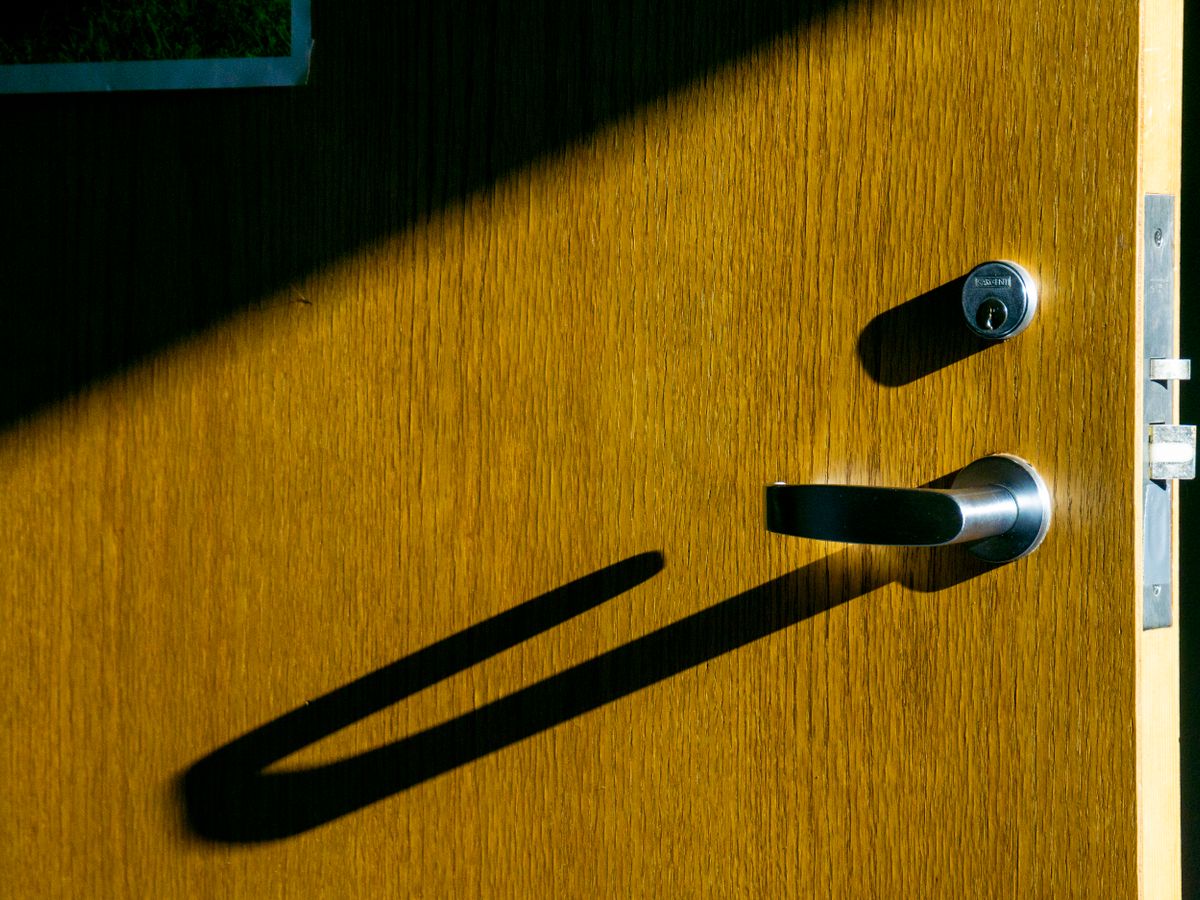
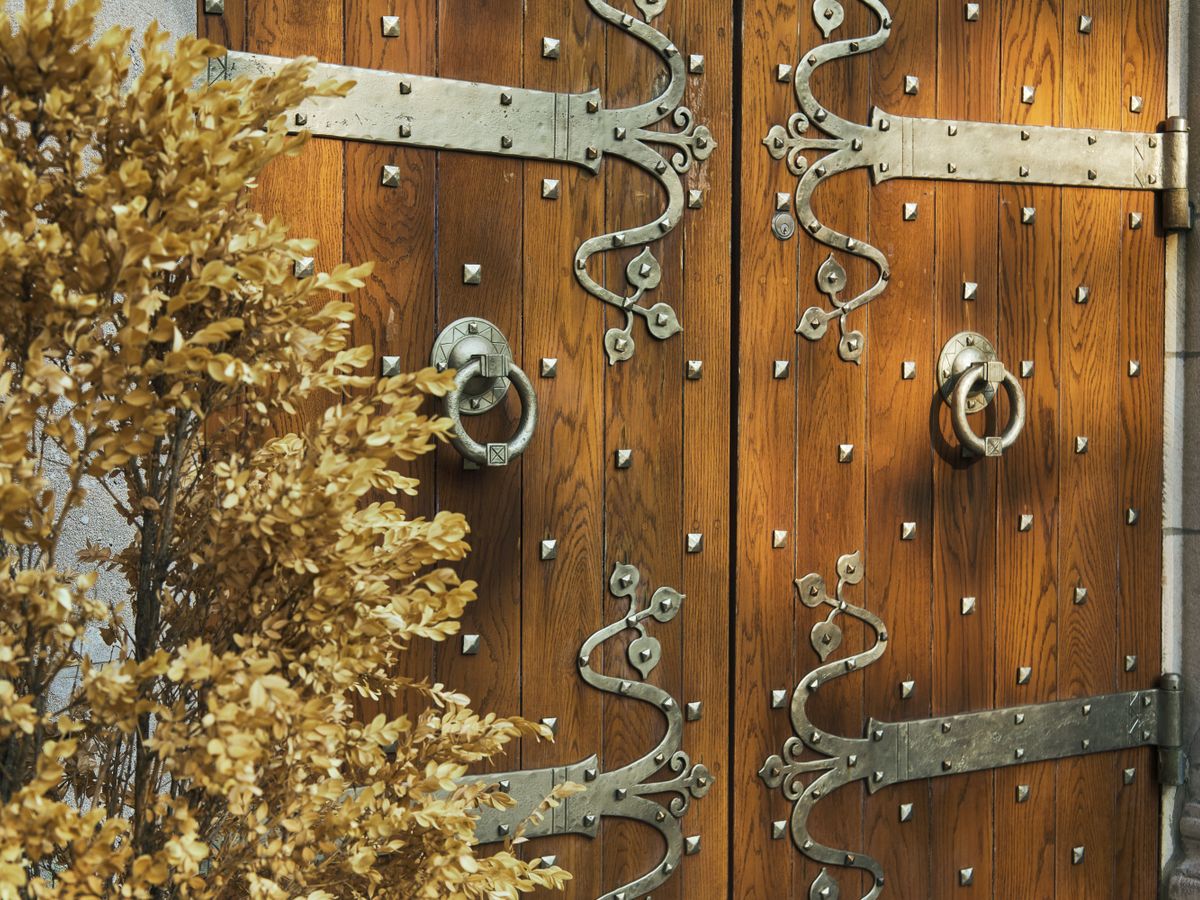
photo 01 · pexels licenceWooden door with a stainless steel lever handle casting a sharp shadow
Operable parts: lever shape, 5 lbf and 34-48 inch height are code, not preference
photo 02 · pexels licenceHeavy ornamental wooden door with forged iron strapwork and circular handles
Heavy leaves need Grade 1 hinges, sized and counted for the door weight
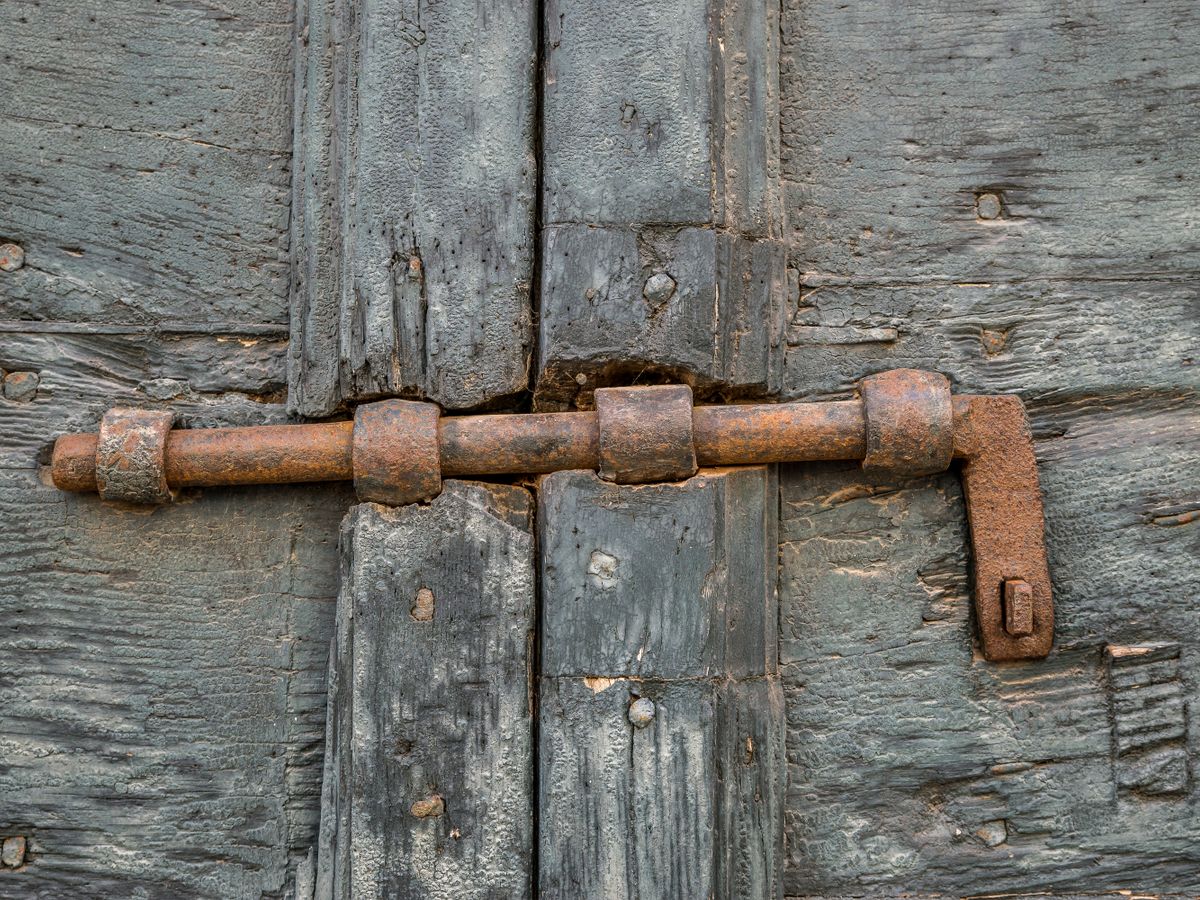
photo 03 · pexels licenceCorroded iron bolt lock on a weathered wooden door
A finish grade chosen for the wrong environment fails long before the mechanism does
08 · FIRE-RATED HARDWARE

A rated door is only as rated as its weakest part.

Every component on a fire-rated assembly must be listed and labelled for that assembly’s rating. Grade and listing are separate requirements — most rated hardware is both, and the inspector checks both.

01 · Listed and labelled for the rating
Hardware on a fire-rated assembly must be listed for use on that assembly and carry the label or listing mark. A physically identical unlisted part voids the assembly’s certification — this is checked at inspection, not at order.
02 · Hinges: material, size, count and bearings
Rated doors take steel hinges with no melting-point compromise (aluminium and brass butts are not permitted on most rated assemblies). Count and size follow the leaf: the long-standing rule of thumb is one hinge per 30″ of door height, with ball bearings on heavy or high-traffic leaves.
03 · Closers and self-closing devices
A rated door must self-close and positively latch from any open position, so Grade 1 closers and listed self-closing hinges are the practical minimum. See the door closer guide for NFPA 80 detail.
04 · Exit devices and trim
Panic hardware on a rated leaf must be fire-rated (labelled “FH” where required) as well as listed to A156.3. Trim, electric strikes and cylinders must also match the listing.
05 · No field modification
Drilling, cutting, welding, re-plating or fitting non-listed fasteners to labelled hardware can void the whole assembly. Mount to the manufacturer’s template with the supplied fixings.
06 · Glass lites and louvres
Any vision panel in a rated leaf is a listed assembly of its own: glass type, size limits, glazing system and the label. Fire-rated glass is not the same as fire-protection-rated glass.
07 · Annual inspection
NFPA 80 requires fire door assemblies — including their hardware — to be inspected at least annually, with written records kept for the authority having jurisdiction.
!

Never paint over a label, never substitute an unlisted part, and never field-modify labelled hardware. All three void the assembly at inspection — after the wall is closed.
09 · CODE & ACCESSIBILITY

The numbers code cares about: 5 lbf, 34–48″, one hand.

Grade measures durability; code sets the operable limits. A million-cycle Grade 1 lock that needs two hands still fails accessibility review.

Requirement Limit Reference Note
Operable parts — force 5 lbf maximum ADA 309.4 / 404.2.9 Applies to interior hinged doors on accessible routes; fire doors are exempt under ADA but not under ICC A117.1.
Operable parts — operation One hand, no tight grasping, pinching or wrist twisting ADA 309.4 This is why lever hardware replaced knobs on accessible routes.
Hardware height 34″–48″ above finished floor ADA 309.3 / 404.2.7 Measured to the operable part, not the rose.
Egress door operation 30 lbf to release the latch · 15 lbf to open · 5 lbf to keep moving IBC 1010.1.2 Applies to doors on the means of egress, independent of accessibility.
Panic hardware triggers Assembly and educational occupancies at 50+ occupants, and high-hazard IBC 1010.2.9 Exit devices must be listed to A156.3 and, on rated leaves, fire labelled.
No special knowledge or key Egress must be immediate and obvious IBC 1010.1 Double-cylinder deadbolts and delayed egress are restricted and heavily conditioned.
Fire-rated assemblies Self-closing or automatic-closing, positive latch NFPA 80 / IBC 716 Hardware grade follows: Grade 1 in practice on every rated opening.
Finish and durability Per A156.18 for the location ANSI/BHMA A156.18 Wet, coastal, healthcare and food locations need stainless or PVD, not lacquered brass.
✓

Lever hardware, 5 lbf operable force and 34–48″ mounting height are cheap on paper and expensive as a retrofit — and they are why knobs disappeared from accessible routes.
10 · RESIDENTIAL GRADES

Retail packaging uses the same three grades — differently.

Residential products are tested to the same A156 standards, but retail boxes quote the grades with different cycle expectations, and there is a separate certified security grading for deadbolts and locksets.

Grade Cycle expectation Security Where
Grade 1 800,000–1,000,000 cycles Highest attack resistance in the certified programme Main entries, multi-family unit doors, heavy-use residential
Grade 2 400,000 cycles Mid-level attack resistance Standard residential entries and exterior doors — the retail default
Grade 3 200,000 cycles Basic functional resistance Interior passage, privacy and closet doors
!

For a front door, buy Grade 1 or 2 with a certified deadbolt — the security grade is a separate decision from the durability grade.
11 · SPECIFYING & MISTAKES

How to write a grade that can be verified.

“Commercial grade” is not a specification. Write the standard, the grade, the function, the finish code with base metal, and the certification listing number — for every product on the schedule.

✓

The pattern

“Cylindrical lever lockset, ANSI/BHMA A156.2 Grade 1, classroom function, 626 (US26D) satin chrome on brass, lever style L07, 2-3/4″ backset, for 1-3/4″ leaf, BHMA Certified listing no. …”. Repeat for hinges (A156.1), closer (A156.4), exit device (A156.3) and any electrified component (A156.25).

LINE 01
Standard and grade
“ANSI/BHMA A156.2 Grade 1” — never “commercial grade” or a brand name alone.
LINE 02
Function
Passage, privacy, keyed entry, classroom, storeroom, entry, night latch — the function decides the trim.
LINE 03
Finish code
BHMA code first with the US equal in brackets: 626 (US26D), 630 (US32D).
LINE 04
Base metal
Brass/bronze (B), steel (A) or stainless (C) — it changes corrosion performance at the same look.
LINE 05
Handing
LH, RH, LHR, RHR read from the outside — see the handing guide.
LINE 06
Backset and bore
2-3/8″ or 2-3/4″ backset, 2⅛″ cross bore; door thickness range.
LINE 07
Door weight and thickness
Confirm the product’s rated leaf weight and thickness range.
LINE 08
Fire listing
Labelled for the assembly rating where the door is rated; UL 10C for closers.
LINE 09
Accessibility
Lever style, operable force, mounting height, and the applicable standard.
LINE 10
Keying
Keyed alike, keyed different, construction core, restricted keyway, or access-control cylinder.
LINE 11
Electrification
Voltage, fail-safe or fail-secure, duty cycle, and the A156.25 grade.
LINE 12
Warranty and certification
BHMA Certified listing number and the manufacturer’s warranty period.
Lock functions you will see on a schedule
Function Codes Outside Inside Where
Passage F75 / F76 Always free Always free Hallways, closets, circulation doors.
Privacy F76B / F81 Locked by inside turn Always free; emergency release Bedrooms, bathrooms, changing rooms.
Entry / office F82 Key locks and unlocks Always free Offices, staff rooms, main entries.
Classroom F84 Key locks or unlocks Always free Teaching spaces and training rooms.
Storeroom F86 Key retracts latch only Always free Storage, electrical and service rooms.
Apartment F90 Key; inside thumbturn deadbolt Free latch, turn bolt Multi-family unit entries.
Exit only F05 / rim exit No trim; pull side only Push bar free Egress-only doors and rated exits.
Eight ways a hardware specification goes wrong
ERROR 01
Applying one cycle number to every product
Grade 1 means 2.5 million cycles on a hinge and 500,000 on an exit device. The grade is a performance level inside a specific standard, not a universal number.
ERROR 02
Treating Grade 1 as a security rating
Grade 1 is durability plus tested strength. Restricted keyways, drill resistance and key control are separate decisions — and separate products.
ERROR 03
Mixing grades in one opening
A Grade 1 lockset on Grade 3 hinges fails at the hinge. The opening is only as durable as its weakest listed component.
ERROR 04
Specifying the look, not the base metal
626 on brass and 652 on steel look identical on day one. On a coastal door they look very different by year three.
ERROR 05
Buying by brand instead of by grade, function and finish
Every major brand sells all three grades. The submittal has to state grade, function, finish code and handing, or you get whatever is in stock.
ERROR 06
Under-estimating traffic
A retail unit at 200 customers a day is about 150,000 cycles a year. A Grade 3 lockset rated to 200,000 is a season and a half of service.
ERROR 07
Forgetting labelled hardware on rated doors
Unlisted hinges, closers or exit devices on a labelled leaf void the assembly, and the inspector will find it.
ERROR 08
Ignoring accessibility at specification stage
Knob trim, heavy springs and high mounting all fail ADA. Lever hardware, 5 lbf and 34–48″ are cheap on paper and expensive as a retrofit.
Schedule example · hardware set HW-03
Opening — 201–232 (corridor doors)
Hardware set — HW-03
Lockset — Mortise, Grade 1, A156.13, listed for fire door
Function — F86 storeroom, key retracts latch; free egress inside
Cylinder — Grade 1, 6-pin, keyed to master; core per owner standard
Closer — Grade 1, A156.4, listed, parallel arm, automatic-release holder
Hinges — Grade 1, A156.1, ball bearing, listed, stainless steel
Finish — US26D satin chromium throughout
Strike — Grade 1, electrified option not required
Confirmation — Product certificates and listing numbers attached
Hardware grade release checklist
0/0 complete
Saved in this browser. A coordination aid, not a substitute for the approved schedule.
12 · FIELD FAILURES

When the grade was wrong, this is what it looks like.

Every one of these failures was specified years earlier — under-specified traffic, a grade mix inside one opening, or a finish chosen for a different climate.

CAUSE — Hinges under-graded for the leaf weight, wrong count, or non-ball-bearing butts on a heavy door.
FIX — Count and size to the leaf (one hinge per 30″ of height is the starting rule), move to Grade 1 ball-bearing butts, and check the frame anchorage. Continuous hinges are the answer on abuse-prone leaves.

CAUSE — A Grade 3 or 2 lockset past its cycle life, or a worn latchbolt from a misaligned strike.
FIX — Replace with the grade the traffic actually demands; realign the strike before blaming the lock. Cycle count, not age, is what wears a latch out.

CAUSE — Finish tier below the environment — lacquered brass or plated steel in a wet, coastal or chemical location.
FIX — Move to 629/630 stainless or a PVD finish, and match the base metal across every component. Cleaning chemicals in healthcare are a common cause.

CAUSE — Spring wear past the rated cycle life, or a rose loosened by torsion the grade was never tested for.
FIX — Grade up. On high-traffic doors specify through-bolted roses and Grade 1 return springs.

CAUSE — Under-graded device for the traffic, mis-set latch pullback, or a preloaded door fighting the mechanism.
FIX — Grade 1 for any public egress route; adjust the device to the door, not the door to the device. A156.3 cycle tests are run preloaded, so preload is normal — but not excessive.

CAUSE — Low-grade cylinder and heavy key traffic, or a construction core left in place after handover.
FIX — Specify the permanent cylinder and, on heavy-use doors, a restricted or high-security keyway. Change out construction cores at handover.

CAUSE — Grade or size mismatch — an under-sized closer working too hard, or a Grade 3 body on a main entrance.
FIX — Grade 1 and correct spring size on any main or rated opening. See the closer guide for sizing and valve adjustment.

CAUSE — Unlisted or unlabelled parts, field modification, or missing labels after repainting.
FIX — Replace with listed components matching the assembly rating, and never paint over a label. Keep the listings on the submittal for the inspector.
13 · REFERENCE

Hardware grading glossary.

The working vocabulary of hardware specification. Filter for a term, or jump to the broader door glossary for frame and construction terminology.

ANSI
American National Standards Institute — accredits the standards and the process, and lends its name to the A156 series.
BHMA
Builders Hardware Manufacturers Association — writes the A156 product standards and runs the certification programme.
A156 series
The family of North American builders-hardware standards: one per product category, each defining its own Grade 1/2/3 criteria.
Grade 1 / 2 / 3
Performance levels within a specific A156 standard. Grade 1 is always the highest, but the numbers behind it differ by product family.
Cycle
One complete operation: retract the latch or operate the device, open, close and release. The basis of every durability claim.
Operational torque
The effort required to operate the hardware — tested alongside cycle life because a durable product must also be usable.
Latch strength / bolt load
Static and dynamic load applied to the latch or deadbolt; higher requirements at higher grades.
Security test
Pry, impact, drill, saw and cylinder-attack resistance at the level the grade requires. Not a high-security certification.
A156.18 finish code
The three-digit BHMA finish designation (626, 630, 613…) with its US equal, base metal and test method.
Base metal A / B / C
A = steel, B = brass or bronze, C = stainless steel. The same look on different bases performs very differently.
Living finish
A finish designed to change with use and patina over time — oil-rubbed bronze 613 is the classic example.
PVD
Physical vapour deposition — a hard, thin, highly corrosion-resistant coating used for premium and severe-environment finishes.
Salt spray (ASTM B117)
The corrosion test behind finish grading: hours of neutral salt fog before acceptable discolouration or red rust.
BHMA Certified
Third-party certification that a product meets its standard at the claimed grade; listed in the BHMA Certified Products Directory.
Listed / labelled hardware
Components listed for use on a fire-rated assembly and carrying the label — required on rated doors, checked at inspection.
Function
What the lockset does: passage, privacy, keyed entry, classroom, storeroom, entry, night latch. Different from grade and finish.
Backset
Distance from the leaf edge to the centre of the cross bore — 2-3/8″ or 2-3/4″ in most North American work.
Rose / escutcheon
The plate behind the lever or knob. Through-bolting matters on high-traffic doors: torsion pulls a screw-mounted rose loose.
Construction core
A temporary cylinder used during construction, swapped for the permanent, keyed cylinder at handover.
Traffic classification
The estimated cycles per day an opening will see — the input that decides the grade.
14 · QUESTIONS ANSWERED

Hardware grade FAQs.

The questions architects, installers, owners and suppliers ask most often — answered with the standard kept explicit.

They are three performance levels inside each ANSI/BHMA A156 product standard. Grade 1 is heavy duty and institutional; Grade 2 is light commercial and heavy residential; Grade 3 is residential and light duty. The numbers behind the words differ by product family — for hinges (A156.1) the Grade 1/2/3 cycle counts are 2,500,000 / 1,500,000 / 350,000, while for exit devices (A156.3) they are 500,000 / 250,000 / 100,000, run with the door preloaded.

A tested minimum: the cycle count of its standard, plus the bolt strength, impact, torsion, operational torque, finish and door-weight requirements of that grade. It does not guarantee fire rating, high security, restricted keyways, or that every component in the opening shares the grade. Each claim is a separate standard or listing.

Estimate the traffic. Light openings (closets, private offices) are about 25 cycles a day; moderate (office interiors, classrooms) about 100; heavy (school corridors, retail, main entries) about 250; severe about 500; extreme about 1,000. Multiply by 365 and by the design life, add at least 25% margin, and pick the smallest grade whose rated cycles comfortably exceed the total.

They are more durable and pass higher strength tests, but security in the restricted-keyway, drill-resistance and key-control sense is a separate specification. A Grade 3 deadbolt in a certified security programme can out-perform a Grade 1 passage latch in an attack test. Specify both axes separately.

The rating requires listed and labelled hardware, and in practice that means Grade 1 across the opening — but the legal requirement is the listing, not the grade. A Grade 2 lockset cannot be used where the label requires the listed component, so verify the product’s listing for the assembly rating before anything else.

Yes, on lighter traffic where the maths supports it — offices, back-of-house and similar openings. Keep one grade level across the whole set (lock, hinges, closer, exit device), and do not use Grade 2 on a main egress route, a rated door, or anywhere the traffic calculation lands above its cycle rating.

For a quiet office interior doing 30–80 cycles a day, Grade 2 is usually the value point: 400,000 rated cycles is roughly a 20-year service life. For a busy corridor, main entry or any door the public uses, the cost per cycle of Grade 1 is lower over the building’s life — specify it there.

By an independent laboratory to the relevant A156 standard: a machine cycles the product to its rated count, then measures wear, torque and structural integrity. Strength tests load the bolt, latch and rose; finish tests run salt-spray and adhesion per A156.18. The result is a BHMA certification listing, which is what the submittal should cite.

They are two systems for the same thing. The BHMA/ANSI A156.18 three-digit code is current, and the older US code is still used in the field: 626 = US26D satin chromium plated, 630 = US32D satin stainless steel, 625 = US26 bright chrome, 613 = US10B dark oxidized oil-rubbed bronze, 622 = US19 flat black, 606 = US4 satin brass, 605 = US3 bright brass. Write both on the schedule: “626 (US26D) satin chrome”.

Yes, and it is the most common finish mistake. Satin chrome on a brass body is 626; the same appearance on a steel body is 652. In a wet, coastal, healthcare or food environment the steel-based version will corrode far sooner. Stainless (629/630) and PVD finishes sit at the top of the corrosion tiers and are what exit devices, hinges and exterior hardware should be specified in.

Yes. Every component on a fire-rated assembly — hinges, lockset, closer, exit device, trim, cylinders and glass lites — must be listed and labelled for that assembly’s rating. Hinges must be steel, correctly sized and counted for the leaf; the door must self-close and positively latch from any open position, which makes Grade 1 closers and listed self-closing devices the practical requirement. Field modification or painting over a label can void the assembly.

Operable parts must be usable with one hand without tight grasping, pinching or twisting of the wrist — which means lever, push or U-shaped hardware rather than knobs — mounted between 34″ and 48″ above the finished floor, and requiring no more than 5 lbf to operate on interior doors on accessible routes. Note the fire-door nuance: ADA exempts fire doors from the 5 lbf limit, ICC A117.1-2017 does not, and where the IBC applies the more restrictive standard controls.

The grading concept is the same and the standards overlap — residential cylindrical products are tested to A156.2 and deadbolts to A156.5 — but retail packaging usually quotes the same three grades with different cycle expectations, and there is a separate certified security grading for residential deadbolts and locksets covering kick, pry, drill, saw and impact resistance. For a front door, buy Grade 1 or 2 with a certified deadbolt, not a Grade 3 set.

Ask for the BHMA certification listing, not a datasheet claim. Certified products appear in the BHMA Certified Products Directory with the standard, the grade and the listing number, and carry the certification mark. On submittals, require the listing number next to each item, and reject anything described only as “commercial grade” or “heavy duty”.

In first cost, usually yes — but compare cost per cycle. A Grade 3 lockset rated to 200,000 cycles on a door doing 91,000 cycles a year lasts about two years; a Grade 1 at 1,000,000 lasts eleven. On any opening used by the public, the higher grade is cheaper over the building’s life, before you count the call-outs, the security risk and the failed inspections.

Standard, grade, function, finish and base metal, then the opening-specific details. For example: “Cylindrical lever lockset, ANSI/BHMA A156.2 Grade 1, classroom function, 626 (US26D) satin chrome on brass, lever style L07, 2-3/4″ backset, for 1-3/4″ leaf, BHMA Certified listing no. …”. Repeat the pattern for hinges (A156.1), closer (A156.4), exit device (A156.3) and any electrified component (A156.25).
✉

Have a grade claim checked? Send the schedule or the product certificate — our engineering team will confirm the standard, grade and listing before release. Ask a hardware engineer.
LW
Written & reviewed by
JuSen Door Engineering · Leon Wu
Founder & Export Manager — 20 years in door manufacturing. Factory-side technical support for architectural wood doors, hardware coordination, listings and machining. This guide is maintained as a working specification reference and reviewed when A156 standards or editions change.
Standards referenced: ANSI/BHMA A156.1 butts and hinges · A156.2 bored locks · A156.3 exit devices · A156.4 closers · A156.5 auxiliary locks · A156.13 mortise locks · A156.17 self-closing hinges · A156.18 finishes · A156.19 low-energy operators · A156.25 electrified locking · A156.26 continuous hinges · NFPA 80 · ADA / ICC A117.1 · IBC 1010. Confirm the current edition for your jurisdiction before release.
Hardware coordination · before machining

The grade is only real once the certificate is on file.

Send the opening schedule or a proposed hardware set. JuSen engineering will cross-check the standard, grade, function, finish and listing against the door preparation — before anything is bored, mortised or released.

one business day response/no obligation · drawings confidential/updated November 12, 2026
What we check
  • Grade and standard against the schedule
  • Function, finish and keying coordination
  • Listing and preparation before machining
  • Door weight and thickness range

Where the grades and test figures come from

Grade classifications and test results on this page reference published standards. Primary sources:

Scroll to Top
Chat on WhatsApp Send Inquiry