
Last updated: November 25, 2026
The export packaging standard for doors is not a single universal code but a combination of ISPM 15 phytosanitary rules for wood, ISTA 3A/4A drop and vibration test protocols for carton packages, ISO-container securing guidelines, and material-specific moisture-barrier requirements. In practice, every internationally shipped door must arrive free of structural damage, condensation-induced oxidation, and customs holds — and the packaging system you choose depends on door type, transit route, and destination-country import rules.
What Is the Export Packaging Standard for Doors?
Export packaging for doors refers to the standardized methods and materials used to protect door units during international sea freight, ensuring they arrive at the destination port without damage, warping, or finish degradation. There is no single universal standard — instead, the required packaging combines ISPM 15 phytosanitary regulations for wood, ISO container loading guidelines, and material-specific protection protocols agreed between buyer and manufacturer. The exact approach depends on door type (solid wood, thermal-break aluminum, MDF), destination country, and whether the shipment uses FCL or LCL containers. In practice, professional exporters treat packaging as an engineering specification equal in importance to the product itself, since damaged goods represent both financial loss and potential warranty disputes under international trade terms.
How Does Door Export Packaging Work?
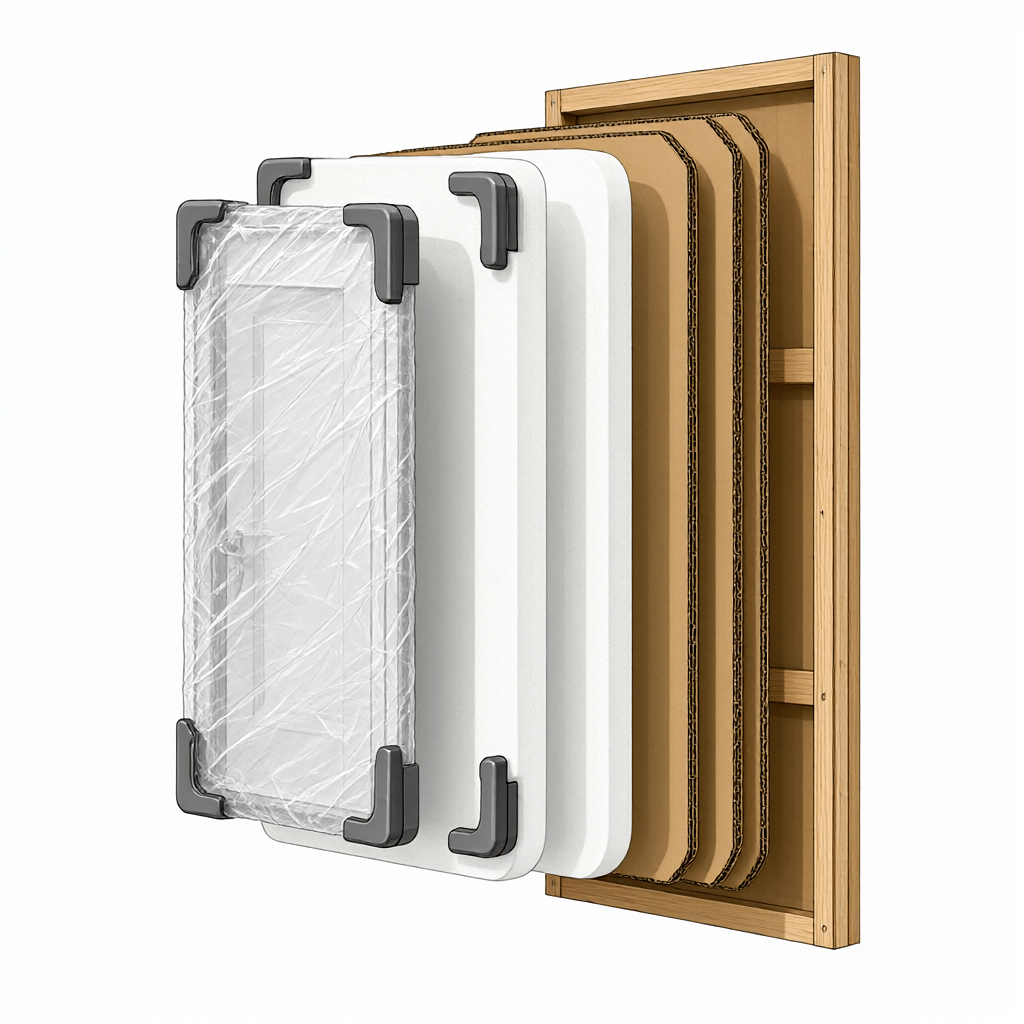
Door packaging follows a layered protection system designed to address three distinct threats: mechanical impact, moisture intrusion, and pest contamination. Each layer serves a specific function within the logistics chain.
Why Does Layered Packaging Matter for Door Shipping?
Doors are high-surface-area products with vulnerable edges, finishes, and glass components. A single point of failure — such as a torn corner wrap exposing bare aluminum or a cracked foam block creating a stress concentration — can cascade into widespread damage during handling. This is why professional packaging avoids relying on any one material alone. Instead, it builds redundancy: an inner protective layer guards the surface, a structural layer resists compression, and an outer barrier shields against weather and rough handling. For example, when sourcing thermal-break aluminum windows shipped internationally, buyers typically expect polyethylene foam inserts between each unit plus a double-walled corrugated carton that meets ISTA 3A drop-test standards.
Moisture remains the most common failure mode. Sea containers experience significant humidity swings — a sealed container loaded in a humid port can accumulate condensation as temperatures drop overnight. Without proper desiccant treatment and vapor barriers, even thermally broken aluminum frames develop white oxidation spots within 14 days of transit. Wood-based doors face additional risk of mold and dimensional change if moisture content was not stabilized before packing. Buyers should always request evidence that packaging includes silica gel packets sized proportionally to container volume — typically one kilogram per 20-foot container as a minimum baseline.
Mechanical protection focuses on edge and corner reinforcement. Doors are rarely damaged by front-face pressure; they are damaged when corners strike container walls during braking or when stacking loads shift. Industry-standard corner protectors made from high-density polyethylene or thick cardboard absorb impact energy that would otherwise concentrate on the door’s most fragile points. This principle applies equally across interior plywood doors and exterior solid-core models, though the density and thickness of corner blocks varies by door weight.
Which Materials Are Standard for Door Export Packaging?
Material selection depends on door construction type:
- Solid wood doors: Require ISPM 15-compliant untreated lumber crates or heat-treated plywood cases, with kraft paper wrapping as the primary surface barrier and EPE foam for edge protection.
- Aluminum profile doors: Typically use double-wall corrugated cartons with inserted EPE or polystyrene foam dividers, shrink-wrapped at the case level for secondary containment.
- MDF and engineered wood doors: Need enhanced moisture barriers due to core susceptibility to water absorption — often incorporating aluminum foil laminates beneath the outer carton.
- Glass-integrated units: Require separate glazing compartmentalization within the package to prevent glass-to-glass contact and frame deformation.
Packaging labels must communicate handling instructions unambiguously. Standard symbols include “This Side Up” arrows, “Keep Dry” indicators, “Fragile” glass warnings where applicable, and temperature-sensitive markings for doors with applied urethane or PVDF finishes that degrade above specified thresholds.
How Do You Load and Secure Packaged Doors in Containers?
Container loading strategy directly affects packaging effectiveness. Doors must never be placed flat and stacked vertically like books — the resulting compressive load on lower units causes frame distortion and finish bruising. The industry standard is vertical loading with A-frame racking systems or heavy-duty wooden cradles bolted to the container floor. Each rack holds doors at a slight forward lean angle, distributing weight through reinforced corner posts rather than resting on door surfaces. For bulk shipments, a typical 20-foot container configuration secures approximately 80–120 door sets depending on dimensions, using strap anchors rated for ocean freight dynamic forces. Understanding these configurations helps when comparing FCL versus LCL shipping options for your project.
What Are the Key Specifications for Export Door Packaging?
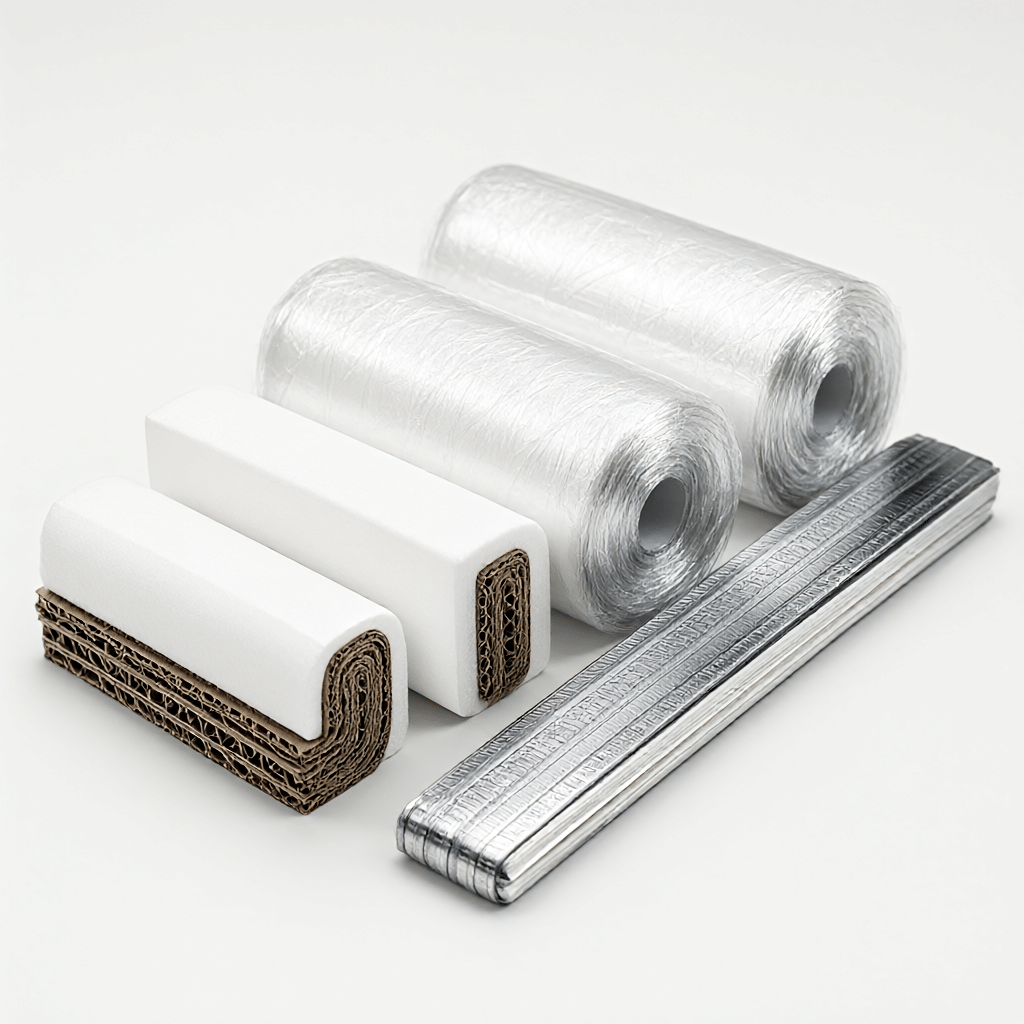
Buyers evaluate packaging quality against measurable parameters rather than subjective impressions. The following specifications define a professional-grade export package:
Inner protection: Minimum 2 mm closed-cell EPE foam on all four edges; full surface coverage with non-abrasive polyethylene film for metal-framed units; acid-free kraft paper for wood-grain finishes. Foam density should be at least 30 kg/m³ to resist compression under container stacking loads.
Outer enclosure: Double-wall corrugated fiberboard minimum 275 ECT (Edge Crush Test rating) for carton-packaged doors; or 18 mm marine-grade plywood crates for heavier solid wood units. Single-wall cartons are inadequate for intermodal container transport involving crane lifts and forklift handling.
Moisture control: Silica gel desiccant capacity matching the enclosed volume — minimum 1 kg per 20-foot container — placed at multiple points including top, bottom, and sides. Vapor barrier liner (0.1 mm polyethylene sheeting) inside crates for humidity-sensitive finishes.
Pest compliance: All wooden packaging materials — pallets, crates, dunnage blocks — must bear the IPPC mark confirming ISPM 15 treatment. Acceptable treatments are heat treatment (minimum 56°C core temperature for 30 minutes) or methyl bromide fumigation, though the latter is increasingly restricted by destination countries.
Securement hardware: Steel strapping minimum 19 mm width with tensioned edge protectors; stretch wrap minimum 23 microns for case-level consolidation; corner boards minimum 25 mm thickness for crate-based packages.
These specifications are documented in packaging test reports that reputable suppliers provide alongside commercial invoices. When evaluating suppliers, review their factory audit documentation to confirm packaging capability matches stated standards.
What Standards and Regulations Apply to Export Door Packaging?
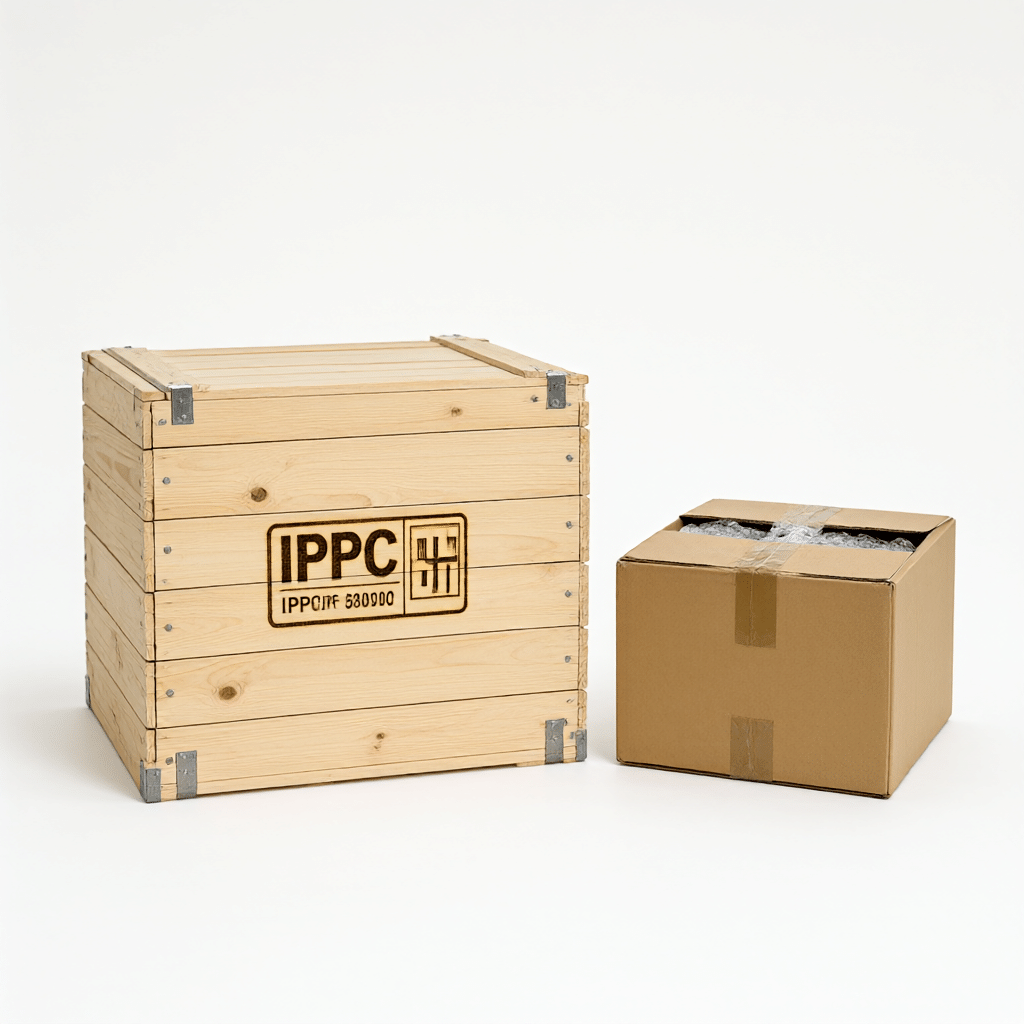
Three regulatory and standards frameworks govern door packaging for international shipment. None is optional for compliant cross-border trade.
ISPM 15 (International Standards for Phytosanitary Measures No. 15): Published by the International Plant Protection Convention, this regulation mandates that all raw wood packaging material entering international commerce undergo approved pest-control treatment and bear the official IPPC stamp. Non-compliant wooden crates or pallets are subject to rejection, re-treatment, or destruction at the destination port at the importer’s expense. The United States USDA APHIS, the European Union’s NPPO framework, China Customs, and Australia’s DAFF all enforce ISPM 15 independently — meaning your supplier must understand which enforcement agency governs your specific route. Violations cost time, demurrage fees, and damaged business relationships.
ISO 19977 (Road Vehicles — Packaging for the Transport of Goods): While primarily focused on road transport, ISO 19977’s principles for load securing, friction coefficient requirements, and restraint system design inform container loading best practices accepted by major shipping lines. Professional door manufacturers reference these guidelines when designing stacking patterns and strap tension protocols.
National import regulations: Destination-country requirements may exceed ISPM 15 minimums. Australia and New Zealand maintain some of the world’s strictest biosecurity controls, requiring additionally that wood packaging show zero evidence of borer holes or fungal staining beyond ISPM 15 treatment markers. Japan requires detailed wood species declarations on packing lists. The EU enforces additional wood treatment traceability through its Timber Regulation framework for certain origin routes.
For door-specific performance data that supports packaging integrity claims, industry reference standards such as ASTM testing protocols for dimensional stability and finish adhesion provide the technical basis for determining appropriate packaging stress tolerances.
Which Customs Documentation Relates to Packaging?
Packaging information appears in multiple commercial documents and must be consistent across all of them. The commercial invoice should specify packaging type (carton, crate, palletized), total package count, gross weight per package, and whether ISPM 15 treatment was applied. The packing list breaks down contents by package number for customs and warehouse verification. The bill of lading must accurately reflect package count and weight because discrepancies trigger inspection flags. Any misstatement — particularly regarding wood treatment declarations — creates customs clearance delays that compound shipping costs significantly. Understanding the relationship between HS code classification and duty rates for your door type also helps ensure packaging weight calculations align with declared customs values.
What Should You Consider When Sourcing Export-Packaged Doors?
Several practical factors distinguish a smooth shipment from a costly dispute.
Verify packaging test records before order confirmation. Reputable manufacturers conduct drop tests, vibration tests, and climate chamber exposure trials on representative packages before committing to production schedules. Request third-party laboratory reports when available, and check whether test conditions match your actual routing — a package tested under tropical container conditions differs materially from one tested for temperate-zone transit.
Clarify responsibility boundaries for damage attribution. Standard FOB terms transfer risk at the loading port, but packaging failures that manifest only after weeks at sea create ambiguous liability. Include explicit packaging quality clauses in your purchase agreement specifying acceptable damage rates, photo documentation requirements for claims, and replacement part timelines. This prevents post-arrival disputes where the carrier blames packaging and the manufacturer blames handling.
Match packaging to your end-use environment. Doors destined for humid coastal markets require more aggressive moisture barriers than those heading to arid destinations. Units with pre-finished PVDF or powder-coated surfaces need protection from UV-exposed transit storage. Glass-filled doors bound for seismic zones benefit from additional lateral bracing beyond standard corner protection. Discuss your delivery location and stored conditions with your supplier before finalizing packaging specifications.
Assess your supplier’s container loading expertise. Packaging design and container stowing are interdependent — well-packaged units arranged poorly still sustain damage. Ask whether your supplier provides container loading diagrams as part of their shipping documentation. Suppliers who proactively share 20ft container loading configurations demonstrate familiarity with spatial optimization and securement mechanics that reduce in-transit movement.
Confirm fire-rating documentation is preserved through packaging. If you’re purchasing fire-rated doors for regulated markets, ensure the packaging does not obscure or damage certification labels and plaques affixed to each door frame. Labels must remain legible upon arrival for building inspector verification.
Here Is How We Approach Export Door Packaging
As a manufacturer supplying doors globally, our packaging process starts with understanding the complete journey each shipment will undertake — from factory floor to final installation site. We design our packaging around the specific vulnerabilities of each product type rather than applying a single template to every order.
For solid wood doors, we use ISPM 15-certified untreated timber crates with individually wrapped panels and reinforced corner posts, ensuring the IPPC stamp appears clearly on every external surface for customs compliance. Our thermal-break aluminum doors ship in double-wall corrugated cartons with inserted EPE foam dividers and aluminum-foil vapor barrier liners, specifically selected to prevent condensation-related oxidation during ocean transit. Every shipment includes silica gel desiccants sized to the enclosed volume, and we document desiccant placement in the packing list for buyer record-keeping.
Our pre-shipment inspection covers air-tightness, water-tightness, and wind resistance test results for each door batch — these certifications travel with the documentation package so importing inspectors have immediate access to performance verification. We adjust profile structures and fitting configurations to align with the building code requirements of each target market, which means packaging dimensions and securing methods are optimized for the specific product configuration rather than a generic default.
We handle both FCL and LCL shipments with direct factory delivery from China, and our export team prepares complete documentation including packing lists, proforma invoices, and full customs paperwork. Our packaging specifications are documented before production begins and confirmed before container loading, giving buyers visibility into exactly how their order will be protected during transit.
Contact Our Team to discuss your project’s packaging and shipping requirements.
Quick Answer: What Is the Export Packaging Standard for Doors?
There is no single mandatory standard for door export packaging. Instead, compliant shipments combine the following minimum requirements:
| Layer | Standard / Requirement | Purpose |
|---|---|---|
| Wood packaging | ISPM 15 — heat treatment (HT) ≥56 °C for 30 min or methyl bromide fumigation (MB) | Prevent pest/wood-borer transport across borders |
| Corrugated cartons | Minimum 275 ECT double-wall; ISTA 3A drop/vibration tested | Withstand stacking and transit impacts |
| Plywood crates | 18 mm marine-grade plywood with corner posts | Heavy solid-wood doors over 40 kg per piece |
| Moisture barrier | ≥0.1 mm polyethylene liner + silica gel (1 kg per 20′ container min.) | Stop condensation and panel warping |
| Surface protection | Non-abrasive PE film or kraft paper wrap per finish type | Guard glass, aluminum powder-coat, or wood veneer |
| Markings & labels | ISTA barcodes, “This Side Up,” “Keep Dry,” IPPC stamp on wood | Unambiguous handling and customs clearance |
| Container securing | Steel strapping ≥19 mm width; A-frame or racking systems | Eliminate lateral shift during ocean freight |
Meeting all seven layers above will clear customs in the US, EU, Australia, and Japan and arrive without claims-worthy damage under standard FOB terms.
Which Testing Certifications Should Your Supplier Provide?
Before confirming an order, request one or more of the following lab reports:
- ISTA 3A — package drop, incline impact, and vibration tests simulating 1,000+ km road + port-handling conditions; pass rate typically requires <2 % cosmetic damage after cycling.
- ISTA 6-FedEx or ASTM D4169 — air-freight variant when doors move by cargo plane before ocean leg.
- EN 1634-1 / ASTM E119 — fire-rating label integrity after packaging removal (relevant for EI30/EI60/EI90 units).
- Windsress / water-tightness lab certificates — prove the finished window-door unit meets its rated class (e.g., Class A4 air permeability per EN 12207) even after transit stress.
Reputable suppliers run these tests on a production-run sample — not just a lab prototype — so ask for batch-level test records tied to your order quantity.
Cost Comparison: Packaging Methods at a Glance
| Method | Approx. Unit Cost* | Best For | Transit Damage Risk |
|---|---|---|---|
| Double-wall corrugated carton (275 ECT) + EPE foam inserts | $8–$15 per door set | Aluminum tilt-and-turn, sliding patio doors up to 1.2 m² | Low (if ISTA 3A tested) |
| Plywood crate (18 mm marine) with steel strapping | $25–$45 per door set | Solid wood entrance doors, oversized villa casements >1.8 m² | Very low |
| Wooden slatted frame + stretch wrap (budget) | $5–$9 per door set | Interior MDF/hollow-core doors, short-haul routes | Moderate–high; not recommended for ocean freight |
| Full wooden case (ISPM 15 + foam-lined interior) | $35–$60 per door set | High-end PVDF-finish doors, glass integrated units | Lowest; preferred for Australia/Japan imports |
\*Costs vary by door size, order volume, and material sourcing. Bulk orders (≥50 sets/container) typically reduce per-unit packaging spend by 15–25 %.
How to Choose the Right Packaging Standard for Your Project
Use this five-step decision framework when specifying packaging for an incoming purchase order:
- Identify the door construction type. Solid wood → ISPM 15 crate mandatory. Thermal-break aluminum → 275 ECT carton + EPE dividers acceptable. Glass-integrated → separate glazing compartmentalization inside the case.
- Map the transit route and mode. FCL ocean → ISTA 3A minimum. LCL + multiple handlings → upgrade to full crate. Air + ocean intermodal → add ASTM D4169 vibration profile.
- Check destination-country biosecurity rules. Australia/New Zealand require both ISPM 15 HT stamp and borer-hole inspection certificates. Japan requires species declaration on the packing list. The US accepts either HT or MB but inspectors increasingly prefer HT-only.
- Factor in storage conditions at destination. Coastal/high-humidity ports demand vapor-barrier liners and extra desiccant (increase from 1 kg to 2 kg per 20 ft container). Arid regions allow standard paper-wrapped packages.
- Align packaging spec with your warranty claim terms. Specify in the PO whether the supplier guarantees <2 % transit-damage rate; include clauses for on-site replacement parts and photo-evidence procedures so liability stays clear.
When these steps are documented up front, your procurement team avoids post-delivery disputes and customs rejections alike.
Red-Flag Indicators: Substandard Door Packaging You Should Reject
Flag an order immediately if your supplier shows any of these warning signs:
- Single-wall corrugated cartons (instead of double-wall ≥275 ECT) — insufficient crush resistance for container stacking.
- No visible IPPC stamp on any wooden pallet or crate side — guaranteed customs hold or rejection at major ports.
- Absent or undersized silica gel (fewer than 500 g per 20 ft container) — condensation damage is nearly inevitable on tropical routes.
- Missing corner protectors or using thin cardboard instead of HDPE/foam blocks — edge bruising is the #1 cause of finish rejects.
- No ISTA or in-house drop-test records on file — the supplier cannot prove package integrity under simulated transit forces.
- Stretch wrap thinner than 15 microns — tears easily during crane lifts; moisture ingress risk spikes.
- Mixed-spec boxes in one container with inconsistent labeling — indicates poor QC discipline that often extends to product tolerances too.
If any red flag appears in a pre-shipment photo or audit report, request remediation before cargo leaves the factory floor.
Sources & References
- USDA APHIS — www.astm.org
- thermal-break aluminum windows — doorwoodendoors.com
- plywood doors — doorwoodendoors.com
- FCL versus LCL shipping options — doorwoodendoors.com
- factory audit documentation — doorwoodendoors.com
- HS code classification and duty rates — doorwoodendoors.com
- 20ft container loading configurations — doorwoodendoors.com
- fire-rated doors — doorwoodendoors.com











