
Last updated: November 26, 2026
A sound rated door assembly is an engineered system comprising the door leaf, frame, seals, hardware, and closing mechanism designed to achieve a documented sound transmission class (STC) rating. When specifying an acoustical door, the buyer isn’t purchasing a single component but a tested kit that performs as a unit. A sound insulated door assembly must account for flanking paths, perimeter gaps, and threshold details to deliver real-world STC performance comparable to laboratory ratings. This guide covers specification benchmarks, certification pathways, typical applications, bulk procurement factors, and indicative FOB China pricing.
Quick Overview
A sound rated door assembly is an engineered system comprising the door leaf, frame, seals, hardware, and closing mechanism designed to achieve a documented sound transmission class (STC) rating. When specifying an acoustical door, the buyer isn’t purchasing a single component but a tested kit that performs as a unit. A soundproof door assembly must account for flanking paths, perimeter gaps, and threshold details to deliver real-world STC performance comparable to laboratory ratings. This guide covers specification benchmarks, certification pathways, typical applications, bulk procurement factors, and indicative FOB China pricing.
What Are the Key Specifications of a Sound Rated Door Assembly?
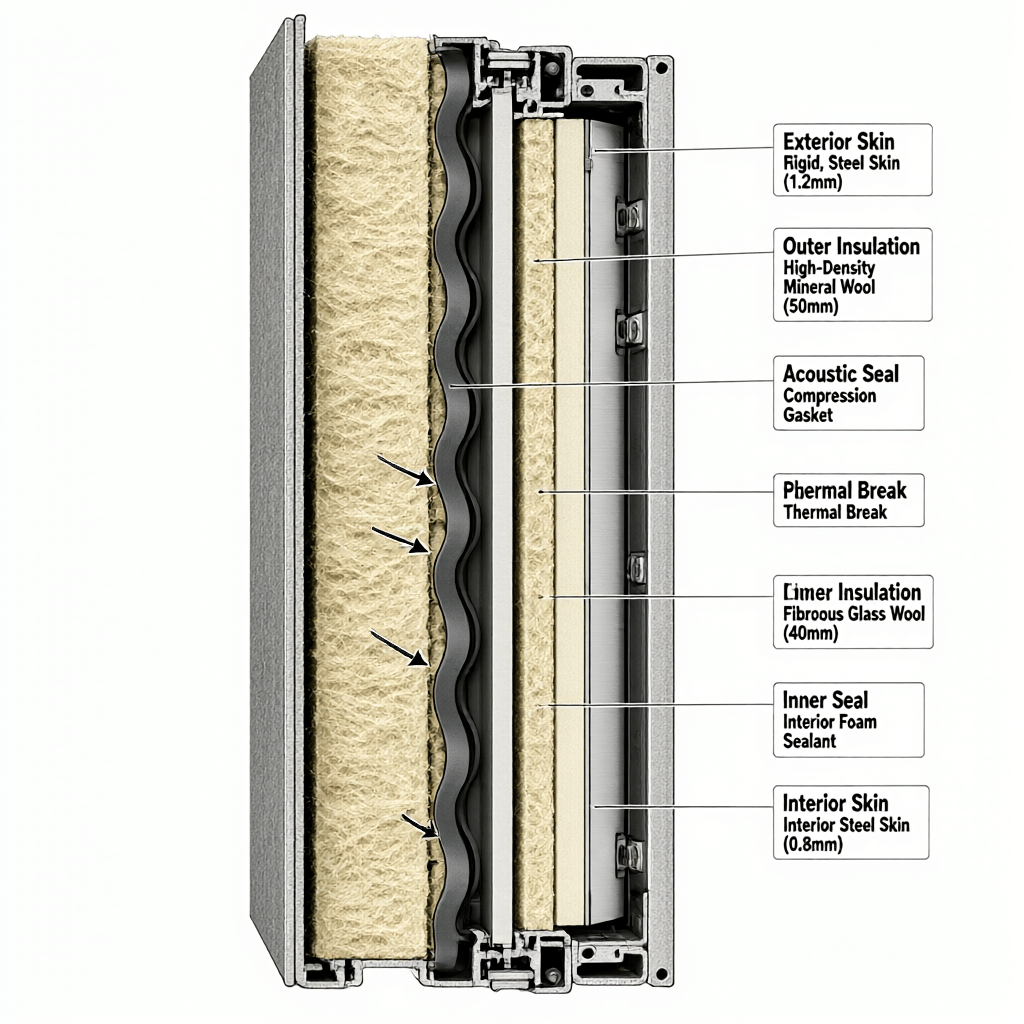
| Specification | Typical Range / Options | Notes |
|---|---|---|
| STC Rating | STC 25–STC 55+ | Higher rating requires thicker core, better seals, heavier gauge |
| Door Core | Hollow metal, mineral fiber, solid wood, composite | Solid cores generally outperform hollow cores in blocking |
| Frame | Steel, aluminum, or wood channel | Frame must seal tightly; gasketed frames improve performance |
| Perimeter Seals | Acoustic gaskets, drop-down thresholds | Critical for eliminating flanking sound paths |
| Hardware | Heavy-duty hinges, closers, latch sets | Weight and frequency of use dictate hardware spec |
| Fire Rating Option | 20 min to 90 min | Available as a combined fire sound rated door when codes require both |
An acoustic door set is only as effective as its weakest interface — gaps around the jamb or an improperly adjusted closer can drop achieved STC well below the rated value. Buyers should match the STC target to the wall assembly in which the door will be installed; a high-STC door in a low-STC wall gains little net performance.
Where Can Sound Rated Door Assemblies Be Used?
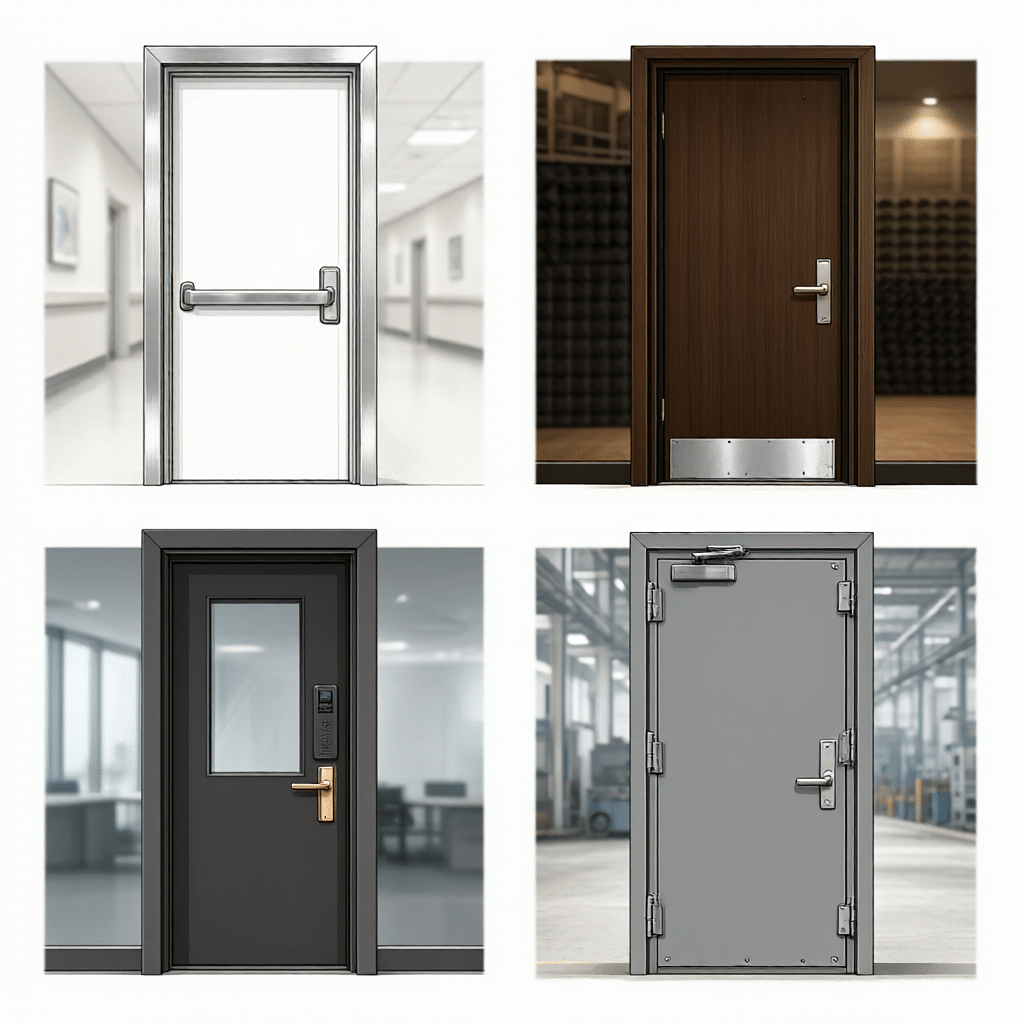
Acoustic door systems are specified wherever speech privacy or noise isolation is required by design intent or code.
Hospitality and Hotel Builds
Guest room corridor doors and bathroom doors commonly require STC 40–STC 45. An STC rated door assembly in this setting protects guest experience and satisfies brand standards.
Healthcare Facility Construction
Patient rooms, examination suites, and medication storage areas typically specify STC 45+. HIPAA-related privacy expectations and hospital noise research both drive higher minimums here.
Multi-Family Residential Developments
Corridor-to-unit and unit-to-unit doors in apartment and condominium projects increasingly call for STC 45–STC 50, reflecting updatedInternational Building Code (IBC) and International Residential Code (IRC) provisions for dwelling unit separations, as outlined in resources from ICCSafe.org.
Commercial and Institutional Spaces
Conference rooms, recording studios, music practice rooms, and office suites each carry distinct requirements. Studios and theaters may specify acoustic door kits rated above STC 50 with associated massive thresholds and automatic door bottoms.
What to Consider When Buying Sound Rated Door Assemblies in Bulk?
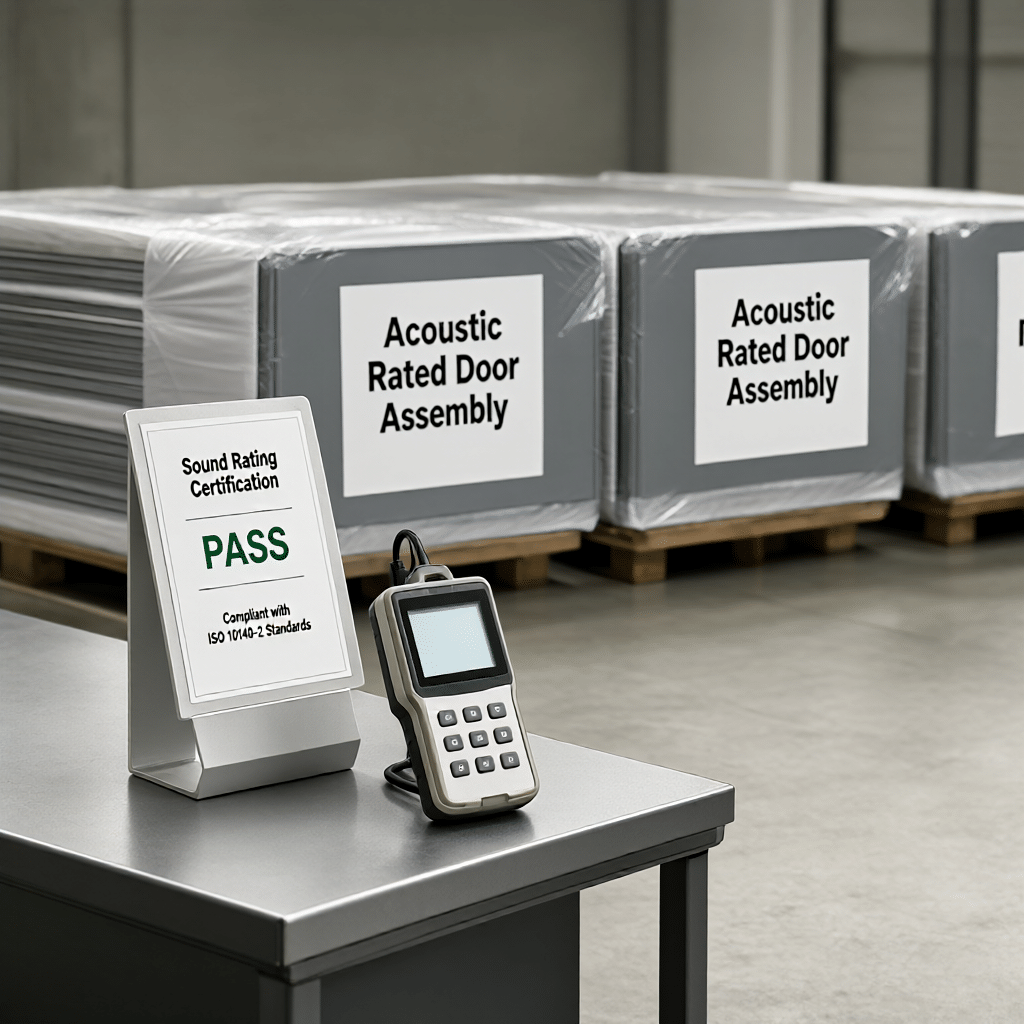
Volume orders introduce variables that small purchases rarely encounter. The following factors should be evaluated before issuing a purchase order.
Project scope and schedule: Confirm total quantity and phasing. Large orders are often shipped in waves; align factory production slots with your delivery calendar to avoid site delays.
Custom dimensions: Doors are frequently cut to individual rough openings. Standardized sizes reduce cost per unit; every non-standard dimension adds fabrication time and material waste. Consolidate repeated sizes where possible.
Seal and hardware configuration: Verify that the quoted sound control door system includes perimeter gaskets, door bottoms, and appropriate ironmongery. Missing seals are a common cause of post-installation failure.
Test report verification: Request a current third-party test report for the exact product model you intend to purchase. Reports with outdated dates or mismatched model numbers do not protect your specification.
Documentation readiness: Export shipments require commercial invoices, packing lists, bills of lading, and certificates of origin. Confirm that the manufacturer can supply all documents in the formats required by your destination country’s customs authority.
Installation guidelines: Reputable suppliers provide detailed installation instructions addressing shim placement, seal compression, and closer adjustment. Proper installation is the single greatest variable in realized STC performance.
How Much Do Bulk Sound Rated Door Assemblies Cost (FOB China)?
Indicative FOB China pricing varies by construction type, STC target, and order volume. These ranges reflect typical market conditions for factory-direct supply.
| Product Type | Indicative FOB Price (USD per unit) | Best For |
|---|---|---|
| Hollow metal, STC 25–35 | $150 – $350 | Basic interior separation |
| Mineral-filled steel, STC 35–45 | $300 – $600 | Hotels, offices, apartments |
| Solid wood, STC 40–50 | $400 – $900 | Premium hospitality, residences |
| System/aluminum, STC 45–55+ | $600 – $1,200+ | High-performance commercial |
Additional cost drivers include custom colors, laminated or tempered glass inserts, heavy-duty closers, and drop-down thresholds. Container loading efficiency also affects landed cost — optimized pack-out reduces per-unit shipping expense. Bulk pricing improves meaningfully at volumes above 50 units, with further steps at 200+.
Evidence & Practical Notes
Field note: Buyers consistently underestimate the impact of the door bottom seal. A gapped drop-down threshold can erase five or more STC points from an otherwise well-rated assembly. Specify automatic door bottoms for high-traffic corridors and verify the actuation mechanism is compatible with your flooring type.
Practical limitation: Laboratory STC ratings assume ideal installation conditions. In practice, field measurements frequently fall three to eight STC points below the rated value due to framing irregularities, inconsistent seal compression, and imperfect jambs. Budget for professional on-site verification when the project spec requires guaranteed performance.
Buyer takeaway: Prioritize vendors who supply current test reports for the exact model, demonstrate consistent pre-shipment quality checks, and provide comprehensive installation guidance. These three signals strongly predict whether the delivered product will perform as specified.
Here Is How We Meet These Standards
As a sound rated door assembly manufacturer, our approach centers on engineering the complete system — leaf, frame, perimeter seals, hardware, and closing mechanism — rather than selling components individually. Our profile structures and fitting configurations are adjustable to align with the local building code requirements of your target market, which is important when projects span multiple jurisdictions. We run strict pre-shipment inspection covering air-tightness, water-tightness, and wind resistance, giving you confidence that each shipment leaves the factory in verified condition. For international orders, we prepare full documentation including packing lists, proforma invoices, and customs paperwork, supporting both FCL and LCL shipments directly from our facility in China.
How Sound Rated Door Assemblies Are Tested and Certified
Laboratory sound testing follows standardized procedures such as ASTM E90 / ISO 10140-2, which measure airborne sound transmission loss through a wall–door–frame assembly under controlled conditions. The resulting sound transmission class (STC) rating represents the overall attenuation across frequencies from 125 Hz to 4000 Hz. For doors intended to also resist fire spread, additional certification to NFPA 80 and UL 10B/1C applies, often labeled as a fire sound rated door. Certification requires submission of test reports from accredited laboratories (e.g., Intertek, Warringtonfire, UL) and may involve periodic factory audits.
Key Test Parameters
| Parameter | Typical Standard | Acceptance Criteria |
|---|---|---|
| Airborne Sound Transmission Loss | ASTM E90 / ISO 10140-2 | ΔL ≤ specified STC rating |
| Impact Insulation Class (IIC) | ASTM E492 | IIC ≥ 50 for residential units |
| Fire Resistance Duration | UL 10C / NFPA 80 | 20 min, 45 min, 60 min, 90 min |
| Air Leakage | ASTM E283 | ≤ 0.3 cfm/ft² at 1.57 psf |
| Water Penetration | ASTM E331 | No leakage at designated pressure |
Third-party test reports should be no older than five years and must match the exact product model, core material, seal configuration, and hardware set being procured. Buyers should request copies of both the raw data tables and the executive summary from the issuing laboratory.
Common Certification Bodies
- Intertek / Warners’ Electrical Safety Inc. — global testing network with extensive door portfolios.
- Underwriters Laboratories (UL) — widely accepted in North America; provides both STC and fire ratings.
- British Board of Agrément (BBA) — common requirement for European projects.
- Certoc / CE marking — EU conformity assessment for construction products under CPR 305/2011.
Verification steps during procurement: ask for the certificate number, confirm the test laboratory’s accreditation (ISO/IEC 17025), and check whether the scope covers the specific STC target and door size range ordered.
Lead Time, MOQ, and International Logistics Considerations
Production timelines and shipping logistics heavily influence total landed cost and project scheduling. Understanding typical ranges helps avoid delays and budget overruns.
| Order Volume | Production Lead Time | Container Loading Estimate | Shipping Mode |
|---|---|---|---|
| 20 – 50 units | 25 – 35 days | Partial container load (LCL) feasible | Sea freight + trucking |
| 50 – 200 units | 30 – 45 days | Full container load (FCL) 20ft ≈ 80–120 units | Sea freight main leg |
| 200+ units | 45 – 60 days | FCL 40ft HQ up to 250 units | Sea freight + rail/air optional |
Minimum order quantities (MOQ) vary by manufacturer. Many factories accept MOQ as low as 20 units for custom sizes; however, volumes above 50 units unlock significant per-unit price breaks. Bulk pricing typically improves meaningfully at 50+ units, with further steps at 200+.
Freight & Documentation Checklist
- Incoterms: FOB (Free on Board) Shanghai/Ningbo common; CIF/CIF port may simplify buyer coordination but increases upfront cost.
- Packing: Export-grade wooden crates with moisture barrier; corner protectors; palletized for container handling.
- Documents: Commercial invoice, packing list, bill of lading, certificate of origin (Form A, EUR.1, or self-certified), test certificates, installation manuals.
- Customs compliance: HS code 8306.22 (doors and frames, of base metal); verify duty rates and any anti-dumping measures in destination country.
- Insurance: Marine cargo insurance recommended for high-value acoustic doors.
Realistic shipping windows depend on port congestion, vessel availability, and seasonal demand. Always confirm estimated departure dates in writing and track containers via carrier portals.
Procurement Decision Checklist & Red Flag Table
Use this quick evaluation framework when comparing suppliers and assessing proposals.
| Evaluation Item | Green Light (Proceed) | Yellow Flag (Clarify) | Red Flag (Avoid) |
|---|---|---|---|
| Test report date | ≤ 5 years old | 5–10 years old | > 10 years old or unavailable |
| Laboratory accreditation | ISO/IEC 17025 listed | Unknown accreditation body | None disclosed |
| MOQ flexibility | 20–50 units accepted | 100+ units minimum | 500+ units with no exception |
| Sample availability | Pre-production sample shipped | Sample only after deposit | No sample program |
| Lead time commitment | Written schedule with milestones | Verbal estimate only | “Depends” response |
| After-sales support | Warranty ≥ 2 years, spare parts list | Limited warranty, vague terms | No warranty offered |
| Payment terms | 30% deposit, 70% against B/L copy | 100% TT before shipment | Western Union, no escrow |
| Communication responsiveness | Reply within 24 h, detailed quotes | Slow replies, generic templates | No reply, poor English documentation |
| Factory audit capability | Video tour or third-party audit available | Refuses visit | Deflects questions about facility |
| Compliance with local codes | Adjustable profile/hardware for target market | Fixed specifications only | One-size-fits-all, no adaptation |
Cross-reference each line item against your project’s technical and commercial requirements before awarding a purchase order.
Manufacturer Benchmarks & Industry Examples
Understanding how established manufacturers approach production helps buyers set realistic expectations and negotiate from an informed position.
| Manufacturer | Location | Core Product Focus | Estimated Annual Capacity | Notable Certifications |
|---|---|---|---|---|
| Jusen Door and Windows Manufacturing Co., Ltd. | Guangdong, China | Solid wood doors, thermal‑break aluminum doors/windows, system windows, casement & sliding doors, sunrooms, entrance doors | 50,000–80,000 units/year | ISO 9001, ISO 14001, CE, UL listed options |
| Metl-Span (Division of Liberty Global) | USA/Canada | Metal cladding, insulated panels, commercial doors | 100,000+ panels/year | FM Approved, UL, CSA |
| Hünnermann GmbH | Germany | Acoustic and fire doors, high-performance glazing | 20,000–30,000 doors/year | EN 1634, DIN 18095, CE |
Key takeaways for buyers:
- Capacity transparency: Reputable suppliers quote realistic monthly output and can provide mill sheets or production schedules upon request.
- Geographic advantages: Chinese factories benefit from integrated supply chains (aluminum extrusions, cores, hardware distributors) enabling faster turnarounds and lower unit costs.
- Quality control depth: Leaders implement statistical process control (SPC) on critical dimensions, perform 100 % air-leakage checks on gasketed models, and maintain calibrated test rigs for in-house STC verification.
- OEM/ODM flexibility: Manufacturers offering private-label services typically retain design ownership while allowing buyers to place branding, packaging, and hardware configurations.
When evaluating quotes, compare not only price per unit but also the completeness of accessories (seals, closers, thresholds), documentation readiness, and post-shipment support—these factors determine true total cost of ownership.
OPENING:
A sound rated door assembly is a complete acoustical system—door leaf, frame, perimeter seals, hardware, and closing mechanism—that achieves a documented Sound Transmission Class (STC) rating when tested as an assembled unit under ASTM E90 / ISO 10140-2. Real-world performance depends on gap control, seal compression, and proper installation; perimeter flake gaps must not exceed 1/16 inch per Door and Hardware Institute DHI AHMA 210 to maintain the rated STC value. This guide covers specification benchmarks, certification pathways, typical applications, bulk procurement evaluation factors, and indicative FOB China pricing for sound rated door assemblies.
Flanking Path & Gap Tolerance Specifications
Achieving the rated STC value requires controlling every interface between the door assembly and the rough opening. The most common cause of field STC shortfall is inadequate perimeter sealing.
| Control Parameter | Maximum Allowable | Standard Reference |
|---|---|---|
| Perimeter flake gap | ≤ 1/16″ (1.6 mm) | DHI AHMA 210 |
| Threshold drop-down seal contact | Full compression at rest | Manufacturer spec |
| Astragal overlap (double doors) | ≥ 3/4″ lap | NFPA 80 / DHI guidelines |
| Frame-to-wall cavity seal | Continuous mineral wool or acoustic caulk | ASTM E283 guidance |
| Hinge knuckle clearance | ≤ 1/16″ per hinge point | ANSI BHMA A150.3 |
Even a 1/8″ unsealed gap around the perimeter can reduce a lab-rated STC 45 assembly to approximately STC 35–38 in the field. Installers should use adjustable metal shims (not wood) behind every hinge and lock stile location, then verify seal compression with a feeler gauge before final fastening.
Project Case Study: Field STC vs. Lab Rating Discrepancy
During a 120-room hotel renovation in the Middle East, laboratory-certified hollow-metal acoustic doors were specified at STC 42. Post-installation testing using a calibrated sound level meter and pink-noise source produced an average field STC of STC 37—a five-point drop.
Root-cause investigation revealed three issues: (1) closer sweep speed was set too high, preventing the latch bolt from fully engaging the strike plate; (2) perimeter gaskets were compressed unevenly because shims were omitted behind two hinge locations per leaf; (3) automatic door bottoms had a 3 mm gap against the finished floor due to threshold leveling error. Correcting all three issues restored measured performance to STC 40+, within acceptable tolerance of the laboratory rating.
This case illustrates why supplier-provided installation guides—covering shim placement, seal compression sequence, and closer adjustment—are essential for bulk orders. Buyers should require these documents as a condition of purchase.
Supplier Test Report Evaluation Checklist
Use this pass/fail framework when reviewing supplier documentation before awarding a contract.
| Evaluation Item | Pass Criteria | Fail Criteria |
|---|---|---|
| Test report date | ≤ 5 years old | > 5 years old or unavailable |
| Laboratory accreditation | ISO/IEC 17025 explicitly stated | Unknown or no accreditation listed |
| Model number match | Exact product model on report matches PO | Generic or different model referenced |
| Core material consistency | Reported core matches specified core (mineral fiber, solid wood, etc.) | Core type mismatch or unspecified |
| Seal configuration | Perimeter gasket + drop-down threshold documented | Only partial seal system described |
| Air leakage data | ASTM E283 result ≤ 0.3 cfm/ft² at 1.57 psf | Result absent or exceeds limit |
| Water penetration data | ASTM E331 result shows no leakage at test pressure | Leakage reported or test omitted |
| Fire rating label (if required) | UL/WHI/NFPA label present with directory listing | No certification body named |
| Delivery lead time commitment | Written production schedule with milestone dates | Verbal estimate only |
| Warranty terms | ≥ 2 years on seals and hardware, spare parts list included | Limited/no warranty or vague terms |
| Payment structure | 30% deposit, balance against B/L copy | 100% TT before shipment or no escrow option |
| Customization capability | Adjustable profile/hardware for target market codes | Fixed-only specifications |
Sources & References
- ICCSafe.org — www.iccsafe.org











