
Last updated: November 25, 2026
Fire-rated wooden doors are solid-core timber door assemblies tested to resist fire for a specified duration—FD30 through FD90—and certified under regional standards such as BS 410, EN 1634, AS 1530.4, or NFPA 80. For B2B buyers sourcing from China, the decisive factors are certification standard alignment, core material density, glazing limits, and hardware parity—not unit price alone.
Quick Overview
Fire-rated wooden doors are solid-core or engineered wood-based door assemblies tested to resist fire for a defined duration — typically FD30 (30 min), FD45 (45 min), FD60 (60 min), or FD90 (90 min) — and certified under regional standards including BS 410 (UK), EN 1634 (EU), AS 1530.4 (Australia), or NFPA 80 (US). They combine a fire-resistive core, intumescent edge seals, and certified hinges and closers with a visible wood finish suitable for commercial and residential construction projects. For B2B buyers evaluating a fire rated wooden doors manufacturer, the critical decision variables are certification standard alignment, core construction, profile dimensions, glass panel configuration, and hardware rating — not just unit price per piece.
Send us your door schedules for a spec-matched bulk quotation.
Specifications
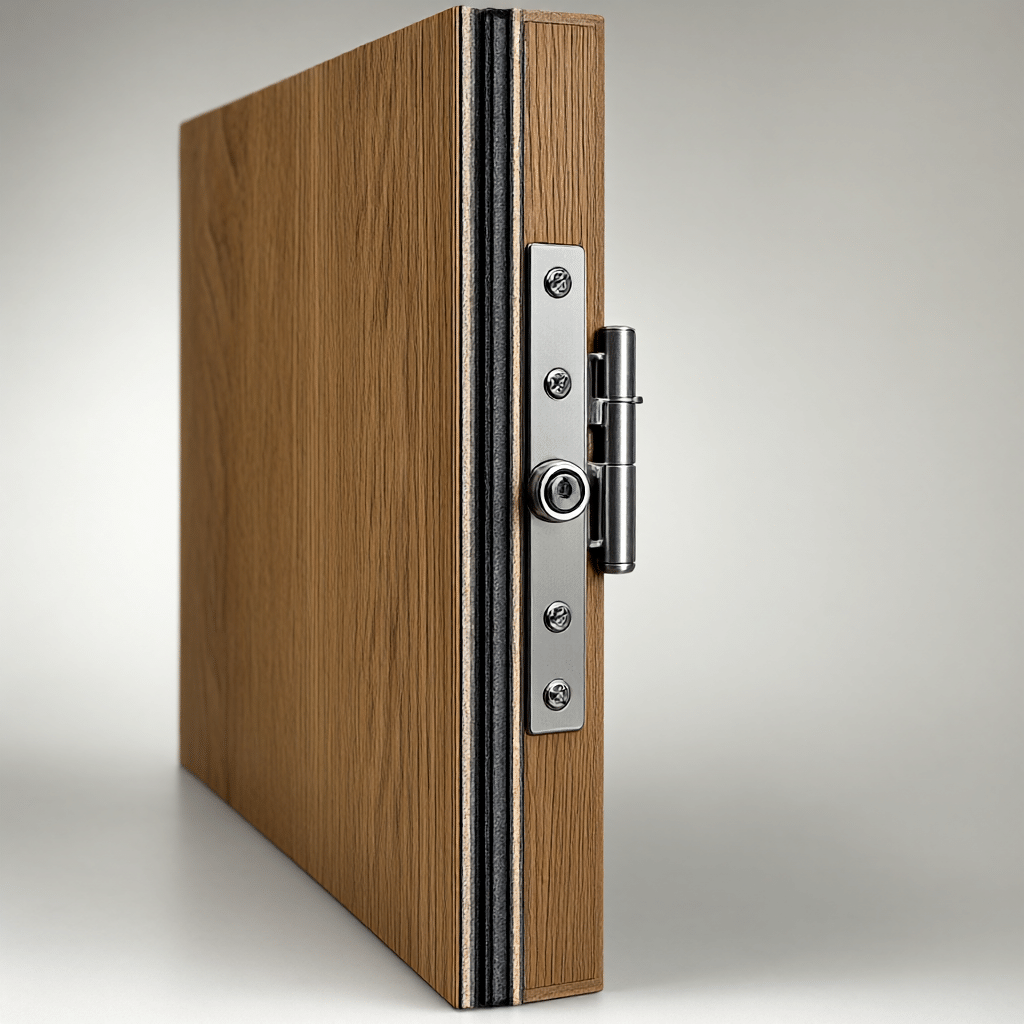
What are the key specifications of fire rated wooden doors?
| Specification | Typical Range / Standard |
|---|---|
| Fire rating duration | FD30 · FD45 · FD60 · FD90 (minutes of tested integrity + insulation) |
| Profile thickness | 44 mm (FD30/FD45) · 54 mm (FD60) · 68–70 mm (FD90) |
| Core material | Mineral wool · calcium silicate board · perlite composite |
| Frame type | Solid timber frame or steel-reinforced timber frame |
| Surface finish | Veneer overlay, lacquered, painted MDF face, or thermofoil |
| Glazing option | Fire-rated glass panel up to 25% of leaf area (certified bead system) |
| Intumescent seals | Embedded in edge; expands at ~150–200 °C to seal gaps |
| Certified hardware | FD-rated hinges (3 pcs min.), close rod or overhead closer, panic exit device |
| Leaf width range | 610–1100 mm single · 1220–2200 mm double |
| Leaf height | Up to 2400 mm (custom heights available with reinforced core) |
Intumescent seals are mandatory on every certified fire door assembly and must be specified at the order stage — adding them retroactively voids the certificate. When comparing a wooden fire door manufacturer‘s offerings, verify that the seal channel is pre-routed into the stile and that the gasket is supplied separately or pre-fitted, clearly documented on the product data sheet.
Contact our team with your schedule for exact cut sizes and hardware selection.
Applications
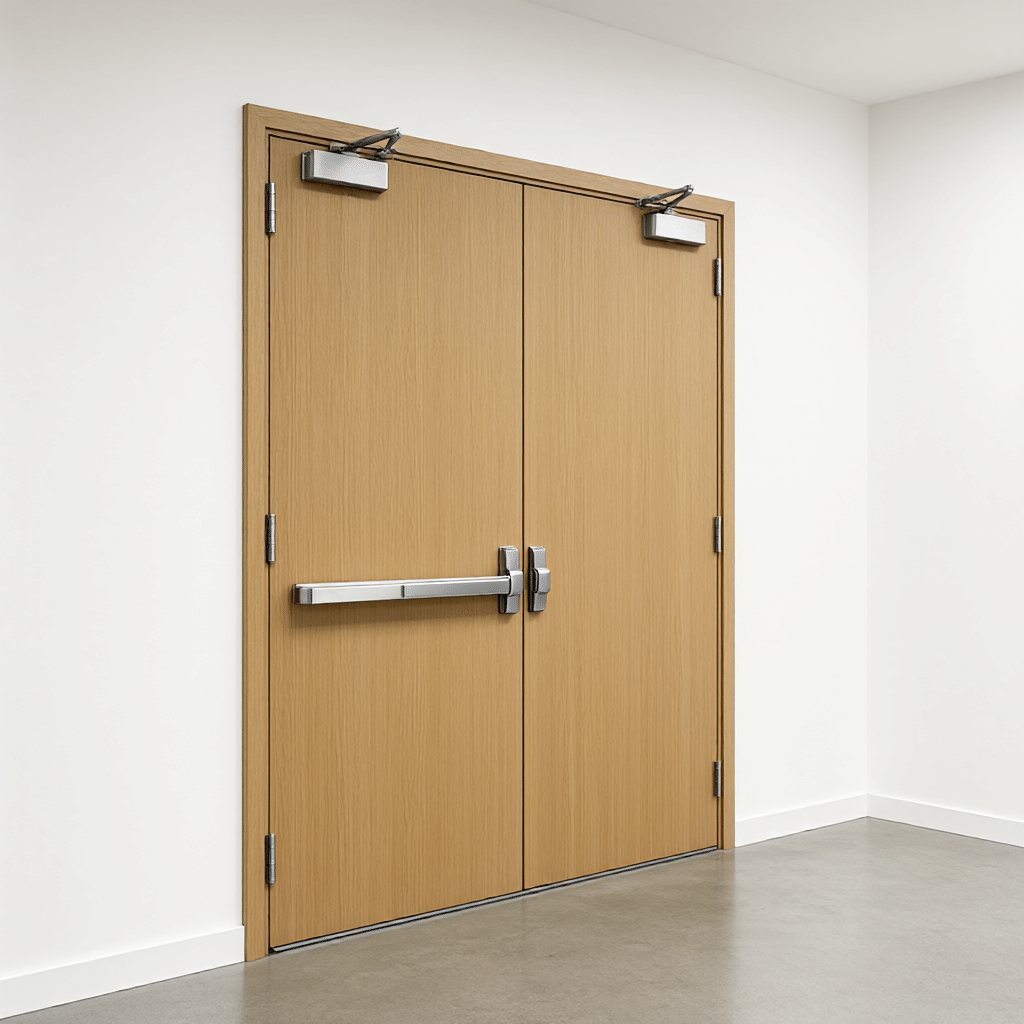
Where can fire-rated wooden doors be used?
Timber fire doors appear wherever a fire compartment requires a rated doorway with aesthetic flexibility. The main project typologies are:
- Multi-unit residential developments — stairwell enclosures, corridor doors, and flat entrance doors requiring FD30 or FD60, depending on local code occupancy classification.
- Hotel and hospitality builds — guest-room corridor doors (FD30), service riser doors (FD60), and fire-rated bathroom or minibar cabinetry where fire separation applies.
- Healthcare facility builds — isolation rooms, plant corridors, and pharmacy barriers demanding FD60 assemblies with higher acoustic performance alongside fire resistance.
- Commercial office fit-outs — tenant separation doors, escape route doors, and lift lobby entrances rated to the same standard as the enclosing wall.
These timber fire doors bridge the gap between purely utilitarian steel entry doors and non-rated solid wood interior doors. Unlike hollow-core residential products, they carry test certificates proving integrity and, where required, insulation performance under the relevant standard for the target market.
Buying Factors
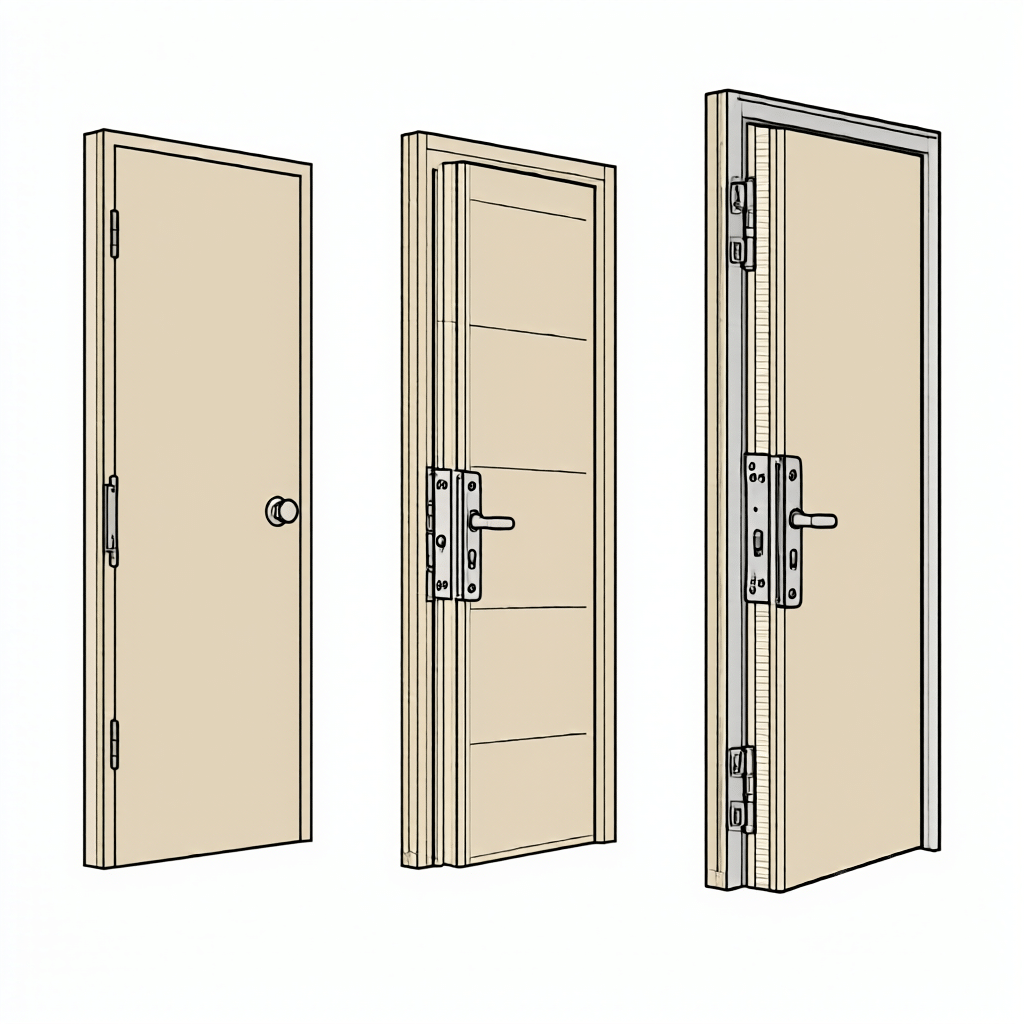
What to consider when buying fire rated wooden doors in bulk?
Several interdependent variables determine whether a batch passes inspection and meets project requirements:
- Certification matching — Confirm which regional test standard applies to your destination market. A door tested to BS 410 does not automatically satisfy NHBC or Irish building regulations unless the test report explicitly references those provisions. Similarly, an AS 1530.4 certificate may cite a specific furnace curve that must align with the relevant NCC clause cited in your specification.
- Core density and layering — Mineral wool cores deliver more consistent thermal insulation than perlite boards, which can settle during transit if not properly edge-sealed. Ask for core density figures (typically ≥ 120 kg/m³ for mineral wool) and whether the manufacturer laminates multiple ply layers rather than using a single homogeneous slab.
- Glass panel proportion and framing — Any glazed aperture reduces the amount of solid fire-resistive material in the leaf. Verify that the glazed area per door does not exceed the percentage allowed by the certificate, and that the glazing bead is part of the same tested assembly.
- Hardware certification parity — Hinges, closers, and panic devices must themselves be rated or approved for use on fire doors. Mixing an unrated closer with a certified FD60 door invalidates the door’s listing in most inspection regimes.
- Joint tolerances and delivery condition — Fire doors require tight fitting gaps (typically 2–4 mm per side at the factory set). Check that packaging protects vulnerable corners during container load-out and that each bundle includes the associated certificate copy.
Specification mismatches account for the majority of post-delivery delays on fire door orders. Require the supplier to confirm compliance against the named standard on the purchase order itself, not merely reference it loosely.
Price & Cost
How much do bulk fire rated wooden doors cost? (FOB China)
Below is indicative FOB China wholesale pricing for commonly ordered fire-rated wooden doors, grouped by rating and quantity tier. Final prices depend on finish type, glazing extent, hardware package, and delivery terms.
| Door Rating | Profile Thickness | Unit Price Range (USD) | MOQ Reference |
|---|---|---|---|
| FD30 | 44 mm | $110 – $185 | 50+ sets |
| FD45 | 44 mm | $130 – $210 | 50+ sets |
| FD60 | 54 mm | $175 – $290 | 30+ sets |
| FD90 | 68–70 mm | $290 – $480 | 20+ sets |
Indicative FOB China bulk-order pricing for trade buyers — not a retail price and not a binding offer; final pricing depends on quantity, specification, and order schedule.
Key cost drivers beyond the base rating include double-door conversion (+30–50 % per pair), fire-rated glazing insert (+$45–$120 per panel depending on size and glass type), upgraded acoustic seals, and premium veneer finishes such as oak or walnut vs. standard painted MDF face. Freight, customs documentation, and LCL consolidation charges are negotiated separately from the quoted FOB line.
Evidence & Practical Notes
Field note: Many European-spec fire doors arrive at site with intumescent strips still sealed in plastic packaging because the supplier intended to protect the adhesive until installation. On large projects this oversight costs several person-days of rework; specify upfront whether strips should be pre-installed or shipped loose with clear handling instructions on the packing list.
Practical limitation: The maximum glazed area permitted under a given certificate is fixed — you cannot substitute a larger fire-rated glass pane into a smaller tested aperture without requesting a revised test report from the manufacturer. Always validate panel dimensions against the actual certificate annex before placing the order.
Buyer takeaway: Treat the product data sheet as a contract attachment. If it omits core density, seal type, hinge load class, or glazing limits, request those items explicitly; ambiguous documentation is the earliest indicator of potential inspection failures.
Choosing Your Manufacturer
What to evaluate when selecting a fire rated wooden doors manufacturer?
Finding a reliable fire rated wooden doors manufacturer comes down to verifying that their production process and quality system actually match the certifications they claim on paper. Three checkpoints consistently differentiate mature exporters from occasional suppliers:
First, review the test reports yourself rather than accepting a verbal confirmation. Each FD-rating certificate should name the lab, the exact standard version, the specimen dimensions tested, and the hardware list included in the test. If a supplier cannot produce the original report — or sends a redacted summary with key parameters obscured — escalate internally before proceeding.
Second, ask about their pre-shipment inspection protocol. Reputable factories run air-tightness, water-tightness, and wind-resistance checks on randomly sampled units from each production batch, particularly for doors sized outside nominal catalog dimensions. Confirm whether third-party inspection agencies such as SGS or Bureau Veritas can attend loading, since that affects both risk allocation and dispute resolution timeframes.
Third, clarify how profile structures and fittings are adjusted for local building codes. Different markets have varying gap tolerances, hinge placement rules, and closer force requirements. A competent fire resistance wooden door factory modifies the machining layout rather than forcing your project to conform to their default template.
As a manufacturer, our approach to these checkpoints is straightforward: we supply doors that match the test-certificate specimen exactly, and any deviation — whether in leaf thickness, glazing area, or hardware specification — is confirmed against the applicable standard before production begins. Our QC process runs the same air-, water-, and wind-resistance tests on every export batch, and we prepare full customs documentation including packing lists and proforma invoices to keep LCL or FCL shipments moving without clearance delays. Get a free quote with your project specs attached.
How Fire-Rated Wooden Doors Work (Technical Deep-Dive)
What makes a wooden door fire-rated?
A fire-rated wooden door is not simply “thick wood.” It is an engineered assembly where every component—from core density to edge seal expansion temperature—is validated together in a furnace test. The three performance criteria measured are:
- Integrity (E): The door prevents flame and hot gas passage for the rated duration.
- Insulation (I): The unexposed-side surface temperature does not exceed 140 °C average or 180 °C peak above ambient, per EN 1634-1.
- Radiation (W): Optional; limits radiant heat transmission on the protected side.
The core material is the primary insulating barrier. Mineral wool cores (density ≥ 120 kg/m³, thermal conductivity λ ≈ 0.040 W/m·K) provide the most consistent performance. Calcium silicate boards offer higher compressive strength but may require greater thickness to achieve equivalent insulation. Perlite composites are economical but risk core settlement if edge seals are incomplete.
Intumescent edge seals activate at approximately 150–200 °C, swelling to fill the gap between leaf and frame. Without these seals, even a nominally rated door will fail the integrity test within minutes as smoke and flames breach the perimeter.
Certification references: ASTM E119 (furnace curve methodology), ISO 834 (fire-resistance test standards), ICCA Safe guidelines (installation and inspection best practices).
Why core density matters more than profile thickness
Two doors with identical 54 mm profiles can perform differently if their core densities diverge. A mineral wool core at 100 kg/m³ will conduct heat faster than one at 140 kg/m³, potentially causing the unexposed side to exceed the 140 °C insulation limit before the rated time elapses. Always request the core density specification on the product data sheet and compare it against the test report specimen. If the report does not state core density, treat this as a red flag.
Get a free quote with your project specs attached.
Supplier Qualification Checklist
Beyond pricing: how to vet a fire door manufacturer
Price is only one input. A rigorous supplier qualification process includes:
| Criteria | Minimum Requirement | Validation Method |
|---|---|---|
| Test certificates | Original reports from an ILAC-accredited laboratory | Cross-check lab name, standard version, specimen dimensions |
| Core density specification | ≥ 120 kg/m³ for mineral wool; documented on data sheet | Request signed product spec sheet |
| Pre-shipment inspection protocol | Random-batch air/water/wind resistance testing | Ask for QC procedure document |
| Third-party inspection allowance | SGS, Bureau Veritas, or TÜV attendance at loading | Confirm in writing before order placement |
| Lead time benchmark | 25–35 days for FD30/FD45; 35–45 days for FD60/FD90 | Compare quoted vs. industry norm |
| Profile code adjustability | Ability to modify hinge placement, gap tolerances per target market | Technical discussion with engineering team |
| Documentation readiness | Packing list, proforma invoice, customs documents prepared per shipment | Request sample package |
| OEM/ODM capability | Custom size, finish, and hardware configuration support | Review past project references |
Buyers should reject suppliers who cannot produce original test reports with full parameter disclosure or who refuse third-party inspection attendance. These are early indicators of weak quality systems.
Buyer Decision Red Flags
Warning signs that a fire door supplier may not meet your project requirements
Use this yes/no checklist during vendor evaluation. Any “yes” to a red-flag item warrants internal escalation before purchase.
Certification & Testing
- [ ] Can the supplier produce the original, unredacted test report naming the accredited laboratory?
- [ ] Does the report specify core density, seal type, hinge load class, and maximum glazing area?
- [ ] Is the test standard version current (not an obsolete reference)?
Technical Transparency
- [ ] Does the product data sheet include core material, density figure, and thermal conductivity value?
- [ ] Are intumescent seals pre-routed into the stile with documented expansion temperature?
- [ ] Is the hardware list included in the test report explicitly named (make/model/certification)?
Quality Control
- [ ] Does the supplier run pre-shipment air-tightness, water-tightness, and wind-resistance tests on sampled units?
- [ ] Will they allow third-party inspection at the loading port?
- [ ] Is there a documented corrective-action process for non-conforming units?
Commercial & Logistics
- [ ] Are lead times stated explicitly (not “varies by order”)?
- [ ] Do they prepare full customs documentation (packing list, PI, commercial invoice) for both FCL and LCL shipments?
- [ ] Can they adjust profile structure and fittings to match your target market’s building codes?
If you cannot get clear answers to more than two red flags, look elsewhere. Ambiguous responses are the strongest predictor of post-delivery inspection failures.
FAQ
Frequently asked questions about fire-rated wooden door procurement
Q: Can I request a sample before placing a bulk order?
Yes. Most manufacturers will ship one production-representative sample for evaluation. Clarify whether the sample is charged at full unit price or discounted, and whether it carries the same test certificate as the bulk order. Samples are essential for verifying finish quality, hardware feel, and seal installation before committing to a container quantity.
Q: Is third-party inspection mandatory?
Not always, but it is strongly recommended for orders exceeding $10,000 FOB or for projects in regulated markets (EU, UK, Australia, US). Agencies such as SGS, Bureau Veritas, and TÜV Rheinland can conduct pre-shipment inspections at the factory, verifying dimensions, hardware, finish, and packaging against your purchase order. Their inspection certificate is widely accepted by customs and project engineers.
Q: Can a test certificate be transferred to a different buyer?
Test certificates are issued to the manufacturer, not to individual purchasers. However, the certificate can typically be cited in your project submissions as long as the doors supplied exactly match the tested specimen (same profile thickness, core material, glazing area, and hardware list). Always confirm with your local building authority whether certificate citation is acceptable for your jurisdiction.
Q: What happens if my project requires a non-standard door size?
Non-standard sizes may require a revised test report if they fall outside the envelope of the existing certificate. Reputable manufacturers can extrapolate performance within validated ranges or commission a new test. This adds 2–6 weeks and additional cost. Discuss size requirements early in the inquiry phase.
Q: Do fire-rated wooden doors meet acoustic performance requirements?
Fire-rated doors prioritize fire integrity, not sound isolation. However, many FD30 and FD60 wooden doors achieve STC 30–35 dB as a secondary benefit due to their dense mineral wool core. If acoustic performance is critical (e.g., healthcare, hospitality), request the manufacturer’s acoustic test data separately and verify that fire-rating compliance is not compromised.
Q: How do I ensure the intumescent seals are correctly installed on site?
Seals must be fitted into the pre-routed channel in the leaf stile or door frame. They should never be surface-mounted with adhesive tape. During installation, verify that the seal runs continuously around all four edges without gaps at joints. Commissioning engineers commonly reject doors where intumescent strips are missing, damaged, or incorrectly positioned.
Sourcing From a Certified Manufacturer
How we meet these standards — Jusen Door and Windows
After evaluating multiple suppliers across Asia, we found that the manufacturers who consistently deliver compliant fire-rated wooden doors share one trait: they treat certification as a production requirement, not a marketing document. At Jusen Door and Windows, our approach mirrors the checkpoints described above. Every FD-rated door we produce is manufactured to match an original test report from an ILAC-accredited laboratory. We specify core density, intumescent seal activation temperature, and hardware certification directly on our product data sheets.
Our pre-shipment inspection covers air-tightness, water-tightness, and wind-resistance testing on randomly sampled units from each batch. We welcome third-party inspection agencies at our facility and at the loading port. Because we understand that different markets have different building code requirements, we adjust profile structures, hinge placements, and closer force settings to align with your target jurisdiction—whether that is the UK, EU, Australia, or North America.
As a direct-from-factory supplier, we eliminate middleman markup while maintaining full traceability: packing lists, proforma invoices, and complete customs documentation are prepared for every FCL and LCL shipment. Our customization scope covers size, finish veneer, glass panel configuration, and hardware selection—all validated against the applicable fire-rating standard before production begins. Request a bulk quotation with your door schedule attached.
Sources & References
- ASTM E119 — www.astm.org
- ISO 834 — www.iso.org
- ICCA Safe guidelines — www.iccsafe.org











