
Last updated: November 25, 2026
Quick Overview
Who manufactures door weatherstrips? They are produced by specialty extruders, rubber compounders, and door/window system manufacturers. A qualified door weatherstrip manufacturer runs continuous extrusion lines, maintains material test reports, performs routine compression and ageing checks, and supplies documentation that proves the seal will meet the performance level your project requires.
What should buyers consider when sourcing in bulk? Focus on the seal’s material compatibility with your operating environment, its compression performance over time, the manufacturer’s quality documentation and testing capability, and the total cost of ownership — including lead time, rework risk, and replacement cycle. A lower unit price rarely compensates for premature seal failure in the field.
What Are the Key Specifications of Door Weatherstrips?
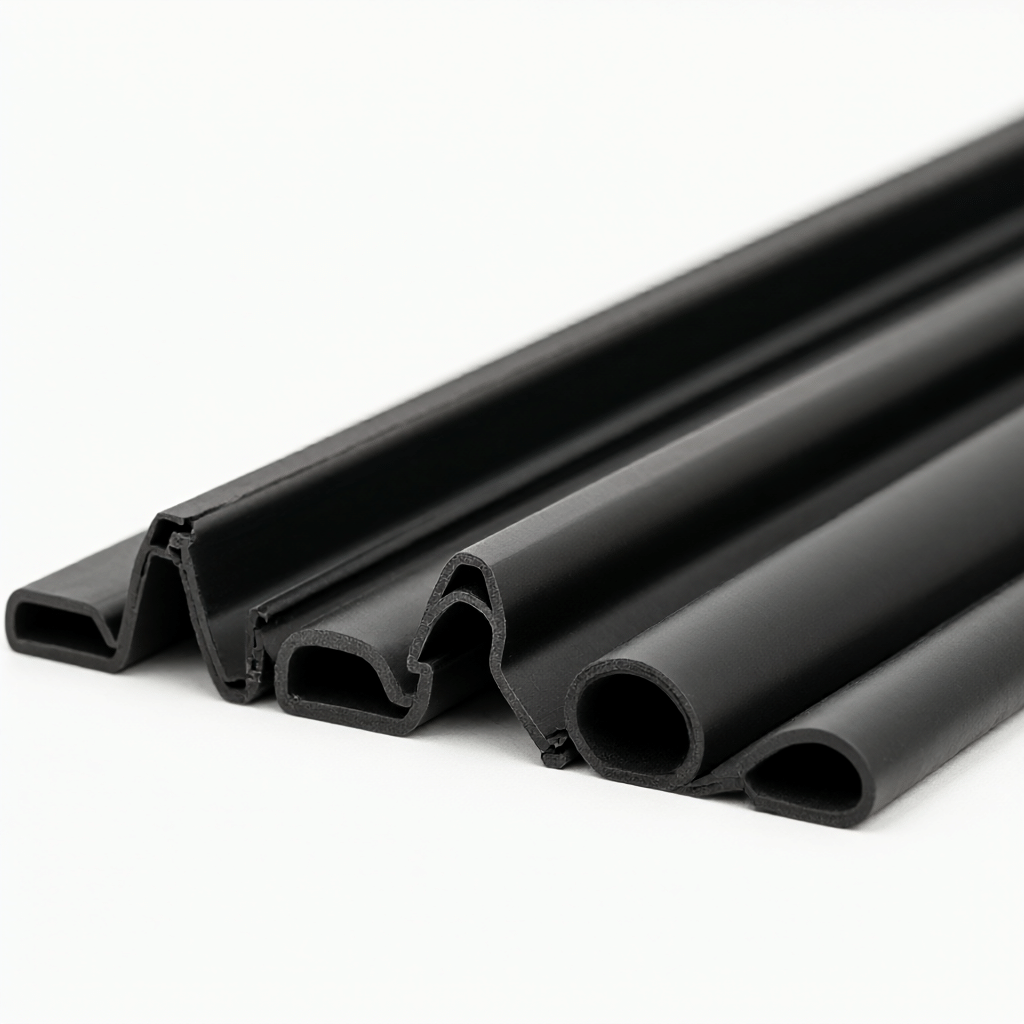
Door weatherstrips are evaluated through a combination of material properties, cross-section geometry, and installed performance metrics. Understanding these parameters helps buyers compare products on equal footing instead of relying on generic supplier claims.
| Specification | What It Means | Why It Matters |
|---|---|---|
| Material type | EPDM rubber, silicone, TPE, PVC, brush, closed-cell foam | Determines temperature range, UV resistance, chemical compatibility, and compression set behavior |
| Durometer (hardness) | Shore A rating, typically 40–70 for door seals | Controls how easily the seal compresses and recovers; too hard leaves gaps, too soft deforms permanently |
| Compression set | Permanent deformation after sustained compression, tested per ASTM D395 Method B | Low compression set = longer service life; high compression set means the seal “flat-spots” and loses contact pressure |
| Cross-section profile | Tube, fin, bulb, D-shape (D-type), brush pile, vinyl flap | Profile dictates contact width, installation method, and suitability for gap size and frame geometry |
| Working temperature range | Minimum and maximum service temperatures the material tolerates | EPDM typically handles −40 °C to +120 °C; silicone extends higher but at greater cost |
| Shore hardness recovery | Percentage of original thickness restored after release | Indicates long-term resilience; good EPDM recoveries exceed 85 % after 24 hours |
| Air/water infiltration rating | Measured performance under standardized cycling tests | Directly ties to energy code compliance and occupant comfort |
| Dimensional tolerance | ± millimeter allowance on width, height, and bulb diameter | Tighter tolerances matter for precision-fitted system doors; looser tolerances suffice for retrofit applications |
When evaluating a specification sheet, request raw test data whenever possible — particularly compression set, tensile strength, and thermal ageing results. These figures reveal far more than marketing language alone.
Where Can Door Weatherstrips Be Used?
Weather sealing gaskets serve multiple sectors, and selecting the right material depends heavily on the environmental conditions each application demands.
Exterior swing and sliding doors — Main entry doors, patio doors, and French doors face solar UV exposure, rain, wind-driven moisture, and wide temperature swings. EPDM remains the industry workhorse here because of its balanced UV stability, water resistance, and moderate cost.
Interior and commercial doors — Office partitions, hotel room doors, and interior fire-rated assemblies prioritize acoustics and aesthetic finish over extreme weather resistance. Closed-cell foam and low-durometer TPE are common choices, with attention paid to paintability and color consistency across batches.
Industrial and warehouse doors — High-cycle usage, exposure to oils or cleaning chemicals, and potential impact damage call for tougher compounds or reinforced profiles. Brush-type seals and heavy-gauge rubber door bottom sweeps dominate these environments.
Automotive and RV doors — Vibrations, under-hood heat, and fluid contact require silicone or specially formulated EPDM with superior oil resistance. These are niche extrusions with tighter dimensional control.
Custom villa and high-end residential builds — Architects often specify seamless transitions between frame and leaf, matching colors to cladding, and minimizing visible hardware. Fin-shaped EPDM seals with integrated attachment fins, or custom-molded perimeter compression seals, are typical selections.
If your project involves harsh chemical exposure or temperatures beyond ±60 °°C, communicate those parameters early. Many suppliers default to standard EPDM formulations unless told otherwise, which can lead to unexpected failures in aggressive environments.
What to Consider When Buying Door Weatherstrips in Bulk?
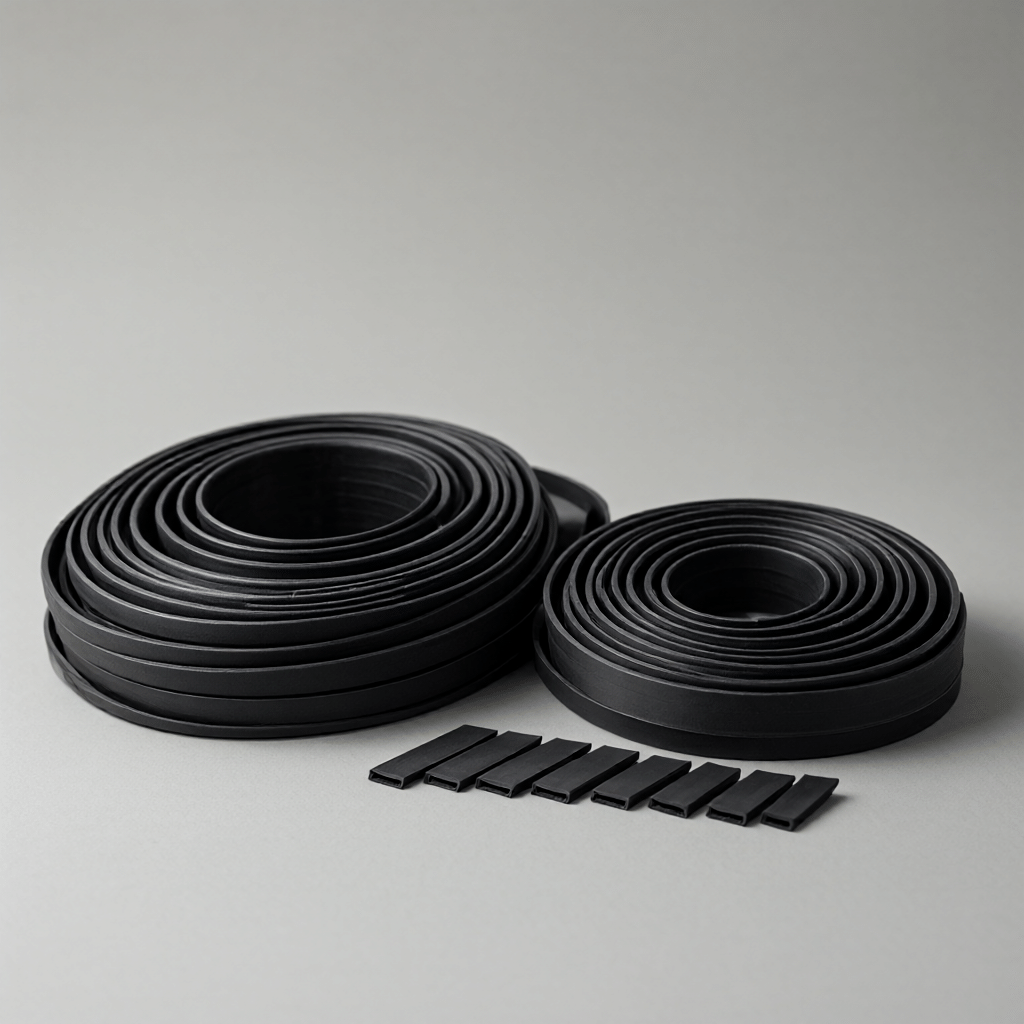
Sourcing weather stripping strips for a multi-unit project or ongoing production line involves several decision layers. Buyers who skip any of them tend to discover gaps late — usually when shipments arrive or installations begin.
Material selection and climate match
Match the seal compound to your harshest expected condition. A tropical coastal project demands excellent UV and salt-spray resistance; a Nordic installation requires reliable flexibility well below freezing. Do not assume “EPDM” is a monolith — formulation varies between suppliers, and some include cheaper filler loads that reduce longevity.
Certification and regulatory alignment
Compliance requirements depend on your target market. In the US and Canada, ICC building codes reference air-infiltration limits for exterior doors, and products contributing to envelope sealing may need to demonstrate performance per standards such as ASTM E283 for laboratory air-leakage testing. European markets commonly align with EN 1026 for air tightness and EN 12208 for water permeability. Always confirm that the manufacturer can provide valid test reports and, where applicable, third-party certification — and verify those documents against issuing bodies rather than accepting photocopies at face value.
Customization vs. stock profiles
Off-the-shelf shapes cover many standard applications quickly. Custom extrusion — whether for a unique fin geometry, non-standard bulb diameter, integrated mounting channel, or specific durometer — adds setup cost and lead time but eliminates fitment compromises. If your door frames have unconventional reveals or require a very specific compression range, a tailored profile often pays for itself through fewer callbacks.
Sample evaluation before commitment
Never place a large order without physical samples. Test compression in a clamp gauge, check color consistency against your finish schedule, and simulate installation on representative frame material. A supplier that refuses or delays sampling is a red flag.
Supplier audit readiness
Reputable manufacturers maintain documented quality management systems, material traceability, and records of periodic testing. If asked, they should be able to share ISO 9001 registration details, material safety data sheets, and recent test certificates without excessive friction. For construction project procurement, ask about audit access and whether they welcome pre-shipment inspections by third parties.
Request a Sample Kit and Technical Sheet
How Much Do Bulk Door Weatherstrips Cost? (FOB China)
Pricing for door seal strip orders varies widely because the product sits at the intersection of commodity extrusion and engineered sealing performance. Several variables determine where your unit price lands.
Material composition accounts for the largest share of cost. Standard black EPDM is the most economical option. White or color-matched EPDM incurs a pigment premium. Silicone compounds typically run 30–60 % above EPDM on a weight basis. Thermoplastic elastomers occupy a middle ground.
Profile complexity matters. Simple rectangular foam tape is cheap to extrude. Bulb seals with formed fins, interlocking grommets, adhesive-backed variants, or dual-durometer constructions require additional tooling and slower line speeds.
Length and reel packaging influence logistics cost. Longer reels reduce end-cap waste but increase shipping density. Shorter cut lengths suited for on-site trimming raise handling costs per meter.
Volume tier drives unit-price drops through fixed-cost amortization. Setup charges for custom dies are spread across more linear meters, improving effective pricing.
Rough industry reference ranges for FOB China pricing follow:
- Standard black EPDM tube/seal profiles: approximately $0.15 – $0.55 USD per linear meter at mid-volume tiers
- Color-matched or specialized EPDM compounds: approximately $0.40 – $1.10 USD per linear meter
- Silicone weather sealing gaskets: approximately $0.80 – $2.00+ USD per linear meter, depending on formulation
- Brush-style door bottom sweeps: approximately $0.60 – $1.80 USD per linear meter
These figures shift based on crude rubber and additive commodity markets, exchange rates, order quantity, packaging requirements, and whether tooling fees are amortized or charged separately. Treat any published price list as indicative rather than binding until you receive a formal quotation backed by an exact drawing.
To obtain an accurate quote for your project, send your profile requirements and estimated quantities. Our team prepares itemized proposals within one business day for standard items and two to three days for custom configurations.
Quality Assurance Processes and Relevant Certifications
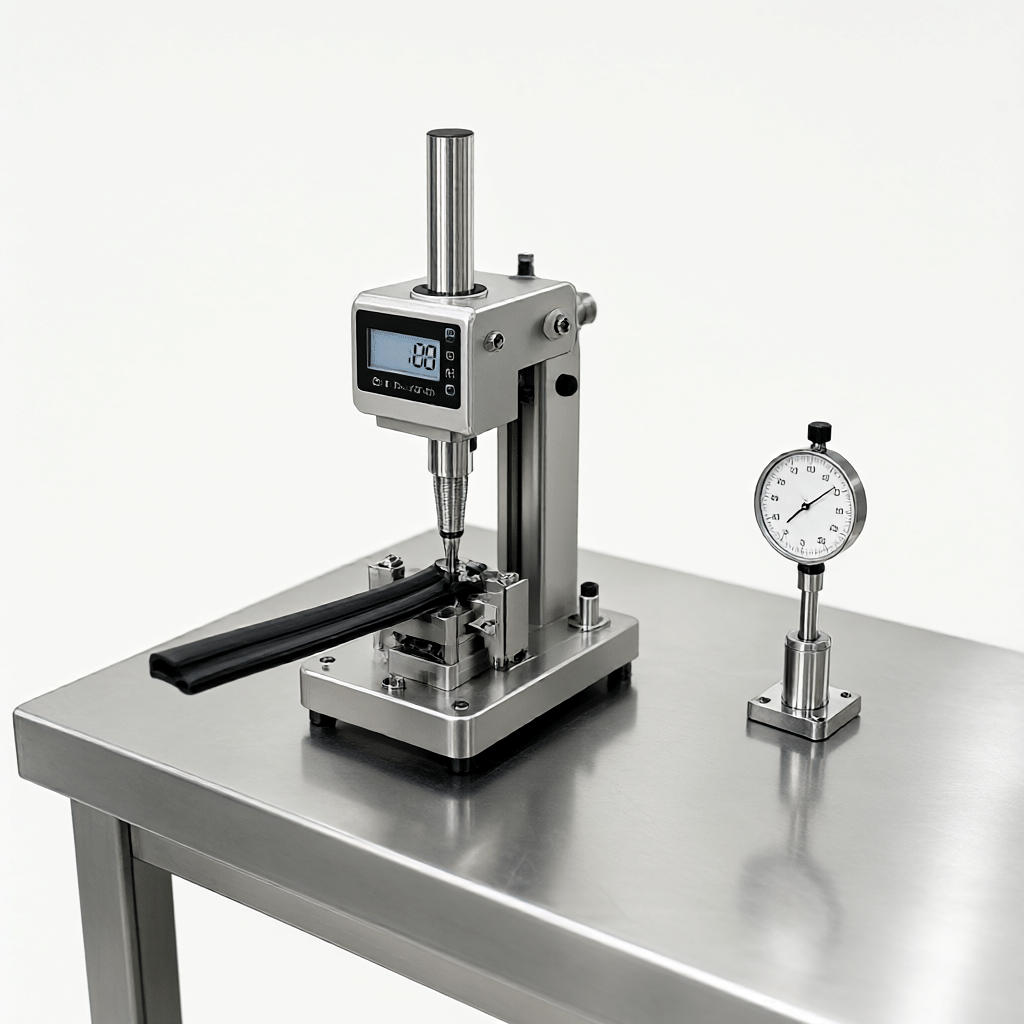
A trustworthy manufacturer treats quality assurance as an operating discipline, not an add-on. Expected practices include incoming material verification, in-process dimension checks, finished-product sampling, and batch-level documentation.
Key quality activities you should expect:
- Raw material certification — Compound receipts should trace back to the rubber or polymer supplier, with lot numbers recorded.
- Extrusion process controls — Diameter, wall thickness, and profile shape are monitored at regular intervals using calipers or optical gauges.
- Compression set testing — Routine verification per ASTM D395 confirms the compound retains rebound characteristics over time.
- Thermal ageing assessment — Exposure to elevated temperatures in controlled ovens simulates years of service in accelerated cycles.
- Adhesion and peel checks — For self-adhesive variants, peel strength measurements prevent installation failures caused by weak bonding.
- Air and water leak testing — Samples are cycled in chamber rigs to verify infiltration rates meet claimed performance bands.
Common certifications relevant to door weatherstrip suppliers include ISO 9001 for quality management, REACH compliance for chemical substance reporting in the EU, and RoHS conformity where electronics-adjacent facilities overlap. Some buyers also request UL listing for specific compound families or project-specific test reports aligned with NFRC or CWCT protocols. Because certification scope varies by lab and by product class, always ask for the actual certificate number and issuing organization so you can independently validate it.
Lead Times, Packaging, and Logistics From Factory
Standard perimeter compression seal profiles in established sizes typically ship within 7 to 14 working days after deposit confirmation, assuming no custom tooling is required. Custom profiles with new dies add 15 to 25 working days for tooling fabrication, followed by the same production window. Rush slots may be available at a premium, but squeezing timing too aggressively risks skipping process validations that protect long-term seal performance.
Packaging normally consists of coiled reels protected by cardboard cores and poly bags, bundled into export cartons. For fragile or color-sensitive profiles, manufacturers may add dividers or secondary wrapping to prevent scuffing during transit. Palletization follows export-standard plywood-free methods when ocean freight is involved.
Shipping options include FCL for large-volume project orders and LCL when consolidation reduces cost for smaller batches. Sea freight lead times vary by destination port but commonly range from 20 to 40 days door-to-port for major routes. Air freight is reserved for urgent samples or small remedial orders due to cost.
Before committing, clarify packaging specifications, cargo insurance terms, Incoterms preference, and any customs-documentation requirements your destination country mandates. A smooth shipment depends as much on administrative clarity as on product quality.
How Do We Evaluate Suppliers Before Placing an Order?
A structured vetting process reduces procurement risk. Use this sequence when comparing door weatherstrip manufacturers:
- Define your technical baseline — Document required material, profile, hardness, temperature range, and any applicable code references.
- Shortlist three to five suppliers — Prioritize manufacturers with verifiable factory operations rather than pure trading intermediaries when component integrity is critical.
- Request documentation — Ask for ISO certificates, recent test reports, REACH/RoHS declarations if relevant, and a sample package.
- Evaluate sample quality — Inspect profile geometry, surface finish, color uniformity, and flexibility. Measure compression with a simple feel gauge or digital caliper setup.
- Clarify commercial terms — Confirm MOQ, unit pricing tiers, tooling amortization policy, payment terms, and lead-time commitments in writing.
- Conduct a facility review — Video walkthroughs or on-site audits reveal process discipline, inventory organization, and inspection practices more reliably than glossy brochures.
- Start with a pilot order — Even a modest initial run exposes communication style, defect-rate reality, and packaging adequacy before you scale.
Evidence & Practical Notes
Field note: Many installation failures trace back to using a standard black EPDM seal in direct southern exposure without verifying UV-stabilizer content. The compound appears intact initially but begins chalking and cracking within 18 to 24 months, causing drafts and noise recurrence that homeowners mistakenly attribute to poor installation.
Practical limitation: Extremely low durometer seals feel softer and easier to compress during demo, but they also flatten faster under sustained door-closure loads. Specifying marginally higher hardness — when the latch and frame design allow it — often extends useful life without sacrificing seal comfort.
Buyer takeaway: Prioritize a manufacturer’s willingness to share raw test data and accept independent verification over impressive presentation. A supplier confident in their compound formulation welcomes scrutiny; one hiding behind vague claims usually has reason to.
Here Is How We Meet These Standards
We manufacture and supply door weatherstrips as part of a complete portfolio that includes solid wood doors, thermal-break aluminum doors and windows, system windows, casement and sliding doors, custom villa entrances, sunrooms, and aluminum alloy entrance doors. Rather than speaking in generalities, we structure our weather sealing supply around three operational pillars: material transparency, performance validation, and documented traceability.
On material selection, we source EPDM compounds with verified UV stabilizer packages for exterior applications and keep formulation records accessible so procurement teams can match seals to their climatic exposure without guessing. Where projects demand specific durometers or color matches, we adjust the compound blend and document the change rather than substituting silently.
On performance validation, every shipment undergoes a strict pre-shipment inspection that includes air-tightness, water-tightness, and wind-resistance testing. These checks mirror the kinds of cycles referenced in common envelope-performance frameworks and give buyers a tangible benchmark before cargo leaves the facility. We do not rely solely on certificate papers; we run the tests and record the outcomes.
On traceability and documentation, we maintain batch records linking raw-material lots to finished-profile serials, provide test summaries on request, and support both FCL and LCL shipments directly from our factory. For international orders, our trade team prepares packing lists, proforma invoices, and full customs documentation so your importing process encounters fewer administrative surprises.
Because every project has different requirements, we adjust profile structures, compound grades, and accessory integrations to suit local building-code expectations and architect specifications. Whether you are procuring for a hotel renovation, a residential developer, or a wholesale distribution channel, the goal remains the same: deliver seals that perform consistently and provide the documentation your quality team needs to approve them.
View our full product catalog and contact information
Visit our Contact Page or reach out directly to Leon Wu at cyxs001@gmail.com
What Does a Reliable Door Weatherstrip Manufacturer Test? (Standards Reference)
When evaluating suppliers, request test reports aligned with recognized standards rather than accepting vague “quality checked” claims. Below are the most commonly referenced standards and what they verify:
| Standard | Issuing Body | Test Performed | Relevance to Door Seals |
|---|---|---|---|
| ASTM D395 – Method B | ASTM | Compression set after 22 hours at elevated temperature | Predicts long-term deformation and loss of sealing force |
| ASTM E283 / E331 | ASTM | Air infiltration and water permeability of installed assemblies | Confirms envelope performance under simulated wind/rain conditions |
| EN 1026:2000 | CEN / ICC compliance paths | Air tightness classification for doors and windows | Required for European-market projects meeting energy code bands |
| EN 12208:1999 | CEN | Water permeability classification under controlled cycling | Validates resistance to driving rain at rated pressure differentials |
| ASTM E330 | ASTM | Structural performance of exterior windows under uniform static air pressure | Applicable when weatherstrip must maintain seal under high wind loads |
| REACH (EC 1907/2006) | European Chemicals Agency | Restriction and reporting of hazardous substances | Mandatory for EU-bound shipments; confirms compound safety compliance |
| RoHS Directive 2015/863 | EU | Limits on certain hazardous substances in manufactured goods | Relevant where seals interface with smart or electrified door systems |
Always ask for certificate numbers and cross-reference them with issuing bodies such as iso.org or astm.org. Photocopied certificates without traceable registration numbers are common red flags in low-cost sourcing channels.
How Samples and Pre-Production Approvals Are Handled
Samples represent the physical bridge between your specification and mass production. A professional manufacturer follows a defined approval workflow:
- Drawing review — YourCAD or hand-drawn profile specs are checked against available tooling and extrusion capabilities.
- Lab-sample provision — Short cuts (typically 1–3 meters) are shipped within 3–7 business days for evaluation. No deposit is normally required for basic stock profiles; custom-profile samples may carry a nominal fee refundable against the first production order.
- Compression and fit testing — You install the sample on representative frame material and measure contact pressure, gap closure, and aesthetic appearance under normal closed-door conditions.
- Pre-production sample (PPS) — Once the lab sample is approved, the manufacturer produces a short batch from the actual production line using the production die. This PPS confirms dimensional consistency, color match, and surface finish at scale.
- Written sign-off — Both parties confirm the approved sample with photographs, measurements, and a signed check sheet. Production only commences after this gate is cleared.
If a supplier cannot articulate this process or skips the PPS stage, quality variance in bulk orders becomes significantly more likely.
Procurement Decision Framework: Step-by-Step Evaluation Matrix
Use the following matrix to score and compare shortlisted door weatherstrip manufacturers objectively:
| Evaluation Criterion | Weight (%) | Supplier A Score (1–5) | Supplier B Score (1–5) | Supplier C Score (1–5) |
|---|---|---|---|---|
| Material test report availability (ASTM/EN) | 20 | |||
| ISO 9001 or equivalent QMS certification | 15 | |||
| In-house compression-set & ageing lab | 15 | |||
| Customization flexibility (profile, durometer, color) | 12 | |||
| MOQ alignment with project size | 10 | |||
| Lead-time commitment clarity | 10 | |||
| Third-party inspection acceptance policy | 8 | |||
| References / project case studies | 5 | |||
| Communication responsiveness & documentation quality | 5 | |||
| Total weighted score | 100 |
A supplier scoring below 70 out of 100 should face additional scrutiny before contract award. Weight adjustments can be applied based on whether your priority is cost, speed, or regulatory compliance.
Buyer Checklist: Vendor Evaluation Quick-Scan
Print or save this checklist to use during supplier interviews and site audits:
Before Requesting Quotes
- [ ] Define required material (EPDM / silicone / TPE / PVC), durometer range, and operating temperature
- [ ] Prepare cross-section drawings or reference profiles with tolerances
- [ ] Identify target market code requirements (ICC, EN, NFRC, CWCT)
- [ ] Establish minimum order quantity and desired delivery window
During Supplier Vetting
- [ ] Verified ISO 9001 registration number on iso.org or national registry
- [ ] Received recent ASTM D395 compression-set report with pass/fail results
- [ ] Confirmed ability to supply EN 1026 / EN 12208 test data for sealed assemblies
- [ ] Reviewed REACH declaration for EU-facing projects
- [ ] Confirmed willingness to provide pre-production samples before tooling investment
- [ ] Clarified packaging method, pallet configuration, and Incoterms offered
- [ ] Asked about third-party inspection rights (SGS, BV, TÜV acceptance)
Post-Order / Pre-Shipment
- [ ] Approved pre-production sample matches drawing and colour standard
- [ ] Factory provides packing list, proforma invoice, and customs document package
- [ ] Optional pre-shipment inspection passed against agreed AQL levels
- [ ] Shipment dispatched via confirmed FCL or LCL routing with tracking
Common Red Flags When Sourcing Door Weatherstrips
Beware of suppliers exhibiting any of the following warning signs:
- No verifiable ASTM or EN test reports — Claims of “premium quality” without citing specific standard numbers and passing values indicate inadequate quality infrastructure.
- Refusal to provide free or paid samples — Legitimate manufacturers understand sampling is essential for buyer confidence and industry standard practice.
- Missing compression-set data — Compression set is the single strongest predictor of seal longevity; any supplier unable to share this figure is hiding critical performance risk.
- Unusually low unit prices with no MOQ explanation — Prices significantly below market range often reflect filler-loaded compounds or recycled rubber blends that degrade prematurely.
- Vague dimensional tolerances — Statements like “standard tolerance” without numeric ± values make fitment unpredictable and increase on-site modification costs.
- No mention of ISO 9001 or quality management system — Absence of formal QMS suggests ad-hoc production controls with inconsistent batch-to-batch quality.
- Pressure to pay 100 % upfront before any documentation — Reputable factories accept balanced payment terms (e.g., 30 % deposit, 70 % before shipment) and support letter-of-credit arrangements.
- Inability to discuss air/water infiltration testing protocols — A supplier who cannot explain how they validate sealing performance lacks the technical depth needed for critical applications.
Real-World Case Study: Coastal Multi-Unit Residential Project
A 120-unit residential development on the Gulf Coast of Florida specified custom EPDM fin-seal weatherstrips with UV stabilizers (equivalent to ASTM D395-compliant formulation) supplied by a qualified China-based extruder. The previous specification had used an un-stabilized compound that degraded within two years, generating callback rates of approximately 8 % per annum for seal replacement.
After transitioning to the stabilized EPDM profile — with compression-set validated at less than 20 % per ASTM D395 and proven UV resistance through accelerated weathering — callback rates dropped to under 1 % over a five-year observation period. The project achieved full air-infiltration compliance per ICC referencing standards and eliminated recurring maintenance costs estimated at $12 000 annually.
This outcome underscores why material specification, documented testing, and supplier accountability matter more than unit price alone in demanding environments.
How Jusen Door and Windows Meets These Standards
As a manufacturer operating our own extrusion and assembly facility, our approach to door and window weather sealing integrates directly with the performance expectations outlined above. Here is how we align with industry best practices:
Factory-direct supply eliminates middleman markups, ensuring competitive pricing while maintaining traceability from raw compound to finished profile. Every shipment undergoes strict pre-shipment inspection covering air-tightness, water-tightness, and wind resistance testing — the same parameters referenced in ASTM E283 and EN 1026 protocols.
Our full customization capability covers profile geometry, material compound, color (RAL-matched), glass specifications, and hardware integration. Profile structures and fittings are adjustable to comply with the local building codes of your target market, whether that involves US ICC references, EU EN classifications, or other regional requirements.
For international buyers, our extensive foreign trade experience means we routinely prepare complete documentation packages — packing lists, proforma invoices, commercial invoices, and customs declarations — ensuring smooth clearance at destination ports. We support both FCL and LCL shipments with direct dispatch from our China factory, and our standard lead times range from 7 to 14 working days for stock profiles and 15 to 25 working days for custom-extruded tools, depending on die complexity.
Minimum order quantities are flexible and negotiated per project scale. Samples are provided within 3–7 business days, with pre-production approval conducted through our documented PPS workflow before bulk manufacture begins.
Contact Our Team to discuss your project specifications, receive a tailored quotation, or request a sample kit with supporting test documentation.
Sources & References
- ASTM E283 — www.astm.org
- iso.org — www.iso.org
- ICC building codes — www.iccsafe.org
- Visit our Contact Page — doorwoodendoors.com











