
Last updated: November 25, 2026
For architectural aluminum profiles and finished doors/windows, the minimum order for a custom RAL colour typically runs 200–500 linear metres of extrusion or USD 3 000–8 000 FOB, with ready-made units often starting at 50–150 pieces. Custom-colour batches carry higher fixed setup costs — pigment blending, line clearing, and colour-validation testing — which make low-volume orders uneconomical for most coating lines. Understanding how RAL colour systems work, which material types carry different MOQ floors, where price scales break down, and which quality checkpoints protect your order will help you negotiate a realistic minimum without compromising finish durability. This guide walks through each of those variables with concrete industry benchmarks and practical decision frameworks for project buyers.
Quick Answer — What is the minimum order for custom RAL colour?
For architectural aluminum extrusions and door/window frames finished in a non-standard RAL colour, the industry-typical minimum order runs roughly 200–500 linear metres of profile, or an equivalent order value of USD 3 000–8 000 FOB. For ready-made doors and windows shipped as finished units, buyers often see a floor of 50–150 units, depending on the supplier’s powder-coating capacity and the complexity of the shade.
Below these thresholds, suppliers generally either refuse the job or treat it as a one-off batch at a steep unit premium. The reason is not arbitrary — it reflects the fixed costs of colour matching, line clearing, and batch verification that do not shrink with small volume.
If you are evaluating whether your project crosses the minimum order for custom RAL colour threshold, the figures above are a working baseline. Actual MOQs vary by manufacturer, coating line configuration, pigment demand, and whether the colour falls within the RAL Design palette or requires a bespoke formulation. The sections below explain how those variables combine and what levers exist to lower the barrier without sacrificing colour consistency or finish durability.
Detailed Explanation — How does MOQ for custom RAL colour work?
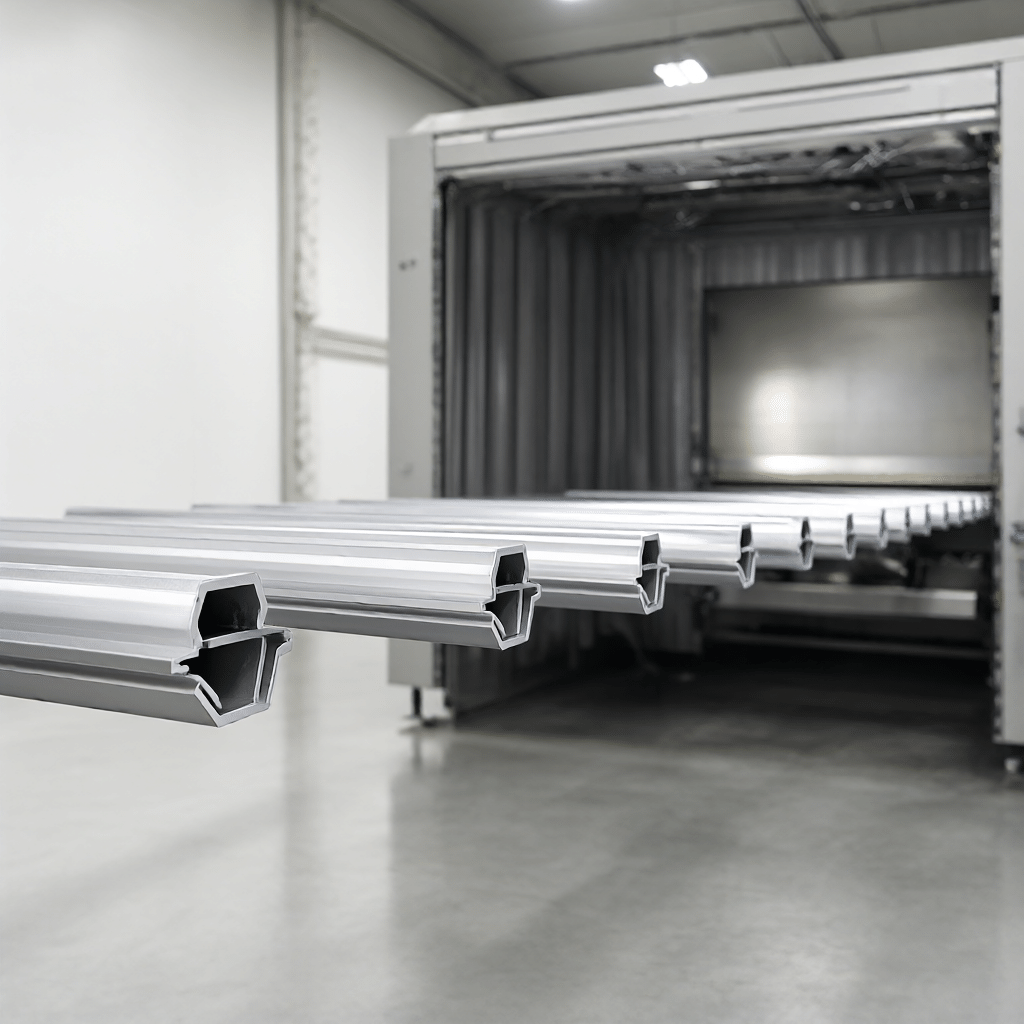
A custom RAL colour order starts the moment a buyer selects a shade outside the supplier’s pre-mixed stock inventory. On the production side, that single decision triggers a sequence of technical and commercial steps — each carrying a fixed cost that the supplier spreads across the order quantity. Understanding that sequence explains why MOQ exists, why it differs by product type, and how it ultimately shapes unit economics.
What drives MOQ up for a non-standard RAL finish?
Three interrelated factors set the floor on any custom colour batch. The first is colourant cost and formulation time. Powder-coating lines stock a narrow range of base pigments. When a requested RAL shade sits outside that library, the coating shop must either blend a custom masterbatch or purchase niche colour concentrates. Both options carry minimum purchase quantities from the pigment supplier and require laboratory mixing time before a production trial can run.
The second factor is line clearing. A powder-coating oven belt that has been running RAL 9016 Traffic White cannot simply switch to RAL 6001 Green without flushing the entire system — dust collectors, transfer booths, hopper lines, and the cure oven itself. This clean-out process typically wastes a full shift of output and generates scrap material equal to several hundred square metres of coating. The larger the incoming order, the more that waste gets absorbed into per-unit cost.
The third factor is consistency validation. Custom colours require a pilot batch that is visually compared against the approved RAL sample under controlled lighting, followed by adhesion, thickness, and weathering checks. These tests consume time and materials regardless of whether the final shipment contains 50 metres or 5 000 metres. For repeat orders of the same shade, the setup cost drops dramatically; for one-off projects, it remains a heavy fixed component.
Together, these elements mean that every custom colour run carries a baseline overhead that makes very small orders economically unviable for most coating lines.
How does MOQ affect the unit price of a custom-finished product?
MOQ and unit price share an inverse relationship driven by amortised fixed costs. At the low end of the scale — say, 100 linear metres of a bespoke dark RAL shade — the line-clearing and pigment-blending expense alone may add USD 2–4 per metre to the coating charge beyond what a standard colour would cost. As volume rises toward 500 metres and beyond, that per-metre setup surcharge falls to under USD 0.50, and the price differential between custom and stock colour narrows to a few percentage points.
Buyers should also expect a secondary effect: colour consistency improves with volume. A 200-metre batch pulled from a single mixed drum of pigment tends to show tighter ΔE tolerance than two separate 100-metre pulls from different blends. For projects where façade panels arrive in multiple shipments, this distinction matters — mismatched tint between batches is one of the most common complaints in architectural procurement.
When you are weighing whether to consolidate a split shipment into one custom colour order or absorb the risk of separate batches, calculating the marginal cost difference per metre against the aesthetic risk is usually the fastest way to decide.
Can I place a small trial order for a custom RAL colour?
Yes, but expect trade-offs. Many manufacturers will accept orders below their published MOQ if the buyer agrees to a setup fee that covers line clearing, pigment blending, and initial testing. That fee typically ranges from USD 300 to USD 1 500 depending on colour complexity and the coating line’s current schedule. Alternatively, some suppliers offer a sample run at reduced length — often 20–50 metres — intended for visual approval before committing to the full production batch.
For smaller projects such as hospitality refurbishments or residential renovations, combining custom-colour profiles with other finishes from the same order can help reach the minimum threshold without inflating total spend. If the goal is purely to verify colour match before a large order, requesting a small sample coupon coated on the actual profile cross-section you intend to use is more reliable than relying on a printed RAL card or a loose paint chip.
Key Specifications — What are the key specs for custom RAL colour orders?
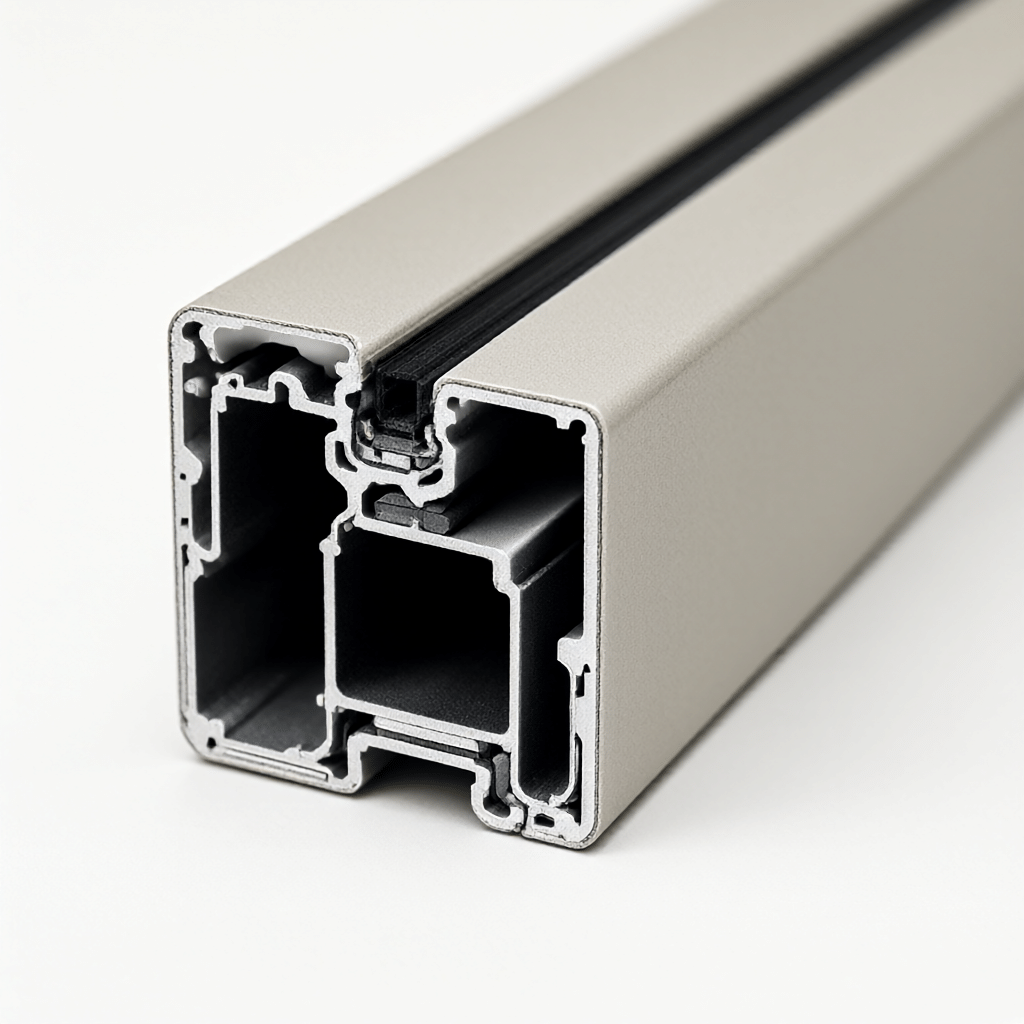
The following table summarises representative MOQ ranges and associated parameters across common finish types found in the doors-and-windows supply chain. Figures reflect typical industry practice in 2026 and should be treated as negotiation baselines rather than absolute limits.
| Finish Type | Typical MOQ (Linear Metres / Units) | Approximate Order Value Floor (USD) | Common Coating Thickness | Lead Time After Colour Approval |
|---|---|---|---|---|
| Powder-coated aluminium extrusion (custom RAL) | 200–500 lm | 3 000–8 000 | 60–80 µm | 15–25 days |
| Powder-coated made-to-order doors/windows (finished units) | 50–150 units | 4 000–10 000 | 60–80 µm | 20–30 days |
| Liquid-paint steel frames (custom colour) | 100–300 lm | 2 500–6 000 | 40–70 µm | 12–20 days |
| Anodised aluminium (non-standard tint) | 300–600 lm | 5 000–12 000 | 15–25 µm | 18–28 days |
| PVDF-coated aluminium coils (pre-finished) | Based on coil width/length | N/A — sold by area | 20–35 µm | 10–15 days |
A few notes on reading these numbers. “Linear metres” refers to the extended length of extruded profile before it is cut and fabricated into windows or doors. When a supplier quotes MOQ in units rather than metres, they are typically referring to completed assemblies — casement windows, sliding panels, entrance doors — where each unit consumes a variable amount of profile depending on size and configuration.
Coating thickness ranges shown above align with common performance targets for exterior architectural use. Thinner films under 50 µm on powder-coated aluminium tend to show faster chalking and colour fade, especially on dark shades that absorb more UV energy. Most specifiers targeting long service life — say, multi-unit residential developments or commercial façades — specify a minimum of 60 µm dry film thickness for custom exterior colours.
Standards & Requirements — What standards apply to custom powder-coat finishes?
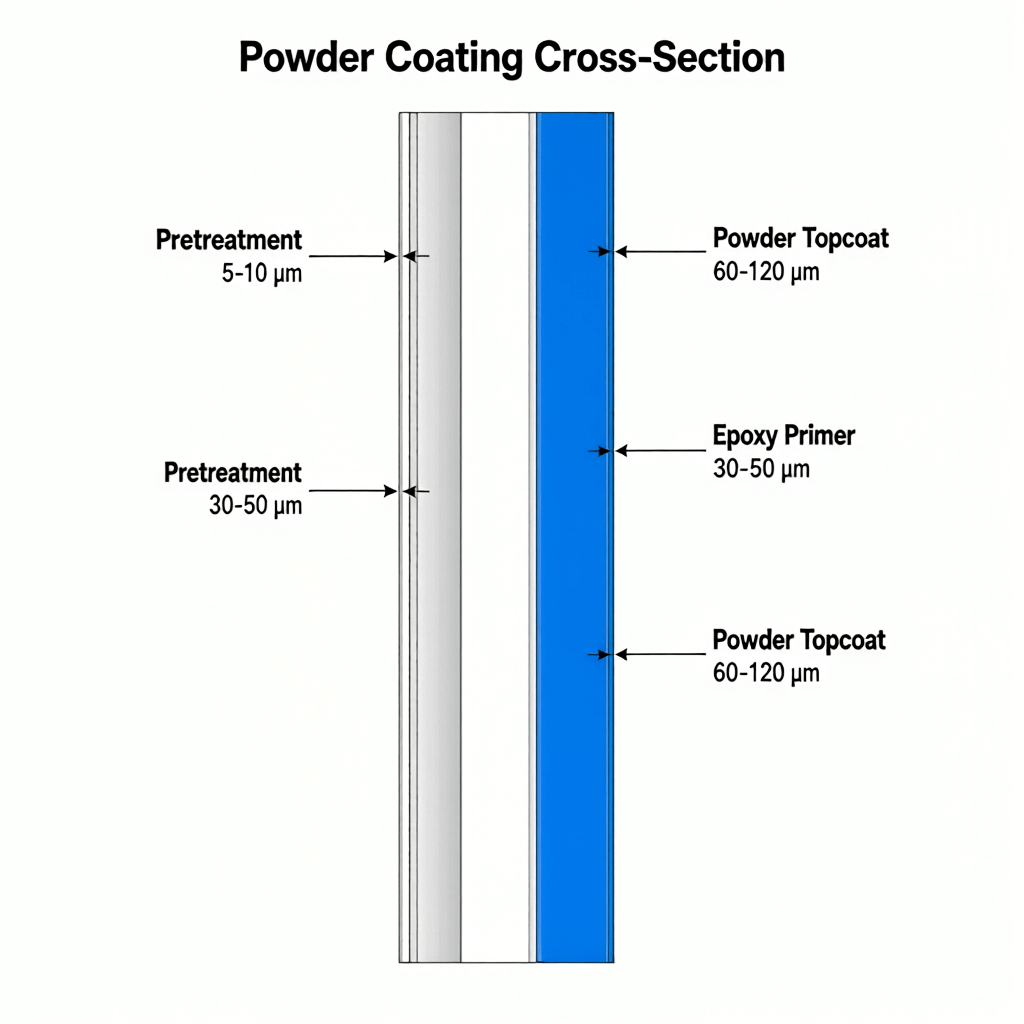
Custom colour work on architectural aluminium is governed by a combination of product-performance standards and finish-quality benchmarks. None of these dictate MOQ directly, but compliance with relevant standards is often used as a gate requirement during supplier evaluation and may influence the price a buyer pays.
ISO 12944 (corrosion protection of steel and aluminium structures) provides the framework for coating selection and durability classification. For exterior aluminium in aggressive environments, C4 or C5-I categories are commonly referenced. Powder-coat systems that meet ISO 12944 expectations typically deliver 10–15 years of service life on well-maintained façades when applied at sufficient thickness and with proper surface preparation.
ISO 2409 (cross-cut adhesion test) and ISO 7774 (impact resistance) are among the most frequently requested test reports for custom coatings. Buyers sourcing from China often ask for third-party certification from labs such as SGS, BV, or Intertek, particularly on projects that require documented proof of finish performance for building-code compliance.
GB/T 5237 is the Chinese national standard for aluminium alloy extruded profiles with surface treatments. It covers colour difference tolerances, adhesion, humidity resistance, and salt-spray performance for powder-coated products. While it does not prescribe RAL colour matching, it defines acceptable ΔE values — usually ≤ 1.5 for visual match under standardized viewing conditions — which is the metric most directly relevant to custom colour consistency.
It is worth noting that RAL GSC guidelines describe how RAL colours should be produced and presented, but RAL gGmbH does not certify individual factory batches. Colour consistency claims rely on the supplier’s internal spectrophotometer readings and controlled-light comparison booths, not on external RAL accreditation. Reputable mills maintain calibrated equipment and document batch-level measurements, which is something buyers should verify during a factory audit rather than assume.
Related Considerations — What should you consider when placing a custom RAL order?
Specifying a custom colour is straightforward in theory and occasionally surprising in practice. The following considerations address the most common friction points that arise during the procurement of non-standard RAL finishes on aluminum doors, windows, and profiles.
How long does production take once the custom colour is approved?
After the colour sample is approved — usually confirmed through a coated test coupon viewed under D65 standard light — typical lead time for a full powder-coated extrusion order ranges from 15 to 25 days for volumes between 200 and 1 000 linear metres. Beyond 1 000 metres, schedules compress proportionally because the line operates continuously rather than stopping for frequent colour changes. Finished door and window assemblies may add 5–10 days on top of the coating lead time, depending on glazing, hardware installation, and packaging requirements.
Custom liquid-paint steel orders tend to be slightly faster at 12–20 days, partly because the application process involves fewer curing stages than powder coating. Anodised finishes in non-standard tints carry the longest turnaround, frequently 18–28 days, due to the electrochemical bath conditioning and longer cycle times required for custom dye colours.
What parameters most influence the supplier’s MOQ decision?
Suppliers weigh at least five inputs when setting the minimum threshold for a custom colour run:
- Current line utilisation — A busy facility with a queue of stock-colour orders will assign higher MOQs to custom jobs because each changeover displaces revenue-generating production. An idle line is more flexible.
- Shade darkness and opacity requirements — Deep blacks, chartreuse greens, and certain reds demand more opaque primer-seal sequences and additional pigment loading, increasing waste during flush and raising effective MOQ.
- Profile geometry — Complex extrusions with deep grooves and hard-to-reach cavities require more thorough cleaning between colour changes, extending the line-clearing cost.
- Repeat versus one-off status — If the colour has been run before and the batch formula is on file, setup is quicker and MOQ can be lowered. Truly novel formulations carry higher entry costs.
- Order composition — Mixed orders that pair a custom colour with standard stock items on the same line can sometimes be accommodated at lower MOQ for the custom portion, since the line does not need to return to a neutral baseline after completion.
Understanding which of these factors applies to your order helps you frame negotiations more effectively. For example, proposing to combine a custom-colour facade order with a secondary order for standard-white structural members may reduce the effective MOQ pressure on the bespoke shade.
Is there a price premium for using a custom RAL code instead of a standard one?
Yes, but the magnitude depends on volume and colour complexity. For orders meeting or exceeding the standard MOQ, the premium typically lands in the 3–8% range over the equivalent stock-colour price. Below MOQ, the premium spikes sharply because the fixed setup cost is amortised over fewer metres.
Some Dark or highly saturated RAL shades — particularly RAL 9005 Jet Black, RAL 3000 Flame Red, and RAL 6021 Pale Emerald — command higher premiums even at volume because they require heavier pigment loads and additional opacity passes. Conversely, mid-tone shades close to existing stock formulas may carry little to no premium if the supplier can approximate them with minor adjustments.
The price gap between a stock colour like RAL 9016 Traffic White or RAL 7016 Anthracite Grey and a truly custom shade narrows noticeably once orders pass 500 linear metres. For budget planning on larger projects, requesting both a stock-colour quote and a custom-colour quote side by side — with identical profile sections and hardware specs — gives the clearest picture of the real cost difference.
What are the practical steps to specify and verify a custom colour before production begins?
A disciplined specification process prevents the most common custom-colour disputes. The following workflow applies to any buyer ordering architecturally finished aluminum profiles or assembled doors and windows.
First, anchor the colour reference to a physical sample, not just a digital code. RAL codes are reproducible, but monitor calibration and screen rendering can shift perceived hue by several ΔE units. Request a laminated RAL card from the official source or an original painted coupon from the supplier’s previous batch of the same shade.
Second, define acceptable tolerance upfront. Most reputable suppliers target ΔE ≤ 1.5 for visual acceptance under standard lighting. For critical façade applications, state this limit explicitly in the purchase order. Accepting “match to sample” without a numeric bound leaves room for subjective interpretation later.
Third, approve a pilot coupon before full production. This coupon should be coated on the exact profile cross-section you intend to use, cured under the same cycle parameters, and inspected under the lighting conditions it will experience in situ. Daylight, warm LED, and fluorescent illuminants render custom colours differently, so a panel approved under showroom lights may look unacceptable on a sunlit facade.
Fourth, document the approved batch formula and lot number. Once production begins, request that the supplier record the masterbatch weight, pigment lot, and cure parameters. If a follow-up order arrives six months later, that documentation allows the mill to reproduce the shade with minimal deviation — something that becomes essential when subsequent deliveries must match an earlier batch on an active construction site.
Fifth, scheduleColour verification at key milestones during the run. A midpoint check after 20–30% of the order has passed through the line catches drift early, before the entire batch is committed. Rejecting a colour shift at that stage is far cheaper than discovering it after full shipment.
These steps are equally relevant whether you are specifying custom colours for a high-rise retrofit, a hotel refurbishment, or a residential development. The investment in upfront clarification consistently pays for itself in reduced rework and fewer disputes.
Distinguishing custom RAL orders from stock-colour purchases
The distinction between a stock-colour order and a custom RAL batch extends beyond MOQ and price. Stock colours sit in the supplier’s premixed inventory and can be queued onto the line immediately. Custom colours require a dedicated formulation step, a cleaning cycle, and a verification run before the main production sequence begins. That operational difference cascades into longer lead times, tighter lot-control documentation, and often more conservative warranty terms for the first custom run.
From a procurement standpoint, treating custom-colour orders as a separate category — with their own quality gates and acceptance criteria — avoids conflating them with routine reorder transactions. The cost and scheduling impact is real, and acknowledging it early in the bid process prevents downstream surprises.
How Industry Manufacturers Handle Custom RAL Colour Orders
The principles above are not theoretical — they reflect the daily operating logic of coating lines that serve architectural door and window manufacturers. Here is how that translates into a real-world purchasing scenario.
A project team working on a villa restoration might need entrance doors and window frames finished in a specific dark bronze RAL shade that does not appear in the supplier’s standard palette. The engineering team calculates approximately 320 linear metres of 6063-T5 profile plus 80 pairs of assembled casement windows. The specification calls for a minimum 70 µm powder-coat film, ISO 12944 C4 compatibility, and ΔE ≤ 1.5 against the approved RAL sample.
On the cost side, the mill quotes a setup surcharge covering line clear, pigment blend, and initial test coupons, then layers a 5% colour-premium on top of the per-metre profile price. Because the total order exceeds the typical 200-metre powder-coating floor, the MOQ hurdle clears cleanly and the blended per-unit price lands within the expected 3–8% band over the stock-colour baseline. Lead time settles at roughly 20 days from colour approval, with a midpoint inspection scheduled after the first 100 metres exit the oven.
Packaging and export documentation follow the same procedures applied to standard orders — packing list, proforma invoice, and customs paperwork — though the colour certificate and batch records become part of the delivery packet for archival purposes. The buyer arranges FCL shipment directly from the factory, keeping logistics simple and traceable.
This kind of end-to-end visibility — where colour specification, production scheduling, and export documentation are handled within a single manufacturer’s workflow — reduces coordination risk on custom-colour projects. It also means the buyer deals with one accountable party for both the finish quality and the shipping documentation, rather than splitting responsibility between a coater and a fabricator.
Send us your opening sizes for a custom quote
FCL vs LCL for Door Shipments: Cost, Speed & Risk Comparison
Door Factory Audit Checklist: How to Evaluate Suppliers
Powder Coat vs Anodized vs PVDF Finish Comparison for
Door HS Code & Import Duty: Complete Procurement Guide 2026
EI30 vs EI60 vs EI90: Fire Door Rating Comparison Guide
20ft Container Door Loading Quantity — Bulk Shipping Guide
Plywood Doors Price Per Unit — Bulk Wholesale Pricing Guide
MDF Doors Price Per Unit: Bulk Pricing & Buying Guide 2026
What Is the RAL Colour System and Why Does It Matter for Doors and Windows?
RAL is a German colour classification system originally developed in 1927 to standardise paint shades across construction, industrial, and consumer sectors. Today it exists in several parallel palettes; the two most relevant to architectural metal finishing are RAL Design (1 925 systematically ordered hues based on human perception) and RAL Classic (the legacy set of 213 industrially used colours such as RAL 9016 Traffic White, RAL 7016 Anthracite Grey, and RAL 6001 Green). Both are published reference charts — not product specifications — and neither RAL gGmbH nor any other third party certifies individual factory batches against them.
For doors and windows, the RAL system matters because it gives architects, specifiers, and contractors a common language for colour intent across supply chains that span multiple continents. A project specification can state “outer frames RAL 7016, inner frames RAL 9016” and every supplier worldwide understands exactly which visual target applies, regardless of local naming conventions. In practice, however, translating a RAL swatch into a consistent coating on aluminum requires controlled laboratory formulation, spectrophotometer verification under D65 illuminant, and batch-level recording — steps that small-batch producers sometimes shortcut.
Buyers should distinguish between stock RAL colours (pre-mixed pigments already held by the coater, offering fast lead times near zero setup) and custom or bespoke RAL matches (shades outside the supplier’s library, requiring new pigment blending, trial coating, and approval before full production). The distinction directly determines MOQ, unit price, and lead time, as detailed in the sections that follow.
Stock RAL Colour versus Custom RAL Batch
| Attribute | Stock RAL Colour | Custom/Bespoke RAL Batch |
|---|---|---|
| Pigment availability | Pre-mixed and stored on site | New masterbatch blended from concentrates |
| Line-clearing requirement | Minimal or none | Full system flush required |
| Test-coupon approval needed | Rarely, unless specified | Always required before bulk run |
| Typical MOQ impact | Reduced or waived | Sets the floor for the order |
| Lead-time difference | 5–10 days faster than custom | 15–25+ days after colour approval |
| ΔE tolerance expectation | ≤ 1.0 achievable | ≤ 1.5 typical; tighter depends on supplier capability |
Understanding this gap helps buyers decide whether a project truly needs a non-standard shade or whether an existing stock colour achieves the design intent at lower MOQ and shorter lead time.
How MOQ Differs by Material and Finish Type
MOQ for custom colour is not a single number — it shifts significantly depending on the substrate and the application method. The same RAL shade may carry very different minimums when applied to powder-coated aluminum versus liquid-painted steel, anodised profiles, or pre-finished PVDF coils.
Powder-Coated Aluminium Profiles
Powder coating is the dominant finish for exterior aluminum doors and windows. A custom colour requires the entire electrostatic booth, powder recirculation system, hopper feed lines, and cure oven to be cleared of the previous pigment load. Because powder systems run closed-loop, cross-contamination risk is high; even trace residues alter hue and saturation on the next batch. Typical MOQ sits at 200–500 linear metres or the equivalent order value floor of USD 3 000–8 000 FOB.
Liquid-Paint Steel Frames
Electrostatic liquid spray or conventional brush/roller application on steel follows a different chemistry. Waterborne and solventborne systems dry at lower temperatures, which reduces energy cost per batch but introduces different film-building constraints. MOQ ranges 100–300 linear metres, often with a slightly lower order-value floor because the throughput speed is higher.
Anodised Aluminium
Anodising builds a porous oxide layer that is then dyed in an electrolytic bath. Achieving a non-standard tint means conditioning the dye tank, running rinse cycles, and verifying hue consistency through extended electrochemical exposure. This process is inherently slower and more batch-sensitive than powder coating, pushing MOQ higher to 300–600 linear metres despite thinner final films.
PVDF-Coated Coils (Pre-Finished)
Coil coating operates on continuous strip lines rather than batch processing. Once a plant commits to a custom colour run, the line cannot easily revert, which creates a different economics model. MOQ is usually expressed as minimum coil weight rather than linear metres, and custom-colour changeovers on coil lines can cost thousands of dollars in wasted substrate before the new shade stabilises.
Wood and MDF Core Substrates
Solid wood and MDF door cores use pigment stains, lacquers, or UV-cured topcoats. Each material absorbs colour differently, and grain variation on solid wood adds another consistency variable. Procurement teams should treat these substrates separately from aluminum and steel when negotiating custom-colour MOQ, since the baseline tolerances and defect modes differ substantially.
Standards, Tests and Technical Benchmarks for Custom Colour Finishes
Custom RAL colour work on architectural aluminum is governed by a network of international and national standards. These do not dictate MOQ directly, but compliance data is frequently used as a gate requirement during supplier qualification and tender evaluation. Buyers who reference specific standard numbers in purchase orders gain stronger leverage in post-delivery disputes.
ISO 12944 Series — Protective Paint Systems
ISO 12944 defines corrosivity categories for coated structures. For exterior aluminum in urban or coastal environments, designers commonly specify:
- C3 — medium corrosivity (urban interiors and mild outdoor)
- C4 — high corrosivity (industrial atmospheres, coastal up to 5 km inland)
- C5-I — very high corrosivity (industrial with high humidity; C5-M for marine)
A powder-coating system meeting C4/C5 requirements typically delivers 10–15 years of service life on well-maintained façades when applied at sufficient thickness and with proper surface preparation per ISO 8501-1.
Coating Thickness and Adhesion Benchmarks
For exterior architectural aluminium, the widely accepted minimum dry-film thickness is:
- Powder coat: 60–80 µm (microns)
- Liquid paint: 40–70 µm
- Anodised (standard): 15–25 µm
- Anodised (architectural heavy-duty): 25–40 µm
Cross-cut adhesion must meet ISO 2409 Class 0–1 (no flaking or only slight flaking at intersections) for exterior-grade custom coatings. Adhesion below Class 2 is generally considered unacceptable for building envelope applications in most procurement specifications.
Salt-Spray Performance (ISO 9227 / ASTM B117)
Salt-spray duration correlates loosely with real-world corrosion resistance. Representative targets for exterior aluminium finishes are:
| Finish Type | Minimum Salt-Spray Hours (ISO 9227) | Notes |
|---|---|---|
| Powder-coated aluminium (exterior grade) | ≥ 1 000 h | 2 000 h available for premium C5-rated systems |
| Liquid-painted steel frame | ≥ 500 h | Zinc-rich primers extend performance |
| Anodised aluminium (architectural) | N/A — tested via alternative methods | Qualitative erosion and colour-change assessment |
| PVDF-coated coil | ≥ 4 000 h | Industry benchmark for long-life façades |
When requesting test reports from suppliers, buyers should confirm the test standard, sample pretreatment method, and film thickness at the time of testing. Reports written without pretreatment detail (e.g., chromate conversion vs. non-chromate zirconium treatment) are less useful for comparative evaluation.
GB/T 5237 (China National Standard for Treated Aluminum Extrusions)
GB/T 5237 covers colour-difference tolerance, adhesion, humidity resistance, and salt-spray performance for Chinese-manufactured extruded profiles with surface treatments. Key benchmarks relevant to custom RAL orders include:
- Colour difference (ΔE): ≤ 1.5 under standardized viewing conditions (D65 illuminant, 2° observer)
- Cross-cut adhesion: Class 0–1 per ISO 2409
- Humidity resistance (85°C / 85% RH): No softening, blistering, or peeling after specified hours
- Salt spray: Meets the thresholds listed above depending on corrosivity category
Although GB/T 5237 does not prescribe RAL colour matching itself, it defines the tolerance window within which a custom match must fall to be acceptable — information buyers should cite explicitly in technical annexes.
EN 12206 and EN 12208 — Architectural Aluminum Performance
EN 12206 specifies air permeability and EN 12208 specifies water-tightness for window and door products. While these standards address assembly performance rather than finish quality directly, a custom-colour coating that degrades prematurely (chalking, cracking, or loss of adhesion) can compromise seal integrity at frame joints over time. Specifying minimum coating thickness and adhesion class upstream reduces downstream performance risk.
Electrodepositing Standard — QQ-P-416
Where aluminum components undergo electrocoat primer (primarily for interior or high-corrosion applications), QQ-P-416 governs electrodeposited coating properties including film thickness uniformity, adhesion, and salt-spray endurance. Custom colour control in e-coat is particularly challenging because the deposition process is sensitive to voltage, bath composition, and immersion time; batch-to-batch drift is more likely than in powder coating if process controls are loose.
RAL GSC Guidelines — Limits of Third-Party Certification
RAL gGmbH publishes GSC (Guidelines for the Supply of Colours) describing how RAL colours should be produced and presented. Importantly, RAL does not certify individual factory production batches. Colour consistency claims rest on the supplier’s internal spectrophotometer readings, controlled-light comparison booths, and documented ΔE measurements per batch. Reputable mills maintain calibrated equipment traceable to national standards and provide batch-level measurement records; buyers should verify this during a factory audit rather than assume it.
Procurement Decision Framework — Evaluating Suppliers on MOQ and Colour Capability
Beyond price and delivery date, three dimensions dominate supplier selection for custom-colour architectural aluminum: MOQ flexibility, colour-consistency track record, and testing protocol rigour. The following weighted scoring matrix provides a structured way to compare shortlisted manufacturers. Assign scores from 1 (weak) to 5 (strong) for each criterion, multiply by the assigned weight, and sum to obtain a composite score out of 100.
| Criterion | Weight (%) | Score (1–5) | Weighted Score |
|---|---|---|---|
| Published MOQ for custom RAL colour and willingness to negotiate | 20% | ___ × 0.20 = ___ | |
| Historical ΔE consistency across repeat custom batches | 25% | ___ × 0.25 = ___ | |
| In-house spectrophotometer + calibrated light booth | 15% | ___ × 0.15 = ___ | |
| Third-party test reports (SGS/BV/Intertek) for salt spray & adhesion | 15% | ___ × 0.15 = ___ | |
| Clear document trail: colour formula on file for reorders | 10% | ___ × 0.10 = ___ | |
| Transparent line-clearing and sampling procedure documentation | 10% | ___ × 0.10 = ___ | |
| Total | 100% | ___ / 100 |
A composite score above 75 indicates a supplier capable of handling custom-colour orders with predictable quality outcomes. Scores between 55–75 suggest acceptable capability but require closer specification control (e.g., mandatory pre-shipment sample approval). Below 55, the risk of colour inconsistency, delayed lead times, or MOQ inflexibility is materially higher and warrants either additional due diligence or alternative sourcing.
When applying this framework, request concrete evidence rather than verbal assurance. Ask for: (a) a recent ΔE report comparing two separate custom batches of the same RAL code, (b) the certificate of conformity for salt-spray testing showing actual hours sustained, and (c) a photo log of the comparison booth setup used for colour approval.
Cost Implications at Low versus High Order Volumes
Unit price for custom-colour finishes does not scale linearly with quantity. The relationship is driven primarily by amortisation of fixed setup costs, and recognising where those breakpoints occur helps buyers plan project phasing and payment scheduling.
At the low end (below MOQ or just meeting it), the per-metre or per-unit surcharge for a custom RAL colour can range from USD 2–5 above the equivalent stock-colour price, or represent a 15–30% total premium once all setup fees are included. This bracket also carries elevated risk of batch-to-batch colour drift because each small pull is effectively a pilot run.
In the mid range (approximately 500–1 500 linear metres), the setup surcharge drops to under USD 0.50 per metre, and the total custom-colour premium typically narrows to the 3–8% range cited by most specifiers. Colour consistency improves because the entire volume draws from a single mixed drum or a tightly controlled sequential blend.
At the high end (above 1 500–2 000 linear metres), some suppliers offer zero incremental premium for custom colour if the shade approximates an existing stock formula closely enough to require only minor adjustment. At this volume, the custom-job economics converge toward stock-colour economics, and the primary differentiator becomes schedule priority rather than cost.
Projects that split a custom-colour requirement across multiple buildings or phases should carefully weigh the cost of two smaller orders versus one consolidated run. Even when logistics favour staggered delivery, the cumulative setup expense and consistency risk of separate batches often exceed the holding-cost savings of phased ordering.
Negotion Levers for Lowering MOQ Without Sacrificing Quality
Buyers who cannot meet a supplier’s standard custom-colour MOQ have several realistic options that preserve both budget and finish integrity.
Option 1: Combine with a secondary order. Pairing a custom-colour facade order with a larger secondary order for stock-colour structural members, internal frames, or hardware-mounted assemblies can pull the combined line occupancy above threshold. The custom portion benefits from reduced effective MOQ while the standard portion ships on schedule.
Option 2: Pay a setup fee instead of inflating volume. Many factories accept a flat setup charge — typically USD 300–1 500 — in lieu of a high minimum. This converts a volume constraint into a predictable fixed cost, which is often preferable for tight-budget projects where adding metres solely to satisfy MOQ would waste capital.
Option 3: Use the supplier’s nearest stock alternative. If a requested RAL 2004 Orange is unavailable as a stock item but RAL 2003 Paste Orange is, the colour difference may be negligible in situ, especially on large elevations viewed at distance. Request a physical side-by-side coupon under natural daylight before committing.
Option 4: Consolidate across projects or partners. Coordinating with other buyers on a shared platform or through a purchasing group can aggregate enough demand to clear the MOQ floor individually while preserving design intent across all participating projects.
Option 5: Accept a sample-run compromise. Some suppliers will coat a reduced-length sample run (20–50 linear metres) for approval purposes at a proportional setup charge. Once the colour is locked, the full order proceeds under the established formula, and subsequent reorders of the same shade incur minimal additional setup.
None of these levers eliminate the underlying fixed cost of colour matching and line clearing — they redistribute or defer it. The strongest negotiations recognise that transparency about volume intent upfront yields better terms than retrospective demands after the order is placed.
Quality-Control Checkpoints During Custom Colour Production
Quality control for custom RAL-colour orders should be treated as a series of gates rather than a single inspection event. Skipping or compressing any checkpoint increases the probability of batch rejection at destination. The following sequence represents industry best practice for architectural aluminum doors, windows, and profiles.
Gate 1 — Colour formulation and lab trial. Before any production run begins, the coater mixes a laboratory-scale batch, coats test coupons, and measures ΔE against the approved RAL reference under D65 illumination. This step establishes the working formula and confirms the colour falls within the contractual tolerance (typically ΔE ≤ 1.5). Any deviation beyond that threshold triggers reformulation before the next attempt.
Gate 2 — Pilot batch on production line. A first run of 20–50 metres validates that the lab formula translates to full-scale application. Coating thickness is measured with a magnetic or eddy-current gauge at multiple points per coupon, and cross-cut adhesion is tested per ISO 2409. Salt-spray specimens may be cut from this pilot for accelerated testing, though full-cycle results arrive later.
Gate 3 — Approval coupon and sign-off. The buyer receives a coated test coupon representative of the actual profile cross-section, along with recorded ΔE and thickness data. Written approval from the buyer’s specifying authority locks the formula for the remainder of the order. Unapproved changes to pigment ratios at this stage void quality guarantees on downstream batches.
Gate 4 — In-process monitoring. During full production, random samples are pulled at regular intervals (recommended: every 50–100 linear metres or every two hours of line runtime, whichever comes first). Thickness and colour are checked; if ΔE drifts beyond ± 0.5 from the approved reference, the line is stopped and recalibrated. Documented drift logs are part of the quality record delivered with shipment.
Gate 5 — Pre-shipment verification. Before packaging, a final spot check covers surface appearance, edge coverage, and any handling damage incurred during curing or transfer. Samples retained from Gate 2 and Gate 4 should remain physically present at the facility for the duration of the order, providing a chain-of-custody reference in case of dispute.
Suppliers that publish this checkpoint sequence and invite buyer participation at Gate 3 demonstrate mature quality culture. Those that skip Gates 2 or 4 and ship on reputation alone carry disproportionate risk for custom-colour orders.
Integrated Example — Applying the Framework to a Realistic Project Scenario
Consider a mid-sized residential development specifying RAL 7016 outer window frames and RAL 9016 entrance doors across 12 blocks. The initial procurement team targets a single custom-colour order per block, expecting approximately 180 linear metres of profile per block — just below a typical 200-metre MOQ floor. Applying the decision framework and negotiation levers above, the revised strategy consolidates all outer-frame orders into one 2 160 linear-metre run, dropping the per-metre custom premium close to zero and securing an approved colour formula valid for future replacement orders. Inner-door stock-colour orders remain separate, preserving schedule flexibility without triggering additional custom setup. The resulting composite supplier score exceeds 75 on the weighting matrix, and the pre-shipment QC documentation package includes Gate 1 through Gate 5 records for the contracted shade.
This kind of strategic consolidation illustrates why understanding MOQ dynamics and colour-consistency benchmarks matters beyond a single transaction — it shapes reorder economics, maintenance-spare availability, and whole-lifecycle façade appearance.
About Jusen Door and Windows — How We Approach Custom RAL Orders
As a manufacturer specializing in solid wood doors, thermal-break aluminum doors and windows, system windows, casement and sliding doors, custom villa openings, sunrooms, and aluminum alloy entrance doors, we operate our finishing process around the same checkpoint sequence described in the previous section. Here is how we meet these standards on custom RAL colour orders.
We offer direct supply from our factory with competitive pricing that removes middleman markup, and we apply full customization across size, colour, glass type, and hardware accessories. Before any custom-colour batch enters full production, we run a formulated lab trial under D65 lighting, validate thickness and adhesion per ISO 2409, and issue an approval coupon for your confirmation. Air-tightness, water-tightness, and wind-resistance testing accompany our pre-shipment inspection regime so that colour consistency never comes at the expense of assembly performance.
Because we have extensive foreign-trade experience, we provide packing lists, proforma invoices, and full customs documentation for both FCL and LCL shipments dispatched directly from our China facility. When your target market has specific building-code requirements, we adjust profile structures and fittings accordingly — a flexibility that extends to how we document colour tolerances and batch records for your procurement files.
OPENING:
For architectural aluminum profiles and finished doors/windows, the minimum order for a custom RAL colour typically runs 200–500 linear metres of extrusion or an equivalent order value of USD 3 000–8 000 FOB, with ready-made units starting at 50–150 pieces. This threshold exists because non-standard colour batches require fixed setup costs — pigment blending, coating-line clearing, and batch validation — that become uneconomical below a certain volume. The guide below explains what the RAL system is, which material types carry different MOQ floors, how volume shapes unit pricing and colour consistency, which quality checkpoints matter, and what levers buyers can use to negotiate a lower minimum.
### Factors that drive MOQ up for custom colours
Beyond the general setup costs already noted, three additional variables can push the effective MOQ higher for a particular order.
Colourant cost and formulation time. Powder-coating lines maintain a limited pigment library. A request for an uncommon RAL shade — or a bespoke Pantone/HKS match outside the library — requires either synthesising a custom masterbatch or sourcing niche colour concentrates, both of which carry minimum purchase quantities from the chemical supplier. Formulation time in the laboratory, followed by trial runs and spectrophotometer verification, adds fixed cost that does not scale with order length.
Line clearing and cross-contamination risk. Switching from a light stock colour to a dark custom shade — or vice versa — demands thorough cleaning of dust collectors, hopper lines, spray guns, and the cure oven. Dark pigments, especially black and deep brown RAL tones, are notoriously difficult to flush completely; residual traces can taint subsequent light-colour runs. Suppliers often enforce a higher MOQ for high-contrast transitions to ensure the clearing waste is absorbed economically.
Profile complexity and geometry. Multi-chamber thermal-break profiles, deeply grooved entrance-door frames, and slim-line minimalist windows present harder-to-clean cavities than simple rectangular sections. More surface area and tighter tolerances increase the amount of powder wasted during line clearance, raising the effective floor.
### Typical MOQ ranges by material and finish type
While the overview table in the key-specifications section provides representative figures, it is useful to understand why the floors differ so sharply between finish categories.
Powder-coated aluminium extrusion carries the most commonly encountered MOQ of 200–500 linear metres. This reflects the balance between line-clearing waste and the need to run enough profile to make the pigment-blending and testing investment worthwhile. The 60–80 µm dry-film thickness target aligns with ISO 12944 C4/C5 exterior Durability Class requirements and ensures adequate UV and corrosion resistance.
Made-to-order doors and windows as finished assemblies usually start at 50–150 units because each unit requires not only coating but also fabrication, glazing, hardware fitting, and packaging — a much richer value basket per piece than bare profile.
Liquid-paint steel frames have a lower floor at 100–300 linear metres because liquid application generally involves faster changeover and less severe cross-contamination concerns than powder coating.
Anodised aluminium in non-standard tints requires 300–600 linear metres due to the electrochemical nature of the process — dye baths must be prepared, conditioned, and validated individually, and bath replenishment carries its own minimum economics.
PVDF-coated coils (pre-finished) operate differently since colour is applied at the mill before forming; MOQ is driven by coil width and total square-metre requirement rather than a traditional linear-metre floor, making this option viable for smaller custom projects that can absorb a higher per-square-metre price.
A complementary logistics perspective on bulk procurement can be found in our FCL vs LCL for Door Shipments guide, which covers how shipment configuration interacts with minimum order sizing.
### Impact of order volume on unit price and colour consistency
Order volume influences two distinct outcomes: per-unit cost and batch-to-batch colour stability.
On the cost side, every custom colour run carries a nearly constant setup block — labour for formulation, line-clearing waste, test coupons, and lab time. When you spread that fixed block across 200 metres instead of 1 000 metres, the per-metre surcharge shrinks dramatically. Empirical data from Chinese aluminium-profile exporters in 2025–2026 places the custom-colour premium at roughly USD 2–4 per linear metre at the low end of MOQ and under USD 0.50 per metre once orders exceed 500 metres. On finished assemblies, the equivalent premium drops from approximately USD 15–30 per unit to USD 3–8 per unit at higher volumes.
On the consistency side, larger single-batch orders benefit from drawing pigment from the same mixed drum, yielding tighter ΔE tolerance (usually ≤ 1.0 ΔE under D65 illumination). Splitting a project into multiple smaller custom batches introduces formulation-variance risk — even when produced from the same base formula, slight differences in mixing ratio, application temperature, and cure cycle can shift perceived colour between shipments. For large façades or facade-panel projects where panels arrive staggered, this mismatch is one of the most frequent post-delivery complaints. Consolidating volume into one approval batch is therefore both a cost-saving and a quality-protection move.
### Negotiation levers for lowering MOQ without sacrificing quality
Buyers who cannot meet the standard custom-colour floor have several practical levers worth exploring before switching suppliers.
Bundle with stock-colour items on the same PO. If part of your order can use an in-house stock RAL shade, the supplier may allow the custom portion to ride alongside it on the same line with a reduced dedicated MOQ, since line clearing is amortised across the full order.
Accept a setup fee in lieu of volume. Many factories will lower the quantity floor to 100–150 linear metres if the buyer pays a transparent setup charge covering line clearing, pigment blending, and initial QA. This is effectively a cash-for-volume trade-off and is common practice for hospitality or residential renovation projects.
Request a sample coupon before full production. A small 20–50 metre coupon run lets you validate colour and finish quality with minimal commitment. If the result passes, you can commit to the main order knowing the formulation is proven.
Choose lighter custom shades over deep/dark ones. Light and medium RAL tones are easier to clear between batches and generate less waste during transition, allowing suppliers to offer lower MOQs. Going from RAL 9016 to RAL 6001, for instance, carries a lower clearing penalty than switching from RAL 9005 Jet Black to RAL 1015 Light Yellow.
Lock in a repeat-colour agreement. If there is a reasonable probability you will reorder the same shade within 12–24 months, negotiating a reduced MOQ on the assumption that the batch formula stays on file can yield meaningful savings on future runs.
These levers align with standard B2B procurement practice and do not require compromising on adhesion, thickness, or weathering performance — provided the supplier’s QC checkpoints remain intact. A factory-audit framework that helps you verify these standards before committing is available in our Door Factory Audit Checklist.
How Jusen Door and Windows approaches custom RAL colour orders
As a manufacturer supplying direct from our factory, we structure custom colour procurement around the same technical and commercial principles outlined above — but we apply them with the flexibility our facility design allows. Our approach centres on six operational capabilities:
- Direct factory supply without middleman markup. Orders bypass trading companies, so the MOQ figures and setup fees you receive reflect actual production economics rather than intermediary margins.
- Full customization on size, colour, glass, and hardware accessories. Whether you need a bespoke RAL Classic shade, a custom Pantone match, or a specific glass specification paired with the finish, our profile and assembly lines accommodate variable configurations on the same order.
- Strict pre-shipment inspection covering air-tightness, water-tightness, and wind resistance. Custom colour consistency is only one dimension of quality; we verify that finished doors and windows meet performance benchmarks before loading, ensuring colour durability is matched by functional reliability.
- Extensive foreign-trade experience with complete documentation support. We prepare packing lists, proforma invoices, and full customs documentation so that import clearance proceeds smoothly regardless of your destination market’s regulatory requirements.
- FCL and LCL shipment options with direct delivery from our China factory. You can consolidate a full container for the strongest per-unit economics or arrange less-than-container-load shipments when project phasing calls for partial deliveries.
- Adjustable profile structures and fittings tailored to local building codes. Because doorway dimensions, thermal-break configurations, and hardware standards vary by region, we adapt our extrusions and assemblies to comply with the codes applicable to your target market.
When evaluating whether your custom colour order fits comfortably inside the MOQ bands discussed here, or whether a negotiated arrangement makes sense for your project scope, we are happy to review your specifications and return a realistic quote with lead-time and volume recommendations. Reach us via WhatsApp at +8613126008852 or email cyxs001@gmail.com — our team, led by Leon Wu, responds to every inquiry.
Sources & References
- FCL vs LCL for Door Shipments: Cost, Speed & Risk Comparison — doorwoodendoors.com
- Door Factory Audit Checklist: How to Evaluate Suppliers — doorwoodendoors.com
- Powder Coat vs Anodized vs PVDF Finish Comparison for — doorwoodendoors.com
- Door HS Code & Import Duty: Complete Procurement Guide 2026 — doorwoodendoors.com
- EI30 vs EI60 vs EI90: Fire Door Rating Comparison Guide — doorwoodendoors.com
- 20ft Container Door Loading Quantity — Bulk Shipping Guide — doorwoodendoors.com
- Plywood Doors Price Per Unit — Bulk Wholesale Pricing Guide — doorwoodendoors.com
- MDF Doors Price Per Unit: Bulk Pricing & Buying Guide 2026 — doorwoodendoors.com











