
Last updated: November 26, 2026
Sourcing smart door locks from Chinese manufacturers requires validating specification parity against your target market, verifying third-party certifications (UL 437 / EN 14833), assessing OEM customization depth, confirming factory QA audits, and calculating total landed cost. Buyers who align test reports, firmware support commitments, and shipping terms before placing orders consistently avoid costly mismatches across hotel access-system projects, villa development rollouts, and private-label distribution contracts.
Quick Overview
Choosing a reliable china smart door lock manufacturer comes down to evaluating four pillars: certified product specifications that match your target market, verified factory quality systems, clear OEM/ODM customization pathways, and transparent pricing with realistic lead times. A qualified supplier should demonstrate compliance with recognized standards such as UL 437 for the US market, EN 14833 for Europe, or GB/T standards domestically — each governing mechanical durability, electronic reliability, and safety requirements differently. Buyers should request third-party test reports, audit factory QA procedures, and compare quotes based on specification parity rather than unit price alone, because lower prices often reflect thinner profiles, generic hardware, or omitted certification costs.
For guidance on broader procurement frameworks, see our shower filter suppliers and B2B sourcing guide, which outlines similar evaluation checkpoints applicable across hardware categories.
Specifications
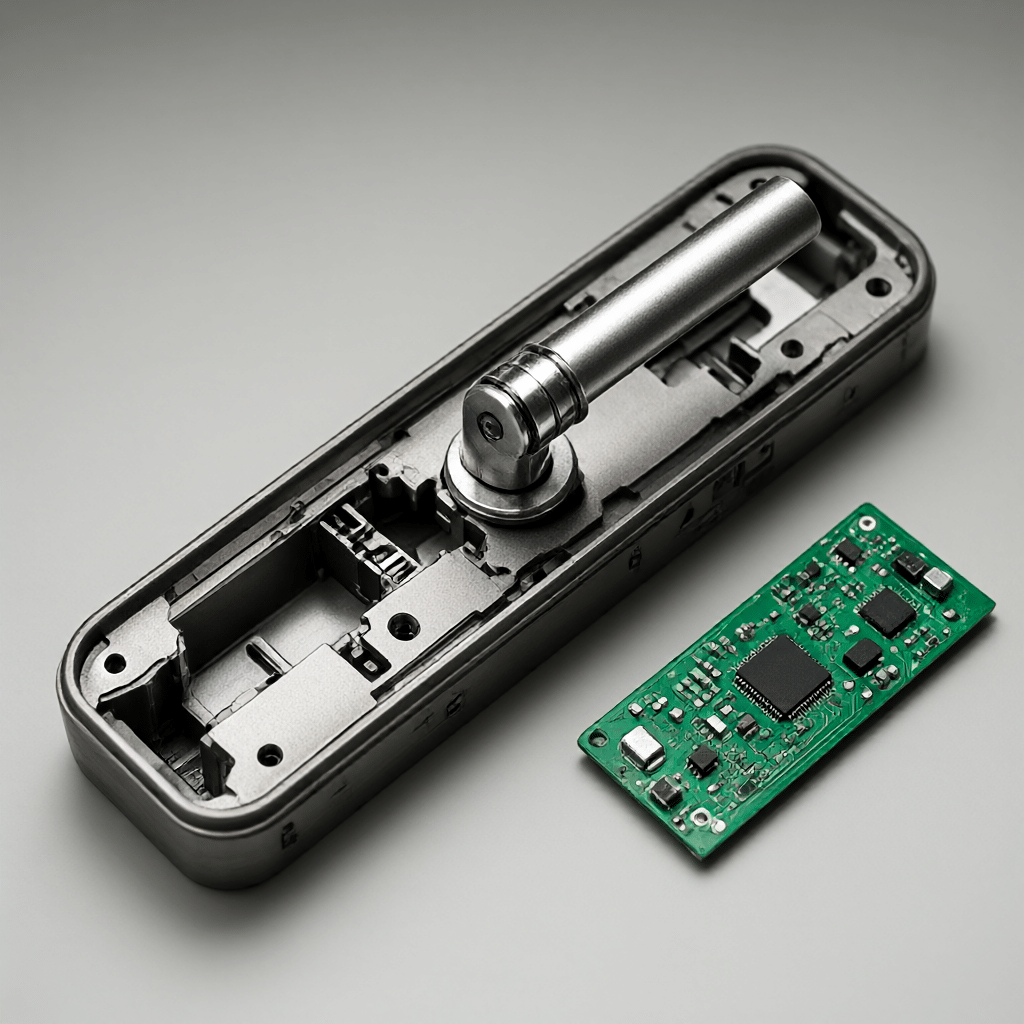
What are the key specifications of smart door locks available from Chinese manufacturers?
Smart door lock specifications vary significantly by lock type, connectivity technology, and intended application. Below is a representative specification matrix used for B2B procurement comparisons:
| Specification | Typical Range / Standard | Notes |
|---|---|---|
| Lock body material | Zinc alloy, stainless steel, aluminum alloy | Determines corrosion resistance and finish longevity |
| Cylinder class | Grade 1–3 per EN 1303 / ANSI BHMA | Higher grade = longer cycle life, better security |
| Connectivity | Wi-Fi, Bluetooth 5.x, Zigbee 3.0, NFC | Choice affects app integration and hub dependency |
| Power supply | 4× AA alkaline or lithium; some Li-ion rechargeable | Runtime typically 8–12 months depending on usage |
| Access methods | Keypad, fingerprint, RFID card, mobile app, mechanical key | Multi-modal locks command premium pricing |
| Mortise compatibility | ISO standard mortise bodies; custom widths available | Must match door thickness (35–100 mm typical) |
| Cycle rating | 100,000+ cycles (mechanical), 50,000+ (electronic actuator) | Refer to independent lab reports |
| Operating temperature | −20 °C to +70 °C | Critical for unheated buildings and export regions |
| Cybersecurity | AES-128/256 encryption; GDPR/CCPA data handling | Verify firmware update policy and vulnerability disclosure |
Buyers should anchor their evaluation to specification sheets that reference recognized testing standards rather than generic marketing claims. When comparing an OEM smart lock factory offering, confirm whether the listed cycle ratings were validated through a third-party lab — not just simulated internally. For project-specific queries, our filtered shower head manufacturing for wholesale sourcing resource covers parallel spec-depth practices relevant to hardware procurement.
Applications
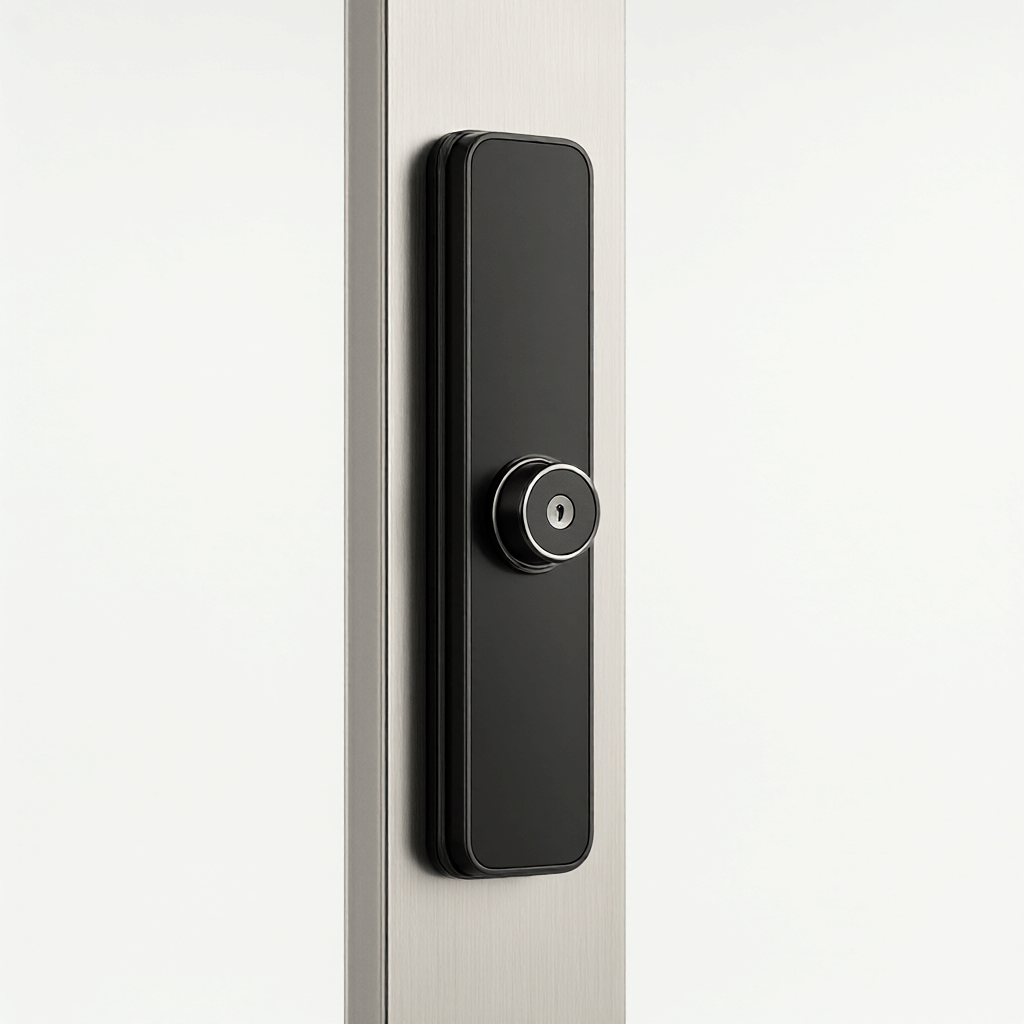
Where can smart door locks be applied in B2B projects?
Smart door locks span several B2B segments, each carrying distinct technical and compliance requirements:
- Door and window manufacturing projects: Integrated locking systems sold as part of pre-hung or custom door assemblies. These require tight fit tolerances and often need multi-point locking profiles compatible with uPVC, aluminum, or solid wood doors.
- Villa and residential development bulk orders: High-rise and suburban developments specify uniform access solutions across units. Consistency in batch quality, finish matching, and centralized management software matters more than individual lock features.
- Hotel and commercial building supply: Hospitality locks demand robust cycle ratings, temporary code generation, property management system (PMS) integration, and adherence to fire egress regulations.
- Window and door OEM sourcing: Private-label brands contract factories to produce locks bearing their own branding while leveraging the manufacturer’s profile platform and hardware ecosystem.
A practical alignment note: the same factory serving hotel smart lock hardware accessory manufacturer orders often has different certification pathways versus those supplying residential custom electronic door lock supplier projects. Buyers should confirm the manufacturer’s track record in their specific segment before issuing an RFQ.
Buying Factors
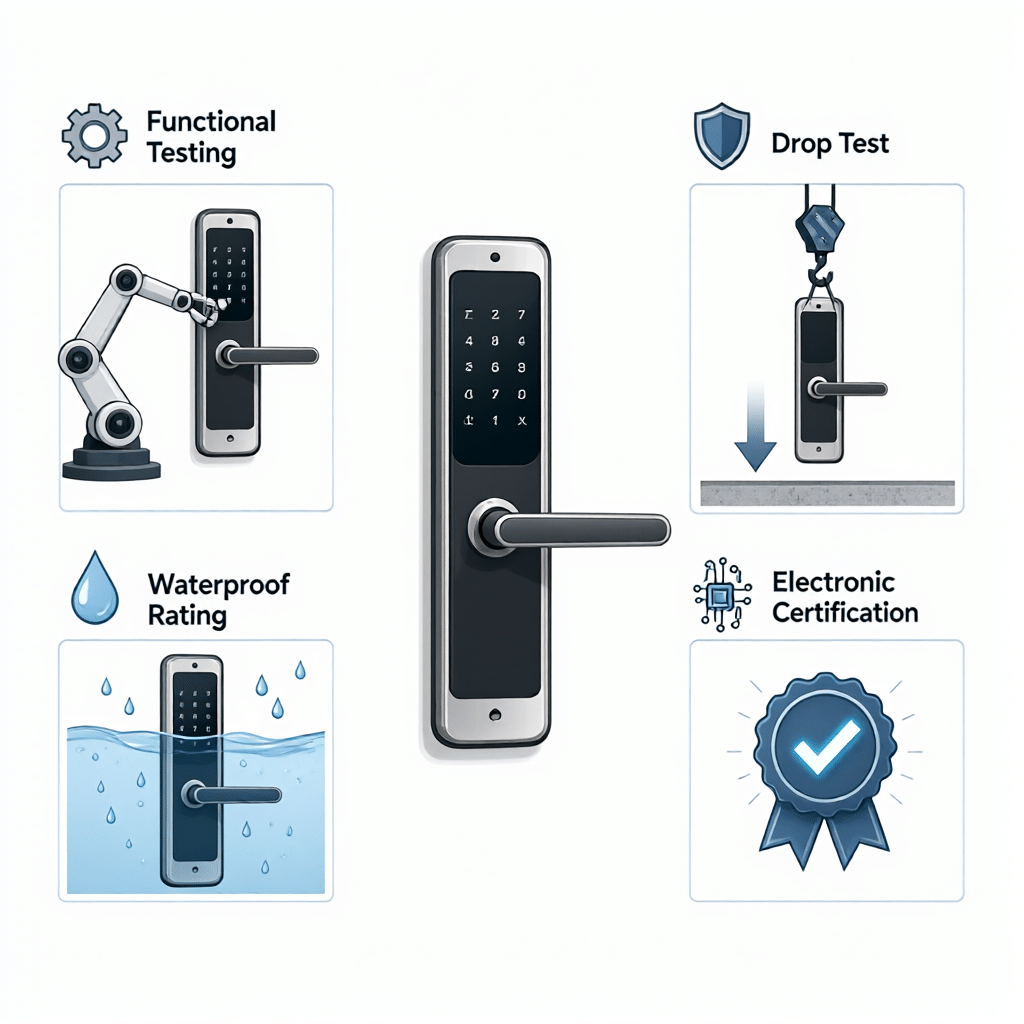
What factors should you evaluate when selecting a china smart door lock manufacturer?
Beyond product specs, buyer due diligence should cover factory capability, compliance documentation, and post-sale support infrastructure.
Compliance and certification verification
Request copies of current test reports for your target market:
- United States: UL 437 (mechanical locks) and FCC Part 15 (wireless emissions). Note that UL listing is model-specific — a certificate covering one SKU does not validate others.
- European Union: EN 14833 (cylinders), CE marking under the Construction Products Regulation where applicable, and RoHS for restricted substances.
- China domestic: GB/T 28481 (smart padlocks) and GB 21556 (lock security levels).
Cross-check report numbers against the issuing laboratory’s database. If the manufacturer cannot produce these documents during the quoting phase, proceed with caution. For deeper insight into how factories handle documentation in other hardware categories, review our KDF shower filter manufacturing specifications resource.
Factory audit checklist
A structured audit reduces sourcing risk. Score each checkpoint on a 1–5 scale and set a minimum threshold before sampling:
- Production line organization — Is there dedicated assembly seating with electrostatic discharge (ESD) protection for electronic components?
- Incoming material inspection — Are raw metals, PCBA boards, and sensors inspected against incoming QC records?
- In-process quality control — Are functional tests performed at each assembly stage, not only at final packing?
- Aging and burn-in testing — Do units undergo powered cycling before shipping? What duration and pass criteria?
- Final random inspection — Does AQL sampling apply to packaging, labeling, and accessories?
- Firmware version control — Is there a documented process for OTA updates and rollback safety?
- After-sales RMA workflow — What is the documented response time for failure reporting and replacement shipment?
Factories that score below threshold on points 4 or 7 present elevated long-term risk, especially for volume deployments where field failures generate significant replacement logistics costs.
OEM / ODM customization depth
Customization falls along two axes:
- Hardware customization: Profile cross-section, finish (powder coat, anodized, PVD), lever/cubby style, cylinder type, and IP rating for exterior models. Confirm whether design modifications are handled by the factory’s engineering team or outsourced.
- Software and branding: Mobile app white-labeling, API access for integrations, serial number encoding, barcode labeling, and packaging design. Request examples of prior private-label work to verify the supplier’s ability to deliver polished branded experiences.
Evaluate whether the manufacturer offers both hardware and software customization or delegates one side. A single-point intelligent locking system manufacturer that coordinates both reduces coordination overhead and accountability gaps.
Communication timelines and sample accuracy
Track how quickly the supplier responds to technical clarifications during negotiation. Long delays in answering specification questions typically predict longer lead times once production begins. Validate the first pre-production sample against your approved drawing set before authorizing mass production — discrepancies found at this stage are far cheaper to resolve than field rejections.
Price & Cost
How much do bulk smart door locks cost, FOB China?
Pricing bands shift according to technology tier, customization scope, order volume, and certification loadings. The ranges below reflect typical 2025–2026 FOB China benchmarks and should serve as decision anchors, not fixed quotes:
| Category | Unit price range (USD) | Indicative MOQ | Lead time |
|---|---|---|---|
| Basic Bluetooth keypad lock (no app) | $18 – $35 | 200 pcs | 25 – 35 days |
| Mid-range Bluetooth + NFC, white-label app | $35 – $65 | 100 pcs | 30 – 45 days |
| High-end multi-mode (Wi-Fi / Zigbee + fingerprint) | $65 – $140 | 50 pcs | 35 – 50 days |
| Hotel-grade managed system lock | $80 – $180 | 200 pcs | 40 – 60 days |
| Custom-profile OEM lock (new tooling required) | Negotiable | 500+ pcs | 60 – 90 days incl. tooling |
Several variables move price outside these bands:
- Profile structure changes (e.g., reinforcing extrusions for higher wind-load environments) add material and machining costs.
- Fingerprint sensor grade varies widely; capacitive sensors rated for wet/dirty fingers carry a premium over basic resistive types.
- Certification loadings such as UL or EN testing fees are sometimes amortized into unit price for large orders but may appear as separate NRE charges for smaller runs.
- Packaging complexity — retail-ready box printing increases cost versus neutral master cartons.
When comparing quotes, ensure every bidder is pricing identical specification packages. A $10/unit variance often traces back to differences in cycle-rating certification, sensor grade, or included app functionality rather than genuine efficiency savings.
Request a specification-matched quote for your target market and order volume. Our engineering team reviews your drawdown and responds with itemized pricing, tooling requirements, and compliance documentation timelines within 48 hours.
Evidence & Practical Notes
Field note: Buyers frequently discover mid-order that a quoted lock’s mortise body differs from the door jamb prepared on site. Even a 2 mm mismatch forces rework across hundreds of units. Always confirm backset, edge dimension, and bore size against the actual door schedule before signing the production order.
Practical limitation: Firmware-related issues — failed OTA push, pairing regression, or credential loss after power interruption — account for a notable share of post-delivery support tickets. Few suppliers publish uptime metrics or vulnerability disclosure policies upfront. Address this in your contract by requiring a firmware release note archive and a guaranteed minimum patch-response window for critical defects.
Buyer takeaway: Price-per-unit comparisons without specification parity are misleading. Anchor your evaluation to audited test reports, a completed factory audit using the checklist above, and explicit firmware-RMA commitments. A slightly higher quote from a compliant, well-audited factory typically produces a lower total cost of ownership than a cheaper alternative with undocumented certification gaps.
How We Work
As a manufacturer, our approach aligns with the evaluation framework outlined above: we begin with your target market standards, map the required certifications, and then confirm whether existing profiles meet those thresholds or whether new tooling is needed.
We provide direct factory supply without intermediary markup, full customization across size, finish, glass-compatible hardware interfaces, and accessory selection, and strict pre-shipment inspection covering air-tightness, water-tightness, and wind-resistance performance where applicable. Our trade documentation team prepares packing lists, proforma invoices, and complete customs paperwork, and we ship via FCL or LCL directly from China. Where local building codes require adjustments, we adapt profile structures and fitting configurations to match.
If you are evaluating a china smart door lock manufacturer for door manufacturing project procurement, villa development supply, or private-label distribution, send us your opening sizes and specification requirements and we will respond with a scoped quote and compliance pathway within one business day.
Logistics and Shipping Options from China Factories
What logistics and shipping options do china smart door lock manufacturers typically offer, and how do they affect lead time and total landed cost?
Chinese manufacturers generally provide three primary shipping pathways, each with different trade terms, transit durations, and cost structures:
Shipping Methods and Trade Terms
| Method | Typical Transit Time | Incoterm | Best For |
|---|---|---|---|
| Express courier (DHL, FedEx, UPS) | 5 – 10 days | EXW / DDP | Samples, small replacements (< 50 pcs) |
| Air freight | 7 – 14 days | CPT / CIF | Low-volume orders requiring fast turnaround |
| Sea freight FCL (Full Container Load) | 25 – 40 days | FOB / CIF / CNF | Full-container volumes (≥ 1 × 40’HQ ≈ 3,000–6,000 smart locks depending on packaging) |
| Sea freight LCL (Less than Container Load) | 30 – 45 days | FOB / CFR | Mid-size orders below one container threshold |
| Rail freight (China–Europe) | 18 – 25 days | CPT | Eco-conscious buyers targeting EU markets seeking faster-than-sea transit |
Estimated Freight Costs (Reference Ranges)
| Route | FCL 40’HQ Approx. | LCL per CBM | Express (per kg) |
|---|---|---|---|
| China → US West Coast | $1,800 – $3,200 | $120 – $200 | $4.50 – $7.00 |
| China → US East Coast | $2,200 – $3,800 | $140 – $220 | $5.00 – $7.50 |
| China → Northern Europe | $1,600 – $2,800 | $110 – $180 | $4.00 – $6.50 |
| China → Middle East (UAE) | $900 – $1,500 | $80 – $140 | $3.50 – $5.50 |
| China → Southeast Asia | $400 – $800 | $50 – $90 | N/A (often road/rail alternatives available) |
Note: Freight rates fluctuate with fuel surcharges, peak-season capacity constraints, and geopolitical disruptions. Always confirm current rates with your freight forwarder at the time of booking.
Packaging and Container Loading Guide
Smart door lock factories typically ship in export-grade corrugated cartons with the following standard dimensions:
- Inner box: 380 × 180 × 130 mm (fits 1–2 locks depending on model)
- Master carton: 800 × 420 × 560 mm (holds ~20–40 units, gross weight 8–18 kg)
- Pallet configuration: Standard 120 × 100 cm pallet holds ~40 master cartons; stretch-wrapped and strapped
A 40’HQ container accommodates approximately 850–950 master cartons (17,000–38,000 units), depending on packaging density and included accessories.
Real-World Case Examples
- European hotel chain: A German hospitality group sourced 4,200 managed smart locks for a 280-room property renovation via FCL from Guangdong. The order shipped under CIF Rotterdam terms, arrived in 32 days, and included EN 14833-certified cylinders with PMS API integration. Total logistics cost averaged €18/unit including sea freight and port charges.
- US residential developer: A Florida-based builder ordered 1,800 Bluetooth + fingerprint locks for a mixed-income housing project. They elected FOB Los Angeles terms, booked a 20′ container ($2,100 all-in), and coordinated customs clearance through a US customs broker, achieving 38-day door-to-door delivery.
- Middle East villa developer: A UAE developer required 600 multi-mode locks rated for +50 °C exterior conditions. They shipped via LCL (4.2 CBM) under CFR Jebel Ali, arriving in 28 days, and consolidated the order with window and door hardware from the same factory to reduce per-unit freight burden.
Import Compliance and Documentation
Chinese suppliers responsible for export documentation typically provide:
- Commercial invoice
- Packing list
- Bill of lading (sea) or air waybill (air)
- Certificate of origin (Form E for ASEAN, or standard non-preferential COO)
- FCC/CE test report summaries (when applicable)
- Insurance certificate (under CIF/CIP terms)
Buyers should verify that HS code classification matches their local duty rate. Smart door locks commonly fall under HS 8301.00 (locks and lock mechanisms) — confirm classifications with your customs broker before ordering to prevent unexpected tariffs. Industry best practices recommend specifying Incoterms 2020 explicitly in purchase contracts to define risk transfer points clearly per ISO-standard trade term conventions.
Buyer Decision Checklist and Go/No-Go Framework
Use this structured decision matrix before committing to a production order. Procurement managers should score each checkpoint against their minimum acceptance criteria.
Pre-Qualification Gate (Must Pass Before Sampling)
| Checkpoint | Required Evidence | Go/No-Go Criteria |
|---|---|---|
| Valid business license and export registration | Business license copy; customs registration number | ⚠️ No-Go if unavailable |
| Target-market certification for quoted SKU | UL 437 / EN 14833 / GB/T test report (model-specific) | ⚠️ No-Go if generic or expired (> 2 years) |
| Factory quality management system | ISO 9001 certificate; QA process documentation | Recommended but not mandatory for smaller suppliers |
| Communication responsiveness | Technical responses within 48 hours during RFQ phase | Score below 3/5 triggers further review |
Sampling Gate (Must Pass Before Mass Production)
| Checkpoint | Acceptance Criterion | Go/No-Go Criteria |
|---|---|---|
| Sample matches approved drawing/spec sheet | Dimensional tolerance ± 0.5 mm; correct mortise profile | ⚠️ No-Go if dimensions outside tolerance |
| Cycle test verification | ≥ 100,000 mechanical cycles or ≥ 50,000 electronic actuator cycles per independent lab report | ⚠️ No-Go if unverified |
| Connectivity functionality | Successful pairing, app control, fallback mechanical key operation | ⚠️ No-Go if critical function fails |
| Firmware stability | No critical bugs after 48-hour continuous-use burn-in test | ⚠️ No-Go if firmware crashes observed |
Commercial Gate (Final Approval Before PO Issuance)
| Checkpoint | Required Confirmation | Go/No-Go Criteria |
|---|---|---|
| Agreed FOB/unit price matches spec parity | Quote compared line-item by line-item across bidders | Proceed only if variance explainsable by spec difference |
| Lead time commitment documented in contract | Written agreement on production and shipment dates | ⚠️ No-Go if vague or verbal-only commitments |
| Payment terms acceptable | T/T 30% deposit / 70% before shipment, or LC at sight for large orders | Proceed based on risk appetite and relationship |
| Warranty and RMA policy defined | Minimum 1-year warranty; replacement parts availability confirmed | ⚠️ No-Go if no written warranty |
| Logistics route and insurance coverage | Ship method, carrier, and insurance responsibility clarified | Proceed once terms documented |
Submit inquiry with your spec requirements and we will cross-reference the checklist above against our existing product portfolio to recommend the fastest compliance pathway for your target market.
Decision Matrix: Go / No-Go Thresholds for Manufacturer Evaluation
| Criterion | Go Threshold | No-Go Trigger |
|---|---|---|
| Third-party test report for target-market standard | Report verifiable in issuing lab database; model-specific certificate | Generic/unverifiable report; one SKU certificate claimed for all models |
| Factory audit score (from checklist below) | ≥ 35 / 50 total weighted points | Score < 28, or any single criterion weighted at ≥ 10 scores below 2 |
| Sample lead time commitment in writing | ≤ 10 business days from approved drawing set | Verbal-only timelines; no written confirmation |
| Firmware/RMA response commitment | ≤ 5 business days for critical defects; written SLA | No documented RMA workflow; vague “we’ll handle it” responses |
| MOQ alignment with order volume | MOQ ≤ 30% of initial order quantity | MOQ exceeds intended first-order quantity without flexibility clause |
| Certification path clarity for target market | Written compliance roadmap within 48 hours of RFQ | Manufacturer cannot identify applicable standard or defer answer |
Use this matrix during the pre-production qualification stage. A vendor failing more than two No-Go triggers should be deprioritized regardless of unit price advantage.
Supplier Evaluation Scorecard (10-Point Weighted Framework)
Evaluate prospective manufacturers against these weighted criteria. Each item scores 1–5. Multiply by weight to produce a weighted score. Minimum passing threshold: 35 / 50.
| # | Evaluation Criterion | Weight | Score (1–5) | Weighted Score |
|---|---|---|---|---|
| 1 | Verified third-party test reports for target market (UL 437 / EN 14833 / FCC) | ×5 | ||
| 2 | Factory QA system maturity — incoming material inspection, in-process QC, final AQL sampling | ×5 | ||
| 3 | Aging / burn-in testing protocol duration and pass criteria documentation | ×4 | ||
| 4 | OEM customization capability — hardware profiles, finishes, cylinder types | ×4 | ||
| 5 | Software / white-label app capability and API integration readiness | ×3 | ||
| 6 | Firmware update policy, OTA rollback safety, vulnerability disclosure practice | ×4 | ||
| 7 | After-sales RMA workflow and documented response-time commitment | ×4 | ||
| 8 | Export documentation completeness — packing list, proforma invoice, customs paperwork | ×3 | ||
| 9 | Sample accuracy vs. approved drawings and responsiveness to technical clarifications | ×3 | ||
| 10 | Lead time reliability record and on-time delivery track record (reference checks) | ×3 | ||
| TOTAL | ×35 | __/35 |
Score interpretation:
- 38–42: Strong candidate — proceed to sample order and contractual SLA signing.
- 30–37: Marginal — request corrective action plan before sampling; consider alternate supplier.
- Below 30: High risk — decline or require remediation audit before further engagement.
Download printable scorecard template
Industry Case Examples
Case A — Hotel Chain, UAE: 2,400 Smart Locks, EN 14833 Cycle Failure on Batch 2
A mid-size UAE hospitality group sourced electronic door locks for a 2,400-room property upgrade. Batch 1 passed EN 14833 cycle testing at an independent laboratory. Batch 2 — reordered at reduced unit price — failed the same test after 42,000 cycles (requirement: 50,000+). Root cause traced to an unauthorized substitution of the actuator motor supplier by the original factory’s secondary sourcing channel. Remediation required re-tooling at the primary factory and re-testing at the buyer’s expense, adding approximately six weeks and $18,000 in costs. Lesson: enforce contractual clauses requiring written approval for any component-level substitutions; require lot-traceable serial records on every shipment.
Case B — Residential Developer, Germany: UL Certificate Mismatch Across SKUs
A German residentialdeveloper specified locks bearing UL 437 certification for a 600-unit project. During installation, the installer discovered the delivered SKU carried an expired UL listing — the manufacturer had renewed the certificate for a newer model but not the exact SKU under contract. Because UL certificates are model-specific, the mismatch created a code-compliance gap. The developer rejected the full shipment and relocated sourcing to a manufacturer with active, verifiable certificates for each ordered SKU. Lesson: always cross-check certificate numbers against the issuing body’s public database before production authorization.
Sources & References
- per ISO-standard trade term conventions — www.iso.org
- shower filter suppliers and B2B sourcing — zooshen.com
- filtered shower head manufacturing for wholesale sourcing — zooshen.com
- KDF shower filter manufacturing specifications — zooshen.com











