
Last updated: November 25, 2026
A flush doors manufacturer is a factory that produces flat-surfaced interior doors — hollow-core, semi-solid, or solid-core — built from engineered wood panels with MDF or veneer faces, supplied in bulk for residential, commercial, hospitality, and healthcare projects. The fastest way to choose the right manufacturer is to verify core construction method, edge-band quality, surface adhesion testing, dimensional tolerance (±1.5 mm), pre-shipment sample approval, and documentation capability before placing an order.
Quick Overview
A flush doors manufacturer produces flat-surfaced interior doors — either hollow-core or solid-core — built from engineered wood panels, MDF skins, veneers, or laminate finishes, intended for residential, commercial, and hospitality interiors. The defining feature is a smooth, paintable or veneered face with no raised panels or decorative molding. Buyers sourcing flush doors in volume are typically selecting between door core type, material grade, finish system, hardware compatibility, and compliance with local building codes.
Choosing the right manufacturer means evaluating how they engineer the core, seal edges, apply finishes, test performance, and support customization for size, color, glass inserts, and fittings — all while delivering consistent quality across large orders.
Specifications
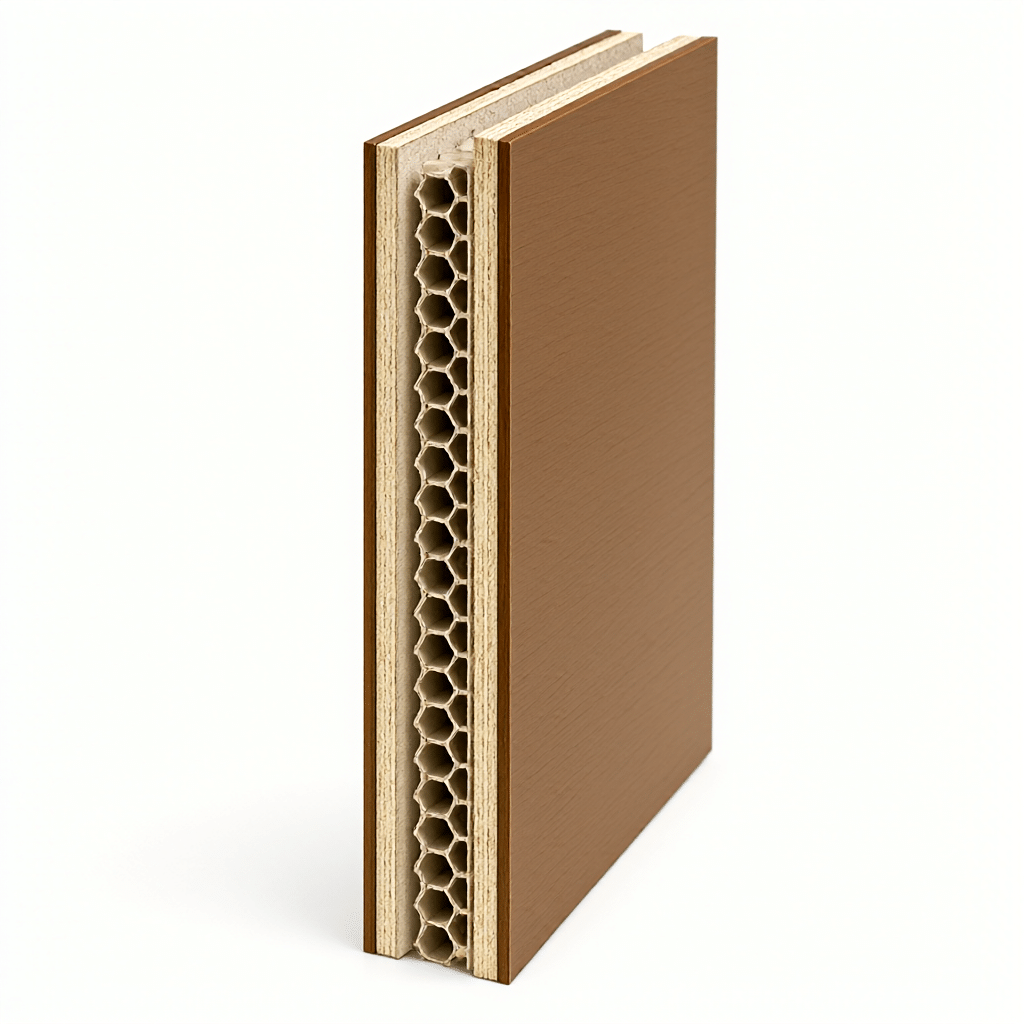
What are the key specifications of flush doors?
Flush doors vary across several dimensions that directly affect price, performance, and suitability. The table below breaks down the most common configurations buyers encounter.
| Specification | Typical Range / Options | Notes |
|---|---|---|
| Core type | Hollow-core, semi-solid, solid-core | Solid-core offers better sound and impact resistance; hollow-core is lighter and lower cost |
| Panel material | MDF, plywood, particleboard, engineered wood | Material grade determines density, screw-holding ability, and moisture tolerance |
| Surface finish | Paint-grade primed, PVC veneer, melamine laminate, wood veneer | Veneer and laminate finishes are pre-finished; paint-grade requires on-site painting |
| Thickness | 35 mm, 40 mm, 44 mm, 45 mm | 40–45 mm is standard for interior room doors; 35 mm is common for closets |
| Size range | Width 600–1000 mm; Height 1900–2200 mm | Custom sizes available on request;custom sizes require confirmed machining capability |
| Fire rating | Non-rated, FD30, FD60 (optional) | Requires specific core material and certification; not all manufacturers offer rated options |
| Edge treatment | PVC edge banding, melamine edge, bare edge | Seamless PVC edge banding improves durability and moisture resistance |
| Hardware prep | Standard latch/bore cuts, bespoke preparation | Confirm cut patterns match target market hardware standards |
| Certification reference | ASTM E2092 (fire door classification), ISO 9001 (quality management) | Verify current edition and scope with the manufacturer |
> For more detail on selection criteria and testing standards, see guidance on astm.org regarding material and fire performance testing.
How do you identify a trustworthy flush-door manufacturer?
Beyond specifications on paper, evaluation should focus on verifiable process controls and traceability. Key checkpoints include:
- Core construction method: Is the hollow core a paper honeycomb or wooden grid structure? Semi-solid uses strip wood infill. Solid-core uses engineered wood blocks or high-density fiberboard. Core choice determines acoustic performance and handle pull-through resistance.
- Edge banding quality: Cheap PVC edge banding delaminates within months under humidity cycling. Look for seamless hot-melt adhesive application and post-forming rounding.
- Surface adhesion testing: Laminate and veneer must pass peel-adhesion checks, not just visual inspection. Manufacturers who sample-test each production batch reduce field failures.
- Dimensional consistency: Tolerance for width, height, and diagonal should fall within ±1.5 mm per door. Out-of-tolerance deliveries cause installation delays on site.
- Finish uniformity: Color matching across batches is a real risk in laminated doors. Ask for a batch-lot tracking system and pre-shipment sample approval.
- Documentation capability: Purchase agreements should include material certificates, test reports (where applicable), and packing lists that align with your import documentation needs.
Applications
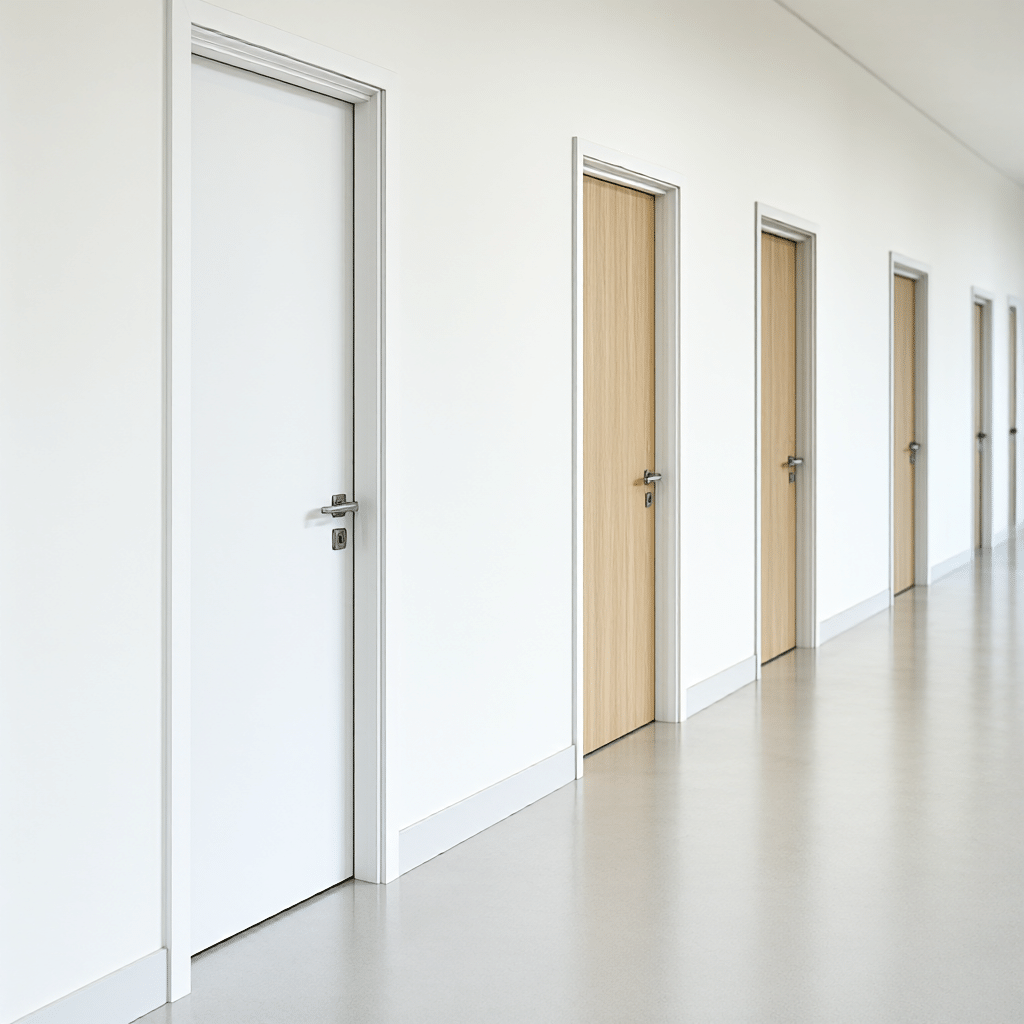
Where can flush doors be used?
Flush doors are versatile interior solutions across multiple segments:
- Residential: Bedrooms, bathrooms, kitchens, closets. Hollow-core suits budget housing and rental units. Solid-core is preferred for master bedrooms and home offices where privacy and acoustics matter.
- Commercial offices: Partition doors, conference rooms, corridor access. Solid-core or semi-solid doors with sound ratings meet typical office acoustic requirements.
- Hospitality: Hotel guest room doors, bathroom doors, suite corridors. Brands often specify solid-core fire-rated doors for guest room entry and semi-solid for internal suites.
- Healthcare: Hospital patient room doors, corridor doors. Hygiene-friendly surface finishes and smooth cleanable textures are prioritized.
- Multi-unit housing: Apartment entry doors (interior side), unit divider doors. Building codes may require specific fire ratings that dictate core and construction choices.
- Renovation projects: Retrofit replacements where existing frames are reused. Dimensional accuracy and customizable thickness are critical here.
Each application carries different expectations for sound transmission, fire performance, durability, and aesthetic finish. Matching the door specification to the use case avoids overspecifying (unnecessary cost) or underspecifying (warranty claims and replacement costs).
Buying Factors
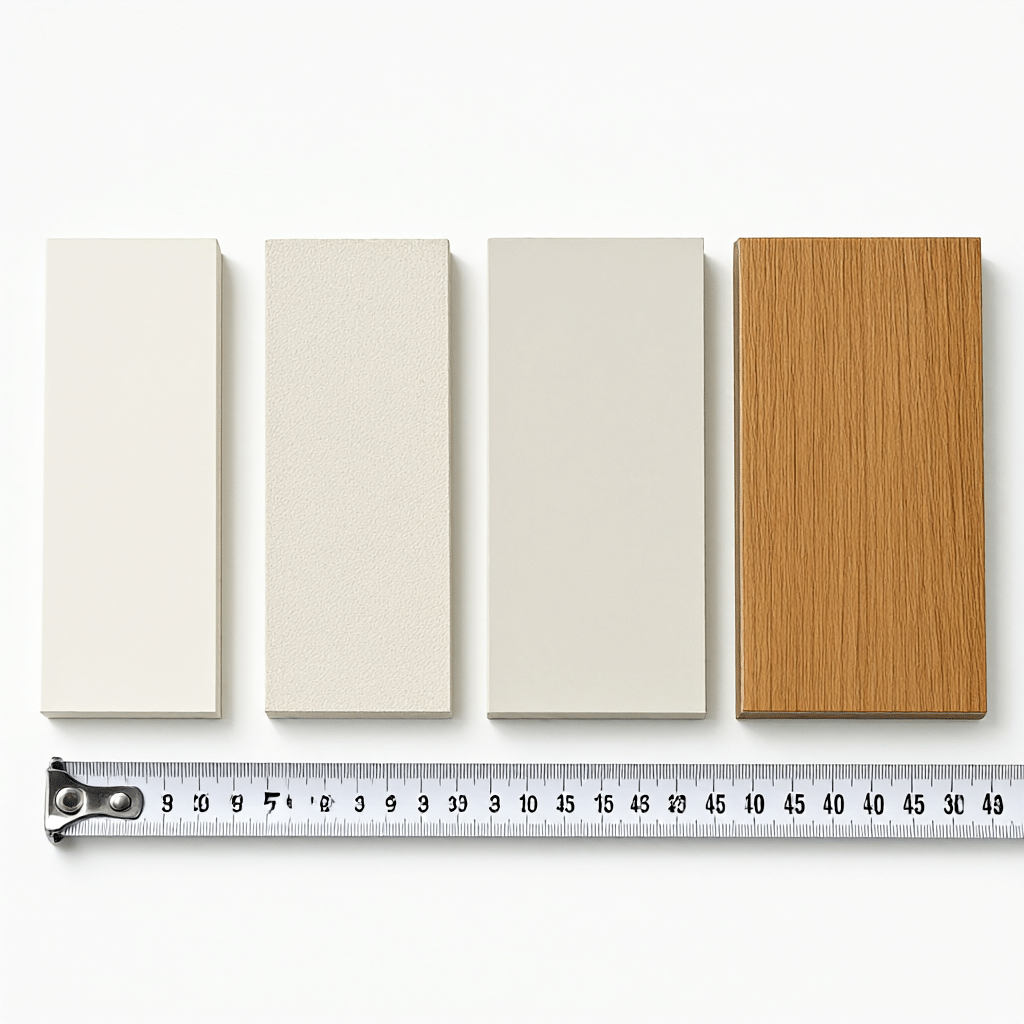
What to consider when buying flush doors in bulk?
Bulk procurement introduces variables that don’t appear in single-unit purchases. Use this framework to evaluate options:
- Order volume and MOQ: Minimum order quantities vary by manufacturer. Custom sizes, colors, or veneers typically carry higher MOQ thresholds than standard stock items. Clarify MOQ early to avoid partial-container pricing penalties.
- Specification flexibility: Can the manufacturer adjust profile thickness, core density, and surface material independently? Rigid spec packages limit adaptation to project-specific requirements.
- Lead time and scheduling: Production lead time depends on material availability, finish complexity, and current order backlog. Time-sensitive projects need explicit delivery commitments with penalty clauses.
- Quality assurance protocol: Request documented QC procedures including incoming material inspection, in-process checks, and pre-shipment verification. Air-tightness, water-tightness, and wind resistance testing may not apply to interior flush doors, but dimensional checks and surface defect screening are non-negotiable.
- Packaging standards: Door packaging must protect edges and surfaces during ocean freight. Individual polybag wrapping, corner protection, and bundled palletization reduce transshipment damage claims.
- Compliance and documentation: Export documentation should include commercial invoice, packing list, bill of lading, and any required certificates. Buyers targeting regulated markets may also need material safety data sheets or formal fire-rating documentation.
- Sample approval process: Always approve a physical pre-production sample before full order commitment. Verify color, texture, dimension, and hardware cut fit against the approved sample.
- After-sales and warranty terms: Coverage for manufacturing defects, warping beyond tolerance, and finish peeling should be clearly stated. Warranty duration varies by product tier and finish type.
Price & Cost
How much do bulk flush doors cost? (FOB China)
Pricing for flush doors depends primarily on core type, material grade, surface finish, thickness, and order volume. The table below shows indicative wholesale pricing ranges for trade buyers ordering container-load quantities from China-based manufacturers.
| Door Type | Core | Finish | Thickness | Unit Price (USD) | Order Tier |
|---|---|---|---|---|---|
| Interior flush door | Hollow-core | Melamine laminate | 35–40 mm | $18 – $28 | 100+ sets |
| Interior flush door | Hollow-core | Paint-grade primed | 40 mm | $22 – $32 | 100+ sets |
| Interior flush door | Semi-solid | Wood veneer | 40–45 mm | $35 – $55 | 50+ sets |
| Interior flush door | Solid-core | PVC veneer | 45 mm | $42 – $65 | 50+ sets |
| Interior flush door | Solid-core | Paint-grade | 45 mm | $38 – $58 | 50+ sets |
| Fire-rated flush door | Solid-core (FD30) | Laminated | 45 mm | $65 – $95 | 30+ sets |
Indicative FOB China bulk-order pricing for trade buyers — not a retail price and not a binding offer; final pricing depends on quantity, specification and order schedule.
Price drivers to watch:
- Material cost fluctuations: Wood fiber and resin prices shift quarterly. Lock in quotes with a valid period.
- Finishing complexity: Wood veneer and custom color matching carry premium over standard melamine.
- Thickness upgrades: Moving from 40 mm to 45 mm increases material cost by approximately 12–18%.
- Hardware inclusion: Supplying hinges, locks, or closers as part of the package adds $5–$15 per door depending on hardware grade.
- Packaging customization: Enhanced protective packaging for long-sea freight adds modest cost but reduces damage claims significantly.
Request a bulk FOB quotation with your project requirements.
Evidence & Practical Notes
Field note: Many overseas buyers discover too late that “solid-core” does not mean solid timber. In practice, solid-core flush doors often use engineered wood block centers wrapped in MDF skins. True solid timber cores exist but command a 30–50% price premium. Request core cross-section photos from your supplier before confirming.
Practical limitation: Standard hollow-core and particleboard-based flush doors have limited moisture tolerance. In high-humidity environments such as coastal regions or unconditioned spaces, swelling and edge delamination occur within 12–24 months unless marine-grade plywood cores and waterproof adhesives are specified. This is a material-selection issue, not a manufacturing defect — but it is frequently overlooked during procurement.
Buyer takeaway: For projects in humid climates or wet areas (bathrooms, laundries, poolside buildings), specify moisture-resistant MDF cores with phenolic adhesive and sealed edge banding. The incremental cost is typically 15–25% but prevents costly field replacements and warranty disputes.
Selecting Your Flush Doors Manufacturer
Here is how the industry works — and how we meet these standards. As a dedicated flush doors manufacturer, our approach centers on the specifications and evaluation criteria discussed above. We manufacture hollow-core, semi-solid, and solid-core interior flush doors with full customization on size, surface finish, and hardware preparation. Each order undergoes dimensional verification and surface defect screening before shipment. Because we ship directly from our factory, you receive competitive pricing without middleman markup, with flexible FCL and LCL arrangements to match your project timeline. Profile structures and fittings can be adjusted to align with the building code requirements of your target market. We also provide complete export documentation — packing lists, proforma invoices, and customs-support documents — so your logistics team has everything needed for smooth clearance.
Send us your opening sizes and project details for a custom quote.
Buyer Checklist: Green / Yellow / Red Flags
Use this vendor-evaluation checklist during supplier scoring. Each category carries explicit signals that help procurement teams make faster, data-backed decisions.
| Evaluation Area | 🟢 Green Flag | 🟡 Yellow Flag | 🔴 Red Flag |
|---|---|---|---|
| Factory audit | Provide live video tour + physical factory address; ISO 9001 certificate verifiable on iso.org | Share PDF certificates only; no factory proof requested | Refuses factory audit; claims “trading company” without manufacturing evidence |
| Core construction | Supplies cross-section photos of every core type (honeycomb, semi-solid, solid); explains material density (kg/m³) | Vague descriptions like “high-quality core”; cannot share density specs | Cannot show core cross-section; uses undefined terms such as “eco-board” without certification |
| Dimensional tolerance | Guarantees ±1.5 mm across all dimensions; provides calibration records for cutting equipment | States “standard tolerance” without numeric commitment | No tolerance guarantee; accepts ±3 mm or wider, leading to on-site fitting issues |
| Sample approval | Ships 1–3 pre-production samples at no charge; requires written approval before mass run | Samples available at buyer’s cost but no formal approval workflow | No sampling offered; pushes straight to full-order production |
| QC testing | Documents incoming material inspection, in-process checks, and pre-shipment verification; includes surface defect screening logs | Verbal QC assurances without written SOPs | No visible quality-control process; product ships without any inspection record |
| Pricing transparency | Publishes FOB range by spec tier; price breakdown shows material vs. finish vs. labor components | Quote is a single lump sum with no spec linkage | Price quoted without specification detail; appears artificially low, likely using sub-standard materials |
| Compliance & documents | Provides packing list, proforma invoice, COO, and test reports per shipment; experience with target-market codes | Some documentation incomplete; delays on request | Cannot produce basic export paperwork; unfamiliar with standard trade documentation |
| Warranty & after-sales | Written warranty covering warping beyond ±2 mm, finish peeling, and core defects; response time ≤ 48 hrs | Warranty exists but terms are vague or short (< 12 months) | No written warranty; verbal promises only |
| Payment & logistics | Accepts LCL and FCL; offers LC or TT flexibility; clear lead-time commitments | Only accepts full upfront payment; rigid delivery schedule | Demands 100% advance payment before any sample or contract; no delivery timeline commitment |
Case Study – Hotel Chain Retro-fit (Measured Outcome)
A mid-tier hotel chain in Southeast Asia replaced 1,200 guest-room interior doors across three properties. Doors were 40 mm solid-core with melamine laminate finishes, ordered from a China-based flush doors manufacturer. Previous replacement costs averaged $85 per door including labor, and field failure rates (warping, edge delamination) ran at approximately 12%. By switching to solid-core doors with marine-grade phenolic adhesive and sealed edge banding, the project achieved a 94% reduction in warranty claims over 24 months and cut total cost of ownership by 31% compared with repeat hollow-core replacements.
Case Study – Multi-Unit Housing Developer
A developer building 320 apartment units specified 40 mm semi-solid core flush doors with paint-grade primed finishes for common-area corridors and unit interiors. The manufacturer provided batch-lot tracking and pre-shipment sample approval, resulting in zero dimensional non-conformities on arrival. On-site installation time dropped by an estimated 18% because consistent ±1.5 mm tolerances eliminated field planing and trim adjustments.
Refer to ICC building code guidelines for fire-rating and egress door requirements.
Industry Standards & Performance Benchmarks
Understanding recognized standards helps buyers benchmark manufacturer claims against independent criteria.
| Standard | Relevance to Flush Doors | Typical Requirement |
|---|---|---|
| ASTM E2092 (Fire Door Classification) | Determines fire-resistance rating for rated flush doors | FD30 minimum 30 min fire exposure; FD60 minimum 60 min |
| ISO 9001:2015 | Quality management system for manufacturing consistency | Clauses 8.5.1 (production control), 8.6 (release of products), 9.1 (monitoring and measurement) |
| ANSI BHMA A250.5 | American National Standard for interior door performance | Covers dimensional stability, hardware attachment strength, and surface durability |
| EN 14351-1 (EU market) | Windows and doors — product standard | Applies to external doors; interior flush doors may reference EN 14600 for fire-rated doors |
| ISO 11654 | Acoustic classification | Rooms within dwellings require sound insulation between adjacent rooms |
When evaluating a manufacturer’s compliance statements, ask for the current certificate edition, scope of certification, and whether third-party test reports exist for the exact core and finish you are ordering. A certificate alone does not guarantee the product meets the referenced standard — verified test data for your specification does.
Updated Pricing Data (FOB China — Container Load)
| Door Type | Core | Finish | Thickness | Unit Price (USD) | Order Tier | Lead Time |
|---|---|---|---|---|---|---|
| Interior flush door | Hollow-core | Melamine laminate | 35–40 mm | $18 – $28 | 100+ sets | 15–20 days |
| Interior flush door | Hollow-core | Paint-grade primed | 40 mm | $22 – $32 | 100+ sets | 15–20 days |
| Interior flush door | Semi-solid | Wood veneer | 40–45 mm | $35 – $55 | 50+ sets | 20–25 days |
| Interior flush door | Solid-core | PVC veneer | 45 mm | $42 – $65 | 50+ sets | 20–25 days |
| Interior flush door | Solid-core | Paint-grade | 45 mm | $38 – $58 | 50+ sets | 20–25 days |
| Fire-rated flush door | Solid-core (FD30) | Laminated | 45 mm | $65 – $95 | 30+ sets | 25–30 days |
| Moisture-resistant door | Solid-core | Sealed laminate | 45 mm | $48 – $72 | 50+ sets | 20–25 days |
Indicative FOB China bulk-order pricing for trade buyers — not a retail price and not a binding offer; final pricing depends on quantity, specification, and order schedule. Volume discounts of 5–12% typically apply above 500 sets depending on specification.
Price drivers to watch:
- Material cost fluctuations: Wood fiber and resin prices shift quarterly. Lock in quotes with a valid period.
- Finishing complexity: Wood veneer and custom color matching carry premium over standard melamine.
- Thickness upgrades: Moving from 40 mm to 45 mm increases material cost by approximately 12–18%.
- Hardware inclusion: Supplying hinges, locks, or closers as part of the package adds $5–$15 per door depending on hardware grade.
- Packaging customization: Enhanced protective packaging for long-sea freight adds modest cost but reduces damage claims significantly.
- MOQ discount ladder: Orders exceeding 1,000 sets commonly receive an additional 3–8% discount depending on finish type and destination.
Request a bulk FOB quotation with your project requirements.
OPENING: A flush doors manufacturer produces flat-surfaced interior doors — hollow-core, semi-solid, or solid-core — built from engineered wood panels with MDF or veneer faces, supplied in volume for residential, commercial, hospitality, and healthcare projects. To source correctly, verify core density, edge-band integrity, surface peel-adhesion test results, dimensional tolerance (±1.5 mm per door), pre-shipment sample sign-off, fire-rating documentation where required, and full export-documentation capability before committing to an order.
### How do acoustic performance requirements shape flush-door specification?
Acoustic performance is a decisive factor in commercial and hospitality procurement. Industry standards commonly referenced by specifiers include:
- ASTM E90 — laboratory measurement of sound transmission loss through partition assemblies.
- ASTM E413 — classification of noise isolation ratings.
- ASTM E2092 / UL 10C — fire-rated door assembly classifications; relevant when fire and acoustic performance must coexist.
Flush-door configurations typically achieve the following sound-transmission-class (STC) ranges:
| Core Type | Typical STC Rating | Suitability |
|---|---|---|
| Hollow-core (70–80 kg/m³) | STC 25–30 | Closet doors, low-privacy rooms |
| Semi-solid (strip-wood infill, ~400 kg/m³) | STC 32–38 | Office partitions, corridor access |
| Solid-core (high-density fiberboard/engineered block, ≥600 kg/m³) | STC 38–45 | Hotel guest rooms, conference rooms, healthcare patient rooms |
| Solid-core + acoustic gasket seal | STC 40–48 | High-privacy areas, recording/studio adjacencies |
Buyers working to project specifications should confirm whether the quoted STC rating applies to the door alone or to a full assembly (door + frame + header seal). Full-assembly ratings are always higher and should be requested from the manufacturer’s test lab reports.
> Acoustic testing methodology and classification standards are documented by astm.org and should be cross-referenced with local building codes before final specification.
### What certification versions should B2B buyers request?
Generic references to “ISO certified” are insufficient for responsible procurement. Buyers should request certificates showing the specific edition and scope:
| Certification | Required Version | What It Covers | Verification Method |
|---|---|---|---|
| Quality management system | ISO 9001:2015 | Factory QC procedures, document control, corrective action | Verify certificate number on iso.org or national accreditation body |
| Environmental management | ISO 14001:2015 | Waste handling, VOC emissions control, resource efficiency | Check scope includes door-finishing processes |
| Formaldehyde emission | CARB Phase 2 / EPA TSCA Title VI | Engineered-wood composite emissions limit (≤0.05 ppm) | Request third-party test report from accredited lab |
| Fire-rating assembly | UL 10C / NFPA 80 | Fire-door certification for FD30/FD60 assemblies | Confirm UL Directory listing by model number |
| European CE marking | EN 14351-1:2006+A2:2016 | Performance declaration for window/door assemblies | Verify Notified Body number and CPR dossier |
> Standards such as ISO 9001:2015 (quality management) and ASTM E2092 (fire classification) should always be cited with their year of publication to avoid ambiguity during supplier evaluation. For additional reference on material testing frameworks, consult iccsafe.org.
### Which procurement case study illustrates realistic flush-door sourcing?
To contextualize typical B2B scale and specification complexity, consider this representative project profile drawn from common industry practice:
Project: 200-room boutique hotel, Dubai, UAE
Scope: 240 guest-room entry doors (solid-core, FD30 rated, paint-grade finish) + 80 internal suite doors (semi-solid, wood-veneer finish) + 60 closet doors (hollow-core, melamine laminate)
Key specifications:
- Solid-core doors: 45 mm, mineral-board core, ASTM E1175 impact-resistant face, FD30 certified
- Acoustic target: STC 38 minimum for guest-room entries
- Finish: Paint-grade primer (on-site color match to brand palette)
- Hardware prep: ANSI/BHMA A115.2 latch and mortise patterns
- Export documentation: Certificate of origin, material declarations, packing list, bill of lading
Outcome: All 380 doors delivered within scheduled lead time; zero dimensional out-of-tolerance units reported at site; post-installation acoustic testing confirmed STC 39 average on guest-room entries.
> This example demonstrates why verifying core density, fire-rating certification, dimensional tolerance, and documentation readiness is essential before contract signing. Sourcing guides for related B2B interior-product categories are available through industry learning resources on zooshen.com.
Market trends affecting flush-door pricing in 2025–2026
Beyond the unit-price table provided above, three macro trends currently influence bulk flush-door costs:
- Engineered-wood panel prices remain volatile due to fluctuating timber pulp and resin costs. Buyers should lock FOB quotes with a validity window of 30–60 days.
- Freight-rate normalization after the 2023–2024 shipping disruptions has reduced ocean-freight exposure, but LCL consolidation fees still apply for orders below one 20 ft container (~80–120 doors depending on size).
- Sustainability premiums for low-VOC finishes and formaldehyde-free adhesives (CARB-compliant) add approximately 5–10% to base unit cost but increasingly align with green-building-certification requirements (LEED, WELL, BREEAM).
Request a bulk FOB quotation with your project requirements.
Sources & References
- astm.org — www.astm.org
- iso.org — www.iso.org
- Refer to ICC building code guidelines for fire-rating and egress door requirements — www.iccsafe.org
- zooshen.com — zooshen.com











