
Last updated: November 25, 2026
An engineered wood doors manufacturer for UAE construction projects is one that delivers fire-rated, moisture-resistant, and UV-stable composite doors directly from a certified Chinese factory—customized to exact sizes, finishes, glass inserts, and hardware layouts, then pre-inspected for air-tightness, water-tightness, and wind-load performance before shipping via FCL or LCL with full export documentation to meet Emirates Authority for Standardization and Metrology (ES) standards and local civil-defence requirements.
What Makes an Engineered Wood Doors Manufacturer Suitable for UAE Projects?
A qualified engineered wood doors manufacturer for the United Arab Emirates is one that can produce hollow-core or solid-core composite doors meeting local fire-rating expectations, accommodate high humidity and UV exposure without core degradation, customize sizes and finishes to architect specifications, and ship reliably via FCL or LCL with full export documentation. The right supplier combines factory-direct pricing with documented quality-testing—airtightness, watertightness, and wind-load resistance—before goods leave the facility.
The distinction matters because UAE construction projects (hospitality fit-outs, multi-unit residential towers, commercial offices) demand consistent panel performance across large orders. A manufacturer that only offers standard catalog sizes without testing discipline will create variation problems that surface during site installation, not during procurement.
For architectural specifications aroundEI-rated assemblies, see our EI30 vs EI60 vs EI90 Fire Resistance Ratings Comparison Guide.
Why Engineered Wood Doors Are Used Instead of Solid Wood
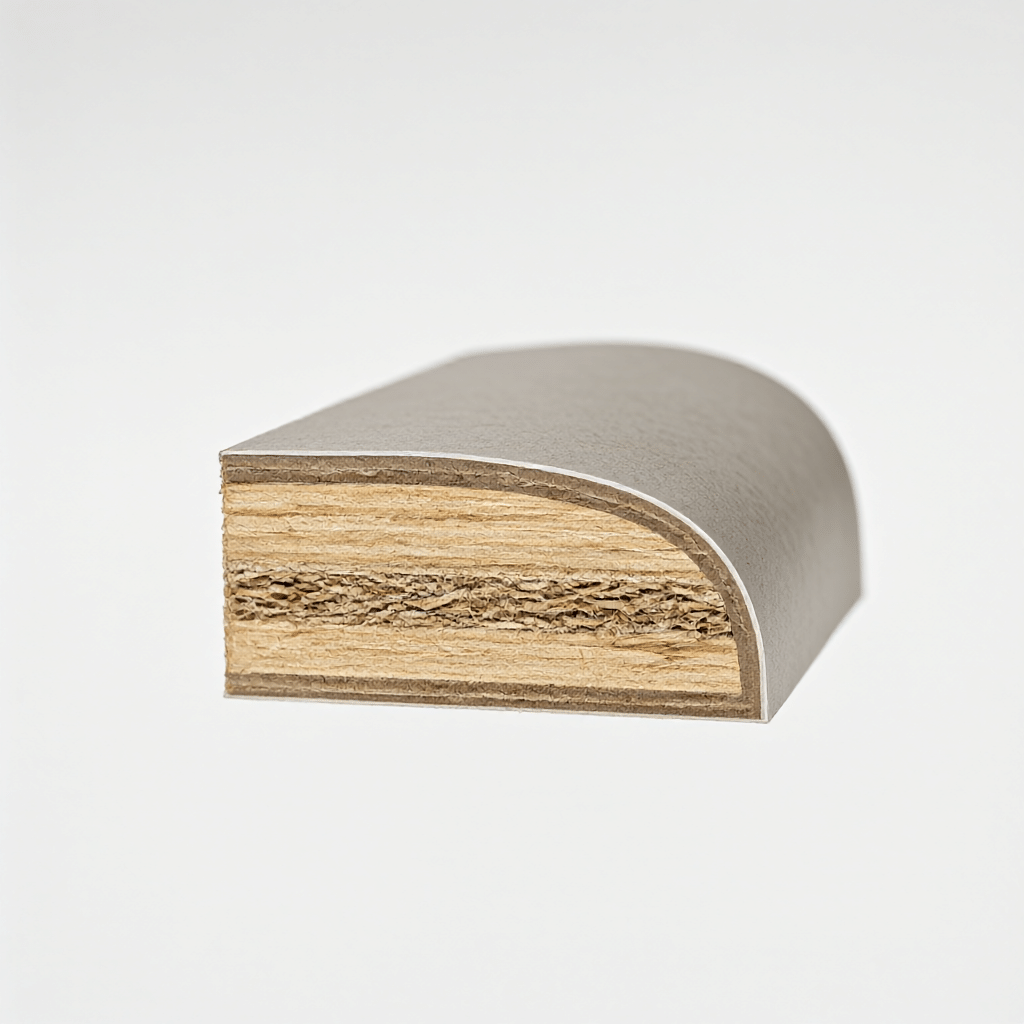
Engineered wood doors are panels manufactured from composite substrates — MDF, HDF, plywood, LVL, or solid-wood laminations — bonded under heat and pressure and finished with veneer, melamine, PVC, or paint-grade skin. They differ from solid-wood doors in three practical ways:
Dimensional stability. Composite cores resist warping and swelling better than solid timber when exposed to temperature swings and moisture. In Gulf climates where indoor spaces are air-conditioned to approximately 22–24 °C while outdoor temperatures reach 45 °C in summer, the movement differential across a door panel is significant. Solid wood reacts to those changes; engineered cores are less prone to visible distortion.
Cost predictability. MDF and HDF cores deliver consistent density across the entire panel, which means fewer hidden-replacement units during installation. Solid-wood panels vary by piece, increasing waste on large orders.
Fire and acoustic flexibility. Hollow-core, semi-solid-core, and solid-core variants allow buyers to match performance tiers to room classification rather than defaulting to one material across every opening.
Hollow-core engineered doors work well for interior closets and low-traffic partitions. Solid-core engineered doors, sometimes called wood-composite doors in procurement documents, are the baseline for hotel guest rooms and corridor fire doors. Laminated veneer doors sit between those two for applications needing a natural finish with moderate performance.
What Door Specifications Change When Supply Is Bound for the UAE
Several specification points carry more weight for UAE-bound orders than for temperate-climate supply chains:
Door thickness and core selection
Standard door panel thickness ranges from 35 mm to 45 mm. Thicker profiles improve both acoustic isolation and hardware mounting stability. Interior villa and residential fit-out projects often specify 40 mm panels as a balanced choice; hospitality contracts commonly require 44–45 mm solid-core panels for guest-room and corridor fire doors.
Core type and application matching
| Core type | Typical use case | Performance note |
|---|---|---|
| Hollow-core engineered doors | Interior closets, low-use partitions | Lowest cost; limited acoustic and fire rating |
| Semi-solid / particleboard core | Moderate-traffic interiors | Better acoustics; no fire certification without assembly testing |
| Solid-core engineered doors | Hotel rooms, corridor fire doors, exterior-grade interior doors | Highest load-bearing for hinges and locks; supports EI30/EI60 assemblies |
| Laminated veneer doors | Appearance-driven villas and retail fit-outs | Veneer over engineered core balances aesthetics with stability |
The term plywood doors appears frequently in sourcing conversations when the substrate is veneer-core plywood rather than MDF. Plywood-core panels offer slightly higher moisture resistance, which is relevant for bathrooms and service areas.
Finish systems and climate durability
Solar exposure and salt-laden coastal air accelerate finish degradation if the coating system is underspecified. PVDF-coated finishes and properly sealed marine-grade melamine skins resist UV fading and humidity better than standard acrylic paints on unprotected substrates. Interior-only doors in non-coastal emirates can use lower-cost melamine finishes; coastal projects near Jebel Ali, Khor Fakkan, or Fujairah benefit from higher-solids coatings and tighter edge-sealing.
Frame and hinge preparation
UAE contractors often receive doors pre-hung or loose-leaved depending on the structural timeline. Hardware cutouts must accommodate commercial-grade cylindrical locks and heavy-duty ball-bearing hinges rated for sustained use in high-turnover environments. Under-sized bore holes or shallow mortises cause field modifications that delay handover.
Request a Quote for your project dimensions and finish schedule.
Which Standards Apply to Engineered Wood Doors Supplied to the UAE
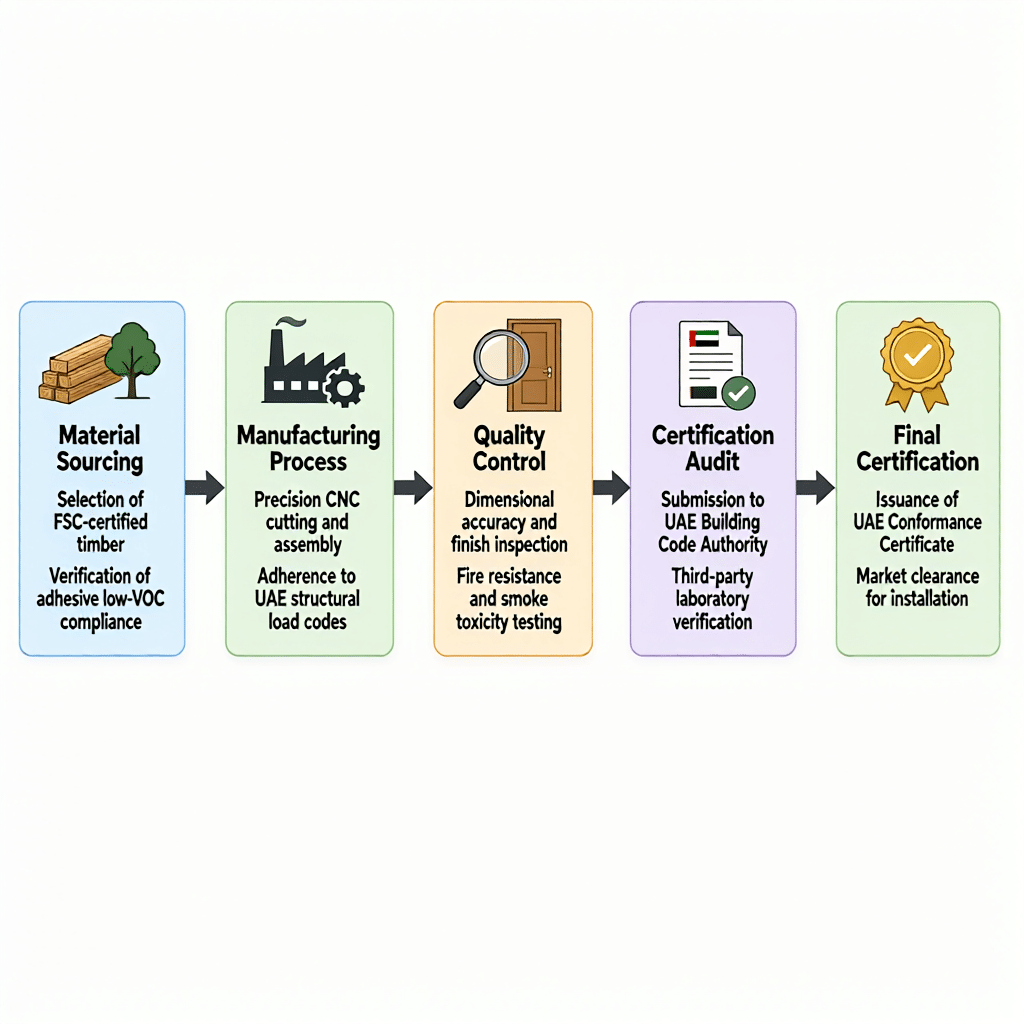
UAE building projects generally reference a blend of local civil-defence requirements and internationally recognized test methods. Understanding which document governs which performance metric prevents specification errors before purchase.
Fire ratings. EI classifications describe the duration a door assembly maintains integrity and insulation under fire conditions. EI30 provides approximately 30 minutes of protection, EI60 extends to 60 minutes, and EI90 covers 90 minutes. These ratings apply to the complete assembly — panel, frame, seals, and hardware — not the bare panel alone. Our related guide comparesEI30 vs EI60 vs EI90 fire door rating optionswith practical selection guidance.
Air-tightness, water-tightness, and wind resistance. These three performance categories are tested according to widely adopted European EN protocols that are also referenced in many UAE spec sheets. For example, EN 12207 addresses air permeability, EN 12208 covers water tightness, and EN 12210 defines wind-load resistance. Laboratories grade results into classes, and the minimum required class depends on floor level, façade orientation, and proximity to the coast.
Acoustic performance. Acoustic ratings follow ISO 10140 series testing for laboratory sound attenuation. Typical UAE hospitality specifications call for Rw values around 30–35 dB for internal room doors and 35–40 dB for corridor-facing or guest-room entry doors. Higher ratings require mass-loaded cores, sealed perimeter gaskets, and precise fitting tolerances.
Material safety and formaldehyde emissions. Projects aiming for LEED or Estidama credits often reference limits on VOC and formaldehyde emissions from composite panels. Buyers should request emission test reports aligned with applicable standards when sustainability certification is part of the brief.
Procurement packages routinely cross-reference multiple test documents. Requiring a single compliance certificate for all metrics is uncommon; instead, buyers verify that the quoted assembly has been evaluated against each relevant standard individually.
How to Evaluate a Manufacturer’s Readiness Before Sourcing
Evaluation should focus on verifiable capability indicators rather than marketing language. The following checkpoints separate prepared suppliers from firms that simply reprice generic products.
Quality-testing documentation
A credible manufacturer performs pre-shipment inspections covering air-tightness, water-tightness, and wind resistance on representative samples from each production batch. Request test reports showing actual class ratings, not just claims of “tested to standard.” Inspectors should confirm that core density, glue-line integrity, and surface adhesion fall within specified tolerances before loading containers.
Customization range
Size, color, glass inserts, and hardware are standard customization requests, but responsiveness varies. Verify whether the factory adjusts profile structures and fittings to match target-market building codes, and whether it can handle non-standard opening dimensions without requiring wholesale redesign. OEM and ODM capabilities matter when a developer needs private-label branding across multiple buildings.
Export experience and documentation support
China-to-UAE shipments require packing lists, proforma invoices, certificates of origin, and any additional customs paperwork your freight forwarder expects. Manufacturers experienced in foreign trade routines reduce administrative delays. Confirm whether the supplier handles both FCL and LCL consolidation, since project phasing often dictates container strategy.
Factory audit readiness
Site visits or virtual audits reveal whether production lines maintain consistent core pressing, edge banding, and finishing workflows. A published door factory audit checklist for B2B procurementcan structure your evaluation visit and ensure you ask about incoming material inspection, in-process QC hold points, and final shipment verification.
Procurement Framework for UAE-Bound Door Orders
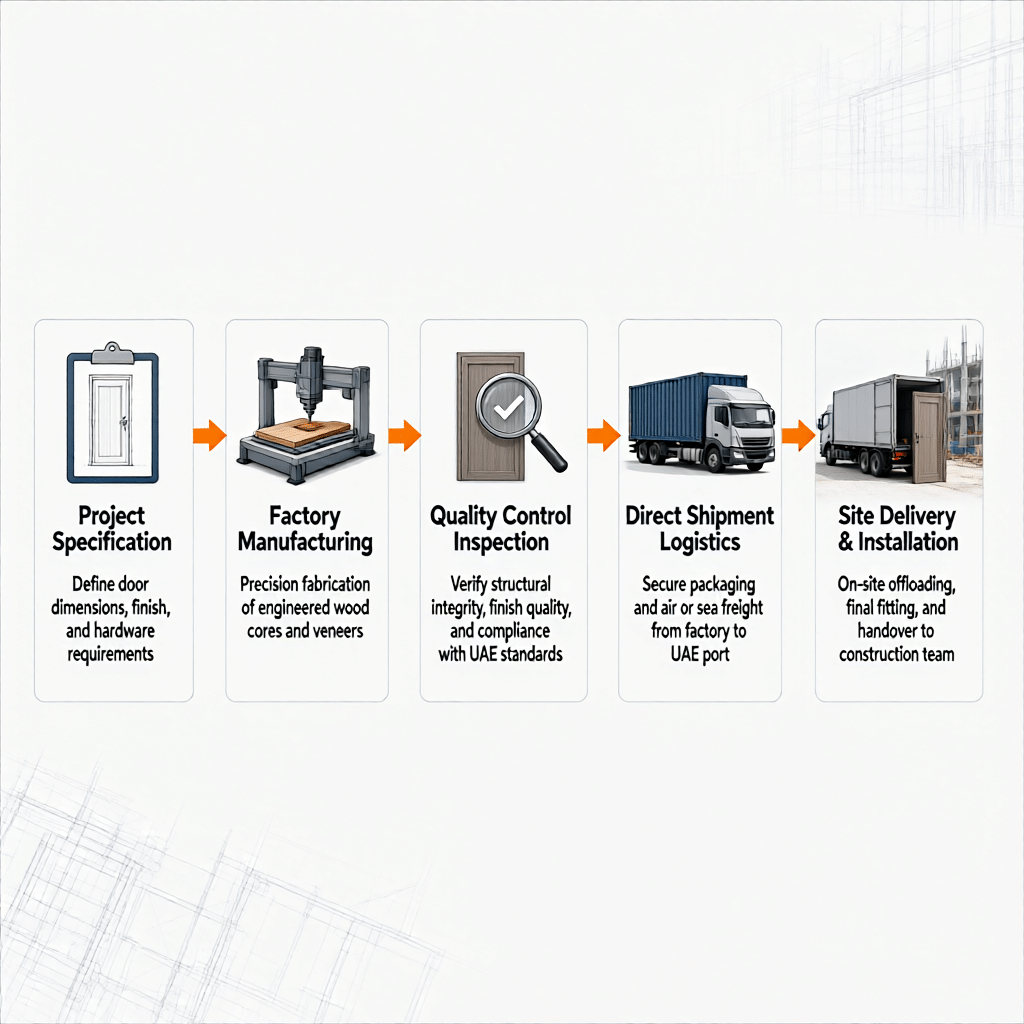
Timing and logistics decisions determine whether door deliveries align with site schedules or become a bottleneck.
Container loading and quantity planning
A 20-foot container typically carries a predictable number of panels depending on door size, packaging method, and whether frames are included. Loading configuration affects unit cost through space utilization. Our 20ft container door loading quantity and shipping configuration guidebreaks down common arrangements so buyers can forecast quantities accurately.
FCL versus LCL trade-offs
Full container loads provide better protection against mixed-cargo handling damage and simplify customs clearance because each container is individually documented. Less-than-container-load shipments are viable for smaller fit-out projects or replenishment orders, but they increase transshipment risk and can extend lead time waiting for consolidation. See ourFCL vs LCL shipping comparison for door procurementfor detailed cost and risk factors.
HS-code and duty awareness
Correct commodity classification helps avoid unexpected charges at Dubai Customs or other emirate ports. The door HS code and import duty guide for 2026outlines typical classifications and current duty treatment so buyers can budget accurately.
Lead-time variables
Custom colors, specialty glazing, and non-standard heights add processing steps. Manufacturers that adjust production scheduling rather than falling back to stock sizes usually maintain steadier delivery promises for complex orders.
How Factory-Direct Supply from China Can Meet UAE Project Requirements
Factory-direct sourcing removes middleman markup, but the advantage only converts into project value when specification alignment is confirmed early. Several practical differences shape the decision:
Pricing transparency. Without intermediary margins, buyers compare base material costs, processing fees, and freight separately. This clarity helps evaluate whether a quoted price reflects genuine value or merely low-cost materials. Guides such as ourMDF doors pricing per unit for B2B procurementand plywood doors price-per-unit bulk guideillustrate how component choices move unit costs.
Specification adaptation. Reputable factories modify profile depth, core density, and hardware prep to match local code expectations before production begins. The result is a product designed for the target market rather than adapted after the fact.
Quality checkpoints before shipment. Pre-shipment inspections for air-tightness, water-tightness, and wind resistance catch specification drift that otherwise surfaces during site reception. Documentation provided with each shipment enables smooth customs and client handover.
Logistics control. Direct factory relationships let buyers choose between FCL and LCL based on project phasing rather than accepting whatever a trader offers. Combined with complete export-document preparation, this reduces administrative friction at port.
When specifications align with local codes and the supplier maintains documented testing, factory-direct Chinese manufacturing delivers competitive pricing without sacrificing performance credibility.
How We Approach UAE-Bound Engineered Wood Door Supply
We work as a manufacturer producing engineered wood doors for international construction supply. Our process starts from your project specifications — core type, fire-class requirement, finish system, hardware layout, and container plan — then adapts profile structures and fittings accordingly.
Pre-shipment inspection is mandatory for every order. Each batch is checked for air-tightness, water-tightness, and wind resistance before loading, and documentation is prepared for customs clearance. We handle both FCL and LCL shipments and coordinate packing-list generation, proforma invoicing, and any additional trade documents your forwarder requires.
Custom sizing, color selection, glass inserts, and hardware configurations are adjusted to match the intended application, whether this is a villa fit-out, a hotel guest-room contract, or a multi-unit residential tower supply package. If you want to discuss project requirements or review specification options, contact our team and share your opening sizes and finish schedule.
Customization impact on lead time and unit cost
Size, color, glazing, and hardware choices directly influence both production timelines and per-unit pricing. Non-standard dimensions typically add 3–7 working days to the manufacturing schedule because custom milling, frame routing, and dedicated edge-sealing are required rather than drawing from existing stock profiles. Color changes—especially specialty powder-coat RAL shades or PVDF metallic finishes—add 5–10 % to coating costs and may introduce a 2–4 day curing and quality-check hold. Glass inserts such as tempered or laminated panels sourced separately contribute an additional 7–14 day lead window and increase unit cost by approximately USD 8–25 per door depending on glazing type. Hardware selections (commercial locks, heavy-duty hinges, closers) are often stocked items and add minimal delay, but special-purpose hardware ordered from third-party suppliers can extend timelines by 10–21 days. In practice, a fully specified custom order from order confirmation to pre-shipment inspection commonly requires 25–45 calendar days, whereas standard-size stock orders ship within 15–25 days. Buyers should lock all spec choices—including RAL color codes, glass type, and hardware SKUs—into the purchase order before production begins to avoid mid-run delays.
Factory-direct versus middleman procurement
Factory-direct sourcing means the buyer contracts straight with the manufacturing facility, eliminating intermediary margin layers that typically add 12–25 % to the landed unit price. A middleman or trading company aggregates orders from multiple factories but rarely controls quality-testing procedures, profile engineering, or container-loading optimization firsthand. With a factory-direct supplier, buyers receive traceable production records, batch-level test reports, and the ability to request photo or video evidence from the production line before shipment. Middlemen also tend to offer a narrower customization palette because they resell catalog configurations rather than engineer products to project specs. Another practical distinction is documentation: factory-direct suppliers prepare packing lists, proforma invoices, certificates of origin, and customs paperwork as part of their export workflow, while intermediaries often outsource this task, increasing the risk of incomplete or inaccurate shipping documents.
UAE-specific standards and certification details
UAE-regulated door procurement requires alignment with several identifiable standards beyond general “SASO compliance.” The Emirates Authority for Standardization and Metrology (ES MA) enforces ES 903 for aluminum and uPVC windows and doors, which covers air permeability, water tightness, and wind-load resistance class ratings applicable to exterior door assemblies installed in building façades. For fire-rated engineered wood doors, UAE Civil Defence typically requires testing under BS EN 1634-1 or ASTM E152 / UL 10A protocols, with EI30/EI60/EI90 certification documented on a Third Party Assessment Certificate issued by an accredited laboratory such as Intertek, SGS, or TÜV. Interior door specifications often cross-reference ISO 10140-2 for airborne sound insulation testing and ISO 140 series methods for field sound performance verification. Formaldehyde emission limits for composite panels used in residential and hospitality projects generally follow the California Air Resources Board (CARB) Phase 2 or Japan’s F★ star rating system, with F★★★★ or CARB-compliant MDF/HDF cores expected on LEED and Estidama-registered projects. Buyers should request copies of each relevant test certificate mapped to the specific product model—not generic documents—and verify that certificate issue dates fall within the past three years.
Concrete project case: Dubai hospitality fit-out
In Q3 2024, a Dubai-based hospitality contractor procured 1,240 engineered wood corridor doors for a six-story boutique hotel renovation. The specification required EI30 fire-rated solid-core doors, 44 mm thickness, RAL 9016 powder-coated finish, concealed ball-bearing hinges, and integrated smoke seals. The manufacturer produced the doors in a 38-day cycle—from detailed shop drawings approval through pressing, edge banding, priming, topcoat application, hardware prep, and batch-level air/water/wind inspection—then loaded 18 × 20-foot containers via FCL shipment from Shenzhen to Jebel Ali. Pre-shipment inspection reports confirmed Class 4 air permeability, Class 7A water tightness, and Class C3 wind-load resistance per EN 12207, EN 12208, and EN 12210 respectively. All doors passed on-site receipt inspection without corrective action, and the project achieved its handover deadline. This case illustrates how specification alignment with EN protocols and disciplined pre-shipment quality control enable factory-direct Chinese manufacturing to satisfy UAE project timelines and code requirements.
Procurement decision matrix for UAE-sourced doors
| Criterion | Weight (%) | Evaluation method | Minimum pass threshold |
|---|---|---|---|
| Fire-rating certification (EI30/EI60/EI90) aligned to BS EN 1634-1 or ASTM E152 | 20 | Request third-party test certificate dated within 3 years | Certificate matches specified assembly |
| Air-tightness / water-tightness / wind-load test reports (EN 12207, EN 12208, EN 12210) | 15 | Verify reported class ratings on test report | Meets or exceeds façade zone requirement |
| Material safety / formaldehyde emission compliance (CARB Phase 2 or F★★★★) | 10 | Emission test report from accredited lab | Compliant with project sustainability target |
| Factory audit results or virtual production-line review | 10 | On-site or video audit using door factory audit checklist | Verified QC hold points and incoming material inspection |
| Reference project list for UAE/GCC deliveries | 10 | Contact 2 previous UAE clients for delivery and quality feedback | Positive reference response |
| FCL/LCL logistics capability and documentation completeness | 10 | Confirm packing list, PI, COO, customs doc readiness | All documents provided before shipment |
| Customization responsiveness (size, finish, glazing, hardware) | 10 | Review sample lead times and MOQ flexibility | Custom order lead time ≤ 45 days |
| Warranty terms and after-sales spare-parts availability | 5 | Written warranty covering panel defect and hardware failure | Minimum 2-year warranty |
| Pricing competitiveness vs. benchmark unit cost | 10 | Compare against published MDF/plywood door pricing guides | Within ±15 % of market average |
Total score across weighted criteria determines shortlisting; proposals scoring below 70 % of total should be rejected or renegotiated before contract award.
Request a Quote for your project dimensions and finish schedule.
Sources & References
- EN 12207 — www.iso.org
- EN 12208 — www.iso.org
- EN 12210 — www.iso.org
- EI30 vs EI60 vs EI90 Fire Resistance Ratings Comparison Guide — doorwoodendoors.com
- door factory audit checklist for B2B procurement — doorwoodendoors.com
- 20ft container door loading quantity and shipping configuration guide — doorwoodendoors.com
- FCL vs LCL shipping comparison for door procurement — doorwoodendoors.com
- door HS code and import duty guide for 2026 — doorwoodendoors.com
- MDF doors pricing per unit for B2B procurement — doorwoodendoors.com
- plywood doors price-per-unit bulk guide — doorwoodendoors.com











