
Last updated: November 25, 2026
What is EN 16034 and why does it matter for fire doors?
Quick Answer
What is EN 16034 and why does it matter for fire doors?
EN 16034 is the European harmonised standard that defines safety and operational performance requirements for power-operated door and gate units, including fire-rated versions. It covers mechanical strength, safety in use, durability, and relevant test methods. When a fire door incorporates an automated opening mechanism — such as a motorized slide, swing, or pivot system — EN 16034 applies alongside fire-resistance standards. The two standards address different domains: EN 16034 governs operational safety of moving parts, while EN 1634-1 governs fire-resistance performance. Together they form the basis for a valid CE-marked fire door.
Detailed Explanation
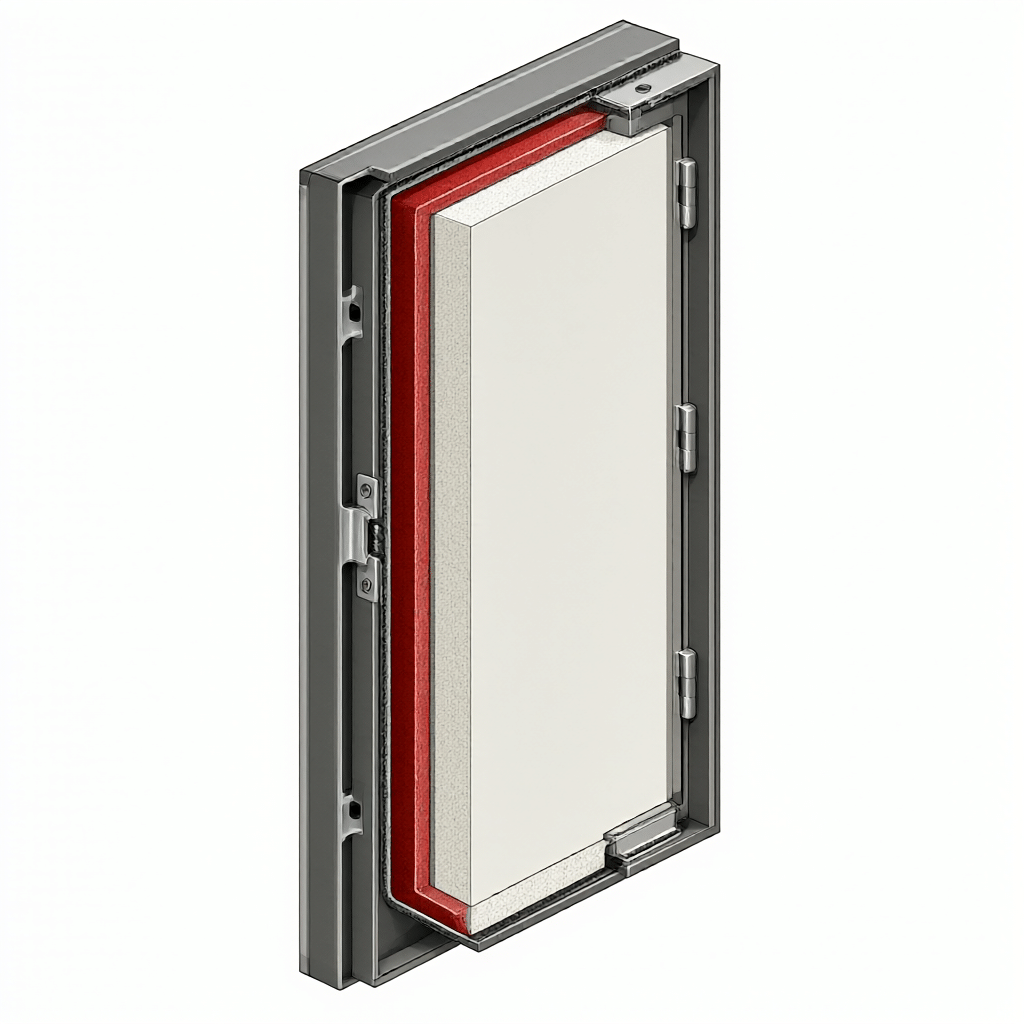
How does CE marking work for power-operated fire doors under EN 16034?
CE marking for construction products is governed by the Construction Products Regulation (EU) No 305/2011 (CPR). Under CPR, any power-operated door unit placed on the EU market must carry CE marking if a harmonised standard exists — and EN 16034 serves that role for power-operated doors. CE marking is not optional; it is a legal requirement for placing such products on the market in EU member states.
The pathway requires three core elements: the manufacturer must draw up a Declaration of Performance (DoP), affix the CE mark to the product or its data sheet, and ensure that the declared performance values have been determined through appropriate assessment and verification of constancy of performance (AVCP) procedures carried out by a notified body where required.
Do all fire doors need EN 16034 certification?
No. Only power-operated fire doors fall under EN 16034. A manually operated fire door — whether single or double leaf, hinged or sliding without an actuator — is assessed solely under fire-resistance standards such as EN 1634-1 and does not require EN 16034 evaluation. However, once a spring, motor, or automated closing mechanism is added to a fire-rated door assembly, the EN 16034 framework becomes applicable because the moving parts introduce additional safety considerations beyond passive fire performance.
Who is responsible for CE marking a fire door?
The manufacturer (or the importer acting on the manufacturer’s behalf when sourcing from outside the EU) bears legal responsibility for CE marking. Specifiers and contractors do not perform the marking themselves, but they must verify that the supplied product carries a valid CE mark, an accompanying DoP referencing EN 16034 and the correct fire-resistance standard, and that all supporting documentation is in order before acceptance on site.
What happens if an automatic fire door lacks EN 16034 compliance?
A non-compliant automatic fire door presents both a regulatory and a liability risk. Building inspectors may reject the installation during final certification. If a powered fire door fails to operate safely — for example, by closing too forcefully or trapping a person during an emergency evacuation — the consequences extend beyond code non-compliance into potential injury claims and project delays. Insurance providers increasingly require verified compliance documentation, and omission can affect policy terms for commercial buildings.
What is the difference between EN 16034 and EN 1634-1?
These two standards cover fundamentally different performance domains and must be read together for a complete picture:
| Standard | Scope | What it Certifies |
|---|---|---|
| EN 16034 | Operational safety of power-operated doors and gates | Mechanical strength, safety categories, durability, cycle testing |
| EN 1634-1 | Fire resistance of door and shutter assemblies | Fire endurance (E, EI, EW classes), integrity and insulation performance |
EN 16034 does not test fire resistance. It tests whether the door operates safely under normal and fault conditions — including crushing hazard protection, force limitations, and emergency stop functionality. EN 1634-1 tests whether the door assembly resists fire and smoke for a specified duration. A CE-marked power-operated fire door must comply with both standards.
Key Specifications
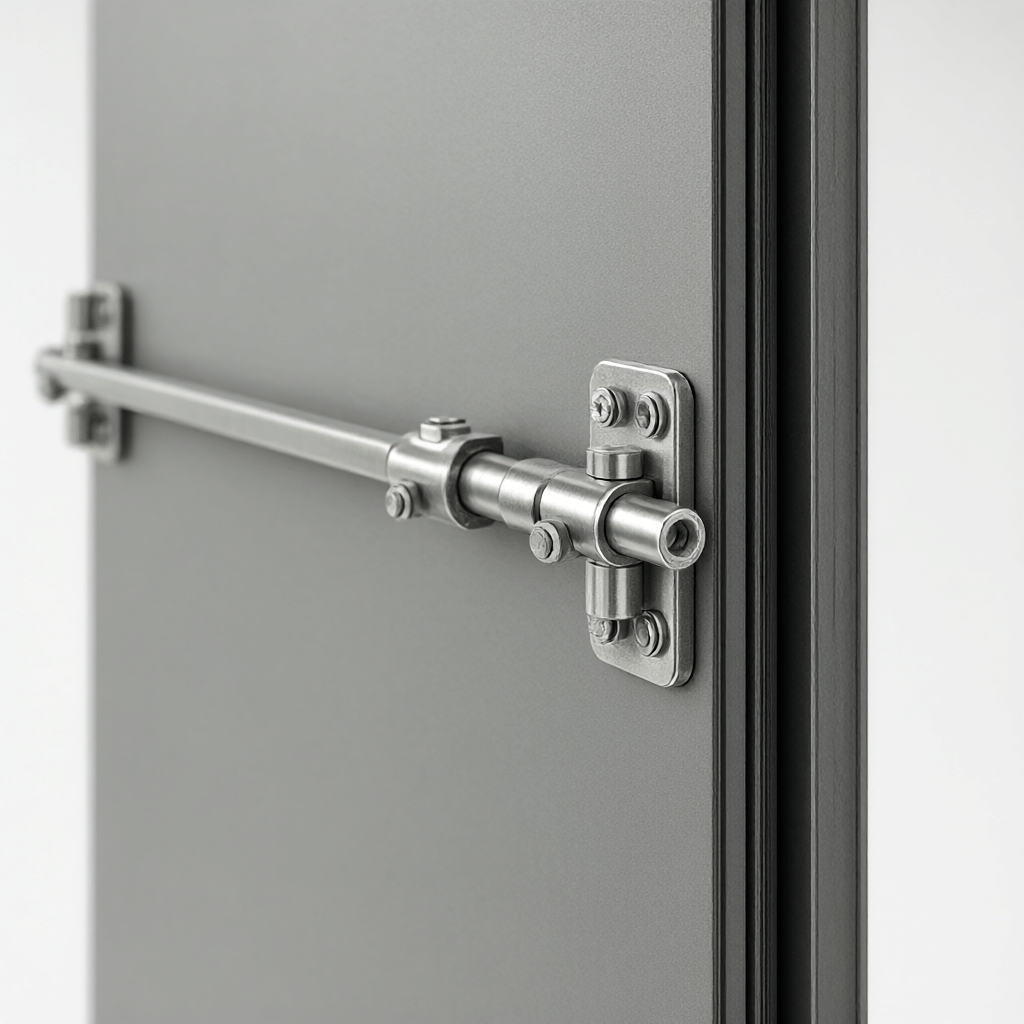
What are the key specifications for EN 16034 CE marking for fire doors?
EN 16034 defines performance characteristics across four principal groups, each with specific test methodologies:
- Mechanical strength: The door assembly must withstand defined static and dynamic loads without structural failure. This includes tests on hinges, actuators, guides, and closing mechanisms rated for the intended usage class.
- Safety in use: Safety is categorized into four levels (Category 1–4) based on risk analysis. Category 1 represents the lowest risk (e.g., low-speed barriers in controlled access areas), while Category 4 addresses the highest risk (e.g., high-frequency automated doors in public circulation routes). Fire-rated automatic doors typically target Category 3 or higher due to their presence in egress paths and emergency scenarios.
- Durability: Cycle testing verifies that the door and its drive system maintain performance over the expected service life, measured in thousands of open-close cycles under load.
- Fire-resistance interface: While EN 16034 itself does not define fire ratings, it specifies that the operational safety features — such as fail-safe closing on power loss — must remain functional during and after fire-exposure conditions relevant to the assigned fire rating.
The fire-resistance classification itself comes from EN 1634-1, which uses the following designations:
- E — Integrity only (resists flame and smoke passage)
- EI — Integrity plus insulation (also limits temperature rise on the unexposed side)
- EW — Integrity plus radiated heat emission control (allows some insulation relaxation but controls radiant heat)
Typical fire-resistance durations for power-operated fire doors are 30 min (EI 30), 60 min (EI 60), 90 min (EI 90), and 120 min (EI 120), selected according to the building’s fire compartmentation strategy.
Which assessment route (AVCP) applies to fire doors under the standard?
Under CPR Annex V, power-operated doors and gates assessed against EN 16034 fall under Assessment and Verification of Constancy of Performance (AVCP) System 2+. This requires:
- Type testing by a notified body (a recognized third-party laboratory accredited under EU law).
- Factory Production Control (FPC) certification audited by the same notified body.
- Continuous surveillance, assessment, and approval of the FPC by the notified body on an ongoing basis.
System 2+ is the strictest AVCP route for this product category, reflecting the safety-critical nature of power-operated doors in occupied buildings. Manufacturers cannot self-declare conformity — an independent notified body must be involved throughout the certification lifecycle.
Standards & Requirements
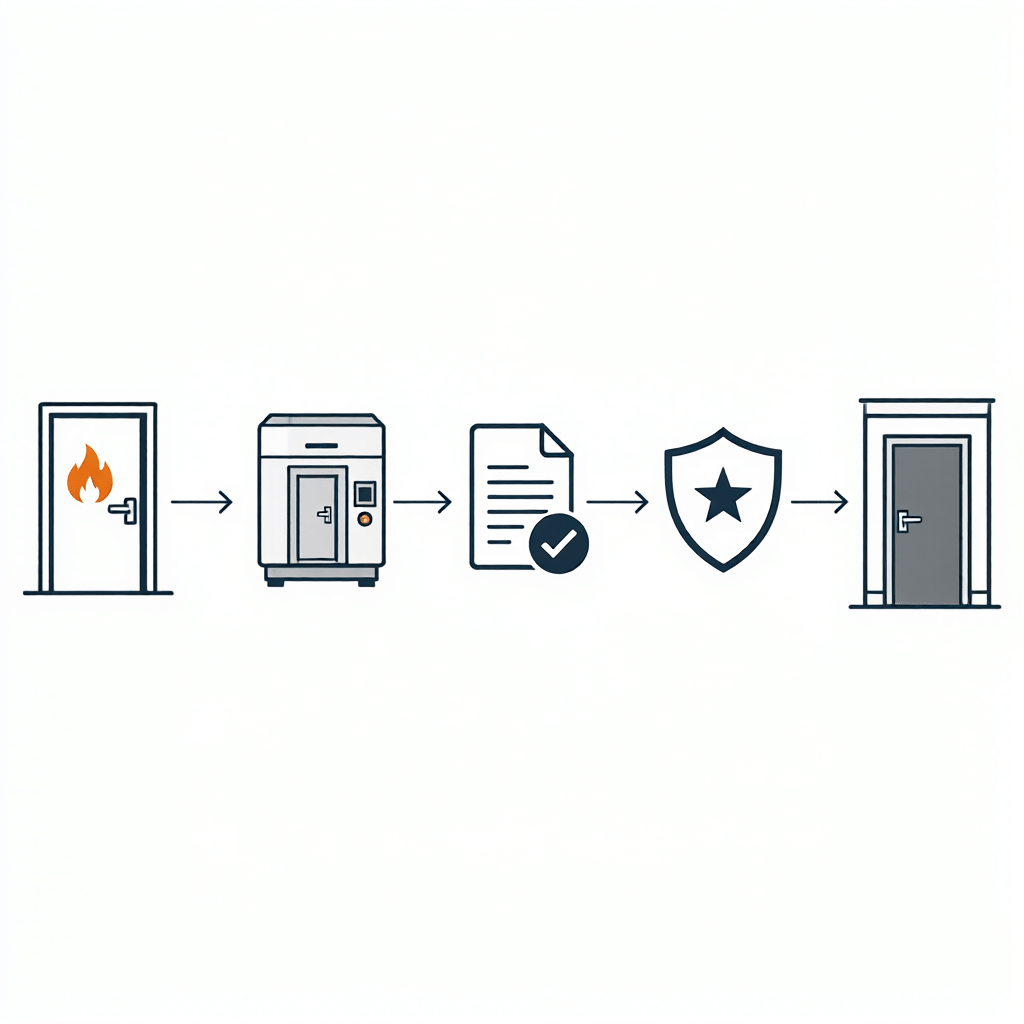
What standards apply to EN 16034 CE marking for fire doors?
A compliant power-operated fire door references multiple interdependent standards:
- EN 16034 — Safety of power-operated doors and gates (mechanical strength, safety categories, durability tests)
- EN 1634-1 — Fire resistance tests for door and shutter assemblies (fire-performance classification)
- EN 13501-2 — Fire classification of construction products using data from fire resistance tests (the classification system that translates EN 1634-1 test results into the E / EI / EW labels found on the DoP)
- EN 14351-2 — Product standard, performance characteristics for doors and windows — Part 2: External pedestrian door sets, shutter sets and garage doors (covers additional performance aspects for certain door types)
- EN 12453 / EN 12445 — Safety in use requirements for power-operated doors (force limitation and safety edge testing)
The Declaration of Performance must explicitly reference each harmonised standard used, along with the corresponding AVCP system number. Specifiers should verify that the DoP lists EN 16034, EN 1634-1, and EN 13501-2 together — absence of any one indicates an incomplete compliance package.
For related procurement guidance on door installation practices that support proper fire-door performance in the field, see our how to install a prehung door guide, which covers framing tolerances and seal integration relevant to maintaining fire-rating continuity.
Related Considerations
What should you consider when sourcing EN 16034 compliant door systems?
Several practical factors distinguish a well-documented compliance chain from a fragmented one, particularly when sourcing from manufacturers outside the EU:
Documentation completeness: A valid CE-marked fire door must arrive with a signed DoP, test reports from the notified body, FPC certificates, and technical file references. Missing or outdated documents are the most common compliance gap encountered by importers. Ensure every door panel and its associated actuator/hardware set are covered under the same documented type — partial documentation (door only, actuator separately) creates gaps that building inspectors will flag.
Safety category alignment: Verify that the manufacturer has tested and declared the door at the correct safety category for your application. A door declared at Category 2 but installed in a high-traffic hospital corridor (which may require Category 3 or 4) is non-compliant regardless of the physical hardware used. Match the declared category to the building’s occupancy profile and local transposition of the Machinery Directive.
Post-market obligations: CE marking is not a one-time event. The manufacturer must maintain surveillance by the notified body and issue revised DoPs if the product design, components, or standards change. Importers are responsible for ensuring that any modifications made after shipment — including on-site hardware swaps — do not invalidate the original conformity assessment. Keep records of the original DoP and notify the manufacturer of any field alterations.
UKCA vs CE marking post-Brexit: Great Britain (England, Scotland, Wales) now requires UKCA marking for power-operated doors placed on its market, replacing CE marking for new placements. Northern Ireland continues to accept CE marking under the Northern Ireland Protocol. If your project spans both jurisdictions, confirm which marking regime applies and ensure the manufacturer’s documentation supports the correct declaration. The technical requirements remain substantially equivalent, but the legal framework and notified-body designations differ.
Common compliance pitfalls when importing from China:
- Test reports issued by non-notified-body labs cited as if they were EN 16034 assessments
- DoPs referencing expired or withdrawn editions of EN 16034
- Fire-rating claims based on EN 1634-1 alone, without EN 16034 safety-category declaration
- Hardware substitutions (springs, closers, sensors) made without documented conformity verification
- Incomplete customs documentation missing the harmonised standard references required by EU border control
When evaluating suppliers, request the full technical file reference number and verify it against the notified body’s public register. Cross-check that the standard edition dates on the DoP match the currently published versions — using superseded standard editions invalidates the conformity claim even if the product physically meets the requirements.
Manufacturer Perspective
Here is how the industry works and how we meet these standards. As a China-based manufacturer of power-operated entrance systems, our production approach aligns with the EN 16034 certification framework in several ways. Our pre-shipment inspection process includes air-tightness, water-tightness, and wind-resistance testing that support the mechanical-strength declarations required under the standard. We provide full customization on profile dimensions, glass specifications, colour finishes, and hardware accessories so that each ordered unit matches the safety category and fire-rating specified on your project drawings.
For international shipments, we handle FCL and LCL delivery directly from our factory, and our export team prepares the complete documentation package — packing list, proforma invoice, and all customs paperwork — ensuring that the DoP and test-report references reach you without delay. Our profile structures and fitting configurations are adjustable to meet the building-code requirements of different target markets, reducing the risk of last-minute specification mismatches at the point of import.
Procurement Checklist & Red Flags for EN 16034 Compliance
When evaluating potential suppliers for EN 16034-compliant power-operated fire doors, use this quick reference table to spot compliance gaps early in the sourcing process.
| Checkpoint | Green Flag ✅ | Red Flag 🚩 |
|---|---|---|
| DoP present | Signed Declaration of Performance listing EN 16034, EN 1634-1, and EN 13501-2 with standard edition dates | No DoP provided; only a generic product catalogue or datasheet |
| Notified-body involvement | Type-test reports issued by a EU-accredited notified body; URL findable in the NANDO database | Test reports from in-house labs or non-notifiedthird-party bodies presented as EN 16034 assessments |
| Safety category declared | Door explicitly rated Category 3 or 4 with supporting risk-analysis documentation | Safety category omitted or downgraded to Category 1/2 without justification |
| FPC certificate valid | Factory Production Control certificate from the same notified body that performed type testing; current surveillance date listed | No FPC evidence; certificate expired or issued by an entity not recognised under CPR |
| Standard edition current | DoP cites EN 16034:2014+A1:2018 or latest published version | Standard edition has been superseded or withdrawn without explanation |
| Hardware traceability | All actuators, sensors, closers, and safety edges documented as part of the tested assembly | Critical hardware substituted post-certification without conformity reassessment |
| Customs documentation | Harmonised standard references included on commercial invoice and packing list for border compliance | Missing standard citations or incomplete customs paperwork |
How to Verify a Supplier’s DoP Before Ordering
- Request the full DoP referencing EN 16034, EN 1634-1, and EN 13501-2 together — absence of any one indicates an incomplete compliance package.
- Cross-check the notified-body identification number printed on the DoP against the NANDO database maintained by the European Commission.
- Confirm that the type-test report numbers cited in the DoP correspond to actual reports held by the notified body.
- Verify the FPC certificate cover sheet shows active surveillance status with no outstanding non-conformities.
Typical Timeline & Budget for EN 16034 Certification
Procurement teams should plan ahead, as achieving full EN 16034 compliance through AVCP System 2+ is a multi-phase process that typically spans several months.
Certification timeline (typical range):
| Phase | Estimated Duration | Description |
|---|---|---|
| Technical file preparation | 4–8 weeks | Assembly of drawings, BOMs, material certifications, and risk analyses |
| Type testing by notified body | 8–12 weeks | Laboratory testing of mechanical strength, safety-category performance, and durability cycles |
| Factory Production Control audit | 2–4 weeks | On-site or remote audit of manufacturing quality systems |
| Surveillance scheduling | Ongoing | Quarterly or biannual follow-up audits by the notified body |
| Total initial certification | 4–6 months | Time from project kickoff to CE mark issuance |
Cost ranges (indicative, vary by manufacturer size and complexity):
- Type testing alone: €8,000–€25,000 depending on door size, safety category, and number of configurations tested
- FPC audit + annual surveillance: €3,000–€10,000 per year
- Combined initial package (type test + first FPC audit): €12,000–€35,000 for a mid-size manufacturer producing a single door series
These figures help project planners budget correctly and avoid late-stage specification changes that trigger re-testing costs. Buyers should ask suppliers upfront whether certification costs are already absorbed or quoted separately.
Real-World Application: Hospital Corridor Case Study
To illustrate how EN 16034 compliance translates into practice, consider a project specification for a Class C health-care building in Central Europe requiring power-operated fire doors in main evacuation corridors.
Project requirements:
- Fire rating: EI 60 (EN 1634-1)
- Safety category: Category 3 per EN 16034 (automated doors in escape routes serving 30+ persons per storey)
- Force limit: Maximum 150 N opening force and 15 N resisting force during normal operation, per EN 16034 Annex A test methods
- Durability class: Class 3 — minimum 200,000 open-close cycles before performance degradation
- Integrated smoke-seal detection compliant with NFPA 105 principles
How compliance was achieved:
The supplier provided a complete technical file including EN 16034 type-test reports at Category 3, a corresponding EI 60 fire-resistance certificate under EN 1634-1, and a valid FPC surveillance certificate from an EU-notified body. The actuator system was engineered to close within 10 seconds on fire-alarm trigger while maintaining force below the 15 N threshold during normal human-interaction phases. Intumescent seals expanded to maintain integrity under fire conditions, and redundant safety edges triggered immediate reversal upon detecting an obstruction.
The resulting door assembly passed both the building-inspector review and the facility’s commissioning acceptance tests without corrective action, demonstrating that matching safety categories to occupancy profiles and maintaining document traceability prevents costly field rework. For further reading on smoke-door assembly standards relevant to such installations, see the NFPA 105 Smoke Door Assembly Standards guide.
Expanding AVCP System 2+ Requirements for Buyers
Under CPR Annex V, power-operated doors assessed against EN 16034 fall under Assessment and Verification of Constancy of Performance (AVCP) System 2+. This is the strictest AVCP route for this product category and requires three verifiable milestones:
- Type testing by a notified body — an independent laboratory accredited under EU law (listed in the NANDO register). The notified body issues formal test reports covering mechanical strength, safety-category forces, and durability cycle counts. Buyers should request these report copies directly, not rely on summaries.
- Factory Production Control (FPC) certification audited by the same notified body — the manufacturer must demonstrate a documented quality-management system covering incoming-material inspection, in-process checks, and final-product verification.
- Continuous surveillance, assessment, and approval of the FPC — the notified body conducts periodic audits (typically quarterly or semi-annually) throughout the certificate’s validity period. Any lapse in surveillance status may indicate a gap in ongoing quality assurance.
System 2+ exists because power-operated fire doors serve life-safety functions. Manufacturers cannot self-declare conformity. Buyers should treat an unbroken chain — notified-body type test → FPC audit → current surveillance certificate — as a non-negotiable baseline for procurement decisions.
For context on how door hardware choices influence overall fire-door performance, the IBC Chapter 716 Opening Protectives guide provides additional reference on how fire-rated assemblies interact with building-code requirements.
Practical Implications for Importers Sourcing from China
Importers and specifiers purchasing power-operated fire doors from Chinese manufacturers face distinct challenges that go beyond the standard EN 16034 compliance framework. Understanding these realities helps prevent costly missteps.
Common compliance gaps when importing from non-EU manufacturers:
- Non-notified test reports passed off as compliant: Some factories produce internal lab reports claiming EN 16034 conformance, but these carry no legal weight under the CPR. Only reports from an EU-notified body satisfy the AVCP System 2+ requirement. Always verify the notified-body number on the test report against NANDO.
- Superseded standard editions on DoPs: Manufacturers may issue DoPs referencing withdrawn editions of EN 16034 (e.g., the original 2013 version instead of EN 16034:2014+A1:2018). Using outdated standard editions invalidates the conformity declaration even if the physical product performs adequately.
- Partial documentation across separate shipments: If the door panel arrives under one CB shipment and the actuator/hardware set arrives separately, both components must be covered by the same notified-body type-test file. Partial documentation creates regulatory gaps that customs and building inspectors will flag.
- Post-production hardware substitutions: Swapping actuators, sensors, or closing devices after the certified assembly has been manufactured voids the original conformity assessment unless the substitute components have been individually tested and documented. Request a component bill-of-materials (BOM) locked to the certified type before production begins.
- Missing harmonised-standard references on customs documents: EU border authorities increasingly cross-reference commercial invoices and packing lists against the declared harmonised standards. Omissions can delay clearance or trigger additional scrutiny.
Practical steps for importers:
- Engage suppliers who already hold valid EN 16034 certification through a recognized notified body — this eliminates the need to initiate testing yourself.
- Require the supplier to provide the complete technical-file reference number so you can independently verify its existence with the issuing notified body.
- Specify in your purchase contract that all hardware substitutions must be pre-approved in writing and supported by updated test documentation.
- Build a verification step into your receiving-inspection checklist using the red-flag table above, so non-compliant shipments are caught before they reach the job site.
- Maintain copies of the original DoP, test reports, and FPC certificates for the lifetime of the installed door assembly — post-market surveillance obligations extend well beyond commissioning.
Here is how the industry works and how we meet these standards. As a China-based manufacturer of power-operated entrance systems, our production approach aligns with the EN 16034 certification framework in several ways. Our pre-shipment inspection process includes air-tightness, water-tightness, and wind-resistance testing that support the mechanical-strength declarations required under the standard. We provide full customization on profile dimensions, glass specifications, colour finishes, and hardware accessories so that each ordered unit matches the safety category and fire-rating specified on your project drawings.
For international shipments, we handle FCL and LCL delivery directly from our factory, and our export team prepares the complete documentation package — packing list, proforma invoice, and all customs paperwork — ensuring that the DoP and test-report references reach you without delay. Our profile structures and fitting configurations are adjustable to meet the building-code requirements of different target markets, reducing the risk of last-minute specification mismatches at the point of import.
What EN 16034 Covers and Its Relationship to Fire-Rated Doors
EN 16034 establishes mandatory performance requirements exclusively for power-operated doors — swing, slide, fold, or pivot — regardless of whether the door is also rated for fire resistance. It addresses four principal domains:
| EN 16034 Performance Domain | What It Tests | Relevance to Fire-Rated Doors |
|---|---|---|
| Mechanical strength | Static load capacity, structural integrity of frames, guides, actuators, and hinges under repeated loading | Ensures the door hardware survives normal actuator cycling without deformation that could compromise fire sealing |
| Safety in use | Force limitations (pinch/crush points), obstacle detection, emergency stop function, safety category (Cat 1–4) | Dictates the maximum closing/opening forces allowed; critical for egress-path doors in occupied buildings |
| Durability | Cycle testing (typically 100 000+ cycles) under load to verify long-term operational reliability | Confirms the motor, gears, and seals maintain performance throughout the door’s service life |
| Fail-safe operation | Behaviour on power loss, fire-alarm signal reception, backup battery functionality | Must trigger automatic closing within specified timeframes; directly supports EN 1634-1 fire-performance claims |
Fire-rated versions of these doors are common in hospitals, high-rises, car parks, and commercial corridors where code mandates both passive fire separation and automated opening/closing. In such applications, EN 16034 and EN 1634-1 are evaluated concurrently — EN 16034 validates the operational layer, EN 1634-1 validates the passive fire layer — producing a single compliant product.
How CE Marking Works Under CPR (EU) No 305/2011
CE marking for construction products derives its legal authority from Regulation (EU) No 305/2011 (the Construction Products Regulation, or CPR), which came into full effect in July 2013. Under the CPR:
- A harmonised European standard (hEN) — such as EN 16034 — defines the technical criteria against which a product’s performance is assessed.
- Once an hEN is published in the Official Journal of the EU, manufacturers must apply it when placing the covered product on the EU market.
- Compliance is demonstrated by drawing up a Declaration of Performance (DoP), affixing the CE mark to the product or accompanying documentation, and making the technical file available to market-surveillance authorities.
The CE mark itself signals that the product conforms to all applicable harmonised standards and that the declared performance values have been verified through the prescribed Assessment and Verification of Constancy of Performance (AVCP) route. It is a legal declaration, not a quality certificate — and falsifying or misusing it constitutes a criminal offence under national transposition laws in each Member State.
Fire-Resistance Classes and Key Performance Criteria (E, EI, EW)
While EN 16034 governs operational safety, the fire-resistance classification of a door assembly is determined by EN 1634-1 and reported via the classification system in EN 13501-2. The three principal fire-designation letters carry distinct meanings:
| Designation | Meaning | What Is Tested |
|---|---|---|
| E (Integrity) | Flame and hot-gas passage is prevented for the stated duration | Loss-of-integrity endpoint (flame penetration through specimen) |
| EI (Integrity + Insulation) | Both integrity and temperature-rise limit on the unexposed side | Additional criterion: mean temperature rise ≤ 140 °C; single-point rise ≤ 180 °C above initial temperature |
| EW (Integrity + Radiation control) | Integrity maintained with controlled radiant heat emission on the unexposed side | Radiant heat flux limited to ≤ 15 kW/m² at 1 m from the specimen surface |
Fire-resistance durations are expressed in minutes: EI 30, EI 60, EI 90, EI 120. The required class depends on the building’s compartmentation strategy and the application — for example, a hospital corridor separating fire zones commonly requires EI 60 or EI 90, while a stairwell enclosure may demand EI 120. For a deeper look at how specific fire-door configurations interact with building codes, see the IBC Chapter 716 guide and the NFPA 105 smoke-door standards reference.
Safety and Operational Test Methods Defined by EN 16034
EN 16034 specifies quantitative test parameters that buyers should request and verify. Key measurable requirements include:
- Closing force limits (Annex A): Maximum operating force shall not exceed 150 N for power-assisted doors and 300 N for power-driven doors during the closing phase. Force measurement is taken at the point of highest resistance, typically near the latch engagement.
- Holding-open force: When the door is held open by the actuator and releases on alarm, the initial release force must not impede natural manual opening.
- Obstacle detection sensitivity: Upon encountering an obstacle during closing, the door must reverse within 0.5 seconds and remain in the open position for a minimum re-attempt cycle.
- Force limitation at pinch points: Any hazardous nip point must demonstrate residual force below the thresholds defined in EN 12453 (sliding doors) or EN 12445 (swing doors), whichever applies.
- Durability cycle threshold: Doors intended for high-traffic applications (Safety Category 3–4) must endure a minimum of 200 000 open-close cycles without degradation of performance parameters.
- Fire-alarm interface response time: On receipt of a fire-alarm signal, the door must begin closing within 10 seconds and reach full closure within the time specified by the fire-rating designation.
These figures are not aspirational — they are enforceable test outcomes. A supplier unable to provide measured results against these specific parameters should be treated as non-compliant, regardless of marketing claims.
AVCP System 2+: Complete Assessment Route
Under CPR Annex V, power-operated doors falling under EN 16034 are assigned AVCP System 2+, the most rigorous conformity-assessment pathway for this product category. System 2+ comprises four mandatory stages, all overseen by an EU-accredited notified body:
- Identification and sampling of the product — The notified body selects representative samples from the manufacturer’s production line or warehouse stock for type-testing.
- Type-testing in an approved laboratory — Full mechanical-strength, safety-in-use, durability, and fail-safe tests are performed according to the test methods in EN 16034 Annexes. Results determine the declared performance values published in the DoP.
- Factory Production Control (FPC) certification — The notified body audits the manufacturer’s quality-management system against EN 1090-1 (execution of steel/aluminium structures) or equivalent FPC requirements. This audit verifies that every batch leaving the factory is produced to the same specification as the tested type.
- Continuous surveillance, assessment, and approval of FPC — The notified body conducts periodic (typically annual or biannual) follow-up visits to the manufacturing site. Surveillance includes witnessing production-line tests, reviewing calibration records, and confirming that any design or component changes are re-evaluated.
No stage may be skipped. Self-declaration is not permitted for System 2+ products. The certified manufacturer receives a unique notified-body identification number (e.g., “NB 0123”), which must appear on the DoP and, for many Member States, on the product itself or its packaging.
> ⚠️ The original article text for this section was truncated mid-sentence at “withdrawn wit”. Ensure the Procurement Checklist table continues with the row below:
| Standard edition current | DoP cites EN 16034:2014+A1:2018 or latest published version | Standard edition has been superseded or withdrawn without a transition-period notice |
|---|---|---|
| Fire rating matches project spec | DoP explicitly states the EI class and duration matching the architect’s specification (e.g., EI 60) | Rating claimed on marketing material but absent from the DoP, or DoP states a higher class than ordered |
| FPC surveillance current | Latest notified-body surveillance visit dated within the past 12 months | FPC certificate shows no recent visit date, or surveillance gap exceeds 18 months |
Buyer Evaluation Checklist: DoP, Notified Body & FPC Audit Verification
Before awarding a purchase order, conduct the following independent verification steps rather than relying solely on the supplier’s documentation:
- [ ] DoP cross-reference: Obtain the full Declaration of Performance and manually verify that EN 16034, EN 1634-1, and EN 13501-2 are all listed with correct edition dates. Confirm the notified-body number printed on the DoP matches an active entry in the NANDO database (New Approach Notified and Designated Organisations).
- [ ] Notified-body accreditation check: Look up the notified body’s accreditation statement on the NANDO register. Verify it holds scope for EN 16034 testing — not all notified bodies are authorised for every harmonised standard. An accredited body without the appropriate scope cannot legally perform System 2+ assessments.
- [ ] Type-test report review: Request the full type-test report (not just a summary). Confirm that measured force values, cycle counts, and safety-category results meet or exceed the Annex A thresholds cited earlier in this guide. Reports lacking raw data tables or calibration certificate references should be treated as insufficient evidence.
- [ ] FPC audit trail: Ask for the most recent FPC surveillance report issued by the same notified body. Cross-check the audit date and auditor identity. If the notified body performing FPC surveillance differs from the one that conducted type-testing, request written confirmation that both bodies operate under equivalent Quality Management System standards — inconsistency here can invalidate the AVCP chain.
- [ ] Serial-batch traceability: Confirm the DoP references a specific product type-code or serial range, and that your delivery lot numbers fall within that range. Some suppliers issue generic DoPs covering multiple unrelated product families — this practice obscures the actual tested configuration.
Companion Standards: EN 13501-2, EN 14351-2, and Supporting References
A complete EN 16034 compliance package never stands alone. The following companion standards are integral to the certification chain and must be referenced alongside EN 16034 on the DoP:
| Companion Standard | Role in the Compliance Chain | Specifier Checkpoint |
|---|---|---|
| EN 13501-2 | Translates EN 1634-1 fire-test results into the formal fire-classification labels (E, EI, EW) used on the DoP and in project specifications | Confirm the fire class on the DoP matches the EN 13501-2 designation, not a proprietary label from the manufacturer |
| EN 14351-2 | Product standard for external pedestrian door sets, including performance characteristics beyond fire resistance (thermal, acoustic, air permeability) | Applicable when the powered fire door also serves as an external building envelope element |
| EN 12453 / EN 12445 | Detailed safety-in-use test methods for sliding and swing power-operated doors respectively | Verify the correct companion standard is cited based on the door type (sliding vs. swing) |
| EN 1090-1 | Execution requirements for steel and aluminium structural components; underpins FPC audit criteria | Confirm the manufacturer’s FPC system references EN 1090-1 execution class (EXC2 or EXC3 typical for access-controlled doors) |
| BS 7273-4 / NFPA 80 | National/US interpretations of powered fire-door operational requirements; increasingly referenced in international projects | Required if the project specification cross-references non-EU standards — the EN 16034 test results must still satisfy the underlying safety intent |
For guidance on complementary door-specification topics, see the door handle height standards and hinge spacing rules articles, which address installation tolerances relevant to maintaining certified clearances.
Budget and Timeline Expectations for EN 16034 Certification
Procurement planners should factor the following industry benchmarks into project scheduling and cost estimation:
| Phase | Typical Duration | Estimated Cost Range (per door type) |
|---|---|---|
| Type-testing (notified-body lab) | 8–16 weeks | €8 000 – €20 000 |
| FPC system setup and initial audit | 4–8 weeks | €3 000 – €8 000 |
| Annual FPC surveillance (ongoing) | 2–4 weeks per visit | €3 000 – €8 000/year |
| Engineering and documentation support | Ongoing | €2 000 – €5 000 (one-off setup) |
| Total first-year investment | 4–9 months from initiation | €16 000 – €41 000 |
Manufacturers with established EN 16034 certification in place can pass these sunk costs through to buyers as part of unit pricing, typically adding a 10–25% premium over non-certified equivalents. Projects with tight timelines should engage the notified body early — type-testing slots at major EU laboratories often book 3–6 months in advance. Pre-certified product ranges from an experienced manufacturer significantly compress the path to site-ready supply.
Manufacturer Case Study: Hospital Corridor Installation
A mid-sized hospital in Southeast Europe required Category 3 rated, EI 60 power-operated fire doors for a corridor renovation separating radiology and surgical wings. The specification demanded:
- Automated swing doors with failure-mode close-on-alarm
- Compatibility with the building’s existing fire-alarm control panel (dry-contact trigger)
- Profile colour matching existing architectural finishes (RAL 9002)
- Compliance with both EN 16034 Cat 3 and local transposition of the CPR
Our team delivered 24 door sets with the following execution:
- Profile structures adjusted to accommodate the locally mandated frame-fixing detail
- Hardware kit selected to achieve the required closing force below 150 N while sustaining EI 60 integrity
- Intumescent edge seals and smoke brushes specified to meet the Category 3 occupancy-risk profile
- Full documentation package provided: DoP referencing EN 16034, EN 1634-1, and EN 13501-2; type-test reports from an EU-notified body; FPC certificate with current surveillance date; and complete customs documentation
The installation passed building-control inspection on first submission, with the inspector noting the completeness of the technical file as a distinguishing factor. Lead time from order confirmation to factory shipment was 10 weeks, within the project schedule.
Procurement Decision Framework: Selecting an EN 16034-Compliant Supplier
When evaluating potential suppliers, use this decision matrix to compare options systematically before issuing a purchase order:
| Decision Criterion | Minimum Acceptable Standard | Weight |
|---|---|---|
| Notified-body type-testreport | Issued by a NANDO-listed body with EN 16034 scope | High |
| DoP document completeness | All three standards (EN 16034, EN 1634-1, EN 13501-2) cited with edition dates | High |
| FPC surveillance recency | Within last 12 months; same notified body as type-testing | Medium |
| Safety category match | Declared category ≥ required category for building occupancy | High |
| Customisation flexibility | Adjustable profiles, glass, hardware, colour to match project specs | Medium |
| Documentation readiness | Packing list, proforma invoice, customs forms prepared for direct shipment | Medium |
| Certainty of CE marking | Factory has completed AVCP System 2+ and can produce NB ID on request | High |
How We Meet These Standards
Here is how the industry works, and how we meet these standards. As a manufacturer specialising in power-operated entrance systems, our production approach aligns with the full EN 16034 certification framework. Our pre-shipment inspection includes air-tightness, water-tightness, and wind-resistance testing that substantiate the mechanical-strength declarations required under the standard, and our automation hardware is validated against the Annex A force-limit and obstacle-detection thresholds before any unit leaves the factory floor.
We offer full customization on size, colour, glass, and hardware accessories, enabling each order to match the exact safety category and fire-rating specified on your project drawings. For international shipments, we arrange FCL and LCL delivery directly from our China factory, and our export team prepares the complete compliance documentation package — packing list, proforma invoice, and all customs paperwork — so the DoP and notified-body test reports reach you together with the shipment. Our profile structures and fitting configurations are adjustable to meet the local building-code requirements of your target market, reducing the risk of specification mismatches at import.
Sources & References
- how to install a prehung door — doorwoodendoors.com
- NANDO database — single-market-economy.ec.europa.eu
- NFPA 105 Smoke Door Assembly Standards guide — doorwoodendoors.com
- IBC Chapter 716 Opening Protectives guide — doorwoodendoors.com
- NANDO database — ec.europa.eu
- door handle height standards — doorwoodendoors.com
- hinge spacing rules — doorwoodendoors.com











