
Last updated: November 25, 2026
Veneer, laminate, and painted door finishes differ in composition, durability, moisture tolerance, and cost. Veneer uses thin real‑wood slices over engineered cores for authentic grain; laminate fuses melamine‑impregnated decorative sheets for maximum wear resistance; painted MDF applies primer and multiple coating layers for uniform, unlimited‑color surfaces. For B2B buyers, the right choice depends on traffic level, humidity exposure, design intent, and total landed cost per unit across project scale.
Veneer vs Laminate vs Painted Doors: What B2B Buyers Need to Know
Veneer doors use a thin layer of real or engineered wood bonded to a substrate; laminate doors have a high-pressure decorative sheet fused to the surface; painted doors feature a solid core coated with primer and paint. The fundamental choice comes down to aesthetics versus durability: veneered doors deliver authentic wood grain for projects prioritizing appearance, laminate doors offer maximum wear resistance for high-traffic spaces, and painted doors provide flexible color options and a smooth finished look for modern interiors. Each system has distinct trade-offs in moisture performance, repairability, lead time, and unit cost that should drive your specification decisions.
Types & Categories
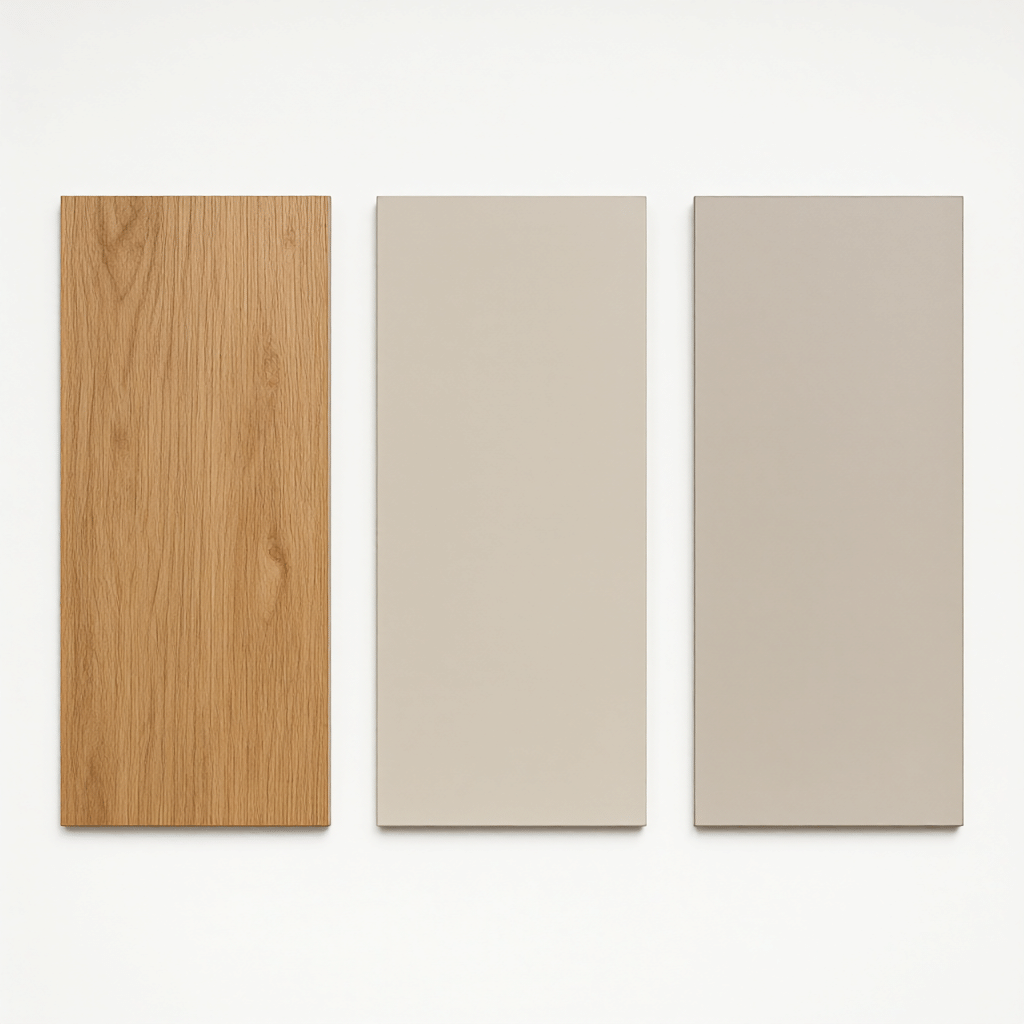
What does each door finish actually consist of?
Veneer doors — also called wood veneer finish doors — are constructed by bonding a thin slice of natural wood (typically 0.5 mm to 3 mm thick) onto a core substrate such as MDF, plywood, or particleboard. Real wood veneer comes from species like oak, walnut, mahogany, and ash. Synthetic or “engineered” veneer uses printed decorative films that mimic wood grain. The depth and variation of the grain give veneer its characteristic authenticity — no other finish replicates it quite the same way.
Laminate doors apply a decor paper impregnated with melamine resin under high heat and pressure to create a durable surface layer. This is what the industry commonly calls HPL door panels or melamine laminate. Thin-sheet laminates (also known as thermofoil or low-pressure laminate) bond similarly but produce a slightly less hard-wearing face. Laminates excel at resisting scratches, stains, and UV fading, making them the workhorse option for corridors and utility areas.
Painted doors start with a dense substrate — usually MDF — primed and then coated with multiple layers of polyurethane, acrylic, or water-based enamel. The result is a uniform, smooth surface available in any RAL or custom color. Painted surfaces can be gloss, satin, matte, or textured depending on the application method. When specifiers ask whether painted MDF doors can match veneer quality visually, the honest answer is yes for solid-color schemes, though they lack the tactile grain depth of real wood.
Which finish fits which building type best?
Hotel corridor door procurement typically favors laminate or painted finishes for their clean maintenance and impact resistance. Multi-unit residential projects often specify veneer for unit entry doors where visual appeal matters to residents. Commercial office fit-out can go either direction — laminate for back-of-house and painted for executive suites. A villa/custom entrance door specification frequently lands on veneer for exterior-grade appearance or powder-coated aluminum alternatives depending on exposure.
For projects needing fire-rated options, understanding EI30 vs EI60 vs EI90 fire door rating comparison alongside surface finish selection ensures compliance without compromising aesthetics.
Comparison Table
| Specification | Wood Veneer Finish | High-Pressure Laminate | Painted (MDF Base) |
|---|---|---|---|
| Composition | 0.5–3 mm natural/engineered wood slice over MDF/plywood core | Decorative melamine sheet fused under high pressure/heat | Primer + multiple paint layers over MDF substrate |
| Scratch resistance | Moderate — visible to light abrasion over time | High — resistant to scuffs and daily wear | Good — depends on paint grade and topcoat |
| Moisture resistance | Low to moderate (vulnerable to warping if not sealed properly) | High — suitable for kitchens, laundry rooms, bathrooms | Moderate — prone to chipping at edges if impacted |
| Aesthetic range | Authentic wood grain; limited to natural tones and stains | Broad finish options including wood-grain prints, solids, patterns | Unlimited solid colors; no natural grain texture |
| Repair/Touch-up | Can be sanded and refinished; deep damage may require veneer patching | Cannot be refinished; chips are permanent — panel replacement needed | Scuff and minor scratch repairable with touch-up paint |
| Service life | 10–15 years with proper maintenance | 10–20 years, minimal degradation | 8–15 years; yellowing or gloss loss possible over time |
| Typical cost tier | $$–$$$ | $–$$ | $$–$$$ |
Performance & Durability
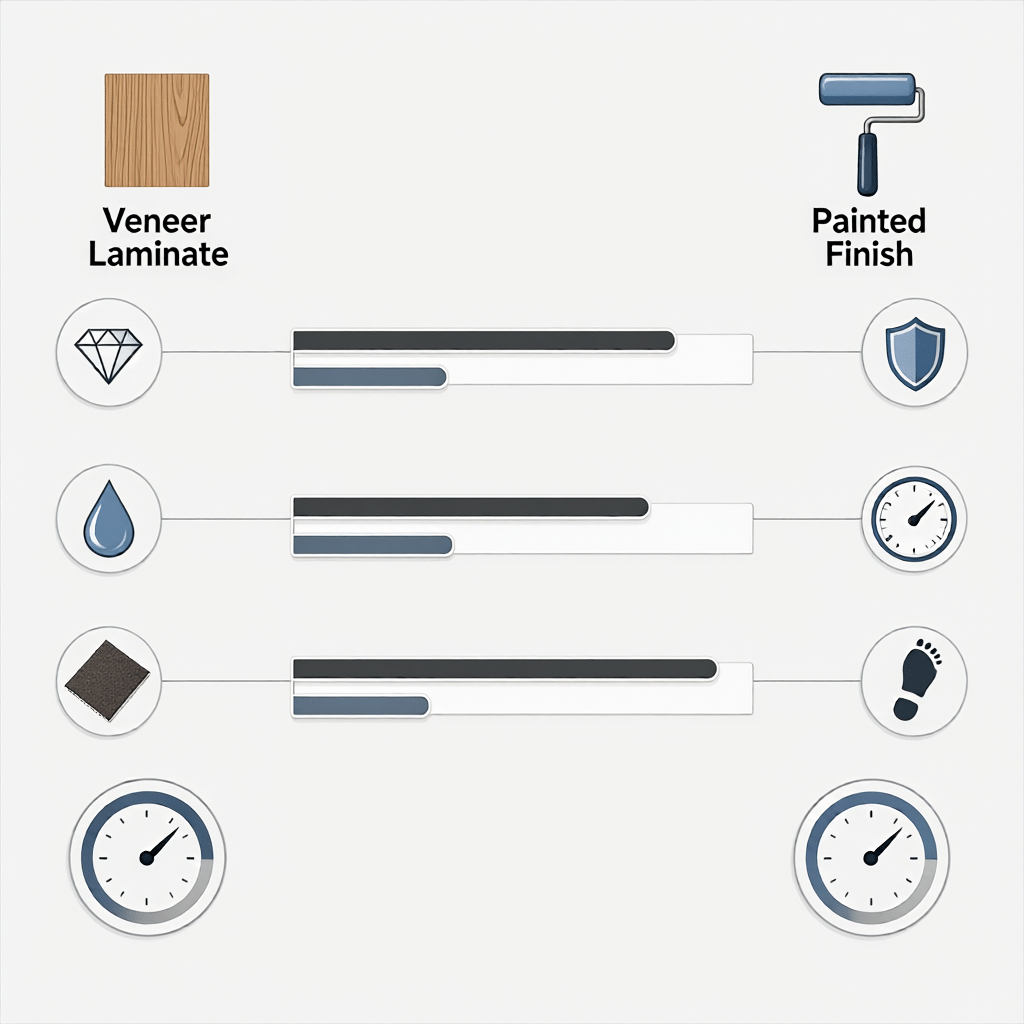
Which door finish lasts longest in demanding environments?
Durability differences among these three systems are significant and driven by surface chemistry rather than just hardness. Laminate surfaces consistently outperform both veneer and painted finishes in scratch and stain resistance due to the thermoset melamine matrix. In hotel corridor or hospital settings where doors receive constant contact, laminate maintains its appearance far longer than unpainted veneer or standard enamel.
Veneer sits in the middle — it offers acceptable scratch resistance for low-to-moderate traffic when properly coated with a clear protective lacquer, but it will show wear patterns within a few years in busy installations. A key advantage is that veneer can be sanded and re-stained, extending its usable life well beyond laminate’s replace-only scenario.
Painted doors present a unique vulnerability: edge chipping. Where the paint coat meets unsealed edges or high-impact zones, chips expose the bare MDF core, which swells rapidly when exposed to moisture. This makes painted doors less ideal for high-moisture areas unless manufacturers apply full-edge sealing and use premium chip-resistant paint systems. According to ASTM International material testing standards, surface durability should be validated through standardized abrasion and adhesion tests — buyers should request these test reports from suppliers before committing to volume orders.
Aging timelines matter for long-term projections. At one year, all three finishes typically look close to factory-new. By five years, veneer develops a warm patina that many owners find desirable; laminate shows minimal change unless subjected to extreme UV; painted surfaces may exhibit subtle gloss reduction or edge wear in high-contact areas. At ten-plus years, only well-maintained veneer and high-quality laminate remain visually acceptable without intervention.
When evaluating moisture resistance across rooms, laminate clearly leads for kitchens, laundry rooms, and bathroom applications. Veneer performs adequately in bedrooms and living areas with normal humidity but requires extra sealing near wet zones. Painted doors fall somewhere between — they handle normal interior conditions fine but need edge protection for damp environments.
Cost & Pricing
How much do veneer, laminate, and painted doors typically cost per unit?
Per-door pricing varies by size, core construction, and finish complexity. As a general benchmark for standard 80″ × 36″ hollow-core or semi-solid-core interior doors:
- Laminate doors: $45–$90 per unit at wholesale/project pricing
- Painted MDF doors: $60–$120 per unit
- Veneer doors: $80–$200+ per unit depending on wood species and veneer thickness
Commercial-grade solid-core versions push all categories upward. Custom sizes, exotic wood species for veneer, or specialized paint colors with metallic or chalk finishes add 20–50% to base prices. Volume discounts of 10–30% typically apply at 50+ door quantities, with further tiered reductions at 200+ units.
Factors driving price variance include core material density (solid wood core costs more than MDF), veneer grade (commercial grade vs. premium selected grade), laminate thickness and brand licensing, paint system layers and VOC compliance requirements, and regional labor and shipping costs. Understanding how MDF doors pricing per unit works helps contextualize why two painted doors from different suppliers may carry significantly different unit costs even at identical dimensions.
Request a Quote for Your Project Specs
Buying Factors for B2B Procurement
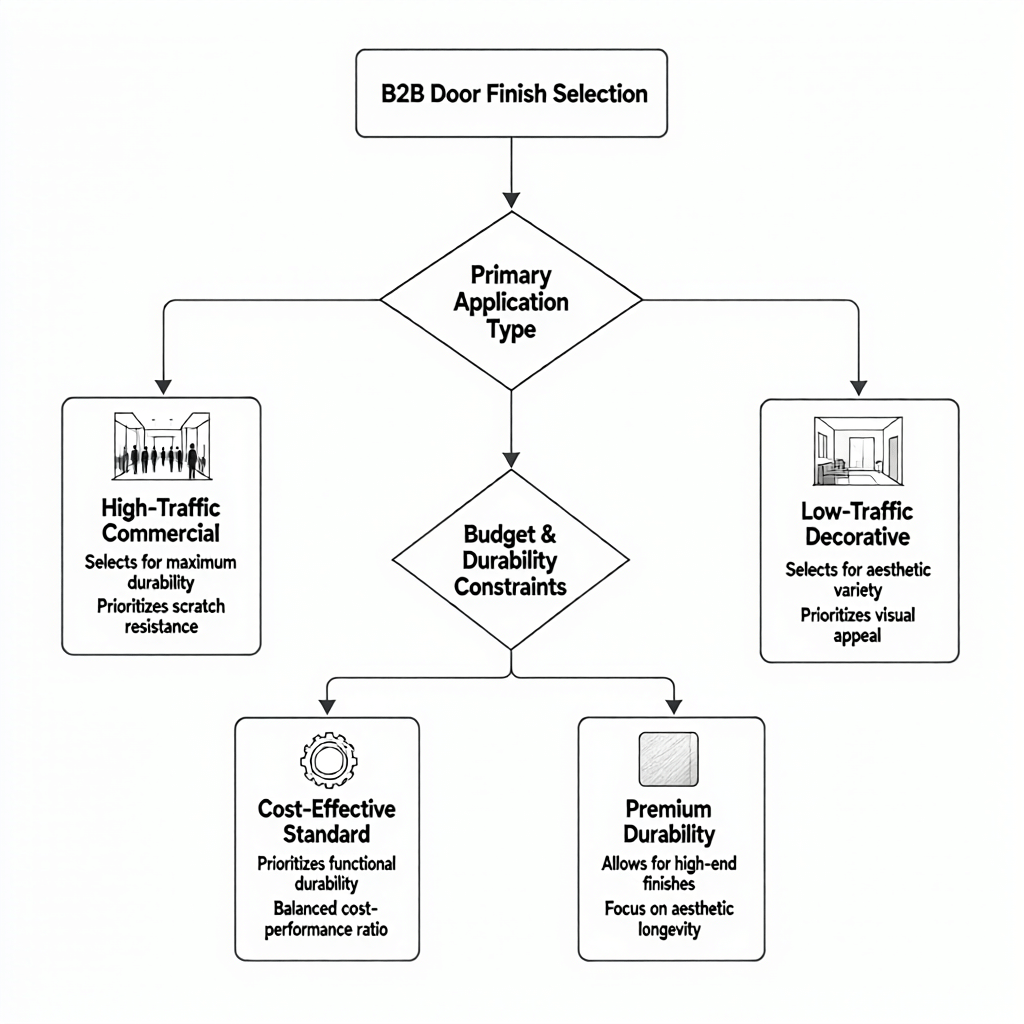
What factors matter most when choosing between veneer, laminate, and painted doors for a bulk order?
Regulatory compliance tops the list for international projects. Formaldehyde emission standards vary by region — CARB Phase 2 in California, EPA TSCA Title VI in the United States, and E1/E2 classifications in Europe all impose different limits on substrate board emissions. Verify that supplier MDF cores meet your target market’s requirement before signing purchase orders. See EPA guidelines on indoor air quality for current formaldehyde standards.
Lead time and MOQ directly affect project scheduling. Standard finishes (white painted, common oak veneer, basic laminate patterns) typically ship within 15–25 days from order confirmation. Exotic veneer species or customRAL colors may extend lead times to 30–40 days. Minimum order quantities range from 50 to 200 units depending on the manufacturer and finish type. Understanding FCL vs LCL shipping options early in the sourcing process prevents costly demurrage charges and ensures containers are optimally loaded — refer to our guide on 20ft container door loading configurations for planning purposes.
Customization flexibility differs substantially across the three systems. Veneer offers the richest natural aesthetic but limited color range — you’re working with what the wood species provides, plus stain options. Laminate provides the widest pattern variety including non-wood designs, textures, and colors at competitive pricing. Painted finishes offer unlimited solid colors but no grain texture, making them ideal for contemporary minimalist specifications where color consistency across large volumes is critical.
Quality verification criteria should include pre-shipment inspection reports covering air-tightness, water-tightness, and wind resistance testing for exterior applications. For interior doors, request sample panels for visual approval before full production, and confirm that the supplier conducts incoming material checks on substrate moisture content — excessive moisture in MDF causes delamination during veneer or laminate bonding. Our door factory audit checklist outlines the key evaluation points for potential suppliers.
Import documentation readiness is essential for cross-border procurement. Ensure your supplier can provide packing lists, proforma invoices, commercial invoices, certificates of origin, and accurate HS code classification and import duty information for your destination country. Delays in customs documentation can hold entire shipments for weeks.
Can painted doors match the aesthetic quality of real wood veneer in project specifications?
For solid-color and monochrome schemes, high-quality painted doors achieve a level of finish consistency that rivals — and sometimes exceeds — veneer because there are no grain variations between units. In architectural competitions where every door must read identically (hospital wards, dormitory corridors, fast-food restaurant restrooms), paint is genuinely advantageous. However, where wood character and warmth are design drivers, painted surfaces cannot replicate the depth and movement of real wood grain, regardless of paint technology or texture application methods.
Pros & Cons Summary
| Finish Type | Advantages | Disadvantages |
|---|---|---|
| Wood Veneer | Authentic grain; refinishing possible; premium feel; good for villa/custom entrances | Higher cost; sensitive to moisture; visible scratches over time; species availability constraints |
| Laminate | Highest scratch/wear resistance; moisture tolerant; lowest maintenance; cost-effective at scale | Cannot refinish; edge visibility if chipped; limited premium aesthetic perception |
| Painted (MDF) | Unlimited color options; smooth professional finish; consistent across large batches | Edge chipping risk; requires careful handling; not ideal for high-moisture zones without full sealing |
Evidence & Practical Notes
Field note: In multi-unit residential and hospitality projects we’ve observed, laminate doors consistently require the fewest warranty claims over a five-year period. Maintenance teams report that daily cleaning with standard commercial disinfectants does not degrade laminate surfaces, whereas painted doors often show cumulative scuff marks in corridor applications that demand frequent touch-ups.
Practical limitation: Veneer doors sourced from lower-tier manufacturers sometimes arrive with veneer peel at edges or corners due to inadequate adhesive application or insufficient pressing time during manufacturing. This defect is rarely visible in initial sample approval but surfaces en masse during full production — a risk that underscores the importance of factory audits and third-party inspection before shipment release.
Buyer takeaway: Match the finish to the traffic zone, not just the aesthetic preference. Specify laminate for corridors, stairwells, and shared amenities where physical abuse is inevitable. Reserve veneer for lobbies, executive suites, and residential units where appearance drives perceived value. Use painted doors where color cohesion across hundreds of units is architecturally mandated and moisture exposure is controlled.
Sourcing as a Manufacturer
Here is how the industry works — and here is how we meet these standards.
As a manufacturer, our approach to veneer, laminate, and painted door finishes is rooted in the same performance criteria every discerning buyer evaluates. We apply strict pre-shipment inspection protocols covering air-tightness, water-tightness, and wind resistance testing to ensure every batch meets functional expectations before leaving the factory. Our profile structures and fitting configurations are adjustable to align with local building codes in your target market, whether that’s European EN standards, American ASTM requirements, or Middle Eastern AS/NZS classifications.
We maintain direct factory supply channels, which means competitive pricing without middleman markup and the ability to offer full customization on size, color, glass, and hardware accessories tailored to your project drawings. Whether you’re sourcing for a hotel corridor refresh requiring 500 laminate doors or a villa development specifying 80 custom-sized veneer entrance doors, we support both FCL and LCL shipment arrangements with complete export documentation — packing lists, proforma invoices, and all customs-required paperwork handled from our end.
For buyers evaluating whether to proceed with a specific finish type for their upcoming project, Contact Us to discuss your requirements and receive a detailed quotation aligned to your quantity and delivery timeline.
Aesthetic Range & Customization Flexibility by Finish Type
What visual and design options does each finish system provide?
Wood veneer finishes offer the broadest natural-aesthetic range because every species carries unique grain patterns, color variation, and figure characteristics. Common domestic species available for B2B orders include oak (red/white), ash, walnut, cherry, maple, and elm. Exotic options such as teak, mahogany, sycamore, and ebony expand the palette for luxury villa, hotel lobby, and high-end residential projects. Veneer can be further customized through stain selection (lightNatural, medium walnut, dark espresso), wire-brushing for a textured matte feel, or gloss/satin clear lacquer topcoats that shift sheen without altering color. The one constraint: veneer cannot produce a solid non-grain color outside of stained/translucent treatments.
Laminate finishes excel in pattern variety rather than natural authenticity. HPL sheets come in wood-grain prints that replicate dozens of species (oak, teak, walnut, etc.) alongside bold solids, metallic accents, concrete looks, fabric textures, and graphic patterns. Thin-sheet laminates follow the same visual library. Custom colors are achievable through proprietary decor paper mills but typically carry higher MOQ thresholds (often 100+ panels per color). Laminate cannot be refinished or altered post-production — the design is locked into the sheet.
Painted MDF finishes provide truly unlimited solid-color capability through RAL, NCS, or Pantone matching. This makes them the default choice for brand-consistent environments: corporate offices requiring exact corporate colors, healthcare facilities needing hospital-grade palettes, hospitality chains specifying room-by-room color codes across hundreds of units. Painted surfaces can achieve flat matte to high-gloss finishes (typically 10–85 gloss units measured at 60° per ASTM D523). Textured paints and anti-bacterial topcoats add functional differentiation. The trade-off: no tactile grain depth exists regardless of paint technology.
Custom wood-grain embossing on laminate (EIR — embossed-in-register) has narrowed the realism gap for high-traffic applications where both aesthetic warmth and durability matter. However, even embossed laminate retains a uniform, repeatable pattern across all panels — a feature some specifiers prefer for large-scale consistency, while others consider it a limitation versus natural veneer variation.
Certifications & Testing Standards for B2B Buyers
What certifications and testing should B2B buyers require from door finish suppliers?
Reputable manufacturers validate their finishes against recognized international standards. Request these test reports before approving production samples:
| Test / Certification | Standard | What It Verifies | Typical Threshold |
|---|---|---|---|
| Formaldehyde emission | CARB Phase 2 / EPA TSCA Title VI (US); E1 (EU) | Substrate board safety | ≤0.05 ppm (CARB PH2); ≤0.124 mg/m³ (E1) |
| Laminate surface hardness | ISO 12543-2 / ANSI A208.1 | Resistance to indentation and wear | HPL ≥ 150 µm thickness class |
| Paint adhesion | ISO 2409 (cross-cut) / ASTM D3359 | Coating bond to substrate | Rating 4B–5B required for B2B |
| Surface abrasion resistance | Taber abraser (ISO 5470 / ASTM D4060) | Wear cycling endurance | Laminate: 2,000+ cycles; Paint: 500+ cycles |
| Water absorption / swelling | EN 317 (MDF) | Edge swelling after moisture exposure | <15% swelling after 24h immersion acceptable |
| Fire rating (exterior/engineered doors) | EN 1633-1 / UL 10C | Fire-resistance classification | EI30 / EI60 / EI90 per project requirement |
| VOC content (painted doors) | EPA VOC limits / EU Solvent Emissions Directive | Indoor air quality compliance | <50 g/L for water-based enamels |
| Wind / water tightness (architectural doors) | ASTM E283 / EN 12207 | Air/water infiltration under pressure | Class A1/E4/B5 minimum for exterior grade |
Buyers should insist on third-party laboratory reports rather than self-declared compliance. For fire-rated doors, verifying EI30 vs EI60 vs EI90 fire door rating specifications alongside surface finish selection ensures the chosen veneer, laminate, or paint system does not compromise the certified assembly’s fire-performance integrity.
Per ASTM International material testing standards, surface durability claims must be supported by lab-certified abrasion and adhesion data. For formald ehyde emissions relevant to indoor air quality, consult EPA guidelines and your local building-code authority. ICC standards referenced via iccsafe.org govern assembly-level fire and egress compliance that may constrain finish choices.
How Custom Specifications Affect Finish Selection & Total Project Cost
In what ways do custom dimensions, colors, and performance requirements shift pricing?
Standard sizes (e.g., 80″ × 36″ × 1¾”) in stock finishes carry the lowest per-unit cost. Any deviation triggers compounding adjustments:
- Non-standard dimensions (heights above 96″, width over 48″, specialty proportions): Add 15–40% to base price due to custom substrate cutting, handling losses, and reconfigured pressing cycles. Oversized doors may require thicker cores or reinforced frames to prevent warping, especially for veneer applications.
- Exotic wood species for veneer (ebony, figured walnut, burl slices): 25–75% premium over commercial-grade oak or ash. Limited-species availability can extend lead times by 2–4 weeks.
- Custom RAL/colors for painted doors: Single custom colors usually have no additional charge at 100+ unit quantities. Below that threshold, a color-mix setup fee of $200–$500 may apply. Metallic, pearlescent, or chalk finishes command 10–20% premiums due to specialized pigment costs.
- HPL custom patterns: Many laminate manufacturers hold standard decor libraries at no extra cost. Non-stock patterns typically require a minimum order of 200–500 panels to justify plate/setup fees ranging from $800 to $2,500 per design.
- Fire-rated assemblies with specified finishes: Applying veneer or paint over a fire-rated core requires tested and listed assembly combinations. An untested finish-lamination pairing voids the fire certificate — forcing specifiers toward pre-tested laminate systems or OEM-supplied factory-finished fire doors. Refer to our EI30 vs EI60 vs EI90 fire door rating comparison for guidance on balancing fire compliance with surface aesthetics.
- Full-edge sealing and specialty coatings: Doors specified for high-moisture zones (spa bathrooms, pool areas, marine environments) benefit from full-edge encapsulation and moisture-barrier primers, adding approximately $8–$15 per unit depending on finish type.
Volume tier discounts compound with customization. A 200+ door order in a custom paint color typically nets 15–25% off list, whereas the same quantity in exotic veneer may only achieve 8–12% discount due to raw-material cost rigidity. Planning FCL vs LCL shipping configurations and reviewing our 20ft container loading guide early prevents last-minute logistical surcharges that erode per-unit savings.
Weighted Procurement Decision Framework
How should B2B buyers systematically score each finish against project requirements?
Use the following weighted-criteria matrix to objectively evaluate veneer, laminate, and painted options. Assign each finish a score of 1–10 for every criterion, multiply by the project-specific weight, and sum for a comparative ranking.
| Criterion | Weight (Example) | Veneer Score (×Weight) | Laminate Score (×Weight) | Painted Score (×Weight) |
|---|---|---|---|---|
| Authentic appearance / wood grain | 20% | 9 × 0.20 = 1.80 | 5 × 0.20 = 1.00 | 3 × 0.20 = 0.60 |
| Scratch & wear resistance | 20% | 5 × 0.20 = 1.00 | 9 × 0.20 = 1.80 | 6 × 0.20 = 1.20 |
| Moisture / humidity tolerance | 15% | 4 × 0.15 = 0.60 | 9 × 0.15 = 1.35 | 6 × 0.15 = 0.90 |
| Color/design flexibility | 10% | 3 × 0.10 = 0.30 | 8 × 0.10 = 0.80 | 10 × 0.10 = 1.00 |
| Repairability / touch-up ease | 10% | 8 × 0.10 = 0.80 | 2 × 0.10 = 0.20 | 7 × 0.10 = 0.70 |
| Unit cost (lower = better) | 15% | 4 × 0.15 = 0.60 | 8 × 0.15 = 1.20 | 6 × 0.15 = 0.90 |
| Lead time reliability | 10% | 6 × 0.10 = 0.60 | 8 × 0.10 = 0.80 | 8 × 0.10 = 0.80 |
| Fire-rated compatibility | 10% | 5 × 0.10 = 0.50 | 9 × 0.10 = 0.90 | 6 × 0.10 = 0.60 |
| Total weighted score | 100% | 6.20 | 7.05 | 6.70 |
Note: Weights are illustrative. Adjust them based on your project’s priority — e.g., increase moisture weight to 25% for tropical-climate hospitality projects, or boost appearance weight to 30% for luxury residential sales units.
This framework quantifies what procurement teams often decide intuitively. It also reveals scenarios where the “best” finish shifts: a coastal resort prioritizing moisture resistance (weight → 25%) would likely see laminate win decisively, while a boutique hotel emphasizing authentic materiality (appearance weight → 35%) might tip toward veneer despite higher maintenance costs.
Pre-Shipment Quality Verification Checklist
What inspection steps should B2B buyers mandate before release?
Before authorizing shipment, request or conduct the following verification points:
- Incoming material certificates — Verify MDF core formaldehyde emission class (E1 or lower), veneer species documentation, and laminate lot numbers match approved samples.
- Moisture content check — Substrate should be 6–10% MC for interior doors; >12% risks delamination during bonding. Request a moisture-meter reading report from a random 5% sample batch.
- Visual approval panel — Compare first-article production pieces against the signed sample for color consistency, grain alignment, surface defects, edge banding quality, and hardware cutout precision.
- Adhesion test — Cross-cut tape test (ISO 2409) on painted and laminated panels; target rating 4B or higher. Reject lots falling below 3B.
- Dimensional tolerance — Verify door leaf dimensions within ±1.5 mm of drawing; squareness within ±2 mm diagonals; thickness within ±0.5 mm.
- Surface defect audit — Inspect for scratches, pinholes, glue bleed-through, uneven coating, visible seams at edges, and color batch inconsistency across the lot.
- Performance spot-checks — Where feasible, run Taber abrasion spot-tests on laminate and paint adhesion tests on painted units. Even minimal in-house validation catches supplier deviations.
- Packing integrity — Confirm corner protection, interleaving paper, and strapping meet export-grade standards to prevent transit damage — particularly critical for veneer doors where surface scratches are immediately apparent.
Our comprehensive door factory audit checklist expands on these points with auditor-level evaluation criteria you can use during supplier visits or virtual audits.
Supplier Profile: Manufacturing Standards That Matter
Here is how the industry works, and how we meet these standards at our facility. As a direct-from-factory manufacturer, we align every veneer, laminate, and painted door we produce with the frameworks outlined above — because an attractive comparison table means little if the product doesn’t survive its first year on site.
Our approach begins with material sourcing. All MDF substrates are sourced from certified mills meeting CARB Phase 2 and E1 formaldehyde emission standards, and we routinely provide third-party test reports upon request. Our veneer inventory covers commercial-grade oak, ash, walnut, and maple as standard stock, with exotic species available on order. Every incoming veneer sheet is inspected for grain consistency, thickness tolerance (0.5–3 mm per specification), and absence of defects before entering production.
For laminate applications, we work with HPL sheets rated to ISO 12543 standards, selecting surface textures and thickness classes matched to the traffic profile of each project. Embossed-in-register (EIR) options are available for clients seeking tactile realism alongside high-wear performance. Painted doors use multi-layer primer-and-enamel systems applied in climate-controlled booths, with cross-cut adhesion testing performed on each production batch. Our target adhesion rating is 4B–5B per ISO 2409, well above the minimum threshold most specifiers require.
Quality verification is built into our process rather than added as an afterthought. Before any shipment leaves our facility, every order undergoes air-tightness, water-tightness, and wind resistance testing for exterior-grade doors, plus dimensional checks, surface defect audits, and adhesion spot-tests for interior lines. We understand that a defective batch discovered after ocean freight is far more costly than catching it at the packing stage — which is why we treat pre-shipment inspection as non-negotiable.
Customization is where our factory model adds tangible value. Because we control the entire chain from substrate cutting through finishing, we can adjust profile structures, hardware preparations, and finish specifications to comply with the local building codes of your target market. Whether you need EI30 fire-rated assemblies with compatible surface finishes, non-standard dimensions for heritage building renovations, or brand-specific RAL colors executed consistently across 500+ units, our engineering team evaluates feasibility before quoting — so you receive accurate lead times and realistic cost projections, not optimistic estimates that stall during production.
Logistics are handled directly from our China factory with both FCL and LCL shipment options. We prepare complete export documentation including packing lists, proforma invoices, commercial invoices, and certificates of origin, drawing on years of foreign-trade experience to navigate customs requirements across diverse markets. If you’re planning container loads, reviewing our FCL vs LCL shipping comparison and 20ft container door loading guide helps you optimize cargo space and reduce per-unit landed cost.
Certification & Testing Standards for Door Finishes
Why certifications matter in B2B specifications
International procurement requires verifiable proof that finishes meet regional emissions, safety, and performance standards. Without certified test reports, buyers risk non‑compliance at customs, costly rework, or warranty disputes.
Key standards by region
- United States: CARB Phase 2 (California) and EPA TSCA Title VI set formaldehyde emission limits for composite wood products; ANSI BHMA A250.6 covers hardware durability and coating adhesion for interior doors.
- Europe: EN 14351‑1 defines performance characteristics for doors and windows (air‑tightness, water‑tightness, wind resistance); E1/E2 classifications govern VOC emissions from panel substrates.
- Fire ratings: NFPA 80 specifies installation and inspection requirements for fire‑door assemblies (EI30, EI60, EI90). Surface finishes must not compromise the rated integrity.
- Surface testing: ASTM D4236 (standard test methods for rating cleanliness of surfaces) and ISO 12543‑2 (laminate–based panels) provide benchmarks for scratch, stain, and abrasion resistance.
Buyers should request certificates for substrate emissions, coating adhesion, and, for exterior‑grade applications, performance tests per EN 14351 or local building codes. Refer to EPA guidelines on indoor air quality and ICC building code resources for current regulatory thresholds.
Procurement Buyer Checklist
Weighable criteria for finishing selection
Use the following matrix to score suppliers and finalize specifications:
| Criterion | Veneer | Laminate | Painted (MDF) | Minimum Acceptable Threshold |
|---|---|---|---|---|
| Formaldehyde emission cert (CARB/E1) | Required | Required | Required | ≤ 0.05 ppm (TSCA Title VI) |
| Scratch‑resistance rating (mm) | Moderate (≤ 2 mm) | High (≥ 3 mm) | Good (depends on topcoat) | ≥ 2 mm per ASTM D4236 |
| Moisture‑swelling resistance (%) | Low–moderate (2–5%) | High (1–3%) | Moderate (2–4%) | ≤ 3% swelling after 24h soak |
| Lead time (days from PO) | 20–35 | 15–25 | 15–30 | ≤ 30 days for standard specs |
| MOQ (units) | 50–200 | 50–150 | 50–200 | ≤ 200 units |
| Bulk discount (% off list) | 10–25% | 15–30% | 10–20% | ≥ 10% at 200+ units |
| Pre‑shipment inspection report | Air/water/wind test | Wear/stain test | Adhesion/coating thickness test | Full report required |
When scoring, prioritize projects with high humidity (kitchens, bathrooms, coastal regions) toward laminate or fully sealed painted systems. For premium residential or hospitality interiors where visual warmth drives resident satisfaction, specify veneer with clear protective lacquer and confirm edge‑sealing procedures.
Get a Free Quote with Our Customization Options
Manufacturer Perspective: How Jusen Door and Windows Meets These Standards
As a specialized manufacturer of solid‑wood, thermal‑break aluminum, and custom door/window systems, we approach finish selection through the same lens you do — balancing aesthetics, durability, and total cost while ensuring compliance with international codes.
How we match each finish to project requirements
- Veneer doors — We bond 0.5–3 mm natural or engineered wood slices onto kiln‑dried MDF/plywood cores using moisture‑cured polyurethane adhesives. Every batch undergoes a 24‑hour dwell test to verify delamination resistance. Exotic species (walnut, mahogany, white oak) are available in commercial or selected grades, with stains tailored to RAL/NCS palettes.
- Laminate doors — Our high‑pressure laminates (HPL) are fused at 150 °C and 1.2 MPa, achieving a surface hardness of ≥ 3 mm abrasion resistance. We offer both thick‑sheet (1–1.5 mm) and thin‑sheet thermofoil options, with UV‑stable inks that minimize fading under continuous interior lighting.
- Painted doors — We prime dense 18 mm MDF cores with water‑based acrylic sealers, then apply two topcoats of alkyd‑polyurethane hybrid enamel. Edge‑banding with PVC or ABS tape is standard to prevent chipping; gloss levels from matte (5–10 GU) to semi‑gloss (30–40 GU) are achievable.
Quality‑control checks aligned with industry norms
Before any container leaves our factory, we perform:
- Air‑tightness test (EN 12207 Level 4) for exterior‑grade installations.
- Water‑tightness test (EN 12208 Class E900) to verify seal integrity around sash and frame.
- Wind‑resistance deflection test (EN 12210 Class C5) for high‑rise applications.
- Formaldehyde emission verification via chamber method per ASTM D6007, targeting ≤ 0.05 ppm.
Our engineers can adjust profile dimensions, gasket compounds, and fitting hardware to satisfy local building codes — whether you’re specifying California CARB Phase 2, EU CE marking, or Middle East ESMA requirements.
Logistics & documentation support
We have extensive experience exporting FCL and LCL shipments directly from Chinese ports. Each order is accompanied by a complete packing list, proforma invoice, commercial invoice, certificate of origin, and material safety data sheets. For volume orders, we optimize container loading ratios (see our 20ft container door loading configuration guide) to reduce demurrage risk and unit freight cost.
Talk to Our Team for Project‑Specific Quoting
Sources & References
- ASTM International material testing standards — www.astm.org
- EPA guidelines on indoor air quality — www.epa.gov
- EI30 vs EI60 vs EI90 fire door rating comparison — doorwoodendoors.com
- MDF doors pricing per unit works — doorwoodendoors.com
- FCL vs LCL shipping options — doorwoodendoors.com
- 20ft container door loading configurations — doorwoodendoors.com
- door factory audit checklist — doorwoodendoors.com
- HS code classification and import duty — doorwoodendoors.com
- iccsafe.org — www.iccsafe.org











