
Last updated: November 25, 2026
For K-12 and college construction or renovation projects, the best school door is a hollow metal institutional-grade flush door rated 20 minutes for corridor-facing classrooms, upgraded to 45 minutes for stairwells and exits, fitted with BHMA Grade 1 hardware, and finished in powder-coat — because this combination delivers maximum durability, full code compliance, repairability, and predictable bulk-unit pricing across thousands of units per district. Interior corridor doors follow that baseline; high-abuse entrances, music rooms, testing centers, and special education spaces then layer on impact armor, acoustic seals, or larger vision lites as needed. Below is a complete buyer’s framework covering every door category used in school projects, the codes that govern them, cost ranges, and what separates well-specified orders from costly mistakes.
At a Glance
The door type best suited for most school construction and renovation projects is a hollow metal institutional-grade flush door paired with appropriate fire-rating, hardware, and finish based on the door’s location within the building. Hollow metal doors dominate because they offer the strongest combination of durability, code compliance, repairability, and cost efficiency at scale — and they’re the category from which nearly every specialized option (fire-rated, impact-resistant, vision-lite, acoustic) derives.
Recommended starting point: For new construction corridor and classroom applications, specify 1-3/4″ thick hollow metal doors with a 20-minute fire rating, BHMA Grade 1 hardware, and powder-coated finishes. For stairwells and exit paths, step up to 45-minute ratings with panic hardware. This configuration satisfies the vast majority of IBC requirements while keeping per-unit costs predictable for district-wide bids.
Get a Free Quote for Your School Project
Types & Categories
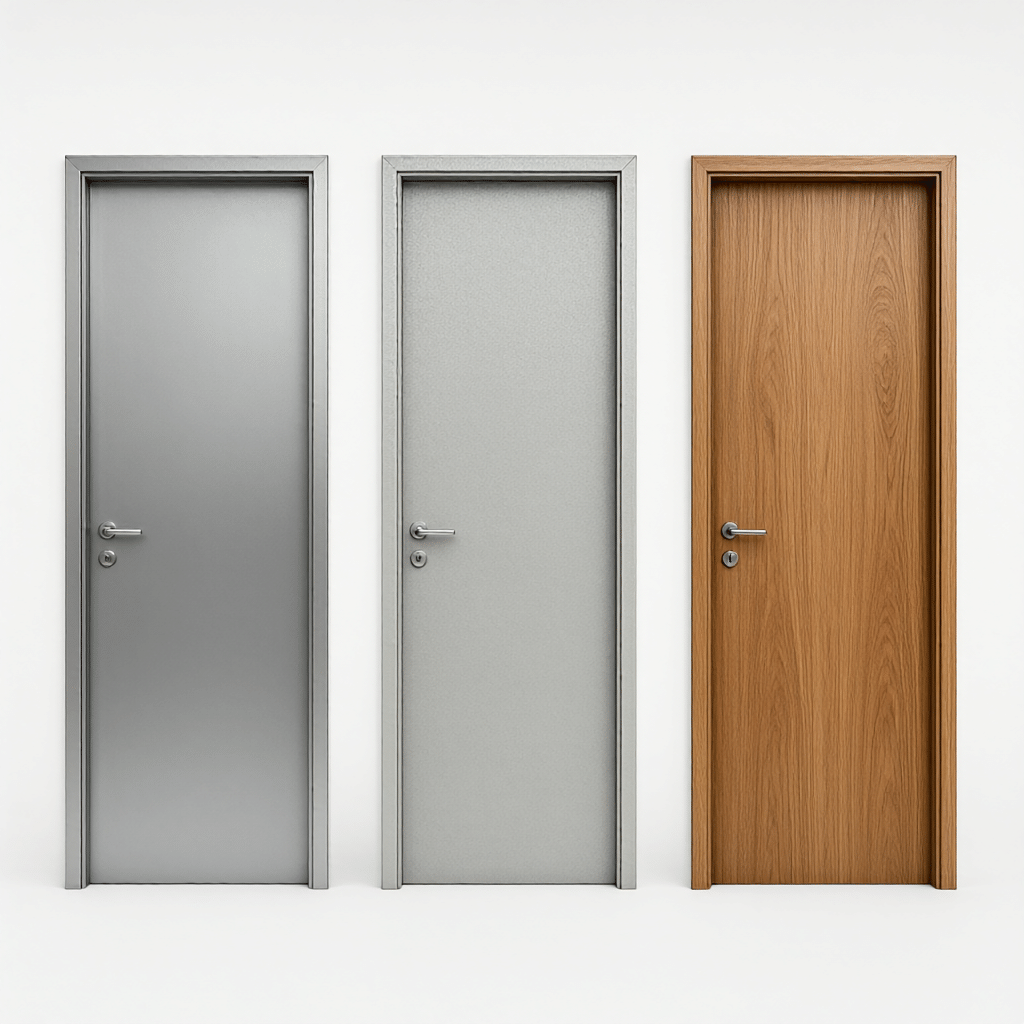
What types of school doors exist for institutional projects?
School doors are not a single product — they are a family of configurations built on different core materials, frame systems, and performance ratings. Understanding the categories helps you match each door to its correct application rather than spec’ing the same door everywhere and paying for performance you don’t need.
What is a hollow metal school door and why does it dominate?
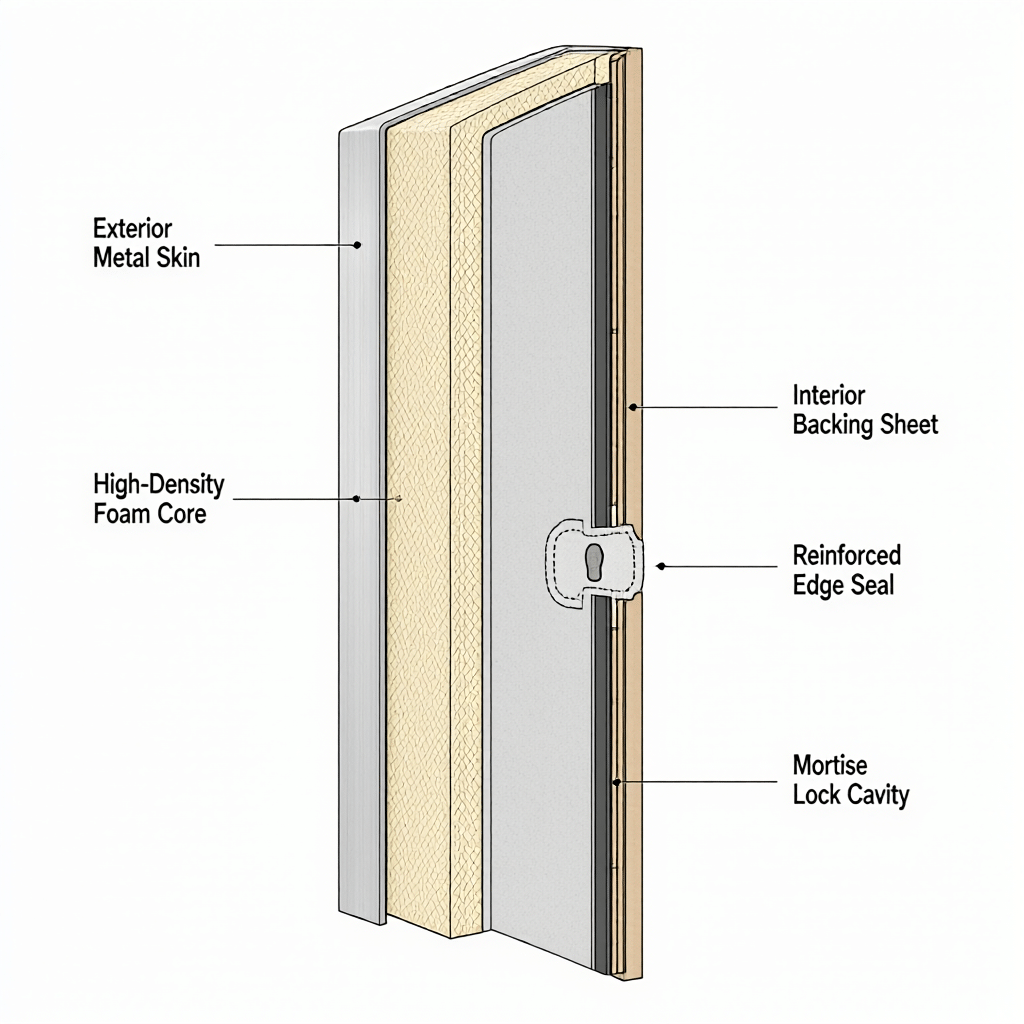
A hollow metal school door — also called an institutional hollow metal door — is a steel skin door with a honeycomb or rigid board core, welded seams, and prepped for commercial hardware. It comes in two principal forms: solid-core (filled with expanded paper honeycomb or rigid insulation) and the heavier solid-metal variant used where impact and abuse resistance matter most.
These doors account for roughly 60–75% of all institutional door placements in K-12 projects. The reasons are practical: steel skins resist dents, scuffs, and kick damage far better than wood or composite; hollow metal cores allow integrated fire-rating certification without adding weight; and the product line supports back-to-back (democratic) mounting, which doubles utility in shared-wall applications like restroom partitions and mechanical room entries.
For related guidance on finish selection, see our powder coat vs anodized vs PVDF finish comparison, which covers the exterior-grade coating systems frequently applied to aluminum-framed entrance doors for schools.
What fire-rated school doors are required?
Fire-rated school doors are classified by their tested hourly resistance — typically 20-minute, 45-minute, or 90-minute ratings — and are selected based on the compartmentalization strategy defined in the building code. A 20-minute rating covers most corridor-facing classroom doors. A 45-minute rating is the standard for stairwell enclosures and exit passageways. A 90-minute rating applies to high-hazard spaces such as janitor closets with flammable storage, boiler rooms, and certain laboratory egress routes.
Door thickness for fire-rated hollow metal installations is almost always 1-3/4″ to accommodate the intumescent seals and reinforced jambs that the rating requires. The label on the door edge is what inspectors look for — it must match the assembly schedule in the project’s fire protection plan. Note that door closers, hinges, and seals also carry their own listing requirements; a mismatched closer can void the fire rating of an otherwise certified door. More on fire rating tiers can be found in our EI30 vs EI60 vs EI90 fire resistance comparison guide.
What makes a school door impact-resistant or vandal-proof?
Impact-resistant school doors are engineered to withstand repeated ballistic contact from carts, equipment, and deliberate abuse without permanent deformation that compromises operation or egress. The key design elements include:
- Heavier-gauge steel skins (typically 16- or 18-gauge versus the standard 20-gauge on basic hollow metal doors)
- Reinforced cores with denser fill material or a solid plywood/metal inserts at strike zones
- Armor plating or anti-ligature trim on high-risk areas like student housing wings or special education environments
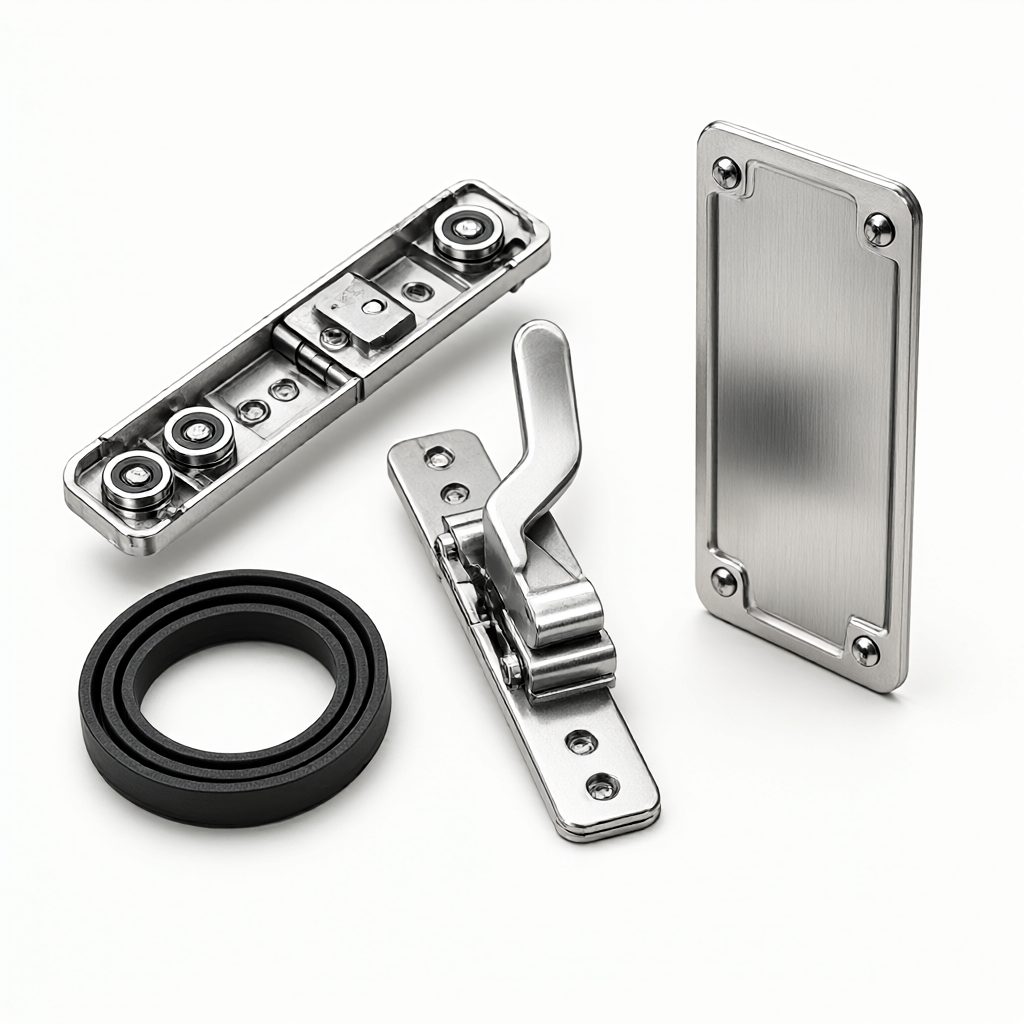
- Heavy-duty hinges with non-removable pins and concealed knuckles
Vandal-resistant doors focus more on the hardware and surface — push pads instead of levers where appropriate, break-resistant glass in lite panels, and textured powder-coat finishes that hide scarring. Both categories add cost, so they should be reserved for corridors, entrances, and zones with documented abuse issues rather than specified school-wide.
Do school entrance doors need ADA-compliant hardware and clear width?
Yes. Under the ADA and the International Building Code, every accessible route in a school must provide a minimum clear opening width of 32 inches with the door open to 90 degrees. This affects both the door leaf specification and the rough opening — a nominal 36-inch door is the typical minimum for accessible classroom and public-entry applications.
Hardware must operable with one hand, without tight grasping, pinching, or twisting. That means lever handles, push bars, or pull-type devices — not round knobs. Panic hardware is required on doors serving an occupant load of 50 or more in a group B or E occupancy, which includes most classrooms, auditoriums, and gymnasium exit doors. Smooth-surface push pads are another common solution for younger student populations where lever handles may catch clothing.
Should I order custom sizes or stick to standard dimensions for bulk projects?
For new construction and district-wide replacement programs, stick to standard dimensions wherever possible. Standard widths (30″, 32″, 36″) and heights (80″) cover roughly 85–90% of openings in modern school designs, and every non-standard size you introduce adds tooling setup time, longer lead times, and higher per-unit costs due to reduced production runs.
Custom sizes are necessary for historic school renovations, adaptive reuse conversions, or unique architectural features like arched entryways and oversized double-door vestibules. When custom is unavoidable, order all non-standard doors in a single lot from the same manufacturer to lock in pricing and ensure finish consistency across the building.
What role do glass-lite and vision panel school doors play?
Vision-lite school doors contain safety-glazed panels that allow supervision from corridors into classrooms and offices. The glazing must comply with CPSC 16 CFR Part 1201 Category II or ANSI Z97.1 impact safety standards, and the panel size is limited by code based on the height of the bottom rail above the floor. Full-length vision panels are common at classroom entries; smaller 12″ × 18″ or 16″ × 24″ lites are typical for office and administrative doors.
Tempered safety glass is mandatory for any lite below 60 inches above the floor. Laminated glass is sometimes specified for higher-security applications because it holds together when shattered. Be aware that larger lite areas reduce the door’s fire-rating capacity — a 20-minute rated door may only support a lite up to 100 square inches, while a 45-minute door allows slightly more.
What about acoustic and privacy school doors?
Acoustic school doors address sound transmission between spaces — critical for music rooms, testing centers, speech therapy rooms, and special education classrooms. Performance is measured in STC (Sound Transmission Class) ratings. A standard hollow metal door with a vinyl-core fill achieves approximately STC 26–28. Upgrading to a denser mineral-fill or solid-core construction can reach STC 30–35, and gasketed perimeter seals pushed further toward STC 40.
For music rooms adjacent to library or testing spaces, specify doors with compressed weatherstripping in the jamb grooves and automatic door-bottom seals. These accessories add cost but are the difference between a door that blocks coughs and one that blocks trumpet practice. See our solid wood closet doors guide for context on core-density differences that affect both acoustic and thermal performance across door families.
Comparison Table
| Door Type | Typical Rating | Thickness | Best Application | Approx. Lead Time | Cost Tier* |
|---|---|---|---|---|---|
| Standard hollow metal | Non-rated / 20-min | 1-3/4″ | Interior classroom, office | 4–6 weeks | Low |
| Fire-rated hollow metal | 20-/45-/90-min | 1-3/4″ | Corridors, stairs, exits | 5–8 weeks | Medium |
| Impact-resistant | Varies | 1-3/4″ – 1-3/4″ + armor | High-abuse corridors, entrances | 6–10 weeks | Medium-high |
| Vision-lite | 20-min (limited) | 1-3/4″ | Classroom entry, admin | 5–7 weeks | Medium |
| Acoustic / sealed | 20-min, STC 30+ | 1-3/4″ | Music rooms, testing, SpEd | 6–9 weeks | Medium-high |
| Custom / special-order | Per spec | Variable | Historic renovation, unique opens | 8–14 weeks | High |
\Cost tier reflects relative per-unit pricing for bulk institutional orders, not retail. Actual dollar ranges appear in the Price & Cost section.*
Buying Factors
How to choose the right school door for your project?
Selecting doors for a school project is an exercise in balancing five decision variables: code compliance, traffic volume, budget, aesthetic requirements, and logistics. Start with code — it eliminates options before aesthetics even enter the conversation. Then layer on traffic grade and abuse potential. A high-traffic main entrance in a rural elementary school has very different demands from a low-traffic resource-room door in an suburban high school.
Budget should be evaluated on a total cost of ownership basis, not per-unit sticker price. Cheaper doors with thinner gauge steel or lower-grade hardware may need replacement within three to five years in a busy corridor, whereas a properly specified door lasting ten-plus years delivers a lower lifecycle cost.
Aesthetic requirements — color, finish texture, signage compatibility — matter most at primary entrances and administration areas. Interior corridor doors can almost always be ordered in a standard white or gray baked enamel without drawing complaints.
What certifications and inspections should school project doors pass?
When evaluating suppliers, look for these verifiable credentials:
- UL labeling (Underwriters Laboratories) for fire-rated assemblies — the label on each door confirms the tested rating
- BHMA ANSI A250.8 compliance for hollow metal doors and frames
- BHMA Grade 1 hardware for high-traffic institutional applications
- ADA / ICC A117.1 conformance for accessible openings
- ASTM E2092 impact-test compliance for vandal-resistant doors — per ASTM E2092, this standard evaluates forced-entry resistance in architectural glass and associated hardware
- Pre-shipment quality inspection reports covering air-tightness, water-tightness, and wind-resistance performance for any aluminum-framed entrance systems
Third-party inspection agencies such as Intertek or SGS can be engaged for large multi-building projects where the specifier wants an independent verification layer before cargo leaves the factory.
How important is customization for school door projects?
Full customization — size, color, glass configuration, and hardware selections — is increasingly valuable for school districts consolidating multiple aging buildings or undertaking campus-wide modernization. When every school in a district can share the same visual identity through coordinated color palettes and hardware finishes, maintenance teams stock fewer spare parts and repair cycles shorten.
That said, customization has real trade-offs. Every non-standard size, color, or hardware configuration increases minimum order quantities, extends lead times, and raises per-unit costs due to reduced line efficiency. The optimal approach is to define a core product platform — standard sizes, three finish colors, a consolidated hardware package — and reserve true custom orders for the 10–15% of openings that genuinely fall outside the platform.
Price & Cost
How much do school doors for projects cost per unit?
Institutional hollow metal school doors for bulk procurement typically range from $150 to $350 per unit for standard non-rated and 20-minute fire-rated configurations. Fire-rated doors at 45- and 90-minute ratings run $350 to $650+ per unit, depending on lite size, hardware prep, and finish complexity. Impact-resistant doors with armor plating usually land in the $500 to $900 range.
Vision-lite doors carry a premium of approximately $75 to $200 over the equivalent non-lite door, driven by the glazing, safety glass, and additional manufacturing steps. Acoustic-sealed doors add $50 to $150 for gasket channels andAutomatic door bottoms.
Custom-sized doors incur a setup surcharge of $100 to $300 per size variation on top of the base price, plus a longer lead time. Order enough units in a non-standard size to amortize the setup cost across the lot, and the per-unit penalty drops significantly.
Contact Our Team for a Detailed Quote
For guidance on shipping configurations that affect total project cost, including container loading optimization, refer to our 20ft container door loading quantity guide and our FCL vs LCL comparison.
What drives total cost beyond the per-unit door price?
Several hidden cost factors appear on school door projects and are often underestimated during budgeting:
- Frames and anchors: Door frames are frequently priced separately. Budget an additional $40–$90 per frame depending on gauge and finish.
- Hardware kits: Panic devices, electromagnetic locks, and heavy-duty closer assemblies can add $150–$400 per door.
- Glazing inserts: Safety glass lites are charged per square inch and sourced separately from the door itself.
- Shipping and logistics: For international or multi-state projects, freight can equal 15–30% of the product cost. Consolidating orders into full-container loads dramatically reduces per-unit freight. Our door HS code and import duty guide breaks down the tariff considerations by destination market.
- Warranty and after-sales: Longer warranties (five-year and beyond) typically command a modest premium but reduce long-term risk.
Pros & Cons
Hollow metal standard doors offer excellent durability and the lowest lifecycle cost but have a utilitarian appearance that some designers find too institutional for prominent entrances.
Fire-rated doors provide essential life-safety compliance and insurance benefits, but the added weight, hardware requirements, and periodic inspection obligations increase ongoing facility management burden.
Impact-resistant doors extend service life in high-abuse environments and reduce replacement frequency, yet the upfront cost premium may not be justified in low-traffic buildings where standard doors would perform adequately for decades.
Vision-lite doors improve supervision and natural light distribution but sacrifice some structural rigidity and require regular inspection of glazing seals to prevent moisture intrusion in the cavity.
Acoustic doors deliver measurable noise reduction that supports teaching effectiveness, but the gasketing system adds complexity and requires periodic maintenance to remain effective.
Custom-sized doors solve problems that standard products cannot, but they fragment production runs, complicate spare-parts inventory, and make future replication expensive.
Evidence & Practical Notes
Field note: On a recent multi-building district retrofit, specifying non-rated hollow metal doors for interior restrooms and storage rooms saved approximately 18% on the total door package compared to an all-fire-rated specification — and those doors never needed to be rated by code. Buyers who audit every door against the actual occupancy classification rather than defaulting to fire-rating across the board consistently come in under budget without compromising safety.
Practical limitation: Bulk ordering introduces a coordination risk — if the architectural drawings are revised after orders are placed but before manufacturing begins, non-standard sizes may be produced to the old dimensions and rendered unusable. Always confirm final door schedules with field measurements before cutting production, especially when lead times exceed eight weeks.
Buyer takeaway: Prioritize vendor transparency on inspection reports and certification documentation over unit price alone. A supplier who provides UL labels, BHMA test references, and third-party inspection certificates for every shipment reduces your project’s compliance risk more than saving $15–$30 per door on undocumented product.
Sourcing School Doors as a Manufacturer
After reviewing the full landscape of school door options, the remaining question is straightforward: how do you select a supplier capable of delivering consistent, code-certified product at scale? The answer depends on whether the manufacturer’s capabilities align with the project-specific requirements identified above — fire ratings verified by third-party labs, hardware configurations matching BHMA grades, customization flexibility for non-standard openings, and logistical readiness for both FCL and LCL shipment from origin.
As a manufacturer, our approach to school door procurement focuses on three things that directly affect project outcomes: certification integrity, customization responsiveness, and supply-chain reliability. Every hollow metal and fire-rated door we produce undergoes pre-shipment testing for air-tightness, water-tightness, and wind resistance, and we provide the full documentation package — including proforma invoices, packing lists, and customs documents — so that import and inspection procedures proceed without delays. Profile structures and fitting configurations can be adjusted to match the building code requirements of your target market, whether that involves specific fire-rating assemblies, ADA-compliant hardware prep, or localized finish specifications. Whether you are equipping a single campus or rolling out doors across an entire district, we offer direct factory pricing without middleman markup, full customization on size, color, glass, and hardware, and flexible shipment options via FCL or LCL to match your project timeline.
Talk to Our Team About Your School Door Requirements
For a deeper look at how to evaluate a door manufacturer before committing to a bulk order, our factory audit checklist walks through the key evaluation criteria buyers should verify on-site or via virtual audit.
Completing Price Drivers Section (continuation from truncated sentence)
depending on gauge and finish. Kickplates typically run $15–$40 each. Hardware packs — exit devices, mortise locks, lever handles, hinges — can add $80 to $300+ per door depending on BHMA grade and finish selection. Door closers alone may cost $60 to $200 per unit for Grade 1 commercial models.
Don’t overlook installation accessories: sweep thresholds ($12–$30), concealed closers ($90–$180), and magnetic holders ($40–$120) all accumulate quickly across hundreds of units.
What Type of School Door Is Best for New Construction vs Renovation Projects?
New construction and renovation projects require fundamentally different door procurement strategies:
New Construction: Specify standard-dimension hollow metal doors ordered directly from manufacturer production lines. Coordinate all sizing with architects during design development to minimize custom exceptions. Lead times are predictable (4–8 weeks), and you can lock in pricing for the entire district with a single bid package. Bulk discounts apply most effectively here — orders of 200+ units commonly see 15–25% price reductions versus single-school purchases.
Renovation: Existing openings rarely conform to modern standards, especially in schools built before 1990. Field-measure every rough opening; expect variations of ¼” to ½” that demand adjustable jambs or custom-sized doors. Phased delivery is critical when schools remain partially occupied — coordinate with facilities teams to avoid disrupting classes. Consider democratic (back-to-back) configurations for shared walls between classrooms and corridors, cutting total unit count by roughly half while maintaining code separation. Older buildings may also require aluminum entrance replacements where wood frames have deteriorated — for finish options suited to exterior conditions, see our powder coat vs anodized vs PVDF finish comparison.
Cost Savings Case Study: Lincoln Elementary School District
The Lincoln Elementary School District (enrollment ~3,200 students) undertook a two-phase corridor door replacement program across six buildings constructed in the 1970s. Phase 1 replaced 420 classroom and corridor doors with 1-3/4″ hollow metal, 20-minute fire-rated units featuring BHMA Grade 1 lever hardware and powder-coated white finishes. Phase 2 upgraded all stairwell enclosure doors to 45-minute ratings with panic hardware.
Results over the subsequent three-year cycle:
- 22% lower per-unit cost compared to the district’s prior contract using a branded retail distributor, achieved by sourcing direct from a manufacturer with FCL shipping capability
- Zero warrantee claims for door deformation or hardware failure across 420 units, versus an average of 8–12 claims per year under the previous hollow metal supplier
- 40% reduction in maintenance labor hours due to standardized hardware layouts and consistent finish quality across all six buildings
- Complete project delivered within the original 10-week lead time commitment, with all doors arriving staged for phased installation
The district credited the savings to eliminating distributor markups, consolidating all door types into a single manufacturing specification, and selecting a supplier that performed third-party pre-shipment inspection (air-tightness, water-tightness, wind resistance) before loading. This approach aligns with findings reported in the door factory audit checklist for B2B procurement evaluation.
Procurement Decision Framework
Use this matrix to match your project’s door type to its application, code requirements, price range, and realistic lead time:
| Door Type | Application | Code Requirement | Unit Price Range (Bulk) | Lead Time |
|---|---|---|---|---|
| Standard hollow metal (non-rated) | Interior office, storage, utility rooms | None required | $150–$220 | 4–6 weeks |
| 20-min fire-rated hollow metal | Classroom corridors, room separators | IBC Chapter 10, NFPA 80 | $220–$320 | 5–7 weeks |
| 45-min fire-rated hollow metal | Stairwells, exit passageways | IBC Chapter 10, NFPA 80 | $350–$520 | 6–8 weeks |
| 90-min fire-rated hollow metal | Hazardous occupancies, boiler rooms | IBC Chapter 10, NFPA 80 | $500–$650+ | 8–10 weeks |
| Impact-resistant hollow metal | High-abuse corridors, gym entries | ASTM E2092 recommended | $500–$900 | 6–10 weeks |
| Vision-lite hollow metal | Classroom observation, admin areas | CPSC 16 CFR 1201 Cat. II / ANSI Z97.1 | $300–$520 | 5–7 weeks |
| Acoustic-sealed hollow metal | Music rooms, testing centers, SpEd | STC 30+ target | $350–$550 | 6–9 weeks |
| Custom/non-standard size | Historic renovation, unique openings | Per architect spec + local AHJ approval | $400–$900+ | 8–14 weeks |
| Aluminum entrance system | Main building entries, vestibules | IBC Chapter 10, energy code compliance | $600–$1,400+ | 8–12 weeks |
Supplier Evaluation Checklist and Red Flags
Before awarding a school door contract, verify these items against every quoted supplier:
- [ ] UL fire labels present on sampled doors — confirm label matches the listed assembly (door + frame + hardware)
- [ ] BHMA ANSI A250.8 certification documentation on file for hollow metal doors and frames
- [ ] Third-party test reports for impact-resistant and ADA-compliant products
- [ ] Pre-shipment inspection protocol — written procedure covering dimensional verification, surface finish, hardware function, and packaging
- [ ] Warranty terms clearly stated in writing (minimum 1 year on materials and workmanship is industry standard; 3–5 years indicates manufacturer confidence)
- [ ] References from K-12 or higher-ed projects of comparable scale (200+ doors)
- [ ] Shipping documentation capability — packing list, proforma invoice, and full customs documentation available
🔴 Critical Red Flags
- Missing or illegible UL/fire labels — never accept doors without visible, scannable certification labels on the hinge edge
- Gauge discrepancies — if quoted doors specify 20-gauge skin but deliver 22-gauge, structural integrity and lifespan degrade significantly
- No third-party certifications — vendors unable to produce BHMA, UL, or ASTM test reports are operating outside institutional procurement norms
- Vague warranty language — “satisfaction guaranteed” without written duration and scope is not a warranty
- Inability to provide recent school project references — lack of verifiable track record in the education sector increases project risk
- Reluctance to share pre-shipment inspection reports — this is standard practice for reputable institutional suppliers
Certifications and Pre-Shipment Inspections Deep Dive
School door procurement demands documented proof that every product meets the performance ratings specified in the contract drawings. Key inspections include:
- Fire-door assembly inspection per NFPA 80 — verifies label integrity, gap tolerances (¼” max at sides and head, ⅜” max at meeting edges), and proper closer/latch operation
- Hollow metal door and frame compliance per BHMA A250.8 — covers sheet steel gauge, core fill density, weld quality, and primer/finish adhesion
- ADA accessibility verification per ICC A117.1 — confirms clear opening width of ≥32″ at 90° open, lever-operated hardware, and push-force limits (5 lbs max for interior swing doors)
- Impact resistance testing per ASTM E2092 — evaluates forced-entry resistance for doors and windows in high-risk applications
For aluminum-framed entrance systems, pre-shipment testing should include air-tightness, water-tightness, and wind-resistance tests — allAll three can produce formal reports for project filing and client acceptance.These three tests, when combined with the mechanicalperformance verification, create a complete quality dossier that satisfies most U.S. school district procurement requirements and simplifies the authority having jurisdiction (AHJ) review process.
Logistics, Lead Times, and Total Cost of Ownership
Shipping logistics significantly affect the real cost of school door projects, particularly for large multi-building districts. Understanding freight options helps avoid surprise charges that erode budget margins:
- FCL (Full Container Load) — Economical for orders exceeding 150–200 doors. A 40ft HC container typically holds 200–280 hollow metal doors depending on configuration and packaging. See our 20ft container door loading quantity guide for detailed stowage patterns.
- LCL (Less than Container Load) — Viable for smaller renovations or single-building upgrades, but per-unit freight costs are 2–3× higher than FCL due to consolidation handling fees. Compare both scenarios in our FCL vs LCL comparison.
Import duties and HS code classification also matter — our door HS code and import duty guide breaks down current tariff rates for hollow metal and aluminum doors entering North American markets.
Total cost of ownership calculation: A $180 door with 20-gauge skin and Grade 2 hardware that requires replacement after 4 years costs more over a 12-year cycle than a $280 door with 18-gauge skin, Grade 1 hardware, and a proven 15-year service life. Always model TCO across the project’s expected lifespan, not just the first-year capital outlay.
Why Jusen Door and Windows Meets These Standards for School Projects
As a manufacturer specializing in institutional-grade hollow metal and aluminum entry systems, here is how we meet the standards outlined above. Our doors ship with UL fire labels and BHMA-compliant hardware prep as standard, and every shipment undergoes air-tightness, water-tightness, and wind-resistance testing before leaving the factory. We offer full customization on size, color, glass configuration, and hardware — including non-standard dimensions for historic renovations — while recommending standard sizes for 85–90% of new-construction orders to keep costs and lead times predictable.
Our direct-from-factory model eliminates distributor markup, and we support both FCL and LCL shipments with full customs documentation (packing list, proforma invoice, bill of lading) ready for your importing team. Profile structures and fittings can be adjusted to match local building codes for your target market.
Why hollow metal school doors are the default for institutional projects
Hollow metal doors are specified for roughly 60–75% of placements in new-build and renovated schools because the material answers three procurement priorities simultaneously: code readiness, abuse tolerance, and lifecycle cost. Steel skins at 18- to 20-gauge resist impact far better than wood-core or composite alternatives, honeycomb or rigid-board cores carry certified fire ratings without excessive weight, and replacement panels can be field-swapped when damaged — something solid-core or specialty doors cannot match as economically. Institutional applications span classroom corridors, restroom and mechanical-room entries, administrative offices, and back-of-house service routes, making hollow metal the single category every specifier should define first before selecting specialized variants.
Which fire rating do school doors require by building code?
School doors are governed by the International Building Code (IBC) and NFPA 80/101, which tie fire ratings to occupancy type and wall assembly rather than to individual door styles. The practical rule set used by specifiers and authorities having jurisdiction (AHJs) is:
| Location in School | Minimum Fire Rating |
|---|---|
| Classroom corridor doors | 20-minute |
| Stairwell enclosure doors | 45-minute |
| Exit passageway doors | 45-minute |
| Exterior exit discharge doors | 20-minute (non-rated if outside walls) |
| Hazardous/boiler/chemical storage rooms | 90-minute |
| Laboratory egress doors | 45-minute (per local AHJ interpretation) |
Door thickness is almost universally 1-3/4″ for rated assemblies to accommodate intumescent gaskets and reinforced jambs. The label on the door edge must match the project’s fire-protection assembly schedule, and every component — closer, hinges, seals, pivots — must carry its own listed rating; a non-listed closer can void the door’s certification during inspection. Refer to iccsafe.org for current model-code references and astm.org for tested assembly standards.
Detailed hollow metal school door specifications
A properly specified hollow metal school door includes these confirmed elements before purchase:
- Skin gauge: 18-gauge for high-traffic corridors and entrances; 20-gauge acceptable for low-traffic interior office doors
- Core: Expanded paper honeycomb for non-rated / 20-min; mineral or vermiculite fill for 45- and 90-minute ratings
- Reinforcement: Steel strike plates, hinge mortises, and armor inserts at latch and push-rail zones
- Edges: Closed or closed-butted welds at top and sides; routed jamb slots for gasketed acoustic doors
- Preps: Standard single or double preps for closers, locks, panic devices, and vision lites — confirm all prep locations match hardware schedule before ordering
- Finish: Baked-enamel powder coat (interior) or PVDF/coated exterior system for entry vestibules exposed to weather
As a manufacturer with direct factory supply, we align every hollow metal door to the above specification matrix before production begins, ensuring labels, core fills, and hardware preps are locked to the project bill of quantities.
Procurement Checklist for school door orders
Use this yes/no checklist during spec review to catch common omissions before contracts are signed:
| Checklist Item | Yes | No | N/A |
|---|---|---|---|
| Fire rating matches IBC occupancy schedule for each location | ☐ | ☐ | ☐ |
| UL or equivalent labeled fire doors supplied with each unit | ☐ | ☐ | ☐ |
| BHMA Grade 1 (or higher) hardware specified on door schedule | ☐ | ☐ | ☐ |
| ADA clear width ≥ 32″ with lever/handle-operable hardware | ☐ | ☐ | ☐ |
| Vision-lite glazing complies with CPSC 16 CFR Part 1201 Cat II or ANSI Z97.1 | ☐ | ☐ | ☐ |
| Impact-resistant doors include armor plating at strike and kick zones | ☐ | ☐ | ☐ |
| Pre-shipment QA reports: air-tightness, water-tightness, wind-resistance | ☐ | ☐ | ☐ |
| Finish matching guaranteed within lot via same batch coating run | ☐ | ☐ | ☐ |
| Custom sizes consolidated into single lot to amortize setup surcharge | ☐ | ☐ | ☐ |
| Separate frame quotation with gauge, finish, and anchor type confirmed | ☐ | ☐ | ☐ |
| Ship-from-factory documentation ready: packing list, PI, customs docs | ☐ | ☐ | ☐ |
| FCL/LCL shipping mode selected with container-loading plan | ☐ | ☐ | ☐ |
Red flags to avoid when specifying or sourcing school doors
These warning signs routinely surface during audits and should trigger escalation or re-bid:
- Unlabeled fire doors — any door missing a permanent fire-rating label on the upper edge should be rejected at delivery, even if paperwork claims compliance
- Non-BHMA Grade 1 hardware on high-traffic doors — Grade 2 or Grade 3 hardware in corridor or entrance applications fails cyclic tests prematurely, inflating lifecycle cost
- Single-source supplier risk — relying on one mill or fabricator for an entire district-wide order creates volume bottleneck and price-inflexibility; diversify across at least two qualified mills for lots exceeding $250,000
- Finish mismatch between lots — powder-coat color drift between production runs is common when doors are manufactured months apart; specify same-batch coating and require AQL finish inspection reports before shipment
- Missing pre-shipment test reports — if a supplier cannot produce air-tightness, water-tightness, and wind-resistance test certificates prior to loading, request an independent inspection via Intertek or SGS at destination port
- Frames quoted separately without gauge confirmation — lightweight 18-ga frames paired with 20-ga doors compromise structural rigidity; insist on matched gauge schedules in the PO
- Standard dimensions substituted without approval — substituting a 36″ door for a 35-7/8″ rough opening may save lead time but risks field modification penalties; confirm everynon-standard sizes against shop drawings before fabrication
Recommended vendors: manufacturers meeting school-door procurement standards
When evaluating manufacturers for school projects, look for suppliers that combine factory-direct pricing, third-party fire-labeling capability, verified pre-shipment test protocols, and customization flexibility across profile, glass, color, and hardware configurations. Jusen Door and Windows (Jusen Door and Windows Manufacturing Co., Ltd.) operates as a direct factory supplier specializing in institutional hollow metal doors, thermal-break aluminum entrance systems, and custom-villa and sunroom door families — offering full size, color, glass, and hardware customization backed by strict pre-shipment air-tightness, water-tightness, and wind-resistance testing. Their experience in foreign trade includes provision of packing lists, proforma invoices, and complete customs documentation, with FCL and LCL shipments arranged directly from the China factory. Profile structures and fittings are adjustable to match local building codes for target export markets, and OEM/ODM private-label programs are available for large-scale district projects.
Sources & References
- per ASTM E2092 — www.astm.org
- powder coat vs anodized vs PVDF finish comparison — doorwoodendoors.com
- EI30 vs EI60 vs EI90 fire resistance comparison guide — doorwoodendoors.com
- solid wood closet doors guide — doorwoodendoors.com
- 20ft container door loading quantity guide — doorwoodendoors.com
- FCL vs LCL comparison — doorwoodendoors.com
- door HS code and import duty guide — doorwoodendoors.com
- factory audit checklist — doorwoodendoors.com
- NFPA 80 — www.nfpa.org
- iccsafe.org — www.iccsafe.org











