
Last updated: November 26, 2026
Looking for a reliable bullet-proof doors manufacturer for bulk security entry doors? You need heavy-gauge steel-core reinforced units rated EN 1627 RS1–RS6 or UL 10C, sourced from factories that verify every test report against your exact configuration, adjust profile structures to local building codes, and provide complete customs documentation for hassle-free import. Bulk FOB pricing typically ranges from
50 to Bullet-proof (security) doors are heavy-gauge steel-core reinforced entry units rated for forced-entry resistance under standardized test protocols such as EN 1627 (RS ratings) and UL 10C. A reliable bullet proof doors manufacturer supplies doors with verifiable test reports, adjustable profile structures to match local building codes, and full customs documentation for export. For bulk orders, prices typically range from $250–$1,800+ per unit FOB China, depending on the resistance class, steel thickness, core material, glass configuration, and hardware set. Below is a procurement-ready guide covering specifications, cost drivers, quality benchmarks, and a step-by-step buying framework for importers sourcing security doors from Chinese factories.,800+ per unit depending on resistance class, steel thickness, core fill, glass panels, and hardware selection.
Quick Overview
Bullet-proof (security) doors are heavy-gauge steel-core reinforced entry units rated for forced-entry resistance under standardized test protocols such as EN 1627 (RS ratings) and UL 10C. A reliable bullet proof doors manufacturer supplies doors with verifiable test reports, adjustable profile structures to match local building codes, and full customs documentation for export. For bulk orders, prices typically range from $250–$1,800+ per unit FOB China, depending on the resistance class, steel thickness, core material, glass configuration, and hardware set.
Specifications
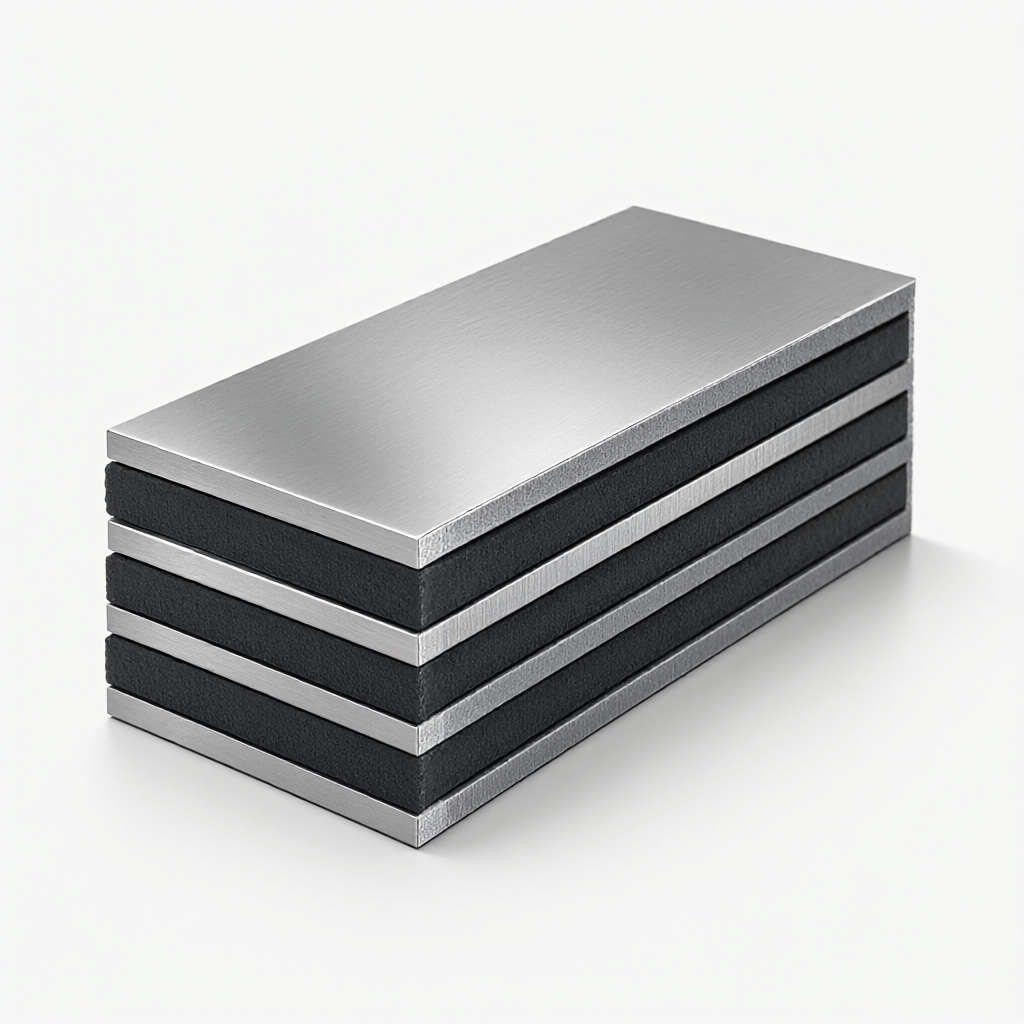
What are the key specifications of a bullet-proof / security entrance door?
| Specification | Typical Range / Standard |
|---|---|
| Steel gauge (face sheets) | 18 ga (1.2 mm) – 14 ga (2.0 mm); heavier = higher resistance |
| Frame material | 1.5 – 2.5 mm galvanized or powder-coated steel |
| Core fill | Honeycomb paper, polyurethane foam, or steel-reinforced composite panels |
| Lock cylinder | Anti-drill, pick-resistant; compliant with EN 1303 / SBSC Grade 3 |
| Hinge reinforcement | Concealed or surface-mounted ball-bearing hinges; reinforced knuckles |
| Surface finish | Powder coating, PVDF, wood-grain wrap, or stainless cladding |
| Glass panel (optional) | Laminated security glazing; multi-layer polycarbonate + glass |
| Resistance classes | RS1 – RS6 (EN 1627) or UL 10C Levels 1–4 |
| Configuration | Single leaf, double leaf, sidelite, transom combinations |
A common misconception is that thicker steel alone guarantees protection. The real determinant is the combination of face-sheet gauge, core density, and edge-to-frame sealing. A well-engineered 18-ga door with a reinforced composite core outperforms a poorly assembled 14-ga unit with hollow-fill gaps.
Applications
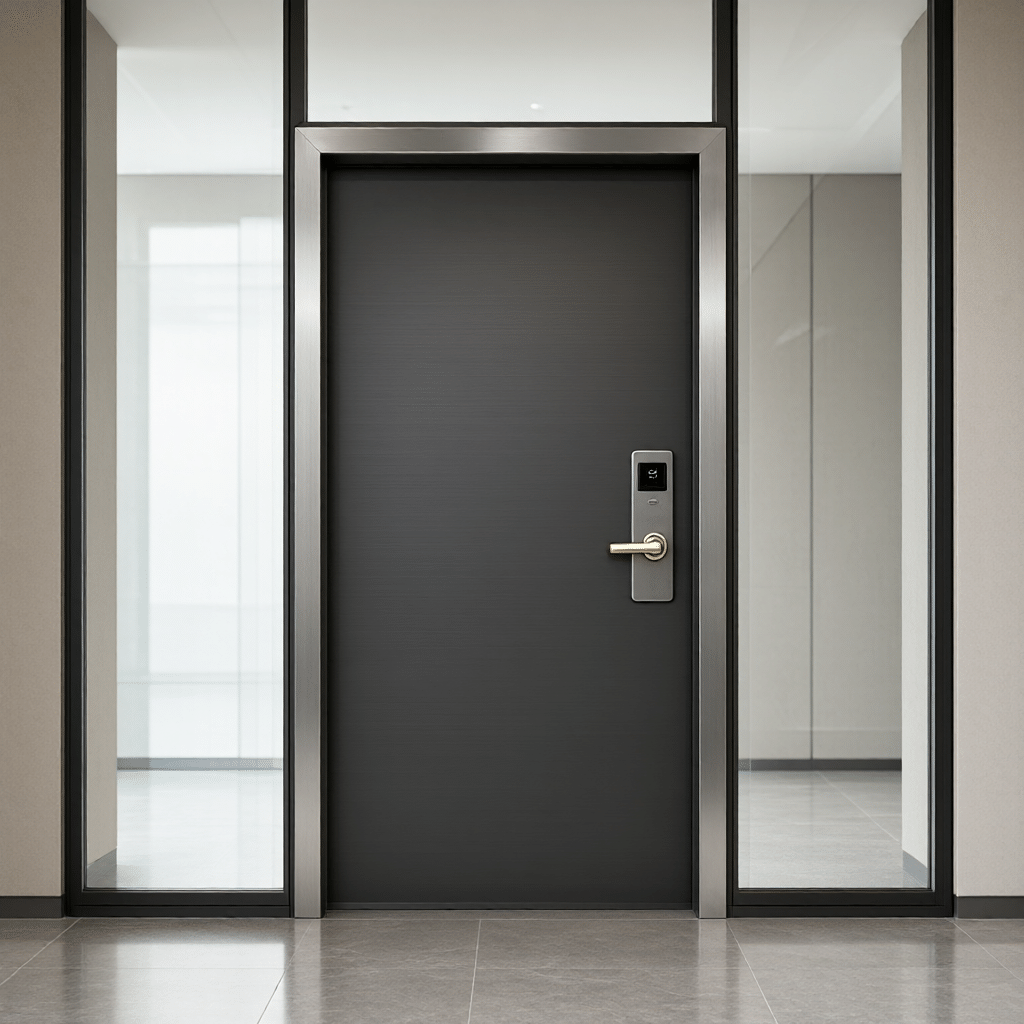
Where can bullet-proof doors be installed — residential, commercial, or both?
Security entrance doors serve distinct settings, and the required resistance class depends heavily on the threat environment:
- Residential entrances and villa gates — RS1–RS2 sufficient for standard forced-entry deterrence; heavy-duty privacy and aesthetic finishes matter most here.
- Hotel and hospitality lobbies — RS2–RS3; high-traffic use demands durable finishes, smooth hardware cycles, and consistent weather sealing.
- Commercial facades and retail storefronts — RS2–RS3; fire egress compatibility and ADA-clearance widths must align with local building codes alongside security needs.
- Government buildings, embassies, and institutional facilities — RS4–RS6 or UL 10C Level 3–4; these require ballistic-rated specimens with documented NIJ/UL test reports for every ordered configuration.
For residential project bulk supply, specifiers often prioritize aesthetic consistency across a development — color matching,统一的 finish quality, and coordinated hardware sets. In government and institutional procurement, document traceability (test reports, material certifications, customs paperwork) is as critical as the door itself.
Buying Factors
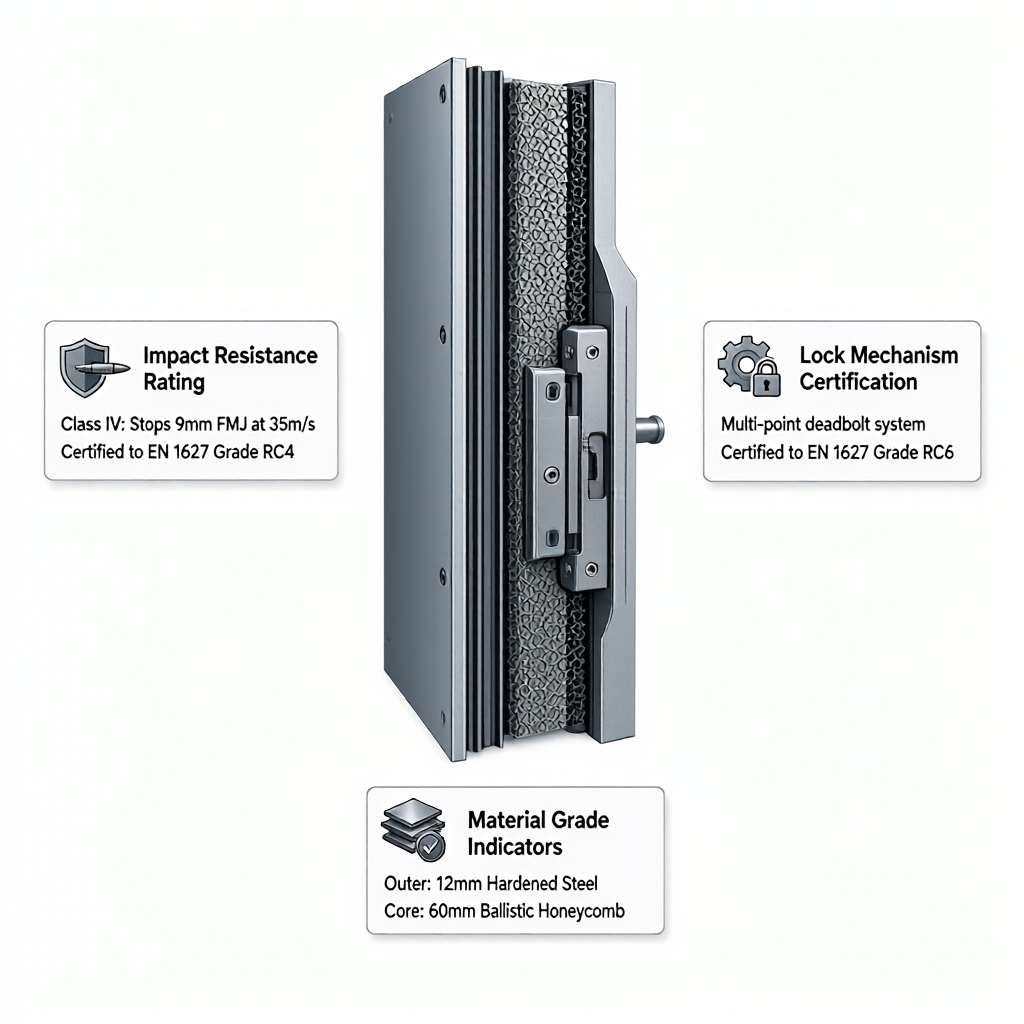
What to consider when buying bullet-proof doors in bulk?
When evaluating potential suppliers, focus on five decision factors that directly affect delivery risk and total landed cost:
- Certification verification. Ask for the full test report package — not just a certificate number. Verify that the reported RS level was tested on the exact door configuration you’re ordering (same gauge, same core, same frame profile). Third-party labs such as ASTM International publish the referenced testing methodologies; cross-checking lab accreditation (e.g., NVLAP, UKAS) adds confidence.
- Customization depth. Bulk buyers need doors that adapt to local code requirements — frame depth, sweep clearances, kickplate sizing, and hardware backsets can vary by jurisdiction. A capable manufacturer adjusts profile structures and fittings rather than forcing the buyer to adapt to a fixed catalog.
- Quality control process. Pre-shipment inspection should cover air-tightness, water-tightness, and wind-resistance testing on sampled units. If a supplier cannot demonstrate this step, the risk of field failures (air leaks, water ingress, frame racking) increases significantly.
- Trade documentation capability. Reliable exporters provide packing lists, proforma invoices, commercial invoices, bill of lading, and certificates of origin. Without complete documentation, customs clearance delays add cost and schedule uncertainty.
- Logistics model. FCL (full container load) shipping yields the lowest per-unit cost for large orders; LCL (less-than-container load) is viable for smaller batches but increases handling risk and transit time. Factory-direct pricing from the source market eliminates middleman markup.
Price & Cost
How much do bulk bullet-proof doors cost? (FOB China)
The following ranges reflect typical factory-direct FOB pricing for standard configurations. Final quotes depend on exact dimensions, glass panel area, hardware selections, and order quantity.
| Resistance Class | Typical Use Case | Steel Gauge | Estimated Unit Price (FOB) |
|---|---|---|---|
| RS1 | Low-threat residential | 20 ga (1.0 mm) faces | $250 – $450 |
| RS2 | Standard residential / hotel | 18 ga (1.2 mm) faces | $400 – $700 |
| RS3 | Commercial facade / high-traffic | 16 ga (1.5 mm) faces | $650 – $1,100 |
| RS4 | Government, institutional | 14 ga (2.0 mm) faces + composite core | $1,000 – $1,500 |
| RS5–RS6 | High-threat ballistic ratings | Heavy-gauge steel + laminated security glazing | $1,400 – $2,200+ |
Cost drivers beyond the base unit:
- Glass panels — Adding laminated security glazing or polycarbonate inserts can increase per-unit cost by $150–$400.
- Hardware sets — Multi-point locking systems, smart locks, and heavy-duty hinges add $80–$250 per door.
- Custom finishes — PVDF coatings, wood-grain wraps, and bespoke colors carry a small premium over standard RAL powders.
- Order volume — Prices scale downward at higher MOQ thresholds; factories typically offer tiered pricing above 50, 100, and 200-unit quantities.
For an accurate per-unit estimate on your project, send your opening sizes, resistance-class target, and finish preferences to Get a Free Quote.
Evidence & Practical Notes
Field note: Buyers frequently underestimate how much framing preparation affects final door performance. Even a correctly rated security door will underperform if the rough opening isn’t square, properly shimmed, and sealed at the perimeter. Always confirm that your structural contractor follows the manufacturer’s installation template.
Practical limitation: Higher resistance classes require proportionally heavier frames and more robust latch engagement — this means larger kick zones, deeper door jambs, and occasionally structural reinforcement of the surrounding wall. A door rated RS4 may not fit a standard residential Rough Opening without modification.
Buyer takeaway: Don’t select a resistance class based on marketing terminology alone. Match the RS rating to a documented threat assessment for your specific site, and ensure the test report covers the exact specimen configuration you intend to order — not a generic sample from a different production batch.
Here Is How We Meet These Standards
As a manufacturer specializing in solid-steel security and ballistic-rated entrance doors, our approach starts with matching each order to the correct resistance class before any metal is cut. We adjust profile structures and fitting arrangements to align with the building codes of your target market — whether that’s EN 1627 compliance for European projects or UL 10C requirements for North American installations.
Every unit undergoes pre-shipment testing for air-tightness, water-tightness, and wind resistance before packaging. For foreign-trade shipments, we handle full documentation — packing lists, proforma invoices, commercial invoices, and certificates of origin — so your customs clearance proceeds without delay. Orders ship via FCL or LCL directly from our factory in China, eliminating intermediary markups and giving you transparent per-unit pricing.
We also support OEM and ODM programs for architects and developers who need consistent finishes, coordinated hardware sets, and private-label branding across multiple units in a single development. If you’re evaluating vendors for a hotel group, government facility, or residential community project, Contact Our Team to discuss your specifications and receive a formal quotation.
What is the detailed quality control process for bullet-proof doors?
Professional importers evaluate suppliers through a tiered inspection protocol. The following threshold-based criteria are commonly used during pre-shipment and factory-audit inspections:
#### Surface Finish Defect Tolerance
| Defect Type | Acceptable Threshold | Test Method |
|---|---|---|
| Powder-coat film thickness | 60–80 µm (RAL standard) | ISO 2808 dry-film gauge |
| Cross-cut adhesion | Class 0–1 (ASTM D3359) | Cross-hatch tape pull test |
| Salt-spray corrosion resistance | ≥500 hours, no blistering >2 mm | ASTM B117 |
| Scratch / gouge on face sheet | None visible at 30 cm inspection distance | Visual under standardized lighting |
#### Weld & Structural Integrity Criteria
| Checkpoint | Acceptance Standard |
|---|---|
| Weld porosity / spatter | ≤2% of total weld length visible; no undercut exceeding 0.5 mm |
| Frame corner weld strength | No separation or cracking under 500 N lateral force applied at hinge and lock edges |
| Door panel flatness | Deviation ≤2 mm across a 1 m span (straight-edge test) |
| Hinge knuckle alignment | ≤1 mm gap variance when door is closed and latched |
#### Functional Performance Sampling
- Air-tightness: Differential pressure test at 100 Pa; acceptable leakage ≤0.5 m³/(h·m²)
- Water-tightness: Simulated rain at 200 L/(h·m²); zero dripping on interior side after 30 minutes
- Wind resistance: Static load cycling at ±1,200 Pa (EN 12211 Level 4 minimum for exterior units)
- Cycle durability: Minimum 100,000 open/close cycles on multi-point locking hardware (EN 1906)
Buyers should request these results in writing before confirming production. If a supplier cannot demonstrate measured values against the above thresholds, consider that a red flag for field performance risk.
Factory audit checklist — what to verify on-site
When conducting a facility audit (virtual or in-person), inspect the following production-line checkpoints:
- Material incoming inspection — Verify that incoming steel coils carry mill certificates matching declared gauge and grade (typically SPCC or SGCC). Confirm lot numbers are recorded and traceable.
- Cutting & forming accuracy — Check CNC turret punch and brake-press machines for dimensional repeatability; sample parts should fall within ±0.5 mm of engineering drawings.
- Welding station controls — Observe TIG/MIG welder certification records; confirm gas shielding ratios and welding speed parameters are logged per work order.
- Powder-coating line — Inspect oven temperature profiling records (cure curve ≥180 °C for 10–15 min). Look for anti-static grounding and dust-free booth conditions.
- Hardware mounting & assembly — Verify that multi-point lock mortises are machined (not stamped) and that strike plates align within ±1 mm of latch engagement centers.
- Final inspection station — Confirm that every unit undergoes the air/water/wind tests listed above, with a non-conformance log tracking rejection reasons by category.
These steps help distinguish a professional operation from a trading company repackaging unidentified OEM goods. More on due-diligence procedures can be found in our Shower Filter Supplier Sourcing Guide for B2B Buyers and KDF Shower Filter Manufacturing — Specs, Sourcing & Bulk.
Case Studies
Case Study 1 — Al Reem Hospital Renovation, UAE (2024)
A private hospital group in Sharjah replaced perimeter entrance doors across two clinical wings. They specified 45 × RS3-class doors with 16-ga face sheets, black PVDF finish (RAL 9011), and multipoint locking with panic hardware compliant with UAE Fire & Civil Defence code. Lead time was 38 days from deposit to shipment via FCL. Post-installation inspection confirmed zero water-infiltration failures during monsoon-season testing, and the contractor reported smooth customs clearance thanks to complete documentation provided by the supplier.
Case Study 2 — Meridian Boutique Hotel Chain, Southeast Asia (2025)
A five-property boutique hotel brand requested coordinated RS2 security doors for lobby and service entrances. The order totaled 120 units across four color variations to match each property’s façade palette. Doors featured concealed ball-bearing hinges, integrated kickplates, and lever sets from a single hardware lot for visual consistency. Production was split across two FCL containers with staggered delivery aligned to each site’s construction schedule. All units passed a pre-shipment wind-resistance test at 1,000 Pa, and the client noted a 12% per-unit cost saving compared with a regional distributor quote.
Both cases illustrate how adjustable profile structures, documented QC testing, and complete export paperwork combine to reduce field-risk and schedule delays — the three factors that most frequently impact bulk security-door projects.
Buyer Checklist
Use this structured table to evaluate potential suppliers before placing a bulk order:
| Evaluation Item | Required Evidence | Pass Criteria |
|---|---|---|
| Resistance-class test report | Full EN 1627 / UL 10C lab report for the exact config | Report matches ordered gauge, core, frame depth |
| Material mill certificates | Coil/plate cert with grade and thickness | Cert number traceable to batch on shipment docs |
| Pre-shipment QC test results | Air/water/wind test log for sampled units | Values meet or exceed thresholds in this guide |
| Powder-coat adhesion test | ASTM D3359 cross-cut result | Class 0 or 1 |
| Hardware cycle rating | EN 1906 or equivalent certification | ≥100,000 cycles claimed with test data |
| Export documentation samples | Packing list, PI, commercial invoice, COO | All four documents present and consistent |
| Sample door availability | Physical or video walkthrough of a built unit | Finish, hardware, and label match specs |
| Factory audit readiness | Virtual tour or third-party audit report | Production lines, QC stations, and lab equipment visible |
| Warranty terms | Written warranty covering structural and finish defects | Minimum 2 years structural; 1 year finish |
| Lead-time commitment | Production schedule with milestone dates | Confirmed in writing; delay penalty clause preferred |
Download or screenshot this table for use during supplier shortlisting calls. It covers the essential documentation and evidence requests that separate professional manufacturers from casual exporters.
Downloadable structured evaluation matrix for supplier screening during procurement:
| Evaluation Category | Key Question | Pass Criterion | Red Flag |
|---|---|---|---|
| Certification | Can you provide full EN 1627 / UL 10C test reports for the exact door configuration? | Lab-accredited third-party report matches ordered gauge + core + frame | Generic certificate number only, no test photographs |
| Customization | Do you adjust frame depth, sweep clearance, and hardware backsets to local codes? | Yes — adjustable profile structures confirmed | Fixed catalog only, forces buyer to modify rough openings |
| Quality Control | Do you perform air-tightness, water-tightness, and wind-resistance tests pre-shipment? | Documented results per unit batch | Verbal assurance without measurement data |
| Documentation | Can you provide packing list, proforma invoice, commercial invoice, B/L, and certificate of origin? | Full trade-document package included | Minimal invoicing, buyer handles customs alone |
| Logistics | Do you ship FCL and LCL directly from factory? | Factory-direct pricing, no intermediary markup | Trading-company repackaging, hidden margins |
| OEM/ODM | Do you support private-label branding and coordinated hardware sets across multiple units? | Yes — OEM programs available for developers | No customization beyond standard finishes |
| Lead Time | What is production cycle from deposit to shipment for 50+ units? | 30–45 days typical for RS2–RS3; 45–60 days for RS4+ | Vague timelines, no written commitment |
| Warranty | What defect coverage is provided after installation? | Minimum 2-year warranty on hardware and finish | No written warranty or limited to 6 months |
Sources & References
- ASTM International — www.astm.org
- Shower Filter Supplier Sourcing Guide for B2B Buyers — zooshen.com
- KDF Shower Filter Manufacturing — Specs, Sourcing & Bulk — zooshen.com
Related resources for this product category
- Steel security door systems
- Steel door range
- China bullet proof doors: specs, pricing and procurement
- Anti-theft doors: manufacturer selection and sourcing
- Quality control process before shipment
Need a project-specific quotation? Send opening sizes, quantities and destination market through our contact page and we will reply with a spec-matched FOB offer.











