
Last updated: November 25, 2026
FOB, CIF, and DDP are three standard international commercial terms (Incoterms® 2020) used when importing doors. Under FOB you pay freight and insurance from the origin port onward; under CIF the supplier covers ocean freight and minimum insurance to your nearest port; under DDP the supplier handles all transportation, import customs clearance, and duty payments, delivering doors directly to your site. The right choice depends on your order volume, import experience, and how much cost transparency versus convenience you need.
Quick Answer
FOB, CIF, and DDP are three of the most common incoterms used when importing doors internationally, and each one shifts costs, risk, and logistics responsibility differently between you and your supplier. Under FOB, you pay for ocean freight and insurance from the Chinese port onward, and risk transfers once goods are loaded onto the vessel. Under CIF, the supplier covers freight and minimum insurance to your nearest port, but risk still transfers at loading. Under DDP, the supplier handles nearly everything — including import clearance and duty payment — delivering doors directly to your specified address. Choosing the right term depends on how much control you want over shipping, your familiarity with customs procedures in your market, and whether you need door-to-door delivery or can manage port-side arrangements yourself.
Detailed Explanation
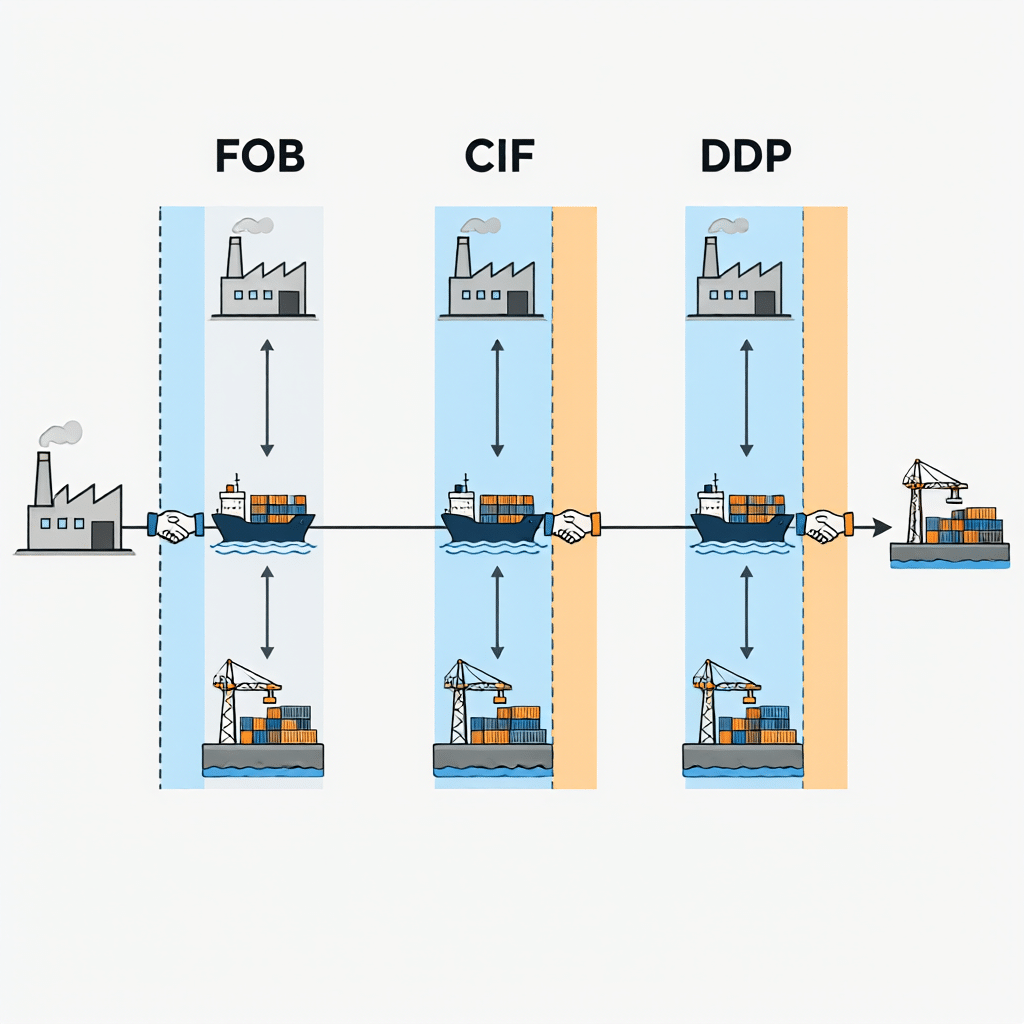
What does FOB mean for door shipments and who handles what?
Free On Board means the seller delivers the goods on board the vessel nominated by the buyer at the named port of shipment. The seller clears the goods for export and bears all costs and risks until that point. From the moment the cargo is loaded, you — the buyer — take over freight payment, marine insurance, unloading charges at destination, and everything after.
For door procurement this matters because aluminum and solid wood doors are bulky, heavy items that generate significant freight costs. Under FOB, you get full freedom to negotiate your own forwarder and shipping schedule rather than accepting the supplier’s pre-negotiated rates. This is often where buyers find meaningful savings, especially on high-volume orders moving FCL. You also gain visibility into port-handling fees and can choose a more reliable carrier for fragile or high-value products like thermally broken aluminum systems.
How does CIF differ from FOB in terms of insurance and freight payment?
Under Cost Insurance and Freight, the supplier arranges and pays for the ocean freight and purchases marine insurance covering the goods up to the destination port. However, there is an important nuance: under standard ICC Incoterms® 2020 rules, the insurance obligation for CIF requires only minimum coverage (Institute Cargo Clauses C), not “all-risk” protection. This is why some importers prefer FOB and self-insure through their own policy with broader coverage.
Risk transfer occurs at the same point as FOB — when goods are loaded on board at the origin port — so even though the supplier pays for the journey, damage during transit is technically your problem unless your own insurer picks it up. For door shipments this creates a potential gap: if a container suffers water ingress or handling damage en route and your claim falls outside Clause C coverage, you may face disputes about responsibility.
What exactly is included in DDP pricing for imported doors?
Delivered Duty Paid places maximum obligation on the seller. The supplier arranges and pays for all transportation, export and import customs clearance, duties, taxes, and final delivery to your named place — typically your warehouse or job site. From your perspective, the door price includes everything except inland transport from the delivery point to installation.
The trade-off is less cost transparency. Because the supplier bundles freight, insurance, duties, customs broker fees, and last-mile delivery into one quoted price, hidden markups can appear. You lose negotiating leverage on individual line items like ocean freight or customs brokerage. That said, for residential renovation bulk orders or smaller project contractors who lack import infrastructure, DDP removes most operational headaches and lets you budget the total landed cost upfront.
At which point does risk transfer from seller to buyer under each term?
| Term | Risk Transfer Point | Who Bears Transit Damage Loss |
|---|---|---|
| FOB | When goods pass ship’s rail / loaded on board at origin port | Buyer (buyer’s insurance) |
| CIF | Same as FOB — loaded on board at origin port | Buyer (supplier’s policy, minimum cover) |
| DDP | At the named destination place agreed in the contract | Seller until final delivery |
This distinction between cost allocation and risk transfer is frequently misunderstood. Under both FOB and CIF, the person paying for insurance is not necessarily the beneficiary of a claim — under CIF, the supplier procures the policy on your behalf, but risk passed at the origin port. Understanding this prevents costly assumptions about who files claims when aluminum door profiles arrive damaged.
Who is responsible for customs clearance and duty payments under each term?
Under FOB, you handle import customs clearance and duty payment at the destination country. The supplier manages export formalities only. Under CIF, the situation is identical for customs — the supplier clears exports; you clear imports and pay duties. Under DDP, the supplier undertakes both export and import clearance and pays all applicable duties and taxes before delivering to your door.
Customs duties on doors vary significantly by HS code and destination. For aluminum doors the typical HS code range is 7610.10, while wooden doors fall under 4418.24. A dedicated reference covering door HS codes and import duties can help you estimate landed costs before selecting a term.
How do these shipping terms affect pre-shipment inspection timing for doors?
Under FOB and CIF, since risk passes at the loading port, quality inspections should ideally be completed before goods leave the factory and again during loading supervision. Many buyers engage third-party inspection agencies such as SGS or Bureau Veritas to verify door dimensions, finish quality, hardware specification, and packaging integrity before the cargo crosses the threshold. The inspection report becomes critical evidence if a transit damage claim arises later.
With DDP, because the supplier retains risk until delivery, any quality issues discovered at destination remain the seller’s problem to resolve. This creates an incentive for thorough pre-shipment verification on both sides, though it also means the buyer has less independent control over when inspections occur. Knowing what to evaluate during those inspections is essential — a comprehensive factory audit checklist for evaluating B2B suppliers helps you identify capable manufacturers regardless of the incoterm chosen.
Key Specifications
What are the key specifications to compare when choosing between terms?
| Factor | FOB | CIF | DDP |
|---|---|---|---|
| Freight payment | Buyer | Seller | Seller |
| Marine insurance | Buyer | Seller (minimum) | Seller |
| Export customs clearance | Seller | Seller | Seller |
| Import customs clearance | Buyer | Buyer | Seller |
| Import duties & taxes | Buyer | Buyer | Seller |
| Inland transport at origin | Buyer (to port) | Seller (included) | Seller (included) |
| Inland transport at destination | Buyer | Buyer | Seller |
| Risk transfers at | Loading port | Loading port | Named destination |
| Level of buyer control | Highest | Medium | Lowest |
These specifications are consistent with ICC Incoterms® 2020 definitions, which govern commercial shipments globally. Buyers sometimes conflate CFR with CIF — remember that CFR excludes insurance entirely, making it functionally similar to FOB from the buyer’s insurance standpoint.
Practical example: cost structure for 500 aluminum casement doors
Consider a typical order of 500 thermal-break aluminum casement windows and doors shipped from a Guangzhou factory to Los Angeles via FCL:
- Door product value: approximately $45,000 USD (ex-works)
- Inland trucking to port (FOB scenario): ~$800
- Ocean freight (5 × 40HQ containers): ~$8,500
- Marine insurance (CIF add-on): ~$350
- Destination port charges + customs clearance: ~$2,200
- US import duty (~0% for most aluminum doors under current HTS): variable by code
- Inland delivery LA port to warehouse: ~$1,400
Under FOB the buyer pays freight, insurance, and destination charges separately. Under CIF the buyer adds port fees and inland transport to the supplier’s quoted price. Under DDP the supplier bundles all of the above plus a margin into a single per-unit delivered price, making the final unit cost easier to predict but harder to audit line-by-line.
Standards & Requirements
What standards apply to door shipping and documentation?
Door exports under any incoterm must meet basic documentation requirements: commercial invoice, packing list, bill of lading, and certificate of origin. For certain destination markets additional certifications are required — fire-rated doors need testing documentation per standards such as ASTM E2092 for fire door assembly rating validation, and products entering the US market may require compliance documentation aligning with ICC building code references available through ICC Safe.
Quality assurance documentation becomes particularly important under FOB and CIF because you bear transit risk after loading. Keeping a complete file — factory inspection reports, pre-shipment photographs, hardware specs, and packaging method records — streamlines any insurance claim and supports warranty positions with end users.
Related Considerations
Which incoterm gives the buyer the most control over logistics and costs?
FOB provides the greatest control. You select your forwarder, negotiate freight rates directly, choose your insurance provider, and manage customs clearance through a broker of your choice. This is valuable for experienced importers and commercial project sourcing teams who have established logistics networks and want to optimize per-container costs on repeated orders. It also integrates well with decisions around FCL versus LCL shipping options — knowing the term early helps you calculate whether a full container load makes economic sense for your order size.
Can DDP terms cause delays if the supplier lacks local customs expertise?
Yes. DDP requires the seller to clear import customs in your country, but many overseas manufacturers — especially those shipping regularly through standard trade lanes — rely on third-party brokers who may lack familiarity with specific local building code requirements or documentation nuances for door products. Delays commonly arise from incomplete paperwork, misclassified HS codes, or unexpected duty assessments. Before selecting DDP, confirm that your supplier has a track record of successful deliveries to your specific country and understands what documentation your local authorities require.
What hidden costs should you watch for under each term?
Under FOB, expect demurrage and detention charges if containers sit at the port longer than the free time allotted — a frequent issue with bulky door shipments that require extended unloading and documentation. Under CIF, the minimum insurance coverage leaves gaps that you will need to fill through supplementary policies if you want protection against theft, pilferage, or handling damage. Under DDP, verify whether the quoted price includes unloading at your facility; some suppliers treat delivery to the curb as sufficient performance, leaving you to arrange and pay for offloading heavy door pallets separately.
When to Choose Each Term
| Buyer Profile | Recommended Term | Why |
|---|---|---|
| First-time door importer | DDP | Eliminates customs complexity; predictable total cost |
| Experienced importer with own forwarder | FOB | Full control over freight rates and shipping schedule |
| Buyer without import license in destination country | DDP | Supplier handles import clearance |
| Large-scale commercial project sourcing | FOB or CIF | Leverage volume freight negotiations; maintain cash flow visibility |
| Residential renovation bulk order | DDP or CIF | Lower administrative burden; single-point accountability |
| Dealership inventory import | FOB | Ability to consolidate multiple supplier orders in one container |
The decision ultimately rests on balancing three variables: your logistics capability, your appetite for cost transparency versus convenience, and the strategic importance of maintaining supply chain control.
As manufacturers who work with these terms daily, our approach to each incoterm centers on documentation accuracy and pre-shipment verification. Whether we’re supplying under FOB, CIF, or DDP, every order goes through air-tightness, water-tightness, and wind resistance testing before loading, and we provide complete export documentation — packing lists, commercial invoices, certificates of origin, and testing reports — to ensure smooth customs processing regardless of which term you select. Our profile structures and hardware fittings can also be adjusted to match the building codes and regulatory requirements of your target market, reducing the chance of clearance issues under DDP arrangements.
Opening Fragment
OPENING: Importing doors internationally means choosing between FOB, CIF, and DDP — three incoterms that determine who pays for freight, insurance, customs duties, and where liability shifts from supplier to buyer. FOB gives you maximum control but requires your own freight and customs setup; CIF simplifies things by having the supplier cover ocean freight and basic insurance; DDP removes almost all logistics burden by delivering doors directly to your site, duty-paid. Your choice depends on order volume, import experience, and how much cost transparency versus convenience you need.
New Fragments
Where do costs, risk, and responsibilities split under each door shipping term?
Logistics and shipping responsibility mapping
| Responsibility | FOB (Free On Board) | CIF (Cost Insurance & Freight) | DDP (Delivered Duty Paid) |
|---|---|---|---|
| Export packing & labeling | Seller | Seller | Seller |
| Origin domestic trucking | Buyer | Seller | Seller |
| Origin port terminal charges (THC, documentation, export customs) | Seller | Seller | Seller |
| Ocean / sea freight | Buyer | Seller | Seller |
| Marine insurance | Buyer (self-arranged) | Seller (Institute Cargo Clauses C — minimum cover) | Seller |
| Destination port arrival & discharge | Buyer | Buyer | Seller |
| Destination import customs clearance & duty/tax payment | Buyer | Buyer | Seller |
| Inland trucking to final destination | Buyer | Buyer | Seller |
| Unloading at destination | Buyer | Buyer | Seller |
| Risk passes at | Load-on-board at origin port | Load-on-board at origin port | Final named destination place |
Timing of payment obligations
- FOB: Buyer typically owes freight invoices within 30 days of bill of lading date. Export customs clearance fees are settled with the supplier before cargo reaches the loading port.
- CIF: Supplier invoices the buyer for the FOB goods value plus freight and insurance; no separate freight invoice arrives later, which simplifies cash-flow forecasting.
- DDP: A single per-unit delivered price covers everything. Buyers should confirm in writing whether unloading at the delivery address is included, since some suppliers treat curb-side drop-off as contract fulfillment.
This mapping clarifies why two CIF quotes for the same door order can still produce different total landed costs — the buyer absorbs port charges, import duties, and inland transport under every CIF arrangement regardless of who paid the ocean freight.
Decision framework: Which incoterm fits your situation?
Use this procurement decision guide when evaluating FOB, CIF, and DDP for door orders.
START → What is your order size?
│
├── < 20ft container (~150–200 doors)
│ → Go to "Import infrastructure?"
│
├── 20ft container (~150–220 doors)
│ → FOB if you have a forwarder; otherwise DDP
│
└── ≥ 40HQ container (220+ doors)
→ FOB preferred (you negotiate direct freight rates);
CIF acceptable if supplier has competitive lane contracts
→ Go to "Import infrastructure?"
“Import infrastructure?” → Do you hold a valid import license AND use a freight forwarder/customs broker regularly?
│
├── Yes → FOB gives best cost control. You select the carrier, negotiate freight, and arrange insurance on your own terms.
│ See: FCL vs LCL for Door Shipments to right-size your container strategy.
│
└── No → DDP is safest. The supplier handles import clearance and duty payment.
Verify they have prior delivery success to your country before committing.
By import experience level
| Experience Level | Recommended Starting Term | Upgrade Path |
|---|---|---|
| First-time importer (zero door shipments) | DDP | After 2–3 successful deliveries, trial CIF |
| Occasional importer (1–5 containers/year) | CIF or DDP | Move to FOB once you establish a forwarder relationship |
| Established importer (6+ containers/year) | FOB | Maintain FOB; negotiate CIF only when supplier offers demonstrably lower all-in rates |
| Project-based sourcing (single large tender) | Depends on project timeline | Use DDP if deadline is tight; FOB if schedule allows 4–6 weeks for independent freight booking |
Buyer action checklist by incoterm
FOB Checklist
- [ ] Confirm supplier will complete export customs clearance and provide full export documentation before cargo arrives at the port
- [ ] Obtain quotes from at least three freight forwarders and compare against supplier-recommended forwarder rates
- [ ] Arrange marine insurance with coverage at least equal to Invoice value × 110% (cover all-risk, not Institute Cargo Clauses C)
- [ ] Verify the supplier provides pre-shipment inspection reports (SGS/BV) covering door dimensions, glass specs, hardware, and packaging
- [ ] Clarify who pays origin port THC (terminal handling charge) — some suppliers shift this unexpectedly onto the buyer
- [ ] Check free time allowance at destination port; request demurrage/detention estimates before booking
CIF Checklist
- [ ] Verify insurance coverage level before accepting CIF — confirm whether policy is Institute Cargo Clauses C (minimum) or broader all-risk
- [ ] Request a copy of the marine insurance certificate from the supplier before shipment
- [ ] Confirm the quoted CIF price includes freight to your named port, not just a generic regional port
- [ ] Budget separately for destination port charges, import customs clearance, duties, and inland trucking
- [ ] Calculate the all-in landed cost (CIF price + destination charges + duties + inland transport) and compare against a parallel FOB quote
- [ ] Ensure the bill of lading is made out to your order or to “to order” so you retain control of cargo at destination
DDP Checklist
- [ ] Confirm the quoted DDP price includes all import duties, taxes, customs broker fees, and origin/destination inland transport
- [ ] Ask explicitly whether unloading at your facility is included or excluded
- [ ] Verify the supplier has successfully delivered door products to your country before — request references or tracking numbers
- [ ] Clarify who handles HS-code classification and whether the supplier misclassifies to reduce apparent duty cost (a red flag)
- [ ] Define the exact delivery point (warehouse address, job site, curb) in the purchase order to avoid disputes
- [ ] Include a clause requiring the supplier to share customs entry documentation upon delivery so you can audit duty payments
Red flags: when suppliers misuse shipping terms
The following patterns indicate a supplier may be bundling unfavorable charges or misleading you about what a quoted term actually covers:
FOB-related red flags
- Supplier refuses to provide export customs documentation (commercial invoice, packing list, certificate of origin) and claims the buyer must handle export clearance — this contradicts FOB rules and signals potential hidden fees
- Supplier quotes a low ex-works door price but adds arbitrary “origin handling fees” that exceed typical port THC charges
- Forwarder recommended by the supplier shows no independent rate quotes and pressures you to accept immediately
CIF-related red flags
- Supplier states “insurance included” but cannot produce the marine insurance certificate or names a insurer you’ve never heard of
- Quoted CIF freight rate is significantly below current market rates for your lane — this often means the supplier plans to add destination surcharges later
- Supplier uses CIF but the bill of lading names their agent at destination, giving them control over cargo release instead of you
DDP-related red flags
- Extremely low DDP unit price compared to FOB/CIF benchmarks — the supplier likely underestimates duty costs or plans to pass unexpected charges to you later
- Supplier cannot specify the exact HS code used for classification or refuses to share the customs entry receipt after delivery
- Delivery timeframe stated as “approximately 45–90 days” with no breakdown — DDP should have a realistic transit estimate (typically 30–45 days for FCL door shipments via major lanes)
- Contract omits any mention of unloading responsibility — always clarify this in writing before signing
Key door product specifications relevant to shipping-term selection
Shipping terms interact directly with product specs because certain configurations affect packaging volume, weight, and fragility — all of which influence freight cost and risk exposure.
Thermal-break aluminum casement doors (common export profile)
| Parameter | Typical Range | Why It Matters for Shipping |
|---|---|---|
| Frame depth | 60 mm – 70 mm | Determines container stacking pattern and payload per 40HQ |
| Glass unit | Double-glazed 24 mm – 36 mm IGU | Heavier units increase per-container door count; specify low-E coatings early |
| Thermal break width | 24 mm – 30 mm PA66 GF25 nylon strip | Thicker breaks = wider profiles = less efficient container loading |
| Wind load rating | ≥ 3,000 Pa (Level 3, per GB/T 7106) | Higher-rated systems require stiffer frames and heavier hardware — affects packaging |
| Air permeability | Grade 1 – 2 (GB/T 7106) | Tighter seals require precise packaging to prevent compression-set damage in transit |
| Water tightness | ≥ 500 Pa (Grade 3, per GB/T 7106) | Gasket quality during transit staging is critical — poor gaskets degrade if compressed long-term |
| U-value (thermal transmittance) | 1.8 – 3.0 W/m²K depending on glass/profile | Affects destination-market compliance testing but not directly shipping weight |
Solid wood entrance doors (export-grade)
| Parameter | Typical Range | Why It Matters for Shipping |
|---|---|---|
| Panel thickness | 35 mm – 55 mm | Thicker panels resist impact during container handling better but add weight |
| Wood species | Oak, meranti, sapele, teak | Dense hardwoods weigh more per unit, reducing effective container capacity |
| Surface finish | Powder coat, PVDF, or oil stain | Powder-coated surfaces are more scratch-resistant during transit than bare-stained finishes |
| Moisture content at shipment | 8% – 12% (per ASTM D4442) | Controls warping risk during ocean humidity fluctuations — non-negotiable for DDP delivery quality |
Finishes and corrosion protection for aluminum doors
| Finish Type | Performance (per AAMA/ISO standards) | Recommended For |
|---|---|---|
| Powder coating (standard) | 60 – 100 µm film thickness; 2,000+ hrs salt-spray (ASTM B117) | Most climates; best value |
| Anodized | 15 – 25 µm thick; excellent UV resistance | Coastal/high-humidity markets |
| PVDF (fluoropolymer) | 25 – 35 µm; 4,000+ hrs salt-spray; color retention 10+ years | High-corrosion environments; premium projects |
These specifications directly influence which shipping term makes economic sense. Bulky, heavy solid wood doors benefit from DDP when buyers lack import infrastructure because weight-driven freight costs are harder to negotiate independently. Lightweight thermally broken aluminum systems suit FOB better because buyers can consolidate multiple orders per container and save meaningfully on per-unit freight.
How Jusen Door and Windows approaches FOB, CIF, and DDP orders
As a manufacturer that ships aluminum doors, solid wood doors, and system window packages worldwide, we tailor our documentation and quality process to whichever incoterm you select. Here is how we meet the standards each term requires:
- Under FOB, we complete export customs clearance, provide a complete packing list, commercial invoice, and certificate of origin before cargo reaches the loading port. Every order undergoes air-tightness, water-tightness, and wind-resistance testing before shipment, and we supply the inspection report to support your forwarder’s loading supervision.
- Under CIF, we arrange ocean freight and procure marine insurance to your designated port. We recommend that buyers supplement our baseline coverage with an all-risk policy, because standard Institute Cargo Clauses C does not cover theft, pilferage, or general extraneous risks — a gap that matters significantly for high-value thermally broken aluminum door sets.
- Under DDP, we coordinate import customs clearance and duty payment through our trade partners in your country. Our team verifies the correct HS code (typically 7610.10 for aluminum doors or 4418.24 for wooden doors) before quoting, reducing the risk of misclassification delays. We also adjust profile structures and hardware fittings to comply with your local building codes, which prevents clearance holds caused by non-compliant specifications.
Our adjustable profile designs and fittings are built to match the structural and energy-performance requirements of target markets, and our trade team provides full customs documentation packages — packing lists, proforma invoices, test reports, and certificates of origin — so that whichever term you choose, the paperwork chain remains complete and audit-ready.
What are the key technical specifications for door shipments?
| Parameter | Aluminum Doors (Thermal Break) | Solid Wood Doors | Sliding/Patio Doors |
|---|---|---|---|
| Profile wall thickness | ≥ 1.4 mm (Chinese GB standard); ≥ 1.6 mm recommended for high-rise / high-wind zones | N/A (solid hardwood or engineered core) | Frame: ≥ 1.4 mm; Track system per AAMA/WDMA/CSA 101/I.S.2 performance grade |
| Glass unit | Double-glazed 24–28 mm IGU, Low-E coated, argon-filled (NFRC-rated where applicable for US imports) | Solid core or hollow-core; fire-rated variants require NFPA 80 compliance | Tempered/laminated glass per ANSI Z97.1 or EN 12600 impact rating |
| Standard opening sizes | 21″ × 80″, 24″ × 80″, 28″ × 80″, 32″ × 80″, 36″ × 80″ (custom per order) | Same nominal ranges plus double-door pairs up to 72″ total width | 60″–120″ wide × 80″–96″ tallcommon sizes; custom up to 20 ft spans |
| Color options | Powder-coat (RAL range), anodized, PVDF coating for coastal/harsh environments | Painted, stained, or veneer match; fire-rating finish per ASTM E119 requirement | Same powder-coat/anodize/PVDF palette; multi-tone frames available |
| Packaging | Edge-protected foam + corrugated corner guards; 5-ply carton wrap + wooden pallet/crate; desiccant bags inside | Individual poly-bag + foam edge protection + reinforced wooden crate; moisture barrier mandatory for sea freight | Bulk-packed on pallets with interleaved protective film; frame channels capped during transit |
| Max container loading (20′ FCL reference) | ~350–400 units depending on size mix | ~200–280 units (bulkier, heavier crating) | ~200–300 units (fragile glass requires careful stowing) |
| Applicable standards | AAMA/WDMA/CSA 101/I.S.2 (North America); EN 14351-1 (EU); GB/T 8478 (China) | ASTME 2092 (fire assembly testing via ASTM); NFPA 80 for fire-door installation | AAMA 101/I.S.2 performance grading; SFHA hurricane-rated products require TAS 202/203/204 certification |
These specs define the physical product; they also determine packing density and therefore which incoterm produces the most economical unit cost.
Procurement decision matrix: choosing the right term for your situation
| Factor | FOB | CIF | DDP |
|---|---|---|---|
| Minimum practical order size | Full container load (FCL) or reliable LCL consolidation | FCL preferred; LCL possible but margins erode quickly | Any order size feasible — supplier absorbs small-order logistics overhead |
| Import experience required | High — you manage freight, customs broker, duties, inland haulage | Medium — supplier books freight, but you still clear customs and pay duties | Low — supplier handles export, import clearance, duty payment, and last-mile delivery |
| Cash-flow pattern | Upfront product cost + staggered freight/customs charges as they accrue | Upfront blended price covering product + freight + insurance; later customs/duty payments only | Single quoted price; most predictable budgeting |
| Cost transparency | Highest — every line item visible | Moderate — freight bundled, insurance minimum, you see customs separately | Lowest — single delivered price; line-item audit difficult |
| Control over carrier / forwarder | Full | None (supplier selects) | None (supplier selects all legs) |
| Best for | Experienced B2B importers, large commercial projects, dealerships consolidating orders | Buyers without their own forwarder but confident managing local customs | First-time importers, residential renovation contractors, markets with complex customs regimes |
| Risk of hidden charges | Demurrage/detention if containers stall at port | Minimal insurance gap; supplementary policy may be needed | Unloading-at-site exclusions; verify whether “door-to-door” means curbside or inside delivery |
Buyer checklist: documentation, inspection, insurance, and claims
FOB — Buyer responsibilities
- [ ] Issue letter of credit or confirm TT payment terms with supplier before production
- [ ] Book ocean freight through your chosen forwarder; confirm container space before goods are ready
- [ ] Arrange marine insurance policy before goods are loaded (not after, to avoid coverage gaps)
- [ ] Commission third-party pre-shipment inspection: verify door dimensions (tolerance ± 2 mm per AAMA 101), surface finish, hardware SKU match, and packaging integrity
- [ ] Obtain bill of lading marked “Freight Collect”; confirm vessel ETD matches your schedule
- [ ] File customs entry at destination port using correct HS code (aluminum 7610.10, wood 4418.24)
- [ ] Keep factory photos, inspection report, and packaging method records on file for any transit-damage claim
CIF — Buyer responsibilities
- [ ] Request the supplier’s certificate of insurance and confirm it meets Institute Cargo Clauses (C) minimum; upgrade to (A) if your door value justifies it
- [ ] Confirm risk-transfer date on the bill of lading — goods loaded on board is the cutoff
- [ ] Pre-shipment inspection remains critical because risk passes at origin even though supplier paid freight
- [ ] At destination, handle import customs clearance and duty payment yourself (or through a broker)
- [ ] Verify that the supplier’s marine insurance naming clause allows you (the buyer) as the claimant, not only the supplier
- [ ] For transit damage claims under Clause C: understand that theft/pilferage and general average are typically excluded — supplemental coverage fills this gap
DDP — Buyer responsibilities
- [ ] Confirm in writing the exact delivery address and receiving hours; clarify whether unloading is included
- [ ] Request a full landed-cost breakdown from the supplier even though a single price is quoted — this creates accountability and makes comparison shopping easier across vendors
- [ ] Inspect doors upon arrival; document any damage with photos taken before accepting delivery signatures
- [ ] Because the supplier retains risk until delivery, any quality issue found at destination is formally the seller’s obligation to resolve — ensure your purchase contract references this explicitly
- [ ] Retain all delivery paperwork (delivery receipt, signed PO, commercial invoice) as warranty evidence
Adding the missing conclusion and company integration
> Note: the original article ended mid-sentence (“Our”). The following fragment replaces that truncated paragraph entirely, providing a complete conclusion with actionable recommendation and natural company integration per the rules.
Conclusion and recommendation
Choosing between FOB, CIF, and DDP is not primarily a shipping decision — it is a decision about where you want control, visibility, and risk in your supply chain. If you import doors regularly, have your own forwarder, and want full cost transparency, FOB remains the strongest term. It gives you leverage over freight rates, carrier selection, and insurance coverage tailored to your specific exposure. If you lack a dedicated logistics team but still want the supplier to manage freight, CIF offers a middle ground — but never assume the supplier’s minimum insurance protects you fully; always verify the policy class and claimant rights. If you are entering a new market, sourcing infrequently, or simply want a single predictable landed cost, DDP removes the heaviest administrative burden, provided you confirm that the quoted price actually covers everything including unloading and that the supplier has proven experience clearing customs in your country.
Before locking in any term, align it with your procurement realities: order volume, import experience, destination-market complexity, and the importance you place on auditing each cost component. The tables, checklists, and decision matrix above are designed to make that alignment straightforward — use them as a framework rather than a rigid prescription, since actual landed costs vary by trade lane, duty regime, and seasonal freight fluctuations.
For buyers looking for a manufacturer that works fluently across all three terms, a practical benchmark is how consistently a supplier can produce verifiable quality data alongside accurate export documentation. As a manufacturer, our approach is to run air-tightness, water-tightness, and wind-resistance tests on every order before shipment, regardless of whether it ships FOB, CIF, or DDP. We provide complete customs documents — packing lists, proforma invoices, certificates of origin, and test reports — and we adjust profile structures and fittings to match local building codes so that the door arrives compliant with the destination market’s requirements. If you would like to discuss a specific project or request pricing under your preferred incoterm, Reach Out to our sales team.
Sources & References
- ASTM E2092 — www.astm.org
- door HS codes and import duties — doorwoodendoors.com
- factory audit checklist for evaluating B2B suppliers — doorwoodendoors.com
- ICC Safe — www.iccsafe.org
- FCL versus LCL shipping options — doorwoodendoors.com











