
Last updated: November 25, 2026
For bulk orders of engineered wood doors from China factories, expect a minimum order quantity of 50–100 pieces per SKU for standard catalogue products, rising to 100–200+ pieces for OEM/private-label runs. Typical production lead times are 25–35 calendar days for stock designs and 35–50 working days for fully custom orders, with unit pricing dropping progressively once you pass the 100-unit and 200-unit tiers. This guide covers the specifications, buying factors, shipping modes (FCL/LCL), pre-shipment quality checks, required export documentation, and price ranges so project buyers can plan accurately before committing to a purchase order.
Quick Overview
Engineered wood doors typically carry a minimum order quantity of 50–100 pieces per SKU from mid-tier China factories, rising to 100–200+ pieces for premium private-label runs. Standard catalog designs ship in 25–35 calendar days from deposit receipt; custom doors with special finishes, glass inserts, or non-standard dimensions generally require 35–50 working days. Price drops substantially once you clear the 50-unit threshold, and a second, sharper drop usually occurs near 200–300 units, which is why a well-structured bulk order makes sense for hotel renovations, multi-unit residential builds, and commercial office fit-outs alike.
Specifications
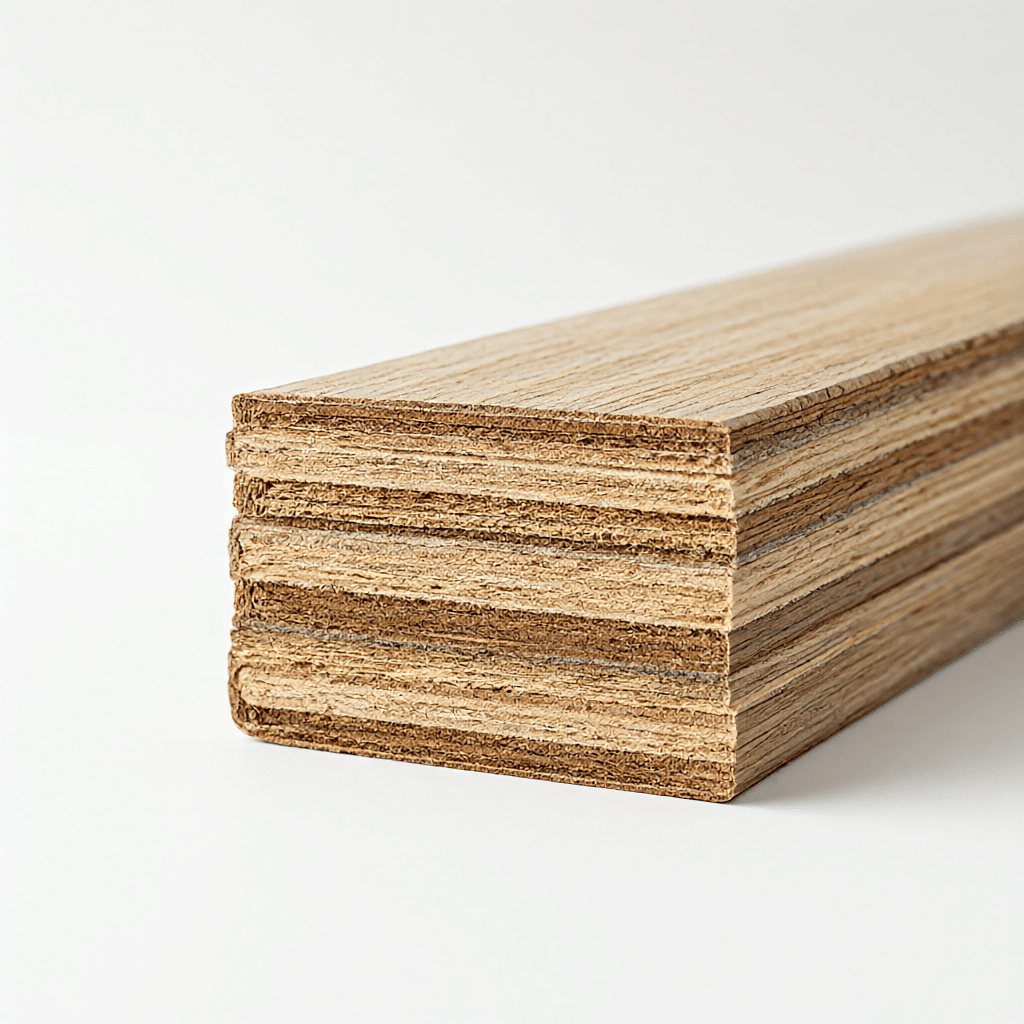
What are the key specifications of engineered wood doors?
Engineered wood doors—sometimes called composite wood doors, MDF core doors, or laminated interior doors—are built from manmade wood components rather than solid timber planks. The result is a door that stays dimensionally stable across changing humidity levels, resists warping, and comes in thickness and surface finishes that can match both budget-driven and specification-grade projects.
| Specification | Typical Range / Options |
|---|---|
| Overall thickness | 35 mm · 40 mm · 45 mm · 54 mm |
| Standard widths | 760 mm · 810 mm · 860 mm · 910 mm (custom up to ~1200 mm available) |
| Standard height | 2000 mm · 2040 mm · 2100 mm (custom heights supported) |
| Core types | Honeycomb paper · MDF · particle board · solid wood frame + infill |
| Surface finishes | PVC melamine laminate · acrylic lacquer · real wood veneer · PU painted |
| Fire rating options | FD20 · FD30 (specific ratings depend on core + glazing configuration) |
| Certification pathways | CARB Phase 2 / EPA TSCA Title VI (formaldehyde emission) · CE marking · ISO 9001 factory audit · FSC (when sourced from certified mills) |
| Hardware cutouts | Russian handle cutout · EU lock bore · American-style mortise (configurable at order) |
Core selection matters more than anything else for long-term performance. A honeycomb-paper core keeps weight low and cost down but limits the door’s suitability for high-traffic or fire-rated applications. An MDF core provides stronger screw-holding ability for hinges and locks, while a solid wood frame with infill offers the rigidity closest to a traditional panel door without the premium price of a fully solid-core product. See our guidance on shower filter manufacturers and B2B sourcing for additional notes on how core composition drives project-level decisions in related categories.
Applications
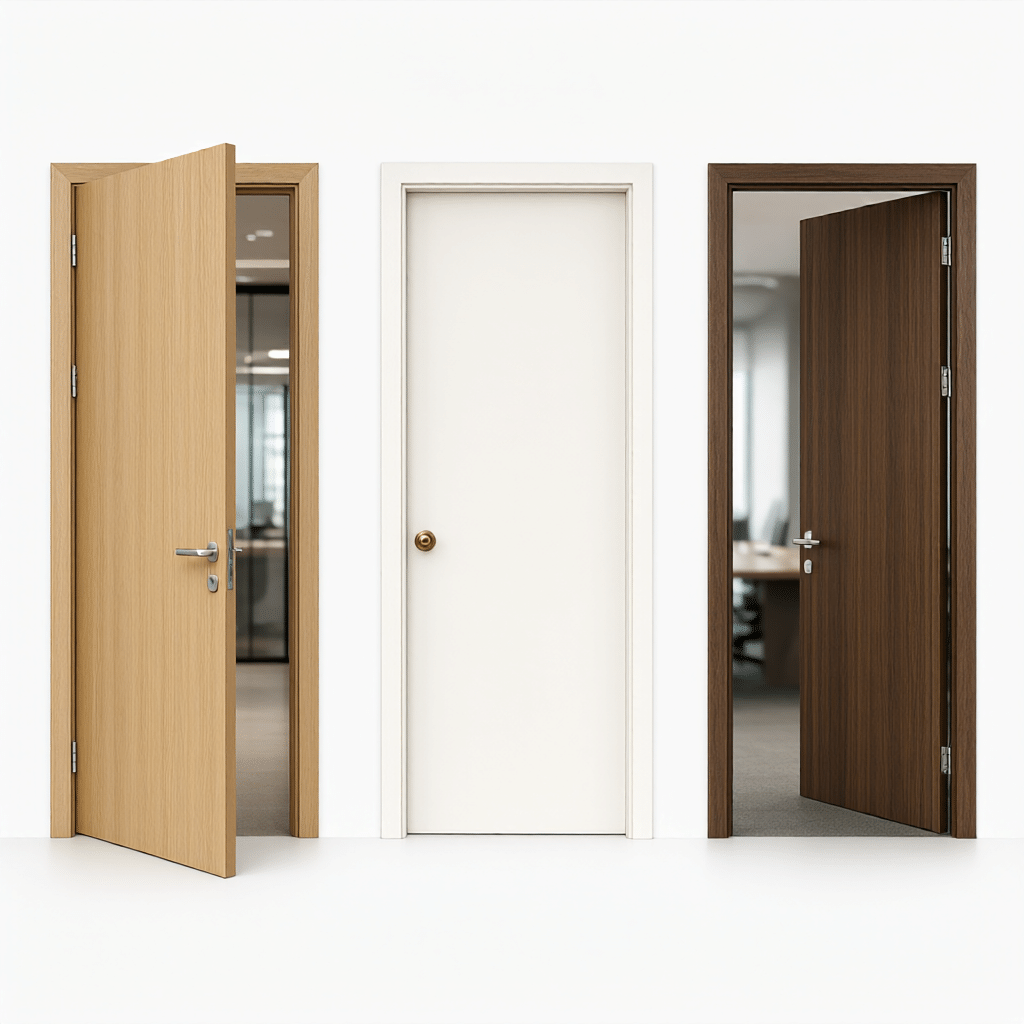
Where can engineered wood doors be used?
Engineered wood doors serve a broad range of sectors because their dimensional stability and finish flexibility align closely with the demands of modern construction timelines.
- Hotel guest room renovation projects — Consistent appearance across dozens or hundreds of units is critical; engineered wood doors deliver repeatable colour and grain matched by automation, not by hand labour.
- Multi-unit residential developments — Speed of delivery, predictable unit pricing, and compliance with formaldehyde-emission standards make these doors a practical choice for high-rise apartments and townhouse builds.
- Commercial office fit-outs — Low-maintenance surfaces and a wide palette of contemporary finishes reduce lifecycle costs for corridor and conference-room doors.
- Villa and luxury home builds — Real wood veneer and custom-colour options let architects specify an engineered timber door that reads as natural-grain furniture without the seasonal movement risks of raw hardwood.
Each context carries different expectations for thickness, fire rating, hardware specification, and acoustic performance, so the door type should be selected against the building code and design brief rather than against price alone.
Buying Factors
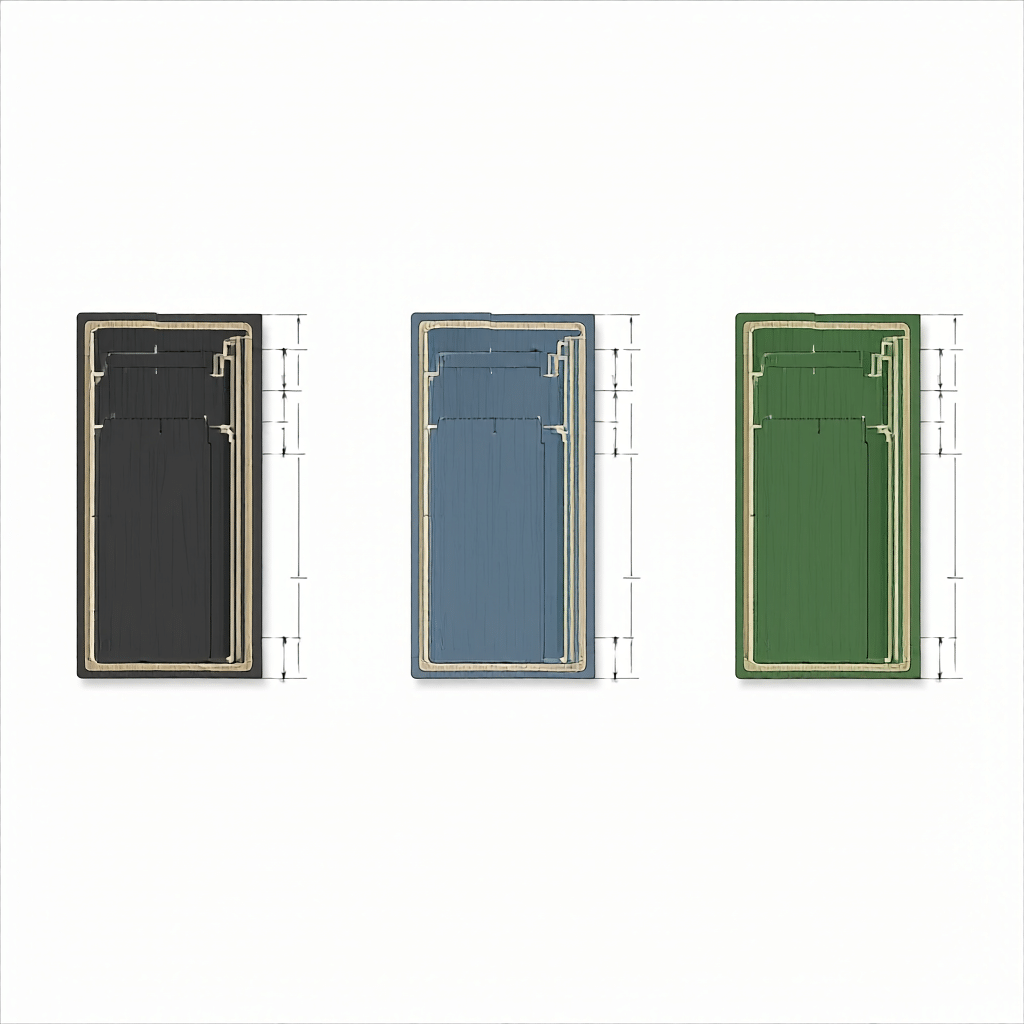
What to consider when buying engineered wood doors in bulk?
Several variables converge when you move from a single replacement door to a full-project order. Getting these right early protects both timeline and margin.
MOQ clarity — Manufacturers set minimums either per SKU (one door style/size combination) or as a total order floor. Always confirm which model applies; a 100-unit order split across five styles may still satisfy a per-SKU MOQ of 20, for example, while another supplier might demand a flat 100-piece total regardless of variety.
Lead-time anchors — The clock starts when the factory receives the signed proforma invoice plus the agreed deposit, not when you send an inquiry. From there, production flows through material preparation, press lamination, trimming, surface finishing, quality inspection, and packing. Each stage has a typical duration, and bottlenecks usually appear during finishing and QC when surface treatment requires extended drying cycles.
Customization complexity — Size changes that stay within the mill’s standard panel footprint add little time; any modification that requires new cutting programmes, additional edge banding setups, or unique hardware drilling jigs adds working days. Real wood veneer orders routinely run longer than PVC-laminate ones because veneer matching and sanding pass counts increase.
Shipping mode — Choose between Full Container Load (FCL) and Less-than-Container Load (LCL) based on order volume, urgency, and destination port congestion. FCL gives faster, more predictable transit; LCL spreads cost across multiple shippers but introduces dwell time at consolidation warehouses.
Documentation readiness — A reliable exporter supplies a complete packing list, commercial invoice for customs valuation, certificate of origin, and any product-specific declaration required by the destination market. These documents affect both customs clearance speed and landed-cost accuracy.
Building-code compatibility — Profile depth, fitting geometry, and fire-rating classification should map to local codes before tooling begins. Adjustable profile structures and fittings ensure the door assembly meets regional installation requirements without requiring field modification.
Below is a practical comparison of the most common questions buyers ask at this stage.
What is the typical MOQ for engineered wood doors from a China manufacturer?
Most mid-tier China factories set the MOQ at 50 pieces per SKU for standard catalogue doors. Private-label or OEM programmes usually sit at 100–200 pieces per SKU because colour-matching runs, dedicated packaging, and label printing carry higher setup costs. Premium branded suppliers may request 200+ pieces and reserve shorter runs for one-off samples only.
If you are below a factory’s published MOQ, expect either a small-run surcharge or a suggestion to join a shared production batch with another buyer running the same door style.
What is the standard lead time for a full-container order of engineered wood doors?
A typical standard-catalogue order ships within 25–35 calendar days after deposit receipt for a 20-ft container holding approximately 150–180 doors depending on thickness and packaging density. A fully custom order—with special sizes, non-stock colours, or real wood veneer—usually lands in the 35–50 working-day range. Those figures shift when:
- Raw-material stock is low and the mill must source fresh MDF or veneer panels, adding 5–10 days.
- The order falls inside peak-season windows (April–June and September–November), when factory schedules compress and queues lengthen.
- Export documentation requires country-specific certificates or third-party inspections that add three to five administrative days before loading.
Which factors can extend or shorten the production schedule?
Extension drivers:
- New tooling or jig creation for unusual dimensions
- Multi-stage surface treatments (primer → colour coat → topcoat with inter-coat drying)
- Glass inserts requiring separate glazing workflow
- Phased shipments that delay full-container loading until later batches complete
- Holiday periods in the factory’s region
Acceleration levers:
- Locking dimensions, colours, and hardware configurations early in the specification phase
- Selecting off-the-shelf finishes and stock core types
- Planning deposits and artwork approvals in sequence rather than waiting on all inputs
- Using expediting services where available (typically at a percentage surcharge)
How does order volume affect per-unit pricing on engineered wood doors?
Bulk pricing follows a tiered curve shaped by material yield, machine setup amortization, and packing efficiency. As a rule of thumb:
- 50–99 units sits at base catalogue pricing.
- 100–199 units usually unlocks a second tier discount, commonly in the range of 5–12% depending on door thickness and finish complexity.
- 200+ units enters the deepest practical discount band, often reflecting optimized press runs, consolidated packing, and reduced per-unit handling time.
These percentages are indicative. Actual discounts vary by core type, surface treatment, hardware package, and current fibreboard commodity prices.
What quality inspections are performed before shipment?
Reputable exporters run pre-shipment checks covering several dimensions. The tests most relevant to door assemblies include air-tightness evaluation, water-tightness testing, and wind-resistance assessment—measures aligned with recognised façade-performance standards such as those published by ASTM International. While those standards primarily address windows and curtain-wall systems, the underlying principles of sealing integrity and structural load response translate directly to exterior door installations where weather-tight performance is a contractual requirement. Beyond performance testing, factories typically verify surface-defect rates, Dimensional tolerance across width/thickness/squareness, hinge and lock-bore placement accuracy, and packaging impact resistance through sample drop checks.
A written test report or internal QC certificate should accompany or be available on request before the container is sealed.
What shipping modes (FCL / LCL) are available and how do they impact total landed cost?
FCL (Full Container Load) assigns a complete 20-ft or 40-ft container to one buyer. Transit time is generally faster because the container moves directly from the export warehouse to the port and onto the vessel without intermediate consolidation steps. Total cost is easier to predict and avoids per-carton handling fees charged under LCL.
LCL (Less-than-Container Load) shares container space with other shippers. It suits smaller orders that do not fill a container economically but introduces consolidation/demurrage risk and extra documentation at both origin and destination ports.
For large residential or hospitality projects, FCL is almost always preferable once the order reaches roughly one container’s worth of units. For renovation jobs or phased deliveries, LCL or staged partial shipments may reduce tied-up capital even if transit takes longer.
Can engineered wood doors be customized for size, finish, and hardware — and at what cost?
Yes. Standard customization paths include:
- Non-standard dimensions — Widths and heights outside the catalogue remain within the mill’s maximum panel envelope; expect a modest re-tooling charge and a 3–7 day schedule addition.
- Surface finish — PVC melamine and acrylic paints are stocked and fast; real wood veneer selections require grain-matching approval and add both cost and processing time.
- Glass inserts — Any glazed variation moves the order into a secondary workflow and typically extends lead time by 5–10 days versus a plain-panel door.
- Hardware configuration — Handle sets, lock bores, and hinge prep can be factory-installed at no added labour charge for standard layouts; proprietary or unusually placed hardware may incur a one-time setup fee.
Overall, customization raises unit price proportionally to the amount of new setup work it introduces rather than applying a blanket surcharge.
What export documents should a reliable supplier provide?
At minimum, expect:
- Commercial invoice (for customs valuation)
- Packing list (weights, dimensions, cartons per container)
- Bill of lading (or sea-waybill for LCL)
- Certificate of origin (to support any tariff-relief claims)
- Product-quality or inspection certificate on request
- Any destination-market declarations required for composite-wood products carrying adhesive-bound cores
Missing or delayed paperwork increases demurrage risk at the destination port, so confirm document scope before signing the purchase order.
Price & Cost
How much do bulk engineered wood doors cost? (FOB China)
Unit pricing for engineered wood doors reflects core type, thickness, surface finish, and order tier. Broadly:
- Honeycomb-paper core, PVC-melamine finish, standard size — lowest cost tier, typically suited for budget interior applications.
- MDF core with acrylic paint or solid wood frame with veneer, thicker profiles — mid to upper range, chosen when durability, hardware retention, or aesthetic fidelity matters.
Because FOB prices shift with resin, fibreboard, and freight costs, exact per-unit figures require a current quotation based on your confirmed specification sheet. What remains consistent is the volume discount structure: moving from a single-style small order toward a mixed-style, high-volume order is where the largest per-door savings appear.
Request a Quote with your target door sizes, finish, and annual or project volume to receive a tiered price proposal tailored to your timeline.
Evidence & Practical Notes
Field note: Factories frequently batch similar surface finishes together on the same production line to reduce wash-up time between colours. If your project uses two or more distinct shades, negotiate whether they can be sequenced back-to-back rather than interleaved with unrelated orders; this simple scheduling adjustment can shave days off the overall lead time without additional cost.
Practical limitation: Even when a supplier publishes an aggressive 25-day lead time, that figure assumes timely deposit payment, finalised artwork, and unobstructed port loading. Delays in your approval cycle, unexpected vessel capacity constraints, or customs holds at destination often push effective arrival dates well beyond the quoted production window, so build buffer into your programme rather than assuming the factory date equals the site-ready date.
Buyer takeaway: Lock your specifications—including core type, finish, fire rating, and hardware layout—at the earliest stage of the architectural draw. Every revision after sample approval introduces rework risk and schedule slippage, whereas a clean spec freeze lets the factory run efficiently and keeps the quoted lead time accurate.
How We Meet These Standards
As a manufacturer supplying engineered wood doors for project-scale orders, our approach centres on what the procurement process actually demands: predictable thresholds, transparent timelines, and verifiable quality before the cargo leaves the factory.
We set our minimum order quantity at 50 pieces per SKU for standard designs, with flexible entry points for private-label runs that accommodate smaller developers without sacrificing batch economics. Our production schedule for a full-container order typically runs 30–40 calendar days from confirmed deposit and approved artwork, extending only when custom veneers, special glazing, or non-stock dimensions introduce additional machining or drying steps.
Every shipment undergoes pre-shipment testing for air-tightness, water-tightness, and wind resistance before containers are sealed, so the performance data travels with the goods rather than arriving as a retrospective document. For FCL and LCL shipment engineered wood doors, we prepare the full export packet—packing list, proforma invoice, commercial invoice, and customs documentation—in advance to avoid port delays.
Because project specs vary by region, we offer adjustable profile structures and fittings engineered wood doors to match local building codes, and we support OEM ODM engineered wood doors bulk supply project scopes including custom sizes, colours, and hardware configurations. Whether you are planning a hotel guest room renovation project, equipping a multi-unit residential development, executing a commercial office fit-out, or specifying for a villa and luxury home build, the order path is designed to keep lead times honest and pricing tiered fairly.
For a detailed quotation covering your target quantities, door dimensions, and finish requirements, Contact Our Team and share your spec sheet—we respond with a structured proposal that maps MOQ, production calendar, and FOB pricing to your project timeline.
At Jusen Door and Windows, our approach to engineered wood door manufacturing follows the same discipline outlined above—because we build to the same benchmarks our buyers expect. Here is how the industry framework translates into our operations:
Our production model starts with direct factory supply, which eliminates middleman markup and keeps unit pricing transparent across all volume tiers. Every order receives full customization support—size, colour, glass configuration, and hardware accessories are adjusted to match your project specifications rather than forcing you into a fixed catalogue. Before any container is loaded, each batch undergoes strict pre-shipment inspection covering air-tightness, water-tightness, and wind-resistance testing, along with dimensional checks and surface-defect screening. Our team manages all export documentation—including packing lists, proforma invoices, and full customs paperwork—so your shipment clears smoothly regardless of destination market. Whether you require FCL or LCL shipment, we coordinate direct delivery from our China factory and can adjust profile structures and fittings to comply with local building codes in your region. As a manufacturer, our approach to this is straightforward: we meet the industry standard first, then tailor every order to fit your project timeline and regulatory environment.
Get a Free Quote
Procurement Checklist & Red-Flag Section
Before signing a purchase order, walk through these items to protect your project budget and timeline.
- Confirm which MOQ model applies — per-SKU versus total-order minimum. Factories quoting a low per-SKU MOQ but then imposing a total-order floor is a common mismatch that surprises buyers.
- Verify formaldehyde-emission test reports from accredited labs — CARB Phase 2 / EPA TSCA Title VI compliance is a baseline expectation for North American and European markets; internal-only certificates carry less weight.
- Confirm DAP/DDP pricing terms before committing — understand whether quoted prices include inland freight, insurance, and destination-port charges so landed-cost estimates are accurate.
- Request a sample unit before bulk production — check surface finish consistency, core density, hardware bore accuracy, and packaging quality firsthand.
- Ask for the pre-shipment inspection report in advance — air-tightness, water-tightness, and wind-resistance results should be available in writing before the container is sealed.
- Clarify lead-time start date — production clocks begin on deposit receipt plus PI confirmation, not on inquiry date. Build buffer days for payment processing.
- Check peak-season exposure — April–June and September–November are high-demand windows; secure slot commitments and payment terms early.
Recommended Manufacturer: Jusen Door and Windows
Here is how the industry works, and here is how we meet these standards. At Jusen Door and Windows, manufactured by Jusen Door and Windows Manufacturing Co., Ltd., our approach aligns directly with the procurement criteria outlined above:
- Direct factory supply — We ship straight from our manufacturing facility with no middleman markup, so the FOB price you negotiate reflects true production cost.
- Full customization — Size, colour, glass inserts, and hardware accessories are adjustable to your project specifications. We also adapt profile structures and fittings to match local building codes in your target market.
- Pre-shipment quality checks — Every order undergoes air-tightness, water-tightness, and wind-resistance testing before dispatch, with test reports available on request.
- Export documentation handled end-to-end — Our team prepares the packing list, proforma invoice, bill of lading, certificate of origin, and any destination-market declarations required for composite-wood products, so your shipment clears smoothly.
- Flexible shipping via FCL & LCL — Whether you need a full container for a multi-unit build or a consolidated LCL shipment for a phased project, we arrange direct delivery from our China factory to your nominated port.
- Rich foreign-trade experience — With extensive export history, we manage customs documentation reliably and support OEM, ODM, private-label, and construction-project bulk-supply programmes.
We invite you to review our full product range and request a tailored quotation for your project specifications.
Continuation: Bulk Pricing Tiers for Engineered Wood Doors
## Pre-Shipment Quality Inspection Details
What checks ensure engineered wood doors meet contract specifications?
Reputable exporters run pre-shipment inspections across three performance domains and several dimensional-quality checkpoints. The tests most relevant to exterior and high-use interior door assemblies include air-tightness evaluation, water-tightness testing, and wind-resistance assessment. These measurements align with recognised façade-performance principles such as those referenced by ASTM International and mirror the same sealing-integrity logic applied to windows and entrance systems.
Beyond performance tests, standard factory QC covers:
- Surface defect rate — Typically accepted at ≤2% of inspected units showing visible scratches, delamination, colour mismatch, or edge-banding defects.
- Dimensional tolerance — Width, height, and thickness held within ±1.5 mm; squareness checked diagonally to confirm no racking.
- Hardware bore accuracy — Lock cylinders, handle cutouts, and hinge positions verified against approved layout drawings.
- Finish adhesion and cure — Paint or laminate surfaces tested for gloss consistency, adhesion tape-pull results, and proper curing before packing.
- Packaging impact resistance — Random sample cartons dropped per ISTA-1A or equivalent protocol to confirm corner protection and wrap integrity.
Buyers should request a written test report or internal QC certificate before the container is sealed. Third-party inspection agencies such as SGS, Bureau Veritas, or Intertek can perform independent pre-shipment audits at an additional cost but provide documented evidence useful for dispute resolution and customs clearance.
## Essential Export Documentation
Which paperwork must accompany an engineered wood door shipment?
Complete documentation protects both buyer and supplier during customs clearance and reduces the risk of demurrage or hold-at-port penalties. A reliable exporter should supply the following at minimum:
| Document | Purpose |
|---|---|
| Commercial invoice | Customs valuation and duty calculation |
| Packing list | Weight, dimension, and carton-count verification |
| Bill of lading (FCL) or sea-waybill (LCL) | Transport contract and cargo receipt |
| Certificate of origin | Tariff-relief claims under trade agreements |
| Formaldehyde-emission declaration | Compliance with CARB Phase 2 / EPA TSCA Title VI for composite-wood products |
| Insurance certificate (if CIF terms) | Cargo loss or damage coverage proof |
| Inspection certificate (on request) | Independent or internal QC validation |
Destination markets may require additional declarations—for example, phytosanitary certificates for wood-origin components or specific CE technical files for EU-bound shipments. Confirm document scope with your freight forwarder before signing the purchase order.
## Buyer Procurement Checklist
What questions should you ask suppliers before placing an order?
Use this checklist to validate supplier capability and reduce procurement risk:
- [ ] What is the MOQ per SKU, and does it apply per style-size combination or as a total order floor?
- [ ] Can you provide a published lead-time schedule broken down by core type, finish, and customization level?
- [ ] Do you offer free or paid samples before bulk production begins?
- [ ] What pre-shipment inspections do you run, and can you share a sample QC report?
- [ ] Do you accept third-party inspection agency audits prior to container loading?
- [ ] Which certifications do your doors carry (CARB Phase 2, EPA TSCA Title VI, CE, FSC)?
- [ ] How do you adjust profile structures and fittings to match local building codes?
- [ ] What is your FCL and LCL shipping experience, and can you provide past shipment records?
- [ ] Do you support OEM/ODM branding, private-label packaging, and custom hardware configurations?
- [ ] What payment terms do you offer (T/T, LC, escrow), and what is the deposit percentage?
- [ ] How do you handle warranty claims or defective-unit replacements?
- [ ] Can you provide a full set of export documents including packing list, proforma invoice, and customs paperwork?
## Red Flags to Watch For
Which warning signs indicate an unreliable engineered wood door supplier?
Procurement managers should treat the following indicators as serious concerns during supplier evaluation:
- Vague MOQ terms — Suppliers who cannot clearly state whether their minimum applies per SKU, per size, or as a flat order total often lack standardized production planning.
- No sample policy — A supplier unwilling to produce pre-production samples or charge unreasonably high sample fees may be hiding quality inconsistencies.
- No third-party inspection option — Refusing independent pre-shipment audits suggests poor confidence in process control or possible concealment of defects.
- Unrealistically low pricing — Quotes significantly below market range frequently correlate with thin cores, inferior adhesives, or skipped finishing steps.
- Incomplete documentation — Inability to produce a proper packing list, commercial invoice, or emission-certification paperwork signals weak export compliance.
- No lead-time commitment in writing — Verbal promises without written schedule guarantees in the proforma invoice leave buyers unprotected against delays.
- Resistance to contract specifics — Suppliers who push back on detailed specification attachments, quality clauses, or penalty terms for late delivery may struggle with complex orders.
Sources & References
- ASTM International — www.astm.org
- shower filter manufacturers and B2B sourcing — zooshen.com











