
Last updated: November 25, 2026
Sourcing china 90 minute fire doors manufacturer supplies requires verified test files, recognized certifications, and auditable supply-chain documentation. Bulk FOB prices typically range from $180 to $480 per doorset depending on configuration, while compliance gaps account for roughly 22–38% of port inspection holds in construction imports from Asia, making certified suppliers critical to avoiding costly rejections.
Why Supplier Selection Matters
When sourcing china 90 minute fire doors manufacturer options for international projects, the right supplier combines compliant testing (EN 1634-1, BS 476 Part 22, or UL 10C), complete doorset assemblies, and export-ready documentation. A typical wholesale price sits around $180–$350 per unit FOB China for standard sizes in bulk, while full specifications, certification recognition, and verification checklists determine whether the product will clear local authority having jurisdiction (AHJ) review on time.
Quick Overview
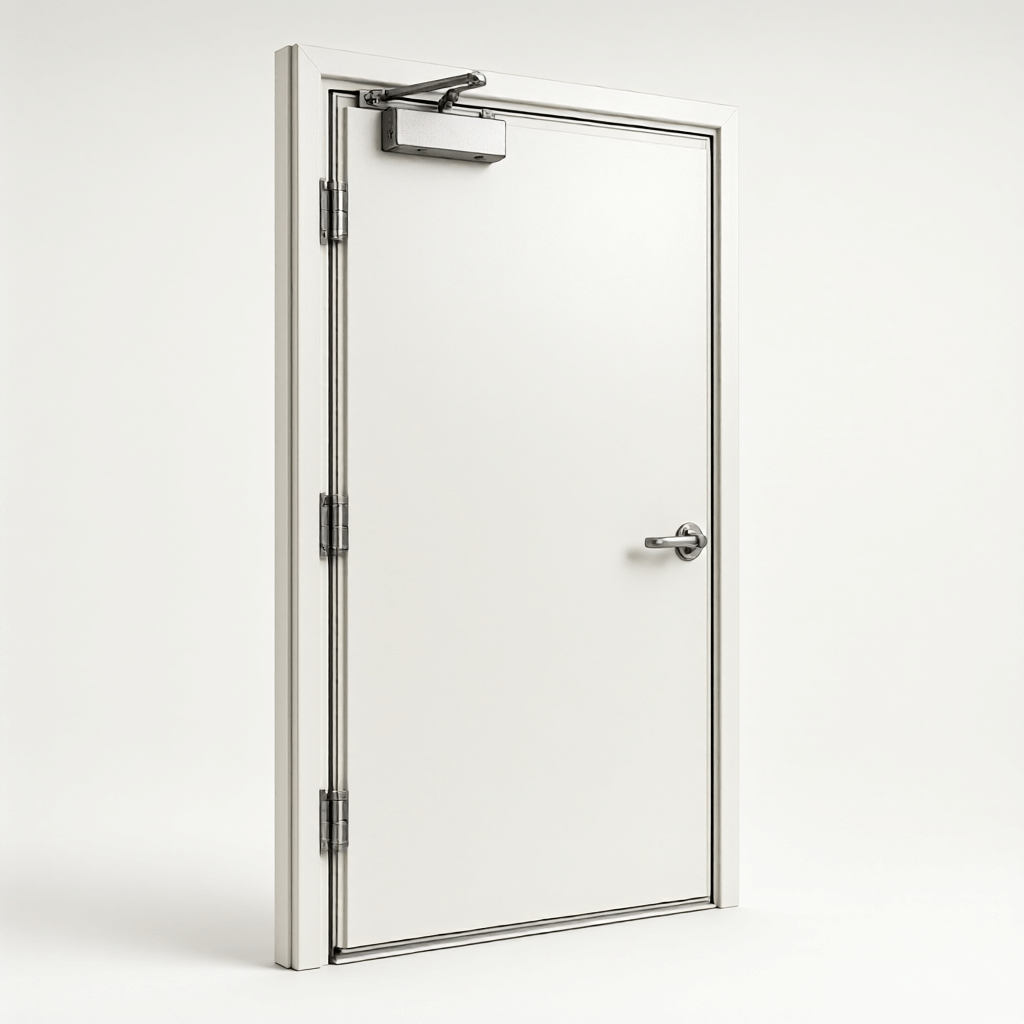
A 90 minute fire rating (often labeled FD90 door, Class 1 fire door, or steel fire door) guarantees that a tested door assembly maintains structural integrity and limits flame/smoke passage for at least 90 minutes under standardized fire conditions. For double leaf fire door or single leaf fire door configurations, the rating applies to the complete rated doorset—including frame, core, intumescent seal, and matching hardware—rather than the panel alone. Buyers should treat fire door procurement as a compliance-driven purchase: specifications, test reports, and customs documentation are as important as unit price.
Specifications
What are the key specifications of a 90 minute fire door assembly?
A compliant fire rated doorset typically includes:
| Component | Typical Specification |
|---|---|
| Rating | 90 minutes (FD90 / 90-minute rated door) |
| Standard references | EN 1634-1, BS 476 Part 22, UL 10C / UL 263 |
| Door leaf material | Cold-rolled steel, commonly 1.2–1.5 mm thickness |
| Core filling | Mineral wool or perlite-based fire-resistant board |
| Frame profile | Matched steel frame; often C/U-channel sections |
| Glazing (if any) | Wired glass or ceramic/fire-rated glazing with listed beads |
| Intumescent seal | Perimeter seal activated by heat; sized to door configuration |
| Hardware | Fire-rated hinges, closers, locks/latches from certified lists |
| Surface finish | Powder-coated or primed; color available on request |
| Leaf config | Single leaf or double leaf; astragal/overlap at meeting stile |
| Max opening size | Varies by tested design; common nominal widths 800–1200 mm per leaf |
Performance targets behind the rating include temperature rise limits on the unexposed face and integrity against flame penetration during the test period. Because these values depend on the tested profile, core density, seal placement, and hardware selection, small changes can affect certification validity—and subsequent AHJ acceptance.
Applications
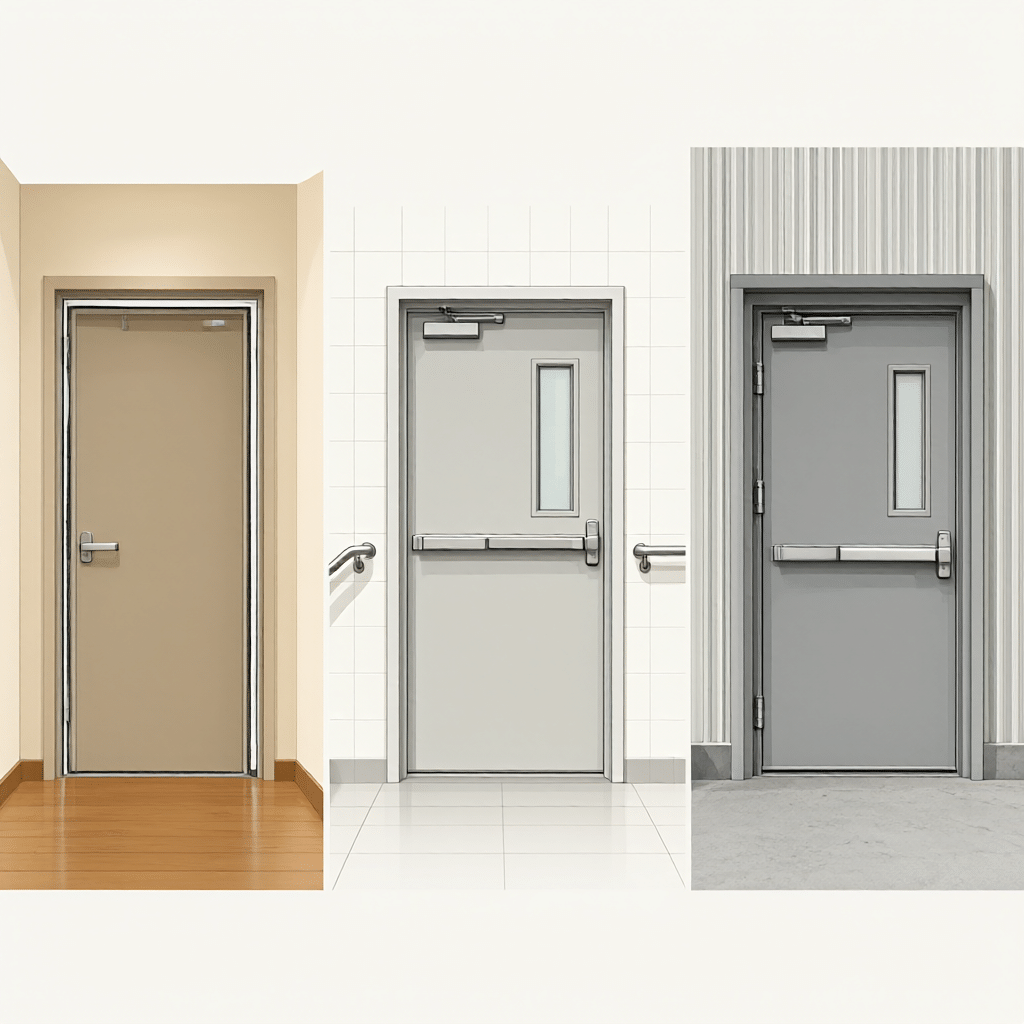
Where can 90 minute fire doors be used?
FD90 assemblies are commonly specified where building codes require higher passive fire protection durations:
- Commercial construction projects: stairwell enclosures, core corridors, riser rooms, and separation betweatenancies in offices and retail.
- Hospital & healthcare buildings: patient-care corridors, isolation rooms, and vertical circulation barriers.
- Industrial warehouse fit-outs: compartmentation around high-hazard storage, plant rooms, and loading bay separations.
- High-rise residential developments: lobby-to-corridor transitions, apartment entry cores, and communal egress routes.
The selection usually follows occupancy type, floor area, and evacuation strategy rather than aesthetics alone. When a project demands a CE marked fire door or equivalent recognized listing, confirm early that the manufacturer’s test file matches the exact configuration your architect has approved.
Buying Factors
What to consider when buying fire doors in bulk?
Procurement teams should verify five areas before placing an order:
- Certification recognition
– Map each destination market’s required standard: EU/UK typically reference EN 1634-1 and BIM/BSI pathways; the US relies on UL listings and NFPA-compliant inspections; Middle East and Southeast Asia often accept EN 1634-1 test reports alongside local notarization.
– Confirm the test institute is accepted by the relevant AHJ—acceptance can change even for well-known labs.
- Test file consistency
– A certificate without a traceable report number, test report images, and configuration matrix creates risk at inspection.
– Matching the supplied hardware, seal sizes, and frame sections to the tested drawing is essential.
- Quality assurance practices
– Look for in-process checks and pre-shipment verification covering air-tightness, water-tightness, and wind resistance characteristics where applicable, along with visual and dimensional audits.
– Ask for third-party or factory audit records if your project requires auditable QC trails.
- Documentation readiness
– Export paperwork should include packing list, proforma invoice, commercial invoice, certificates of origin, test reports, and any required conformity declarations.
– Incomplete customs documents delay clearance more often than product defects do.
- Total cost picture
– Unit price is only part of the calculation. Freight, insurance, import duties, AHJ fees, and potential re-testing costs can shift total landed expense significantly.
When auditing suppliers, use a simple red-flag checklist: vague test references, missing configuration matrices, requests for full payment before shipment, inconsistent documentation formats, and unwillingness to provide third-party test files. These indicators frequently appear in sourcing disputes across global construction supply chains.
Price & Cost
How much do bulk 90 minute fire doors cost FOB China?
Indicative FOB China wholesale pricing for trade buyers varies with size, finish, glazing, hardware grade, and order volume. The figures below are reference ranges, not binding quotes.
| Product config | Quantity tier | Indicative FOB price (USD/unit) |
|---|---|---|
| Single leaf, basic powder coat | 50–99 sets | $180 – $240 |
| Single leaf, reinforced frame + listed hardware | 100+ sets | $230 – $310 |
| Double leaf, standard finishes | 50–99 sets | $260 – $360 |
| Double leaf, glazed panels + upgraded seals/hardware | 100+ sets | $340 – $480 |
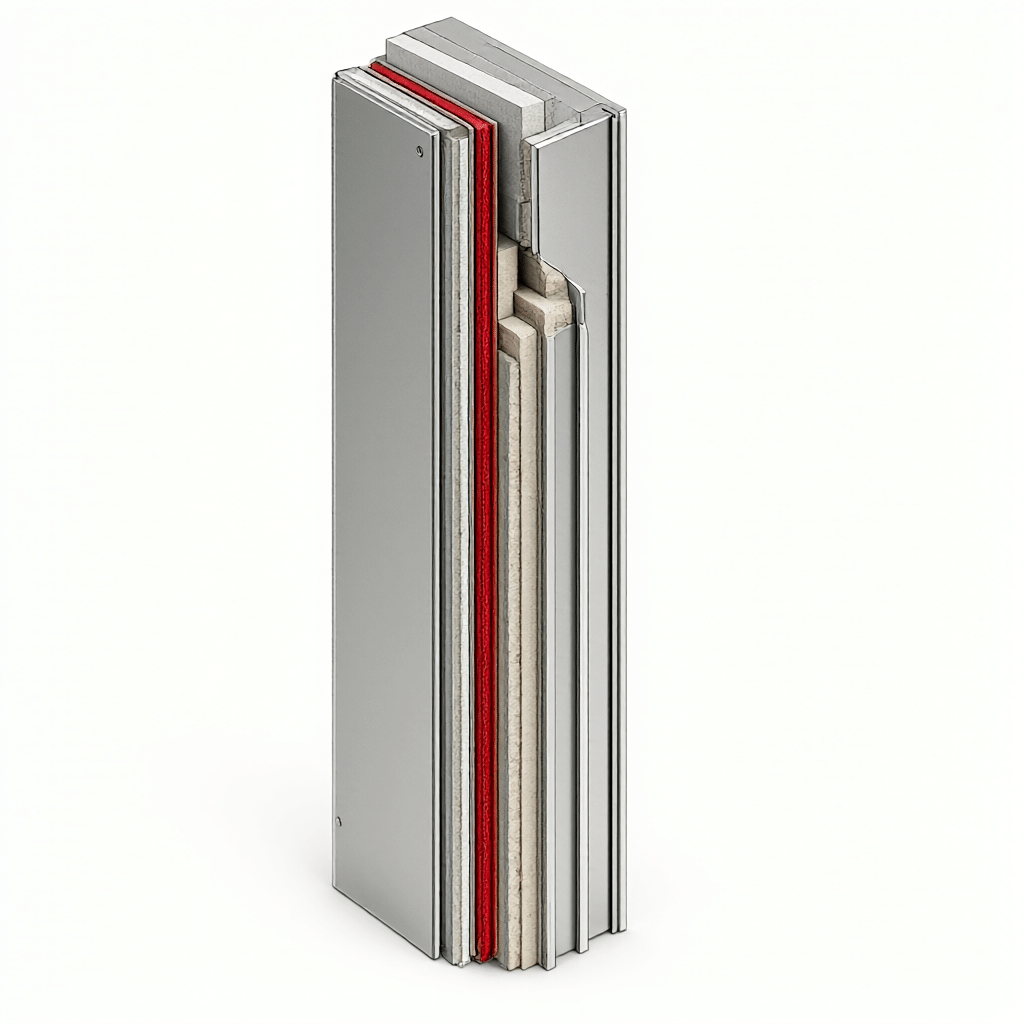
Variables that move price include thicker gauge steel, ceramic glazing instead of wired glass, heavy-duty fire exit devices, custom colors, and expedited lead times. Shipping method (FCL vs LCL), origin port, and destination also affect landed cost.
Request a bulk FOB quotation with your opening sizes, target standard, and quantity tier so the supplier can price the exact doorset configuration your project requires.
Customization & Local Code Compliance
Can Chinese manufacturers adjust doorsets to meet local building codes?
Responsive engineering is where experienced exporters add real value. Manufacturers can often adapt profile structures, seal placements, and fittings to better match local expectations—for example:
- Adjusting frame section depth for regional wall constructions
- Selecting hardware listed under local standards
- Providing finish and labeling options demanded by regional inspectors
That said, code alignment is not automatic. Local variants like an FD100 equivalent requirement, different temperature-rise criteria, or unique labeling rules may still need project-specific engineering submissions. Early coordination between architect, specifier, and manufacturer prevents late-stage rework.
If you already have opening schedules or spec sheets, you can send us your opening sizes for a custom quote and receive a configuration-matched proposal rather than a generic catalog offer.
Evidence & Practical Notes
Field note: Test file cross-referencing matters more than certificate thumbnails. On site, inspectors usually ask for the report number, manufacturer name, test institute, date, and the exact configuration matrix; missing any of those fields is a common reason for hold notices.
Practical limitation: Certification acceptance depends on the local AHJ, not just the test report itself. Even widely recognized standards like EN 1634-1 or UL 10C can require additional local endorsements, translation notarization, or supplementary performance data depending on the country.
Buyer takeaway: Prioritize documentation completeness and configuration traceability over low unit price. A slightly higher FOB rate with clean test files, correct customs paperwork, and reliable pre-shipment checks usually delivers lower total cost than a cheaper quote that stalls at border inspection.
Manufacturer Fit
In practice, selecting among a china 90 minute fire doors manufacturer shortlist comes down to whether the supplier can deliver the complete set you need—tested assemblies, consistent hardware, and export-ready paperwork—without forcing unnecessary redesigns. As a manufacturer, our approach is to offer direct supply without middleman markup, full customization on size, color, glass, and hardware accessories, strict pre-shipment inspection for air-tightness, water-tightness, and wind resistance, and documentation support including packing lists, proforma invoices, and full customs paperwork for FCL and LCL shipments. We also adjust profile structure and fittings to better align with the local building codes of target markets, which helps keep project timelines predictable.
Contact Our Team to discuss your project’s fire door requirements.
Standards & Test Report Reference
Compliant FD90 doorsets are validated against internationally recognized fire-resistance protocols. The most frequently requested references are:
- EN 1634-1:2014 — Fire resistance and smoke control tests for doors and openable windows, Part 1: Fire resistance tests for doors and shutters. Published by CEN.
- BS 476 Part 22:1987 — Methods for determining the fire resistance of non-loadbearing elements of construction. Published by BSI.
- UL 10C:2023 — Positive Pressure Fire Tests of Door Assemblies. Underwriters Laboratories.
- ISO 10289:2022 — Fire tests for building components — Elements of vertical separation — General requirements for test apparatus and procedures. Published by ISO.
- NFPA 80:2022 — Standard for Fire Doors and Other Opening Protectives. National Fire Protection Association.
Reputable suppliers present test reports in a traceable format similar to the matrix below. Use it as a procurement checklist before committing to an order.
| Field | Example entry |
|---|---|
| Report no. | TR-JC-2023-FD90-0847 |
| Applicant | Jusen Door and Windows Manufacturing Co., Ltd. |
| Tested product | Single-leaf steel fire doorset, FD90 |
| Standard applied | EN 1634-1:2014 |
| Test institute | [SGS / Intertek / TÜV name, country] |
| Date of test | 2023-06-15 |
| Result | Passed — 90 min integrity & insulation |
| Max tested opening | W 1200 × H 2300 mm (single leaf) |
| Core material | Mineral wool, density ≥ 150 kg/m³ |
| Intumescent seal | 3 mm strip, perimeter installed |
| Hardware list | hinge × 3 (EN 179 Class 3), closer (EN 1154), lock set (listed) |
| Frame section | 1.5 mm galvanized steel U-channel, 75 mm jamb width |
| Certificate no. | CERT-FD90-2023-0847 (cross-references TR-JC-2023-FD90-0847) |
The certificate and report must list the same door dimensions, core type, seal placement, and approved hardware schedule. Any deviation during installation — for example a thicker frame or unlisted ironmongery — can invalidate the rating in the eyes of the AHJ. When evaluating a supplier’s claim, always ask for the full report PDF, not merely a certificate thumbnail.
Procurement Utility: RFQ & Specification Checklist
Supplying a detailed RFQ to potential vendors reduces back-and-forth and produces comparable quotes. Consider attaching the following template to every inquiry:
- Project name / location / AHJ jurisdiction
- Door schedule (leaf config, nominal width × height, swing direction, astragal or non-astragal)
- Required standard & certification pathway (EN 1634-1, UL 10C, etc.)
- Core filling preference (mineral wool vs. perlite board)
- Glazing requirement (size, type — wired or ceramic, held beads or fixed)
- Hardware schedule — hinges, closers, locks, panic devices, with reference to relevant EN / ANSI listings
- Surface finish — RAL color code, powder-coat or primer only
- Label / stamp requirement (manufacturer logo, rating plate, CE mark format)
- Delivery terms — FCA, CFR, or CIF; target port; desired lead time
- Documentation required — factory audit record, individual test report per configuration, conformity declaration, packing list template
Suppliers that respond with a completed configuration matrix rather than a generic brochure are usually better positioned to deliver on-time and within spec.
Manufacturers That Meet These Standards
Selecting among a china 90 minute fire doors manufacturer shortlist comes down to whether the supplier can deliver the complete set you need—tested assemblies, consistent hardware, and export-ready paperwork—without forcing unnecessary redesigns. As a manufacturer, our approach is to offer direct supply without middleman markup, full customization on size, color, glass, and hardware accessories, strict pre-shipment inspection for air-tightness, water-tightness, and wind resistance, and documentation support including packing lists, proforma invoices, and full customs paperwork for FCL and LCL shipments. We also adjust profile structure and fittings to better align with the local building codes of target markets, which helps keep project timelines predictable.
Contact Our Team to discuss your project’s fire door requirements.
Downloadable verification checklist
Copy this checklist into a spreadsheet or PDF template for use across vendor evaluations:
| Verification step | Status (✓/✗/N/A) | Notes |
|---|---|---|
| Test institute identity confirmed | ||
| Report number cross-referenced with applicant | ||
| Configuration matrix matches requested door size | ||
| Hardware schedule matches tested bill of materials | ||
| Intumescent seal sizing and positioning documented | ||
| Core material density specified and tested | ||
| Frame section depth/thickness within tested tolerance | ||
| Third-party audit record supplied (if required) | ||
| Commercial invoice / packing list template reviewed | ||
| Export documentation package completeness confirmed |
Completing this table before purchase commitment provides an auditable trail that AHJ reviewers and internal quality teams typically expect during contract closeout.
Sources & References
- Contact Page — doorwoodendoors.com











