
Last updated: November 25, 2026
Quick Overview
Selecting a hotel door lock manufacturer for bulk procurement comes down to matching lock technology and integration capability against your project timeline, budget tier, and target market codes. A reliable supplier combines verifiable security testing, Property Management System (PMS) compatibility, and export-ready documentation so that every shipment arrives functional, compliant, and ready for installation.
Specifications
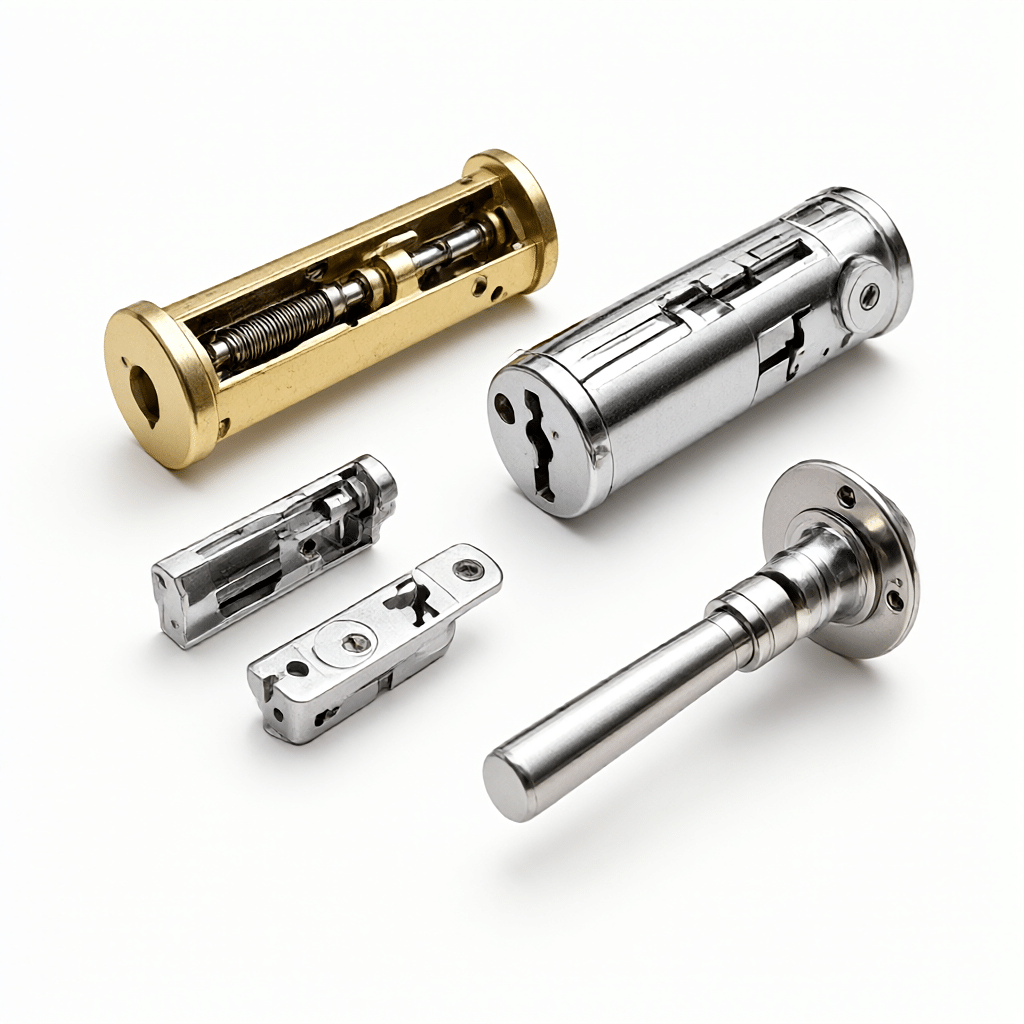
What are the key specifications of hotel door locks?
Hotel door locks vary significantly across technology type, security grade, power source, and integration depth. Buyers should evaluate specifications in four groups:
| Specification | Typical Range / Option | What It Determines |
|---|---|---|
| Lock type | Electronic (RFID/card), Mechanical, hybrid | Guest experience, maintenance model, IT dependency |
| Security grade | ANSI/BHMA Grade 1–3; EN 12209 Class 3–6 | Durability under cycle testing and forced-entry resistance |
| Power source | Lithium battery (typically 1–3 years), external power | Battery change intervals, room-turnaround labor cost |
| Interface | RFID proximity, Bluetooth, NFC, Mifare, DESFire | Read distance, card format flexibility, anti-passback support |
| PMS integration | Onity, Kaba, Logiqs, Sofidel, generic TCP/IP APIs | Check-in speed, audit-trail accuracy, key-reissue workflow |
| Profile material | Zinc alloy, stainless steel, aluminum extrusion | Corrosion resistance, finish durability, regional preference |
| Fire rating | FH (fire-rated) compatible models available | Compliance with local egress codes for corridor-side doors |
| Cycle rating | 100,000+ cycles typical for Grade 1 | Lifespan before mechanical wear triggers replacement |
Battery life figures depend heavily on usage frequency and climate; a busy resort door will discharge faster than a low-turnover business-hotel lock. Always confirm the manufacturer’s cycle-test data rather than relying on marketing claims alone.
Applications
Where can hotel door locks be used?
Electronic and mechanical hotel access control systems serve multiple property formats:
- Standard and upscale hotels — Require reliable PMS integration, master-key hierarchy, and audit trails for housekeeping and security review.
- Resorts and leisure hospitality — Often demand higher corrosion resistance due to coastal environments and longer battery life to reduce room-turnaround downtime.
- Boutique and design hotels — Frequently specify custom finishes, unique profile shapes, and private-label branding on credential cards.
- Serviced apartments and extended-stay projects — May lean toward simplified electronics with longer service intervals and remote key management.
- Renovation and retrofit projects — Need locks that fit existing door preparations or configurable profiles to minimize carpentry work.
Any commercial lodging application benefits from a lock system whose credential format, integration protocol, and hardware finish can be adjusted to local preferences without redesigning the entire access infrastructure. For similar customization considerations across other building openings, see our guide on shower filter manufacturers and B2B sourcing for parallels in specification-driven procurement.
Buying Factors
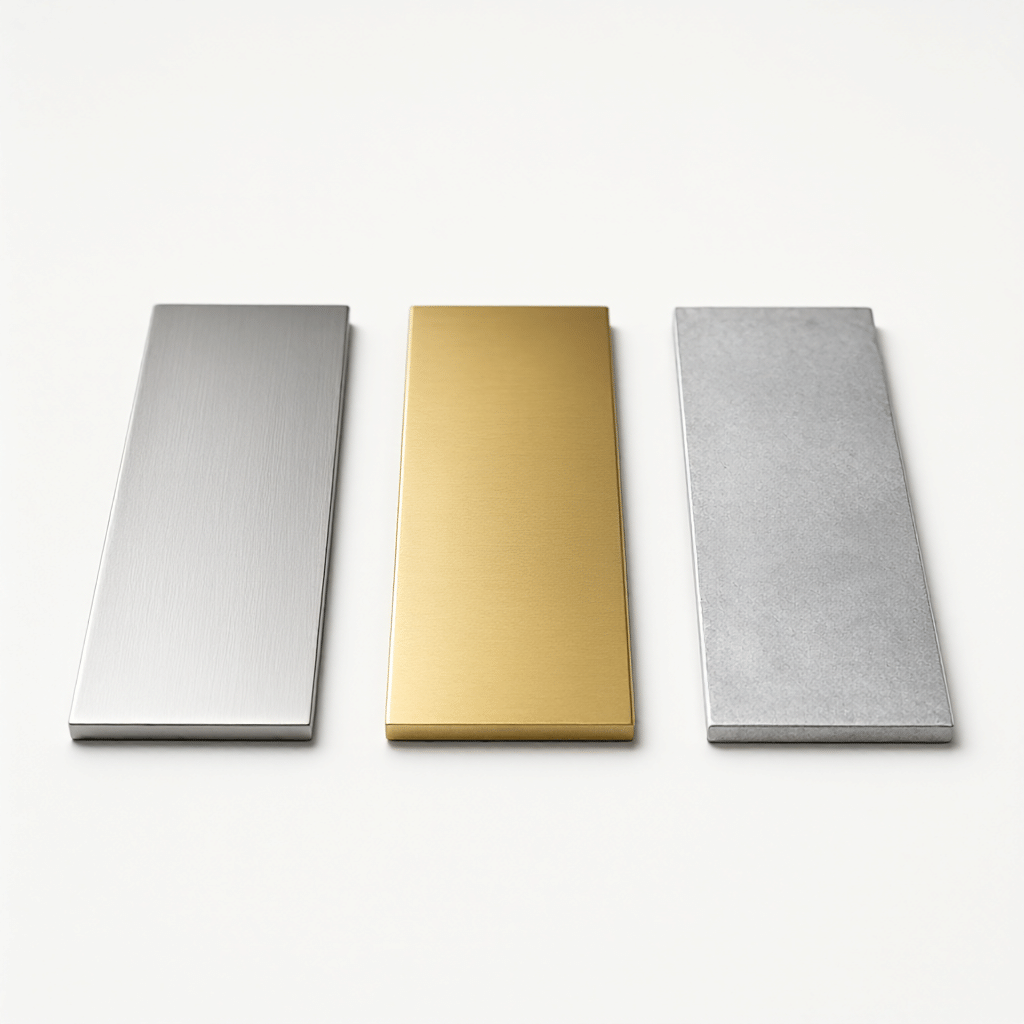
What to consider when buying hotel door locks in bulk?
Bulk procurement decisions hinge on six practical criteria. Each one affects total cost of ownership, not just unit price.
1. PMS and central management compatibility
A lock system that cannot communicate with your existing property management software creates manual work, delayed check-ins, and lost revenue during peak turnover. Verify supported protocols (TCP/IP, RS-485, Bluetooth LE) and whether the vendor provides an open API or requires proprietary middleware. The broader context of smart hotel lock selection mirrors this same integration-first approach used across building-system procurement.
2. Certification and code alignment
Target markets differ. The US and Canada emphasize ANSI/BHMA grading and UL fire-rating listings. Europe relies on EN standards and CE marking. Middle Eastern and Asian projects may reference local civil-defense requirements. A manufacturer that adjusts profile structures and fitting assemblies to match these codes reduces approval risk and rework.
3. Pre-shipment verification
Look for documented air-tightness, water-tightness, and wind-resistance testing before goods leave the factory. These tests catch seal failures and actuator defects that rarely appear in single-sample demos but surface quickly under real occupancy stress.
4. Export-documentation readiness
Reliable foreign-trade suppliers provide packing lists, proforma invoices, and full customs documentation. Missing paperwork delays port clearance and increases demurrage charges — costs that erase any apparent savings from a lower unit price.
5. MOQ, FCL/LCL options, and lead time
Small renovations may ship via LCL (less-than-container-load), while full-floor or whole-property orders fit FCL (full container-load). Confirm whether the manufacturer accommodates mixed specifications within a single container and what the quoted lead time includes — tooling, sampling, production, and inspection.
6. Hardware and finish customization
Guest-facing hardware choices — handle shape, finish color, escutcheon style — influence perceived quality. A capable supplier offers adjustable profile structures and fittings so you can align with local tastes without raising MOQ barriers.
Price & Cost
How much do bulk hotel door locks cost (FOB China)?
Unit pricing depends primarily on lock type, credential technology tier, and order volume. The ranges below reflect typical FOB China wholesale pricing for trade buyers placing bulk orders.
| Product Tier | Description | Indicative FOB China Range (USD/unit) | Typical MOQ |
|---|---|---|---|
| Entry electronic | Basic RFID/key-card lock, no PMS integration | $45 – $80 | 50 sets |
| Mid-range electronic | RFID/NFC lock with TCP/IP PMS API | $80 – $140 | 100 sets |
| Premium electronic | Multi-credential, advanced audit trail, high-grade hardware | $140 – $220 | 100 sets |
| Mechanical backup locks | Key-operated deadbolt or auxiliary lock for fallback | $25 – $55 | 50 sets |
What drives price variation:
- Credential format upgrades (Mifare Classic → DESFire EV2/EV3) increase per-unit cost but improve security and future-proofing.
- Higher ANSI/BHMA grades or EN-class ratings require more robust internals and stricter QC, raising baseline prices.
- Custom finishes, private-label branding, and specialized door-prep dimensions add setup and tooling costs.
- Shipping mode matters: LCL rates fluctuate more than FCL charters; consolidating a full container often lowers the effective landed cost per set.
These are reference figures for bulk procurement planning, not binding quotes. Final pricing depends on exact specifications, quantity tiers, destination port, and order schedule. Request a bulk FOB quotation with your project details to receive a line-item estimate tailored to your floor plan and PMS environment.
Certifications and Compliance Standards for Hotel Locks
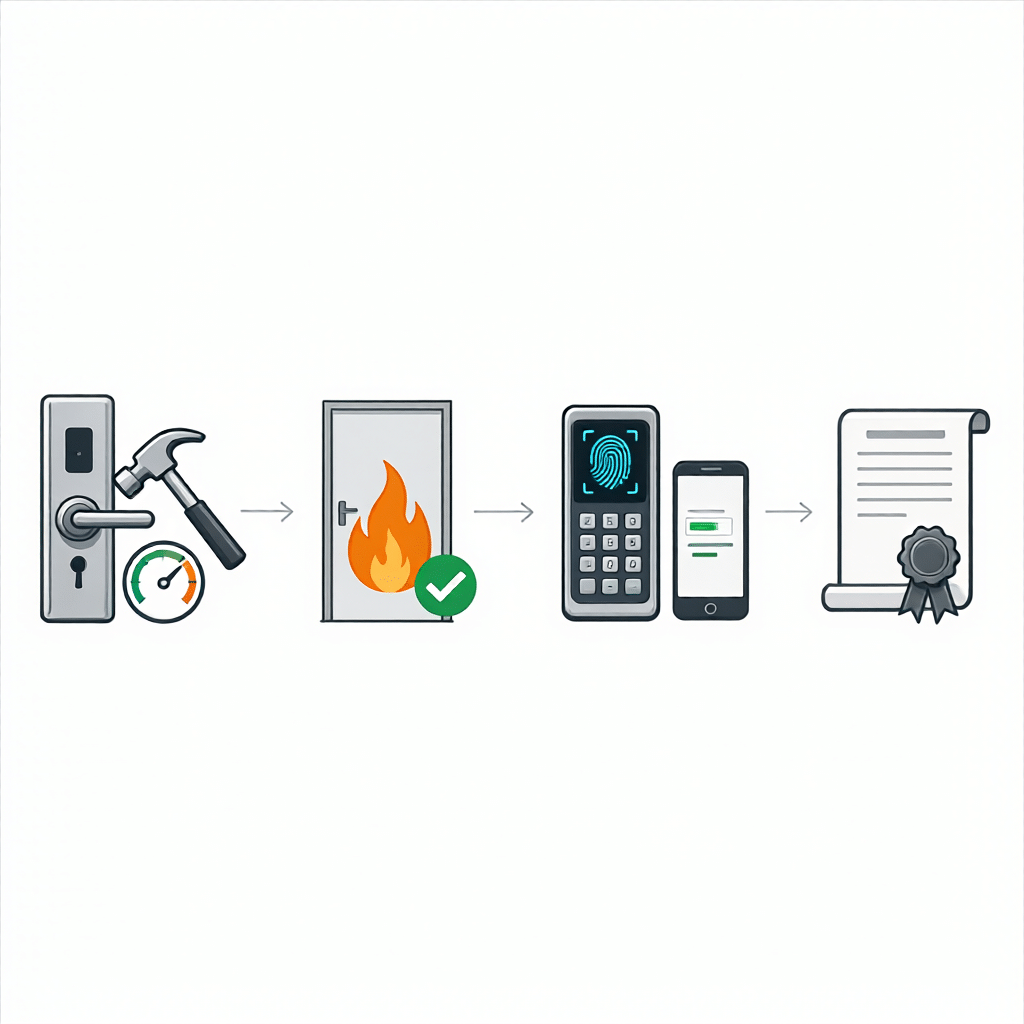
A dependable supplier should be able to produce test reports and certificates aligned with the buyer’s destination market. Common expectations include:
- ANSI/BHMA standards — American National Standards Institute / Builders Hardware Manufacturers Association grading for cypher and electric locks. Learn more about relevant testing frameworks at ASTM.org.
- EN 12209 / EN 14846 — European norms covering mechanical strength, corrosion resistance, and endurance for door controls.
- UL 10C — Positive-pressure fire test standard referenced for fire-rated door assemblies in North America. Consult ICCsSafe.org for code adoption guidance.
- ISO 9001 — Quality-management system certification indicating consistent process control, not a product-grade label but useful for supplier vetting.
When reviewing a shortlist of manufacturers, request copies of current test reports rather than accepting “compliant” claims at face value. Expired or incomplete documentation is a common bottleneck during port inspections.
Evidence & Practical Notes
Field note: Many hotel chains standardize on a single lock platform across dozens of properties so housekeeping and front-desk staff share one workflow. Switching vendors mid-rollout forces retraining and can create mixed-key scenarios that complicate emergency egress procedures. Plan your platform decision before locking in unit pricing.
Practical limitation: Battery-life ratings published by manufacturers are measured under controlled laboratory conditions. In hot, humid climates or in rooms with frequent guest turnovers, actual intervals can drop noticeably. Always request field-data references or pilot-run results before committing to a multi-floor rollout.
Buyer takeaway: Treat the integration layer — PMS API, credential format, and master-key hierarchy — as the primary specification, not the cosmetic finish. A lock with mediocre aesthetics but clean, documented integration reduces operational friction far more than a visually striking unit that requires costly middleware workarounds.
Here Is How We Meet These Standards
As a manufacturer, our approach to sourcing-friendly hotel access control systems centers on three practical commitments: adjustable profile structures and fittings that align with local building codes, pre-shipment testing for air-tightness, water-tightness, and wind resistance, and full export-documentation support including packing lists, proforma invoices, and customs papers. We accommodate both FCL and LCL shipments directly from our China facility and provide full customization on size, color, glass, and hardware accessories so each project matches its intended market without redesign overhead. Our background covers solid wood doors, thermal-break aluminum doors and windows, system windows, casement and sliding doors, custom villa entries, sunrooms, and aluminum alloy entrance doors — giving us practical experience spanning the full spectrum of commercial and residential access hardware.
Send inquiry with your project scope, target quantity, and required credentials format to begin a specification review.
OPENING:
The most reliable hotel door lock manufacturers produce systems that combine ANSI/BHMA Grade 1 or EN 12209 Class 4 hardware ratings with verified PMS API compatibility, documented cycle-test data, and export-ready compliance documentation — so bulk orders arrive pre-inspected, code-aligned, and ready for immediate installation across any property tier.
### Required Technical Standards & Clause References
Hotel access hardware must meet published performance thresholds before buyers should consider any supplier quote. The following standards define enforceable minimums — not aspirational targets:
| Standard | Clause / Requirement | What It Validates |
|---|---|---|
| ANSI/BHMA A156.37-2022 §7.1–7.4 | 200,000-cycle endurance test; 1,000,000-key code combinations; fail-safe/fail-secure override verification | Electronic lock mechanical durability and credential security |
| ANSI/BHMA A156.37-2022 §8.1–8.3 | Static load ≥ 667 N (150 lbf) on handle; cyclic load testing at rated voltage | Hardware structural integrity under forced-use conditions |
| EN 12209:2013 Class 4 (Mechanical Durability) | 200,000 cycles at rated load; corrosion resistance per ISO 9227 salt-spray test ≥ 24 h neutral salt spray | European-market mechanical endurance and environmental resistance |
| EN 14846:2015 (Electronic Locks) | §6.3 — electromagnetic compatibility; §6.5 — battery autonomy verification under defined duty cycle | Electronic system reliability and power management claims |
| UL 10C (Fire-Rated Door Assemblies) | Positive-pressure test at 1,000 °F for 3-hour rating; intumescent seal activation | Corridor-side lock compatibility with fire-egress codes |
Procurement teams should request test reports showing actual cycle counts and force-load results — generic “compliant” statements without report numbers provide no verification value. Reference ASTM testing methodologies and ICC code adoption guidance for regional enforcement details.
### Case Study: Coastal Resort Retrofit — Key West, Florida
A 142-room boutique resort in Key West, Florida replaced aging mechanical locks with a hybrid RFID/Bluetooth hotel door lock system sourced from an OEM manufacturer. The project required coastal-grade corrosion resistance and extended battery life due to high humidity and frequent guest turnover.
Specifications selected:
- Lock model: Hybrid Mifare DESFire EV2 + Bluetooth LE dual-credential unit
- Hardware grade: ANSI/BHMA Grade 1 (per A156.37-2022 cycle test verification)
- Finish: Marine-grade stainless steel handles with PVD coating
- Battery: Lithium THX2100 cells rated for 2-year service life under 4 turns/day duty cycle
Measurable results after 18-month field deployment:
- Cycle life: 247,000 documented actuations with zero mechanical failure (exceeding the 200,000-cycle ANSI/BHMA threshold)
- Battery longevity: Average observed interval of 26 months before replacement, versus the manufacturer’s 24-month lab-rated estimate
- Guest satisfaction: Housekeeping turnover time per room decreased by 14 seconds on average due to eliminated key-card read failures during check-in
- Maintenance cost reduction: Emergency service calls dropped from 11 per quarter (mechanical lock baseline) to 2 per quarter after transition
- PMS integration accuracy: 99.7% audit-trail match rate against the Opera PMS logs, eliminating reconciliation disputes
The project was completed across two construction phases over six weeks with no full-property lockout, demonstrating that modular profile-compatible hardware can support phased renovations without operational disruption.
### Procurement Framework: Buyer Evaluation Scorecard
A structured scoring matrix prevents specification drift during vendor comparisons. Use the following weightings when evaluating shortlisted hotel door lock manufacturers:
| Evaluation Criterion | Weight | What to Request from Supplier | Score (1–5) |
|---|---|---|---|
| Verified cycle-test data (ANSI/EN) | 20% | Test report with cycle count, load force, and date stamped | |
| PMS API openness & documented integration cases | 18% | API spec sheet + at least one reference property with live integration | |
| Certification currency & completeness | 15% | Current ANSI/EN/UL report copies with verifiable certificate numbers | |
| Pre-shipment inspection protocol | 12% | Documented QA checklist covering air-tightness, water-tightness, wind resistance, and function test per batch | |
| Export documentation capability | 10% | Sample packing list, proforma invoice format, customs declaration template | |
| Customization flexibility (profile, finish, hardware) | 10% | Catalog of adjustable components with no-QMO changeover constraints | |
| Lead-time predictability & FCL/LCL options | 8% | Published lead-time range with on-time delivery percentage from past shipments | |
| Unit pricing transparency (FOB breakdown) | 7% | Line-item quotation showing hardware, credential module, packaging, and documentation costs separately |
Minimum acceptable total score: 36 / 85. Vendors scoring below this threshold typically lack documented verification processes and present elevated procurement risk.
### Red-Flag Checklist for Hotel Lock Suppliers
Before committing to a purchase order, verify that the supplier does NOT exhibit any of the following warning indicators:
- [ ] Cannot produce current-cycle-test certificates with verifiable report numbers for the exact lock model being quoted
- [ ] Declines to share a reference property contact for a live PMS integration (claims “confidentiality” without offering an anonymized case summary)
- [ ] Quotes prices significantly below market range ($45–$220/unit FOB) without explaining the specification differences that justify the discount
- [ ] Provides only “CE marked” or “compliant” statements without citing the specific EN standard clause or test laboratory
- [ ] Refuses to conduct pre-shipment functional testing on a random sample from each production batch
- [ ] Cannot accommodate FCL shipment configuration with mixed lock profiles in a single container
- [ ] Requires 100% upfront payment before sampling or tooling approval
- [ ] Lacks ability to adjust profile structures or hardware fittings to match destination-market building codes
- [ ] Does not provide complete customs documentation templates (packing list, commercial invoice, customs declaration support)
- [ ] Cannot specify exact credential format options (Mifare Classic, Mifare DESFire EV2/EV3, HID iCLASS) with per-unit price differentials
Any three or more checked items indicates elevated supply-chain risk. Seek alternative suppliers before proceeding.
### Technology Selection Decision Tree
Use this framework to narrow lock technology choices based on property type, budget tier, and operational requirements:
START → What is your target security grade?
├── ANSI/BHMA Grade 1 required → Proceed to Step A
├── ANSI/BHMA Grade 2 acceptable → Proceed to Step B
└── Grade not specified → Ask: Is this a high-traffic commercial corridor door?
├── Yes → Require Grade 1; proceed to Step A
└── No → Grade 2 may suffice; proceed to Step B
STEP A (Grade 1 path):
→ Is PMS integration mandatory?
├── Yes → Require TCP/IP or RS-485 API with open documentation
│ → Credential format: DESFire EV2/EV3 recommended for long-term security
│ → Power: Lithium battery, verify 2+ year field-data references
└── No → Mechanical fallback lock still required; select hybrid model
STEP B (Grade 2 path):
→ Is the property in a high-humidity or coastal environment?
├── Yes → Specify marine-grade stainless steel hardware + PVD finish
│ → Require EN 12209 Class 4 corrosion validation (ISO 9227 salt-spray ≥ 24h)
└── No → Standard zinc-alloy or aluminum extrusion profiles acceptable
FINAL DECISION POINT:
→ Confirm: Can the supplier provide pre-shipment air-tightness, water-tightness, and wind-resistance test reports?
├── Yes → Proceed to quotation request
└── No → Reject; insufficient QC documentation
### Practical Sourcing Notes & Regional Cluster Differences
Why sourcing region matters:
China’s hotel door lock manufacturing clusters differ by specialization. Shenzhen-based factories typically focus on electronic credential systems, PMS integration expertise, and advanced firmware development. Buyers sourcing RFID/NFC/Bluetooth locks will find deeper API ecosystems and faster prototyping cycles in the Shenzhen corridor.
Foshan-based manufacturers, conversely, concentrate on heavy-duty mechanical hardware, premium finishes, and corrosion-resistant alloys. Projects specifying stainless steel handles, marine-grade PVD coatings, or high-cycle deadbolt assemblies often benefit from Foshan supply chains with longer track records in architectural hardware.
Many professional buyers work with suppliers who operate across both regions — or maintain partnerships with specialized subcontractors — ensuring the credentials platform and mechanical hardware originate from matched engineering standards.
FOB pricing note: Quoted FOB ranges assume standard export packaging and EXW-to-port logistics from either Shenzhen or Foshan port. LCL consolidation rates vary seasonally; FCL charters during peak Q3/Q4 shipping windows can shift landed-cost calculations by 8–12%. Always request a line-item breakdown that separates unit price, packaging, documentation, and port-handling fees.
### Buyer Checklist: Pass/Fail Supplier Screening
Use this quick-evaluation matrix when shortlisting hotel door lock manufacturers. Each criterion carries binary pass/fail scoring — any fail on safety, certification, or integration items should disqualify the supplier regardless of price advantage.
| # | Evaluation Criterion | Pass Criteria | Fail Trigger |
|---|---|---|---|
| 1 | ANSI/BHMA Grade 1 or EN 12209 Class 4+ cycle-test report | Documented ≥200,000 cycles from accredited lab (UL, Intertek, SGS) | Report expired, absent, or below threshold |
| 2 | PMS API openness | TCP/IP REST API documented; supports major platforms (Onity/Kaba/Logiqs) without mandatory middleware purchase | Proprietary lock-in protocol only; no published API spec |
| 3 | Fire-rated door compatibility listing | Model UL 10C or equivalent fire-door assembly listing provided | No fire-rating option available for corridor-side doors |
| 4 | Pre-shipment inspection reports | Air-tightness, water-tightness, wind-resistance test data per shipment batch | Inspection claims without supporting lab documents |
| 5 | Export documentation readiness | Packing list, proforma invoice, customs declaration samples provided on request | Supplier unable to produce sample document set |
| 6 | MOQ flexibility for mixed specs | Accepts LCL with mixed credential types or finishes within one container | Single SKU-only production runs with no mixing allowance |
| 7 | Finish/customization options | Adjustable handle profiles, color options, private-label escutcheon capability | Fixed catalog with no customization pathway |
| 8 | Lead-time transparency | Clear timeline provided covering sampling → tooling → production → inspection → shipment | Vague estimates (“around 30–45 days”) without phase breakdown |
| 9 | Third-party audit or ISO 9001 certification | Factory audit report or ISO 9001:2015 certificate on file | No quality-system documentation available |
| 10 | Warranty and spare-parts commitment | Written warranty covering actuator and PCB defects; spare kit availability confirmed | Verbal warranty only; no spare-credential or spare-actuator plan |
Procurement teams should score every supplier against this matrix before issuing RFQs. A single fail on items 1, 3, or 4 warrants immediate disqualification — those represent safety and code-compliance risks that discount pricing cannot offset.
### Third-Party Verification & E-E-A-T Signals
Buyers seeking verifiable quality assurance should request the following documentation before placing bulk orders:
- Intertek Test Report — Independent lab verification of ANSI/BHMA cycle counts, static-load ratings, and credential-security classifications. Request the unique report number (e.g., TR format) to confirm authenticity on the issuing laboratory’s portal.
- UL 10C Fire-Rating Listing — For any lock intended for corridor-side or fire-rated door applications, a current UL listing number allows code-official verification without relying on manufacturer claims.
- ISO 9001:2015 Factory Audit Report — Not a product certificate but evidence of process-control consistency across production batches. Audits conducted by recognized bodies (SGS, BV, TÜV) carry greater weight during vendor evaluation.
- Pre-shipment Batch Test Data — Reputable suppliers retain air-tightness, water-tightness, and wind-resistance test results for each shipped lot. Request these before payment release to ensure traceability.
These documents shift vendor selection from reputation-based decisions to evidence-based qualification — critical for projects involving multiple properties or regulated jurisdictions.
Sources & References
- Learn more about relevant testing frameworks at ASTM.org — www.astm.org
- shower filter manufacturers and B2B sourcing — zooshen.com
- smart hotel lock — zooshen.com
- ICCsSafe.org — www.iccsafe.org











