
Last updated: November 25, 2026
Glass balustrade manufacturing for B2B buyers involves specifying tempered or laminated safety glass (per ISO 12542/12543), selecting appropriate stainless steel fitting grades (AISI 304 for interior, AISI 316 for coastal/exterior), and ensuring wind-load compliance with target-market building codes — with FOB China pricing ranging from $85/sqm for basic framed systems to $380/sqm for high-wind laminated frameless installations.
Quick Overview
A commercial glass balustrade system consists of tempered or laminated safety glass panels secured within metal frames (or in frameless configurations using minimal fittings), mounted along staircases, balconies, terraces, and mezzanine edges to meet building code requirements for fall protection. For B2B buyers sourcing in bulk, the critical decision factors are glass type and thickness, fitting material and finish, wind load capacity, and the manufacturer’s ability to deliver projects that comply with target-market building codes — with pricing driven primarily by glass specification, order volume, and customization complexity.
Specifications — What Are the Key Specifications of a Glass Balustrade System?
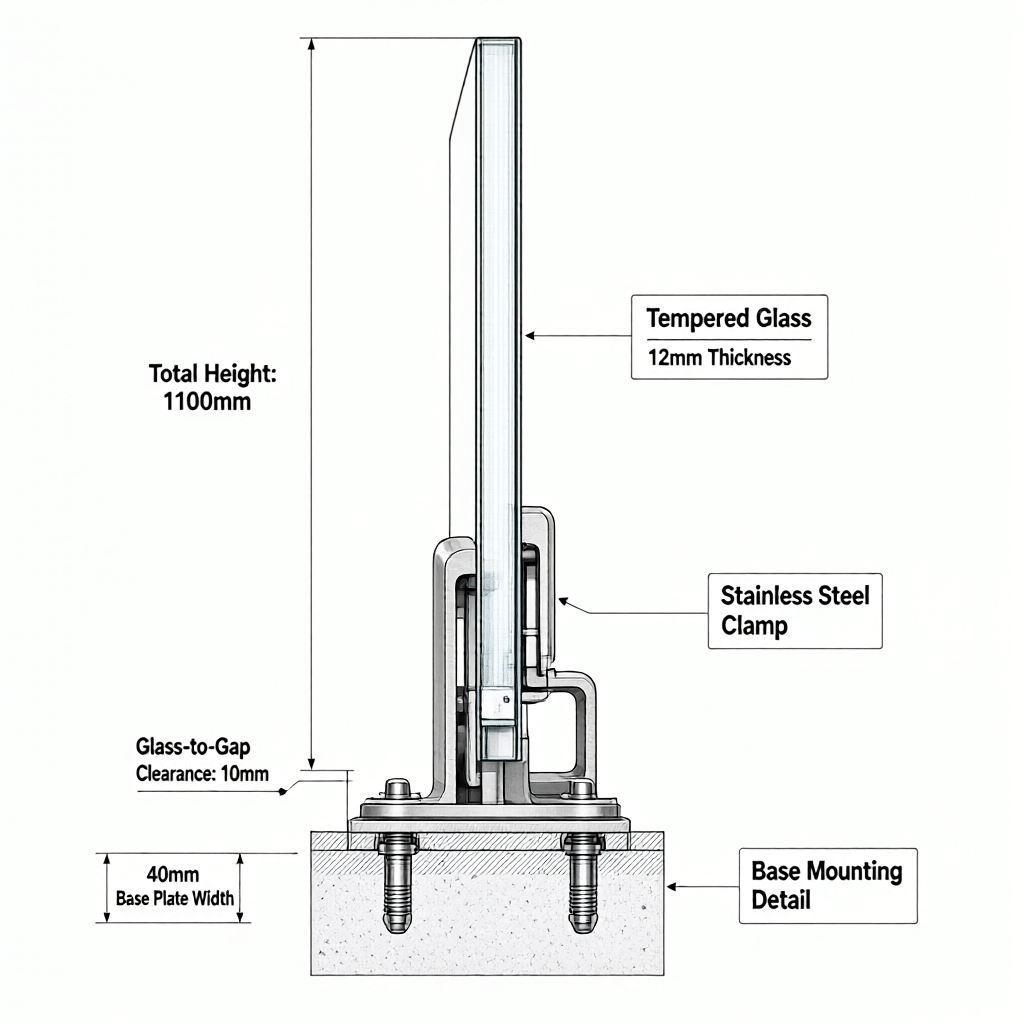
Glass balustrade systems for commercial applications are defined by a set of interdependent technical parameters. Each specification affects safety performance, cost, and installation logistics.
Glass Type and Thickness
| Specification | Typical Range | Application Context |
|---|---|---|
| Tempered glass | 10 mm – 19 mm | Interior staircases, low-rise commercial |
| Laminated glass | 10.52 mm – 19.52 mm | Exterior balconies, high-rise, wind-exposed |
| Frameless standoff systems | 12 mm – 15 mm laminated | Hotel lobbies, luxury residential terraces |
| Semi-frameless (top-rail) | 10 mm – 12 mm tempered | Office mezzanines, cost-sensitive projects |
Tempered glass is heat-treated to shatter into small granular pieces rather than sharp shards. For commercial balustrades where human impact is a risk, most international codes require toughened safety glass. Laminated glass — two or more glass plies bonded with a PVB or SentryGlas interlayer — is the preferred choice for external applications because even if one pane cracks, the interlayer holds the panel in place, maintaining the barrier. This makes laminated glass essential for frameless glass barrier installations on wind-exposed facades.
Fitting and Framing Materials
- Stainless steel fittings (AISI 304 for interior, AISI 316 for coastal or high-humidity environments)
- Anodized aluminum channels for semi-frameless or fully framed systems
- Powder-coated steel profiles when color matching a building’s architectural palette
Fitting thickness and gauge directly affect structural rigidity. A typical clamp or stand-off fitting for a 12 mm panel carries a safe working load well above standard code requirements, but the overall system rating depends on how the base plates are anchored to the substrate.
Height and Load Ratings
International standards such as those published by ISO define minimum balustrade heights and horizontal load capacities. Common benchmarks include:
- Minimum height: 900 mm – 1100 mm depending on building type and jurisdiction
- Horizontal load: typically 0.5 kN/m – 1.5 kN/m for residential; up to 2.0 kN/m for assembly occupancies
- Wind load rating: must be calculated per local code for exterior balcony applications
Manufacturers with project experience engineer the profile structure and fitting spacing to meet these loads without excessive glass thickness, which keeps shipping costs manageable.
Applications — Where Can Glass Balustrade Systems Be Used?
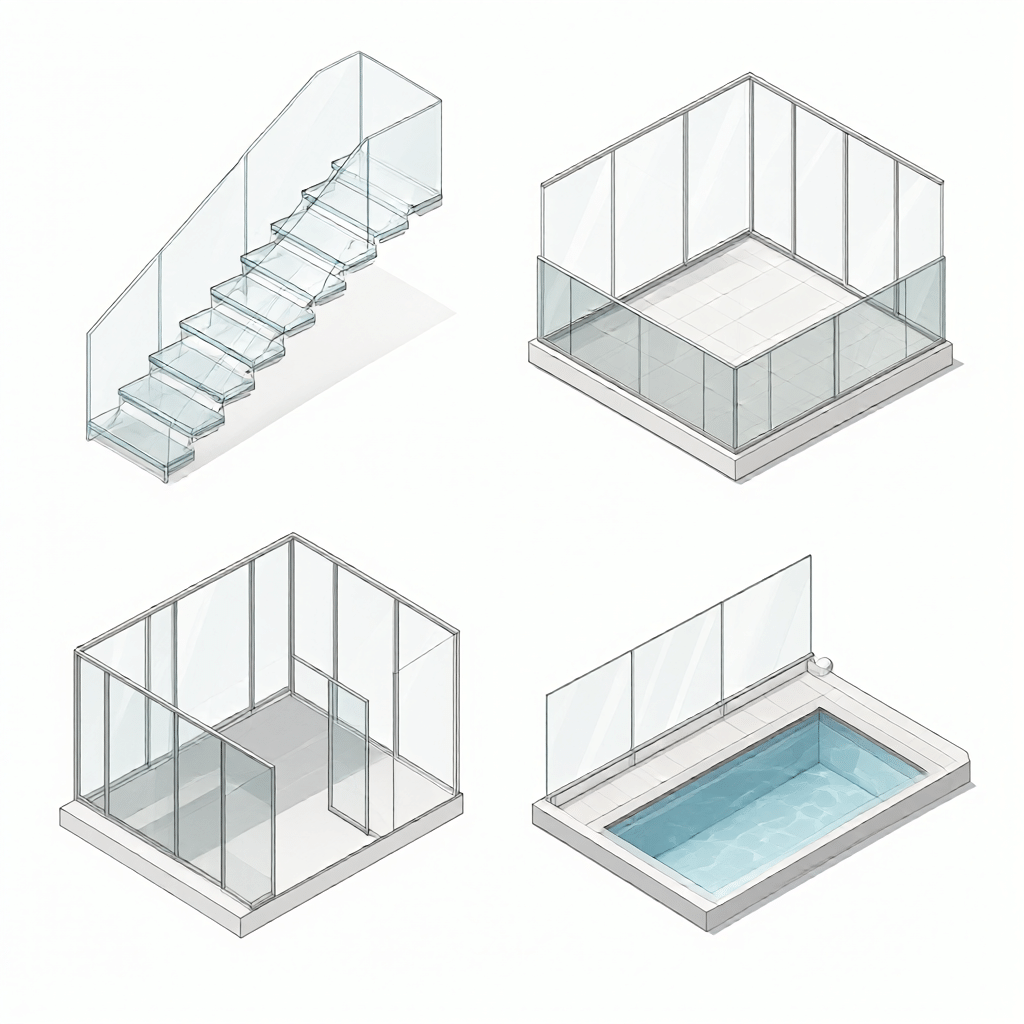
Glass balustrade systems span a wide range of commercial and multi-unit residential projects:
- Hotel balcony projects — exterior laminated glass with 316 stainless steel clamps; wind load and impact resistance are critical
- Office building staircases — semi-frameless or framed systems with tempered glass; cost efficiency and quick installation matter
- Residential high-rise terraces — frameless systems using structural silicone or stand-off fittings for maximum visibility
- Public building balustrades — higher load ratings, anti-climb compliance, and durable surface finishes
The same basic system can be adapted across these scenarios through changes in glass type, fitting grade, and anchor detail. Buyers should evaluate their project against these use cases before specifying.
Buying Factors — What to Consider When Buying Glass Balustrades in Bulk?
1. Compliance with Building Codes
Different markets enforce different standards. Australia and New Zealand follow AS 1288 and NZS 4223. The European market references EN 12600 for impact resistance and EN 1991-1-1 for wind actions. The US typically references ICC-ES evaluation reports and local amendments to the IBC. A reliable glass balustrade manufacturer should be able to adjust profile dimensions, glass thickness, and fitting design to satisfy the code requirements of your target market — and provide test reports or calculations to support compliance.
2. Manufacturing Capability and Quality Control
Ask the manufacturer about:
- Factory production capacity and average lead time for bulk orders
- In-process quality checks (glass edgework, hole drilling tolerance, surface inspection)
- Pre-shipment testing — air-tightness, water-tightness, and wind resistance tests
- Packaging standards for overseas container shipment (crate vs. foam-separated palletizing)
3. Customization Options
Projects rarely fit off-the-shelf dimensions. Key customization variables include panel size, glass tint or frit patterns, fitting finish (brushed, polished, PVD colors), and base plate designs for different substrate types (concrete, steel, timber). A manufacturer offering full OEM/ODM capability can adjust profile structures and hardware to match your project drawings.
4. Export Documentation and Logistics
For international procurement, the supplier should provide a complete export package including packing list, commercial invoice, certificate of origin, and any required material test certificates. FCL shipments are most cost-effective for large projects; LCL is viable for smaller orders or phased deliveries.
Price & Cost — How Much Do Bulk Glass Balustrades Cost? (FOB China)
| System Type | Glass Spec | FOB China (USD/sqm) | MOQ Reference |
|---|---|---|---|
| Tempered framed | 10–12 mm tempered, aluminum channel | $85 – $140 | 50 sqm+ |
| Semi-frameless | 10–12 mm tempered, top rail | $110 – $175 | 50 sqm+ |
| Frameless standoff | 12–15 mm laminated, SS316 fittings | $160 – $260 | 30 sqm+ |
| High-wind exterior | 15–19 mm laminated, SS316 heavy-duty | $220 – $380 | 30 sqm+ |
Indicative FOB China bulk-order pricing for trade buyers — not a retail price and not a binding offer; final pricing depends on quantity, specification and order schedule.
Price drivers beyond glass type include fitting material (316 stainless steel costs roughly 30–50% more than 304), surface treatments, packaging requirements for long-container routes, and any custom profile tooling charges for non-standard projects. Request a bulk FOB quotation with your project drawings for an accurate comparison. Request a Bulk FOB Quotation
Evidence & Practical Notes
Field note: Many B2B buyers discover too late that their specified frameless system requires a structural concrete curb or steel subframe at the base — something their architect did not detail. Always confirm the installation interface before ordering, and ask the manufacturer whether their fittings are compatible with your substrate.
Practical limitation: Laminated glass is significantly heavier than tempered glass of the same nominal thickness. A 15.52 mm laminated panel can weigh over 80 kg per square meter, which increases handling costs on site and may require stronger anchor details. This weight difference also affects container loading quantities and per-unit shipping cost.
Buyer takeaway: Prioritize manufacturers who offer wind-load engineering support and code-adjustable profiles over those who only sell standard catalog sizes. The upfront cost of engineered compliance is far lower than the cost of a failed inspection or a replacement order after a project-specific rejection.
Supplier Evaluation — Choosing a Glass Balustrade Manufacturer for Your Project
When comparing manufacturers for a commercial project, the evaluation should focus on three areas: technical capability, proven export experience, and quality assurance.
A manufacturer that adjusts profile structures and fittings to match local building codes reduces the risk of customs or inspection delays. Pre-shipment testing for air-tightness, water-tightness, and wind resistance gives buyers verifiable evidence that the system performs as specified before it leaves the factory. Full export documentation — packing lists, proforma invoices, and customs paperwork — is essential for smooth international delivery, especially on FCL and LCL shipments from China.
Customization is another key differentiator. Projects ranging from hotel balcony glazing to public building balustrades often require non-standard panel sizes, specific glass tints, or color-matched fittings. A supplier with OEM and ODM capability can adapt both the aluminum or stainless steel profile geometry and the hardware to your project drawings rather than forcing your design to fit their existing catalog.
For buyers evaluating a glass balustrade manufacturer, the practical approach is to request a technical capability statement alongside your inquiry — asking for test report samples, typical export documentation, and examples of code-adaptable profile systems. Send Your Project Requirements for a Custom Quote
Glass Standards and Test Methods
International standards provide the technical backbone for specifying safe, compliant glass balustrade systems. The following standards are the specific references B2B buyers should require in supplier documentation:
- ISO 12542 — Toughened safety glass (tempered glass). Specifies thermal strengthening requirements, fragmentation testing, and optical quality criteria. Any tempered glass panel supplied for balustrade use must carry certification traceable to this standard.
- ISO 12543 — Laminated glass. Covers the construction, bonding performance, and impact safety requirements for multi-ply glass assemblies using PVB or ionomer interlayers. Frameless exterior balustrades must use glass certified to this standard.
- EN 12600 — Glass in building. Pendulum impact test for safety glazing; determines whether a glass assembly meets the required impact resistance classification for human contact applications.
- ASTM A240 — Standard specification for chromium and chromium-nickel stainless steel plate, sheet, and strip. This is the benchmark for verifying AISI 304 and AISI 316 fitting grades.
When sourcing in bulk, request that the manufacturer reference these standard numbers explicitly in their technical submittal — not just generic claims of “compliant with international standards.”
Height, Load, and Wind Rating Specifications
International standards such as those published by ISO define minimum balustrade heights and horizontal load capacities. Common benchmarks include:
- Minimum height: 900 mm – 1100 mm depending on building type and jurisdiction
- Horizontal load: typically 0.5 kN/m – 1.5 kN/m for residential; up to 2.0 kN/m for assembly occupancies
- Wind load rating: must be calculated per local code for exterior balcony applications
For exterior high-rise applications, wind load engineering is critical. The glass thickness, fitting spacing, and base plate design must all be sized to resist the design wind pressure calculated per the target market’s structural code. Manufacturers with project experience engineer the profile structure and fitting spacing to meet these loads without excessive glass thickness, which keeps shipping costs manageable.
Manufacturing Quality Control Benchmarks
Reputable manufacturers implement in-process quality controls aligned with the standards above:
- Glass edgework tolerance: ±0.5 mm on cut dimensions
- Hole drilling tolerance for standoffs and clamps: ±0.3 mm
- Surface inspection under controlled lighting for cosmetic defects in transparent glass
- lamination bond integrity verification for every laminated panel batch
Procurement Buyer Checklist
The following checklist should be completed before placing a bulk order with any glass balustrade manufacturer:
| Checklist Item | Acceptance Criteria | Document Required |
|---|---|---|
| Glass thickness verification | Actual thickness within ±0.2 mm of specified value | Mill certificate / third-party test report |
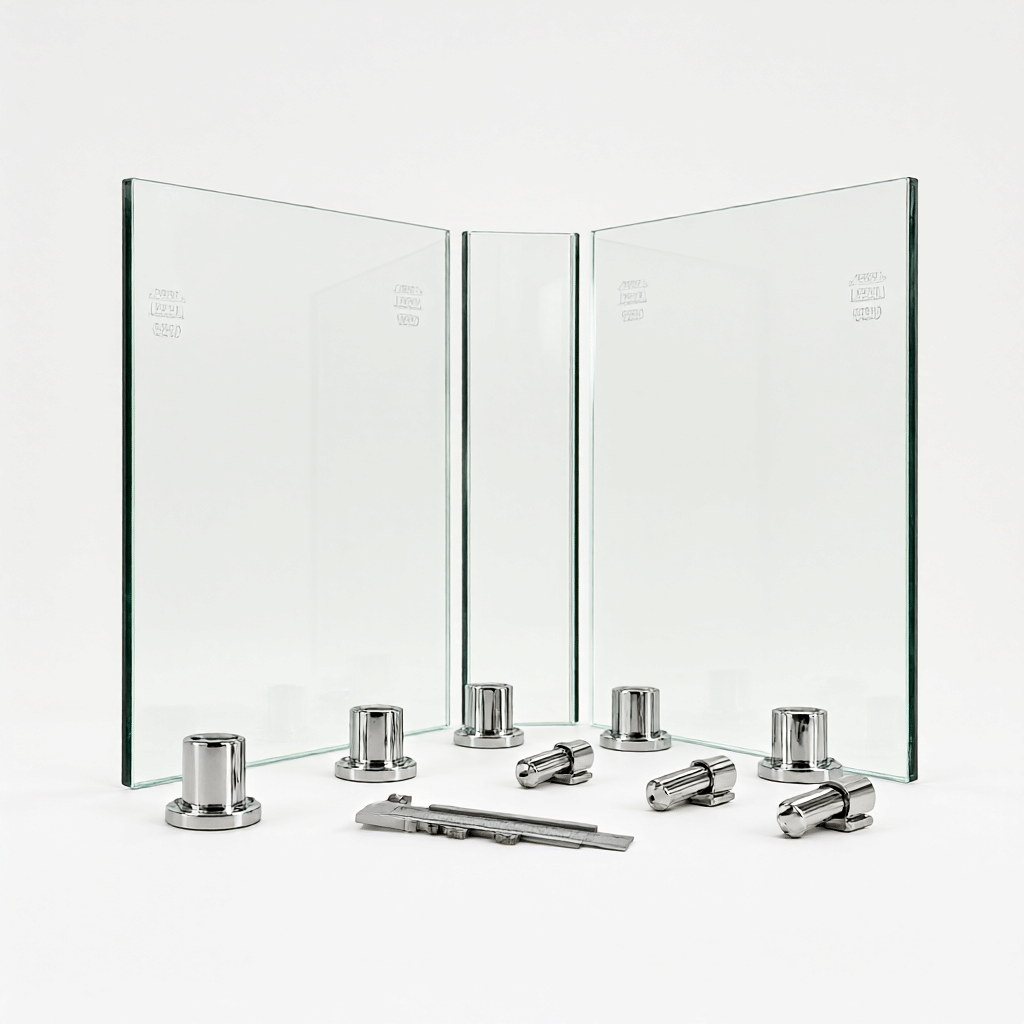
| Tempered glass certification | Conforms to ISO 12542; visible etched mark on every panel | Certification copy; sample photo documentation |
| Laminated glass certification | Conforms to ISO 12543; PVB interlayer thickness documented | Interlayer spec sheet; bond test report |
| Fitting material grade | AISI 304 (interior) or AISI 316 (exterior/coastal) confirmed | ASTM A240 material test report |
| Wind load calculation | Structural calculation per project location’s code | Engineer-stamped calculation sheet |
| Sample approval | First-article sample inspected and signed off before mass production | Signed sample approval form |
| Pre-shipment inspection | Air-tightness, water-tightness, wind resistance tested on representative samples | Test report from certified laboratory |
| Packaging inspection | Glass panels separated by foam/crate; fittings protected; moisture barrier | Packaging standard document; photos |
| Export documentation | Packing list, commercial invoice, certificate of origin, customs paperwork complete | Full documentation package |
Red Flags — Warning Signs to Watch For
When evaluating a glass balustrade manufacturer, the following warning signs indicate potential risk:
- Vague compliance claims without test reports — Phrases like “meets all international standards” without citing specific standard numbers (e.g., ISO 12542, ISO 12543) or providing test certificates. Legitimate manufacturers reference specific standards and produce reports on request.
- Unspecified AISI grades for stainless steel fittings — If a supplier cannot confirm whether fittings are AISI 304 or AISI 316, or refuses to provide material test reports, this is a serious quality risk — particularly for exterior or coastal projects where 316 is mandatory.
- Absence of third-party inspection options — Reputable manufacturers welcome third-party inspection (e.g., SGS, BV) before shipment. Refusal or hesitation is a strong indicator of inconsistent quality control.
- No first-article sampling protocol — Bulk orders without a signed sample approval step carry high risk. Always request and approve a production-representative sample before authorizing full manufacture.
- Glass thickness sold without wind load calculation — For exterior balcony applications, glass thickness alone does not guarantee safety. A responsible manufacturer will provide a wind load calculation based on your project location and height.
- No pre-shipment testing capability — If the manufacturer cannot perform or commission air-tightness, water-tightness, or wind resistance tests, the system’s performance before it reaches your site remains unverified.
Manufacturer Evaluation Framework — Decision Matrix for B2B Buyers
When comparing multiple manufacturers, use the following weighted decision matrix to score each supplier objectively:
| Evaluation Criterion | Weight | Score (1–5) | Weighted Score |
|---|---|---|---|
| Technical capability & code adaptability | 30% | ||
| Export experience & documentation quality | 25% | ||
| Quality assurance & pre-shipment testing | 25% | ||
| Customization & OEM/ODM flexibility | 20% | ||
| Total | 100% | /5.0 |
A supplier scoring below 3.5 across these criteria should be treated as high-risk for critical or time-sensitive projects. The framework prioritizes technical capability and quality assurance because these factors directly determine whether the installed system will pass local building inspections — the most common cause of project delays in international glazing procurement.
How We Approach Glass Balustrade Manufacturing — Jusen Door and Windows
As a manufacturer, our approach to glass balustrade supply follows the same standards and evaluation criteria outlined above. Here is how we meet them in practice:
- Direct factory supply — We eliminate middleman markup, offering competitive FOB pricing with full cost transparency on glass, fittings, packaging, and logistics.
- Full customization — Every project is engineered to your exact panel sizes, glass specifications, fitting finishes, and color requirements. We adjust profile structures and hardware to match your architectural drawings and target-market building codes.
- Pre-shipment testing — Each production batch undergoes air-tightness, water-tightness, and wind resistance testing before shipment, providing verifiable evidence of system performance.
- Export-ready documentation — With extensive foreign trade experience, we provide complete packing lists, proforma invoices, certificates of origin, and all customs documentation required for smooth clearance.
- Flexible shipping — We handle both FCL and LCL shipments, delivering directly from our China factory to your port or project site.
Whether you are sourcing framed systems for an office mezzanine or frameless standoff glazing for a luxury hotel terrace, our team can adjust every specification to your project requirements. Send Your Project Requirements for a Custom Quote
Technical Parameters and Production Processes
Understanding the manufacturing process helps buyers evaluate quality and negotiate effectively. A typical commercial glass balustrade system follows these production stages:
Glass Processing:
- Cutting to specification using CNC waterjet or edger machines (tolerance ±0.5 mm)
- Edgework: seamed (pencil) edge for framed systems, polished edge for frameless applications
- Drilling for standoffs, clamps, and hinges using diamond-tipped tools (tolerance ±0.3 mm)
- Tempering in a continuous furnace at 620°C–650°C, followed by rapid quenching to achieve surface compression of ≥ 10,000 kPa
- Lamination: interlayer (0.76 mm PVB or 0.38 mm SentryGlas) is placed between glass plies, then cured in an autoclave at 130°C under 12–15 bar pressure for 60–90 minutes
Fitting Manufacturing:
- Stainless steel fittings are CNC-machined from bar stock or cast and then finished (brushed, mirror polish, or PVD coating)
- Aluminum profiles are extruded to custom cross-sections, then anodized (minimum 10 µm thickness per ISO 7599) or powder-coated
- Base plates and anchor fittings are designed for specific substrates: cast-in channels for concrete, weld-on plates for steel, or through-bolt fixtures for timber
Assembly and Testing:
- Pre-shipment inspection includes visual checks, dimensional verification, and functional testing of moving parts
- For exterior systems, wind-load proof testing per EN 12600 or local equivalent validates the assembly
- Packaging uses foam-separated crate systems with moisture barriers for container shipping
Industry Case Studies and Real-World Specifications
Concrete project examples illustrate how specifications vary by application:
| Project Type | Location | Glass Specification | Fitting Material | Wind Load Requirement | Typical Unit Price (FOB) |
|---|---|---|---|---|---|
| Hotel balcony glazing | Dubai, UAE | 15.52 mm laminated (2×6.38 mm + 0.76 mm PVB) | AISI 316 SS stand-off | 2.4 kN/m² (local code) | $245–$290/sqm |
| Office staircase railing | London, UK | 12 mm tempered (ISO 12542 certified) | AISI 304 SS clamps | 0.74 kN/m horizontal (BS 6180) | $115–$155/sqm |
| Residential terrace balustrade | Sydney, Australia | 13.52 mm laminated | AISI 316 SS, black PVD finish | 1.5 kN/m (AS 1288) | $185–$230/sqm |
| Public building balustrade | Singapore | 19 mm laminated, clear | AISI 316 SS, mirror polish | 2.0 kN/m (SS 531) | $280–$350/sqm |
These cases demonstrate that a one-size-fits-all specification does not exist. Buyers should work with manufacturers who can engineer profile structures and fitting spacing to meet the calculated wind loads for their specific project location, rather than accepting catalog-standard designs that may require over-specifying glass thickness.
Procurement Decision Guide and Red Flags
Beyond the standard evaluation criteria, experienced B2B buyers look for specific risk indicators during supplier assessment:
Green Flags (Proceed):
- Manufacturer provides ISO 12542/12543 test reports with batch traceability
- Willingness to adjust profile geometry and fitting design to match your target market’s building code
- Pre-shipment testing covers air-tightness, water-tightness, and wind resistance (not just visual inspection)
- Clear export documentation process including packing lists, proforma invoices, and customs support
- Offer FCL and LCL shipping options with experience in container loading optimization
Red Flags (Proceed with Caution):
- Cannot provide material certificates for stainless steel fittings (ASTM A240 or equivalent)
- Claims “compliant with all international standards” without referencing specific standard numbers
- Refuses to share test report samples or calculation methodology for wind-load engineering
- Pushes standard catalog sizes without offering customization for non-standard panel dimensions
- No pre-shipment inspection protocol or packaging standards for overseas shipment
Decision Framework:
- Define your project parameters — glass type, height, load requirements, target market codes
- Request technical submittals from 3–5 manufacturers including test reports, material certificates, and sample calculations
- Evaluate customization capability — can the manufacturer adjust profiles and fittings to your specifications?
- Verify export experience — request references from similar projects shipped to your region
- Order first-article samples — inspect edgework, hole tolerance, surface finish, and fitting functionality before bulk production
- Confirm packaging and logistics — ensure crate/pallet standards protect glass during ocean freight
Company and Brand Context — How We Meet These Standards
When evaluating a glass balustrade manufacturer, it is important to assess whether their capabilities align with the technical and procedural benchmarks described above. Here is how we approach these standards at the manufacturing level.
As a manufacturer specializing in custom glazing systems, our approach centers on engineering flexibility and verifiable quality control. We source tempered glass certified to ISO 12542 and laminated glass certified to ISO 12543, with batch traceability for every order. Our stainless steel fittings are supplied with ASTM A240 material test reports confirming AISI 304 or AISI 316 grade, depending on your project specification.
Our manufacturing process includes CNC precision cutting and drilling with tolerances of ±0.5 mm on glass dimensions and ±0.3 mm on hole positioning. Every laminated panel undergoes autoclave curing and bond integrity verification. Before shipment, each system is inspected for air-tightness, water-tightness, and wind resistance performance — providing you with documented evidence that the installed system will perform as engineered.
We understand that different markets have different code requirements. Our profile structures and fitting designs are adjustable to meet local building codes, whether you are sourcing for AS 1288 compliance in Australia, EN standards in Europe, or IBC amendments in the United States. We provide full export documentation — packing lists, proforma invoices, certificates of origin, and material test certificates — and ship via both FCL and LCL from our China factory.
For buyers seeking a glass balustrade manufacturer that combines technical capability with export readiness, we offer direct factory supply with competitive pricing and full customization on glass type, thickness, fitting material, and profile structure. Contact Our Team for a Technical Discussion
Sources & References
- ISO — www.iso.org











