
Last updated: November 25, 2026
Fibre Cement vs Wood Door Skin — A B2B Buying Comparison
For most modern commercial and residential projects, fibre cement door skin is the better choice over wood due to its superior moisture resistance and lower lifecycle maintenance, though solid wood veneer remains the go-to for projects demanding specific timber aesthetics.
The decision ultimately depends on your climate, building codes, design intent, and budget. This guide breaks down fibre cement vs wood door skin performance so architects, contractors, and procurement managers can specify or order with confidence.
Types & Categories of Door Skin Material
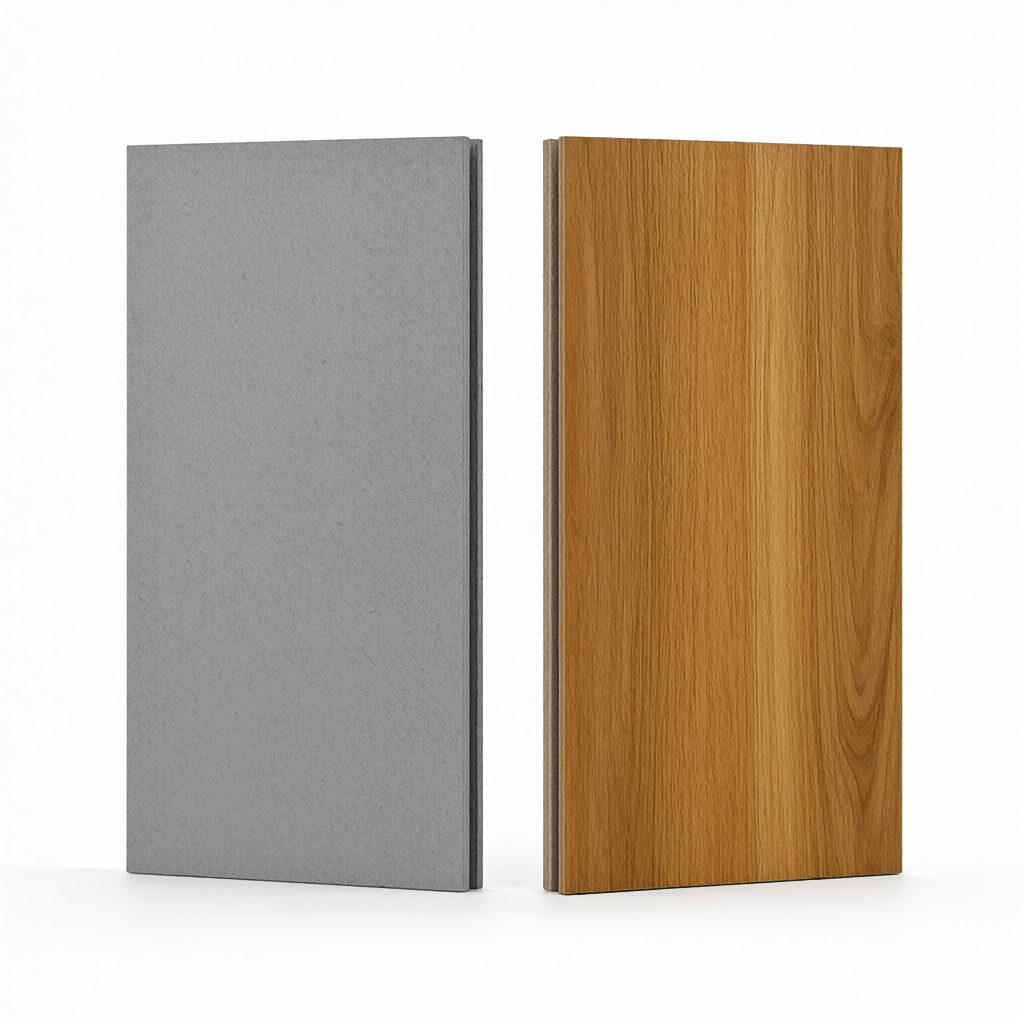
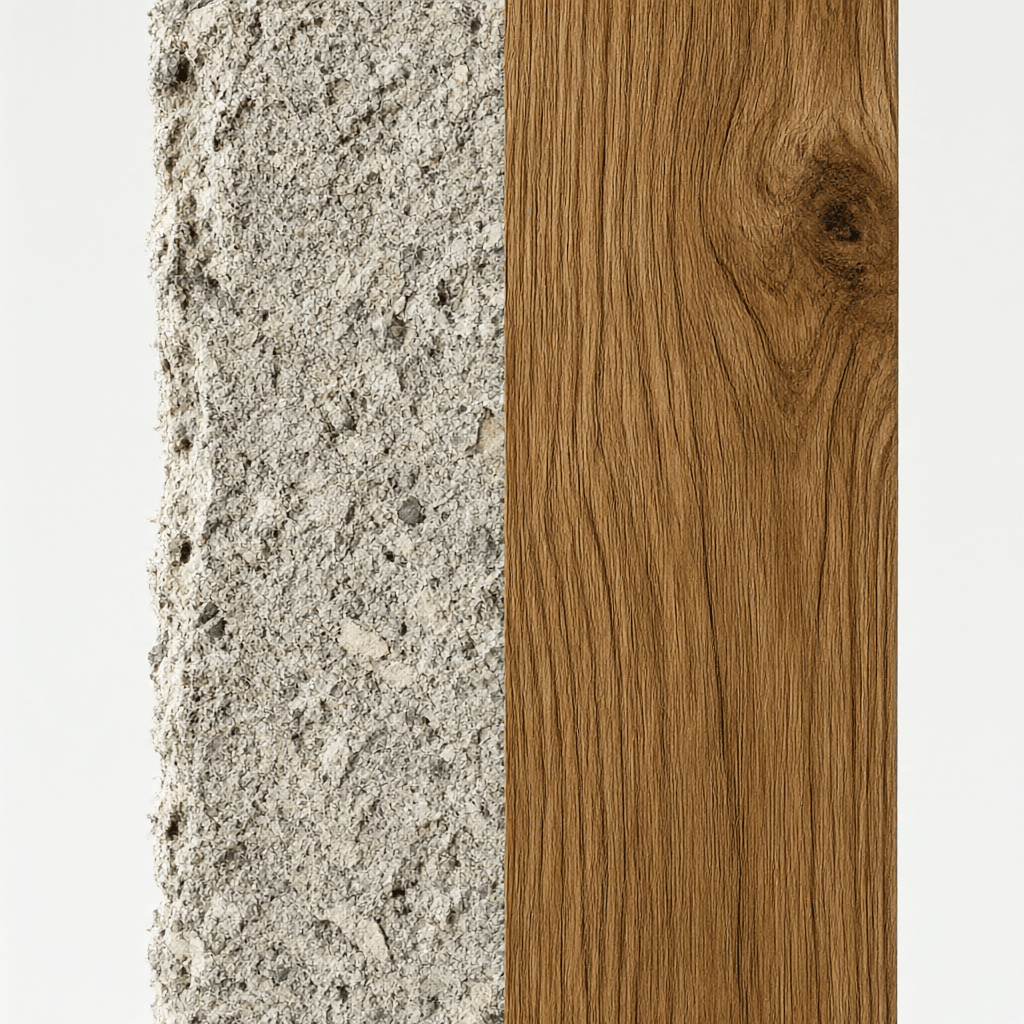
Understanding the two dominant options helps in evaluating their performance profiles.
What is fibre cement door skin?
Fibre cement skin is a dense, engineered cladding panel made from cellulose fibres (recycled paper), Portland cement, and fine silica sand. It is manufactured through a wet-forming and autoclave curing process that creates a rigid, stable surface layer bonded directly onto a door core—typically particle board, Honeycomb paper core, or gypsum. The result is a non-combustible, dimensionally stable outer layer often referred to as an HCFC-free cement board skin. It is widely used for exterior door skin material selection because it handles environmental stress without organic rot.
What wood door skin options are available?
Wood door skins come in two main forms: solid timber planks laminated together and engineered wood veneers applied over a stable core. Common species include oak, teak, meranti, and mahogany, chosen for grain depth and density. For applications where the look of real timber is required, a wood veneer door skin offers visual continuity while reducing weight compared to solid lumber. These skins are generally selected for high-end entrances, hospitality lobbies, and heritage-style facades.
Fibre Cement vs Wood Door Skin — Comparison Table
| Attribute | Fibre Cement Door Skin | Wood Door Skin (Veneer/Solid) |
|---|---|---|
| Moisture Resistance | Excellent; does not rot or swell easily | Good only when sealed; prone to swelling/rot if unsealed |
| Dimensional Stability | Very High; minimal expansion/contraction | Moderate; reacts to humidity changes |
| Impact Resistance | High hardness; resists denting | Variable; softwoods dent easily, hardwoods resist well |
| Weight per Square Metre | Heavier (~15–20 kg/m² depending on thickness) | Lighter (~8–12 kg/m² for veneer) |
| Fire Rating Potential | Non-combustible core contributes to higher fire ratings | Requires special treatment for fire compliance |
| Maintenance Cycle | 5–10 years repaint/coating refresh | 2–4 years for refinishing/sealing |
| Custom Colour Options | Primed white/grey base; paintable any RAL colour | Natural wood tones or stained/painted |
Key Buying Factors: Durability, Maintenance, and Performance
Is fibre cement or wood door skin more durable for exterior use?
In exterior exposure, fibre cement generally outperforms wood in raw durability against weathering. It is immune to termites, fungal decay, and delamination caused by moisture cycling. Wood skins, particularly those made from softer species or thin veneers, require rigorous sealant application on all six sides during manufacturing to match this longevity. If a door face will be subjected to high UV exposure and frequent rain, fibre cement door skin pros and cons heavily favor the pro side regarding lifespan.
Which door skin material resists moisture and warping better?
Fibre cement is inherently hydrophobic enough to resist absorption without warping, making it ideal for coastal buildings and high-humidity zones. Wood expands across the grain when exposed to moisture; therefore, a quality door facing panel of wood must be kiln-dried to 6–8% moisture content before installation and maintained with high-quality finishes. For multi-unit residential developments in tropical climates, fibre cement reduces callback risks significantly.
How much does a fibre cement door skin cost compared to wood?
Material costs vary by supplier and volume, but generally, fibre cement skins sit in a similar mid-range price bracket to premium wood veneers, while being less expensive than thick solid hardwood skins. However, the total cost of ownership favors fibre cement because repainting intervals are longer and labor costs for touch-ups are lower over the building’s life. See our detailed breakdown on MDF doors pricing to understand how core materials influence overall unit economics.
What factors matter most for hardware and framing compatibility?
Weight is critical here. Because fibre cement door skin adds substantial mass to the leaf, heavy-duty hinges and robust frames are mandatory. Standard residential hinges may sag under the load of a large fibre cement-clad entrance door. Conversely, lighter wood skins place less stress on pivots and hinges, allowing for slimmer frame designs. Always verify the door weight against the manufacturer’s hardware specifications before finalizing specs.
Do building codes favour one door skin over the other?
Fire safety regulations often dictate skin choices. In many jurisdictions, exterior doors in commercial corridors must meet strict fire-resistance ratings (e.g., EI30, EI60). Fibre cement naturally supports these ratings because it is non-combustible. Achieving comparable ratings with wood requires intumescent coatings and specialized core engineering. Check local requirements through resources like ICC International Code Council guidelines early in the design phase to avoid costly material substitutions later.
Price Range and Cost Considerations
How much does a door skin material cost per unit?
While exact quotes depend on profile dimensions, glass inserts, and hardware selections, here are typical reference ranges for bulk procurement in 2026:
- Fibre Cement Skin: Mid-tier pricing. The material itself is cost-effective, but shipping weights are higher, which can increase freight costs per container.
- Wood Veneer Skin: Entry-level veneered options are affordable, but high-grade solid timber skins carry a significant premium.
When calculating project budgets, remember to factor in the FCL vs LCL shipping implications since heavier fibre cement units may fill volume faster but add tonnage charges.
Manufacturing Quality and Standards
How leading manufacturers produce and inspect each skin type reveals why some suppliers fail while others deliver consistent performance year after year.
Evidence & Practical Notes
Field note: In practice, one of the most common defects spotted during site delivery inspections is edge delamination on wooden skins where the sealer was omitted on cut edges during fabrication. Fibre cement panels rarely show this specific failure mode because the bond between the cement matrix and the substrate is chemical rather than adhesive-dependent.
Practical limitation: While fibre cement is remarkably durable, it is brittle under point-impact stress. Dropping a heavy tool or striking the door corner aggressively can chip the face. Wood skins tend to scratch or dent but rarely shatter, offering a different kind of resilience suited to high-traffic service corridors.
Buyer takeaway: Specify pre-primed factory finishes wherever possible. Whether you choose a wood or cement skin, post-installation painting on-site introduces variables—temperature, humidity, and dust—that compromise the coating bond. Factory-applied PVDF or acrylic primers ensure uniform coverage and maximum adhesion before the unit ever reaches the job site.
Industry Best Practices for Procurement
When sourcing exterior doors, buyers should request third-party test reports validating air-tightness, water-tightness, and wind resistance according to relevant standards such as ASTM E2092. Verify that the manufacturer conducts rigorous pre-shipment checks. For complex custom projects requiring adherence to specific regional codes, reviewing a Door Factory Audit Checklist can help evaluate potential suppliers objectively.
As a manufacturer operating in this space, we approach material selection based on rigorous testing protocols. Our workflow ensures that both fibre cement and wood skins undergo strict quality control measures—including air-tightness, water-tightness, and wind resistance tests—before leaving the facility. We offer full customization on size, color, glass, and hardware accessories, adjusting profile structures and fittings to match local building codes for target markets. For technical specifications or to discuss your project requirements, Contact Our Team.
Fire Resistance Ratings for Each Door Skin Material
Fire Rating Standards and Classifications
Fire safety is one of the most critical considerations when choosing a door skin material. Different materials carry inherently different fire-resistance profiles, which directly affect compliance with building codes and insurance requirements.
Fibre Cement Door Skin — Non-Combustible Classification
Fibre cement door skins are classified as non-combustible under EN 13501-2 (Fire classification of construction products). Specifically, fibre cement achieves:
| Standard | Rating | Description |
|---|---|---|
| EN 13501-2 | A2-s1,d0 | Non-combustible; very limited flame spread and smoke production |
| ASTM E119 | Up to EI90 | Can support fire-resistive assemblies up to 90 minutes when paired with appropriate core and framing |
| AS 1530.4 | Passes 30–60 min tests | Demonstrates structural integrity and insulation during standard fire exposure |
For projects requiring certified fire doors, fibre cement skins form a reliable outer layer that contributes to EI30, EI60, and EI90 ratings without additional chemical treatments. These ratings indicate the door can maintain both Integrity (E) and Insulation (I) for 30, 60, or 90 minutes respectively under standard fire conditions. For a detailed breakdown of these ratings, see our EI30 vs EI60 vs EI90 Fire Resistance Comparison Guide.
Wood Door Skin — Combustible with Treatment Options
Natural wood is inherently combustible and carries an Euroclass F rating (lowest fire performance) under EN 13501-2 when untreated. To achieve fire-resistance compliance, wood door skins must undergo one or more of the following:
| Treatment Method | Achievable Rating | Notes |
|---|---|---|
| Intumescent coating | EI30–EI60 | Expands under heat to seal gaps; requires reapplication every 3–5 years |
| Fire-retardant impregnation | EI30–EI45 | Chemical treatment forced into wood fibers; may alter natural appearance |
| Laminated fire-rated cores + wood veneer | EI60 | Veneer acts as cosmetic layer over a certified fire-rated core |
| Thick solid timber (≥54 mm) | EI30 | Limited to lower ratings; heavier and more expensive |
Key takeaway: If your project demands EI60 or higher and local code prohibits combustible materials in exit routes, fibre cement is the simpler, more reliable path. Wood remains viable for residential applications where EI30 suffices and aesthetics are prioritised.
Moisture and Humidity Testing Standards
Quality door skin materials undergo validated moisture-resistance testing. Key standards include:
- ISO 12528 — Hygrothermal performance of construction materials and products; measures water absorption, dimensional stability, and moisture content changes over time.
- ASTM C1186 / C1187 — Standard test methods for flexural and compressive strength of fibre-cement board, indirectly confirming structural integrity after moisture exposure.
- EN 845-1 — Solid masonry anchors and inserts; relevant for verifying that fasteners through door skins retain pull-out resistance after wet-dry cycling.
These standards confirm that fibre cement retains its shape and bond under repeated humidity cycles — something wood struggles to match without aggressive pre-treatment and ongoing maintenance.
Aesthetic Finish Options and Customisation Potential
Fibre Cement: Paintable Versatility
Fibre cement door skins arrive typically as a primed white or light grey substrate, ready for any colour application. This gives contractors and homeowners full freedom to match any palette:
- Custom RAL colours — Over 200 RAL shades achievable with professional-grade exterior acrylic or PVDF coatings.
- Textured finishes — Subtle sand-blasted or embossed textures can mimic stone, stucco, or brushed metal aesthetics.
- Dual-tone options — Factory-applied two-tone schemes (e.g., dark frame, lighter panel) are available from select manufacturers.
- Matte, satin, or gloss sheens — Controlled by topcoat selection; matte is preferred for modern minimalist designs, gloss for contemporary statement pieces.
Because fibre cement accepts paint mechanically rather than chemically bonding with stain, it can be repainted repeatedly throughout its lifecycle without stripping.
Wood: Natural Grain and Stain Depth
Wood door skins offer a fundamentally different aesthetic experience defined by organic variation:
- Natural grain patterns — Every plank or veneer sheet presents unique figuring; no two doors look identical.
- Transparent stains — Enhance grain visibility while adding protective colour; popular for oak, teak, walnut, and mahogany.
- Opaque paints and limewash — Full colour coverage while retaining subtle grain texture underneath.
- Whitewash and distressed finishes — Popular in coastal, farmhouse, and Mediterranean styles.
- Species-driven palettes — Teak offers golden-brown warmth, meranti provides a pinkish-red tone, oak delivers classic gold undertones, and mahogany lends deep reddish richness.
Colour and Finish Comparison Summary
| Criterion | Fibre Cement | Wood |
|---|---|---|
| Base colour options | Primed white/grey → any RAL | Natural species tones only |
| Staining capability | N/A (paint-only) | Transparent, semi-transparent, opaque |
| Repaint frequency | Every 5–10 years | Every 2–4 years (refinish/re-seal) |
| Grain authenticity | None (uniform surface) | Unique natural grain per panel |
| Two-tone factory options | Available from some manufacturers | Available via hand-finishing or lamination |
| UV fade resistance | High (with quality PVDF topcoat) | Moderate to low (depends on species and finish) |
| Matching architectural palettes | Fully customisable | Constrained by available wood species |
Which material allows more custom colour and finish options? Fibre cement wins for pure colour flexibility — any RAL shade is achievable. Wood wins for authentic natural aesthetics that synthetic materials cannot fully replicate. The optimal choice depends on whether your design brief prioritises colour precision or organic warmth.
Total Cost of Ownership: Price Range and Lifecycle Economics
Understanding price alone is insufficient for sound procurement decisions. The true cost comparison spans initial purchase, installation, maintenance, and replacement across the product lifespan.
Initial Purchase Price (Per Unit, Bulk Basis)
| Door Type | Fibre Cement Skin | Wood Veneer Skin | Solid Hardwood Skin |
|---|---|---|---|
| Standard Entry Door (≈2000×900 mm) | $180 – $320 | $150 – $280 | $400 – $900+ |
| Tall/Patio Door (≈2400×1200 mm) | $320 – $580 | $280 – $520 | $750 – $1,600+ |
| Fire-Rated Assembly (EI60) | $350 – $650 | $500 – $900* | N/A (requires special core) |
_*Wood at this price includes intumescent treatment and fire-rated core._
Annual Maintenance Cost Estimates (Per Door)
| Maintenance Item | Fibre Cement | Wood (Veneer) | Solid Hardwood |
|---|---|---|---|
| Repainting/Refinishing | Every 7–10 years (~$40–$80) | Every 2–4 years (~$60–$120) | Every 2–3 years (~$80–$150) |
| Sealant Reapplication | Rarely needed | Every 1–2 years (~$20–$40) | Annually (~$30–$50) |
| Patch/Repair (minor damage) | $15–$30 (spot repair) | $40–$100 (fill/sand/refinish) | $60–$200 (veneered patches visible) |
| Full Replacement (after 15 yrs) | Unlikely required | Possible if delamination occurs | May require refinishing only |
15-Year Total Cost of Ownership Example
Based on a mid-range exterior entry door installed on a residential project in a humid climate:
| Cost Category | Fibre Cement | Wood Veneer | Solid Hardwood |
|---|---|---|---|
| Initial purchase | $280 | $240 | $650 |
| Installation | $120 | $120 | $150 |
| 15-year maintenance | ~$60 | ~$420 | ~$600 |
| Expected repaint/refinish cycles | 1–2 | 4–6 | 5–7 |
| Total 15-Year TCO | ~$460 | ~$780 | ~$1,400 |
Conclusion: While solid hardwood commands the highest upfront investment, fibre cement typically delivers the lowest total cost of ownership over a 15-year horizon due to dramatically reduced maintenance. Wood veneer occupies the middle ground but incurs recurring refurbishment costs that accumulate significantly.
Hidden Cost Factors to Consider
- Freight weight: Fibre cement adds ~30% more mass per unit than equivalent wood skins, increasing shipping costs. See our 20ft Container Door Loading Quantity Guide for container optimisation strategies.
- Hardware upgrades: Heavier fibre cement doors often require commercial-grade hinges and closer mechanisms, adding $50–$150 per door.
- Import duties and HS codes: Verify applicable import tariffs before budgeting. Our Door HS Code & Import Duty Guide outlines current rates for major markets.
Procurement Decision Matrix and Step-by-Step Buying Checklist
Decision Matrix: Selecting the Right Door Skin Material
Use the following scoring framework when evaluating fibre cement versus wood for your specific project:
| Evaluation Criterion | Weight | Fibre Cement Score (1–5) | Wood Score (1–5) |
|---|---|---|---|
| Climate suitability (humidity/rain exposure) | 20% | 5 | 3 |
| Fire-rating requirement | 20% | 5 | 2 |
| Aesthetic preferences (natural wood look) | 15% | 2 | 5 |
| Budget constraint (initial cost) | 15% | 3 | 4 |
| Long-term maintenance capacity | 10% | 5 | 2 |
| Custom colour/finish flexibility | 10% | 5 | 3 |
| Structural weight tolerance of frame | 10% | 3 | 5 |
| Weighted Total | 100% | 3.85 | 3.05 |
Interpretation: Scores above 4.0 strongly favour fibre cement. Between 3.0–4.0 indicates a balanced trade-off where project-specific priorities should drive the final decision. Below 3.0 suggests wood may better serve the project goals.
Step-by-Step Procurement Checklist
Follow this sequence when sourcing exterior door skins from manufacturers:
- Define project specifications — Confirm door dimensions, fire-rating requirements, climatic exposure class, and aesthetic direction before contacting suppliers.
- Obtain third-party test reports — Request copies of EN 13501-2 fire classification, ASTM C1186/C1187 (for fibre cement), and ISO 12528 moisture-resistance data. No report = red flag.
- Verify manufacturer certifications — Look for ISO 9001 (quality management), CE marking (EU market), and relevant national product certifications.
- Request physical samples — Order at least one full-size sample per material type. Evaluate finish quality, edge sealing, and surface consistency.
- Confirm MOQ and lead times — Standard MOQ ranges from 50–200 units depending on customisation level. Typical lead times: 25–35 days for standard orders, 40–50 days for custom configurations.
- Review factory audit findings — Assess production capacity, QC processes, and packaging standards. Use our Door Factory Audit Checklist as your evaluation framework.
- Clarify shipping terms — Determine whether FCL or LCL shipping suits your order volume. Refer to our FCL vs LCL Shipping Guide for cost comparisons.
- Finalise documentation requirements — Confirm the supplier can provide packing lists, proforma invoices, certificates of origin, and customs documentation — all essential for smooth import clearance.
Red Flags When Evaluating Suppliers
Watch for these warning signs during supplier assessment:
- ❌ No third-party test reports available — Any supplier unable to produce fire-rating or moisture-resistance certificates from accredited laboratories should be disqualified immediately.
- ❌ Vague or outdated certifications — Certificates older than 3 years or issued by non-accredited bodies do not demonstrate current compliance.
- ❌ Refusal to provide factory audit access — Reputable manufacturers welcome virtual or on-site audits; evasive behaviour signals hidden production issues.
- ❌ Inconsistent sample quality — Samples that look premium but differ from bulk production indicate inadequate quality control.
- ❌ Unrealistic pricing — Quotes significantly below market rate often reflect substandard materials (e.g., low-density fibre cement boards or unseasoned wood).
- ❌ No pre-shipment inspection protocol — Quality assurance before dispatch is non-negotiable for international orders. Absence of this step means defects reach your site unresolved.
- ❌ Incomplete export documentation — Suppliers who cannot prepare full customs documentation create risky import processes.
How Leading Manufacturers Produce and Quality-Check Each Door Skin Type
Fibre Cement Door Skin Manufacturing Process
The production workflow for fibre cement door skins follows a tightly controlled sequence:
- Batch mixing — Portland cement, refined silica sand, and recycled cellulose fibres are homogeneously blended with water in precise ratios to achieve target density (typically 1.4–1.6 g/cm³).
- Wet-forming and pressing — The slurry is deposited onto a moving wire mesh and compressed through hydraulic rollers to the target thickness (commonly 4–6 mm for door skin applications).
- Autoclave curing — Panels undergo steam curing at high pressure (approximately 10–12 bar) and temperature (180–200°C) for 6–8 hours, transforming the mixture into calcium silicate hydrate crystals that deliver exceptional strength and dimensional stability.
- Cutting and edge finishing — Cured panels are precision-cut to door-panel dimensions; edges are sealed with waterproof coating to prevent moisture ingress during installation.
- Surface priming — Factory-applied acrylic primer ensures uniform base colour and improves topcoat adhesion for subsequent painting.
Quality-Check Protocol for Fibre Cement Skins
Leading manufacturers implement multi-stage verification at each production phase:
- Incoming raw material inspection — Cement grade, sand granularity, and fibre length are tested against specifications before batch release.
- In-process density and thickness checks — Automated gauges monitor panel thickness across the entire surface at 100% frequency during forming.
- Compressive and flexural strength sampling — Random samples from each autoclave batch undergo ASTM C1186 testing to confirm minimum strength thresholds (compressive ≥15 MPa; flexural ≥4 MPa).
- Pre-shipment integrated testing — Completed door units are subjected to air-tightness, water-tightness, and wind resistance tests per relevant national standards before being approved for dispatch.
Wood Door Skin Manufacturing Process
Wood skin production emphasises kiln drying, veneer selection, and adhesive bonding:
- Log selection and peeling — Selected timber logs are sliced or rotary-peeled into veneer sheets of specified thickness (typically 0.5–3 mm for veneer applications).
- Kiln drying — Veneer sheets are dried to 6–8% equilibrium moisture content using controlled kiln schedules, preventing future warping after installation.
- Grading and sorting — Sheets are graded by appearance (A, B, C grades) and matched for grain continuity and colour consistency across panels.
- Adhesive application and pressing — Graded veneer is bonded to the door substrate using formaldehyde-emission-compliant adhesives under calibrated heat and pressure.
- Edge banding and finishing — Exposed edges receive solid wood banding; surfaces receive factory primers or pre-finished coatings.
Quality-Check Protocol for Wood Skins
Critical quality checkpoints during wood door skin production:
- Moisture content verification — Each batch is tested with pin-type moisture meters to confirm 6–8% MC before gluing. Out-of-spec material is rejected.
- Veneer grade inspection — Appearance-grade surfaces are visually inspected for knots, colour variation, and defects per industry grading standards.
- Bond strength testing — Peel and shear tests validate adhesive performance;rejected batches are reworked or scrapped.
- Dimensional stability trials — Sample panels are subjected to accelerated humidity cycling to detect potential delamination before bulk production proceeds.
Here is how the industry works — and how we meet these standards. At Jusen Door and Windows, every production line is equipped with automated thickness gauging and mandatory pre-shipment testing for air-tightness, water-tightness, and wind resistance. We offer full customization on size, color, glass, and hardware accessories, adjusting profile structures and fittings to match local building codes for target markets. For technical specifications or to discuss your project requirements, Contact Our Team.
Sources & References
- MDF doors pricing — doorwoodendoors.com
- ICC International Code Council guidelines — www.iccsafe.org
- FCL vs LCL shipping implications — doorwoodendoors.com
- Door Factory Audit Checklist — doorwoodendoors.com
- EI30 vs EI60 vs EI90 Fire Resistance Comparison Guide — doorwoodendoors.com
- 20ft Container Door Loading Quantity Guide — doorwoodendoors.com
- Door HS Code & Import Duty Guide — doorwoodendoors.com











