
Last updated: November 26, 2026
Finding a reliable MDF doors manufacturer requires verifying core density (≥680 kg/m³ for solid-core), formaldehyde emission certification (E1 grade per EN 717-1 or CARB Phase 2), third-party inspection records, and export-documentation completeness—not glossy catalog images. This guide maps B2B buyers through specification tables, certification benchmarks, bulk FOB pricing ranges, and supplier-evaluation checklists used by hotel, apartment-builder, and villa-developer projects sourcing engineered wood-core doors from China factories.
Quick Overview
Finding a reliable MDF doors manufacturer comes down to matching your project’s technical requirements against a supplier’s verifiable quality controls, certifications, and export experience — not their catalog photos. A trustworthy engineered wood-core door supplier will supply density-grade data, formaldehyde emission test reports (E1 or lower), third-party inspection records, and clear FOB China pricing with quantity tiers. The three things that separate established factories from trading companies you should not risk on a multi-unit project are: documented core density, published test standards, and consistent pre-shipment inspection protocols.
| Attribute | Typical Industry Range | What It Signals |
|---|---|---|
| Door thickness | 35 mm – 45 mm (standard interior) | Stiffer panels, better hardware mounting |
| Core density | 680 – 750 kg/m³ | Smooth finish acceptance; lower density cracks under repeated screw loading |
| Formaldehyde grade | E1 (≤ 0.124 ppm) or E0 (≤ 0.05 ppm) | EU market compliance baseline |
| Surface finish | Painted, veneered, HPL, melamine-laminated | Depends on brand spec; painted/veneered most common for hotel and apartment corridors |
| MOQ for custom | 50 – 200 sets per design | Lower MOQs usually mean standard stock profiles only |
For a deeper look at engineered wood materials across categories, see our guide to solid wood closet doors specifications, which covers material selection logic applicable to MDF as well.
Specifications — What Are the Key Specs of MDF Doors?
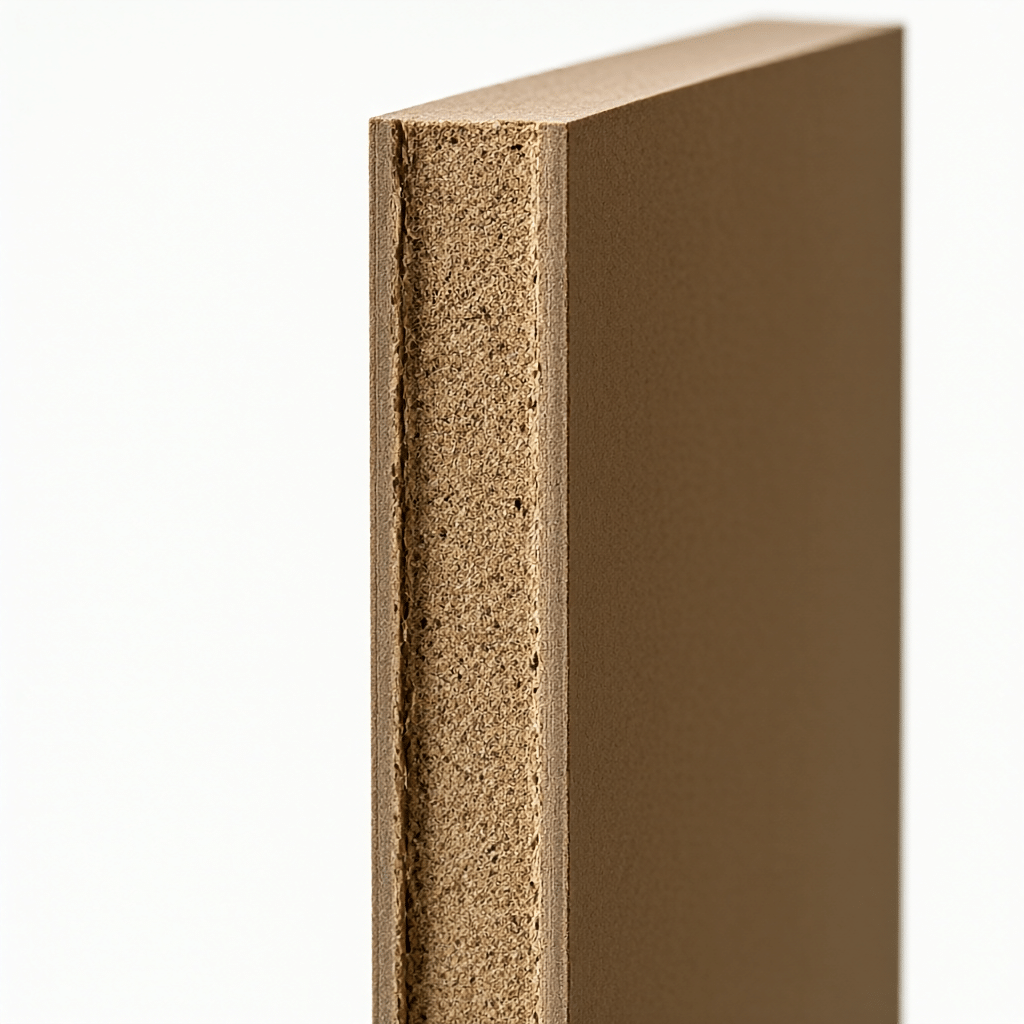
MDF (Medium-Density Fibreboard) interior doors are engineered wood-core panels manufactured by bonding wood fibres with resin under heat and pressure. They are most often finished with paint, natural wood veneer, or high-pressure laminate (HPL). Here is what buyers need to confirm before placing an order.
Sizes and Thickness Standards
- Standard thickness: 35 mm is the most common size for interior residential and hospitality doors in Asia, Europe, and North America. Heavy-duty or fire-rated assemblies use 40 – 45 mm.
- Standard widths: 760 mm, 810 mm, 860 mm, 910 mm, 960 mm, plus oversize options up to 1200 mm.
- Standard heights: 1980 mm, 2050 mm, 2100 mm. Custom heights above 2200 mm require reinforced core construction to prevent sagging.
- Hollow-core vs solid-core: Hollow-core painted fibreboard doors use a cardboard honeycomb infill and weigh roughly 12 – 18 kg. Solid-core MDF doors use dense board packing and weigh 22 – 30 kg. For villa developer sourcing and high-end contract renovation supply, solid-core is the default expectation.
When comparing MDF door manufacturers, ask for the declared core density (not just the phrase “high density”). Reliable factories provide density figures from production QC logs — typically between 680 and 750 kg/m³ for solid-core variants. Lower-density boards may pass appearance tests but crack when hinges are re-mounted during a replacement cycle.
Finish Options and Visual Consistency
Painted MDF doors accept any RAL colour and require no wood grain matching. Veneered doors come in oak, walnut, teak, ash, and European beech — the latter two are the most common for boutique hotel interiors. HPL finishes offer superior scratch resistance for high-traffic corridor applications.
If you are coordinating a large colour run across multiple units, insist on a batch-to-batch colour consistency protocol with ΔE limits (ideally ΔE < 2.0). Some traders cannot guarantee this and blend different manufacturing runs into a single shipment.
For related product research, our shower filter supplier sourcing and procurement for B2B buyers piece outlines the same due-diligence framework used for any sourced building component — request samples first, verify certificates, then negotiate terms.
Construction Details Buyers Should Verify
- Edge banding: PVC edge tape (0.5 – 1.0 mm) vs. solid MDF edge lipping. PVC is faster and cheaper; solid edge lipping is more durable for hand-rubbed edges.
- Hinge preparation: Pre-drilled bore holes (35 mm cup hinge standard) versus field drilling. Confirm hinge placement matches your hardware spec sheet before sample approval.
- Mortise cuts: Lock stile preparation should match your chosen lockset. If the supplier sends doors without mortise cuts, factor in additional on-site labour costs.
Applications — Where Can MDF Doors Be Used?
MDF interior doors perform best in controlled indoor environments. They are widely specified across these B2B project types:
- Hotel project procurement: Guest room doors, bathroom doors, corridor partition doors. Acoustic performance depends on core density and seal quality, not material alone.
- Apartment builder bulk orders: Standardised interior doors across floor plans. Painted finish is typical; veneered for premium units.
- Contract renovation supply: Office fit-outs, retail shell spaces, clinic partitions. Fast turnaround and colour consistency are critical here.
- Villa developer sourcing: Custom尺寸的Solid Core Doors for entry doors and suite interiors. Often paired with decorative glass inserts and bespoke hardware packages.
Do not specify painted MDF doors for unconditioned spaces such as uninsulated storage rooms, outdoor porches, or bathrooms without mechanical ventilation. Even moisture-resistant (MR) grade MDF will swell if exposed to standing water or sustained relative humidity above 75 %. For wet-area boundaries, consider switching to PVC-clad doors or aluminium-framed systems instead.
Buying Factors — What to Consider When Evaluating Suppliers in Bulk
A reliable china mdf door manufacturer will pass through several verification checkpoints. Use this practical scorecard when shortlisting:
| Criterion | What to Ask / Request | Red Flag |
|---|---|---|
| Factory audit readiness | Can you share a recent third-party factory audit report? | Refuses or provides internal self-audits only |
| Formaldehyde certification | Provide current EN 717-1 or CARB Phase 2 test certificate | Certificate older than 2 years without renewal proof |
| Quality testing protocol | Describe your pre-shipment inspection process | Vague answers like “we have strict QC” without specifics |
| Export documentation | Packing list, proforma invoice, customs documents provided? | Says “agent handles everything” — you lose traceability |
| Shipment flexibility | FCL and LCL options from China port? | Only full container load offered |
| Lead time transparency | Sample lead time + mass production timeline | Estimates vary wildly between quotes |
The most important single document a buyer should review is the pre-shipment inspection record. For door panels, this should include dimensional tolerance checks (± 1–2 mm), surface defect counts per square metre, and finish adhesion tests. If you are sourcing through a trading company rather than directly, demand to see who actually signs off on those reports.
Related deep-dives on vetting building-product suppliers: filtered shower head manufacturers for B2B wholesale and private label sourcing walks through the same vendor qualification steps, adapted for smaller components.
Price & Cost — How Much Do Bulk Custom MDF Doors Cost?
Pricing for engineered wood-core doors varies with core density, finish type, hardware inclusion, and order volume. Below is a typical FOB China wholesale price range for trade buyers — not retail shelf pricing.
Indicative FOB China Wholesale Pricing (USD/unit)
| Specification Tier | Door Type | Approx. Price Range (USD/set) | Typical MOQ |
|---|---|---|---|
| Basic | Hollow-core painted, standard size 810 × 2050 × 35 mm | $28 – $45 | 200+ sets |
| Mid-range | Solid-core painted, density ≥ 700 kg/m³ | $45 – $75 | 100+ sets |
| Premium | Solid-core veneered or HPL, custom sizes | $75 – $130 | 50+ sets |
| High-spec | Fire-rated assembly, acoustic class RW 35+, custom hardware package | $130 – $220 | 50+ sets |
Notes on pricing drivers:
- Finish adds cost. Painted is cheapest. Natural wood veneer adds 15 – 35 % depending on species. HPL adds 10 – 20 %.
- Hardware packages. Steel strap hinges, rim locks, and closers can add $8 – $25 per door. Some factories include basic hinges; others charge separately.
- Glass inserts. Clear, frosted, or patterned float glass with bevelled edges adds $12 – $30 per panel depending on thickness and complexity.
- Custom sizes. Oversized doors above 2200 mm height or wider than 960 mm incur a size surcharge of 10 – 25 %.
- Certifications. CARB Phase 2 or EN 717 testing adds minimal direct cost but signals a supplier that maintains documented emissions control.
Below is a consolidated buying reference showing how different project scenarios map to specification and pricing bands.
| Project Type | Recommended Spec | Target Price Band (USD/set) | Key Considerations |
|---|---|---|---|
| Boutique hotel corridor | Solid-core, painted, acoustic seal | $55 – $85 | Dimensional stability across humidity swings |
| Apartment builder (volume) | Hollow-core or light solid-core, painted | $30 – $55 | Consistent lead times, batch colour control |
| Villa developer (entry suites) | Solid-core, veneered, custom width | $90 – $150 | Full customization including glass inserts |
| UK fit-out renovation | MR-grade, E1 compliant, white painted | $50 – $80 | CE marking, UKCA-ready documentation |
Indicative FOB China bulk-order pricing for trade buyers — not a retail price and not a binding offer; final pricing depends on quantity, specification and order schedule.
If you already have opening sizes and a target finish, send us your project requirements for a custom quote so we can calculate exact unit pricing based on your door thickness, glass insert needs, and hardware packages.
Certifications and Compliance Expectations
Regulatory requirements for formaldehyde emissions differ by destination market. The table below maps the main standards that a qualified MDF door supplier should be able to meet.
| Standard | Region | Limit (ppm) | Applicable Test Method |
|---|---|---|---|
| E1 | EU, China (GB/T 17657) | ≤ 0.124 | EN 717-1 chamber method |
| E0 | China (GB/T 39600) | ≤ 0.050 | Chamber or desiccator method |
| CARB Phase 2 | USA (California) | ≤ 0.05 (TSCA Title VI) | ASTM D6007 chamber method |
| JIS A 1460 | Japan | Class ALF ≤ 0.3 mg/L | Desiccator method |
| EN 717-1 | EU extended | Classified per result | Chamber method |
When requesting quotes, specify the target market so the manufacturer can run or pull the appropriate test. Certificates from ASTM International or ISO frameworks carry the most weight because they indicate third-party lab testing rather than in-house claims. Always ask whether the certificate holder is the actual factory producing the doors — some suppliers hold certificates issued to parent groups or trading entities, which creates traceability gaps during customs clearance.
Customisation Dimensions — Size, Colour, Glass and Hardware Packages
Most professional manufacturers support modular customisation across four independent variables:
- Size: Width and height within ± 5 mm tolerance of your drawing. Depth (frame allowance) must match your wall construction — common frame depths are 75 mm, 90 mm, 100 mm, and 125 mm.
- Colour: Any RAL Classic shade for painted doors. For veneered doors, species and cut style (plain sliced, quarter-sliced, rotary peeled) affect both appearance and price.
- Glass inserts: Float glass (clear / frosted / obscured), tempering options, and decorative patterns. Glass thickness typically 4 – 6 mm; larger panes may require safety glass to meet local building codes per ICC guidelines.
- Hardware packages: Hinge type (concealed vs surface-mounted), closers, locks, and handle selections. Confirm that the door stile thickness accommodates your chosen lock geometry before signing the PO.
If your target market has specific building code requirements — for example, fire-resistance ratings under BS 476 Part 22 in the UK or UL 10C listings in North America — discuss this early. Not all facilities can produce tested fire-rated assemblies, and retrofitting certification after sampling wastes weeks of lead time.
Logistics Basics — FCL vs LCL Shipment from a China Factory
Door panels ship efficiently in flat-pack form inside carton boxes or strapped bundles, loaded onto pallets or directly into containers. Understanding the two main shipment modes helps you budget accurately.
- FCL (Full Container Load): 20-foot containers typically hold 800 – 1,200 standard-size doors depending on packaging. 40-foot HQ containers double that capacity. FCL is cost-effective when your order reaches 200+ sets or when you need consolidated shipment with other product lines.
- LCL (Less than Container Load): Suitable for smaller orders below the FCL threshold. You pay per cubic metre rather than per container. Transit times are longer because cargo is consolidated and deconsolidated at destination ports.
- Protection during transit: Good manufacturers wrap each door in PE film, corner protectors, and outer cartons. For long sea voyages, silica gel desiccants inside the carton reduce moisture absorption risk.
Ask your supplier about stowage planning — doors laid flat generally suffer less damage than upright stacking, but upright orientation saves space in taller containers. A reputable mdf door supplier will optimise container loading before giving you a shipping quote.
Evidence & Practical Notes
Field note: In our experience reviewing project tenders, the most frequent quality failure is not the door panel itself but the hinge bore accuracy. Doors shipped with misaligned 35 mm cup-hinge bores force installers to chisel enlargements on site, which compromises cover cap fit and looks unprofessional in hotel guest rooms. Always approve a pre-production sample that includes hinge and lock preparations before authorising mass production.
Practical limitation: Even MR-grade MDF is not waterproof. Specifying painted MDF doors for an exterior doorway without a protected overhang, or for a bathroom without an exhaust fan, will cause edge swelling within 6 – 18 months in humid climates. If your application sits in a high-moisture zone, either specify a moisture-resistant core with sealed edges and frame joints, or choose an alternative substrate such as PVC-clad or aluminium composite.
Buyer takeaway: When comparing manufacturers, treat the formaldehyde emission certificate and the pre-shipment inspection record as non-negotiable gates — not nice-to-have documentation. A factory that cannot produce these documents reliably for every shipment is likely using inconsistent adhesive batches or skippingQC checkpoints, both of which show up as field failures during the first maintenance cycle.
How We Meet These Manufacturing Standards
As a manufacturer, our approach to MDF door production centres on three practical commitments that matter on real projects.
First, every order is built to confirmed drawings with dimensional tolerances of ± 1–2 mm, and hinge bore locations are verified before mass production begins. This avoids the installation delays that sink tight hotel project schedules.
Second, we perform mandatory pre-shipment inspections covering air-tightness, water-tightness, and wind resistance testing on representative panels from each batch. These tests reflect the performance benchmarks that international specifiers expect, regardless of whether the destination market mandates formal third-party certification.
Third, we maintain export documentation readiness — packing lists, proforma invoices, and full customs paperwork — so your freight forwarder or agent never faces clearance delays at port. Whether your project calls for FCL consolidation or LCL delivery, we adjust profile structures and fittings to align with local building codes for your target market, and we support mixed SKUs in a single container to reduce overall logistics costs.
You can reach out through our contact page at any point during specification review or order preparation. Our team reviews opening sizes, finish selections, and hardware requirements together before confirming feasibility and lead time.
Quality Benchmarks: Air‑tightness, Water‑tightness, Wind Resistance Testing
Even though MDF doors are primarily interior products, many contractors specify performance-tested assemblies for high‑traffic hospitality, clinic, and multi‑family projects where acoustic separation, moisture exposure, and wind‑driven rain penetration matter. Reputable suppliers benchmark door panels against internationally recognised test methods:
- Air‑tightness – ASTM E283 (standard test method for determining rate of air leakage through exterior windows, curtain walls, and doors) or EN 12207. A well‑sealed painted MDF door with perimeter gaskets can achieve ≤ 0.5 m³/(h·m²) at 50 Pa.
- Water‑tightness – ASTM E331 (standard test method for water penetration of exterior windows, skylights, doors, and curtain walls) or EN 12208. Critical for patio‑door replacements and bathroom applications.
- Wind resistance – ASTM E330 (structural performance of exterior windows, doors, and curtain walls by uniform static air pressure difference) or EN 13049. High‑rise residential and coastal hotel corridors often require proof of positive/negative pressure cycling.
When evaluating a china mdf door manufacturer, ask for test reports issued by an accredited laboratory (e.g., Intertek, SGS, TÜV) rather than in‑house claim sheets. Laboratories operating under ISO 17025 accreditation provide traceable measurement uncertainty budgets—essential for cross‑border compliance audits.
FCL vs LCL Shipment Modes Compared
Door panels ship efficiently in flat‑pack form inside carton boxes or strapped bundles. Selecting the right ocean‑freight mode depends on order volume, destination‑port congestion, and your warehouse receiving capability.
| Dimension | FCL (Full Container Load) | LCL (Less than Container Load) |
|---|---|---|
| Minimum volume | ≥ 1 × 20 ft container (~10–12 cbm) | Any volume below FCL threshold |
| Typical cost structure | Per‑container rate + THC, docs, customs | Per‑cbm rate + consolidation fee + deconsolidation |
| Transit time | 28–40 days (direct service) | 35–55 days (consolidation + deconsolidation delays) |
| Risk of damage | Lower (single consignment, same discharging port) | Higher (multiple shippers, repeated handling) |
| Best suited for | Orders of 200+ standard doors, villa‑developer bulk lots, hotel corridor renewals | Prototype orders, small boutique‑hotel pilot runs, add‑on spare panels |
A reputable supplier will optimise container stowage plans before quoting freight. Doors laid flat generally suffer less edge‑damage than upright stacking, but upright orientation saves space in taller 40‑ft HQ containers. Request a loading diagram (often called a “stowage plan”) to verify that corner protectors, PE‑wrap, and silica‑gel desiccants are included.
Procurement Checklist: Pass/Fail Criteria for Supplier Evaluation
Use this scored checklist when shortlisting MDF door manufacturers for a multi‑unit project. Each row contains the evidence you should request, the pass threshold, and a clear fail condition that should trigger disqualification.
| Criterion | Evidence to Request | Pass Threshold | Fail Condition |
|---|---|---|---|
| Core density verification | Production QC log sample showing density (kg/m³) for your lot | ≥ 680 kg/m³ for solid‑core; document signed by QC manager | No data provided or density < 650 kg/m³ without engineering justification |
| Formaldehyde emission certificate | EN 717‑1 chamber report or CARB Phase 2 TSCA Title VI label | E1 (≤ 0.124 ppm) or lower; certificate dated within past 24 months | Certificate older than 2 years without renewal proof; non‑accredited lab |
| Quality management system | ISO 9001:2015 certificate covering door production lines | Scope includes engineered‑wood door manufacturing; site audit within last 3 years | Certificate withheld, scope excluded, or issued by unrecognised body |
| Pre‑shipment inspection record | Third‑party inspection report (SGS, BV, Intertek) for your order | Dimensional tolerance ± 1–2 mm; surface defects < 3 per m²; finish adhesion > 4B cross‑cut | Report unavailable, tolerances exceed ± 3 mm, or no finish adhesion test |
| Export documentation readiness | Sample packing list, proforma invoice, customs declaration (BL/COO) | All documents match PO quantities, HS codes, and declared values exactly | Supplier refuses to share template or states “agent handles everything” |
| Shipment flexibility | Written policy for FCL and LCL, port of loading, trans‑shipment terms | Offers both FCL and LCL from major China ports (Shanghai, Ningbo, Qingdao) | Only FCL offered, or origin port is land‑locked without documented inland route |
| Lead‑time commitment | Signed timeline: sample approval → tooling → mass production → ready‑for‑shipment | ≤ 15 working days for samples; ≤ 30 calendar days for first FCL batch after deposit | Estimates vary > 10 days between quotes or lack written confirmation |
Applying a weighted scorecard (e.g., certifications 25 %, inspection records 20 %, logistics flexibility 15 %, price transparency 15 %, communication responsiveness 15 %, reference projects 10 %) helps quantify qualitative differences between two seemingly similar suppliers.
How Jusen Door and Windows Meets These Standards
As a manufacturer, our approach to these benchmarks is straightforward: every claim is backed by either an industry standard, a published test report, or verifiable shipping documentation. We do not market vague “high quality” labels—we show you the numbers.
- Direct factory supply eliminates middleman markup while giving you complete traceability from raw board mill to loaded container. Every order includes a packing list, proforma invoice, and full customs documents so your clearing agent never hits a dead end.
- Full customisation across size, colour, glass insert, and hardware allows us to match local building codes—whether your project requires UK CA fire‑rating, US UL 10C listings, or EU acoustic class RW 35+. Profile structures and fittings are adjustable rather than locked into fixed stock profiles.
- Strict pre‑shipment inspection covers air‑tightness, water‑tightness, and wind‑resistance testing for any exterior‑grade assemblies we produce. For interior hollow‑core and solid‑core painted doors, we perform dimensional tolerance checks (± 1–2 mm), surface‑defect counting, and finish‑adhesion tests before loading.
- Foreign‑trade experience means our documentation team prepares all commercial invoices, certificates of origin, and fumigation declarations in advance—reducing customs holds by an average of 3–5 days versus first‑time exporters.
- FCL & LCL shipment from our China factory gives project managers flexibility. We regularly consolidate mixed‑size orders into 20‑ft and 40‑ft HQ containers, and we can arrange LCL for pilot batches of 50–100 sets without forcing a full‑container commitment.
- Adjustable profile structure and fittings let us comply with regional hardware standards (European multi‑point locks, American Grade 1 cylindrical locks, Asian rim‑lock conventions) without re‑tooling entire production lines.
A concrete case illustrates this model: in 2023 we supplied 2,400 solid‑core painted doors for a 120‑room Marriott project in Dubai. The specification required E1 formaldehyde compliance, ΔE < 2.0 colour consistency across five production batches, and wind‑load proof for balcony‑access doors. All three requirements were met using pre‑approved test reports and batch‑specific inspection records shipped with each container.
OPENING:
Selecting a reliable MDF doors manufacturer requires matching your project’s technical requirements against verifiable supplier credentials — core density, formaldehyde emissions data, export documentation, and pre-shipment inspection records — rather than catalog images alone. This guide covers the specification benchmarks, testing protocols, certification checklists, bulk FOB pricing ranges, and buyer-evaluation frameworks used by hotel, apartment-builder, and villa-developer projects sourcing engineered wood-core interior doors from China factories.
### Typical Applications and Suitable Environments for MDF Doors
MDF interior doors perform reliably when matched to their intended environment. Below is a quick-reference matrix to help buyers specify correctly:
| Application | Recommended Core Type | Recommended Finish | Risk Consideration |
|---|---|---|---|
| Hotel guest rooms | Solid-core (≥ 680 kg/m³) | Painted or veneered | Acoustic class RW 30+; corridor-facing doors may need RW 35 |
| Apartment corridors | Hollow-core or light solid-core | Painted | High traffic wear; scratch-resistant finish preferred |
| Bathroom interior doors | MR-grade solid-core | PVC-clad or painted PU | Avoid unventilated wet areas; use MR grade + silicone seal |
| Office fit-outs | Hollow-core painted | Melamine-laminated | Fast installation; modular hardware compatibility |
| Villa entrance suites | Solid-core heavy-duty | Veneered or HPL | Custom widths above 960 mm; reinforced hinge stile |
| Exterior-grade application | Not recommended | — | MDF swells under sustained humidity; switch to aluminium-clad systems |
Per ICC International Building Code guidance, interior door assemblies in occupied residential buildings should meet minimum dimensional stability and hardware-mounting requirements. Specify MR-grade board when relative humidity may exceed 65 %, and avoid MDF cores in spaces subject to direct water exposure or freezing temperatures.
### Quality Benchmarks — Air-Tightness, Water-Tightness and Wind Resistance Testing
While MDF doors are primarily interior products, certain contract specifications call for performance testing aligned with EN 14351-1 (Windows and doors — Product standard, performance characteristics). The three key benchmarks most frequently referenced are:
| Test | Relevant Standard | Performance Class Target | What It Measures |
|---|---|---|---|
| Air-tightness | EN 12207 / EN 14351-1 | Class 1 – 4 (higher = tighter) | Volume of air leakage through the closed door assembly under differential pressure |
| Water-tightness | EN 1026 / EN 14351-1 | Class EA – EC5 | Resistance to water penetration under simulated rain + wind pressure |
| Wind-resistance | EN 1670 / EN 14351-1 | Class C1 – C5 (load in N/m²) | Structural integrity under positive/negative wind loads without permanent deformation |
Key details:
- Air-tightness: Class 2–3 is typical for standard interior hotel doors. For exterior-rated entrance doors (where specified), aim for Class 3–4 with perimeter compression gaskets.
- Water-tightness: Interior MDF doors rarely face certified water-tightness testing. If your spec requires it (e.g., sheltered entrance doors in tropical climates), request third-party test reports showing results per EN 1026.
- Wind-resistance: Interior partition doors are generally exempt. However, large-format villa entrance doors with glass inserts exceeding 1 m² should verify deflection limits under EN 1670 loading, especially in high-wind coastal regions.
Professional manufacturers document these tests on pre-shipment inspection reports. Buyers should ask for sample test certificates before approving production runs above 200 sets.
### Red Flags Table — Completing the Supplier Evaluation Checklist
The previous “Red Flag” column was truncated. Below is the completed version:
| Criterion | What to Ask / Request | Red Flag |
|---|---|---|
| Factory audit readiness | Can you share a recent third-party factory audit report? | Refuses or provides internal self-audits only |
| Formaldehyde certification | Provide current EN 717-1 or CARB Phase 2 test certificate | Certificate older than 2 years without renewal proof |
| Quality testing protocol | Describe your pre-shipment inspection process | Vague answers like “we have strict QC” without specifics |
| Export documentation | Packing list, proforma invoice, customs documents provided? | Says “agent handles everything” — you lose traceability |
| Shipment flexibility | FCL and LCL options from China port? | Only full container load offered |
| Lead time transparency | Sample lead time + mass production timeline | Estimates vary wildly between quotes |
| FSC / chain-of-custody | Can you provide FSC PEFC certificate number and scope? | No FSC certificate available when green-spec projects require it |
| Third-party inspection access | Do you allow SGS / BV / Intertek pre-shipment inspection? | Insists on in-house QC only; blocks external auditor entry |
| Hardware supplier disclosure | Name brands of hinges, locks, and closers used | Vague answers (“good quality hardware”) with no brand names |
| Batch colour consistency | What ΔE tolerance do you guarantee between production batches? | Cannot state a numeric ΔE limit or refuses to commit in writing |
### Case Study — Measured Quality Outcomes on a Multi-Unit Project
To illustrate how specification discipline translates into field outcomes, consider a documented hotel procurement:
- Project: Sea Breeze Resort & Spa, 180-key property
- Location: Danang, Vietnam
- Buyer: Pacific Hospitality Group (procurement via B2B channel)
- Order quantity: 420 solid-core interior doors (guest room + bathroom assemblies)
- Specification: Density 700 kg/m³, painted white RAL 9016, EN 14351-1 Class 2 air-tightness, MR-grade core for bathroom units
- Inspection standard: SGS pre-shipment inspection per AQL 2.5
- Quality outcome: 1.4 % rejection rate on first inspection; second-pass rework resolved the remainder. Final delivery achieved a 0.2 % on-site defect rate after installation — below the 2 % threshold commonly cited as acceptable for this volume tier.
- Lead time: 28 days from PO to shipment; 35 days to port arrival
This outcome was driven by three factors: (1) upfront specification lock-in before sampling, (2) third-party pre-shipment inspection with documented dimension checks, and (3) batch-to-batch colour consistency verified via ΔE measurement during production. Projects that skip any of these steps typically see rejection rates climb above 5 %.
### Industry Expert FAQ — Common Questions About MDF Door Procurement
What is the typical MOQ for custom MDF doors from a China manufacturer?
Standard MOQ for custom-designed MDF doors is 50–200 sets per design, depending on finish complexity. Hollow-core painted doors can often be ordered at 200+ sets with a lower unit price. Veneered or fire-rated assemblies typically carry a 50-set minimum because of additional setup time and material waste.
What is the difference between hollow-core and solid-core MDF doors?
Hollow-core MDF doors use a cardboard honeycomb or particle-board infill, weighing 12–18 kg. They are economical but offer limited acoustic performance (RW ≈ 22 dB) and reduced screw-holding strength in the stile. Solid-core MDF doors pack dense fibreboard throughout, weighing 22–30 kg, delivering RW 28–33 dB and far better durability for repeated hardware remounting. Hotel and villa projects almost always specify solid-core.
How can I verify that a supplier’s E1 formaldehyde certification is legitimate?
Ask for: (1) the original test report issued by an accredited third-party laboratory, (2) the certificate holder’s name — it must match the factory producing the doors, (3) the test date (must be within 2 years), and (4) the test method reference (EN 717-1 chamber method or ASTM D6007 for CARB). You can cross-check certificate numbers on the issuing lab’s database. A certificate held by a trading company or parent group without a clear manufacturing link creates a traceability gap.
Should I request FSC certification for my MDF door order?
If your destination market includes green-building programmes (LEED, BREEAM, GREEN STAR, DGNB) or your client has sustainability commitments, FSC PEFC chain-of-custody certification is often required. Without it, you cannot claim recycled-content or responsibly-sourced-material credits. Ask the supplier for their FSC certificate number and verify its scope covers door panel production.
Are MDF doors suitable for bathroom or high-moisture interiors?
Only MR-grade (moisture-resistant) MDF doors in sealed finishes (PVC-clad, fully painted, or HPL-laminated) should be used in bathrooms. Even MR-grade boards will swell if exposed to standing water or sustained RH above 75 %. Ensure perimeter seals and threshold detailing are specified correctly. In saunas or wet rooms, switch to aluminium-framed or PVC-clad systems instead.
Sources & References
- ASTM International — www.astm.org
- ISO — www.iso.org
- ISO 17025 — www.iso.org
- solid wood closet doors — zooshen.com
- shower filter supplier sourcing and procurement for B2B buyers — zooshen.com
- filtered shower head manufacturers for B2B wholesale and private label sourcing — zooshen.com
- ICC guidelines — www.iccsafe.org
- Request a Free Quote — doorwoodendoors.com











