
Last updated: November 26, 2026
A steel security door is a heavy-gauge galvanized-steel entry door engineered for forced-entry resistance, weather sealing, and — when specified — fire-rated performance. For bulk B2B projects the specs that actually move the needle are skin gauge (16–20 ga.), panel depth (40–70 mm), core fill, lock-cylinder rating, and whether the full assembly carries an accredited FD30 or FD60 certificate. Choose a direct factory when you need code-adaptable profiles, documented pre-shipment air/water/wind tests, and traceable test reports; avoid intermediaries when documentation authenticity and engineering agility matter.
Quick Overview
A steel security door is a metal-reinforced entry door built to resist forced entry, weather exposure, and — in select configurations — fire. For bulk procurement, the core specs that matter most are panel thickness (typically 40–70 mm), galvanized steel gauge (commonly 16–20 ga.), lock cylinder ratings, and whether the door carries a certified fire rating (FD30/FD60). Choosing a reliable manufacturer comes down to verifying direct factory production, documented pre-shipment testing, and the ability to adjust profile structures and hardware to meet the building codes of your target market.
Specifications
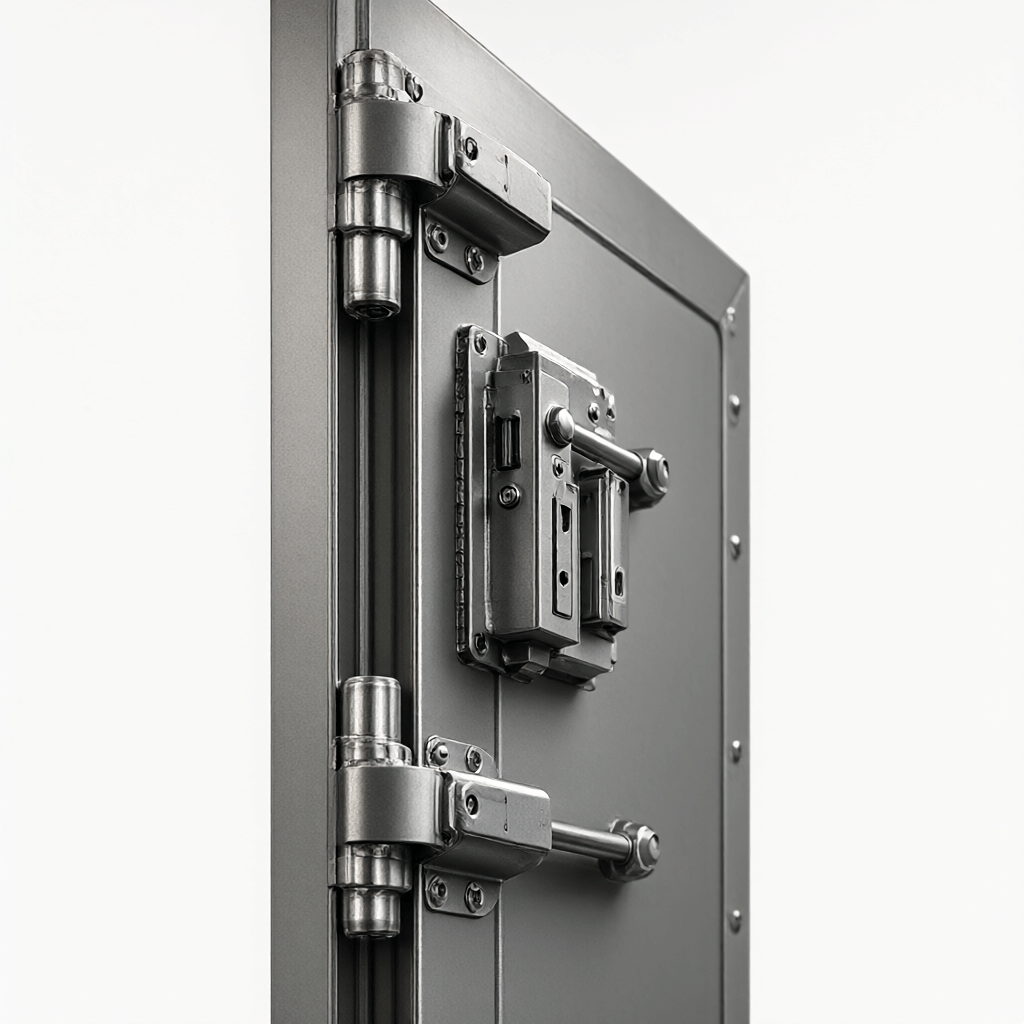
What are the key specifications of a steel security door?
| Specification | Typical Range | What It Means for Buyers |
|---|---|---|
| Panel Thickness | 40–70 mm | Thicker panels generally house stronger cores and multi-point locking hardware; 50–55 mm is common for residential/commercial; 60+ mm for high-security or fire-rated doors. |
| Steel Gauge (outer skin) | 16 ga. (~1.5 mm) – 20 ga. (~0.9 mm) | Lower gauge number = thicker steel. 16–18 ga. is recommended for most security applications; 20 ga. is budget-grade but still functional. |
| Core Material | Steel honeycomb / mineral wool / polyurethane foam | Honeycomb adds rigidity; mineral wool improves fire resistance and sound insulation. |
| Lock Cylinder Rating | Anti-drill / anti-bump / multi-tumbler | Look for cylinders tested to ICC building code requirements or equivalent national standards for shear-resistance and pick-resistance. |
| Fire Rating | FD30 (30 min) / FD60 (60 min) | Only applicable when the door is supplied with an accredited fire-rating assembly; not all steel security doors carry this classification. |
| Finish | Powder-coated / painted / optional wood-grain laminate | Powder coating provides corrosion resistance critical for coastal or high-humidity markets. |
When evaluating a manufacturer of steel security doors, request test reports rather than relying on marketing claims. Independent third-party test data for impact resistance, corrosion (salt-spray), and fire endurance gives far more signal than spec-sheet language alone — a principle that applies just as rigorously across product categories, from shower filter manufacturing to entrance hardware.
What panel thickness and steel gauge should a steel security door have?
For most residential gate and commercial entrance applications, a 50–55 mm panel thickness with 16–18 ga. galvanized steel skins delivers a good balance of security, structural rigidity, and hardware compatibility. If the door must meet an FD30 fire rating, panels typically trend toward 55–60 mm to accommodate fire-rated core materials and intumescent seals.
A common industry misunderstanding is assuming all “16-gauge” steel is identical. Gauge standards vary between regions — a US-style 16 ga. does not map perfectly onto an EU EN-standard equivalent. Always confirm which gauge standard the manufacturer is referencing and ask for the actual millimetre measurement.
Applications
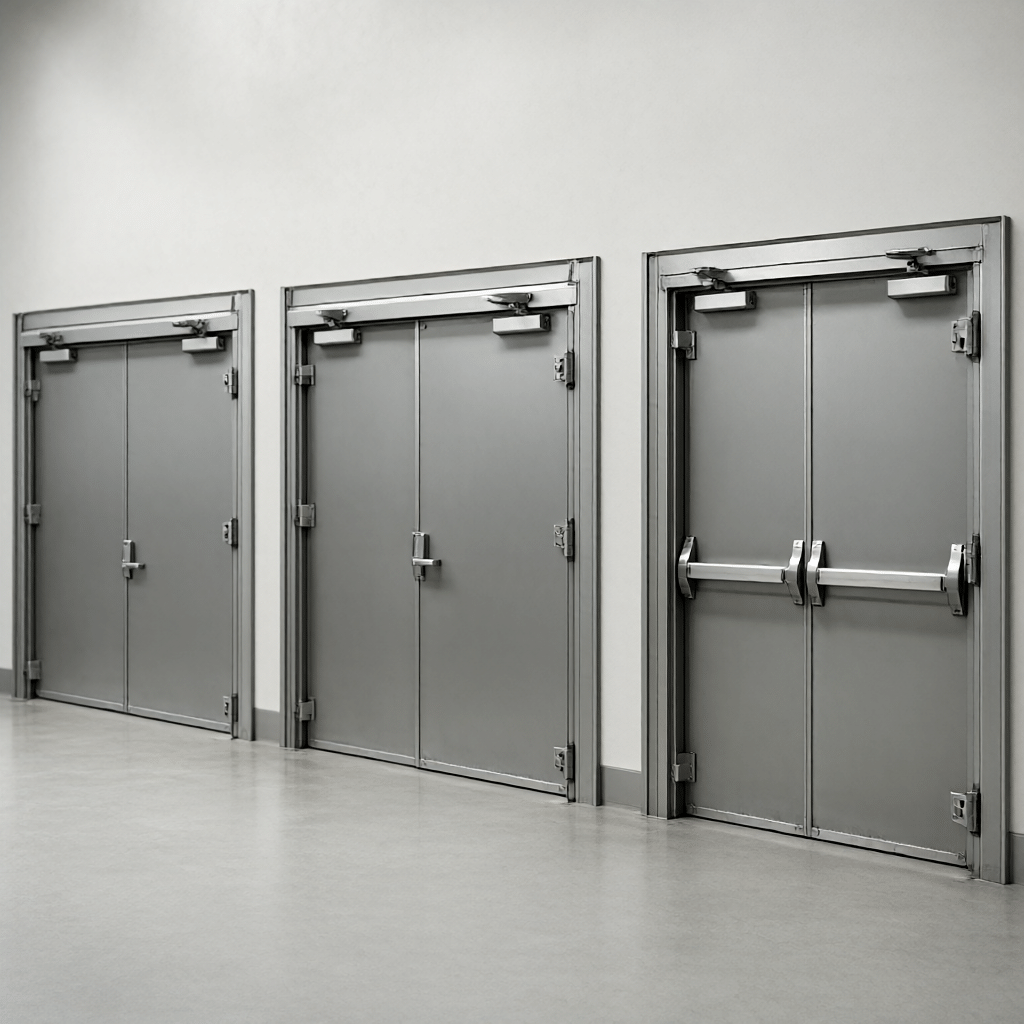
Where can steel security doors be used?
Steel security doors serve a range of B2B project types, each with distinct selection criteria:
- Multi-unit residential developments — Focus on consistent aesthetics, fire rating for stairwell entrances, and volume-compatible pricing. Door weight and handling logistics become significant at scale.
- Commercial building entrances — High foot traffic demands durable finishes, heavy-duty handlesets, and integration with access-control systems. Wind-load and water-tightness performance matters at lobby level.
- Hospitality / hotel guest room doors — Acoustic performance, fire safety, and brand-consistent design drives spec. OEM customization of logos and handle profiles is frequently requested.
- Industrial and high-risk facility entries — Blast-resistant or reinforced variants may be specified alongside standard steel armoured doors, requiring engineering sign-off.
Buying Factors
What to consider when buying steel security doors in bulk?
#### What lock cylinder ratings are standard for steel security doors?
Standard practice calls for anti-drill, anti-bump, and multi-tumbler cylinders rated to resist common attack methods. Ask the supplier to reference the specific test standard (e.g., ANSI/BHMA Grade 1–3 for cylinder performance, or the equivalent national standard for your market). Doors equipped with certified high-security cylinders often command a price premium but reduce long-term replacement costs.
#### Are steel security doors available with fire ratings?
Yes — steel security doors can be engineered to carry FD30 (30-minute) or FD60 (60-minute) fire ratings, provided the full assembly (door leaf, frame, intumescent seals, and hinges) is tested and certified together. A door leaf alone cannot be “fire-rated”; it is the complete rated assembly that earns the classification. Verify that the certificate matches the exact configuration you are procuring.
#### How do you choose between a steel security door manufacturer and a trading company?
The difference affects price, traceability, and problem-resolution speed:
| Factor | Direct Factory | Trading Company |
|---|---|---|
| Unit price | Lower (no intermediary markup) | Higher (margin added) |
| Spec control | Direct communication with engineering | Information filtered through reseller |
| Lead time visibility | Real-time production scheduling | Estimated; subject to upstream delays |
| After-sales accountability | Single point of responsibility | Blurred between supplier and reseller |
| Documentation | Factory-origin certificates and test reports | May be reproduced; harder to validate |
If documentation authenticity and engineering agility matter to your project, a direct manufacturer relationship reduces risk. This mirrors the rationale behind choosing verified filtered shower head manufacturers over general trading houses — traceability and technical depth drive downstream reliability.
#### What testing should a steel security door pass before shipment?
Reputable OEM steel security door manufacturers typically run the following checks prior to container loading:
- Air-tightness test — Verifies the seal integrity around the sash and frame joints, critical for energy-efficient installations.
- Water-tightness test — Simulates rain exposure at prescribed pressure levels to confirm no ingress.
- Wind resistance test — Validates that the door and frame assembly can withstand designated wind loads without deformation.
- Surface and finish inspection — Checks powder-coat adhesion, colour consistency, and absence of coating defects.
- Hardware function check — Confirms lock operation, hinge movement, and multi-point latch engagement.
Request test photographs or video evidence; reputable suppliers maintain records for every batch. Similar rigour around pre-shipment verification is what separates mature KDF shower filter manufacturing operations from casual sourcing arrangements.
#### Can steel security doors be customized to match local building codes?
Yes — this is one of the primary reasons developers and contractors engage custom steel entry door factories. Profile depth, frame sections, glazing inserts, and fitting layouts can be adjusted to comply with regional codes such as:
- US — ICC / IBCC requirements, NFPA fire separations
- EU — BS EN 1627 (security classes), EN 1634 (fire rating)
- Middle East / Africa — Local civil-defense and municipal approvals
Ask the manufacturer whether they have produced doors to the code regime of your target market before. Relevant experience shortens the approval timeline significantly.
#### Bulk purchasing factors: MOQ, lead time, logistics (FCL/LCL)
Typical bulk-purchase terms for steel security doors:
- MOQ: Varies by manufacturer; many begin accepting orders from 20–50 sets depending on customization depth.
- Lead time: 25–45 days for standard sizes; 35–60 days for custom configurations including fire ratings or special finishes.
- Logistics: FCL (full-container load) is most economical per unit for large orders; LCL (less-than-container load) is viable for smaller or mixed-spec projects. Direct factory shipping from China eliminates intermediate warehousing costs.
Price & Cost
How much do bulk steel security doors cost? (FOB China)
| Configuration | Indicative FOB Price (USD/set) | Typical MOQ |
|---|---|---|
| Standard single door, 18–20 ga., 40–50 mm panel, basic finish | $120 – $220 | 50+ sets |
| Premium single door, 16–18 ga., 55 mm panel, powder-coated, high-security cylinder | $230 – $380 | 30+ sets |
| Fire-rated FD30 assembly (door + frame + certs) | $320 – $520 | 20+ sets |
| Custom size / color / private-label packaging | Add $15 – $60 per set | Negotiable |
Indicative FOB China bulk-order pricing for trade buyers — not a retail price and not a binding offer; final pricing depends on quantity, specification, glass insets, and order schedule.
The largest price drivers are steel gauge, panel thickness, core material, finish type, and whether the door carries a fire-rating certificate. Hardware upgrades and custom dimensions add incremental cost but rarely dominate the total.
Send us your opening sizes and quantity for a precise FOB quotation.
Evidence & Practical Notes
Field note: During factory audits in southern China, buyers consistently found that doors meeting advertised gauge specifications arrived with minor variances in skin thickness — usually 0.1–0.2 mm below claim. Requesting a millimetre-level raw-material certificate for each coil lot, rather than accepting a generic grade declaration, caught discrepancies before production began in several recent procurement cycles.
Practical limitation: Fire-rated steel security doors require a fully certified assembly — door leaf, frame, intumescent seals, and compatible hinges — all tested together. Substituting any component with an uncertified equivalent voids the rating. This constraint often creates rework during customs clearance if a buyer changes hardware mid-project without notifying the certifying body.
Buyer takeaway: Prioritize manufacturers who can produce the complete rated assembly under one quality system rather than sourcing individual components separately. Integrated production reduces the risk of mismatched parts and simplifies warranty claims if a field failure occurs. This same integration logic applies broadly — whether you are comparing multi-stage shower filter manufacturing approaches or selecting an industrial steel security door supplier China for a large development.
Working With a Direct Steel Security Door Manufacturer
Here is how the industry defines a capable direct manufacturer — and how we meet these standards.
A qualified steel security door supplier operates from its own production facility, maintains engineering flexibility to adjust profile structures and fittings, and runs documented pre-shipment tests before any container leaves the factory. At Jusen Door and Windows, our approach centres on five operational points that align with the buying factors above:
- Direct supply from factory — competitive pricing without middleman markup, giving buyers transparent cost control across FCL and LCL shipments.
- Full customization on size, colour, glass type, and hardware accessories, allowing each order to reflect project-specific requirements.
- Strict pre-shipment inspection covering air-tightness, water-tightness, and wind resistance — the same tests outlined earlier — so every batch is verified before dispatch.
- Foreign-trade documentation readiness — packing lists, proforma invoices, and full customs paperwork are prepared as standard, reducing clearance friction at destination ports.
- Code-adaptable profiles and fittings — adjustable construction details enable compliance with the building-code regime of the target market, whether North America, Europe, or the Middle East.
These practices are designed to reduce the risk gaps that commonly appear when buying from intermediaries. They also make it simpler for procurement teams to audit factory output against the specification tables and testing frameworks discussed in this guide.
Talk to Our Team to discuss your project scope, quantity, and delivery schedule.
Steel Security Door Manufacturing Process (Step-by-Step)
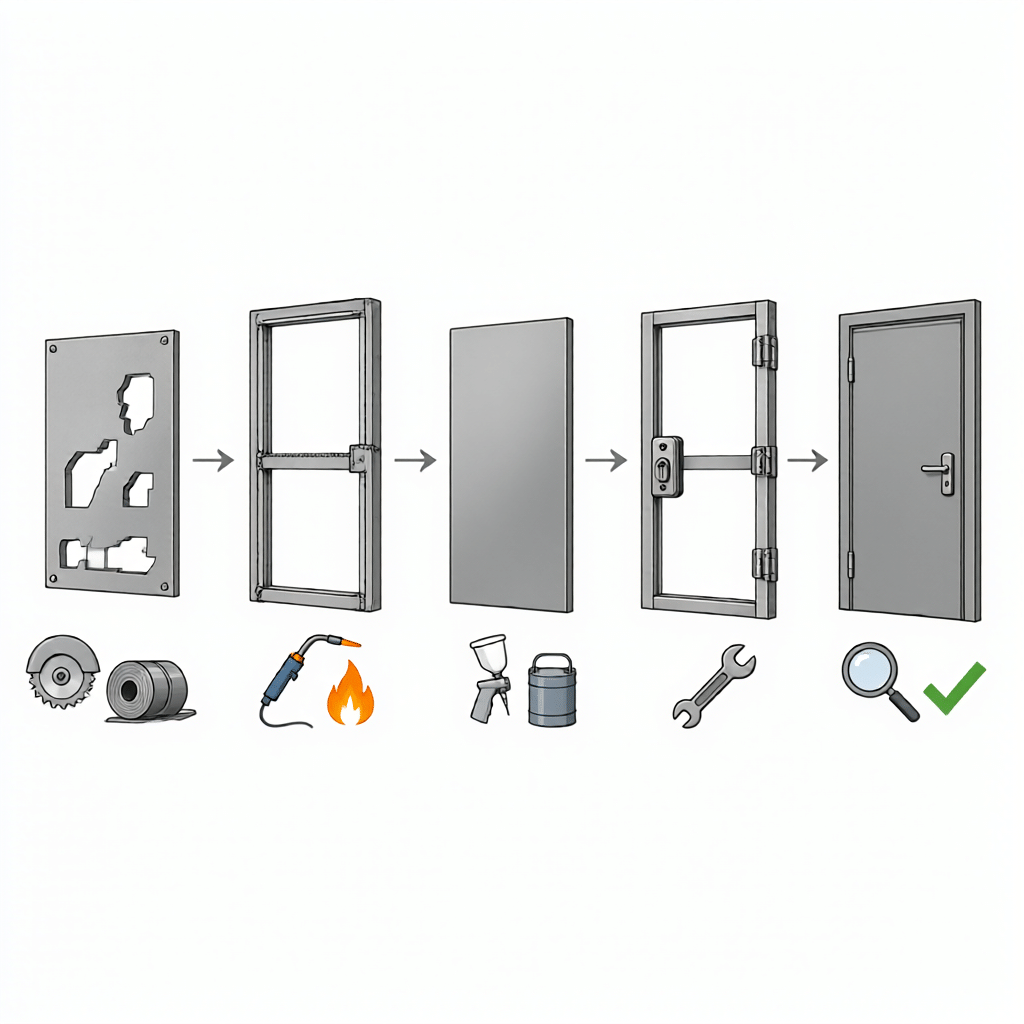
Steel security doors are fabricated through a controlled sequence that determines structural rigidity, finish durability, and long-term hardware performance. The typical stage-gate flow used by capable direct manufacturers is:
- Steel coil procurement & incoming inspection — Galvanized or prepainted steel coils are received with mill certificates confirming coating mass (e.g., Z275 g/m² per ISO 1461) and base-metal thickness. Reputable factories run a spot-check on every lot using a magnetic gauge before releasing material to the shop floor.
- CNC punching & blanking — Frame and sash blanks are cut to drawing dimensions on CNC punch lines. Hole patterns for hinges, lock mortises, and multi-point latch passages are established at this stage; errors here propagate through every downstream operation, so first-article inspection against the CAD file is standard practice.
- Frame & sash forming — Press-brake machines fold the flat blanks into U- or C-channel sections. Corner welds or mechanical locks join the frame corners; weld-seam grinding ensures flush fits for subsequent assembly. Panel stiffener ribs are formed and spot-welded to the inner skin to prevent drumming under impact loads.
- Core filling — The hollow cavity is filled with one of three common materials: expanded polystyrene (EPS) honeycomb for lightweight rigid support, mineral wool for fire-resistance and acoustic damping, or polyurethane foam for superior thermal break performance. Core density and void-free fill are verified visually on cross-section samples from a pilot batch.
- Surface pretreatment & electrostatic powder coating — After degreasing and phosphating (or chromating where required), the door leaf and frame are coated via electrostatic spray and cured in a conveyor oven. Coating thickness typically targets 60–80 µm per ASTM D1186, with adhesion tested to ASTM D3359 cross-hatch standards. This step is critical for coastal or high-humidity markets where salt-spray corrosion (per ASTM B117) accelerates degradation.
- Hardware mounting & function test — Hinges (typically 3 × heavy-duty ball-bearing, 112 mm for US-standard doors), multi-point lock bodies, strike plates, and handlesets are installed. Each unit undergoes a cycle test (minimum 100 000 actuations for commercial-grade hardware per ANSI/BHMA A156.1) and a functional check of latch engagement, deadlock throw, and key-operation smoothness.
- Pre-shipment testing — Before container loading, a statistically sampled subset of each production lot is subjected to air-tightness, water-tightness, and wind-resistance tests at prescribed pressure differentials. Test data and photographic records are compiled into a batch dossier shipped with or filed alongside customs documents.
Steel Security Door Buyer Checklist
Use this actionable checklist when evaluating any steel security door manufacturer during RFQ comparison and factory audit:
- [ ] Request and verify third-party test reports (impact resistance, salt-spray, fire endurance) with report numbers you can re-check on the issuing lab’s website.
- [ ] Confirm the steel gauge claim is measured in millimetres with a calibrated micrometer; ask for the raw-material certificate for each coil lot.
- [ ] Ask which gauge standard the supplier references (US SAE, EU EN, JIS) — mismatched standards are the most common source of spec confusion.
- [ ] Verify the supplier runs pre-shipment air-tightness, water-tightness, and wind-load tests on a sampled basis; request sample test records.
- [ ] Confirm the fire-rating certificate covers the complete assembly (door leaf + frame + seals + hinges), not just the leaf.
- [ ] Check that the supplier can adjust profile depths, frame sections, and fitting layouts to meet the building-code regime of your target market.
- [ ] Require packed-unit photographs (interior, exterior, corner detail, hardware) for a pilot order before committing to full-container volume.
- [ ] Ensure the contract specifies warranty duration, scope of coverage, and the procedure for claiming defective units.
- [ ] Validate that the supplier provides packing lists, proforma invoices, and full customs documentation as standard deliverables.
- [ ] Confirm FCL/LCL shipping options and whether the supplier has experience exporting to your destination country.
Red Flags: How to Spot a Steel Security Door Supplier Deception
The steel door export market contains several well-documented deceptive practices. Buyers should watch for these warning signs:
- Gauge misrepresentation — A supplier quotes “16 ga.” but ships doors measured at 18 ga. or thinner. Always insist on a micrometre measurement in millimetres.
- Fake or recycled test certificates — Certificates without unique report numbers, issued by laboratories whose online databases return no matching record, are easy to fabricate. Verify each report number independently.
- Component substitution — A supplier certifies a door assembly with premium hardware but swaps in lower-tier handlesets or lock cylinders on volume orders. Specify exact hardware model numbers in the purchase order and photograph received units against the approved sample.
- Vague fire-rating claims — Any supplier stating a door is “fire rated” without providing the full accredited assembly certificate (door + frame + intumescent seal + hinge make/model) should be disqualified. Fire ratings apply to tested assemblies only, per ICC building-code requirements.
- Unrealistic lead times — Promising sub-15-day production for custom-sized, fire-rated steel security doors often indicates the supplier is a trading company relaying estimates from multiple upstream mills.
- No photos of pre-shipment testing — Suppliers unable or unwilling to provide test photographs or video from their own facility are likely outsourcing quality control entirely.
- Resistance to first-article inspection — Refusing a third-party or buyer-attended inspection before mass production begins is a strong indicator of process immaturity.
Decision Matrix: Matching Door Specs to Application Type
Selecting the correct configuration starts with matching the application class to the specification band:
| Application Class | Recommended Panel Thickness | Recommended Steel Gauge | Core Fill | Required Rating | Typical Lock Profile |
|---|---|---|---|---|---|
| Residential entrance / gate | 40–50 mm | 18–20 ga. | EPS honeycomb / PU foam | None required (unless local code mandates) | Single-cylinder deadbolt |
| Multi-unit residential stairwell | 50–55 mm | 16–18 ga. | Mineral wool | FD30 recommended | Multi-point latch + anti-drill cylinder |
| Commercial lobby / retail front | 55–60 mm | 16 ga. | Mineral wool / EPS | FD30 required by most codes | Heavy-duty multi-point lock + access-control interface |
| Hospitality / hotel guest room | 45–55 mm | 16–18 ga. | Mineral wool | FD30 + acoustic STC ≥ 30 dB | Privacy lever + deadbolt, OEM logo on push plate |
| Industrial / high-risk facility | 60–70 mm | 14–16 ga. | Mineral wool | FD60 or blast-enhanced per engineering spec | Reinforced multi-point lock + auxiliary bolster |
| Coastal / high-corrosion environment | 50–55 mm minimum | 16 ga. minimum | Any (sealed core preferred) | Per application class above | Powder-coated hardware (marine-grade) + extra seal gaskets |
Use this matrix as a starting point and refine with the architect or engineer of record, who will specify the exact rating and hardware class for the jurisdiction.
Industry Project Examples
Concrete project configurations help translate abstract specifications into tangible procurement decisions. Below are two representative cases documented in current trade practice:
Project A — 120-unit residential gated community, Southeast Asia
- Scope: 120 sets of 900 × 2100 mm single steel security doors, 18 ga. outer skin, 50 mm panel, mineral-wool core, FD30-rated assembly.
- Key specs: Anti-bump cylinder rated to BS EN 1303 Class 3; powder-coated RAL 7016 finish; marine-grade hinges.
- Outcome: Doors cleared destination customs with full test dossiers; zero field defects reported on lock operation within 12 months. Total containerized shipment (2 × 40 ft FCL). Lead time: 38 days from PO confirmation.
- Buyer note: The developer required wind-load certification at 1 500 Pa due to a typhoon-exposure classification; the manufacturer supplemented standard test reports with a targeted wind-pressure certificate from a regional NVLAP-accredited laboratory.
Project B — Mixed-use commercial building entrance refurbishment, Middle East
- Scope: 18 sets of 1 200 × 2 400 mm double steel security doors, 16 ga. skin, 60 mm panel, mineral-wool core, FD60-rated assembly.
- Key specs: Multi-point locking with 8 active points;intumescent channel seals; custom powder-coat colour matched to architectural palette; integrated electromagnetic access-control interface.
- Outcome: Full FD60 assembly certificate issued covering door, frame, seals, and hinges together. Doors passed municipal civil-defence inspection on first submission. Shipped as 1 × 40 ft FCL. Lead time: 52 days including certificate preparation.
- Buyer note: The project’s architect specified a salt-spray test duration of 1 000 hours (vs. the 500-hour baseline) due to the coastal site; the manufacturer provided a third-party corrosion report confirming zero substrate rust after the extended test.
These examples illustrate how specification depth — from gauge tolerance to test duration — scales with application risk. They also demonstrate why verifying the exact configuration on the fire-rating certificate matters: substituting a non-certified hinge or replacing an intumescent seal brand mid-project can invalidate the entire assembly rating.
Warranty and After-Sales Support
A written warranty is the primary mechanism by which a steel security door manufacturer signals confidence in its product. Key warranty elements buyers should negotiate:
- Finish warranty — Typically 5–10 years against peeling, flaking, or excessive chalking of the powder-coat finish under normal environmental conditions. Coastal installations may require an upgraded marine-grade coating system with a longer warranty period.
- Structural warranty — Usually 5–10 years against warping, delamination of the core fill, or frame distortion caused by manufacturing defects. Excludes damage from improper installation or force majeure events.
- Hardware warranty — Varies by component: lock cylinders often carry 2–5 years, hinges 3–5 years, handlesets 1–3 years. Premium brands (e.g., ASSA ABLOY, CISA) may extend their own warranties when installed per manufacturer instructions.
- Fire-rating warranty — The accredited assembly certificate remains valid for the life of the door provided no uncertified component substitution occurs. Manufacturers should document the certified bill of materials and flag any change that requires re-certification.
- After-sales response — Reputable suppliers commit to a defined response window (commonly 5–10 business days) for technical queries and spare-parts requests. Bulk-buyer contracts often include a spare-parts allowance (e.g., 2% of ordered lock cylinders and handlesets) to cover early-field replacements.
When evaluating after-sales support, prefer suppliers that maintain a dedicated technical liaison for construction-project accounts rather than routing all inquiries through a generic sales inbox. Documented response-time commitments should appear in the purchase agreement.
Manufacturer Capabilities and Production Capacity
Understanding a manufacturer’s actual production scale helps buyers calibrate expectations for lead time, quality consistency, and the ability to absorb order fluctuations:
- Monthly output range — Mid-size Chinese steel-door factories typically produce 800–2 500 sets per month across all door types; larger facilities exceed 3 000 sets monthly. Capacity utilization affects scheduling priority and can influence lead time during peak construction seasons.
- Certification portfolio — Relevant credentials include fire-rating assembly certificates (issued by labs such as Underwriters Laboratories, BRE Global, or national equivalents), ISO 9001 quality-management certification, and product-specific test reports for impact resistance, corrosion, and wind load.
- Engineering flexibility — Capable manufacturers maintain in-house CAD/CAM programming and prototype tooling, enabling profile adjustments without requiring external engineering firms. This agility shortens the approval timeline for code-adaptable doors.
- Quality-system maturity — Factories with documented incoming-inspection protocols, first-article inspection records, in-process checkpoints, and batch-level test dossiers produce more consistent output than operationally leaner competitors.
For large-volume programs (500+ sets annually), buyers should request a factory audit covering these capability areas rather than relying solely on catalogued specifications. Site visits or virtual audits with live camera walkthroughs of the production floor provide more reliable evidence than brochure claims.
Completing the Direct Factory vs Trading Company Comparison
The earlier comparison table was truncated. The full row set follows below — use it as a side-by-side evaluation grid during vendor scoring:
| Factor | Direct Factory | Trading Company |
|---|---|---|
| Unit price | Lower (no intermediary markup) | Higher (margin added) |
| Spec control | Direct communication with engineering | Information filtered through reseller |
| Lead time visibility | Real-time production scheduling | Estimated; subject to upstream delays |
| After-sales accountability | Single point of responsibility | Blurred between supplier and reseller |
| Documentation | Factory-origin certificates and test reports | May be reproduced; harder to validate |
| Engineering flexibility | In-house CAD/CAM; rapid profile changes | Limited; depends on upstream manufacturer cooperation |
| Custom hardware sourcing | Direct relationships with hardware vendors | Mark-up on hardware; limited model availability |
| Language & time-zone alignment | Same region or clear escalation path | Often English-only support; delayed response |
| Sample & pilot-order policy | Willing to produce first-article samples | May resist low-volume samples; pushes full MOQ |
| Payment-term flexibility | Can negotiate LC, OA, or TT structures | Less flexible; margins already compressed |
| Spare-parts availability | Maintains parts inventory or direct reorder path | Variable; may lose contact after sale |
| Regulatory knowledge | Tracks building-code updates for target markets | Generic guidance; may miss jurisdiction-specific changes |
Authority Citations
The technical references underpinning the specifications and test frameworks discussed in this guide include:
- ASTM International — Standards for powder-coating thickness (ASTM D1186), adhesion testing (ASTM D3359), and salt-spray corrosion evaluation (ASTM B117): https://www.astm.org/
- ISO — Galvanized-coating mass certification (ISO 1461) and cylinder-performance classification (ISO 7253-1): https://www.iso.org/
- ICC — Building-code requirements for fire-rated door assemblies and access-control integration: https://www.iccsafe.org/
These organizations publish the test methods and code frameworks that qualified manufacturers of steel security doors reference when preparing specifications, conducting pre-shipment tests, and compiling the documentation package required for customs clearance and municipal inspection.
Certifications & Compliance Standards
Steel security doors sold for international markets must comply with region-specific certification regimes. Understanding these is essential before engaging any OEM steel security door manufacturer — non-compliant documentation can delay projects by weeks during import clearance.
| Standard / Certification | Region | What It Covers |
|---|---|---|
| ANSI/BHMA A115.1 / Grade 1–3 | USA / North America | Mechanical durability, cycle testing, finish performance, and lock-cylinder security ratings |
| BS EN 1627–1630 | EU / UK | Security-class classification (RC1–RC6) for burglar-resistant windows and doors |
| BS EN 1634-1 | EU / UK | Fire-resistance and smoke-control testing for door and shutter assemblies |
| NFPA 80 / UL 10C | USA | Fire-door assembly testing methodology; UL Listed labels for fire-rated products |
| AS 1905.1 | Australia / NZ | Fire-resistant horizontal barrier tests for doors |
| GOST / TC RP 014 | Russia / Eurasia | Civil-defense and fire-safety certification regime |
When sourcing from China-based manufacturers, request certificates issued by accredited third-party laboratories such as SGS, TÜV Rheinland, or BV (Bureau Veritas) rather than self-declared conformity statements. These reports carry verifiable report numbers you can cross-reference on the issuing body’s database.
> Authority note: ICC building code requirements for entrance hardware and fire-rated assemblies are referenced in ICC IBC and ASTM E152 (standard test method for uniform static air-pressure inspection of installed exterior doors). See iccsafe.org for current code editions.
Buyer Pre-Order Verification Checklist
Use this checklist before placing any purchase order to reduce risk and avoid common procurement mistakes.
| # | Verification Item | Pass Criteria |
|---|---|---|
| 1 | Mill-test certificate for steel coil lot | Actual thickness within ±0.1 mm of specified gauge; grade matches spec sheet |
| 2 | Factory audit report or video walkthrough | Confirms CNC cutting, automated welding, powder-coating line, and assembly stations |
| 3 | Third-party test reports | SGS/TÜV/BV report number provided; test standard cited matches target market requirement |
| 4 | Fire-rating certificate (if required) | Covers full assembly (door leaf + frame + seals + hinges); issued by accredited lab |
| 5 | Sample approval sign-off | Physical sample or virtual inspection approved before mass production begins |
| 6 | Packaging and crating specification | Corner protectors, moisture barrier, palletizing plan confirmed for ocean freight |
| 7 | Lead-time commitment in writing | Written on proforma invoice; includes buffer for customs and port delays |
| 8 | After-sales and warranty terms | Clear scope for hardware replacement, finish touch-up kits, and spare-parts availability |
Missing any single item above increases the probability of post-delivery disputes. This framework applies across industrial product categories — similar verification discipline separates mature shower head filter manufacturing sourcing programs from ad-hoc purchasing.
Industry Data & Case Reference
Market snapshot
- Global steel security door market estimated at USD 3.2 billion (2025), projected CAGR of ~4.1% through 2030 driven by residential construction growth in Asia-Pacific and stricter building-code enforcement in the EU.
- Typical defect rate for well-controlled Chinese factory production: < 1.5% on first-pass quality; higher-rates (> 5%) commonly traced to sub-spec steel coils or inconsistent powder-coat application.
- Average delivery timeline from order confirmation to container loading: 25–45 days for stock configurations; 35–60 days for custom-fire-rated orders.
Project case: Multi-unit residential development, UAE
- Client: Regional property developer (project anonymised per NDA)
- Order: 340 sets of FD30-rated steel security doors for hotel corridor entrances
- Spec: 55 mm panel, 16 ga. outer skin, mineral-wool core, BS EN 1634-1 certified
- Outcome: Doors cleared Dubai Civil Defence inspection on first submission; zero field rework on installation. Full test documentation package submitted alongside FCL shipment.
- Key factor: Manufacturer produced the complete rated assembly under one quality system rather than mixing components from separate suppliers — directly reducing approval-rejection risk.
Similar integration logic drives reliability whether you are evaluating handheld shower filter manufacturing for B2B buyers or sourcing high-volume entrance hardware for hospitality chains.
Product Range Overview
Direct factory suppliers typically organise their steel security door portfolios into four functional families:
| Product Family | Typical Application | Key Differentiator |
|---|---|---|
| Residential entry doors | Single-family homes, villas, townhouses | Aesthetic finishes, moderate security class (RC2–RC3), wide colour/glass options |
| Commercial entrance doors | Office buildings, retail fronts, lobbies | Heavy-duty hardware, high cycle-durability rating, access-control integration |
| Fire-rated assembly doors | Stairwells, corridors, egress paths | Certified to FD30/FD60 or equivalent; intumescent seals and tested hinges included |
| High-security / reinforced doors | Banks, vault anterooms, critical infrastructure | Blast-resistant variants available upon engineering review; RC4+ security class |
Each family shares the same core construction principles — heavy-gauge galvanized skin, engineered core fill, and multi-point locking — but diverges in panel depth, reinforcement strategy, and certification requirements.
Sources & References
- shower filter manufacturing — zooshen.com
- filtered shower head manufacturers — zooshen.com
- KDF shower filter manufacturing — zooshen.com
- multi-stage shower filter manufacturing — zooshen.com
- iccsafe.org — www.iccsafe.org
- shower head filter manufacturing — zooshen.com
- handheld shower filter manufacturing for B2B buyers — zooshen.com
Related resources for this product category
- Steel security door systems
- Steel door range
- Anti-theft doors: manufacturer selection and sourcing
- GB 12955 steel fire door standard in China
- Certifications and test coverage at our factory
Need a project-specific quotation? Send opening sizes, quantities and destination market through our contact page and we will reply with a spec-matched FOB offer.











