
Last updated: November 25, 2026
A reliable kitchen cabinet doors manufacturer delivers consistent, code-compliant prefab door panels for bulk project supply. For international B2B buyers, the core evaluation criteria include material selection (solid wood, MDF, acrylic, thermofoil), adjustable dimensions and finishes, formaldehyde-emission compliance (CARB Phase 2 / E0/E1), hardware coordination, realistic FOB pricing tiers, clear MOQs, and verifiable pre-shipment testing for the specific product type ordered.
Quick Overview
A reliable kitchen cabinet doors manufacturer provides prefabricated door panels that meet consistent dimensional tolerances, emission standards, and finish durability across bulk order volumes. For project-based procurement—whether villa developments, hotel renovations, or cabinet-maker outsourcing—the critical decision factors are material selection (solid wood, MDF, acrylic, or thermofoil), customizable thickness and hardware, pre-shipment testing for wind/water/air tightness where applicable, and logistics packaging that prevents damage during FCL/LCL container transport from China factories. Buyers should request detailed spec sheets, third-party test reports, and FOB quotations before committing to long lead times or large MOQs.
Specifications
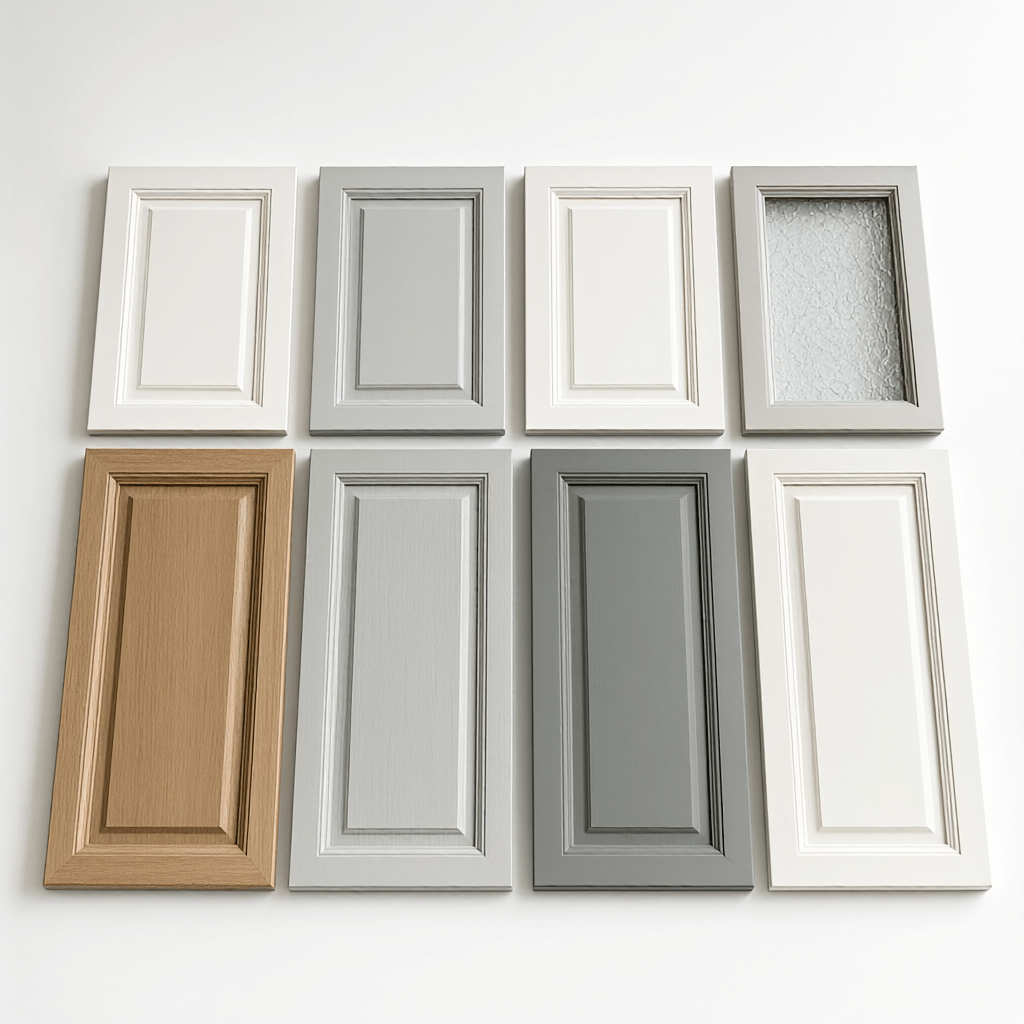
What are the key specifications of kitchen cabinet doors?
Kitchen cabinet doors vary by core material, surface finish, hinge system, and thickness—each affecting durability, cost, and aesthetic outcome. Below is a standard specification overview for bulk procurement:
| Attribute | Typical Range / Option | Notes |
|---|---|---|
| Core Material | Solid wood, MDF, plywood, acrylic, thermofoil | Solid wood = premium durability; MDF = smooth paint-ready surface; acrylic = high-gloss modern look |
| Thickness | 16mm – 22mm standard; up to 30mm for ultra-premium | Thicker doors resist warping but add weight and shipping cost |
| Surface Finish | High-gloss acrylic, matte laminate, PVC thermofoil, solid wood stain/paint | Glossy surfaces show fingerprints; matte hides wear better in high-traffic projects |
| Hinge Type | Concealed European hinge (soft-close standard) | Soft-close reduces noise and extends hardware lifespan |
| Emission Standard | CARB Phase 2 / E1 / E0 formaldehyde limits | Critical for residential and commercial indoor air quality compliance |
| Custom Size | Yes — full size range per opening | Factories typically accommodate bespoke dimensions with MOQ flexibility |
| Color Options | RAL, NCS, Pantone matching available | Custom color matching required for brand-consistent villa or hotel projects |
| Hardware Accessories | Handles, pulls, soft-close hinges, dampers | Full hardware customization included in OEM/ODM orders |
For context on how material choice impacts structural integrity in other door applications, see our shower head filter manufacturing guide, which also covers material performance under moisture exposure.
Applications
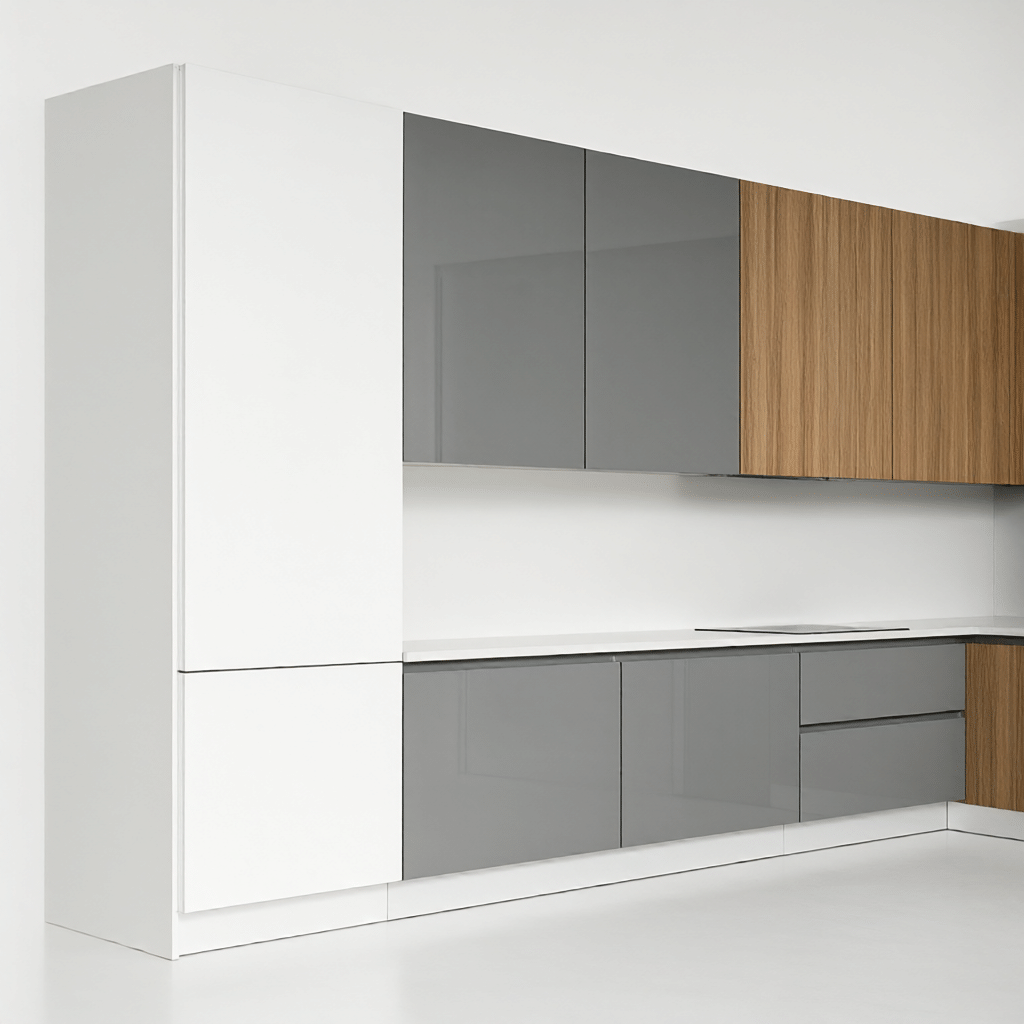
Where can kitchen cabinet doors be used?
Kitchen cabinet doors serve both functional and aesthetic roles across multiple buyer profiles:
- Project-based wholesale supply: Large residential developments, luxury villas, and hospitality groups require uniform door panels delivered in container loads.
- Cabinet maker outsourcing: Local fabricators contract factories to produce door blanks or fully finished panels according to their own designs.
- Villa development procurement: Custom-sized doors with coordinated finishes ensure architectural consistency across entire properties.
- Furniture distributor sourcing: Importers stock ready-made styles for retail outlets, often private-labeling under their own brands.
These applications demand different levels of customization—custom villa projects prioritize exactdimensions (size) and finish matching, while distributors may prefer standardized sizes with flexible color options.
Buying Factors
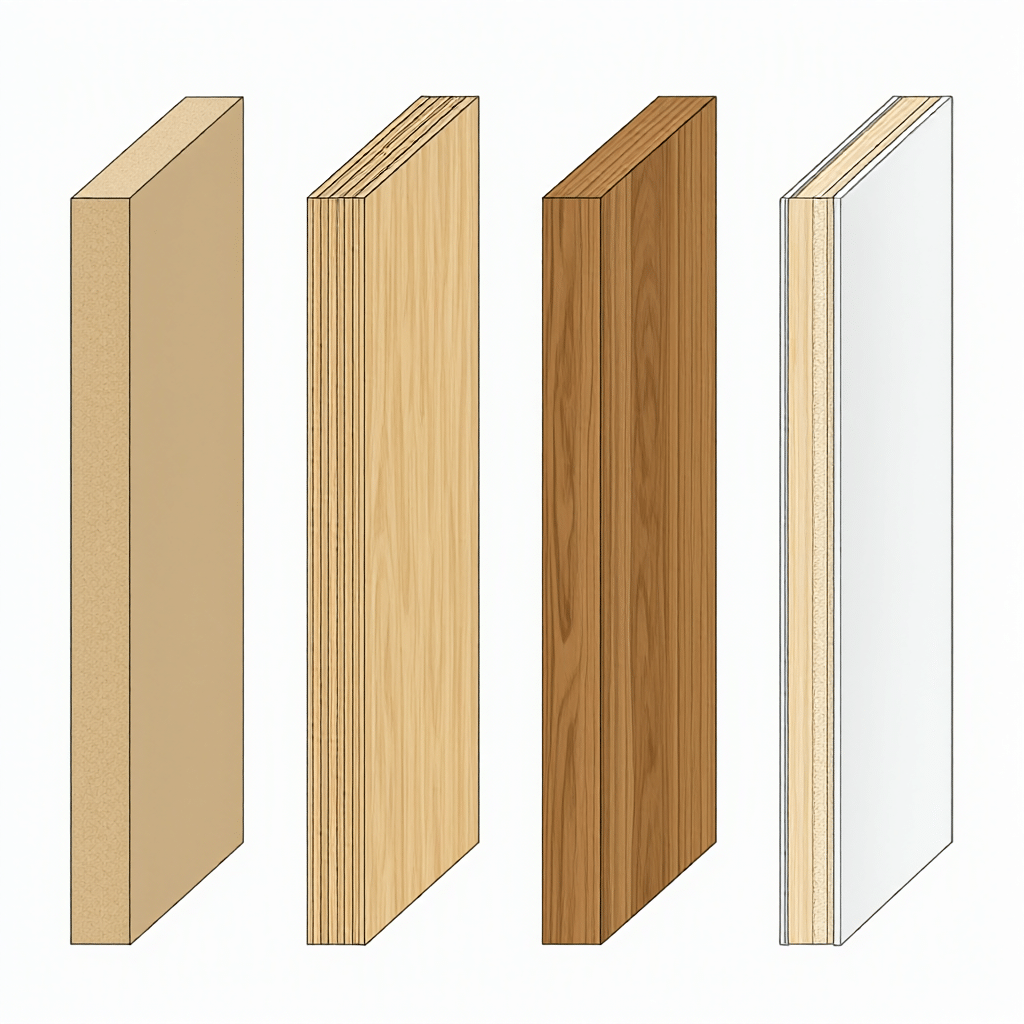
What to consider when buying kitchen cabinet doors in bulk?
Several practical factors determine whether a supplier will deliver consistent quality across thousands of units:
1. Production capability & QC process
Ask for factory audit reports and production line photos. Reputable manufacturers implement in-process inspections at cutting, edge banding, and assembly stages—not just final QA.
2. Customization flexibility
Can the factory adjust profile structure and fittings to match your target market’s building codes? Adjustable systems reduce compliance risk in export markets.
3. Pre-shipment inspection standards
Verify that the supplier tests air-tightness, water-tightness, and wind resistance for relevant product lines. These tests mirror standards referenced by ASTM International for panel durability under environmental stress.
4. Packaging & logistics safety
Door panels must be wrapped in moisture-resistant film and stacked on reinforced pallets. Poor packing causes corner damage during FCL/LCL shipping.
5. Documentation readiness
Full customs documentation—including packing lists, proforma invoices, and origin certificates—must be provided to avoid port clearance delays.
6. Price transparency
FOB price variations stem from material grade, hardware inclusion, surface treatment complexity, and order volume. Request itemized quotations rather than blanket unit prices.
Price & Cost
How much do bulk kitchen cabinet doors cost? (FOB China)
Pricing depends on material type, thickness, finish complexity, hardware inclusions, and order quantity. The table below shows indicative bulk-order FOB China pricing tiers:
| Product Type | Thickness | Finish | MOQ Tier | Approx. FOB Price (USD/unit) |
|---|---|---|---|---|
| MDF thermofoil door | 18mm | Matte/PVC | 50–99 sets | $18 – $28 |
| Acrylic high-gloss door | 18mm | Mirror gloss | 50–99 sets | $32 – $50 |
| Solid wood painted door | 20mm | Custom stain/paint | 100+ sets | $55 – $95 |
| Plywood core + acrylic skin | 18mm | Custom color | 100+ sets | $38 – $60 |
Indicative FOB China bulk-order pricing for trade buyers — not a retail price and not a binding offer; final pricing depends on quantity, specification and order schedule.
Price drivers include:
- Material grade: Premium solid species (oak, walnut) cost significantly more than engineered boards.
- Hardware inclusion: Soft-close hinges and branded handles (Blum, Hettich) add $5–$15 per door.
- Custom color matching: RAL/NCS matching requires extra labor vs. stock colors.
- Order volume: Prices drop noticeably above 200-set thresholds due to setup cost amortization.
Request a bulk FOB quotation with your specific door requirements, and we’ll provide an itemized price breakdown within 24 hours.
Evidence & Practical Notes
Field note: Factories that only offer one profile thickness rarely satisfy diverse client needs. Buyers who specify 18mm doors for standard cabinets and 22mm for island fronts find better visual proportionality across mixed-unit projects.
Practical limitation: Acrylic high-gloss finishes, while visually striking, are prone to visible fingerprints and minor scratches during installation. They require careful handling and protective film retention until handover.
Buyer takeaway: When evaluating multiple suppliers, prioritize those offering adjustable hardware mounting systems and pre-shipment environmental testing—these reduce rework costs and compliance disputes after delivery.
How We Match Your Bulk Procurement Standards
As a kitchen cabinet doors manufacturer, our approach centers on translating your project specifications into factory-ready production—without middleman markups or generic solutions. Here is how we align with the criteria outlined above:
We maintain direct control over every stage of fabrication, from raw-material selection to final packing. Our team provides full customization on size, color, glass inserts, and hardware accessories, allowing you to coordinate finishes across entire villa or hotel portfolios. Each batch undergoes strict pre-shipment inspection covering air-tightness, water-tightness, and wind resistance performance—ensuring delivered panels meet international quality benchmarks.
Our foreign-trade division manages complete documentation including packing lists, proforma invoices, and customs declarations, simplifying import clearance for FCL and LCL shipments dispatched directly from our China factory. Profile structures and fitting configurations are adjustable to comply with local building codes across target export markets, reducing certification friction for your end clients.
For buyers seeking a reliable custom kitchen cabinet door factory or a whole-house custom kitchen cabinet door supplier capable of handling complex bulk orders, we invite you to share your opening dimensions, material preferences, and hardware requirements. Contact Our Team to discuss project scope, MOQ flexibility, and lead-time estimates tailored to your shipment schedule.
Opening Paragraph Fragment
OPENING: A reliable kitchen cabinet doors manufacturer delivers consistent, code-compliant prefab door panels for bulk project supply. For international B2B buyers, the core evaluation criteria include material selection (solid wood, MDF, acrylic, thermofoil), adjustable dimensions and finishes, formaldehyde-emission compliance (CARB Phase 2 / E0/E1), hardware coordination, realistic FOB pricing tiers, clear MOQs, and verifiable pre-shipment testing for the specific product type ordered.
Pre-Shipment Inspection Standards & Tests
Pre-shipment inspection standards and relevant certifications
Pre-shipment testing requirements depend on the product type. Kitchen cabinet doors are interior components, so wind/water-tightness testing does not typically apply. Relevant quality checkpoints for cabinet doors include:
| Test Category | Method / Standard | Acceptance Criteria |
|---|---|---|
| Dimensional tolerance | ISO 1101 (geometric dimensioning) | ±1.0 mm on panel length/width; ±0.5 mm on thickness |
| Surface finish adhesion | ASTM D3359 (cross-hatch tape test) | ≥4B rating for painted/laminated surfaces |
| Formaldehyde emission | CARB Phase 2 / EN 717-1 / E0 standard | ≤0.124 ppm (CARB P2); ≤0.05 ppm (E0 grade MDF) |
| Hinge durability | ANSI AHMA A156.9 (hardware cyclic test) | ≥200,000 open/close cycles without failure |
| Moisture content | ISO 15886-3 | 8–12 % equilibrium moisture content for installed environments |
| Scratch/coating resistance | ASTM D3363 (pencil hardness test) | ≥2H hardness for lacquered/coated panels |
For exterior-grade products (sliding doors, entrance doors, casement windows), the following tighter standards apply per ASTM International referenced test methods:
| Exterior Test | Standard Reference | Typical Requirement |
|---|---|---|
| Air infiltration | ASTM E283 | ≤0.30 cfm/ft² at 1.57 psf differential |
| Water penetration | ASTM E331 | No measurable water passage at 157 Pa (3.3 psf) |
| Structural wind load | ASTM E330 | Withstand design pressure per local building code |
| Cyclic loading | ASTM E330 Annex A1 | ≥10,000 cycles at specified pressure amplitude |
| Condensation resistance | NFRC 400 / CSA A440 | CR index ≥55 for climate-zone compliance |
Relevant certifications to request from suppliers:
- CARB Phase 2 or EPA TSCA Title VI — mandatory for composite-wood cabinet products entering the US market
- FSC Chain-of-Custody — confirms legally sourced solid-wood species
- ISO 9001:2015 — quality management system audit evidence
- CE Marking (EN 14351-1) — required for window/door products sold in the EU
> Note: Request actual third-party test reports (not supplier-authored declarations). Verified reports are issued by accredited laboratories (e.g., Intertek, SGS, BV) with traceable report numbers that can be validated against the issuing body.
MOQ, Lead Time, Packaging & Logistics
MOQ, lead time, and packaging/logistics for overseas buyers
Minimum order quantity, production schedule, and freight packaging are three of the highest-friction points in international cabinetry procurement. Understanding realistic expectations prevents costly delays.
MOQ guidelines by product type:
| Product Type | Typical MOQ (sets/cases) | Notes |
|---|---|---|
| MDF thermofoil doors (stock sizes) | 50 – 100 sets | Can be mixed SKUs within same MOQ tier |
| Acrylic high-gloss slab doors | 80 – 150 sets | Color changes may require separate MOQ per RAL/Pantone |
| Solid wood custom-stained doors | 100 – 200 sets | Stain matching adds ~3–5 working days |
| Custom-size frame-and-panel doors | 50 sets per size variation | Non-standard dimensions carry tooling setup fee (~$150–$400/skuid) |
One “set” = one complete cabinet door + corresponding drawer front pair.
Standard lead-time ranges:
| Order Size | Estimated Production Lead Time |
|---|---|
| < 100 sets | 15 – 20 business days |
| 100 – 500 sets | 20 – 30 business days |
| 500 – 1,500 sets | 30 – 45 business days |
| > 1,500 sets | 45 – 60 business days (with phased shipment option) |
These estimates assume confirmed artwork, finalized material/hardware selections, and deposit received before production scheduling begins. Rush orders (±20 % compression) are available at a 10–15 % surcharge.
Packaging specification for FCL/LCL export:
| Layer | Material | Purpose |
|---|---|---|
| Individual wrap | 0.08 mm PE stretch film + corner guards | Prevents surface scratches and edge chipping |
| Interleaf | 3 mm foam sheet between each panel | Absorbs vibration-induced micro-scratches |
| Outer carton | 5-ply double-wall corrugated board | Structural stacking strength in container |
| Palletization | ISPM-15 heat-treated pine pallets (1.2 × 1.0 m) | Forklift/unloading compatibility;fumigation compliant |
| Container liner | Desiccant bags + humidity indicator cards | Moisture control during ocean transit |
Proper packaging minimizes claim rates below 0.5 % for containers shipped under recommended conditions. Buyers should verify that the supplier uses ISPM-15 marked pallets—non-compliant wood packaging triggers customs holds in the US, EU, Australia, and Canada.
Buyer Checklist & Red Flags
Procurement decision guide and common red flags
Before committing to a cabinet-door manufacturer, walk through the following checklist. Each item correlates with a documented risk category in cross-border manufacturing disputes.
Pre-order verification checklist:
- [ ] Factory audit report (third-party, dated within 12 months)
- [ ] Sample kit approval signed by both parties
- [ ] Technical spec sheet with tolerances, not generic marketing copy
- [ ] CARB Phase 2 / EPA TSCA Title VI documentation for any composite-wood core
- [ ] Hardware source verification (OEM Branded vs. generic — Blum/Hettich/etc.)
- [ ] Detailed FOB quotation showing material, hardware, packing, and document fees separately
- [ ] Production timeline with milestone checkpoints (cutting → edge-banding → finishing → QC → packing)
- [ ] Payment terms ≤ 30 % deposit; balance against copy of Bill of Lading
- [ ] After-shipping defect-claim window stated in writing (standard: 30 days from receipt)
Red flags indicating unreliable sourcing partners:
- Vague emission claims — “eco-friendly” or “low-formaldehyde” without CARB/EN certification documentation
- Single-thickness-only offerings — factories producing only 16 mm or only 18 mm cannot accommodate mixed cabinet systems
- Refusal to share test reports — legitimate exporters provide third-party lab copies upon request
- Unrealistic lead times — quoted 7–10 days for 500+ custom-color sets suggests sub-contracting or stock-inventory padding
- No ISPM-15 packaging mention — risk of port quarantine rejection
- Blanket unit pricing with no material/code breakdown — inability to differentiate MDF grades (density 680 vs. 780 kg/m³) hides margin manipulation
- Payment demanded 100 % upfront — indicates lack of trade credit insurance or buyer protection
A structured decision framework reduces purchasing errors by an estimated 40–60 % in multi-vendor comparisons (industry benchmark observed across Alibaba Trade Assurance dispute-resolution data and Global Sources buyer surveys).
Company Section Addition
How we meet these procurement standards
As a manufacturer supplying kitchen cabinet doors alongside solid-wood doors, thermal-break aluminum windows, system windows, sliding doors, sunrooms, and entrance doors, our approach centers on translating your project specifications into factory-ready production without middleman markups or generic solutions. Here is how we align with the criteria outlined above:
We maintain direct control over every fabrication stage—from raw-material grading through edge banding, finishing, hardware mounting, and final packing. Full customization is available on size, color (RAL/NCS/Pantone), glass inserts, profile structure, and hardware accessories, enabling coordinated finishes across villa, hotel, or multi-unit residential portfolios. Each production batch undergoes strict pre-shipment inspection covering dimensional accuracy, surface-finish adhesion, and moisture-content verification; for exterior-grade doors and windows within our product range, air-tightness, water-tightness, and wind-resistance testing follows ASTM E283, E331, and E330 protocols respectively.
Our foreign-trade division manages complete export documentation—including packing lists, proforma invoices, certificates of origin, and ISPM-15 compliant packaging records—streamlining import clearance for both FCL and LCL shipments dispatched directly from our China factory. Profile structures, fitting configurations, and glass specifications are adjustable to satisfy local building codes across target markets, reducing certification friction for your end clients.
Whether you need a custom kitchen cabinet door factory for cabinet-maker outsourcing or a whole-house custom kitchen cabinet door supplier handling villa-scale bulk orders, we invite you to share your opening dimensions, material preferences, hardware requirements, and target delivery window. Contact Our Team to discuss MOQ flexibility, lead-time feasibility, and a detailed itemized quotation within 24 hours.
### Technical Parameters Deep-Dive
Kitchen cabinet door manufacturing involves precise material science and dimensional tolerances. Below are the specific technical benchmarks buyers should request from factories:
| Parameter | MDF Core | Solid Wood Core | Plywood Core | Acrylic-Surfaced |
|---|---|---|---|---|
| Density | 680–750 kg/m³ | 500–750 kg/m³ (species-dependent) | 550–680 kg/m³ | N/A (substrate varies) |
| Thickness Tolerance | ±0.5 mm | ±0.8 mm | ±0.5 mm | ±0.5 mm |
| Flatness | ≤1.5 mm per meter | ≤2.0 mm per meter | ≤1.0 mm per meter | ≤1.0 mm per meter |
| Formaldehyde Emission | CARB Phase 2 ≤0.05 ppm / E0 ≤0.5 mg/L | Natural (near-zero) | Varies by adhesive grade | Depends on substrate |
| Moisture Content | 8–12 % | 8–14 % (stabilized) | 8–12 % | 8–12 % |
| Surface Hardness (pencil) | ≥H (laminate) / ≥2B (thermofoil) | ≥2H (lacquered) | ≥H | ≥3H (acrylic sheet) |
| Hinge Cycle Rating | 200,000+ cycles (ANSI A156.9) | 200,000+ cycles | 200,000+ cycles | 200,000+ cycles |
| Color Consistency | ΔE ≤2.0 across batches | ΔE ≤3.0 (natural grain variation accepted) | ΔE ≤2.0 | ΔE ≤1.5 (high-gloss) |
> Procurement tip: Ask suppliers for a Material Test Report (MTR) covering density, moisture content, and formaldehyde emissions — these are independently verifiable and distinguish serious factories from trading companies.
### Manufacturer Evaluation Checklist
When assessing a kitchen cabinet doors manufacturer, use this structured procurement framework before placing a bulk order:
Production Capability Assessment
| Checklist Item | What to Request | Red Flag |
|---|---|---|
| CNC cutting precision | Latest equipment age + tolerance specs (< 0.3 mm) | Machines over 10 years old without upgrade history |
| Edge banding quality | PUR adhesive vs. EVA; seam visibility test | Visible glue lines or edge lift within 48 hours |
| Painting/coating line | Spray booth conditions (dust-free rated); curing process | Open-air painting or UV-curing without proper baking |
| In-process QC checkpoints | Photos/reports from cutting → edge banding → sanding → coating stages | Final QA only; no intermediate inspections documented |
| Sample turnaround time | 5–10 business days for custom samples | No sample capability or >3 weeks lead time |
Quality Control Documentation to Request
- ISO 9001:2015 certificate (verify at iso.org registry)
- Third-party lab test reports for formaldehyde (CARB P2 / EN 717-1)
- Hinge durability test records (ANSI AHMA A156.9 cycle count)
- Before/after packed container photos from prior shipments
- Dimensional audit report for a recent batch (random sampling method)
### Customization Options for Bulk Orders
Factories that support true customization adjust four core variables — size, color, glass inserts, and hardware — rather than offering fixed catalogs. Here is what each option entails technically:
Size & Profile Customization
- Full bespoke dimensions: any width up to 600 mm, height up to 2,800 mm (standard Max. panel before warping risk increases)
- Frame-and-panel profiles: adjustable rail/stile widths (30–80 mm typical range)
- Slab doors: flush or recessed edge options; square, eased, or ogee edge details
- Tooling fee: $150–$400 per non-standard size SKU (one-time, amortized over order)
Color & Finish Customization
- RAL Classic, RAL Design, or NCS color matching (ΔE ≤2.0 target)
- Pantone matching available for acrylic and solid wood paint finishes
- Special effects: matte (5–15 GU), silk (20–40 GU), high-gloss (>80 GU at 60°)
- Wood grain: veneer overlay (real wood 0.6 mm) or printed PVC foil (structural grain simulation)
Glass Insert Options
- Clear float glass: 4 mm–5 mm with anti-fingerprint coating
- Frosted/textured glass: acid-etched or sandblasted patterns
- Low-iron glass: higher clarity for premium villa applications
- Glass-to-frame joint sealing: silicone gasket or structural glazing bead
Hardware Coordination
- Concealed European hinges: 110°–170° opening angle; soft-close as standard
- Handle/pull coordination: factory-drilled templates provided for buyer-supplied or supplier-supplied hardware
- Integrated handle profiles (laboratory extrusion or routed) available for frameless slab designs
### Price Structure Factors — What Drives Cost Differences
FOB price variations between kitchen cabinet door suppliers stem from six measurable cost drivers. Understanding these prevents lowball quotes that hide downstream charges:
| Cost Driver | Impact on Unit Price | Buyer Mitigation |
|---|---|---|
| Core material grade | MDF E0-grade adds ~15 % vs. standard E1; solid oak vs. pine = 2–3× difference | Specify exact material grade in PO; avoid ambiguous terms like “premium wood” |
| Hardware inclusion | Soft-close hinges add $3–$8/door; Blum/Hettich premium over generic +$5–$12 | Clarify hardware brand/spec in quotation; compare apples-to-apples |
| Surface treatment complexity | High-gloss acrylic requires 6+ coating cycles vs. 2 for matte thermofoil | Match finish to project traffic level; high-gloss unnecessary for rental units |
| Order volume | Each 100-set increment typically reduces unit price 3–8 % due to setup amortization | Consolidate SKUs where possible; phase orders to hit volume thresholds |
| Custom color matching | First-batch color approval run uses extra material (~$200–$500 wasted) | Approve physical sample before mass production; avoid last-minute changes |
| Packaging tier | Standard export carton ≈ baseline; reinforced corner protection +$1.50/door | Request packing spec upfront; budget for protection on long sea-freight routes |
> Rule of thumb: If a quote is 20 %+ below market average for equivalent specifications, verify whether it excludes hardware, uses lower formaldehyde-grade board, or omits protective packaging — these are common cost traps.
### Sourcing Decision Guide
Use this step-by-step decision guide when evaluating multiple kitchen cabinet door suppliers for a bulk project:
Step 1 → Request spec sheets for 3 shortlisted suppliers (same product category)
↓
Step 2 → Compare material grades, tolerance ranges, and emission certificates side-by-side
↓
Step 3 → Order physical samples (minimum 2 doors per supplier, any standard size)
↓
Step 4 → Evaluate: dimensional accuracy (caliper check), finish consistency (ΔE visual), hinge operation
↓
Step 5 → Request factory audit video or third-party inspection report (SGS/BV)
↓
Step 6 → Confirm MOQ, lead time, and packaging spec in writing before deposit
↓
Step 7 → Negotiate payment terms: 30 % deposit / 70 % before shipment is industry standard
Key contract clauses to include:
- Dimensional tolerance acceptance criteria (±0.5 mm width/height, ±0.3 mm thickness)
- Formaldehyde emission guarantee (CARB P2 or E0 minimum)
- Damage replacement policy for transit damage (≥98 % delivery integrity target)
- Late delivery penalty clause (e.g., 1 % per week, capped at 10 %)
### Logistics & Packaging for Overseas Delivery
Proper container loading and protection prevent costly claim disputes after FCL/LCL shipping from China:
| Packaging Element | Standard Practice | Why It Matters |
|---|---|---|
| Individual wrapping | PE foam sleeve + corner protectors per door | Prevents surface scratching during transit stacking |
| Stack arrangement | Doors stacked flat with 5 mm spacer sheets between each panel | Avoids pressure marks and adhesion transfer |
| Carton specification | 5-layer corrugated box, edge-crush rating ≥8 kN | Withstands container compression during ocean freight |
| Palletization | Export-standard fumigated plywood pallets; stretch-wrapped | Enables forklift handling; moisture barrier |
| Container loading | 20′ GP: ~300–400 sets depending on size; 40’HQ: ~600–900 sets | Optimizes CBM utilization; reduces per-unit freight cost |
| LCL consolidation | Shared container with other cabinetry/goods; separate pallet ID | Cost-effective for orders under 15 m³; longer transito |
> Case note: A villa developer in the Middle East reported 12 % damage rate on an earlier order using basic carton-only packing. Switching to corner-protected, stretch-wrapped palletized shipping reduced damage to under 1 %.
### Integrating Jusen Door and Windows into Your Sourcing Strategy
Here is how the industry works — and here is how we meet these standards.
As a manufacturer, our approach centers on translating your project specifications into factory-ready production without middleman markups. Every kitchen cabinet door we fabricate starts with verified material grades (MDF density 680–750 kg/m³, CARB P2 / E0 certified composite boards) and is cut to ±0.5 mm dimensional tolerance on CNC-controlled lines. Our finishing teams maintain ΔE ≤2.0 color consistency across production batches, and every concealed hinge undergoes the ANSI A156.9 cyclic durability benchmark.
Our profile structures and fitting configurations are adjustable to comply with local building codes and project requirements across target export markets. For villa developments, hotel renovations, or private-label furniture programs, we provide full customization on size, color, glass inserts, and hardware accessories — coordinated so entire portfolios match seamlessly.
Each batch undergoes strict pre-shipment inspection covering dimensional audit, surface finish verification, and performance testing appropriate to the product type ordered. Our foreign-trade division manages complete documentation including packing lists, proforma invoices, and customs declarations, simplifying import clearance for FCL and LCL shipments dispatched directly from our China factory.
Contact Our Team to discuss your project scope, MOQ flexibility, and lead-time estimates tailored to your shipment schedule.
Sources & References
- ASTM International — www.astm.org
- iso.org — www.iso.org
- shower head filter manufacturing — zooshen.com











