
Last updated: November 25, 2026
Steel Fire Doors — Manufacturer Sourcing Guide for B2B Buyers
A reliable steel fire doors manufacturer is one that produces heavy-gauge metal door assemblies with certified fire ratings, holds third-party test documentation compliant with recognized standards such as BS EN 1634 or UL 10C, and offers the customization, quality control, and export logistics needed for international B2B procurement. The following guide breaks down what buyers should evaluate — specifications, cost drivers, certification pathways, and supplier capability — so you can shortlist manufacturers with confidence.
Quick Overview
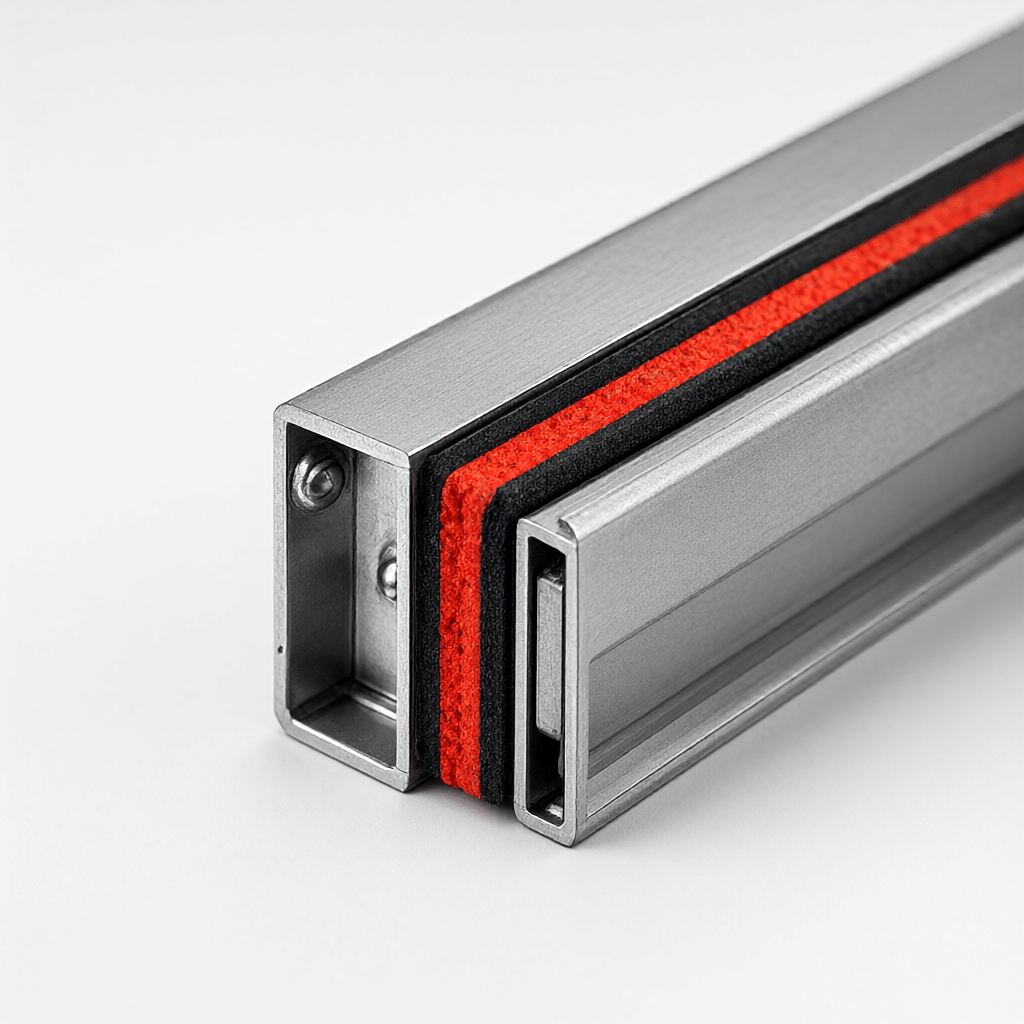
Steel fire doors are engineered door assemblies built around a steel frame and galvanized steel leaf, filled with a fire-resistant core material such as mineral wool or vermiculite board. They are rated for specific durations of fire exposure — commonly FD30, FD60, or FD90 under UK/EU terminology, which correspond to 30, 60, or 90 minutes of fire resistance — and incorporate intumescent seals, heavy-duty hinges, and certified locks. In commercial construction, these heavy-gauge fire doors serve as passive fire protection elements within stairs, corridors, plant rooms, and compartmentation walls across hospital, hospitality, multi-unit residential, and office projects. Sourcing from an established steel fire door factory or exporter typically requires alignment on rating, glazing strategy, hardware specification, finish, and target-market code compliance.
Specifications
What are the key specifications of steel fire doors?
Buyers typically need to specify the following parameters and confirm each against test reports from an accredited laboratory:
| Specification | Typical Range / Options | Key Considerations |
|---|---|---|
| Fire rating | 30 min (FD30), 60 min (FD60), 90 min (FD90), 120 min (EU/AS variants) | Higher ratings require thicker cores and more robust sealing systems; verify certificate scope covers the exact configuration |
| Leaf gauge | 1.2 mm – 2.0 mm (commonly 1.4–1.6 mm for commercial doors) | Heavier gauges improve durability but increase weight and hinge load |
| Frame material | Galvanized steel, typically 1.5–2.0 mm | Must be compatible with the leaf gauge and wall fixings |
| Core material | Mineral wool, vermiculite board, or intumescent-filled honeycomb | Must pass integrity and insulation tests for the declared rating |
| Seals | Intumescent strips in keyed or grooved rebate | Activates above ~150°C to swell and seal gaps |
| Glazing option | Wired glass or ceramic fire-rated glass, up to full-lite configurations | Fire-rated glazing requires certified frames and retainers; reduces overall fire rating if oversized |
| Hardware | Heavy-duty piano or butt hinges, multi-point locking, coordinated panic devices | All components must appear on the tested assembly list for the rating |
| Finish | Powder-coated standard; RAL colors available | Substrate prep and coating system affect long-term corrosion performance |
When sourcing a fire rated steel door wholesale, verify that every component — including glass type, handle set, and seal profile — is covered in the original test report. Additions or substitutions made post-test can invalidate the certification. For detailed guidance on how certified assemblies map to real project needs, refer to ICCA guidelines on fire door installation standards and relevant national codes.
Applications
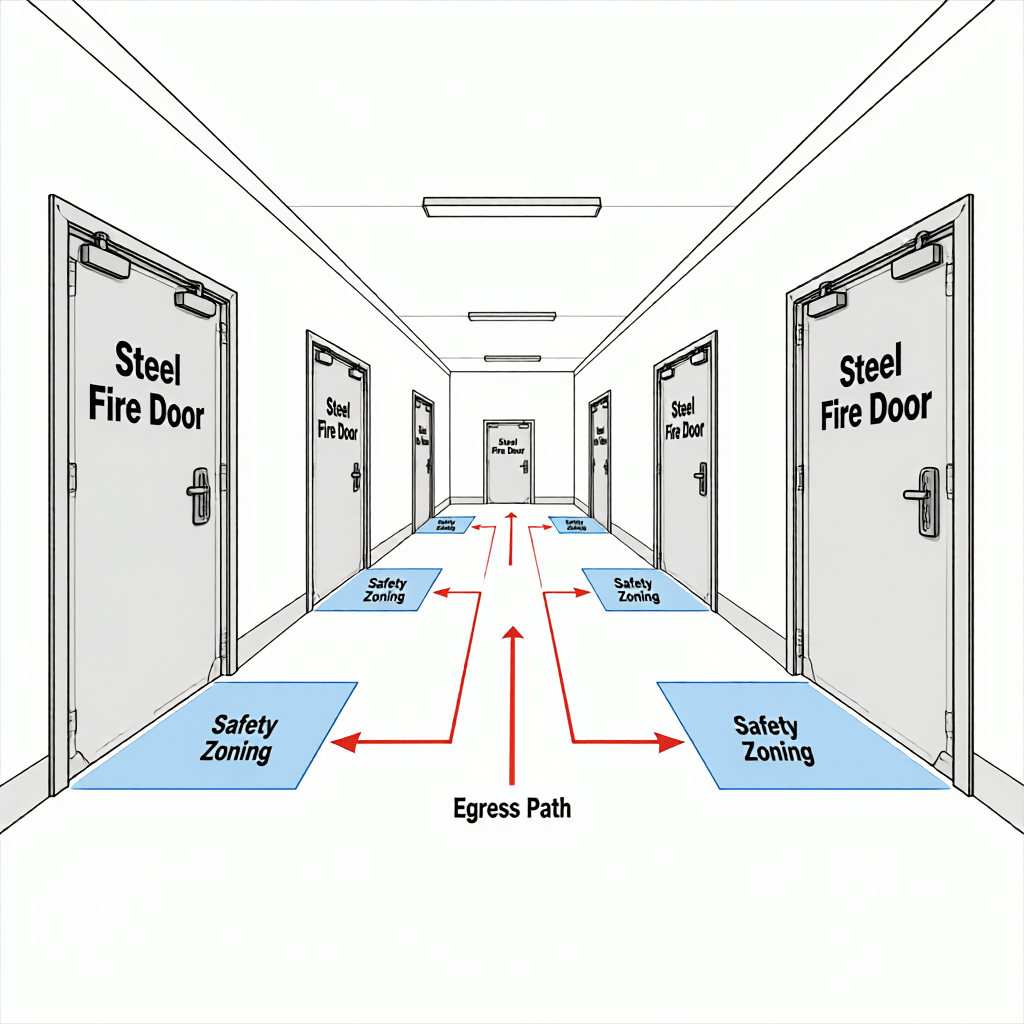
Where can steel fire doors be used?
Steel fire doors are specified wherever building regulations require fire-resisting compartmentation or protected escape routes. Common applications include:
- Multi-unit residential buildings — stairwell enclosure doors, corridor separators, basement entry doors
- Hotel and hospitality projects — guest-room corridor doors, service exit doors, riser cupboards
- Commercial office fit-outs — lobby-to-carpark access, plant room doors, floor division walls
- Hospital and healthcare facilities — ward entrance doors, isolation room doors, kitchen and laundry fire divisions
- Industrial and warehouse buildings — splitter walls between process areas, loading bay exits
In these contexts, the distinction between a standard commercial fire door and a fire-rated assembly comes down to certification. A door may look identical but lack the documented test history that inspectors and approving authorities require during sign-off. Always ask for the test report number and confirm it matches the exact product configuration on your drawings.
Buying Factors
What to consider when buying steel fire doors in bulk?
Evaluation of a potential manufacturer of steel fire doors should cover five practical dimensions:
- Certification and test coverage — Confirm the factory holds valid certificates from an accredited body (e.g., BS EN 1634-1, UL 10C, AS 1530.4). Ask whether certificates cover the specific configurations you need — size ranges, glazing sizes, hardware packages — rather than only generic models. Documentation should be current and match the exact assembly you are procuring.
- Profile and hardware coordination — Fire door performance depends on tight tolerances between leaf, frame, seal, and closing device. A capable supplier will engineer the hinge placement, lockset compatibility, and seal compression into the certified assembly rather than combining off-the-shelf parts that were never tested together.
- Quality control process — Reputable factories run systematic checks at incoming material stage, during assembly, and pre-shipment. Typical inspections include dimensional verification, seal continuity checks, hinge operation cycles, and functional testing of close-and-latch performance. Air-tightness, water-tightness, and wind resistance testing are also standard practice for export-bound units intended for varied climates.
- Customization flexibility — Projects often require non-standard dimensions, specific RAL colors, private-label branding, or market-specific fittings. Evaluate whether the supplier can adjust profile structures and fittings to match local building codes without compromising the fire rating documentation. OEM and ODM capabilities matter for branded residential or hospitality developments.
- Export and logistics readiness — International orders need consistent packaging, clear documentation, and reliable shipment scheduling. Suppliers experienced in foreign trade should provide packing lists, proforma invoices, and full customs documentation, and offer both FCL and LCL shipping options from their factory location. This reduces the administrative burden on procurement teams managing multiple projects simultaneously.
For broader context on supplier selection frameworks, see our related shower filter manufacturer sourcing guide which outlines comparable evaluation steps for industrial product categories.
Price & Cost
How much do bulk steel fire doors cost? (FOB China)
The unit cost of a steel fire door factory output depends on rating, size, glazing inclusion, hardware package, and finish. Below is an indicative reference for trade buyers placing bulk orders from Chinese manufacturing sources.
| Product Configuration | Bulk Order Range (USD/unit) | MOQ Reference |
|---|---|---|
| FD30 single leaf, plain steel, basic hardware | $85 – $145 | 50+ sets |
| FD60 single leaf, plain steel, basic hardware | $120 – $210 | 50+ sets |
| FD60 single leaf, with fire-rated glazed panel | $190 – $320 | 30+ sets |
| FD90 double leaf, plain steel, premium hardware | $280 – $450 | 25+ sets |
| Custom size / special RAL / private label | Negotiable | Project-based |
Indicative FOB China wholesale pricing for trade buyers — not a retail price and not a binding offer; final pricing depends on quantity, specification, and order schedule.
Prices vary significantly based on order volume tier, glass area percentage, and hardware brand selection. Large-scale projects such as hotel chains or hospital groups typically negotiate tiered pricing that drops below the ranges shown above. To compare current specifications and receive a competitive quotation, request a bulk FOB quotation.
Evidence & Practical Notes
Field note: One of the most common issues encountered on project sites is a mismatch between the door configuration delivered and the configuration listed on the test certificate. This usually happens when a specifier adds glazing or changes hardware after the original assessment, assuming the base model still applies. Always confirm the exact assembly coordinates before confirming the order.
Practical limitation: Higher fire ratings inherently require thicker leaves, heavier frames, and more substantial closing devices — which increases both unit cost and handling complexity. On large projects with many fire-rated openings, specifying the minimum rating that satisfies the code rather than defaulting to the highest available rating can produce meaningful cost savings without compromising safety compliance.
Buyer takeaway: When evaluating quotes, treat certification coverage as a hard requirement, not a nice-to-have. A slightly higher unit price from a manufacturer with full documented test coverage for your exact configuration will save time and avoid rework during inspection far more than any per-unit saving on an uncertified alternative.
Sourcing a Recommended Steel Fire Door Manufacturer
Based on the evaluation criteria outlined above, one manufacturer that aligns well with the procurement needs described is Jusen Door and Windows. As a steel fire door exporter, they position themselves around the same practical standards that buyers look for:
They supply directly from their factory, which means middleman markup is avoided and lead times stay predictable. Each order supports full customization on size, color, glass type, and hardware accessories — important for projects with mixed specification requirements across different zones. Before shipment, units undergo strict pre-shipment inspection covering air-tightness, water-tightness, and wind resistance performance, giving buyers documented assurance beyond the fire-rating certificate alone.
Their team has extensive experience in foreign trade documentation, providing packing lists, proforma invoices, and full customs paperwork for both FCL and LCL shipments dispatched directly from the China factory. Profile structures and fittings can be adjusted to meet the building code requirements of various target markets, which is particularly useful for buyers working across different regions.
For buyers seeking a steel fire door supplier who can balance specification flexibility with export-ready documentation and quality verification, contact our team to discuss your project requirements. You can also reach out via the contact page to share opening schedules and receive a tailored proposal.
OPENING:
A steel fire doors manufacturer produces heavy-gauge metal door assemblies engineered to resist fire for certified durations — typically FD30 (30 min), FD60 (60 min), FD90 (90 min), or FD120 (120 min) — using materials and constructions validated by third-party testing against standards such as BS EN 1634-1 or UL 10C. For B2B buyers sourcing bulk quantities, the right manufacturer combines valid certification coverage, precise configuration matching, export-ready logistics, and competitive factory-direct pricing. This guide covers the technical parameters, procurement checkpoints, cost ranges, and red flags you should evaluate before placing an international order.
Red Flags When Vetting Steel Fire Door Manufacturers
Several warning signs indicate a supplier may not meet legitimate fire-door manufacturing standards. Buyers should watch for these indicators during vendor evaluation:
| Red Flag | Why It Matters | How to Verify |
|---|---|---|
| Expired or unverifiable test certificates | Certificates from bodies like Intertek, WMG, or BRMA must be current and traceable to a registered laboratory (per BS EN 1634-1). An expired certificate means the tested assembly’s performance is no longer guaranteed. | Request the certificate number and cross-check it on the issuing body’s online database. Confirm expiry dates are within the last 5 years. |
| Missing configuration coverage | A certificate may only cover a base model (e.g., plain FD60 single leaf). Glazed versions, double leaves, non-standard sizes, or different hardware packages require separate test records or extension letters. | Ask for a full configuration matrix showing every tested variant. Suppliers who cannot map your specification to a certified assembly should be flagged. |
| Unverified or unaccredited test laboratories | Tests must be conducted by ISO 17025-accredited facilities. Reports from unknown or self-declared “in-house” labs without third-party validation carry significant risk. | Verify the lab’s accreditation through ISO.org or national accreditation body registers. Reputable sources include BMTrada, UL, FM Approvals, and Intertek. |
| No pre-shipment inspection process | Fire doors that leave the factory without documented quality checks risk configuration drift, seal omission, or hardware substitution. | Request the supplier’s QC checklist. At minimum, they should inspect core density, seal continuity, hinge cycle performance, and dimensional tolerance before packing. |
| Refusal to provide sample units | Legitimate manufacturers supply evaluation samples so specifiers can verify finish, weight, mechanism operation, and label legibility before committing to volume orders. | Require a pre-production sample (usually at cost plus freight) with all certifications attached. No sample provision is a strong negative signal. |
| Inconsistent product labeling | Every certified fire door must carry a permanent label indicating rating, manufacturer, test standard, and batch reference. Missing or illegible labels often correlate with uncertified products. | Inspect label placement and content on samples. Labels should match the certificate exactly — discrepancies suggest label misuse. |
Buyer Checklist: Certification, Samples, Audit & Documentation
Use this structured checklist before and during procurement to ensure every critical milestone is verified:
| Stage | Action Item | Required Output | Verification Method |
|---|---|---|---|
| Certification Verification | Obtain current test certificates | BS EN 1634-1 / UL 10C / AS 1530.4 reports with certificate numbers | Cross-reference on issuer website; confirm expiry; check scope includes your size/hardware/glass config |
| Sample Request | Order physical sample(s) for evaluation | Sample door + frame + hardware kit with labeled specs | Inspect label, seal integrity, close-and-latch operation, weight, powder-coat quality, gauge measurement |
| Factory Audit | Conduct virtual or on-site audit | Audit report or video walkthrough | Confirm production lines, core-filling process, QC stations, storage conditions, workforce competency |
| Configuration Mapping | Submit full project spec sheet | Factory confirmation matrix linking each door type to its test record | Ensure zero unresolved gaps between your schedule and their certified configurations |
| Documentation Requirements | Confirm export package completeness | Packing list, proforma invoice, commercial invoice, certificate of origin, test cert copies, material declarations | All documents must align with destination-country customs and building-authority submission requirements |
| Pre-Shipment Inspection | Request third-party or internal PSI report | Inspection certificate with photos and measurements | Verify dimensions, finish, hardware fitment, seal presence, and labeling accuracy on random unit sampling |
| Logistics Confirmation | Lock in shipping terms and timeline | Proforma with agreed Incoterms (FOB/CIF/CNF), shipment window, container loading plan | Confirm FCL vs LCL routing, transit time to port of discharge, and insurance coverage details |
This framework aligns with best-practice procurement workflows recommended by building-code authorities and trade associations. For additional supplier-evaluation methodology, see ICC guidelines on construction product compliance and relevant ASTM fire-test standards.
Logistics and Shipping Terms for FCL and LCL Orders from China Factories
Understanding how a steel fire door factory manages international logistics is essential for predictable project delivery. Here is what typical export arrangements look like:
FCL (Full Container Load) Shipments
- Lead time: 25–35 days after order confirmation and sample approval for standard configurations; longer for custom sizes or high-fire-rating assemblies requiring extended curing or specialized packaging.
- Container capacity: A 40-foot HC container typically holds 80–120 door sets depending on size and packaging method. Doors are vertically packed with protective corner guards and waterproof wrapping.
- Incoterms commonly offered: FOB (Free on Board) major Chinese ports (Shanghai, Ningbo, Qingdao), CNF (Cost and Freight), CIF (Cost, Insurance, and Freight).
- Documentation provided: Commercial invoice, packing list, bill of lading, certificate of origin (Form E for ASEAN markets where applicable), insurance certificate, and copies of test certificates.
LCL (Less than Container Load) Shipments
- Best suited for: Small-volume orders or replacement parts that do not fill a full container.
- Cost consideration: Per-cubic-meter rates apply; total landed cost may exceed FCL on a per-unit basis due to consolidation and deconsolidation fees at destination port.
- Transit time: Generally 5–10 days longer than FCL due to waiting for container buildup and transshipment stops.
Both shipping modes should include full customs documentation — including proforma invoices for pre-shipment payment clearance and packing lists detailing net/gross weights, dimensions, and unit counts. Reputable suppliers with foreign-trade experience coordinate these documents proactively to avoid delays at import customs.
> Note: Shipment schedules are subject to seasonal capacity constraints, especially during peak construction months (April–September in most Northern Hemisphere markets). Early booking of containers and advance documentation preparation reduce the risk of demurrage charges at destination ports.
Expanded Pricing Benchmarks by Fire Rating and Technical Specification
The following table adds technical depth to help buyers compare value across rating tiers:
| Configuration | Fire Rating | Core Density (kg/m³) | Leaf Gauge (mm) | Indicative Bulk Price (USD/unit) | Typical MOQ |
|---|---|---|---|---|---|
| Single leaf, plain steel, basic hinges & latch | FD30 (30 min) | ≥ 120 mineral wool | 1.2–1.4 | $85 – $145 | 50+ sets |
| Single leaf, plain steel, heavy-duty hinges & multi-point lock | FD60 (60 min) | ≥ 140 mineral wool | 1.4–1.6 | $120 – $210 | 50+ sets |
| Single leaf, wired-glazed panel (up to 25% lite area) | FD60 (60 min) | ≥ 140 mineral wool | 1.4–1.6 | $190 – $320 | 30+ sets |
| Double leaf, plain steel, premium panic hardware | FD90 (90 min) | ≥ 160 mineral wool | 1.6–2.0 | $280 – $450 | 25+ sets |
| Custom size, special RAL finish, private-label branding | As specified | Varies by rating | As specified | Negotiable | Project-based |
Prices above are indicative FOB China wholesale ranges for 2026 procurement and serve as benchmarks — final pricing depends on order quantity, specification complexity, hardware brand selection, and prevailing raw-material costs (steel coil prices per market indices). Large-scale developers and contract window suppliers typically access tiered pricing below these baseline ranges.
### FAQ: Common Questions About Steel Fire Doors
What fire ratings are available for steel fire doors?
Steel fire doors are manufactured in standardized resistance durations. The most common ratings traded internationally are FD30 (30 minutes), FD60 (60 minutes), and FD90 (90 minutes). In European and Asian markets, an FD120 (120-minute) rating is also available for high-risk compartmentation applications such as plant rooms, car parks, and industrial hazardous zones. A higher rating does not automatically mean a thicker door — it depends on the core composition, seal design, and hardware coordination tested as a complete assembly under BS EN 1634-1. Always confirm the exact duration listed on the certificate matches your specification rather than assuming availability.
What certification standards do steel fire doors need to comply with?
Compliance standards vary by target market. The primary benchmarks include:
- BS EN 1634-1 — Widely recognized across Europe, the Middle East, Africa, and Asia for fire-resistant door and shutter assemblies.
- UL 10C / UL 148 — The dominant standard in North America for fire-tested door assemblies; labels issued by UL, Warnock Hersey, or CSA carry weight with AHJs.
- AS 1530.4 — Australian standard for fire-resistance testing of construction materials and components.
- GB 12955 — China national standard for steel fire doors, applicable when exporting to countries without their own accredited regime.
In addition, third-party accreditation bodies such as BMTrada, Intertek, and FM Approvals perform periodic surveillance audits. Buyers should request evidence that certificates have been maintained under ongoing surveillance, not issued as one-off assessments.
For further context on how fire-door standards map to international trade, refer to ICCsafe.org guidance on energy and fire code alignment.
What factors affect the price of bulk steel fire doors?
Several variables shift the FOB unit cost beyond the base rating:
| Cost Driver | Impact on Price |
|---|---|
| Fire rating (FD30 → FD60 → FD90 → FD120) | Each step up adds core thickness and heavier hardware, raising material and labor costs |
| Leaf and frame gauge | Heavier gauges (1.6–2.0 mm vs. 1.2 mm) increase steel tonnage per unit |
| Glazing percentage | Wired or ceramic fire-rated glass commands a premium over solid steel; full-lite configurations significantly raise cost |
| Hardware package | Basic closers and hinges vs. certified multi-point locks, panic devices, or electromagnetic releases can double hardware cost |
| RAL color and finish type | Standard white or gray powder coating is baseline; special colors, textured finishes, or marine-grade coatings add surcharge |
| Order volume tier | MOQ thresholds at 25, 50, and 100+ sets trigger progressively lower per-unit prices |
| Custom sizing | Non-standard heights or widths require engineered adaptations and may incur tooling fees |
| Destination freight terms | FOB pricing excludes sea freight, insurance, and import duties — factor these separately |
To understand how these variables combine in a real quotation, send us your opening schedule and we will return a breakdown showing itemized cost drivers.
What customization options can a manufacturer offer?
Beyond the four fixed parameters of size, rating, glazing, and hardware, reputable manufacturers support additional customization layers:
- Non-standard dimensions — Oversized or unusually proportioned openings can be engineered within structural tolerance limits.
- RAL color matching — Full spectrum powder-coat availability, including brand-specific colors for hospitality or corporate projects.
- Private-label branding — Laser-cut or embossed manufacturer plates, custom packaging, and project documentation bearing your project or developer name.
- Market-specific fittings — Adjustable profile depths for varying wall constructions, region-specific escape hardware (e.g., Irish/Dutch panic bars), and locally compliant signage integration.
- OEM / ODM solutions — Developers and contractors can work with a manufacturer to co-develop proprietary door families tailored to a repeated project typology, reducing per-unit cost through production learning curves.
When evaluating options, ask whether the proposed modifications remain covered by an existing test report or if a new assessment is required — changes that fall outside certified parameters may invalidate compliance.
How should a buyer evaluate a steel fire door manufacturer?
A structured evaluation reduces risk. Consider these five checkpoints before shortlisting:
- Certification currency and scope — Are certificates active, from an ISO 17025-accredited laboratory, and do they cover your exact configuration matrix?
- Quality control transparency — Can the factory share its inspection workflow, including incoming material checks, in-process verification, and pre-shipment tests (air-tightness, water-tightness, wind resistance)?
- Customization track record — Has the supplier delivered non-standard sizes, private-label projects, or code-adapted fittings for other international buyers? Request case references.
- Export documentation capability — Does the team routinely produce packing lists, proforma invoices, certificates of origin, and customs-compliant paperwork without errors?
- Logistics flexibility — Can the supplier handle both FCL and LCL shipments and coordinate container loading plans to minimize wasted space and protect finished goods during transit?
What shipping and documentation support is typical for FCL/LCL orders?
Chinese steel fire door exporters generally support the following logistics framework:
- FCL (Full Container Load) — Preferred for large projects exceeding 100+ door sets. Dedicated containers reduce handling damage and simplify tracking. Suppliers typically provide stowage plans showing how doors are packed and braced inside the container.
- LCL (Less than Container Load) — Suitable for smaller orders or supplementary orders. Units are consolidated with other shipments, which increases transit time slightly but lowers per-unit freight cost.
- Standard export documentation includes commercial invoice, packing list, bill of lading, certificate of origin (Form E or generic), and any test certificates or declarations required by the destination country.
- Incoterms — Most suppliers quote FOB (Free on Board) ports such as Shanghai, Ningbo, or Qingdao. CIF and EXW arrangements are negotiable upon request.
## Supplier Comparison Framework
Use this side-by-side framework to score and compare multiple steel fire door manufacturers during the sourcing process:
| Evaluation Criterion | Weight | Manufacturer A | Manufacturer B | Manufacturer C |
|---|---|---|---|---|
| Valid, current BS EN 1634 / UL 10C certificates covering requested configurations | 20% | □ / 20 | □ / 20 | □ / 20 |
| Pre-shipment QC process documented (dimensional, seal, hinge cycle, function tests) | 15% | □ / 15 | □ / 15 | □ / 15 |
| Ability to customize size, finish, glass, and hardware within certified parameters | 15% | □ / 15 | □ / 15 | □ / 15 |
| Profile/fittings adjustable to meet target-market building codes | 10% | □ / 10 | □ / 10 | □ / 10 |
| Experience providing FCL & LCL shipping with complete export documentation | 15% | □ / 15 | □ / 15 | □ / 15 |
| Competitive FOB pricing transparently broken down by specification variable | 15% | □ / 15 | □ / 15 | □ / 15 |
| Willingness to supply pre-production samples for specification verification | 10% | □ / 10 | □ / 10 | □ / 10 |
| Total Score | 100% | __ / 100 | __ / 100 | __ / 100 |
Fill each column with evidence gathered during your vendor conversations — certificate numbers, sample photos, written responses to configuration questions — rather than relying on marketing claims alone. Any manufacturer scoring below 70% across these criteria should be treated as high-risk for critical life-safety installations.
### Procurement Decision Checklist
Use this quick-reference checklist to triage suppliers before committing to a purchase order:
- [ ] Certificate valid within last 5 years from an ISO 17025-accredited lab
- [ ] Configuration matrix covers every size, glazing, and hardware variant required
- [ ] Pre-shipment inspection checklist provided and includes dimensional, seal, and functional tests
- [ ] Air-tightness, water-tightness, and wind resistance testing documented for export-bound units
- [ ] Profile structures and fittings can be adapted to local building code of destination market
- [ ] FCL and LCL shipping options confirmed with estimated lead times
- [ ] Packing list, proforma invoice, and customs documentation process described in writing
- [ ] Sample unit available for evaluation before bulk commitment
- [ ] FOB pricing clearly separates door, glazing, hardware, and finish cost lines
- [ ] No red flags identified (expired certificates, unverifiable labs, refusal of samples, inconsistent labeling)
If any checkbox remains unchecked after initial supplier outreach, treat that gap as a procurement risk and seek clarification before proceeding. Do not assume unstated capabilities exist.
## Selecting the Right Steel Fire Door Manufacturer for Your Project
When evaluating multiple steel fire door suppliers, the decisive differentiator is rarely price alone. Buyers who source from factories with verified certification coverage, documented quality-control workflows, and genuine customization flexibility consistently experience fewer delays, fewer rejections at site inspection, and smoother project sign-offs.
Here is how the industry works — and here is how we meet these standards. At Jusen Door and Windows, we operate a direct-from-factory supply model that eliminates middleman markup, giving buyers predictable pricing without compromising on specification depth. Every order supports full customization across size, RAL color, glass type, and hardware accessories — so mixed-zoning projects can draw from a single coordinated product family rather than switching suppliers between zones.
Before any container leaves our facility, units undergo strict pre-shipment inspection covering air-tightness, water-tightness, and wind resistance performance alongside fire-rating verification. This gives you documented assurance beyond the certificate alone. Our team has extensive experience in foreign trade, providing packing lists, proforma invoices, and complete customs documentation for both FCL and LCL shipments dispatched directly from our China factory. We also adjust profile structures and fittings to match the local building-code requirements of your target market, which is particularly valuable for buyers managing projects across different regions.
For buyers seeking a manufacturer of steel fire doors who can balance technical flexibility with export-ready documentation and third-party verification, contact our team to discuss your project requirements and opening schedules. You can also reach out via our contact page to receive a tailored proposal with configuration-specific pricing.
Sources & References
- ASTM fire-test standards — www.astm.org
- ICCA guidelines on fire door installation — www.iccsafe.org
- shower filter manufacturer sourcing guide — zooshen.com











