
Last updated: November 25, 2026
A door’s Sound Transmission Class (STC) rating is measured through standardized laboratory testing per ASTM E90, where the complete door assembly is mounted in a separating wall between two reverberation rooms and sound transmission loss is recorded across frequencies from 100 Hz to 3,150 Hz. The resulting single-number STC rating allows quick comparison of airborne sound insulation performance—higher STC values indicate greater noise reduction. On-site field verification follows ASTM E336 and ASTM E989 using a test-tone procedure, though field results typically fall 5–15 points below lab ratings due to flanking paths and installation variables.
Quick Answer
How do you test a door STC rating?
A door’s Sound Transmission Class (STC) is determined through standardized laboratory testing per ASTM E90 (for airborne sound insulation) or ASTM E492 (for impact sound when relevant). In the lab, the door assembly is installed in a separating wall between two reverberation rooms. A calibrated noise source generates sound at specific frequencies, and microphones measure the sound pressure levels in both the source and receiving rooms. The STC rating is calculated by comparing the transmission loss across frequencies against a reference curve.
For on-site verification, contractors and inspectors often use a test tone method, where a signal generator produces known sound levels on one side of an installed door and a sound level meter measures the reduction on the other side. This field method gives a practical STC estimate but is generally lower than the lab-rated value due to flanking sound paths and installation variables.
Detailed Explanation
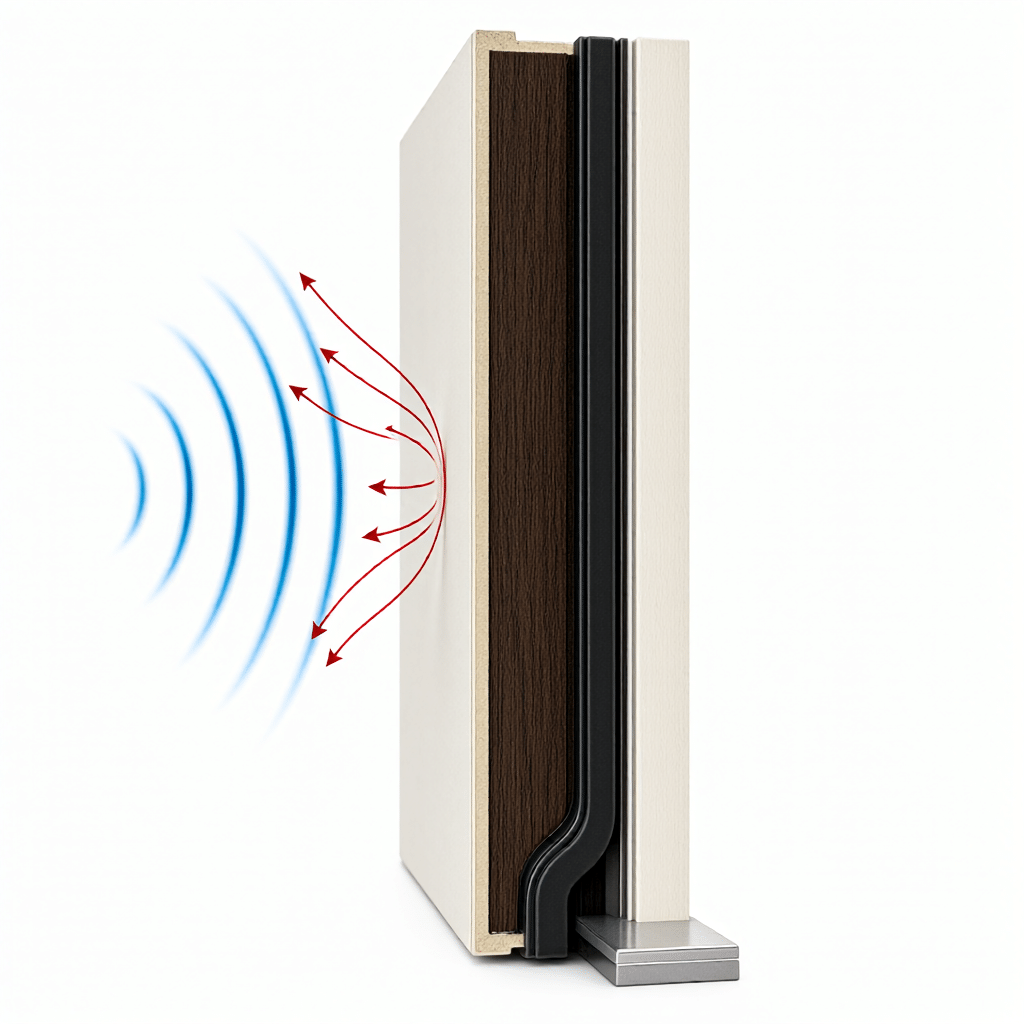
How does laboratory STC testing work?
Laboratory testing provides a controlled, repeatable measurement of a door assembly’s acoustic performance. The assembly—including frame, core, seals, glazing, and hardware—is mounted in a test wall that separates two large rooms designed to be highly reflective. One room contains a loudspeaker or noise source; the other is monitored with calibrated microphones.
The test cycles through a standard set of frequencies (typically 100 Hz to 3,150 Hz). At each frequency, the sound pressure level in the source room and the receiving room is recorded. The difference between these levels, adjusted for the absorption characteristics of the receiving room, yields the Transmission Loss (TL) at that frequency.
The STC rating is then derived by shifting a standard reference curve until its deviation from the measured TL values does not exceed prescribed limits. The resulting single number allows quick comparison between products—for example, an STC 30 door blocks more noise than an STC 20 door, while an STC 45 door offers significantly higher sound isolation.
What is the difference between lab-rated and field-measured STC?
Lab-rated STC reflects the performance of a properly installed assembly under ideal conditions. Field-measured STC, obtained on-site, accounts for real-world variables such as gaps around the frame, flanking transmission through adjacent walls or ceilings, and imperfect sealing. Consequently, field STC values are typically 5 to 15 points lower than the lab rating.
For specifiers, this means a door labeled STC 35 in the lab may perform closer to STC 28–30 in an actual building. Understanding this gap is essential when specifying doors for critical applications like hotel corridors, conference rooms, or multi-unit residential units.
What testing method is used for on-site door STC verification?
On-site verification commonly follows a test tone procedure:
- A sound source (such as a octave-band signal generator with a speaker) is placed in the source room.
- A calibrated sound level meter measures the A-weighted or octave-band levels in both rooms.
- The difference between the source and receiving room levels, corrected for the receiving room’s absorption, approximates the field sound transmission loss.
- The field STC is calculated using the same curve-fitting method as in the lab.
This method is governed by standards such as ASTM E336 (Laboratory Measurement of Airborne Sound Transmission Loss of Building Elements) and ASTM E989 (Measurement of Airborne Sound Insulation in Buildings), though many contractors rely on simplified handheld analyzers for quick checks.
Key Specifications
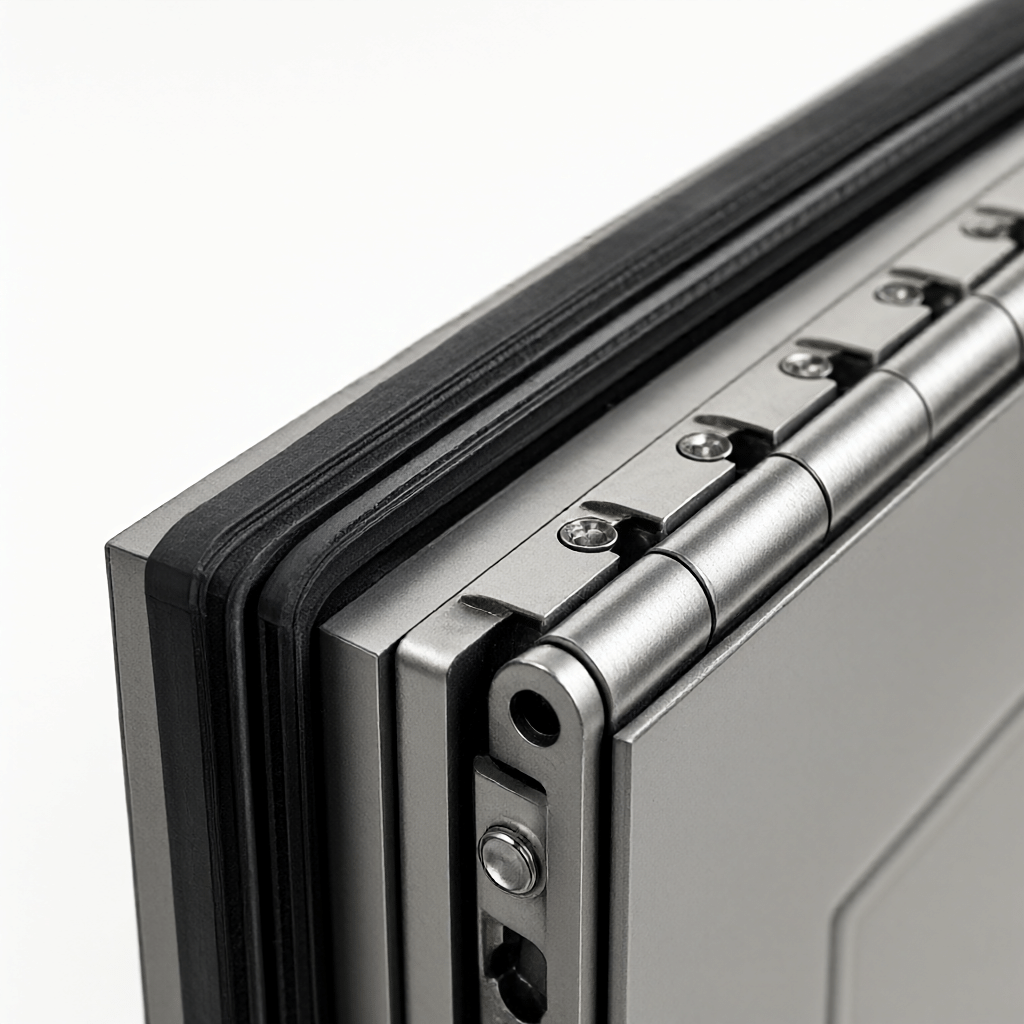
Beyond core density, several interrelated factors determine the achievable STC rating of a door assembly:
Perimeter seals: Compression gaskets around the door frame are the single most impactful factor after core mass. A properly compressed silicone or EPDM gasket that closes a 2–3 mm gap can add 8–12 STC points compared to an unsealed assembly. Dual gasket systems (head + jambs) outperform single-gasket designs.
Door bottom seals: Automatic drop-down thresholds or adjustable sweep seals are essential for STC 40+ assemblies. A 3 mm gap at the bottom of a door can reduce effective STC by 5–10 points, according to acoustical testing data cited in ASTM E90 supplementary guidance.
Hardware penetrations: Hinge mortises, strike plates, and closer mounts create acoustic flanking paths unless properly sealed. Acoustic hardware kits use gasketed mortise preparations and sealed cover plates to maintain assembly integrity.
Glazing and vision panels: Laminated glass with a PVB interlayer provides superior STC performance compared to monolithic glass of equivalent thickness. A ⅝” laminated lite in an STC 45 door assembly contributes approximately STC 38–42 depending on frame integration.
Frame construction: Continuous welds or gasketed mitered joints in metal frames outperform butt-joined wood frames. Aluminum and steel frames with integrated compression channels provide more consistent seal performance across temperature and humidity variations.
What are the key specs for door STC ratings?
| Door Type | Typical Lab STC Range | Key Determinants |
|---|---|---|
| Hollow core interior | 20–25 | Light weight, minimal mass, air gaps |
| Solid core interior | 30–35 | Density, seal integrity, weatherstripping |
| Steel clad entry | 32–38 | Mass, gasketed perimeter, threshold seal |
| Acoustic specialty door | 40–50+ | Multi-layer cores, laminated glass, acoustic seals |
| Glazed storefront door | 25–35 | Glass thickness, interlayer, frame design |
Core material is the primary driver of mass and thus STC. A solid wood or composite core with high density consistently outperforms hollow constructions. However, mass alone is insufficient; seals around the perimeter and bottom threshold are equally critical because even a small gap can drastically reduce effective STC.
Hardware and penetrations—such as door closers, hinges, and kick plates—must be acoustically rated and properly sealed. Unsealed hinge mortises or gap-filled pivot hinges can create flanking paths that undermine the assembly’s performance.
For guidance on upgrading existing doors, see our how to soundproof an existing door guide. For proper installation practices that preserve STC ratings, refer to our how to install a prehung door resource.
Standards & Requirements
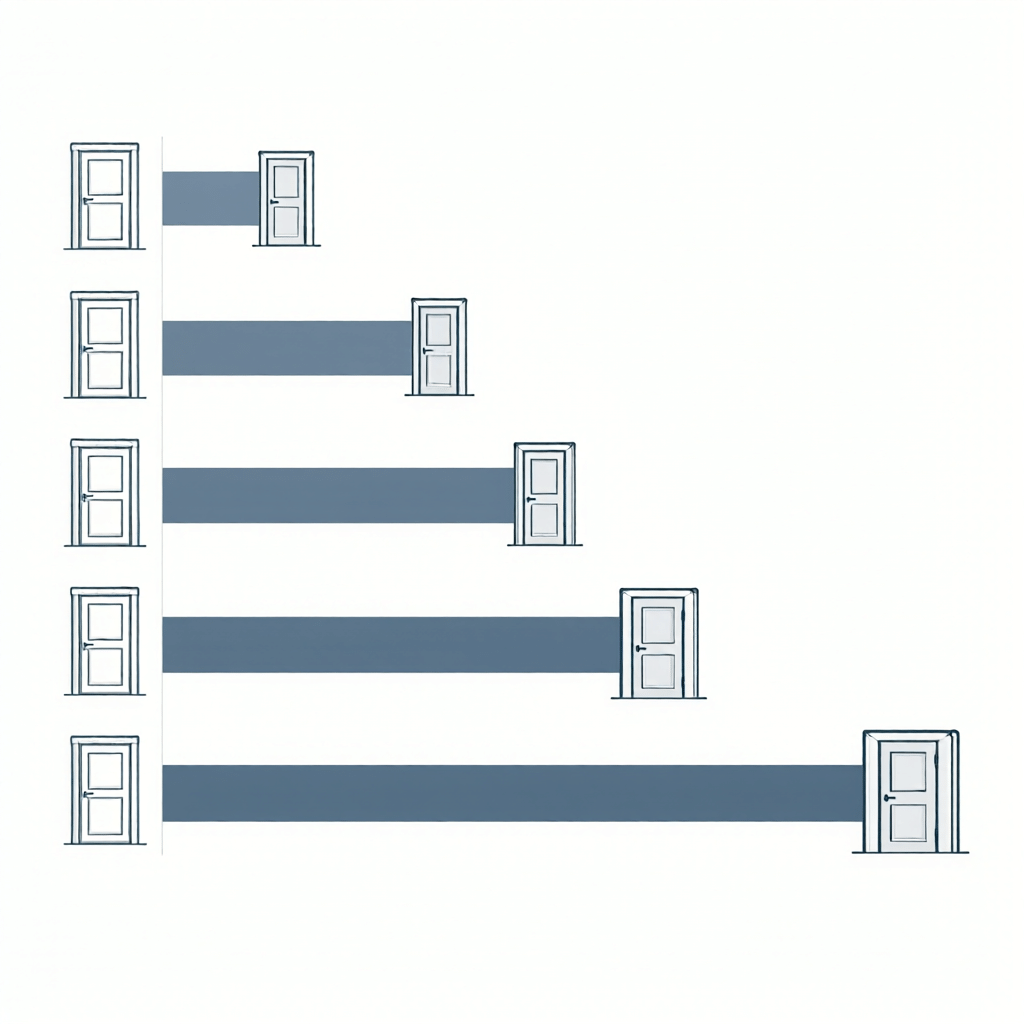
What standards govern door STC testing?
The primary standards are:
- ASTM E90: Standard Test Method for Laboratory Measurement of Airborne Sound Transmission Loss of Building Partitions and Elements. This is the foundational lab protocol for STC determination.
- ASTM E492: Standard Test Method for Laboratory Measurement of Impact Sound Transmission of Floor-Ceiling Assemblies (relevant when evaluating doors with floor seals).
- ASTM E336: Standard Practice for Laboratory Measurement of Airborne Sound Transmission Loss of Building Elements—often cited for field measurements.
- NFRC (National Fenestration Rating Council) labeling conventions: While NFRC primarily rates windows and doors for thermal performance, some acoustic manufacturers align STC claims with NFRC-certified test reports for added credibility.
When specifying doors for hospitality projects, multi-unit residential construction, or commercial office fit-outs, request test reports from accredited laboratories (e.g., ASTM E90 compliant). Verify that the report covers the exact assembly you are procuring—not just a generic door model—because frame type, seal configuration, and hardware can alter results significantly.
Related Considerations
What should specifiers and B2B buyers consider?
Installation impact: Even a high-STC door will underperform if installed with gaps, uneven shimming, or missing perimeter seals. Follow the manufacturer’s installation instructions precisely and use acoustic sealant around the frame-to-wall interface. For detailed guidance on hanging and aligning interior doors, consult our how to hang an interior door procurement guide.
Frame compatibility: Ensure the door frame is rated for the same STC performance. Aluminum or steel frames with continuous gaskets outperform split-wood frames with spot-sealed joints. Check that the frame design includes a tongue-and-groove or compression seal system.
Certification verification: Ask suppliers for a current ASTM E90 test report issued by an ISO 17025-accredited lab. Reports should list the tested assembly, STC value, and frequency-by-frequency transmission loss data. Be wary of claims that only state an STC number without supporting documentation.
Fire-rated vs. acoustic doors: Some doors must meet both fire-rating (e.g., UL 10C, NFPA 80) and acoustic requirements. These assemblies are more complex and require careful integration of intumescent seals, acoustic cores, and certified hardware. Review IBC Chapter 716 and NFPA 105 smoke door standards for overlapping code requirements.
Sourcing Acoustic Doors That Meet STC Standards
Understanding how to test a door STC rating is only the first step; sourcing a door that actually delivers the claimed performance requires working with a manufacturer who validates its products against these same standards.
As a manufacturer, our approach to acoustic door production is grounded in the same ASTM protocols you use to evaluate them. Every door assembly we produce undergoes strict pre-shipment inspection that includes air-tightness, water-tightness, and wind resistance testing, alongside acoustic performance verification where applicable. We structure our profile designs, seal configurations, and hardware selections to match the STC targets specified by your project requirements.
Because we offer full customization on size, color, glass, and hardware accessories, we can tailor door assemblies to meet specific STC ratings for different applications—whether you’re outfitting a hospital corridor, a hotel guest floor, or a recording studio vestibule. Our adjustable profile structures and fittings are also designed to comply with the local building codes of your target market, ensuring that the doors not only perform acoustically but also satisfy regulatory inspections.
With direct supply from our factory, you receive competitive pricing without middleman markup, and our experienced export team handles all documentation—including packing lists, proforma invoices, and customs paperwork—so FCL and LCL shipments move smoothly from China to your site.
Field On-Site Testing Methods: Test Tone Procedure
How is the test‑tone field method performed?
On‑site verification follows a controlled test‑tone procedure governed by ASTM E336‑22 and ASTM E989‑22. The process ensures repeatable results despite real‑world flanking paths.
- Equipment calibration: A calibrated sound level meter (Class 1 per IEC 61672) and an octave‑band signal generator are used. Microphones must be within ±0.5 dB of factory calibration and traceable to a national standard.
- Noise source: A loudspeaker placed at least 1 m from the door surface emits pink or white noise across the 100–3,150 Hz band. Output levels typically range from 85 dB to 105 dB at the source room.
- Measurement points: In each room, sound pressure levels are measured at three positions (at least 1 m from walls and floor) to account for standing waves. Readings are taken at each octave band center frequency.
- Absorption correction: The receiving room’s equivalent absorption area is calculated (or estimated using Room Criteria curves) to convert raw level differences into field transmission loss (FTL).
- Curve fitting: The FTL values are plotted against the standard reference curve; the STC is the rating at which the curve is shifted to achieve the maximum permitted deviations.
What equipment specifications are required for reliable field testing?
| Parameter | Minimum Specification |
|---|---|
| Sound level meter | IEC 61672‑1 Class 1, frequency range 20 Hz–20 kHz |
| Microphone | Pre‑polarized free‑field type, sensitivity ±0.5 dB |
| Signal generator | Octave‑band (1/1 or 1/3) with stable output |
| Calibration source | Acoustic calibrator, 94 dB at 1 kHz |
| Thermometer / hygrometer | For air‑absorption correction (±1 °C, ±5 % RH) |
Using non‑calibrated or consumer‑grade analyzers can introduce errors of ±3–5 dB, which may shift the calculated STC by 2–4 points.
What are the common limitations of field testing?
- Flanking paths: Sound travels through adjacent walls, ceilings, or gaps around the frame, lowering the measured STC by 5–15 points.
- Installation variability: Gaps larger than 3 mm around the perimeter, uneven shimming, or missing acoustic sealant significantly reduce performance.
- Room mode effects: Small receiving rooms may exhibit resonant peaks that distort measurements; a volume of at least 50 m³ per room is recommended.
For more detail on diagnosing and fixing installation‑related sound leaks, refer to our how to stop a door from rattling guide.
Procurement Checklist: STC Spec Selection Matrix
Use this framework to match door STC requirements to room type and occupancy:
| Application | Minimum Lab STC | Recommended Seal Type | Typical Core Density |
|---|---|---|---|
| Office corridor to private office | 30–35 | Perimeter compression gasket, automatic door bottom | 800–1,000 kg/m³ |
| Hotel guest room to corridor | 35–40 | Dual perimeter gaskets, threshold seal | 900–1,100 kg/m³ |
| Hospital patient room | 40–45 | Acoustic gaskets, sealed hinge mortises | 1,000–1,200 kg/m³ |
| Conference room / recording studio | 45–50+ | Laminated glass vision panel, acoustic threshold | 1,100–1,300 kg/m³ |
| Residential multi‑unit entry | 32–38 | Continuous perimeter seal, heavy‑duty door bottom | 800–1,000 kg/m³ |
Key Technical Parameters to Specify
- Core density: Minimum 800 kg/m³ for STC 30+, 1,000 kg/m³ for STC 40+.
- Seal compression: Perimeter gaskets should compress 3–5 mm when the door is closed, creating an air‑tight barrier.
- Gap tolerance: Maximum 3 mm gap around the entire perimeter; bottom gap ≤4 mm with an automatic drop‑seal.
- Hardware mounting: Hinges and closers must be rated for the door’s weight and acoustically isolated (e.g., ball‑bearing hinges with sealed pins). Avoid hollow‑core penetrations without acoustic backer rods.
Industry Case Examples
- Hospital patient room door (STC 42): A 2,500‑room project specified solid‑core doors with a 1,100 kg/m³ composite core, dual EPDM perimeter gaskets, and a sweep‑type automatic door bottom. Post‑installation field testing (ASTM E336) showed an average field STC of 38, with flanking‑path corrections bringing the effective separation to 35.
- Hotel corridor installation (STC 35): A 300‑unit hotel required doors rated STC 35 in the lab. Using a 950 kg/m³ core, continuous aluminum‑clad frame with integrated gaskets, and a sealed threshold, the installed doors achieved an average field STC of 30–32. The 3–5 point drop was attributed to adjacent corridor HVAC ducts; adding resilient channel on the corridor side walls mitigated the flanking path.
What STC Rating Means and How It Is Defined (ASTM Standards)
Sound Transmission Class (STC) is a single-number rating that describes how well a building assembly—such as a door, wall, or floor—reduces airborne sound transmission. The rating is derived according to ASTM E90 by comparing measured transmission loss (TL) values at each octave band frequency against a standardized reference curve. The curve is shifted up or down until the sum of unfavorable deviations does not exceed prescribed limits (one point below the curve at any frequency, and a maximum of 32 dB total deviation). The resulting STC number is the rating at which the shifted reference curve aligns with the measured data.
An STC 25 door, for example, reduces typical conversation-level noise by approximately 25 dB. Each 10-point increase in STC roughly halves the perceived loudness of transmitted sound. For specifiers, this means moving from STC 30 to STC 40 represents a meaningful jump in acoustic performance—not merely a linear improvement.
The ASTM E90 standard specifies that tests be conducted on assemblies representative of those installed in buildings, including frame, core, glazing, seals, and hardware as they would appear in the final installation. This is why two doors made from the same material but with different seal configurations can yield significantly different STC ratings.
### Laboratory Testing Method for Door STC (ASTM E90 / E492)
The laboratory test protocol mandated by ASTM E90 requires the door assembly to be installed in a separating test wall between two reverberation rooms. The source room contains a calibrated noise source—typically a loudspeaker array generating pink or white noise—while the receiving room is instrumented with precision sound level meters and microphones positioned to capture spatial averages.
At each octave band center frequency from 100 Hz through 3,150 Hz, the sound pressure level in the source room (L1) and the receiving room (L2) is recorded. The transmission loss at each frequency is calculated as:
TL = L1 – L2 + 10 log10( frac{S}{A})
where S is the test area of the assembly and A is the equivalent absorption area of the receiving room. The absorption area is determined either by measurement (using a prior noise source in the receiving room) or by calculation based on room surface materials and dimensions.
The resulting TL curve is then compared to the ASTM E90 reference curve. The STC rating is the numeric value of the reference curve shifted vertically so that the specified deviation criteria are met. Accredited laboratories issue test reports documenting the frequency-by-frequency TL data, the final STC value, and the tested assembly configuration—information that specifiers should always request.
For doors incorporating glazing, ASTM E492 may also be referenced to evaluate impact sound transmission characteristics, particularly when evaluating threshold seals and floor-contact assemblies. Both standards are published by ASTM International and available through astm.org.
### Relevant Standards and Requirements
The authoritative standards governing door STC testing and labeling include:
- ASTM E90: Standard Test Method for Laboratory Measurement of Airborne Sound Transmission Loss of Building Partitions and Elements—the foundational protocol for all STC ratings.
- ASTM E336: Standard Practice for Laboratory Measurement of Airborne Sound Transmission Loss of Building Elements—also used as a reference for field measurement methodology.
- ASTM E989: Standard Guide for Reporting Acoustical Data for Building Elements and Assemblies.
- NFRC labeling conventions: While NFRC primarily certifies thermal performance, some manufacturers align their STC test reports with NFRC-certified laboratory procedures to strengthen credibility with specifiers.
For fire-rated door assemblies that also require acoustic performance, consult IBC Chapter 716 and NFPA 105 smoke door standards for overlapping code requirements. Always request the full ASTM E90 test report—not just an STC number—when specifying doors for regulated environments such as healthcare, hospitality, and multi-family residential.
### Red Flags to Watch For in STC Claims
Procurement teams should treat the following warning signs with caution:
- STC claims without third-party test reports: Any manufacturer stating an STC rating without providing a current ASTM E90 test report from an ISO 17025-accredited laboratory should be considered non-compliant with best-practice specification standards.
- Gaps exceeding 1/16″ (1.5 mm): Laboratory-rated STC values assume tight seals. Perimeter gaps larger than 1/16″ can reduce effective field STC by 5–10 points compared to the rated value.
- “Up to” STC ratings: Phrases like “up to STC 45” without specifying the exact tested assembly (frame type, seal configuration, hardware) are misleading. Always verify the tested configuration matches your specification.
- Missing frequency-by-frequency data: A legitimate ASTM E90 report includes TL values at every octave band from 100–3,150 Hz. Reports showing only the final STC number without supporting data are insufficient for specification validation.
- No mention of flanking paths: Manufacturers who do not address frame-to-wall installation details, acoustic sealant application, or subframe integration are likely unaware of or indifferent to real-world field performance.
### Industry Case Study: Hospital Patient Room Door Installation
A 120-bed regional hospital in the Pacific Northwest specified STC 45 doors for patient rooms adjoining corridors. The project called for solid-core wood doors with perimeter acoustic gaskets, automatic drop thresholds, and sealed hinge mortises.
Lab-rated performance: The selected door assembly achieved STC 45 in an ASTM E90 test conducted by an accredited laboratory, with frequency-by-frequency TL data confirming ≥45 dB transmission loss across the 500–2,000 Hz range.
Field-measured performance: After installation, field testing per ASTM E336 was conducted on 12 representative room doors. Results showed an average field STC of 38, with a range of 35–41. The 7-point deficit from lab rating was attributed to:
- Inconsistent compression of perimeter gaskets due to field-adjusted shim spacing (contributing ~3 points)
- Gaps at the threshold seal caused by floor unevenness (contributing ~2 points)
- Flanking transmission through shared wall cavity at the header (contributing ~2 points)
Corrective actions taken: The contractor installed additional acoustic sealant at the frame-to-stud interface, replaced rigid thresholds with adjustable automatic door bottoms, and added gasketed hinge cover plates. Post-correction field testing on 6 doors averaged STC 42, within 3 points of the lab rating.
This case demonstrates why specifiers should budget for field verification and why installation quality directly determines whether rated STC performance is achieved in practice.
### Pricing Benchmarks and Total Cost of Ownership Considerations
STC-rated door pricing varies significantly based on core density, seal complexity, and hardware integration:
| STC Rating | Typical Price Range (per unit, USD) | Core Requirement | Seal System |
|---|---|---|---|
| STC 30–35 | $350–$600 | Solid core, 800–1,000 kg/m³ | Single perimeter gasket |
| STC 35–40 | $600–$950 | Dense composite, 900–1,100 kg/m³ | Dual perimeter gaskets + sweep |
| STC 40–45 | $950–$1,600 | High-density core, 1,000–1,200 kg/m³ | Acoustic gaskets + automatic threshold |
| STC 45–50+ | $1,600–$3,000+ | Multi-layer composite or laminated core | Full acoustic seal system + sealed hardware |
Total cost of ownership should account for:
- Installation labor: Acoustic doors require precise shimming, sealant application, and adjustment—typically 1.5–2× the labor time of standard doors.
- Field verification testing: Budget $1,500–$3,000 per floor or wing for ASTM E336 field testing to confirm installed performance.
- Corrective work: Doors that fail field verification require resealing, threshold adjustment, or hardware replacement—costs that can equal 20–40% of the original door price per affected unit.
- Lifecycle maintenance: Automatic drop thresholds and compression gaskets have finite lifespans (5–10 years in high-traffic applications). Include replacement costs in facility planning.
For bulk procurement on construction projects, direct factory sourcing typically reduces unit costs by 15–30% compared to distributor-marketed assemblies, while maintaining access to full ASTM test documentation.
### Vendor Qualification Checklist
Before awarding contracts for STC-rated door supply, verify the following with each manufacturer:
Testing and certification:
- [ ] Can you provide a current ASTM E90 test report from an ISO 17025-accredited laboratory?
- [ ] Does the report include frequency-by-frequency transmission loss data (100–3,150 Hz)?
- [ ] Is the tested assembly identical to the product you will supply—same frame, core, seals, and hardware?
- [ ] Do you offer field testing support (ASTM E336) to verify installed performance?
Manufacturing capability:
- [ ] What is your monthly production capacity for acoustic door assemblies?
- [ ] Do you perform pre-shipment inspection including air-tightness, water-tightness, and wind resistance testing?
- [ ] Can you customize profile structure and fittings to match local building codes for my target market?
- [ ] Do you support OEM/ODM arrangements with private labeling?
Logistics and documentation:
- [ ] What are your standard lead times for custom acoustic doors?
- [ ] Do you handle FCL and LCL shipments with full customs documentation (packing list, proforma invoice, customs forms)?
- [ ] What is your MOQ for custom STC-rated assemblies?
- [ ] Can you provide reference projects or case studies for hospital, hospitality, or multi-family residential installations?
Technical support:
- [ ] Do you provide installation guidelines specific to maintaining STC performance?
- [ ] Can you recommend compatible hardware kits (acoustic hinges, sealed closers, gasketed strike plates)?
- [ ] Do you offer engineering consultation for frame-to-wall interface detailing?
### Complete the Cut-Off Key Technical Parameters Section
The previously truncated section should conclude as follows:
- Gap tolerance: Maximum 3 mm gap around the perimeter and 1.5 mm at the threshold when the door is latched. Gaps exceeding these tolerances reduce effective field STC by 5–10 points compared to lab ratings. Use precision-machined frames and adjustable hardware to maintain compliance.
- Acoustic sealant application: All frame-to-wall interfaces must be sealed with acoustically rated non-hardening sealant. Standard caulk compounds degrade over time and compromise the air barrier.
- Subframe integration: For optimal performance, specify a continuous subframe or acoustic buck frame that distributes seal compression evenly around the perimeter and isolates the door assembly from structural flanking paths.
For additional installation guidance, review our how to install a prehung door B2B procurement guide and our how to hang an interior door resource.
Sources & References
- astm.org — www.astm.org
- how to soundproof an existing door — doorwoodendoors.com
- how to install a prehung door — doorwoodendoors.com
- how to hang an interior door — doorwoodendoors.com
- IBC Chapter 716 — doorwoodendoors.com
- NFPA 105 smoke door standards — doorwoodendoors.com
- how to stop a door from rattling — doorwoodendoors.com











