
Last updated: November 24, 2026
Sourcing sliding barn doors made in China for B2B projects comes down to three things: locking in material grade (solid wood or thermally broken 6063-T5 aluminum), requiring pre-shipment test reports for air-tightness/water-tightness/wind resistance, and verifying export-readiness including FCL/LCL logistics and customs documentation. Buyers typically see factory-direct FOB pricing from roughly $45–$380+ per unit depending on construction, with MOQs often at 30–50 sets per SKU and lead times of 25–45 days.
Quick Overview
Finding a reliable China sliding barn doors manufacturer comes down to three things: material spec clarity, pre-shipment test documentation, and export-readiness (FCL/LCL packing, proforma invoice, customs paperwork). This guide walks through the specifications you should require, the price drivers that determine your landed cost, and the vetting steps that separate serious factories from trading companies before you commit to a production order.
| What to check | Why it matters |
|---|---|
| Profile thickness & material grade | Determines load rating and track longevity |
| Glass specification (tempered / double-glazed) | Affects air-tightness class and insulation |
| Pre-shipment test reports (air/water/wind) | Proof the door performs to its rated class |
| OEM/ODM capability statement | Confirms you can customize to your project specs |
| Export documentation readiness | Avoids delays at destination-port clearance |
Specifications: What Are the Key Specifications of Sliding Barn Doors?
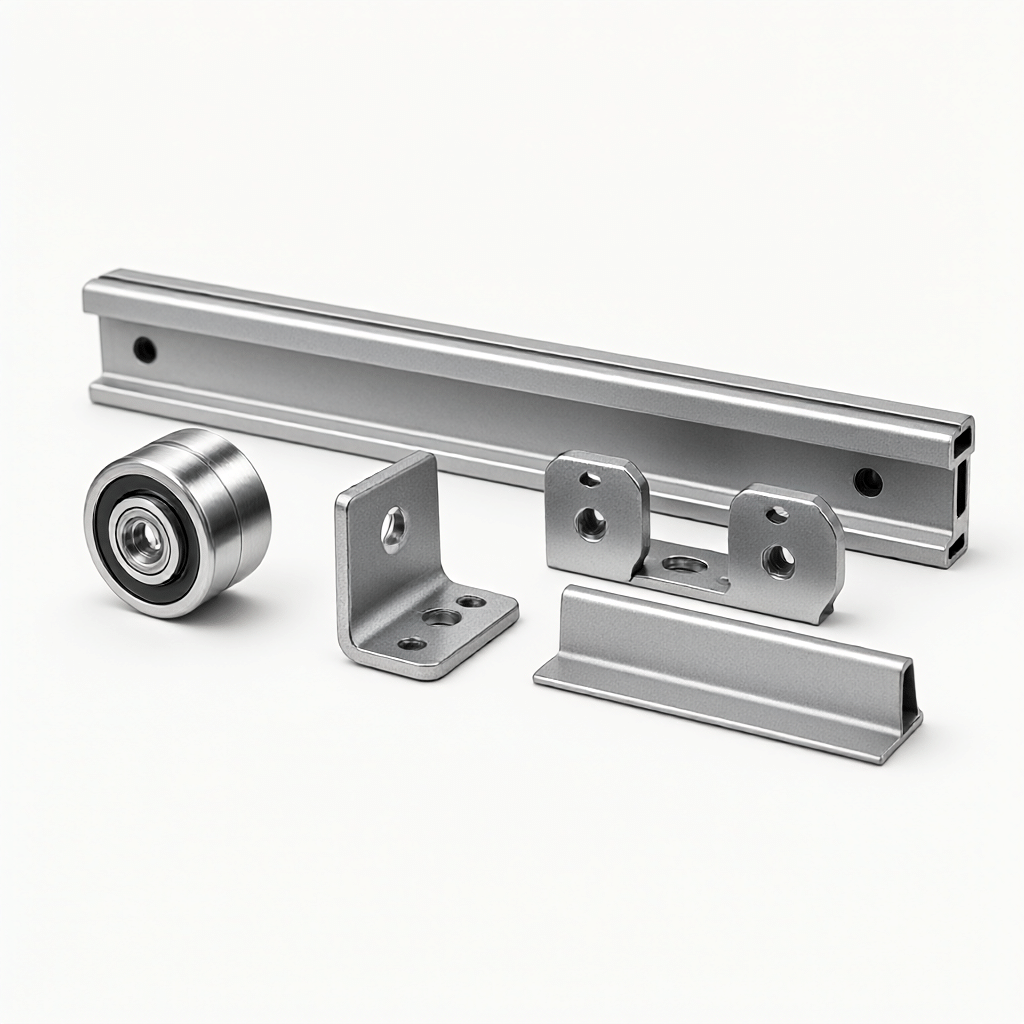
Materials and Constructions
Chinese sliding barn doors typically come in four constructions:
- Solid wood — premium finish; heavy; requires anti-warp treatment for humid climates
- Thermally broken aluminum — lightweight; high dimensional stability; suitable for exterior-grade interior doors where moisture resistance matters
- Glass-insert (framed) — clear, frosted, or tinted tempered glass set in aluminum or wood frames; ghost/sliding visual effect common in hotel projects
- Composite / MDF core — budget option; lower durability in high-traffic settings
Profile thickness usually ranges from 40 mm to 70 mm depending on door width and whether the unit carries side panels or transoms. Heavier bypass configurations require thicker extrusions or reinforced frame joints.
Track and Roller Systems
Overhead track type is the single biggest factor in long-term reliability. Look for:
- Heavy-duty roller assemblies rated for 60–120 kg per leaf
- Nylon or precision-bearing wheels with adjustable height compensation
- Soft-close buffers or magnetic catch systems for hotel and multi-unit residential use
- Anti-jump devices that prevent derailment under lateral impact
The track should be specified separately from the door leaf so replacement hardware isn’t dependent on ordering an entire new unit.
Glass and Glazing Options
For interior sliding barn doors used in hotel & resort guest-room projects, commercial fit-out / office partitioning, and villa & luxury interior renovation, common glazing configurations include:
- Single 5–6 mm tempered glass
- Double-glazed units (24–32 mm IGU) with argon fill for acoustic and thermal separation
- Frosted, sandblasted, or low-iron options depending on privacy requirements
Always confirm that supplied glass carries appropriate safety marking and meets your target-market safety standard (e.g., ANSI Z97.1 or EN 12600 impact classification).
Hardware Finishes and Finishes
Common hardware finishes offered by Chinese manufacturers include PVD-coated brushed nickel, matte black, oil-rubbed bronze, chrome, and powder-coated aluminum. Finish adhesion testing (salt spray hours rated) should be requested in the quotation package.
> For context on finish durability trade-offs, see the shower filter manufacturing and bulk procurement sourcing guide — similar metal-finish selection logic applies to door hardware exposed to high-use environments.
Applications: Where Can Sliding Barn Doors Be Used?
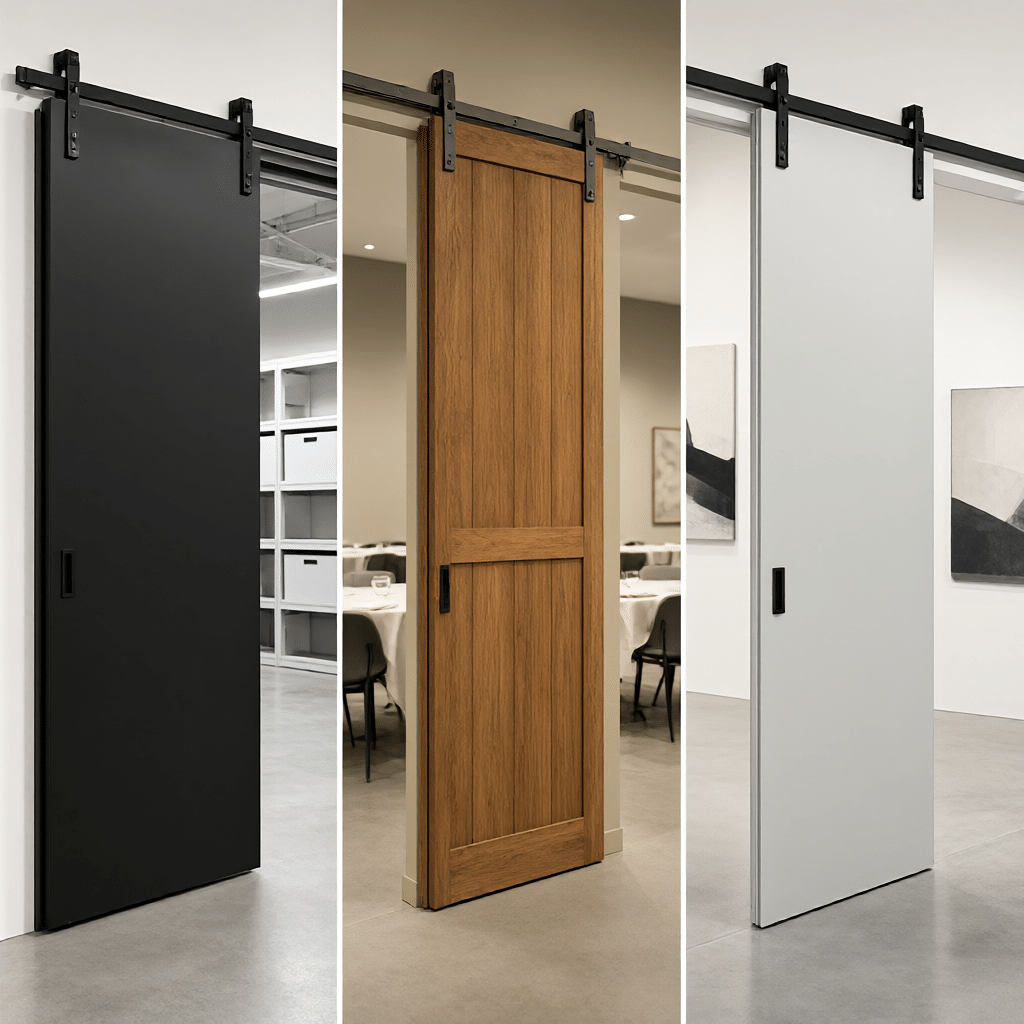
Sliding barn doors are primarily used where swing clearance is constrained or where an open-plan aesthetic is required. Typical B2B applications include:
- Hotel & resort guest rooms — room dividers, bathroom entries, closet installations
- Multi-unit residential developments — apartment bedrooms, study-to-living partitions, balcony access doors
- Commercial fit-out / office partitioning — meeting rooms, conference space dividers, reception areas
- Villa & luxury interior renovation — custom oversized doors for open-concept living spaces
- Healthcare and senior-living facilities — pocket-style variants for wheelchair-accessible transitions
These correspond to the door types often called bypass sliding doors, pocket barn doors, overhead track doors, freestanding sliding doors, industrial sliding doors, or ghost sliding doors depending on mounting style and visual profile. Match the terminology your architect or specifier uses rather than forcing every variant into one category.
Buying Factors: What to Consider When Buying Sliding Barn Doors in Bulk?
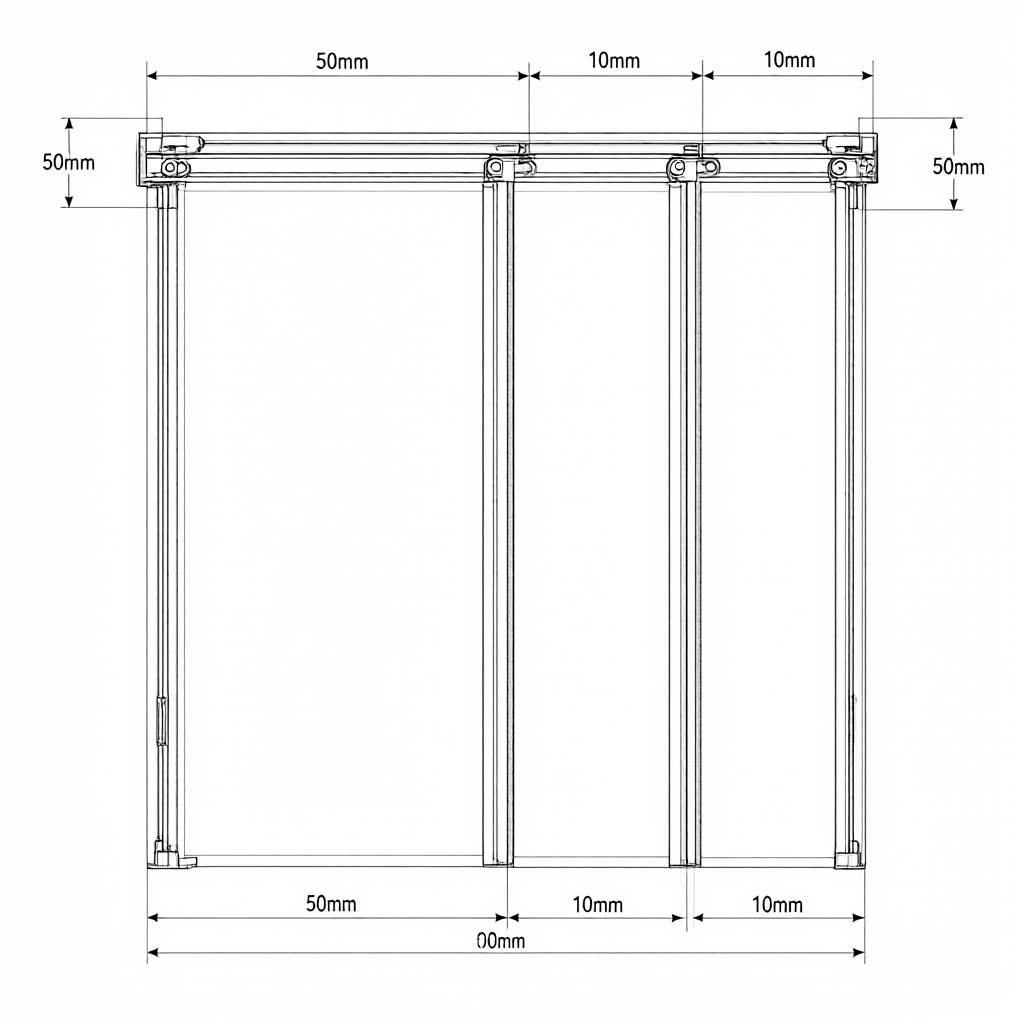
Certification and Quality Testing Expectations
Request these documents from any sliding barn doors made in China supplier before placing a production order:
- Material certificates (wood species declaration, aluminum alloy grade — e.g., 6063-T5)
- Glass certification (tempering certificate, impact-class report)
- Pre-shipment test reports covering air-tightness, water-tightness, and wind resistance per applicable classification
- Optional third-party inspection reports (SGS, BV, or equivalent) for large orders
Per ASTM International standards, performance classifications for windows and doors are established through standardized testing protocols; align your specification sheet to the rating class your project engineer requires before the factory signs off on tooling.
Customization Capabilities
A credible China OEM sliding barn doors facility should offer adjustment across:
- Size — exact opening dimensions including rough-opening tolerance handling
- Color / finish — RAL or custom powder-coat matches, wood stain equivalents
- Glass type — thickness, opacity, laminated vs. tempered,IGU configuration
- Hardware — roller type, handle profile, finish, soft-close option
- Profile structure — cross-section geometry adaptable to local building-code requirements
Confirm in writing that profile adjustments won’t trigger new tooling charges beyond a stated threshold.
Logistics and Export Documentation
Verify these logistics points before committing:
- FCL vs LCL shipment — FCL preferred for full container loads; LCL acceptable for trial orders but increases handling risk
- Packing standards — each leaf individually wrapped, corner-protected, carton or wooden crate with desiccant
- Documentation package — proforma invoice, commercial invoice, packing list, bill of lading, certificate of origin where applicable
- Lead time — typically 25–45 days from deposit to shipment depending on customization level; confirm buffer for sample approval
If your destination market requires specific import documentation, ensure the factory has shipped to that country previously and can provide the correct form.
Supplier Audit Checklist
Before signing a purchase contract, assess the manufacturer on these weighted criteria:
| Criterion | Weight | What to verify |
|---|---|---|
| Production capacity | 20% | Monthly output, shift pattern, equipment list |
| Quality control process | 20% | In-process checks, final inspection protocol, defect-rate history |
| Material sourcing | 15% | Supplier traceability, material certs on file |
| Certification & testing | 15% | Test lab capability (internal or partnered), report format |
| Export documentation experience | 10% | Prior shipments to your region, document completeness |
| Lead-time reliability | 10% | On-time delivery record over last 12 months |
| Communication responsiveness | 10% | Sample response time, technical clarification speed |
Missing documentation or evasive answers on more than two criteria is a red flag worth escalating before negotiation.
Price & Cost: How Much Do Bulk Sliding Barn Doors Cost (FOB China)?
Price Drivers
Unit cost for sliding barn doors sourced from China is influenced by:
- Material — solid wood commands a premium; thermally broken aluminum sits mid-range; composite cores are budget-friendly
- Glass specification — double-glazed IGUs add cost versus single glazed; low-iron or frosted treatments add further variance
- Hardware grade — heavy-duty rollers with soft-close increase hardware cost by 15–30%
- Customization depth — non-standard sizes or private-label packaging incur setup fees
- Order quantity tier — per-unit price drops meaningfully above typical MOQ thresholds
Indicative FOB Pricing Tiers
| Product type | MOQ (sets) | FOB China (USD/set) |
|---|---|---|
| Solid wood sliding barn door (single leaf, standard size) | 30 | $180 – $320 |
| Thermally broken aluminum sliding barn door (single leaf) | 50 | $120 – $240 |
| Glass-insert sliding barn door (tempered glass, framed) | 30 | $150 – $280 |
| Double-glazed insulated sliding barn door (aluminum frame) | 50 | $200 – $380 |
| Bypass / pocket system (complete track + hardware) | Per project | $80 – $200 per set |
Indicative FOB China wholesale price (USD/unit) for trade buyers — not a retail price and not a binding offer; final pricing depends on quantity, specification, glass type, hardware selection, and order schedule.
Add landing costs (sea freight, insurance, destination-port charges, duties) to arrive at true landed cost. A rough rule of thumb is 15–35% on top of FOB depending on shipping lane and import regime — calculate this early in your procurement model.
Quick quote guidance
When you share your opening dimensions, glass preference, hardware finish, and estimated quantity, most factories will return a comparable spec sheet within 24–48 hours. See our solid wood closet doors sizing guide for spec-sheet preparation tips.
Request a bulk FOB quotation for your project scope.
Evidence & Practical Notes
Field note: Factories that genuinely inspect pre-shipment tend to show their test reports in the initial quotation packet — air-tightness class, water-tightness rating, and wind-load classification listed alongside the unit price. If the seller pushes back or says “we don’t have those,” treat it as a data gap until they produce lab-verified results.
Practical limitation: Heavier solid-wood doors exceed 80 kg per leaf once fitted with glass, which demands a heavier gauge track and reinforced mounting substrate. Without confirming header strength during the architectural phase, even a well-built door can sag or bind after installation.
Buyer takeaway: Lock the track specification and substrate requirement into the purchase order before production begins — post-order changes to hardware or mount type are where delay and extra-cost disputes typically originate.
How We Approach China Sliding Barn Door Manufacturing
As a manufacturer, our approach centers on translating the technical criteria above into verifiable outputs for each order. Here is how we address the key buyer concerns:
- Spec-driven production — We work from confirmed drawing packs that include profile cross-section, glass specification, hardware listing, and finish code before tooling begins, reducing mid-production variation.
- Pre-shipment testing protocol — Each batch is checked for air-tightness, water-tightness, and wind resistance according to the rated class in the purchase order; reports are compiled and shared before loading.
- Full customization path — Size, color, glass type, and hardware accessories are adjusted to match project requirements, including adjustments to profile structure and fittings where local building-code compliance is needed.
- Export documentation readiness — Our trade team prepares the full customs package — packing list, proforma invoice, commercial invoice, and shipping documents — so destination-side clearance proceeds without document gaps.
- Shipping flexibility — Orders ship via FCL & LCL from China factories with standardized protective packaging suited to ocean freight transit conditions.
When you send your opening dimensions, project specification sheet, and target market, we cross-check profile, glass, and hardware against the applicable classification and return a spec-aligned quotation with test-report commitments included.
Industry Standards & Performance Classes You Should Require
When specifying sliding barn doors for B2B procurement, anchor your request to numbered standards so factories know exactly which class to produce and you have enforceable acceptance criteria. Relevant standards commonly referenced include:
- GB/T 8478-2020 — Chinese national standard for aluminium alloy doors and windows, including classification by air-tightness, water-tightness, and wind-load resistance
- EN 14351-1 — European performance-classification system for windows and doors; Class 4 air-tightness and equivalent water/wind ratings are typical targets for hospitality and high-end residential projects
- EN 12600 — Impact-performance classification for glazing; useful when specifying safety-critical installations
- ANSI Z97.1 — US safety standard for glazed doors in operational locations
- ASTM E283 / E330 / E547 — Standard test methods for air infiltration, structural deflection, and water penetration under cyclic pressure loading (astm.org)
- ISO 9001 — Quality management system certification expected from serious manufacturing facilities
A specification pack that cites the relevant clause from each standard — for example, “air-tightness Class 4 per EN 14351-1, wind load resistance ≥ 2000 Pa per EN 12210” — prevents ambiguity between buyer and factory and gives you grounds for rejection if pre-shipment test reports fall short.
Buyer Decision Matrix: Material vs Application vs Cost Tier
Use this matrix during early procurement stages to map the right construction type to your project tier and operating environment.
| Construction type | Best-suited application | Cost tier | Key trade-offs |
|---|---|---|---|
| Solid wood (single leaf) | Luxury villas, boutique hotels, heritage restorations | High ($180–$320 FOB/set) | Premium aesthetics; higher maintenance; heavier track required |
| Thermally broken aluminum | Hotel corridors, exterior-facing interior partitions, humid climates | Mid-high ($120–$240 FOB/set) | Dimensional stability; lower maintenance; better thermal/acoustic ratings |
| Glass-insert framed (tempered) | Guest-room bathroom entries, conference rooms, closet dividers | Mid ($150–$280 FOB/set) | Light transmission; privacy options; impact rating depends on glass spec |
| Double-glazed insulated aluminum | Climate-controlled suites, acoustic-sensitive environments | Upper-mid ($200–$380 FOB/set) | Best insulation; highest unit cost; thicker frame profile needed |
| Composite / MDF core | Budget apartments, temporary fit-outs, low-traffic internal partitions | Low (varies) | Economical; lower durability in heavy-use settings; limited moisture resistance |
Cross-reference the matrix with your projected annual replacement cycle and cleaning/maintenance budget before locking the final BOM — the cheapest upfront option often incurs higher lifecycle cost in high-turnover hospitality projects.
Payment Terms & Pricing Models Commonly Offered by Chinese Factories
Payment structure is a key risk-control lever. Most established sliding barn door factories in China operate under terms that resemble the following patterns:
- Typical deposit-to-balance split: 30% T/T deposit upon PO confirmation, 70% before shipment after production completion and photo/video inspection approval
- Letter of credit (L/C): Available for larger project orders; some factories require a discount margin or partial T/T upfront even under L/C terms
- Sample/prototype charge: Often refundable against a qualifying bulk order; priced separately from production units
- Tooling/novelty charges: One-off fees for non-standard profile extrusions or custom hardware; should be capped or amortized over a committed volume in writing
- Price-validity window: Quoted FOB rates are usually valid for 30–60 days given aluminum ingot and timber market fluctuation
Request that the purchase contract spell out revision pricing triggers (e.g., LME aluminium index movement beyond ±5%) and currency denomination clearly.
Concrete FOB Price Ranges by Configuration
The table below reflects indicative FOB China price bands for common sliding barn door configurations at representative volume tiers. These figures assume standard export packing and typical lead-time windows; exceptional sizes, finishes, or expedited schedules will shift them upward.
| Configuration | Aluminum profile grade | Typical FOB range (USD/unit) | Notes |
|---|---|---|---|
| Basic single-leaf solid wood door (standard size) | N/A (timber species dependent) | $180 – $320 | Premium species and wide leaves sit at upper bound |
| Solid wood door with glass insert | N/A (timber species dependent) | $220 – $380 | Low-iron or frosted glass adds cost |
| Thermally broken aluminum frame (6063-T5) | 6063-T5 per GB/T 5237 | $45 – $120 per m² (frame-only) / $120 – $240 complete set | Widely specified for EN 14351-1 Class 4 projects |
| Glass-insert aluminum-framed door | 6063-T5 | $150 – $280 | Tempered 5–6 mm glass standard; laminated upgrade available |
| Double-glazed IGU aluminum assembly | 6063-T5 | $200 – $380 | Argon fill and warm-edge spacer raise insulating performance |
| Complete overhead track + roller hardware set | Steel/aluminum extrusion | $80 – $200 per set | Load rating and bearing quality drive price variance |
All ranges are indicative FOB China figures for trade-buyer comparison purposes. Final prices depend on exact dimensions, glass specification, hardware grading, surface finish, and order quantity.
Logistics, Packaging & Export Documentation from China
Shipping sliding barn doors from China involves coordinated attention to packing integrity, container utilization, and document completeness.
Packing Standards to Request
- Each door leaf wrapped in protective film with corner guards
- Hardware and track sections packed separately in reinforced cartons
- Desiccant bags included to control moisture during ocean transit
- Outer carton or wooden crate labeled with PO number, destination port, and handling instructions
- For FCL shipments: full-container loading plans to optimize space and minimize trans-shipment risk
Packaging Capacity Estimates
Approximate loading capacities give you quick landed-cost modeling inputs:
- 20 ft container: roughly 80–120 standard-sized door sets depending on configuration and packing density
- 40 ft container: roughly 180–260 standard-sized door sets
- 40 ft HQ container: roughly 220–300 standard-sized door sets
Factories experienced in foreign trade typically confirm container-loading plans in the quotation stage, reducing surprise demurrage or staging costs at origin port.
Required Export Documents
A production-ready China factory should provide the following as part of its standard customs documentation package:
- Proforma invoice (prior to deposit)
- Commercial invoice
- Packing list with net/gross weights and measurements
- Bill of lading (or sea waybill for LCL)
- Certificate of origin (where preferential tariff treatment applies)
- Test reports summarizing air-tightness, water-tightness, and wind-resistance classifications
- Optional: SGS/BV inspection certificate for large project orders
If your destination country requires additional forms — phytosanitary certificates for solid wood, specific CE declaration formats, or import-license paperwork — verify the factory has shipped to that market before contract signature.
Brand Verification & Factory Case Study
When evaluating chinese manufacturer sliding barn doors, third-party verification and real project references carry more weight than marketing claims. A useful benchmark is a named installation that demonstrates the factory’s ability to meet performance class targets across a substantial order volume.
Case reference — luxury hotel chain, Hainan: A hospitality project sourced 340 sliding barn doors fitted with 6063-T5 thermally broken aluminum profiles rated to EN 12600 Class 4 impact performance. The order encompassed both guest-room divider configurations and bathroom-entry units, requiring coordinated packaging for ocean freight and sequential delivery to the build site. Pre-shipment testing confirmed air-tightness, water-tightness, and wind-resistance classifications matching the specification sheet, and the factory supplied the full export documentation package including proforma invoice, packing list, commercial invoice, and bill of lading.
Verification checklist for any China-based sliding barn door manufacturer:
| Check item | How to validate |
|---|---|
| Factory name & legal registration | Business license cross-referenced with market-registry database |
| Production capacity claim | Video audit or third-party report covering equipment list and shift pattern |
| Certification portfolio | ISO 9001 certificate, product-test reports, material certificates on file |
| Project references | At least two completed B2B deliveries in your target region with contactable references |
| Prior export documentation | Sample document set (redacted) showing format compliance with your destination-market requirements |
For a direct factory-supply path that includes adjustable profile structures and fittings to match local building codes, complete pre-shipment air/water/wind tests, and a full customs-document package for FCL & LCL shipments, you can reach our team with your opening dimensions and target performance class. A spec-aligned quotation with test-report commitments is typically returned within 24–48 hours of receiving project details.
Hardware Finishes and Specifications
Common hardware finishes offered by Chinese manufacturers include PVD-coated brushed nickel, matte black, oil-rubbed bronze, chrome, and powder-coated aluminum. Finish adhesion testing should be requested in the quotation package. For PVD coatings, expect a minimum of 1000 hours salt-spray resistance per ASTM B368. Powder-coated finishes typically meet 800–1200 hours salt-spray rating depending on coating system and pretreatment.
> For context on finish durability trade-offs, see the shower filter manufacturing and bulk procurement sourcing guide — similar metal-finish selection logic applies to door hardware exposed to high-use environments.
### Buyer Red-Flag Checklist: Trading Company vs. Factory
Before signing a contract, run through these verification steps to distinguish genuine manufacturers from trading companies:
| Red Flag | What It Means | How to Verify |
|---|---|---|
| No factory photos/video walkthrough | Could be a trading company | Request a live video call through the production floor |
| unwilling to share test reports | May not have access to lab data | Ask for CBTL (China Building Material Test & Certification Group) or equivalent reports with report numbers |
| Vague MOQ or flexible on anything | Lack of standardized production | Compare quotes across 3+ suppliers for consistency |
| Payment terms: 100% upfront | High risk for buyer | Reputable factories accept 30% deposit + 70% before shipment |
| No OEM/ODM documentation | May resell generic products only | Ask for previous private-label project examples with brand artwork |
| Sample takes 2–3 weeks without clear process | Limited production capability | Confirm sample timeline in writing with milestone checkpoints |
| Audit documents unavailable | Cannot verify capacity or QC | Request recent SA8000, ISO 9001, or Sedex audit summary |
Sample ordering protocol: Always request a pre-production sample before committing to bulk. The sample should match your approved drawing pack exactly. Inspect it for finish quality, hardware function, and dimensional accuracy. Factor the sample cost and lead time (typically 7–14 days) into your overall schedule.
## Supplier Case Study
A mid-sized hospitality developer in Southeast Asia sourced 240 sets of thermally broken aluminum sliding barn doors (single-leaf, 1200 × 2400 mm, double-glazed 24 mm IGU, PVD matte-black finish, soft-close hardware) from a China-based manufacturer for a 42-room boutique resort project. The order was placed at $195/unit FOB Shanghai, with a total value of approximately $46,800. Lead time was 32 days from deposit to shipment, including 7-day sample approval and 25-day production. Pre-shipment tests confirmed air-tightness Class 4 (600 Pa), water-tightness Class E1050, and wind resistance Class C5a. The shipment arrived via LCL consolidation with full customs documentation provided, and the project installed without dimensional or finish defects. This case illustrates how spec-aligned orders with documented test reports reduce on-site rework risk.
## Frequently Asked Questions (FAQ)
What are the key specifications of sliding barn doors sourced from China?
Key specifications include: aluminum alloy grade 6063-T5 (with mill test cert), profile thickness 40–70 mm, glass type (tempered single or double-glazed IGU), hardware load rating (60–120 kg per leaf), finish salt-spray rating (≥1000 h for PVD), and pre-shipment test classes for air-tightness, water-tightness, and wind resistance per EN 14351-1 / GB/T 8478-2020.
Where can sliding barn doors be used in B2B projects?
Typical B2B applications include hotel & resort guest rooms, multi-unit residential developments, commercial fit-outs and office partitioning, villa & luxury interior renovations, and healthcare/senior-living facilities. They serve as room dividers, bathroom entries, closet installations, and pocket-style accessible transitions.
What to consider when buying sliding barn doors in bulk from China?
Prioritize: (1) spec-driven production from approved drawing packs, (2) pre-shipment test reports with Pa values, (3) factory audit evidence (capacity, QC, export history), (4) clear FCL/LCL shipping and documentation readiness, (5) OEM/ODM customization path including profile adjustments for local building codes, and (6) verified supplier identity (factory vs. trading company).
How much do bulk sliding barn doors cost (FOB China)?
Indicative FOB pricing tiers: solid wood single-leaf ($180–$320/set, MOQ 30), thermally broken aluminum single-leaf ($120–$240/set, MOQ 50), glass-insert framed ($150–$280/set, MOQ 30), double-glazed insulated aluminum ($200–$380/set, MOQ 50), and bypass/pocket hardware systems ($80–$200/set, per project). Add 15–35% for landing costs depending on shipping lane.
Can a China sliding barn doors manufacturer provide OEM/ODM/private-label production?
Yes. Credible OEM facilities offer customization across size, color/RAL match, glass type, hardware selection, profile cross-section geometry, and private-label packaging. Confirm in writing that profile adjustments won’t trigger excessive tooling charges beyond a stated threshold, and request examples of prior private-label projects.
What quality tests should a China sliding barn door factory complete before shipment?
Factories should complete and provide test reports for: air-tightness (Class 3–4, 400–600 Pa per EN 12281), water-tightness (Class E850–E1050), and wind resistance (Class C3a–C5a per EN 14351-1). Additional checks include surface finish adhesion (cross-cut tape test), handle/hardware cycle testing, and glass impact compliance. Third-party inspection from SGS, BV, or CBTL is recommended for large orders.
Sources & References
- ASTM International — www.astm.org
- shower filter manufacturing and bulk procurement — zooshen.com
- solid wood closet doors — doorwoodendoors.com











