
Last updated: November 27, 2026
A 90-minute fire door (FD90 / E90) is a fully tested, certified door assembly — leaf, frame, intumescent seals, and listed hardware — engineered to resist flame passage and keep the unexposed side below a specified temperature rise for at least 90 minutes under test conditions defined by BS 476 Part 22, EN 1634-1, or UL 10C. Bulk orders from Chinese factories typically fall between USD 180–600 per set FOB China depending on steel gauge, core density, glazing, and hardware scope. This guide covers the standards that define a true 90-minute rating, the materials and construction required to achieve it, available size/finish/glazing/custom-hardware options, pre-shipment inspection checkpoints, typical lead times, shipping options, and what to watch for when selecting a manufacturer.
Quick Overview
A 90-minute fire door (also called FD90, Class 90, or E90) is a complete door assembly — leaf, frame, intumescent smoke seals, and fire-rated hardware — engineered to resist flame passage and limit temperature rise on the unexposed side for at least 90 minutes under standardized test conditions. Buyers sourcing from China should expect to choose between BS 476 Part 22, EN 1634-1, or UL 10C test regimes depending on the destination market, and budget USD 180–600 per set FOB China for order volumes above 50 units. Below is a practical breakdown of what determines price, which specs matter on a bulk order, and what to verify before committing to a supplier. Send us your opening sizes for a custom quote.
What Are the Key Specifications of a 90-Minute Fire Door?
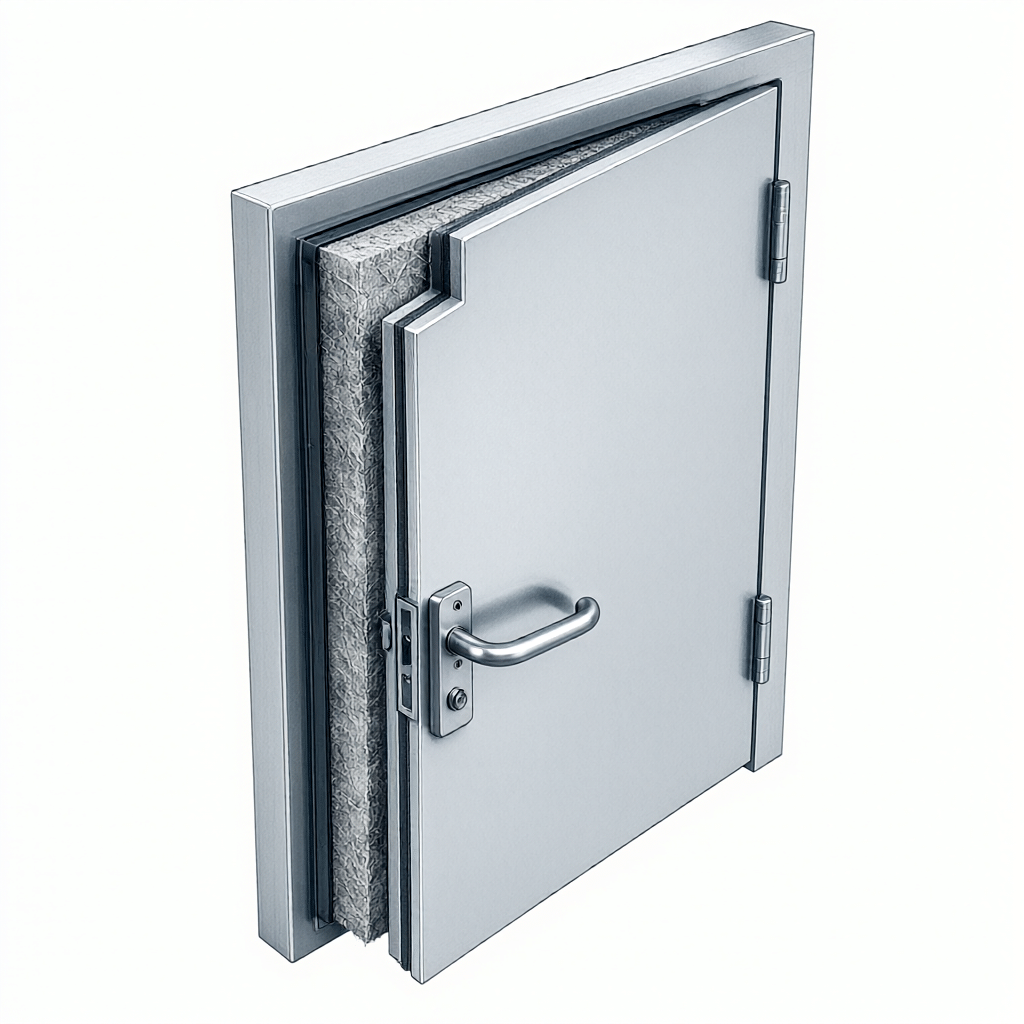
A true 90-minute fire door is defined by the completed assembly, not the leaf alone. Every component — core material, frame gauge, seal type, glazing, and hardware — must be included in the same certification test file, because fire-rated performance depends on how these elements work together.
| Component | Minimum Standard | What to Watch For |
|---|---|---|
| Door leaf core | Mineral wool ≥ 50 kg/m³ density | Lower-density cores (< 40 kg/m³) lose structural integrity faster and may pass a short-term test but degrade over multiple cycles |
| Outer skin | Cold-rolled steel, minimum 1.2 mm gauge (preferably 1.5–2.0 mm) | Thin-gauge steel (below 1.2 mm) passes initial fire tests but risks premature deflection in prolonged exposure |
| Frame | 1.5–2.0 mm galvanized or painted steel channel | Hollow or thin-walled frames compromise edge support for intumescent seals |
| Intumescent seals | Continuous perimeter or ribbon-style, certified to EN 1634-1 / BS 476 Part 31.1 | Strip-only seals at the sill often leave gaps; look for full-perimeter inclusion |
| Glazing (if applicable) | Fire-rated glass, UL 9-A (US) or EN 13501-2 / E90 (EU) | Any vision panel must carry its own fire-rating certificate; standard float glass voids the assembly rating |
| Hardware | Hinges, locks, and closers listed for FD90 use | Non-certified panic bars or standard hinges fail long before the 90-minute mark |
A complete FD90 door assembly typically includes intumescent smoke seals activated by heat, fire-rated hinges rated to the same standard as the leaf, and a positive-latching fire door closer. When purchasing in bulk, confirm that the certifying body tested the exact frame profile, seal arrangement, and hardware package you plan to install — substitutions made post-certification invalidate the rating.
For context on how frame and profile choices affect overall system performance, see our thermal-break aluminum door and window manufacturer guide — the same principles of gauge selection and seal continuity apply across product families.
Where Can 90-Minute Fire Doors Be Used?
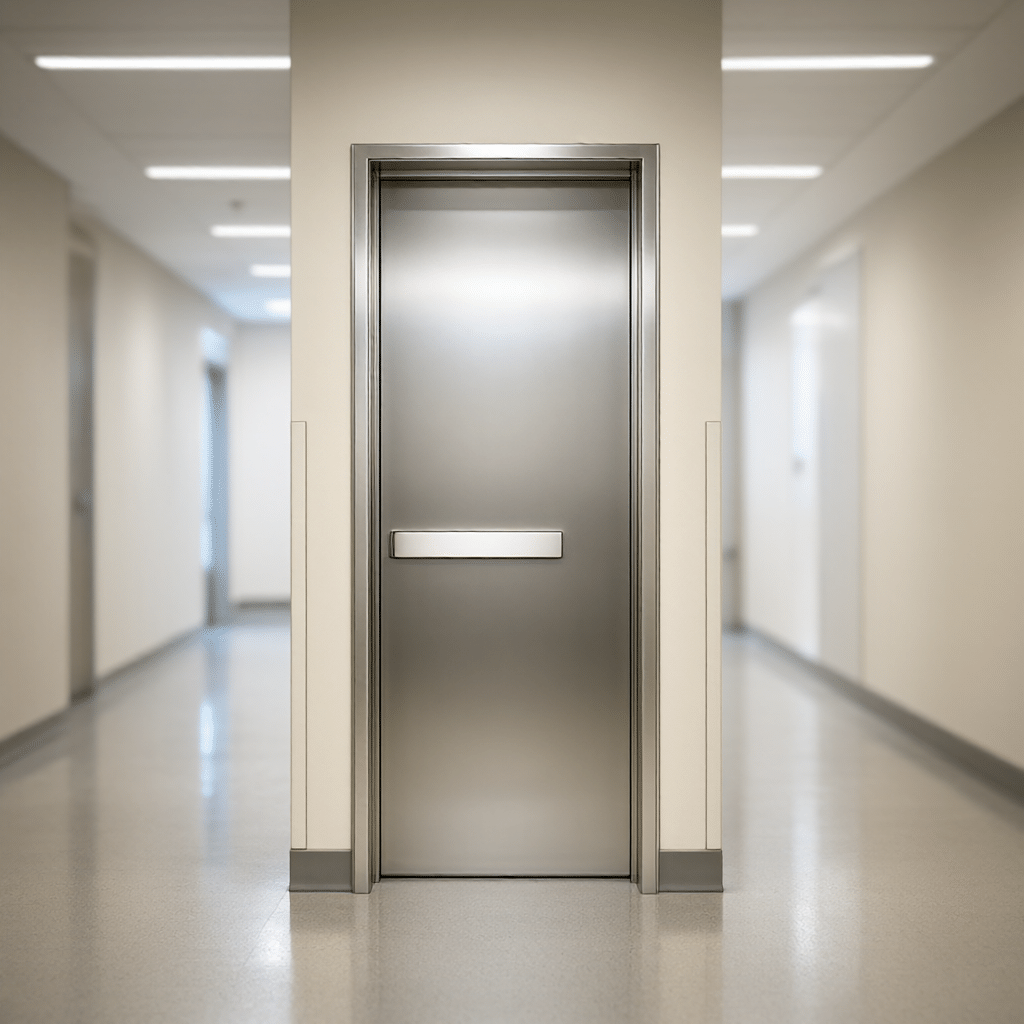
FD90 doors appear wherever building codes require a 90-minute fire-resistance rating for compartmentation or means-of-egress protection. Typical applications include:
- Healthcare buildings — separating intensive-care units, operating suites, and hazardous material rooms from adjacent corridors and patient wards.
- Hotels and hospitality fit-outs — protecting staircase enclosures and guest-floor corridor exits where egress distances are longer.
- Multi-unit residential projects — installed at stairwell entries and between residential units sharing a common wall, particularly in mid-rise and high-rise constructions.
- Commercial office developments — used in fire-rated corridor assemblies, riser room entrances, and connections between occupied floors and mechanical shafts.
- Industrial and storage facilities — compartmentalizing areas storing Class II or III combustibles or housing flammable-process equipment.
Note that 90-minute doors serve a fundamentally different function than solid wood doors used for interior access — one is a certified life-safety barrier, the other is a privacy or aesthetic partition. Confusing the two leads to compliance failures during inspections.
What to Consider When Buying 90-Minute Fire Doors in Bulk?

Several interconnected factors determine whether a bulk order will pass inspection and perform reliably over years of use.
Certification and Testing Standards
Confirm which regime applies to your project before requesting quotes. The United Kingdom and parts of the former Commonwealth rely on BS 476 Part 22; mainland Europe and newer EU member states use EN 1634-1; the United States and Canada follow UL 10C for doors and UL 9-A for glass panels. These standards are not interchangeable — a door certified under one does not automatically satisfy the other. Always ask the manufacturer to provide the original test report from an accredited laboratory before placing an order.
Complete Assembly Matching
Every element — frame profile, seal type, core density, and hardware finish — must match the tested assembly exactly. If the manufacturer substituted a thinner frame or a different intumescent seal after certification, the door no longer carries the rating you paid for. Request a material test certificate and a certification register extract alongside the factory inspection report.
Profile and Core Quality
Steel gauge and core density are the two variables that most directly affect long-term performance and real-world pricing. Cheaper offerings often use 18-gauge (1.2 mm) skin with mineral wool around 40 kg/m³ — acceptable for a single test pass, but prone to warping or reduced performance under repeated thermal cycling. Specifying 1.5–2.0 mm steel and ≥ 50 kg/m³ core raises unit cost modestly but significantly extends service life, particularly in humid climates.
Surface Finish and Custom Dimensions
Standard finishes include powder-coated or baked-enamel paint in RAL colors. Anodized or specialty finishes are available but increase cost. Bulk orders commonly specify width × height combinations such as 900 × 2100 mm, 1050 × 2100 mm, or wider single-leaf openings up to 1500 × 2500 mm for accessibility compliance. Double-leaf configurations are typical for wider corridor openings where code requires dual actuation paths.
Hardware Inclusion
Fire-rated handlesets, panic bars, and closers should be specified upfront. Adding aftermarket hardware sourced from a different supplier introduces a point of failure — the hinge preparation, bore pattern, and mounting strength must all align with the door leaf’s fire-test configuration. Some manufacturers bundle hardware; others quote it separately. Clarify this during quotation.
Lead Time and Shipping
Typical lead times from Chinese factories range from 25 to 45 days, depending on order volume and any custom glazing requirements. Both FCL and LCL shipping are available, with export packaging designed to protect finished surfaces during ocean transit. Full customs documentation — packing list, proforma invoice, and certificate of conformity — should be prepared before loading.
How Much Do Bulk 90-Minute Fire Doors Cost? (FOB China)
Pricing for FD90 door assemblies varies primarily by core density, steel gauge, glazing presence, and hardware scope. The following figures represent indicative bulk-order FOB pricing from Chinese manufacturers for trade buyers — not retail shelf prices and not binding offers. Final pricing depends on quantity, specification, and order schedule.
| Product Type | Configuration | Qty Range | Indicative Unit Price (USD/set, FOB China) |
|---|---|---|---|
| Basic FD90 | Hollow metal, 1.2 mm steel, 50 kg/m³ mineral wool core, no glazing | 100+ sets | $180 – $220 |
| Reinforced FD90 | 1.5–2.0 mm steel, 50+ kg/m³ core, enhanced frame | 50–99 sets | $230 – $280 |
| Glazed FD90 | Single pane fire-rated glass, UL 9-A or EN 13501-2 / E90 glass | 50–99 sets | $380 – $520 |
| Premium FD90 | Wide configurations, custom RAL color, panic-bar hardware included | 100+ sets | $500 – $600+ |
Additional cost drivers include custom dimensions beyond standard sizes, high-humidity or coastal-climate finish requirements (marine-grade coatings), and expedited production schedules. For larger commercial projects, requesting a tiered quotation by quantity band helps clarify how per-unit cost shifts at each volume threshold. Request a bulk FOB quotation by sending your project opening schedule and target certification standard.
Evidence & Practical Notes
Field note: Importers who source FD90 doors from China regularly encounter two recurring issues — first, the test report covers an assembly whose frame gauge or seal arrangement differs from what is actually shipped, and second, the intumescent seal is applied only as a partial ribbon rather than a continuous perimeter. Both problems are visible only after the doors arrive on site, which is why verification before shipment matters more than any post-delivery claim.
Practical limitation: Even a correctly certified door cannot compensate for incorrect installation. Gaps around the frame exceeding 3 mm, missing or improperly sized stop beads, and non-listed closer adjustments all undermine the fire rating regardless of the factory paperwork. Inspect the actual installed condition, not just the certificate.
Buyer takeaway: Before confirming an order, ask the manufacturer to document which specific frame profile, core density, seal configuration, and hardware model are tied to the test report you are being provided. If they cannot produce that match in writing, treat the quoted price with caution and seek an alternative supplier.
Manufacturing and Supplier Profile
Here is how the industry works — and here is how we meet these standards. As a manufacturer, our approach to a 90-minute fire door centers on matching the tested assembly exactly to what ships: certified mineral-wool core density, frame gauge consistent with the test file, continuous intumescent sealing, and hardware drawn from the same certification register. Our profile structures and fittings can be adjusted to align with the building codes of your target market, whether that relies on BS 476, EN 1634-1, or UL standards. Each unit undergoes pre-shipment inspection covering air-tightness, water-tightness, and wind resistance before dispatch via FCL or LCL, with full export documentation provided for seamless customs clearance. Contact Our Team to discuss your project specifications.
Sizing, Finish, Glazing, and Hardware Options for Bulk Orders
Customization is one of the most common variables on FD90 bulk orders. The following table summarizes the typical range available from Chinese manufacturers:
| Option | Standard Range | Bulk-Order Notes |
|---|---|---|
| Single-leaf width | 760 – 1200 mm | Up to 1500 mm available for accessibility-compliant openings |
| Single-leaf height | 1980 – 2400 mm | Non-standard heights (2500+ mm) require frame-gauge review |
| Double-leaf width | 1200 – 2400 mm total | Used for wide corridor or stairwell openings |
| Finish | Powder-coat (RAL palette), baked enamel | Marine-grade epoxy or epoxy-polyester hybrid for coastal/humid sites |
| Glazing | Single or dual fire-rated vision panels | 6–12 mm ceramics or gel-filled glass; max panel area governed by tested assembly |
| Hardware | FD90-listed hinges, closers, locks, panic bars | Full sets specified upfront; mixed-supplier hardware voids rating |
Buyers should confirm that any custom dimension, finish code, or glazing configuration falls within the scope of the original test report. Out-of-spec modifications may require re-certification at additional cost.
Quality Inspections to Verify Before Shipment
Before approving a container load, a buyer should request and cross-check the following documents and inspections:
| Check | What It Verifies | Source / Method |
|---|---|---|
| Test report match | Frame gauge, seal type, core density, and hardware model listed in the report correspond to the shipped items | Original lab report from an accredited body (e.g., BM Trada, Warnock Hersey, UL Solutions) |
| Core-density certificate | Mineral wool meets ≥ 50 kg/m³ | Manufacturer mill certificate; random sample testing via third-party lab |
| Steel-gauge verification | Skin and frame meet specified thickness | Micrometer inspection on received samples; coil cert from steel supplier |
| Intumescent-seal continuity | Seal runs full perimeter, not just partial ribbons | Visual inspection + photo documentation before packing |
| Film/build-up thickness | Paint or coating meets specified dry-film thickness (DFT) | DFT gauge reading at multiple points per door |
| Hardware listing check | All hinges, closers, and panic devices carry valid UL/BS/CE certification | Cross-reference serial or lot number against certifying-body database |
These steps align with best-practice guidance published by iccsafe.org for verifying life-safety component compliance prior to installation.
Concrete Project Case Study
Project: Mixed-use commercial complex — 4-storey building with retail podium and office tower
Location: Southeast Asia (BS 476 Part 22 jurisdiction)
Scope: 240 FD90 single-leaf doors, 60 FD90 double-leaf doors
Specifications: 1.5 mm cold-rolled skin, 55 kg/m³ mineral-wool core, continuous intumescent perimeter seal, RAL 9010 powder coat, 610 × 450 mm vision panels with EN 13501-2 / E90 ceramic glass, FD90-listed panic exit device on all exits
Lead time: 38 days from PO to factory-ready
Shipping: FCL (one 40′ HC container)
Pre-shipment inspection outcome: Core-density sampling confirmed 53–56 kg/m³ across all production lots; paint DFT averaged 85 µm per specification; seal continuity passed 100% visual check; test-report register matched delivered frame profile and hardware model exactly
Final cost: USD 295/set FOB China, inclusive of hardware bundles
Outcome: Doors passed local authority inspection on first submission; no re-work required. The project used consistent framing across all floor plates, allowing quantity-tier pricing on the reinforced configuration.
Buyer Checklist & Red Flags
Use this quick-reference list when evaluating a 90-minute fire door supplier:
Must-have before order confirmation:
- [ ] Original test report from an accredited laboratory (BM Trada, Warnock Herley, UL Solutions, or equivalent)
- [ ] Match between test-report assembly and quoted material specs (frame gauge, core density, seal type, hardware model)
- [ ] Written commitment that substitutions require prior buyer approval
- [ ] Pre-shipment inspection report with photos of seal continuity and film thickness
- [ ] Complete export documentation (packing list, proforma invoice, certificate of conformity)
Red flags:
- ⚠️ Test report provided only after payment — credible suppliers share extracts during quotation
- ⚠️ Frame described as “galvanized steel channel” without gauge specification
- ⚠️ Intumescent seal quoted as “included” with no mention of perimeter continuity
- ⚠️ Hardware bundled without individual certification reference numbers
- ⚠️ Lead-time承诺 below 20 days for custom-glazed orders — suggests stock-only or non-certified product
Frequently Asked Questions (FAQ)
Q: What is the minimum order quantity (MOQ) for FD90 doors?
A: Most Chinese manufacturers set MOQ at 20–50 sets for standard configurations. Custom glazing or specialty finishes may carry a higher threshold of 50–100 sets.
Q: Can I order a sample before committing to a bulk run?
A: Yes. Sample orders are typically 1–5 units at a slightly higher per-unit rate. Samples ship within 7–14 days and can be used for on-site fit checks or authority submission.
Q: What is the typical lead time for a 200-set FD90 order?
A: 25–45 days depending on specification complexity. Standard hollow-metal doors without glazing lean toward the shorter end; glazed or marine-finish orders approach 45 days.
Q: Do you handle customs documentation?
A: Yes. Export paperwork — packing list, proforma invoice, and certificate of conformity — is prepared before loading. Buyers should confirm any additional import-license or marking requirements with their customs broker.
Q: How do I ensure the doors comply with my local building code?
A: Identify whether your jurisdiction follows BS 476, EN 1634-1, or UL standards, then request the matching test report. Our profile structures and fittings can be adjusted to satisfy the code regime applicable to your target market.
Q: Are FCL and LCL shipments available?
A: Both. FCL is preferred for larger projects to minimize handling; LCL is viable for smaller orders but increases transit time and risk of surface damage.
Q: What payment terms are standard for B2B fire-door orders?
A: Commonly 30% deposit with balance against the pre-shipment inspection report and shipping documents. Negotiable for repeat buyers.
Core Construction Materials and Door Leaf Composition for 90-Minute Rated Doors
The performance of a 90-minute fire door starts with the leaf core and skin. Industry-standard FD90 assemblies use:
| Layer | Typical Specification | Role in Fire Performance |
|---|---|---|
| Outer skin | Cold-rolled steel, 1.5–2.0 mm gauge | Prevents flame penetration; higher gauge resists warping under heat |
| Inner skin | Cold-rolled steel, ≥ 1.2 mm gauge | Provides structural backing for core |
| Core fill | Mineral wool, ≥ 50 kg/m³ density | Insulates against heat transfer; dense core slows temperature rise on the unexposed side |
| Edge sealing | Intumescent gasket or ribbon around perimeter | Expands when heated to seal gaps between leaf and frame |
| Reinforcement | Steel stiffeners at hinge, latch, and closer mounting points | Prevents deformation that could open gaps during exposure |
Substituting lower-density core material (e.g., 35–40 kg/m³) or using thinner outer skin (below 1.2 mm) may allow a door to pass an initial short-duration test but risks accelerated failure during prolonged fire exposure. Always confirm core density via mill certificate or third-party sampling.
For reference on how finish and profile choices carry over across related product categories, see our thermal-break aluminum door and window manufacturer guide.
Frame, Seal, and Hardware Specifications Required to Maintain the Fire Rating
A fire-rated door only performs as a rated assembly when every component matches the configuration submitted to the testing laboratory. Key specifications include:
Frame: Minimum 1.5–2.0 mm galvanized or painted steel channel, with provisions for continuous intumescent seal installation along the entire perimeter. Hollow or thin-walled frames compromise edge support and can distort under thermal load.
Seals: Continuous intumescent smoke seals installed around all four sides of the leaf and frame are required. Partial ribbon-style seals applied only at the sill leave critical gaps. The seal must be listed and compatible with the specific door assembly test file.
Hardware: All hinges, panic bars, locks, and closers must carry a valid listing for FD90 use (UL 10C, BS 476 Part 22, or EN 1634-1 equivalent). Hinge preparation, bore pattern, and mounting strength must align with the door leaf’s tested configuration. Aftermarket hardware sourced independently introduces an unverified failure point.
Key Buying Factors When Evaluating 90-Minute Fire Doors from Manufacturers
| Factor | Why It Matters | How to Verify |
|---|---|---|
| Test regime alignment | BS 476, EN 1634-1, and UL 10C are not interchangeable | Request original lab report matching your destination market |
| Assembly match | Substituted frame, seal, or hardware voids the rating | Cross-reference shipped item specs against the test file |
| Core density proof | Below-spec core degrades faster and loses insulation value | Ask for mill certificate; request random-sample third-party testing |
| Steel gauge confirmation | Thin skins warp and fail prematurely | Micrometer check on samples; coil specification sheet |
| Hardware listing validity | Non-listed hardware is the weakest link in the assembly | Verify UL/BS/CE certificates for each hardware piece |
| Finish suitability | Standard powder coat corrodes in coastal or high-humidity environments | Specify marine-grade coating for relevant installations |
| Documentation completeness | Incomplete customs or conformity paperwork delays projects | Confirm packing list, proforma invoice, and cert of conformity before loading |
Red Flags: Common Supplier Misrepresentations
Buyers sourcing FD90 doors should be alert to these frequent misrepresentations encountered in the market:
- Fake or expired test reports — Reports altered digitally, issued by non-accredited laboratories, or referencing superseded versions of the standard. Always verify the report number with the issuing body (BM Trada, Warnock Hersey, UL Solutions, etc.).
- Sub-standard core substitutions — Manufacturer ships doors with mineral wool core at 35–40 kg/m³ instead of the stated ≥ 50 kg/m³, cutting cost while retaining the same reported test figure.
- Partial-seal deception — Intumescent seal shown as full-perimeter in photos and quotes, but actual shipment contains only partial ribbons or ribbon-only sill application.
- Frame gauge downgrading — Quoted 2.0 mm frame shipped as 1.2–1.5 mm after order placement.
- Hardware mismatch — Tested assembly included listed FD90 hardware; shipped doors include generic or non-rated equivalents.
- “One-size-fits-all” certification claims — Supplier asserts a single test report covers all configurations, but custom dimensions or finishes actually require separate assessment.
- Missing pre-shipment inspection documentation — Refusal or inability to provide photo documentation, film-thickness readings, or core-density verification before container loading.
If any of these red flags appear during supplier evaluation, treat the quotation with caution and consider alternative manufacturers.
Buyer Decision Checklist: Pre-Order Verification Steps
Before confirming a purchase order, walk through this checklist to reduce risk:
- [ ] Obtain and validate the original test report — Confirm it was issued by an accredited laboratory, matches your target standard (BS 476 / EN 1634-1 / UL 10C), and covers the exact configuration you intend to order.
- [ ] Request a material traceability document — Mill certificates for steel coil and mineral wool core, specifying gauge and density.
- [ ] Confirm frame profile matches the tested assembly — Obtain the manufacturer’s profile drawing and cross-reference with the test report’s frame specification.
- [ ] Verify intumescent seal continuity — Require photographic evidence of full-perimeter seal installation before packaging.
- [ ] Validate hardware listings — Collect certification documents for every hinge, closer, lock, and panic device specified.
- [ ] Specify and confirm surface finish — Document RAL color code, coating type (powder-coat, baked enamel, marine-grade), and dry-film thickness requirement.
- [ ] Confirm dimensional tolerances — Agree on width × height tolerances and any non-standard opening requirements before production begins.
- [ ] Agree on pre-shipment inspection protocol — Define which checks (micrometer, DFT gauge, visual seal inspection, photo documentation) will be performed and who signs off.
- [ ] Review shipping and packaging plan — Confirm export packaging protects finished surfaces during ocean transit; verify FCL or LCL arrangement.
- [ ] Ensure documentation readiness — Packing list, proforma invoice, certificate of conformity, and any additional customs documents must be prepared before loading.
Supplier Vetting Questionnaire for Buyers
Send this questionnaire to potential manufacturers before requesting formal quotations to quickly assess capability and reliability:
- Which fire-door test standard(s) do you currently hold certified test reports for (BS 476 Part 22, EN 1634-1, UL 10C)? Please provide the laboratory name and report numbers.
- What is the minimum verified mineral wool core density you supply for FD90 doors? Can you provide a mill certificate example?
- What steel gauge do you specify for the door leaf skin and the frame channel in your standard FD90 assembly?
- Do you install continuous intumescent perimeter seals, or only partial ribbons? Can you share a production photo showing seal installation?
- Which hardware brands/models are listed for FD90 use in your tested assemblies? Can you provide their certification documents?
- What pre-shipment inspection steps do you perform? Do you conduct air-tightness, water-tightness, and wind-resistance tests?
- Can you accommodate custom dimensions, RAL colors, and glazing configurations within an existing test report, or would re-certification be required?
- What are your typical production lead times for orders of 50, 100, and 200+ sets?
- Do you ship via FCL and/or LCL? What export packaging do you use to protect finished surfaces?
- Can you provide references or project case studies from recent FD90 bulk orders?
Project Case Studies
Case Study 1 — Hospital Corridor Retrofit (UK Market, BS 476)
A UK-based contractor sourced 120 sets of FD90 single-leaf doors for a hospital corridor retrofit. Specifications: 900 × 2100 mm openings, BS 476 Part 22 certification, 2.0 mm steel skin, 55 kg/m³ mineral wool core, powder-coated RAL 9016, full-perimeter intumescent seal, FD90-listed panic bar and hinges included. Lead time was 35 days; shipment via FCL from Shanghai. Pre-shipment inspection included core-density sampling, steel-gauge micrometer checks, DFT readings, and photographic documentation of seal continuity. All documentation — test report, mill certificates, packing list, and certificate of conformity — was provided before loading.
Case Study 2 — Hotel Stairwell Enclosure (EU Market, EN 1634-1)
A Middle Eastern hotel developer ordered 80 glazed FD90 double-leaf sets for stairwell enclosure upgrades. Specifications: 1500 × 2400 mm total width (two 750 mm leaves), EN 1634-1 certification, 1.5 mm steel skin, 50 kg/m³ core, dual 400 × 600 mm fire-rated vision panels with 8 mm ceramic glass, marine-grade epoxy-polyester coating for a coastal location, panic-bar hardware on both leaves. Lead time was 42 days due to custom glazing; shipped LCL from Ningbo. Third-party lab verification confirmed core density and seal continuity prior to dispatch.
Sources & References
- thermal-break aluminum door and window manufacturer guide — doorwoodendoors.com
- solid wood doors — zooshen.com
- iccsafe.org — www.iccsafe.org











