
Last updated: November 25, 2026
LEED and wellbeing door materials are low-emission, sustainably sourced door assemblies built with formaldehyde-free composite cores, FSC-certified veneers, recycled-content frames, and GREENGUARD Gold–certified finishes. In practice, they satisfy LEED v4.1 EQ Credit 04–05 and WELL Building Standard v2 Feature 06 by providing verified VOC emission data, Health Product Declarations, and chain-of-custody documentation for every layer of the assembly—from adhesive and substrate to paint and sealant. Specifiers choose these materials to protect indoor air quality, earn green-building points, and meet increasingly strict regulatory thresholds like TSCA Title VI and CARB Phase 2.
Quick Answer
What door materials qualify for LEED and wellbeing certifications?
Low-emission door assemblies built with formaldehyde-free composite cores, FSC-certified wood veneers, recycled-content aluminum frames, and GREENGUARD Gold–tested surface finishes are the materials that consistently satisfy both LEED v4.1 Indoor Environmental Quality credits and WELL Building Standard v2 Feature 06. The core requirement is documentation: every component—core substrate, skin, adhesive, paint, and glazing sealant—must carry a verifiable emission rating against TSCA Title VI, CARB Phase 2, or equivalent thresholds, along with an Health Product Declaration or Environmental Product Declaration when the project calls for it. Doors that cannot produce these records will fail audit regardless of how clean they appear on-site.
Detailed Explanation
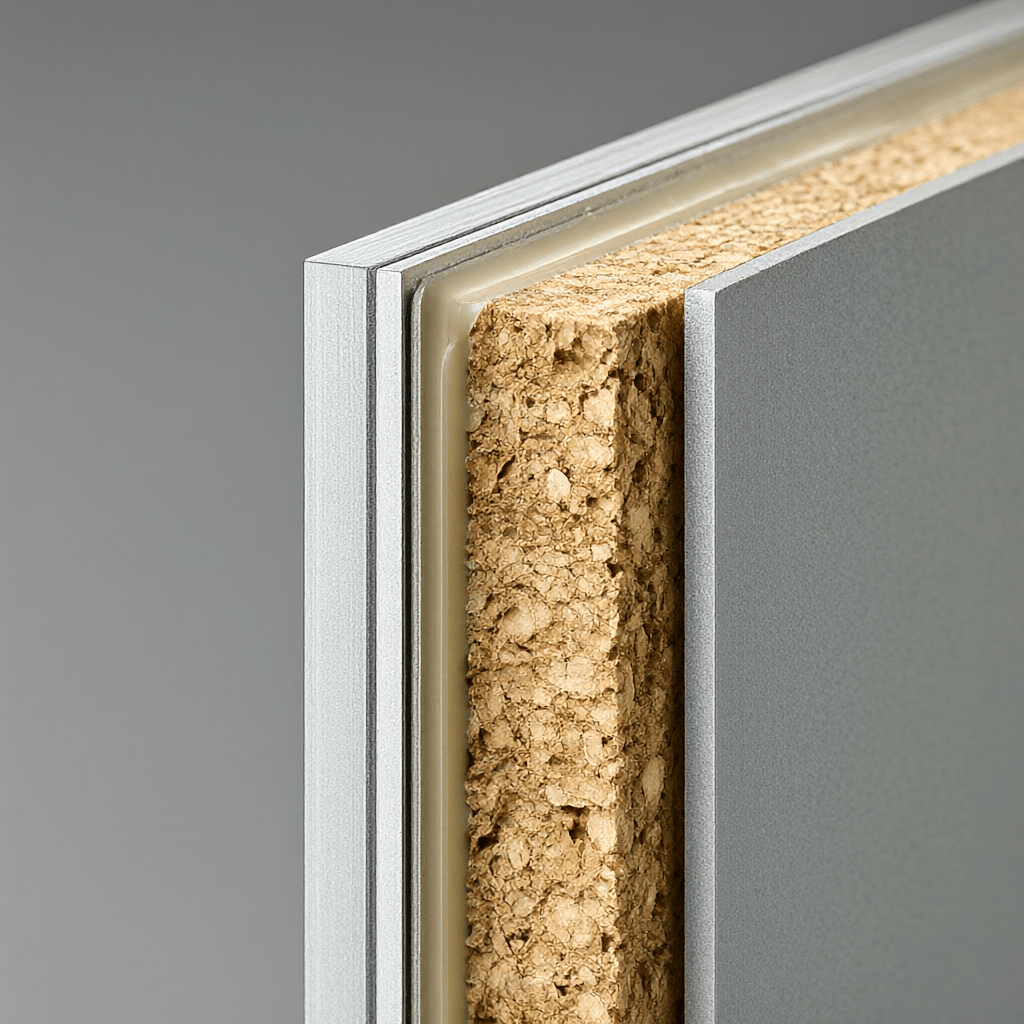
How do door materials impact LEED and WELL compliance?
Door assemblies contribute to green-building scores through two separate pathways. LEED v4.1/v4.2 evaluates doors under EQ Credit 04 (Low-Emitting Materials) for interior finishes and adhesives, and under MR Credit 4 (Recycled Content) or MR Credit 5 (Regional Materials) when the frame or core contains post-consumer or post-industrial recycled aluminium or wood fibre. WELL v2 treats doors under Feature 06 (Air) and Feature 07 (Sound), requiring measurable VOC and formaldehyde limits on all exposed surfaces, sealants, and composite cores, plus minimum STC ratings for partition doors in occupied spaces. A single door assembly therefore needs to clear emission thresholds and meet acoustic or thermal performance targets depending on where it is specified.
What core material options are accepted under LEED EQ Credit 04 and WELL Feature 06?
Engineered wood cores dominate commercial green-certification projects because they offer consistent density, dimensional stability, and a straightforward path to low-formaldehyde compliance.
- HDF (High-Density Fibreboard) cores made with no-added-urea-formaldehyde (NAUF) resins are widely accepted. They score well for acoustic mass and can achieve TSCA Title VI ATCM Phase II compliance readily.
- MDF (Medium-Density Fibreboard) cores follow the same rule: they must be bonded with formaldehyde-free binders (typicallyMDI or phenolic resin systems) and tested per ASTM E2092 or CDPH Method V1 for formaldehyde and total VOC output.
- Particleboard cores are acceptable only when sourced from manufacturers meeting TSCA Title VI Class ULA (ultra-low-emitting) or CARB Phase 2 Compliant designations. Budget-spec particleboard that lacks documented emission proof will fail a LEED submittal review.
- Solid wood cores present fewer compliance headaches—they contain no composite adhesives—but they introduce movement and stability challenges that specifiers must account for, especially in large-format entrance doors. For solid-core options, see our solid wood closet doors reference for material selection guidance.
- Composite alternatives such as mineral-core or gypsum-filled cores are gaining traction in healthcare and hospitality where both fire-rating and low emission are required simultaneously. These cores inherently contain negligible VOC sources but require verification that any facing veneer or skin also meets GREENGUARD Gold or equivalent criteria.
Do recycled-content aluminum frames count toward LEED MR Credit 4?
Yes. Recycled-content aluminium extrusions qualify for LEED Materials & Resources Credit 4 (Recycled Content). The credit assigns points based on the percentage of post-consumer and post-industrial recycled material by cost. Aluminium frames typically contain 70–95% recycled content, making them one of the highest-scoring door frame materials available. To claim the credit, the procurement team must collect mill certificates or supplier declarations confirming the recycled-content ratio for each order, then submit those documents with the project’s LEED documentation package.
Is FSC-certified wood required or preferred for WELL compliance?
FSC certification is not mandatory under WELL v2 for general interior doors, but it is strongly preferred—and effectively required if the project targets additional LEED MR points or aims for Living Building Challenge petal recognition. WELL Feature 06 focuses on emission limits rather than sourcing origin, but WELL Feature 09 (Materials) explicitly rewards third-party certified sustainable materials. For a commercial office fit-out targeting LEED Gold, specifying FSC-certified veneers and solid-wooddoor core material eliminates a potential point gap between credits. When sourcing, verify that the FSC chain-of-custody covers both the veneer layer and the substrate, not just the raw log.
Key Specifications
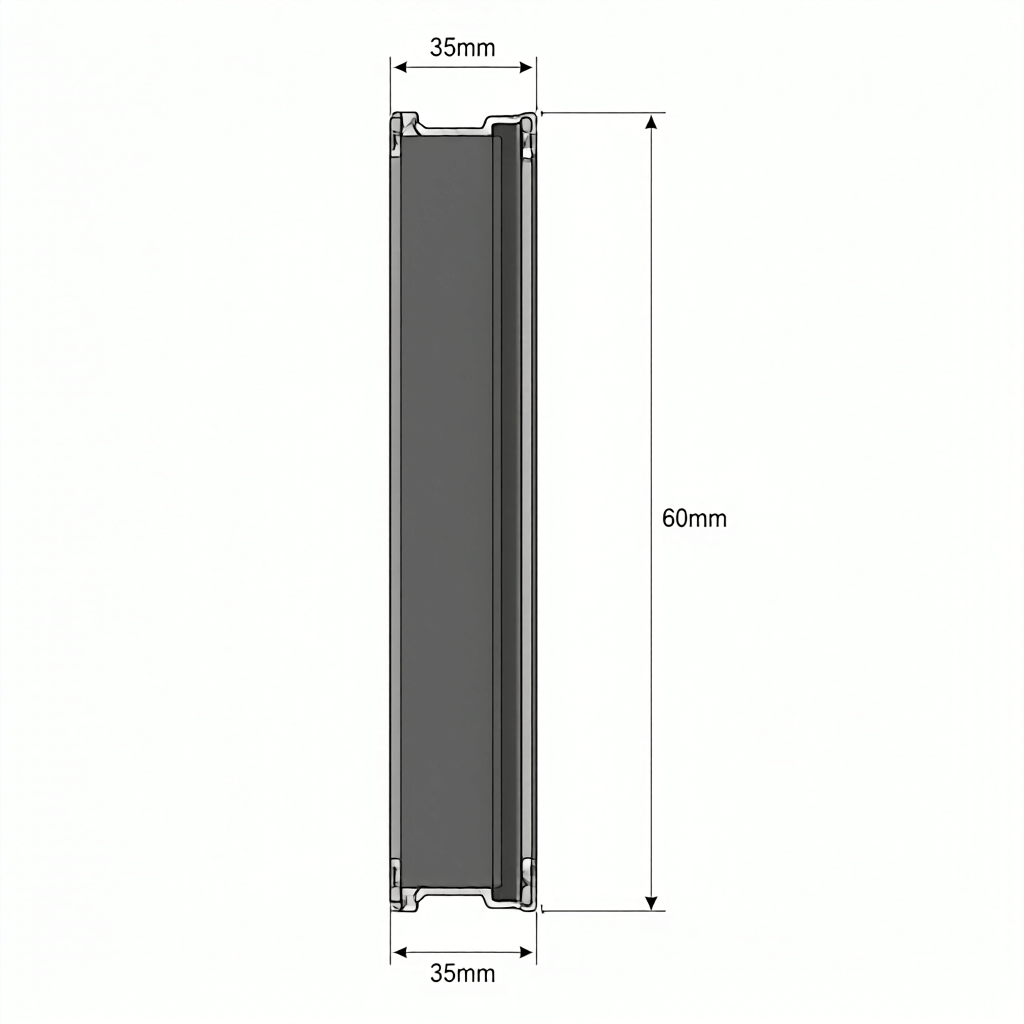
What are the key specifications for certification-compliant door assemblies?
Specifiers should track these measurable parameters during procurement:
| Parameter | Typical Requirement | Acceptance Criterion |
|---|---|---|
| Formaldehyde emission (composite cores) | ≤ 0.05 ppm (TSCA Title VI ULA) | Lab test report from accredited facility |
| Total VOC (finished surfaces) | ≤ 0.5 g/L (GREENGUARD Gold) | GREENGUARD Gold certificate or UL ECVP report |
| Acoustic rating (interior partition doors) | STC 30 minimum; STC 40+ preferred for WELL Feature 07 | ASTM E90 test report |
| Thermal transmittance (exterior doors) | U-value ≤ 0.50 BTU/(h·ft²·°F) for Climate Zones 4+ | NFRC label or equivalent thermal analysis |
| Recycled content (metal frames) | ≥ 70% post-consumer by weight/cost | Mill certificate or supplier declaration |
| FSC chain-of-custody | Verified for all wood veneer and core layers | FSCcoc certificate number on invoice |
| HPD availability | Recommended for WELL Feature 09 | published Health Product Declaration |
These thresholds represent current industry baselines for 2026 green-building submissions. Values shift incrementally as WELL v2 continues to tighten material restrictions—always confirm the latest edition requirements with the project’s GBCI or IWBI registered consultant.
Standards & Requirements
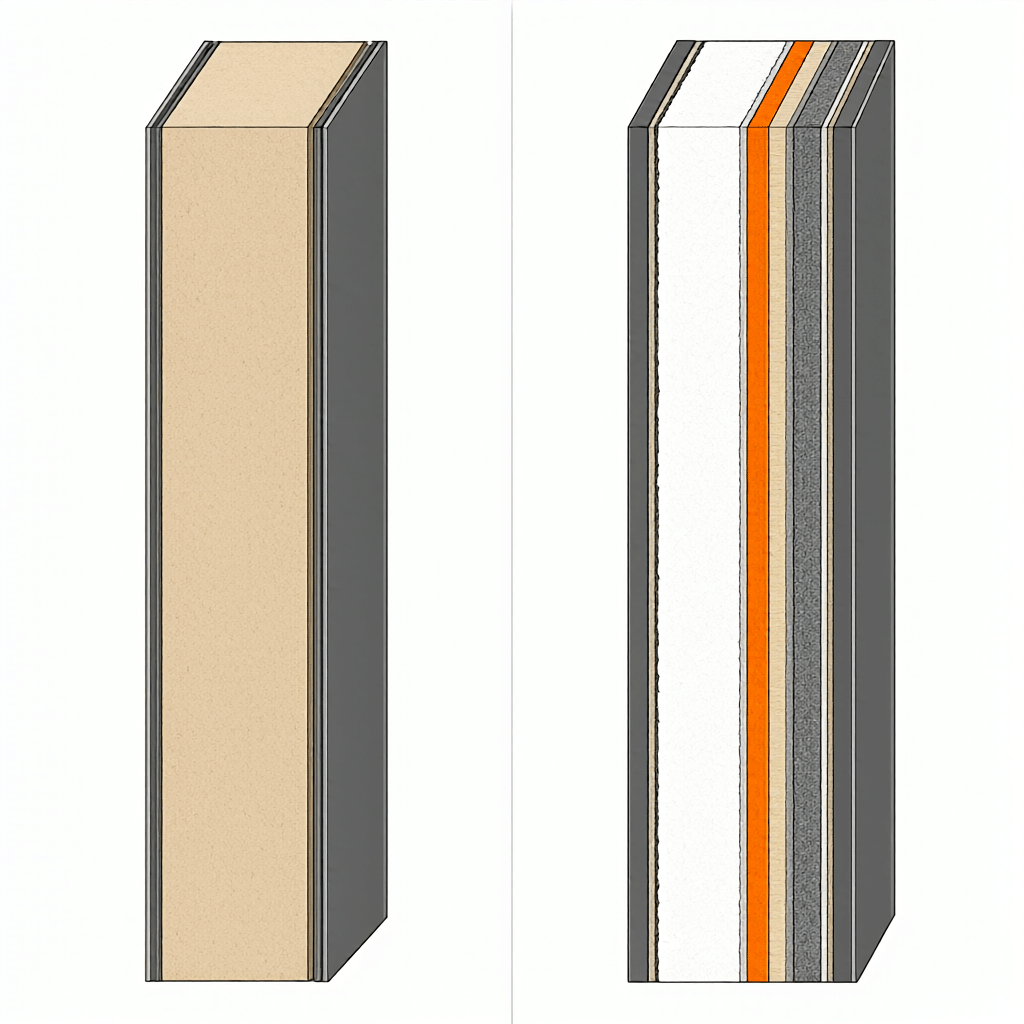
What standards govern door material selection for LEED and WELL?
Three regulatory and voluntary frameworks intersect on every door specification:
- EPA TSCA Title VI sets the enforceable formaldehyde emission ceiling for composite wood products sold in the United States. Any HDF, MDF, or particleboard core used in a LEED-WELL project must carry a TSCA Title VI compliance label or an accredited laboratory test report referencing the applicable ASTM test method.
- CARB Phase 2 ATCM (California Air Resources Board) imposes VOC limits on coated wood and composite products beyond the federal floor. Projects in California—and many national LEED teams adopting CALGreen as a baseline—expect CARB Phase 2 proof even outside the state.
- WELL Building Standard v2 Feature 06 lists prescriptive emission limits for materials installed in indoor environments. Door skins, veneers, paints, primers, and all contact adhesives fall on this material inventory. GREENGUARD Gold remains the most common third-party verification pathway that WELL assessors recognize without additional justification.
For projects pursuing dual LEED and WELL certification simultaneously, alignment is generally achievable: a door that clears TSCA Title VI, CARB Phase 2, and GREENGUARD Gold will satisfy both programs’ emission requirements, leaving only the acoustic and recycled-content calculations as separate tracking items. The intersection of these standards means one well-documented door assembly can clear multiple credit categories without duplicate testing.
How does door U-value and thermal break design feed into LEED Energy & Atmosphere credits?
Exterior door assemblies contribute to LEED EA Credit 5 (Building-Level Energy Performance) through their overall thermal envelope contribution. A thermal-break aluminium frame with insulated glazing and proper perimeter sealing reduces heat gain and loss at a high-traffic insertion point in the building envelope. The U-factor and SHGC values from the door’s NFRC listing—or an engineered thermal analysis—feed directly into the energy model. In cold climates, specifying a thermally broken system with low-e glazing and weatherstripped thresholds can offset a meaningful portion of the door area’s thermal penalty, improving the whole-building energy score.
Related Considerations
What documentation must specifiers collect during procurement?
A complete green-building door submittal package includes:
- EPDs (Environmental Product Declarations) for the frame and core system—required for LEED MR Credit 4 and increasingly expected under WELL Feature 09.
- HPDs (Health Product Declarations) disclosing ingredient contents above de minimis thresholds; essential for WELL and LBChair projects.
- VOC emission test reports from an ISO 17025-accredited laboratory (GREENGUARD Gold, UL ECVP, SCS Global Services, or CDPH Method V1 results).
- TSCA Title VI / CARB compliance certificates for every composite wood component.
- FSC CoC numbers linked to purchase orders for all certified veneer and solid-wood components.
- Mill certificates confirming recycled-content percentages for aluminium or steel frames.
- Declaration letters from the manufacturer attesting to the absence of problematic chemicals listed on the WELL Red List.
Missing any one of these documents creates a gap that the LEED reviewer or WELL assessor will flag during the review cycle. Early coordination with the manufacturer’s technical support team—ideally before the specification phase—prevents last-minute re-testing or substitution delays that can disrupt project schedules.
What are common red flags when selecting doors for green-building audits?
Buyers frequently encounter these pitfalls:
- Assuming “low-VOC paint” automatically satisfies the credit. Paint is only one component; the adhesive, primer, core substrate, and edge-banding also emit VOCs. Every layer in the door assembly must be covered by documentation.
- Ordering doors without pre-shipment performance testing. Some suppliers skip air-tightness, water-tightness, and wind-resistance verification to reduce lead time. While these tests don’t directly affect LEED/WELL credits, failing inspection after delivery triggers replacement costs and schedule delays that indirectly jeopardize certification timelines.
- Accepting supplier-provided emission claims without third-party lab backing. Internal factory test reports are not recognized by GBCI or IWBI reviewers. Only accredited independent test results count.
- Overlooking frame and hardware emissions. Metal frames themselves are inert, but anodizing solutions, powder-coat primers, and silicone sealants used during fabrication can introduce VOCs. Specify low-VOC finishing processes.
- Ignoring regional code overlap. CALGreen and CDPH requirements extend beyond California and often exceed federal TSCA floors. A door that passes EPA standards may still fall short of state-specific VOC limits unless the supplier explicitly confirms compliance.
Manufacturing Alignment
As a manufacturer, our approach to low-emission, certification-ready door assemblies starts at the core and finishes at the inspection line. We build doors using formaldehyde-free composite cores bonded with MDI or phenolic resin systems, apply FSC-certified wood veneers with GREENGUARD Gold–compliant finish coatings, and pair them with thermally broken aluminium profiles that carry verified recycled-content declarations. Every panel undergoes pre-shipment air-tightness, water-tightness, and wind-resistance testing before packing, ensuring that the unit arriving on site matches the performance data submitted for the LEED or WELL file. We also maintain a full set of EPDs, HPDs, and TSCA/CARB compliance records ready for spec submittals, and we can adjust profile structures and fitting configurations to align with local building codes for your target market. Get a Free Quote
What does ‘LEED and wellbeing door material’ actually mean in practice?
In practice, the phrase describes a door assembly whose every component—core, skin, veneer, adhesive, paint, primer, glazing, and sealant—carries documented proof of low chemical emission and sustainable sourcing. It is not a single material but a system approach: each layer must meet independent verification standards so that a Green Business Certification Inc. (GBCI) reviewer or International WELL Building Institute (IWBI) assessor can audit the full submittal without gaps. A “wellbeing door” additionally implies acoustic comfort (WELL Feature 07), non-toxic hardware finishes, and durability that reduces replacement cycles and associated waste.
How do LEED v4.1/v4.2 credits apply to door and wall assembly materials?
EQ Credit 04—Low-Emitting Materials requires all interior finishes, adhesives, sealants, and composite wood products to meet prescribed emission limits. For doors, this means:
- Composite cores (HDF, MDF, particleboard) must comply with EPA TSCA Title VI and CARB Phase 2 ATCM formaldehyde limits, with test reports from accredited laboratories such as Intertek, SGS, or UL.
- Paints, primers, and coatings must meet the SCAQMD Rule 1168 threshold of ≤50 g/L VOC for post-conditioning and ≤5 g/L for pre-conditioning.
- Adhesives and sealants must carry GREENGUARD Gold certification or equivalent, ensuring low total VOC output.
MR Credit 4—Recycled Content awards points based on the percentage of post-consumer and post-industrial recycled material by cost. Aluminium frames typically contain 70–95% recycled content, while steel hardware and some composite substrates can contribute additional credited percentages. Recycled aluminium is particularly attractive because it retains structural integrity after re-melting and avoids the emissions penalty of primary aluminium production.
MR Credit 5—Regional Materials applies whendoor components are extracted, processed, and manufactured within 400 miles of the project site. This credit is less relevant for imported doors but can be claimed when local fabricators use regionally sourced timber or extruded aluminium profiles.
What is the WELL Building Standard v2 requirements for door surfaces, cores, and sealants?
WELL Feature 06—Air mandates that installed materials do not exceed specific VOC and formaldehyde emission limits. Door assemblies must provide:
- A Health Product Declaration (HPD) published on the International Living Future Institute’s database, disclosing all ingredients above de minimis thresholds.
- GREENGUARD Gold certification confirming low chemical emissions, which satisfies WELL’s Material Ingredient Optimization requirements.
- Formaldehyde emission data showing concentrations below 0.05 ppm for composite cores.
WELL Feature 07—Sound requires partition doors in occupied workspaces to achieve minimum STC ratings. Solid-core or multi-layer composite doors with acoustic seals typically reach STC 30–45, with specialized designs achieving STC 50+ for conference rooms and private offices.
Feature 09—Materials rewards the use of sustainably sourced materials. FSC-certified wood veneers and cores, along with recycled-content aluminium frames, help projects accumulate points under this feature.
Which door core materials are accepted under LEED v4.1 EQ Credit 04 and WELL Feature 06?
Four principal core categories serve green-building door applications, each with distinct compliance pathways:
| Core Type | Emission Profile | Certification Pathway | Best Application |
|---|---|---|---|
| HDF (NAUF resin) | Near-zero formaldehyde | TSCA Title VI ULA + GREENGUARD Gold | High-traffic commercial corridors, healthcare |
| MDF (MDI-bonded) | Low formaldehyde | TSCA Title VI Compliant + CARB Phase 2 | Interior partition doors, office fit-outs |
| Particleboard (ULA-grade) | Ultra-low emissions | TSCA Title VI Class ULA certification | Budget-conscious residential and light commercial |
| Solid wood (FSC-certified) | Naturally low VOC | FSC CoC + natural material exemption from composite rules | Heritage buildings, premium residential |
| Mineral/gypsum composite | Zero formaldehyde | Inherently compliant; requires surface finish verification | Fire-rated doors, healthcare, labs |
For a detailed look at how core selection affects installation and procurement workflows, see our guide on how to hang an interior door.
What VOC emission limits must door skins, veneers, and adhesives meet?
VOC limits vary by component type and governing standard:
- Adhesives and sealants: ≤50 g/L VOC (SCAQMD Rule 1168 post-conditioning); GREENGUARD Gold threshold is ≤0.5 mg/m²·hr total VOC for panel materials.
- Paints and coatings on door skins: ≤50 g/L VOC for flat finishes; ≤100 g/L for non-flat finishes under SCAQMD Rule 1168.
- Formaldehyde from composite cores: ≤0.05 ppm (TSCA Title VI ULA) or ≤0.08 ppm (CARB Phase 2 ATCM).
- Total VOC from finished assemblies: ≤0.5 g/L when tested per CDPH Method V1 or EPA International Reference Method.
These thresholds are enforced through third-party laboratory testing. Internal factory claims are insufficient for GBCI or IWBI review—specifiers must request certificates from ISO 17025-accredited facilities.
What testing certificates do specifiers need to submit during green-building reviews?
A complete certification submittal for doors includes:
- TSCA Title VI Compliance Certificate — issued by an EPA-approved third-party certifier, confirming formaldehyde emission levels for all composite wood components.
- CARB Phase 2 ATCM Certificate — required for products sold or installed in California; many national projects adopt it as a baseline.
- GREENGUARD Gold Certificate — verifies low chemical emissions from the finished product, recognized by both LEED and WELL.
- HPD (Health Product Declaration) — discloses material ingredients and hazards; published on the ILFI database.
- EPD (Environmental Product Declaration) — provides lifecycle environmental impact data; supports LEED MR and potentially EA credits.
- FSC Chain-of-Custody Certificate — confirms sustainable sourcing from forest to final product.
- Acoustic Test Report (ASTM E90) — provides STC and IIC ratings for sound performance.
- Mill Certificates — confirm recycled-content percentages for metal frames.
- Fire-Rating Certification — if the door serves as a fire-rated assembly per NFPA 80 or IBC Chapter 716. See our NFPA 105 smoke door assembly guide for relevant standards context.
Concrete industry cases
Case 1 — Healthcare facility, Singapore: A 240-bed hospital specified thermo-laminated composite-core doors with GREENGUARD Gold certification for all patient rooms and corridor partitions. The owner targeted WELL Platinum and LEED Gold. Every door lot was accompanied by HPDs and TSCA Title VI certificates. The acoustic performance (STC 38) exceeded WELL Feature 07 requirements, contributing to a higher Wellness Score. The project avoided substitute-engineering delays because the supplier provided all documentation pre-shipment.
Case 2 — Class-A office tower, London: A 12-story commercial fit-out used FSC-certified veneered hollow-core doors with recycled aluminium frames containing 85% post-consumer content. The project claimed LEED MR Credit 4 for recycled content and WELL Feature 09 for responsible materials. All doors carried CARB Phase 2 compliance labels, satisfying the UK client’s internal sustainability mandate even though UK regulations did not legally require CARB-level standards at the time.
How to verify FSC CoC numbers and HPD authenticity during sourcing
Verification protects against greenwashing and ensures smooth certification audits:
- FSC CoC verification: Visit FSC Certificate Tree and enter the supplier’s CoC number. Confirm that the certificate is active, matches the legal entity name on your purchase contract, and covers the specific product category (e.g., hardwood plywood, softwood lumber). An inactive or mismatched certificate invalidates the claim.
- HPD authenticity check: Navigate to the HPD Open Library and search by product name or manufacturer. Verify that the HPD is signed by an authorized representative and posted within the last three years. Expired or unsigned HPDs will not be accepted by WELL assessors.
- GREENGUARD Gold verification: Search the UL GREENGUARD product directory using the product SKU or manufacturer name. Confirm the certification status is “Active” and that the listed parameters match your ordered specification.
- Cross-reference EPDs: EPDs should follow ISO 14025 and ISO 21930 standards. Verify the EPD has been independently verified and is registered with an approved program operator (e.g., UL, TÜV, IBU). Mismatched product descriptions between the EPD and actual delivered goods can trigger a compliance failure.
Procurement Evaluation Checklist
Use this checklist during vendor pre-qualification to ensure doors meet green-building requirements before placing orders:
- [ ] TSCA Title VI compliance certificate obtained for all composite wood components
- [ ] CARB Phase 2 ATCM certificate secured (or evidence of equivalency for non-US projects)
- [ ] GREENGUARD Gold or equivalent VOC emission certificate for finished surfaces
- [ ] HPD published and accessible in the open library for every material layer
- [ ] EPD available for the complete door assembly (frame + core + finish)
- [ ] FSC CoC number verified against FSC Certificate Tree for all wood veneers and cores
- [ ] Mill certificate confirming recycled-content percentage for metal frames
- [ ] Acoustic test report (ASTM E90) showing STC rating meets project specifications
- [ ] Fire-rating certificate if door is specified as a fire-resistance-rated assembly
- [ ] Pre-shipment inspection report confirming air-tightness, water-tightness, and wind resistance
- [ ] No materials on the WELL Red List or equivalent restricted-substance lists
- [ ] Supplier confirmed ability to adjust profile structures to match local building codes
- [ ] Full customs documentation capability verified (packing list, proforma invoice, origin certificate)
Side-by-side comparison of standard vs certified door materials
| Specification | Standard Commercial Door | LEED/WELL-Certified Door |
|---|---|---|
| Core material | Regular MDF with urea-formaldehyde resin | NAUF-HDF or MDI-bonded MDF; zero added formaldehyde |
| Formaldehyde emission | Not tested; may exceed 0.08 ppm | ≤0.05 ppm (TSCA Title VI ULA); verified by lab report |
| Surface finish VOC | Conventional solvent-based paint (~200–300 g/L) | Low-VOC water-based or powder-coat finish (≤50 g/L) |
| Adhesive type | Standard PU or EVA adhesive | Formaldehyde-free adhesive with GREENGUARD Gold certification |
| Frame material | Virgin aluminium or steel, no recycled content declared | ≥70% recycled-content aluminium with mill certificate |
| Wood veneer | Non-certified tropical or temperate veneer | FSC-certified veneer with verified chain-of-custody |
| Documentation | None or basic CE marking | Full EPD, HPD, TSCA/CARB certs, FSC CoC, acoustic report |
| Pre-shipment testing | Visual inspection only | Air-tightness, water-tightness, wind-resistance tested |
| Price premium | Baseline | Typically 15–35% above standard, depending on specs |
The price premium for certified doors reflects the cost of accredited laboratory testing, sustainably sourced materials, and documented traceability. For most commercial projects, this premium is absorbed within the overall FF&E budget and offset by the value of earned certification points. Doors sourced from manufacturers offering OEM and ODM customization can further align certified specifications with local code requirements, ensuring compliance without sacrificing design intent. To explore custom configuration options, visit our contact page.
Sources & References
- ASTM E2092 — www.astm.org
- solid wood closet doors — doorwoodendoors.com
- how to hang an interior door — doorwoodendoors.com
- NFPA 105 smoke door assembly guide — doorwoodendoors.com
- FSC Certificate Tree — certificate-tree.fsc.org
- HPD Open Library — www.healthproductdeclaration.com
- UL GREENGUARD product directory — greenguard.org
- contact page — doorwoodendoors.com











