
Last updated: November 25, 2026
Choosing engineered wood doors requires evaluating core material, thickness, finish, fire rating, and acoustic performance against your project’s specific code requirements and humidity conditions. For most interior residential and commercial applications, a 40–45 mm solid-core door with HDF core and properly sealed edges meets building-code minimums while delivering strong lifecycle value. Exterior, high-humidity, or fire-rated applications demand moisture-resistant cores, intumescent seals, and verified test documentation from an accredited laboratory.
Quick Answer
How to choose engineered wood doors for a specific project? Start by matching the door’s core material, thickness, surface finish, and performance ratings to the room’s humidity level, traffic volume, and building-code requirements. For most interior applications, a 40–45 mm solid-core door with an HDF face and appropriate fire or acoustic rating meets code and delivers the best lifecycle value. Exterior or high-moisture locations require moisture-resistant cores and sealed-edge veneers. Verify that the manufacturer provides pre-shipment performance testing and complete export documentation before committing to a bulk order.
Detailed Explanation
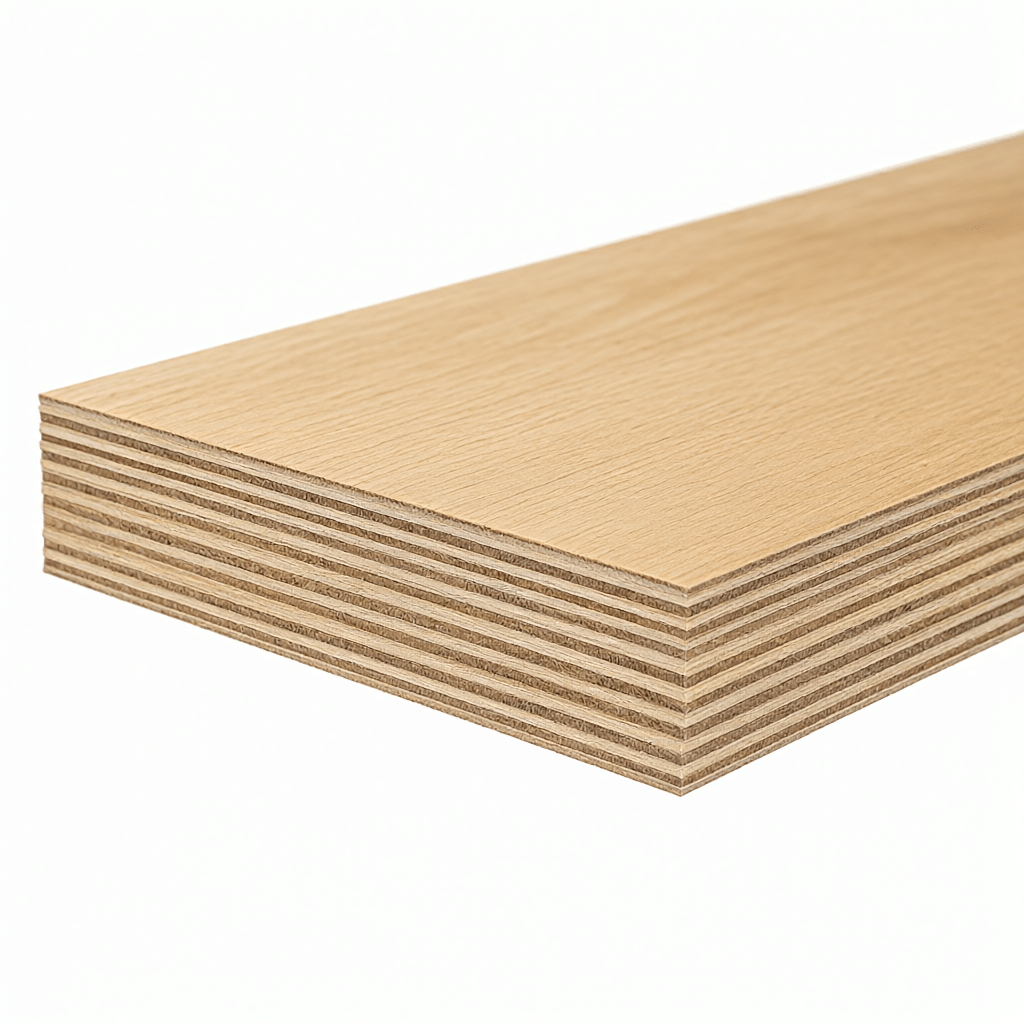
What core material is best for your project?
Engineered wood doors use one of four common core constructions, each with distinct performance trade-offs.
HDF (High-Density Fiberboard) core doors are the industry standard for mid-to-high-range interior applications. HDF offers higher density and superior screw-holding strength compared to MDF, making it the preferred choice for doors that will carry heavy hardware or frequent use in hotel rooms and multi-unit residential units.
MDF (Medium-Density Fiberboard) core doors provide a smooth, uniform surface ideal for painted or laminate finishes. They are cost-effective for low-to-moderate traffic areas such as closets and interior partition doors. However, MDF absorbs moisture more readily than HDF, so it is not recommended for bathrooms or unconditioned spaces without proper edge sealing.
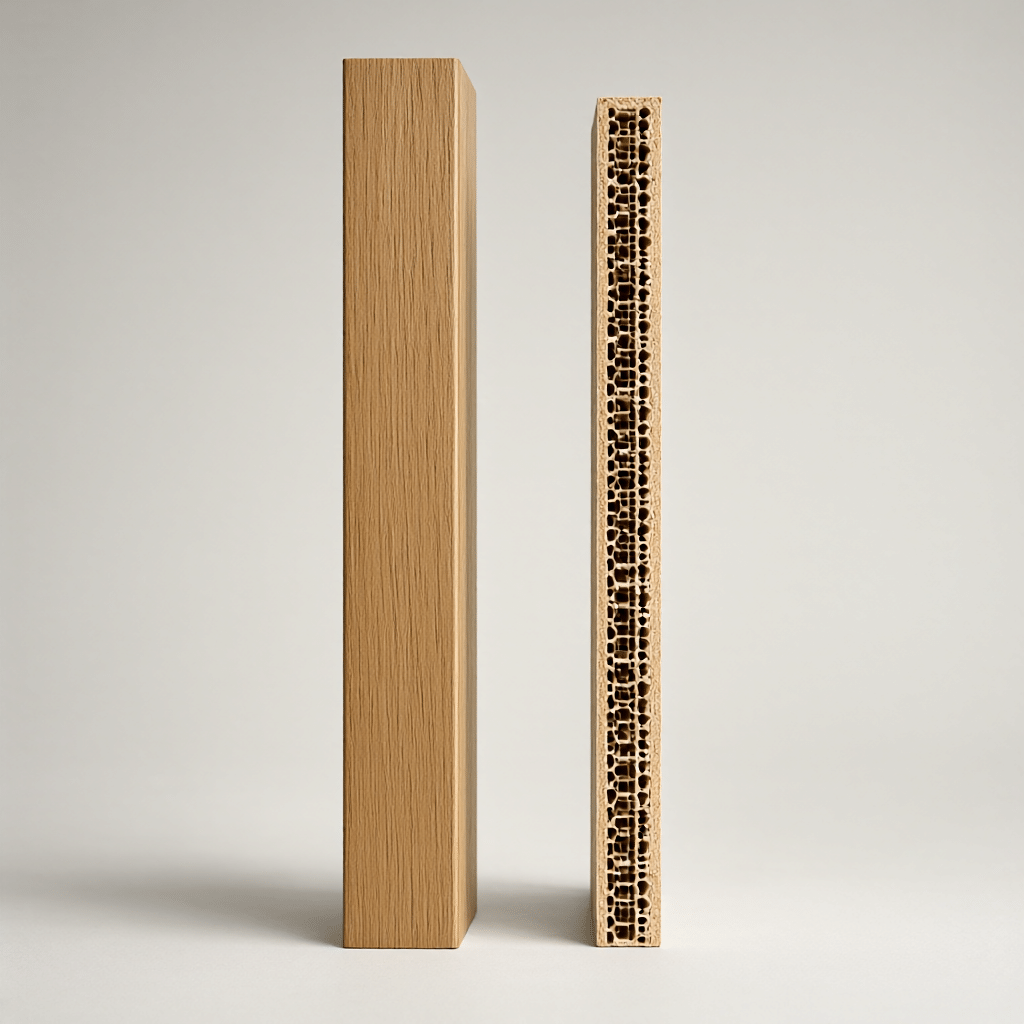
Solid wood frame with honeycomb filler doors use a timber perimeter frame filled with paper honeycomb core. These are the lightest and most economical option, suitable for interior closet and storage doors where sound insulation and durability are secondary concerns. The honeycomb structure does not support heavy hardware well and offers minimal acoustic performance.
Solid core engineered doors — sometimes called composite wood doors — use layered timber or dense fiberboard throughout the full cross-section. These deliver the best balance of weight, stability, and acoustic performance. They are the default recommendation for bedroom, bathroom, and corridor applications in commercial projects.
What door thickness should you specify?
Door thickness directly affects acoustic performance, perceived quality, and code compliance. The following ranges apply to most interior applications:
| Thickness | Typical Use | Performance Notes |
|---|---|---|
| 35 mm | Interior closet, pantry, low-traffic rooms | Basic separation; limited sound control |
| 40 mm | Residential bedrooms, hotel room entries | Minimum for most code-compliant interior use |
| 45 mm | Commercial corridors, bathroom doors, offices | Good balance of acoustics and cost |
| 50 mm+ | High-traffic commercial, fire-rated, acoustic-rated | Maximum performance; heavier hardware required |
For residential projects, 40 mm is generally the minimum specification. Commercial projects — particularly hotels and multi-unit residential developments — should specify 45 mm or thicker for all corridor and unit-entry doors. Thicker doors also accept larger hinge surfaces and more robust locking mechanisms.
What veneer and finish options are available?
The surface finish determines both aesthetics and durability. Veneered doors use a thin slice of natural wood — oak, maple, walnut, or teak — bonded to the engineered core. Veneer provides the look of solid timber at a fraction of the cost and is the most common choice for villa and luxury renovation projects. Laminate finishes offer consistent color and superior scratch resistance, making them practical for high-traffic commercial corridors and hospital environments. Paint-grade doors use an MDF or HDF face ready for on-site finishing.
For high-humidity locations such as bathrooms and laundry rooms, select doors with sealed edges and water-resistant adhesive systems. Unsealed veneer edges are the most common failure point — moisture intrusion at the edge causes delamination and warping over time.
What fire and acoustic ratings apply to engineered wood doors?
Fire-rated engineered wood doors are manufactured to resist flame spread for specified durations. The common classifications are EI30 (30-minute), EI60 (60-minute), and EI90 (90-minute), with the rating determined by core composition, intumescent seals, and certification testing. For detailed comparisons of these ratings, see our EI30 vs EI60 vs EI90 fire resistance guide.
Acoustic performance is measured in STC (Sound Transmission Class) ratings. A standard 40 mm interior door typically achieves STC 28–30. A 45 mm solid-core door with proper edge sealing can reach STC 32–35. For conference rooms, hotel suites, and bedroom corridors, specify doors rated STC 35 or higher. Note that the installed STC rating depends on both the door assembly and the frame sealing — a high-rated door installed in a poorly sealed frame will not achieve its rated performance.
What quality indicators distinguish a premium engineered wood door?
When inspecting a sample door before bulk procurement, check the following:
- Core density: Tap the door surface. A solid-core or HDF door produces a dense, consistent sound. A honeycomb core sounds hollow and uneven.
- Edge sealing: Examine all four edges and the bottom edge. Properly sealed edges show no visible core exposure and no gaps in the veneer or laminate wrap.
- Moisture content: Quality manufacturers control core moisture to 8–12%. Doors with moisture content above 14% are at risk of warping after installation, especially in humid climates.
- Flatness: Lay the door on a flat surface and check for rocking. A warped door indicates poor curing or inadequate kiln drying.
- Hardware prep: Pre-cut hinge and lock bores should be clean and accurately sized. Poorly prepared hardware pockets compromise fit and function.
Key Specifications
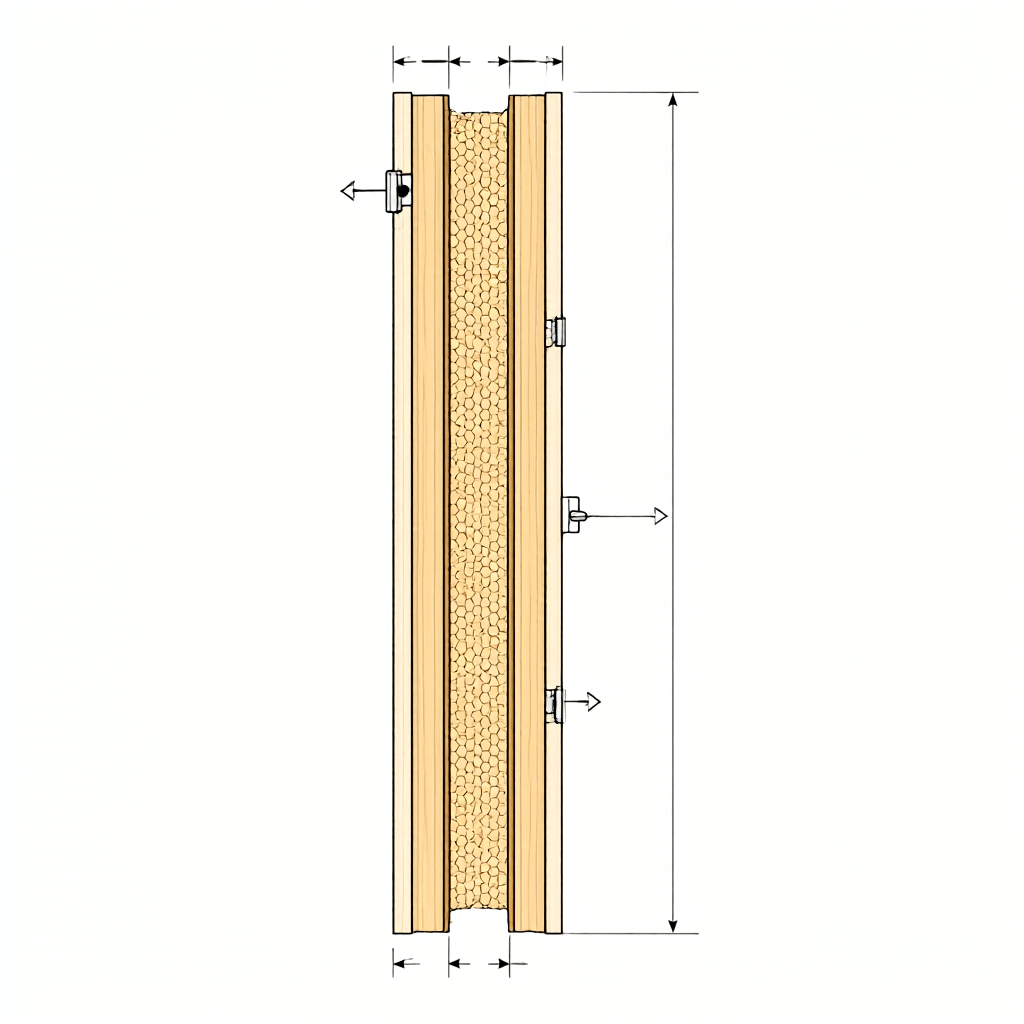
| Specification | Typical Range | Notes |
|---|---|---|
| Core density | 650–850 kg/m³ (HDF) | Higher density = better screw retention |
| Door thickness | 35–55 mm | 40–45 mm most common for interiors |
| Moisture content | 8–12% | Must be controlled during manufacturing |
| Veneer thickness | 0.5–3 mm | Thicker veneer allows more refinishing |
| Fire rating | EI30 / EI60 / EI90 | Depends on core and certification |
| Acoustic rating | STC 28–40 | Depends on door mass and seal quality |
| Frame material | Timber or steel | Must match door weight and usage |
Standards & Requirements
Engineered wood doors for commercial and residential construction must comply with regional building codes and industry standards. Key references include:
- ANSI A250.6 — American National Standard for Interior Wood Flush Doors, covering performance requirements for core density, surface durability, and dimensional stability.
- EN 1634 — European standard for fire resistance testing of doors and shutters.
- BS 476 — British standard for fire classification of building elements.
- ASTM E2092 — Standard test method for fire-resistant door assemblies, as referenced by ASTM International.
- ICC International Building Code (IBC) — Sets minimum door thickness and fire-rating requirements based on occupancy type and egress path, per ICCsafe.org.
Before procurement, confirm which standard applies to your project’s jurisdiction. Importing doors from China requires verification that the manufacturer’s testing aligns with your local code authority’s acceptance criteria.
Related Considerations
Moisture and climate considerations
Engineered wood doors perform differently depending on the climate zone. In humid tropical or subtropical regions, select doors with moisture-resistant HDF cores, sealed edges, and water-based or PVDF finish systems. In dry climates, standard MDF-core doors are adequate for most interior applications. Doors installed in basements, laundries, or unconditioned spaces should always use moisture-resistant construction regardless of climate.
Cost versus lifecycle value
Engineered wood doors typically cost 40–60% less than solid wood doors while delivering comparable aesthetics and sufficient performance for most interior applications. Compared to aluminum doors, engineered wood provides better acoustic insulation and a warmer tactile feel, though aluminum outperforms in corrosion resistance for coastal environments. For hotel and hospitality projects, the lifecycle cost advantage of engineered wood is significant — lower initial cost combined with acceptable durability over a 15–20 year service life makes it the default choice for bulk procurement.
Hardware compatibility
Door weight determined by core type and thickness dictates hinge and frame specifications. A 45 mm solid-core door weighs approximately 25–30 kg, requiring at least two heavy-duty ball-bearing hinges rated for the load. Always confirm hinge bore depth and screw engagement with the manufacturer before finalizing hardware selections. For guidance on bulk shipping configurations that protect hardware and door surfaces, see our FCL vs LCL shipping comparison.
Supplier Evaluation and Procurement
Evaluating an engineered wood door manufacturer requires checking capability beyond product samples. A reliable supplier should demonstrate:
- Factory audit readiness: Visit or request a virtual audit of the production line, including core preparation, pressing, veneering, and curing areas.
- Pre-shipment testing: Confirm that the manufacturer conducts air-tightness, water-tightness, and wind resistance testing on finished doors before shipment.
- Customization flexibility: The ability to adjust profile structures, core density, and fittings to match your local building codes is essential for international projects.
- Export documentation: Full proforma invoices, packing lists, and customs documents should be provided routinely for smooth import clearance. See our door HS code and import duty guide for details on documentation requirements.
- Shipping experience: FCL and LCL shipment capability from the factory ensures flexible logistics for projects of any scale.
When comparing suppliers, request physical samples and third-party test reports for fire and acoustic ratings before placing a bulk order. A thorough evaluation checklist can help you assess multiple vendors consistently — for a structured approach, refer to our door factory audit checklist.
At Jusen Door and Windows, our approach to engineered wood door procurement is straightforward: we match each project’s core requirements to the appropriate material and specification, then validate performance through strict pre-shipment testing. Every order undergoes air-tightness, water-tightness, and wind resistance checks before it leaves the factory. We also provide full export documentation and adjust profile structures to meet the building codes of your target market, whether you are sourcing for a hotel fit-out, a multi-unit residential development, or a commercial office project.
Contact Our Team to discuss your project specifications and receive a tailored quote.
How do you evaluate a manufacturer’s capability and export readiness?
Evaluating a manufacturer goes beyond product samples. Use this structured checklist to confirm that a supplier can meet bulk-order requirements.
#### Technical capability
- Core production: Ask about core‑density control, kiln‑drying capacity, and whether the factory blends HDF/MDF or uses solid‑wood laminations.
- Pressing & veneering: Verify automatic pressing lines and surface‑finishing consistency (veneering, laminate, or paint).
- Testing lab: A reliable supplier maintains an in‑house lab for fire, acoustic, and mechanical tests, and can produce certificates from accredited third‑party laboratories (e.g., Intertek, SGS, TÜV).
#### Quality‑control checkpoints
- Incoming material inspection: Raw timber, fiberboard, and adhesives should be screened for moisture content and formaldehyde emissions (E1 or CARB Phase 2).
- In‑process checks: Dimensional tolerances (±1 mm), surface flatness, and edge‑sealing integrity must be verified during production.
- Pre‑shipment inspection: Final doors should be tested for air‑tightness, water‑tightness, and wind‑resistance (per EN 1634‑1 and ASTM E90) before packaging.
#### Export documentation
- Customs papers: Packing list, proforma invoice, bill of lading, certificate of origin, and any required phytosanitary or fumigation certificates.
- Code‑compliance certificates: Fire‑rating certificates (EN 1634‑1, ASTM E2092), acoustic reports (ASTM E90), and formaldehyde‑emission test results.
- Logistics support: Experience with FCL/LCL shipment, container loading optimization, and coordination with freight forwarders.
#### Go / No‑Go criteria
- ✅ Go: Factory audit pass, pre‑shipment test reports provided, export documentation completeness confirmed, profile/hardware adjustable to local building codes.
- ❌ No‑Go: Missing test certificates, refusal to allow virtual/physical audit, vague moisture‑content statements, inability to adjust frame profiles for regional codes.
Red flags: common supplier warning signs
Watch for these signals that a supplier may not meet bulk‑order standards:
- Moisture‑content variance: Manufacturers that cannot state core moisture range (8–12%) or use uncontrolled drying often produce doors prone to warping.
- Unsealed edges: Visible core exposure or gaps in the veneer/laminate wrap at the edges indicate poor finishing.
- Missing test reports: No fire, acoustic, or environmental‑emission certificates suggest inadequate quality assurance.
- Generic responses to technical questions: Vague answers about core density, adhesive type, or frame construction reveal limited expertise.
- Inability to customize: Suppliers that cannot adjust profile structures, fittings, or finish to match local codes are not suited for international projects.
Industry case example
A mid‑scale hotel chain in Southeast Asia required 1,200 interior unit doors (45 mm solid‑core HDF, EI30 fire‑rated, STC 35) with sealed‑edge oak veneer. The procurement team evaluated three Chinese suppliers. The selected manufacturer demonstrated:
- Core production: HDF core density 780 kg/m³, moisture content 9–11%, tested per ISO 1182.
- Testing: Fire‑resistance certificate (EN 1634‑1) and acoustic report (ASTM E90) from an accredited lab.
- Pre‑shipment inspection: Air‑tightness, water‑tightness, and wind‑resistance tests completed for every batch.
- Export documentation: Full packing list, proforma invoice, bill of lading, and certificate of origin provided within 48 hours.
The doors were shipped via FCL, arrived within the scheduled timeline, and passed on‑site inspection with zero warping or delamination complaints after 12 months of operation.
A 120-room boutique hotel project in Bali required interior corridor and unit-entry doors specified for high humidity and moderate acoustic privacy. The specification called for 45 mm solid-core HDF doors with oak veneer, EI30 fire rating for corridor doors, and STC 32 for unit entries. The procurement team sourced doors from a China-based manufacturer and requested the following before sample approval: EN 1634-1 fire test certificate, ASTM E90 acoustic report, CARB Phase 2 formaldehyde compliance, and a pre-shipment inspection record showing water-tightness and wind-resistance results. Three supplier samples were evaluated; one was rejected due to unsealed edge veneer and no moisture-content documentation. The selected order of 340 doors was shipped via FCL, arrived on schedule, and passed on-site inspection with zero delamination or warping after 18 months of operation in a tropical climate.
How Jusen Door and Windows Meets Industry Standards
As a manufacturer, our approach to engineered wood door procurement is straightforward: we match each project’s core requirements to the appropriate material and specification, then validate performance through strict pre‑shipment testing. Every order undergoes air‑tightness, water‑tightness, and wind‑resistance checks before it leaves the factory. We also provide full export documentation and adjust profile structures to meet the building codes of your target market, whether you are sourcing for a hotel fit‑out, a multi‑unit residential development, or a commercial office project.
Key strengths that support bulk procurement:
- Direct factory supply — competitive pricing without middleman markup.
- Full customization — size, color, glass, and hardware accessories tailored to project needs.
- Strict pre‑shipment inspection — every door tested for air‑tightness, water‑tightness, and wind resistance.
- Foreign‑trade experience — packing list, proforma invoice, and full customs documents provided routinely.
- Flexible logistics — FCL & LCL shipment with direct delivery from the China factory.
- Code‑adjustable profiles — profile structure and fittings can be modified to match local building codes of target markets.
Contact Our Team to discuss your project specifications and receive a tailored quote.
What certifications and standards should you verify before procurement?
Before placing a bulk order, confirm that your supplier can provide test reports aligned with your project’s governing standard. Key certifications and standards to request include:
- EN 1634-1 — European fire-resistance test for doors and shutters. Doors carrying an EI30/EI60/EI90 rating must have a current certificate from an accredited test house.
- ASTM E90 — Standard test method for laboratory measurement of airborne sound transmission loss. Use this to verify STC claims on acoustic-rated doors.
- ASTM E119 — Standard test methods for fire tests of building construction and materials, referenced for fire-door certification.
- ANSI A250.6 — American National Standard covering core density, surface durability, and dimensional stability for interior wood flush doors.
- CARB Phase 2 / EPA TSCA Title VI — Formaldehyde emission limits for composite wood products, required for U.S. market entry.
- ISO 9001 — Quality management system certification indicates the manufacturer maintains documented processes for incoming inspection, in-process control, and pre-shipment testing.
Ask the supplier to provide the actual test certificates—not just marketing claims—and verify that the certificate holder name, test laboratory accreditation (e.g., Intertek, SGS, TÜV), and project scope match your order specifications.
Procurement Decision Framework: Go / No-Go Criteria
Use the following checklist to make a consistent buy/no-buy decision when evaluating engineered wood door suppliers for bulk projects:
| Criterion | Go ✅ | No-Go ❌ |
|---|---|---|
| Fire-rating test report | Valid EN 1634-1 or ASTM E119 certificate from accredited lab, issued within last 3 years | No certificate available, or certificate from non-accredited source |
| Acoustic rating claim | ASTM E90 or EN ISO 10140 test report with measured STC value | Only marketing STC claim with no third-party documentation |
| Moisture content control | Documented process controlling core MC to 8–12%, with QC records | No evidence of kiln-drying or moisture monitoring |
| Edge sealing | All four edges and bottom edge fully wrapped/sealed; no exposed core visible | Unsealed or poorly sealed edges on sample |
| Customization capability | Can adjust profile, core density, and fittings to match local codes | Fixed catalogue only; no engineering flexibility |
| Export documentation | Provides proforma invoice, packing list, customs docs routinely | Unable to provide full export paperwork |
| Pre-shipment inspection | Conducts air-tightness, water-tightness, and wind resistance testing with records | No testing protocol or unwilling to share results |
| Factory audit | Open to virtual or on-site audit; production line visible and organized | Refuses audit or only shows showroom |
| Lead time & MOQ clarity | Clear lead-time quote and minimum order quantity in writing | Vague timelines or unrealistic MOQ demands |
If a supplier fails more than two No-Go criteria, do not proceed to bulk order. Request corrective action and re-evaluate.
Sources & References
- ASTM International — www.astm.org
- EI30 vs EI60 vs EI90 fire resistance guide — doorwoodendoors.com
- ICCsafe.org — www.iccsafe.org
- FCL vs LCL shipping comparison — doorwoodendoors.com
- door HS code and import duty guide — doorwoodendoors.com
- door factory audit checklist — doorwoodendoors.com











