Types of Wooden Moulded Doors: A Detailed Breakdown
Understanding the internal construction is essential because it determines performance, weight, and price. There are four primary types you will encounter in the market.
Hollow Core Moulded Doors
These consist of a wooden perimeter frame with a honeycomb or corrugated cardboard interior, sandwiched between two moulded skins. They are lightweight, typically weighing 20–30% of a solid wood door, and are the most economical option.
Pros: Lowest cost, easy to install, resistant to warping because the core is not affected by humidity gradients like solid lumber.
Cons: Minimal sound insulation, low impact resistance, hollow feel when knocked. Not suitable for exterior high-security applications.
Solid Core Moulded Doors
The moulded skin is applied over a solid core made of particleboard, MDF (medium-density fiberboard), or laminated wood blocks. This construction adds significant mass and density.
Pros: Superior sound insulation compared to hollow core, better fire resistance (depending on core material), feels substantial and close to a solid wood door in weight.
Cons: Heavier, requiring stronger hinges and frames. More expensive than hollow core but still below solid wood pricing. Moisture resistance depends on the core material — standard particleboard performs poorly in humid environments unless sealed.
Pressed Wood / MDF Moulded Doors
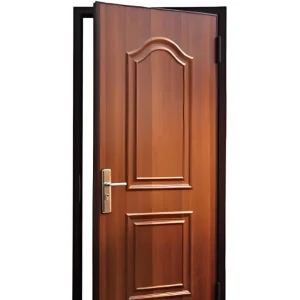
The entire door, including the skin, is made from MDF or high-density fiberboard (HDF). The moulded panel detail is pressed directly into the board during manufacturing. These are often confused with hollow core doors but are a distinct category.
Pros: Uniform density, excellent paint finish, no grain telegraphing, highly stable dimensions. MDF skins are more dent-resistant than thin veneer layers.
Cons: Heavy, susceptible to edge swelling in high humidity if not properly sealed. The material has no natural wood grain, which limits staining options — these doors are designed for painting.
Composite Skin Moulded Doors
The moulded face is made from a fiberglass-reinforced or polymer composite material, sometimes bonded to a wood core. This is a premium variant often used for exterior applications.
Pros: Exceptional dimensional stability, does not absorb moisture, resists cracking and peeling, can be finished to mimic wood grain or painted.
Cons: Higher cost, the composite skin can feel less “natural” to the touch, and requires specific adhesives for installation.
Wooden Moulded Doors vs. Solid Wood vs. Iron Single Doors: A Side-by-Side Comparison
For B2B projects, the comparison is rarely about absolute “best” — it is about matching material properties to project requirements. The table below breaks down the key attributes across the three door types.
| Attribute | Wooden Moulded Door | Solid Wood Door | Iron Single Door |
|---|---|---|---|
| Material Core | Hollow honeycomb, particleboard, or MDF | Solid lumber (oak, mahogany, pine) | Steel or wrought iron sheet over a frame |
| Relative Cost | Low to medium | High | Medium to high (depends on design) |
| Sound Insulation | Poor to fair (hollow core); good (solid core) | Excellent due to mass and density | Fair (metal transmits sound, lacks mass damping) |
| Thermal Insulation | Fair (solid core); poor (hollow core) | Good — natural wood is a natural insulator | Poor — metal is a thermal bridge unless thermally broken |
| Durability / Warping | High dimensional stability, resists warping | Prone to warping, cupping, and splitting with humidity changes | Highly durable, no warping, but prone to dents and rust without coating |
| Security | Low to moderate (hollow core is easy to kick through) | Moderate (solid wood resists impact) | High (metal is difficult to breach) |
| Maintenance | Low — paint or re-paint as needed | High — requires periodic sealing, staining, or varnishing | Moderate — needs rust prevention and repainting |
| Aesthetic Versatility | High — moulded skins mimic paneled designs; paint-grade finish | High — natural grain, can be stained | Limited — typically industrial or custom wrought designs |
| Weight | Light (hollow) to medium (solid core) | Heavy | Heavy |
When to choose which:
- Choose wooden moulded doors for interior rooms in hotels, offices, and residential projects where budget, paintability, and warp-resistance are priorities.
- Choose solid wood doors for high-end residential or heritage projects where natural grain, acoustic performance, and prestige justify the cost and maintenance.
- Choose iron single doors for exterior entry points or security-sensitive areas where forced-entry resistance is the primary requirement, and thermal performance can be managed with a storm door or thermal break.
How to Choose the Right Wooden Moulded Door for Your Project
Selection is not a single decision — it is a matrix of performance requirements. Here is how to evaluate each factor.
Core Material and Location
Match the core to the environment. Hollow core is acceptable for dry interior spaces like bedrooms or closets. Solid core with MDF is better for bathrooms, kitchens, or any area with humidity variance. For exterior applications, specify a composite skin or a solid core with a moisture-resistant sealer — standard MDF will swell at the edges if exposed to weather.
Finish and Paintability
Moulded doors are paint-grade by nature. The quality of the moulded skin determines the final finish. A high-density skin with a smooth surface will require less sanding and fewer coats of paint. If you plan to stain, verify that the skin is a real wood veneer rather than a composite print. Most moulded doors are designed for painting, not staining.
Acoustic Performance
If sound transmission is a concern (e.g., between office conference rooms or hotel suites), do not rely on the door alone. A solid core moulded door combined with proper perimeter gasketing and an automatic door bottom will achieve a sound transmission class (STC) rating in the mid-30s range. Hollow core doors will be significantly worse. Specify the STC requirement to your supplier and ask for test data.
Security Hardware
The door is only as strong as its lock and hinges. For hollow core doors, the lock block is a small piece of wood glued into the core at the strike location. Verify its size and quality — a flimsy lock block is a common failure point. For solid core doors, standard mortise locks are fine. Always specify heavy-gauge hinges on solid core doors to prevent sagging.
Quality Standards and Testing: What to Look For
A reliable manufacturer does not just assemble doors — they test them. When evaluating a supplier, ask specifically about these three test protocols, which are critical for performance claims.
Air-Tightness Testing
This measures air leakage through the closed door assembly. A high-performing door will have a low air leakage rate, typically measured in cubic meters per hour per square meter (m³/h·m²). Look for results that meet or exceed local energy code requirements. Poor air-tightness leads to drafts and energy loss.
Water-Tightness Testing
Critical for exterior doors, this test involves spraying water at the door assembly under controlled pressure and checking for penetration. The test simulates driving rain conditions. A rating of Class 6 or higher (under EN 12208) is generally considered good for exterior applications. For interior doors, this test is less relevant but indicates overall build quality.
Wind Resistance Testing
This evaluates the door’s structural integrity under wind load. The frame and door must not deform permanently or suffer glass breakage (if glazed). This is non-negotiable for exterior doors in high-wind regions. Ask for the test pressure rating in Pascals (Pa) and compare it to your project’s local wind load requirements.
What this means for you: If a manufacturer cannot provide test reports for these three parameters, their performance claims are unverified. Request the actual test certificates, not just a verbal assurance. For interior doors, these tests are less critical, but a manufacturer who performs them on all products demonstrates a higher overall quality culture.
Procurement Guide: Working with a Factory Supplier
Sourcing wooden moulded doors from a factory, particularly overseas, requires attention to logistics and specification. Here is how the process works and what to evaluate.
MOQ, Lead Time, and Shipping
Minimum order quantities (MOQs) vary significantly by factory. Some accept orders as low as a single container (FCL), while others offer less-than-container-load (LCL) options for smaller projects. Lead times typically range from 2–6 weeks for standard sizes and finishes, with custom sizes or bespoke moulding patterns extending this timeline. Always confirm lead time in writing and factor in sea freight transit time, which can be 4–8 weeks depending on the destination port.
Documentation and Compliance
A competent export supplier will provide a packing list, proforma invoice, and full customs documentation. Verify that the wood used complies with international phytosanitary standards (ISPM 15) for treated wood packaging. If your project requires specific building code compliance, the factory should be able to adjust the profile structure and fittings to match your local regulations.
Supplier Evaluation Criteria
When vetting a factory, focus on these verifiable factors rather than marketing claims:
- Manufacturing capability: Ask what production processes are done in-house versus outsourced. A factory that controls its own moulding, pressing, and finishing has tighter quality control.
- Pre-shipment inspection: Does the factory have an internal quality control process? Ask about their inspection points — raw material intake, post-press, and final pre-shipment. A third-party inspection report is a good sign.
- Communication and documentation: Can they provide clear technical drawings and spec sheets? Their ability to communicate specifications accurately is a proxy for their manufacturing precision.
- Customization flexibility: The ability to adjust profiles, sizes, and hardware is critical for projects that do not fit standard dimensions.
Here is how we meet these standards as a manufacturer. At Jusen Door and Windows Manufacturing Co., Ltd., we supply directly from our factory, which means you are working with the producer, not a trading company. This direct relationship allows us to offer full customization on size, color, glass, and hardware accessories without middleman markup. Our pre-shipment inspection protocol includes air-tightness, water-tightness, and wind resistance testing, ensuring the doors we ship meet the performance specifications we quote. For international buyers, we provide complete export documentation, including packing lists and proforma invoices, and we can adjust our profile structures to align with your local building codes. Whether you need OEM, ODM, or bulk construction project supply, our experience in foreign trade ensures smooth logistics for both FCL and LCL shipments. Contact Our Team to discuss your project specifications.
Frequently Asked Questions
Are moulded doors good quality?
Yes, when specified correctly. The quality is determined by the core material and skin density. A solid core moulded door with a high-density MDF skin offers excellent dimensional stability and impact resistance, outperforming solid wood in resistance to warping. The perception of “cheapness” is usually associated with hollow core doors, which are a budget product by design.
Can moulded doors be painted or stained?
Most moulded doors are designed for painting. The smooth, uniform surface of the skin accepts paint exceptionally well. Staining is only possible if the door features a real wood veneer skin. If staining is required, specify a wood veneer moulded door rather than a composite or MDF skin.
How much do wooden moulded doors cost?
Cost varies widely based on core type, skin material, size, and finish. Hollow core doors are the most economical, while solid core and composite skin doors approach the price of entry-level solid wood. For accurate budgeting, request quotes based on your specific specification — published prices without core and skin details are not reliable.
How do moulded doors compare to solid wood doors?
Solid wood doors offer superior acoustic mass and a natural grain that cannot be replicated. However, they are prone to warping and require ongoing maintenance. Moulded doors offer superior dimensional stability, a flawless paint finish, and a significantly lower cost. For high-humidity environments, a moulded door is often the more practical choice.
Are moulded doors durable?
Durability depends on the core and skin. Hollow core doors are susceptible to impact damage and are not suitable for high-traffic commercial areas. Solid core and composite skin doors are highly durable, resisting dents and scratches better than many solid wood species. The skin’s surface is also resistant to cracking and peeling, provided it is painted with a quality exterior-grade paint for exterior applications.
Additional Considerations: Moulded Doors and Iron Single Doors in Context
The Role of Moulded Doors in Mixed-Material Projects
In many commercial and residential projects, the “iron single door” is specified for the primary entrance to maximize security, while wooden moulded doors are used for interior rooms and secondary exits. This combination balances budget and performance. A steel entry door handles the security requirement, while moulded interior doors provide the aesthetic continuity and cost savings. When planning this mix, ensure the architectural style of the iron door complements the panel design of the moulded doors to maintain design cohesion.
Sustainability and Environmental Impact
Moulded doors offer a sustainability advantage over solid wood. They utilize wood fibers and recycled materials in the core, maximizing the yield from each tree harvested. High-quality MDF cores are often manufactured from post-industrial recycled wood. If environmental certification is required for your project, ask the supplier for documentation on the source of their wood fibers and whether their MDF is CARB or E1 certified for low formaldehyde emissions. This is a verifiable data point that separates responsible manufacturers from those simply assembling components.
Final Recommendation
For B2B buyers, wooden moulded doors represent the most balanced option for interior applications where budget, stability, and paintability are the primary drivers. They are not a substitute for the acoustic performance of solid wood or the security of iron, but they are a superior choice for most standard interior requirements.
Choose wooden moulded doors if: your project requires consistent quality across many units, you need a stable substrate for a painted finish, and you want to avoid the warping issues common with solid wood.
Choose a solid core or composite skin moulded door if: you need better sound insulation and impact resistance without moving to the cost and maintenance of solid wood.
Choose an iron single door if: the application is a primary exterior entrance with high security requirements, and you can manage the thermal performance with a proper thermal break or storm door system.