Solid Core Interior Doors Prehung: The Bottom Line
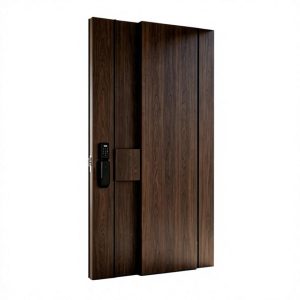
If you are specifying interior doors for a commercial project, multifamily build, or high-end residential renovation, solid core interior doors prehung are the most reliable way to balance sound control, weight, and durability without paying solid wood prices. A prehung unit—door slab mounted on jambs with hinges and a pre-drilled latch bore—arrives ready to set into a rough opening, saving significant framing and alignment labor. The key trade-off is weight: these doors are heavy, and the frame must be shimmed and anchored properly. Buyers who prioritize noise reduction and impact resistance over the natural grain of solid wood should shortlist solid core units immediately.
Solid Core vs. Hollow Core vs. Solid Wood: What’s the Difference?
Understanding the internal construction is the first decision point. All three options look similar from the outside, but performance and cost diverge sharply.
Hollow core doors are essentially a honeycomb cardboard structure sandwiched between two thin veneer faces. They are light (typically 20–30 lbs for a 36-inch door), inexpensive, and easy to install. They offer minimal sound insulation and feel flimsy when knocked. For closets, laundry rooms, or areas where noise is irrelevant, they are acceptable. For bedrooms, offices, or bathrooms, they are a poor choice.
Solid core doors use a dense engineered interior—typically particleboard, wood composite, or a mix of wood fibers—bonded between veneer faces. The core is what gives the door its mass. A 36-inch solid core slab commonly weighs 70–90 lbs, depending on core density and thickness. This mass directly translates to sound absorption and a substantial feel when closing. They resist denting and warping better than hollow units and accept screws and hinges more securely.
Solid wood doors are constructed from stiles and rails of natural lumber, often with wood panels. They offer the most premium aesthetic and can be refinished multiple times. However, they are expensive, prone to seasonal movement (expansion and contraction), and their acoustic performance depends heavily on the panel design—a paneled solid wood door can perform worse than a flush solid core door because thin panels transmit sound. Solid wood also requires more maintenance in climates with humidity swings.
For most contract and commercial applications, solid core delivers the best cost-to-performance ratio. The table below summarizes the trade-offs.
| Feature | Hollow Core | Solid Core | Solid Wood |
|---|---|---|---|
| Weight (36″ slab) | 20–30 lbs | 70–90 lbs | 60–100 lbs |
| Sound insulation | Poor | Good to Excellent | Variable |
| Impact resistance | Low | High | High |
| Moisture stability | Moderate | Good | Poor (seasonal movement) |
| Cost | Low | Moderate | High |
| Refinishing potential | Limited | Moderate | Excellent |
| Best use | Closets, utility | Bedrooms, offices, corridors | High-end residential, feature doors |
Prehung vs. Slab: Which Unit Type Should You Choose?
A slab door is just the door itself—no frame, no hinges, no hardware. You must build or source the jamb separately, cut hinge mortises, bore for the latch, and align everything on site. Slab doors are cheaper per unit and offer flexibility if you are reusing existing frames. However, labor costs and the skill required to hang a heavy solid core door properly often erase the savings.
A prehung unit includes the door slab mounted on a factory-assembled jamb, with hinges attached and the latch bore pre-drilled. The installer sets the entire unit into the rough opening, shims the jambs plumb and square, and screws through the jamb into the wall framing. This is faster, more accurate, and reduces the risk of misaligned hardware.
For solid core doors specifically, prehung is strongly recommended. The weight of the slab makes field-hanging difficult; a prehung unit ensures the hinges are aligned to the jamb, which prevents sagging and binding over time. Prehung units also allow the factory to pre-install weatherstripping or sound seals, which are critical for acoustic performance.
| Factor | Prehung Unit | Slab Only |
|---|---|---|
| Unit cost | Higher | Lower |
| Installation labor | Lower | Higher |
| Skill required | Moderate | High |
| Alignment accuracy | Factory-set | Field-dependent |
| Hardware installation | Pre-drilled | On-site |
| Best for | New construction, renovations | Reusing existing jambs, custom frames |
Panel Styles Explained: Flush, 2-Panel, 5-Panel, and 6-Panel
The panel configuration affects aesthetics, structural rigidity, and acoustic performance. The core remains solid regardless of style, but the surface design changes how the door integrates with your interior.
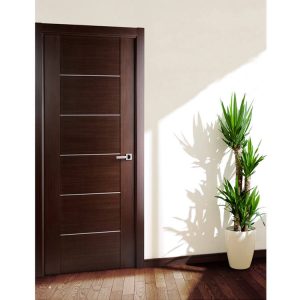
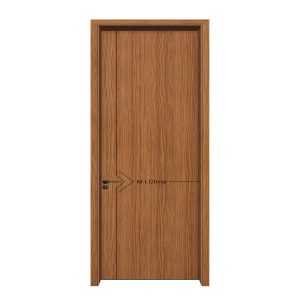
Flush solid core doors feature a perfectly flat surface on both sides. This is the most common choice for commercial corridors, offices, and modern interiors. Flush doors offer the best soundproofing because the entire face is a continuous, unbroken surface with no thin panels or joints. They are also the easiest to clean and the most cost-effective to manufacture. The downside is a utilitarian appearance that may feel too plain for residential applications.
2-panel solid core doors (often called “colonial” or “mission” style) feature two large rectangular panels, typically one above the other. The panels are recessed, creating visual interest while maintaining a clean, traditional look. The panel recesses reduce the effective surface area, slightly diminishing acoustic performance compared to flush, but the difference is minor for most applications.
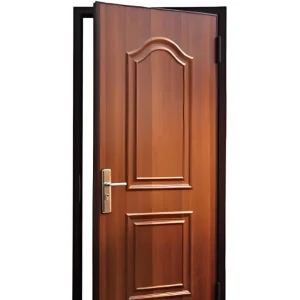
5-panel and 6-panel solid core doors are the classic residential styles. Five-panel designs often feature a larger lower panel with smaller upper panels, while six-panel doors have a symmetrical grid of three panels on each side. These styles suit traditional and transitional interiors. The additional panel divisions add rigidity and visual depth. However, each recessed panel is a potential weak point for sound transmission—the thin panel sections vibrate more than a flat face. For critical acoustic applications, a flush door is superior.
When choosing a panel style, consider the architectural context. A 6-panel door in a modern minimalist office will look out of place. A flush door in a Victorian home will feel sterile. Match the panel style to the interior design language of the building.
Sizes, Weights, and Specifications: What to Look For
Standard interior door heights are 80 inches (6’8″) and 84 inches (7’0″). Widths range from 24, 28, 30, 32, to 36 inches, with 36 inches being the most common for main bedrooms and public spaces. The standard thickness is 1-3/8 inches for interior doors, though 1-3/4 inches is available for higher-end or commercial applications.
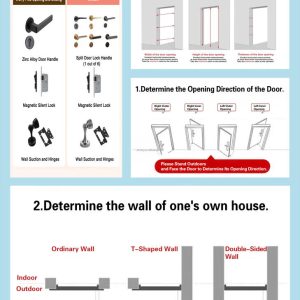
The most common specification is the 36 x 80 interior door solid core unit. This fits a rough opening of approximately 38 x 82 inches. Always measure the rough opening—the framed gap in the wall—not the finished doorway. Prehung units include jambs that adjust to wall thicknesses, typically 4-9/16 inches for standard 2×4 framing and 6-9/16 inches for 2×6 framing.
Weight is a critical specification that many buyers underestimate. A 36-inch solid core prehung unit with jambs and hardware can weigh 100–120 lbs. This affects shipping costs, handling on site, and the strength required of the wall framing. Heavier doors require heavier-duty hinges (typically 3 hinges rated for the door weight) and may need reinforced framing to prevent sagging.
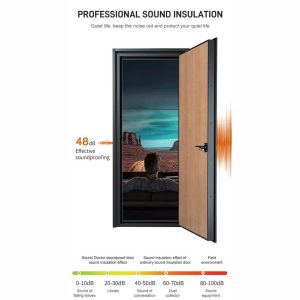
Sound transmission is measured by STC (Sound Transmission Class) rating, tested per ASTM E90. Solid core doors typically achieve STC ratings in the mid-to-high 20s to low 30s, depending on the core density, thickness, and whether perimeter seals are installed. A hollow core door typically rates in the low 20s. For comparison, a standard interior wall achieves STC 35–40. To maximize soundproofing, pair a flush solid core door with a perimeter gasket or drop seal.
Fire ratings are separate from STC. A solid core door can achieve fire ratings of 20, 45, 60, or 90 minutes, but only if it is specifically tested and labeled to standards such as UL 10C or NFPA 252. The label is applied by the manufacturer and includes the rating, the test standard, and the listing agency. If fire rating is required by local code—typically for stairwells, mechanical rooms, or occupancy separations—you must specify a labeled door. Do not assume a solid core door is automatically fire-rated; verify the label.
Comparison Table: Solid Core Prehung Door Options
| Door Type | Core Material | Weight (36″x80″) | STC Range | Fire Rating Available | Typical Use |
|---|---|---|---|---|---|
| Flush Solid Core | Particleboard/composite | 75–90 lbs | 28–32 | Yes (20–90 min) | Offices, corridors, acoustic rooms |
| 2-Panel Solid Core | Particleboard/composite | 70–85 lbs | 26–30 | Yes (20–60 min) | Residential, hospitality |
| 5-Panel Solid Core | Particleboard/composite | 70–85 lbs | 25–29 | Yes (20–45 min) | Residential, traditional interiors |
| 6-Panel Solid Core | Particleboard/composite | 70–85 lbs | 25–29 | Yes (20–45 min) | Residential, traditional interiors |
| Solid Wood | Natural lumber | 60–100 lbs | 24–30 | Yes (varies) | High-end residential, feature doors |
How to Choose a Supplier for Your Project
Supplier selection is where many projects succeed or fail. For B2B buyers ordering multiple units, the evaluation criteria extend beyond unit price. You need a partner who can deliver consistent quality, meet customization requirements, and handle logistics reliably.
Quality control is the first filter. Ask how the factory tests its doors. Reputable manufacturers perform air-tightness, water-tightness, and wind resistance tests on their window and door systems. For interior doors, the relevant checks are dimensional accuracy, squareness, and hinge alignment. A pre-shipment inspection that verifies these parameters prevents the costly problem of receiving doors that do not fit their rough openings.
Customization capability matters for projects with non-standard requirements. Can the factory adjust the door size, panel configuration, veneer finish, or hardware preparation? Can they match a specific color or wood species? Full customization on size, color, glass (for doors with lites), and hardware accessories is a significant advantage when your project demands it. Some manufacturers also offer adjustable profile structures and fittings to match local building codes of the target market—essential for international projects.
Logistics and documentation are the third pillar. A supplier experienced in foreign trade should provide packing lists, proforma invoices, and full customs documentation. They should handle both FCL (full container load) and LCL (less than container load) shipments. Direct delivery from the factory, without middleman markup, reduces both cost and communication delays. Ask about their export experience to your country and whether they can advise on local code compliance.
Here is how we meet these standards at Jusen Door and Windows Manufacturing Co., Ltd. As a factory-direct manufacturer, we supply solid core prehung interior doors alongside our solid wood and thermal-break aluminum product lines. Our pre-shipment inspection includes dimensional checks and hardware alignment verification. We offer full customization on size, panel style (flush, 2-panel, 5-panel, 6-panel), veneer finish, and hardware preparation. For international buyers, we provide complete export documentation and can ship FCL or LCL directly from our China factory. Our experience with overseas projects allows us to adjust profiles and fittings to align with local building codes. We also support OEM and ODM projects, including private label production and bulk supply for construction projects.
When evaluating suppliers, request samples or visit the factory if possible. Verify their production capacity against your order volume. Confirm lead times in writing. And always ask for the fire rating label and STC test data if these are project requirements.
Frequently Asked Questions About Solid Core Prehung Doors
What are the main advantages of solid core interior doors over hollow core doors?
Solid core doors offer superior sound insulation, higher impact resistance, and a more substantial feel. They block approximately 10–15 dB more sound than hollow core doors, making them essential for bedrooms, offices, and any space where privacy matters. They also resist dents and hold hardware more securely.
What is the difference between a prehung door and a slab door?
A prehung door arrives with the slab mounted on jambs with hinges and a pre-drilled latch bore, ready to install into a rough opening. A slab door is just the door panel, requiring you to build or source the frame and install all hardware on site. Prehung units are faster and more accurate to install, especially for heavy solid core doors.
What panel styles are available for solid core interior doors?
Flush, 2-panel, 5-panel, and 6-panel configurations are standard. Flush doors offer the best acoustic performance and a modern look. Paneled styles provide traditional aesthetics but slightly reduce soundproofing due to recessed panel sections.
What are the standard sizes for solid core prehung interior doors?
Standard widths are 24, 28, 30, 32, and 36 inches. Standard heights are 80 and 84 inches. The most common specification is 36 x 80 inches, requiring a rough opening of approximately 38 x 82 inches. Custom sizes are available from most manufacturers.
How much do solid core prehung interior doors typically weigh?
A 36-inch solid core slab weighs 70–90 lbs. The complete prehung unit with jambs and hardware adds 20–30 lbs, bringing the total to 100–120 lbs. Weight affects shipping costs, handling, and hinge requirements.
What should I look for in a manufacturer or supplier for bulk B2B orders?
Evaluate quality control procedures, customization capabilities, export documentation experience, and logistics handling. Verify that pre-shipment inspections cover dimensional accuracy and hardware alignment. Confirm lead times and production capacity in writing.
Can solid core prehung doors be customized in size, panel design, or finish?
Yes. Reputable manufacturers offer custom sizing, panel configurations, veneer species, and color matching. Hardware preparation can be adjusted to accommodate specific locksets and hinges. For international projects, some manufacturers adjust profile structures to meet local building codes.
What is the best solid core prehung interior door option for soundproofing?
A flush solid core door with a perimeter gasket or drop seal offers the best acoustic performance. The continuous flat face minimizes vibration, and the seal eliminates gaps that leak sound. Look for STC ratings of 30 or higher for critical applications.
Are solid core doors fire rated?
Only if specifically tested and labeled. Fire ratings of 20, 45, 60, or 90 minutes are available, but the door must carry a label referencing the test standard (UL 10C, NFPA 252). Verify the label before specifying for code-required locations.
How much do solid core prehung interior doors cost?
Cost varies with size, core density, veneer quality, panel style, and hardware. Solid core doors typically cost 30–50% more than hollow core doors but significantly less than solid wood. For bulk B2B orders, factory-direct pricing reduces per-unit costs substantially. Factor in jamb, hardware, and professional installation labor when budgeting.