Content Menu
● 1. What Is a Prehung Front Door?
● 2. Core Product Categories and Material Performance
● 3. Technical Specifications: What to Verify Before Ordering
● 4. The B2B Procurement Framework: Evaluating Suppliers
● 5. Supply Chain and Logistics: Lead Times and Freight
● 6. Cost Analysis: Budgeting for Prehung Front Doors
● 7. The Production Process: From Raw Material to Finished Door
● 8. Meeting the Industry Standard: How We Serve as a Direct Factory Partner
● 9. Case Scenarios: How Different Buyers Source Prehung Front Doors
● 10. Frequently Asked Questions
12 min read
The first question a contractor asks when a prehung door shipment arrives is rarely about the finish. It is about whether the jamb survived the ocean crossing without twisting. Prehung front doors are not just products — they are a logistics and installation solution. For importers, distributors, and construction firms, the difference between a profitable project and a costly one often comes down to how well the factory builds, packs, and tests these units before they leave the production floor.
This guide covers the technical anatomy of prehung units, the materials that matter, the testing standards buyers should demand, and the procurement frameworks that separate reliable factories from trading companies with a website.
What Is a Prehung Front Door?
A prehung front door is a complete entry unit delivered with the door slab already mounted onto a factory-assembled jamb, with hinges attached and the lockset bore pre-drilled. It ships as one ready-to-install unit, eliminating the need for on-site framing, hinge routing, and alignment work.
This factory assembly is the core advantage. When a door slab arrives separately from its frame, the installation crew must build the jamb, mortise the hinges, and shim everything into a rough opening. Each step introduces error. A prehung unit removes those variables. The door arrives aligned, weatherstripped, and ready to be screwed into the wall opening.
Anatomy of a Prehung Unit
- Door slab: The actual door panel. Materials range from solid wood (mahogany, oak, walnut) to aluminum alloy, steel, and fiberglass.
- Jamb (frame): The vertical and horizontal frame pieces that surround the door. Factory-assembled and pre-drilled for hinges and latch.
- Weatherstripping: Pre-installed around the perimeter to seal air and water gaps.
- Sill pan and threshold: The bottom component that manages water drainage and provides the floor transition.
- Factory alignment: Because all components are assembled on a flat, controlled surface, the door-to-jamb gap remains consistent — typically 1/8 inch on the sides and top.
Prehung vs. Slab Doors
| Factor | Slab Door | Prehung Door |
|---|---|---|
| Components | Door panel only | Door + jamb + hinges + weatherstripping |
| On-site labor | High — frame must be built and fitted | Low — mount unit into rough opening |
| Installation time | 2–4 hours per door | 30–60 minutes per door |
| Unit cost | Lower | Higher |
| Total installed cost | Higher (labor + materials + waste) | Lower for large projects |
| Alignment consistency | Depends on installer skill | Factory-controlled |
For a 200-unit residential development, the labor savings alone can justify the higher unit price of prehung doors. Slab doors require skilled carpenters on-site; prehung units can be installed by general crews with basic tools.
Disadvantages Buyers Must Consider
Prehung units are not without trade-offs. Transportation bulk is the most obvious issue. A prehung door takes up roughly three times the cargo volume of a flat-packed slab. Freight cost per unit rises accordingly. Storage is another concern — prehung units need dry, covered storage on-site. Exposure to moisture can warp the jamb, which defeats the factory alignment advantage. Finally, jamb width matching matters. If the wall thickness does not match the jamb depth, the unit will not fit flush. Retrofit projects often require custom jamb sizing, which adds lead time.
Core Product Categories and Material Performance
The material choice determines price, performance, and the market segment you can serve. Each category has distinct characteristics that matter at the procurement level.
Solid Wood Prehung Front Doors
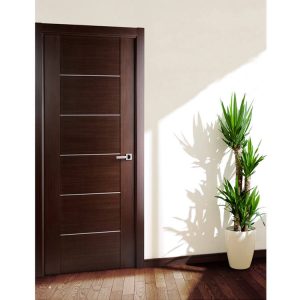
Solid wood remains the premium choice for residential entry doors. Mahogany leads the category because of its dimensional stability and natural rot resistance. Unlike oak or walnut, mahogany holds up well in exterior exposure without excessive movement.
Common configurations in the current market include:
- Craftsman Mahogany 1-Lite and 3-Lite designs — single or triple vertical glass panels framed by solid wood stiles and rails
- Monte Carlo and European-inspired designs — clean, single-panel faces with minimal ornamentation
- Horizontal plank (multi-plank) configurations — modern, geometric facades for contemporary homes
- Vertical lite and 5-rectangle lite layouts — traditional profiles that suit classic architectural styles
Factory-applied UV-resistant finishes are critical for wood doors. A door that ships unfinished will absorb moisture during transit and require extensive sanding and refinishing on-site. Factory finishing adds cost, but it protects the product through the logistics chain.
Aluminum Alloy and Thermal-Break Doors
For commercial projects and high-performance residential builds, aluminum alloy doors with thermal-break profiles are gaining traction. The thermal-break design separates the interior and exterior aluminum frames with a polyamide strip, reducing heat transfer significantly.
Key performance metrics include:
- U-value (thermal transmittance): Thermal-break profiles achieve U-values below 1.0 W/m²K with proper glazing
- Wind load resistance: Structural testing per ASTM E330 verifies performance under hurricane-force conditions
- Glass configurations: Double or triple glazing with Low-E coatings and argon gas fill
Aluminum doors are also fully recyclable, which matters for projects pursuing LEED or BREEAM certification.
Steel and Fiberglass Options
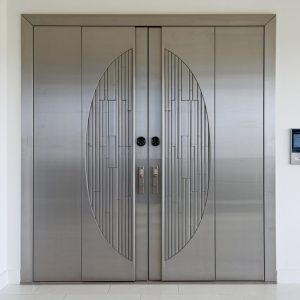
Steel doors offer high security and low maintenance but conduct heat readily. Fiberglass doors mimic wood grain while providing superior dent resistance and insulation. For B2B buyers, a mixed portfolio covering wood, aluminum, steel, and fiberglass allows service to both residential and commercial segments from the same supply relationship.
Technical Specifications: What to Verify Before Ordering
The performance claims of a door are meaningless without test data. Serious buyers request documented evidence before placing a purchase order.
Performance Testing Standards
| Test | Standard | What It Verifies |
|---|---|---|
| Air-tightness | ASTM E283 or EN 1026 | Air leakage through the closed unit |
| Water-tightness | ASTM E547 or EN 1027 | Resistance to water penetration under pressure |
| Wind load resistance | ASTM E330 | Structural integrity under wind pressure |
| Thermal performance | ASTM C518 or EN 10077 | U-value and insulation performance |
These tests determine whether a door can be used in high-rise buildings, coastal zones, or extreme weather locations. A door that passes ASTM E330 at 50 psf may fail at 80 psf. Buyers must match test ratings to the project’s local wind code requirements.
Hardware and Accessories
Hardware quality is a common failure point. Ball-bearing hinges last significantly longer than plain-bearing equivalents under heavy daily use. Stainless steel grades matter — 304 stainless is standard for interior use; 316 stainless is required for coastal environments where salt corrosion is a risk.
Multi-point locking systems add security but also add 10–20% to unit cost. Smart locks and mortise locks each have different bore patterns, so the factory must know the lockset specification before production begins.
Sizing and Local Code Compliance
Standard prehung sizes cover 30-inch, 32-inch, and 36-inch widths with 80-inch and 84-inch heights. Custom sizing is available but requires precise rough opening dimensions.
Local building codes frequently dictate energy efficiency requirements, fire ratings, and egress clearances. ENERGY STAR certification, Passive House standards, and local fire codes all affect door specification. A factory that can adjust profile structure and fittings to match target market codes is more valuable than one that only produces fixed standard sizes.
The B2B Procurement Framework: Evaluating Suppliers
This section provides a structured approach to vetting prehung door factories, particularly when sourcing internationally.
Factory vs. Middleman
The cost difference between direct factory sourcing and buying through a trading company typically ranges from 15% to 30%. Trading companies add markup for their coordination role. What they rarely add is quality control or production oversight.
Verification steps for direct factory sourcing:
- Request factory audit reports from third-party inspection agencies (SGS, Bureau Veritas, TÜV)
- Ask for production line videos showing current orders in progress
- Verify export licenses and customs registration
- Request samples — pay for them if necessary; free samples often reflect little about production quality
Red Flags to Avoid
- Inability to provide test reports — a factory that cannot show ASTM or EN test data likely has not tested its products
- Vague lead times — a supplier that cannot commit to shipping dates will disrupt construction schedules
- Refusal to share packing details — this hides poor packaging standards that cause transit damage
- No customization capability — fixed sizes limit your market reach
Questions to Ask Before Ordering
- What is your current production capacity per month?
- Can you provide test reports for air-tightness, water-tightness, and wind load?
- What is your MOQ for custom sizes versus standard sizes?
- Do you offer OEM production to our exact drawings?
- What is your pre-shipment inspection process?
- Can you ship FCL and LCL?
Choose A if… Choose B if…
Choose a direct factory if you need competitive pricing, custom configurations, and control over quality. Choose a trading company only if you are ordering very small quantities and need someone to consolidate multiple product categories into one shipment.
Supply Chain and Logistics: Lead Times and Freight
Production lead times follow a predictable pattern:
- Standard products: 15–30 days depending on volume
- Custom orders: 30–45 days due to material procurement and finishing
Buyers should align order placement with construction schedules. Storing prehung doors on-site for months increases the risk of damage and ties up working capital.
Shipping options:
- FCL (Full Container Load): Cost-efficient for bulk orders. Reduces handling damage risk since the container is loaded once at the factory and sealed until destination.
- LCL (Less than Container Load): Suitable for samples or first trial orders. Higher per-unit freight cost but lower absolute cost for small volumes.
Packing standards matter significantly for prehung doors. Each unit should be individually wrapped with protective corner guards. Wooden crates provide the best protection but add weight and require fumigation certificates for international shipping.
Cost Analysis: Budgeting for Prehung Front Doors
Wholesale pricing for prehung front doors varies widely by material, glass, hardware, and finish. The framework below helps buyers understand cost drivers.
Price Determinants
- Material: Mahogany commands a premium; aluminum alloy sits mid-to-high; steel is the entry-level option
- Glass: Single glazing is cheapest. Low-E triple glazing with argon fill adds substantial cost — typically 20–40% over single glazing
- Hardware grade: Imported multi-point locks add 10–20% to unit cost
- Finish: Factory UV finish adds cost but eliminates field finishing labor
Total Landed Cost Calculation
The formula every buyer should use:
FOB Price + Ocean Freight + Insurance + Customs Duty + Inland Freight = Total Landed Cost
Always request both FOB and CIF quotes. Comparing these reveals how much the supplier is adding for freight and insurance, and whether their pricing is competitive.
The Production Process: From Raw Material to Finished Door
Understanding how a prehung door is manufactured helps buyers evaluate supplier claims and identify quality indicators during factory visits.
Wood Door Production
- Lumber selection and conditioning: Kiln-dried lumber is sorted for grain pattern and defects. Moisture content should be 8–12% before machining.
- Stile and rail machining: The frame components are cut, profiled, and joined. Mortise-and-tenon joints are standard for exterior doors.
- Panel assembly: The door is assembled with the selected glass configuration or solid panel. Glue is applied under pressure.
- Sanding and finishing: The assembled door is sanded through progressive grits, then finished with UV-resistant coatings. Factory finishing typically involves multiple coats with sanding between each.
- Jamb assembly: The jamb is machined, assembled, and fitted with weatherstripping and the sill pan.
- Hanging: The door slab is hung on the jamb with hinges. Gap consistency is checked.
- Pre-shipment testing: Air-tightness, water-tightness, and wind resistance samples are tested.
Aluminum Door Production
- Profile extrusion: Aluminum billets are heated and extruded through dies to create the door frame profiles.
- Thermal-break assembly: Polyamide strips are inserted between interior and exterior profiles.
- Cutting and machining: Profiles are cut to length and machined for hardware.
- Surface treatment: Anodizing or powder coating provides corrosion resistance and color.
- Glass installation: Insulated glass units are installed with structural sealant.
- Assembly and testing: The complete unit is assembled and tested for performance.
Meeting the Industry Standard: How We Serve as a Direct Factory Partner
The procurement framework above describes what buyers should expect from a serious manufacturer. Here is how we fit into that picture.
As a manufacturing plant, we supply prehung front doors directly to importers, distributors, and contractors. No trading company sits between our production floor and your container. This structure is what allows competitive pricing — the margin that a middleman would take is either eliminated or reinvested into materials.
Our customization capability covers size, color, glass type, and hardware accessories. The adjustable profile structure and fittings are engineered to match local building codes across different target markets, which is essential for buyers who export to multiple countries with varying requirements. Whether your project needs specific wind load ratings for coastal zones or thermal efficiency for cold climates, the configuration can be adapted during production.
Quality assurance is built into the process. Every batch undergoes strict pre-shipment inspection covering the air-tightness, water-tightness, and wind resistance tests discussed earlier in this guide. These are not paper certifications — they are physical tests performed on the actual production run.
Export logistics are straightforward. Our foreign trade experience means we provide complete documentation — packing lists, proforma invoices, and customs paperwork — and ship via FCL or LCL directly from our factory.
Case Scenarios: How Different Buyers Source Prehung Front Doors
The Importer/Distributor
An importer testing a new market might start with a mixed container of solid wood and aluminum units to gauge local demand. The first order ships LCL — perhaps 15–20 units of each material. Once the market responds, repeat orders shift to FCL with adjusted product mix.
The General Contractor
A contractor managing a 200-unit residential development needs consistent sizing across all units. The jamb depth must match the wall thickness exactly. Delivery is staggered to align with construction phases, avoiding on-site storage issues.
The Lumberyard/Retail Chain
A lumberyard stocking prehung doors for local contractors needs private label branding on the door slab and packaging. Inventory must be stable, with quick restocking for popular sizes.
Frequently Asked Questions
What is a prehung front door?
A prehung front door is a complete entry unit that includes the door slab, frame (jamb), hinges, and pre-drilled lockset holes, all assembled at the factory. It installs directly into a rough opening without on-site framing or hinge routing.
What are the disadvantages of a prehung exterior door?
The main disadvantages are higher unit cost compared to slab doors, increased shipping bulk, the need for dry storage on-site, and the requirement that jamb width matches wall thickness exactly.
What is the difference between a prehung door and a regular door?
A regular slab door is just the door panel. A prehung door includes the frame and hinges already installed. Prehung units install faster and ensure better alignment and sealing; slab doors require the frame to be built and fitted on-site.
How much is a prehung front door?
Wholesale pricing varies significantly by material, glass type, and hardware. Solid wood units are the most expensive, followed by aluminum and steel. Buyers should request FOB and CIF quotes to calculate total landed cost accurately.
Can prehung front doors be made to custom sizes?
Yes, reputable factories offer full customization on width, height, jamb depth, and profile structure to match local building codes and rough openings.
What is the typical lead time for a bulk order?
Standard production takes 15–30 days. Custom orders with unique finishes or hardware may take 30–45 days. Lead time also depends on order volume and the factory’s current production schedule.
What testing should buyers look for?
Buyers should verify air-tightness, water-tightness, and wind load resistance test results. These tests ensure the door performs under real weather conditions and meets local building code requirements.
Decision Guide: Making the Final Call
Choose a factory-direct supplier if you are ordering more than 50 units per year, need custom configurations, or serve multiple market segments with different code requirements.
Choose a trading company only for one-off small orders where consolidation convenience outweighs the 15–30% markup.
Choose solid wood for premium residential projects where appearance and natural material matter more than cost.
Choose aluminum with thermal break for commercial projects, coastal regions, or buildings with strict energy efficiency requirements.
The prehung front door market rewards buyers who understand the technical specifications behind the product. Testing standards, material performance, and factory verification are not bureaucratic hurdles — they are the difference between a door that performs for decades and one that fails within a season.
Ready to source prehung front doors for your next project or distribution line? Talk to our team about your specifications and volume requirements.
—
References
- ASTM International. “E283 Standard Test Method for Determining Rate of Air Leakage Through Exterior Windows, Skylights, Curtain Walls, and Doors Under Specified Pressure Differences Across the Specimen.” https://www.astm.org/e0283-19.html
- ASTM International. “E547 Standard Test Method for Water Penetration of Exterior Windows, Skylights, Doors, and Curtain Walls by Cyclic Static Air Pressure Difference.” https://www.astm.org/e0547-00r16.html
- ASTM International. “E330 Standard Test Method for Structural Performance of Exterior Windows, Skylights, Doors and Curtain Walls by Uniform Static Air Pressure Difference.” https://www.astm.org/e0330-21.html
- International Code Council. “International Building Code (IBC) — Door Requirements.” https://www.iccsafe.org/
- ENERGY STAR. “ENERGY STAR Certified Doors.” https://www.energystar.gov/products/windows_doors_and_skylights