Content Menu
● 1. 1. Understanding Double Wood Doors Entry: Types and Applications
● 2. 2. Material Science: Choosing the Right Wood for Double Entry Doors
● 3. 3. Engineering and Performance Standards for Double Wood Entry Doors
● 4. 4. Procurement Framework: How to Source Double Wood Entry Doors for Projects
● 5. 5. Common Mistakes When Buying Double Wood Entry Doors (And How to Avoid Them)
● 6. 6. How to Evaluate Double Wood Doors Entry Suppliers
● 7. 7. Production Process: From Raw Material to Finished Double Wood Entry Door
● 8. 8. Quality Control: What Buyers Should Verify
● 9. 9. Customization and OEM/ODM Options
● 10. 10. Ordering Process: MOQ, Lead Time, and Shipping
● 11. 11. How We Meet These Standards at Jusen Door and Windows Manufacturing Co., Ltd.
17 min read
The first time you watch a 400-pound pair of mahogany doors get lifted onto a test rig, you notice the hinges. They are not decorative brass straps. They are heavy steel blocks, each rated for a load most residential contractors never consider. The test rig pushes, pulls, and slams the doors 500,000 times. That is what a double wood doors entry system endures before it ships.
Most buyers never see that test. They see a photo, a price, and a promise. This article covers what happens in between — the material science, engineering standards, and procurement frameworks that separate a door lasting thirty years from one that sags in three.
—
1. Understanding Double Wood Doors Entry: Types and Applications
Direct answer: A double wood doors entry consists of two adjacent wood door panels (an active leaf and an inactive leaf) that open from the center, typically spanning 60 to 72 inches total. It is also called a double entry door, twin door, or French door when glazed. These systems serve grand residential entrances, commercial storefronts, and luxury villa projects where a single door cannot provide the required width or visual impact.
1.1 What Is a Double Door Entry Called?
Industry terminology varies by region and application:
| Term | Definition | Typical Use |
|---|---|---|
| Double entry doors | Two hinged leaves opening from center | Residential, commercial |
| French doors | Double doors with full or partial glazing | Patios, balconies, interior |
| Twin doors | Two leaves, often unequal width | Commercial, accessibility |
| Pairs | Architectural term for two matching leaves | Specification documents |
The configuration always includes an active leaf (operable, with the primary locking mechanism) and an inactive leaf (fixed with top and bottom bolts when closed). This distinction matters for hardware specification — the inactive leaf is the most common security weak point.
1.2 Why Spec Double Wood Doors for Entry Applications?
Wood remains the preferred material for entry doors in premium residential and hospitality segments for three measurable reasons:
- Thermal performance: Solid wood has a natural R-value of approximately 1.41 per inch — roughly 3–4 times better than aluminum and comparable to insulated steel. For a 1¾-inch slab, this translates to meaningful energy savings in heating-dominated climates [1].
- Acoustic damping: Wood’s cellular structure absorbs sound across a broader frequency range than metal or fiberglass. A solid wood door with perimeter seals achieves STC ratings of 30–35, compared to 25–28 for hollow-core alternatives [2].
- Structural integrity: A 1¾-inch solid wood leaf at 36 inches wide carries significant load. Engineered wood cores improve dimensional stability, reducing warping risk in humid climates.
For high-humidity coastal areas, prioritize moisture resistance — a mahogany or teak door costs more upfront but avoids finish failure and core rot within five years.
1.3 Double Wood Doors Entry vs. Single Entry Doors: A Procurement Perspective
| Factor | Single Door | Double Door |
|---|---|---|
| Opening width | 30″–42″ | 60″–72″ (two leaves) |
| Material cost | Base | 1.8–2.2× base |
| Hardware cost | 1 handleset | 2 handlesets + bolts |
| Installation labor | Standard | +30–50% (header/frame reinforcement) |
| Structural load | Moderate | High (header must support combined weight) |
Recommend double doors when the opening exceeds 48 inches. Below that, a single door with sidelites achieves similar aesthetics at lower cost and complexity.
—
2. Material Science: Choosing the Right Wood for Double Entry Doors
Direct answer: The best wood for double entry doors balances dimensional stability, rot resistance, and cost. Engineered cores (LVL or stave core) outperform solid wood for large double-leaf spans in climates with high seasonal humidity variation. For solid wood, mahogany (Sapele), white oak, and teak offer the best durability and stability for exterior applications.
2.1 Solid Wood vs. Engineered Wood Cores
The debate is not about quality — it is about application.
Solid wood construction (stave core with veneer faces, or solid slabs) offers:
- Premium appearance with continuous grain
- Higher structural rigidity and better acoustic performance
- Higher cost (30–50% more than engineered)
- Greater susceptibility to expansion/contraction (1–2% dimensional change across grain)
Engineered cores (laminated veneer lumber, particleboard core, or hollow-core with wood framing) provide:
- Dimensional stability: movement reduced by 50–70% versus solid wood
- Reduced weight (15–25% lighter)
- Lower cost and consistent flatness — critical for double doors where the center meeting stile must align perfectly
The Architectural Woodwork Institute (AWI) quality standards define three grades — Premium, Custom, and Economy — based on veneer matching, allowable defects, and construction tolerances [3]. For double door entries, specifiers should require at least Custom grade for exterior applications.
2.2 Popular Wood Species for Double Entry Doors
| Species | Density (kg/m³) | Rot Resistance | Price Index | Best Use |
|---|---|---|---|---|
| Sapele (Mahogany) | 640–700 | High | $$$ | Premium exterior, coastal |
| White Oak | 700–770 | Moderate | $$ | Commercial, high-traffic |
| Teak | 620–750 | Very High | $$$$ | Coastal, luxury |
| Walnut | 550–650 | Low-Moderate | $$$ | Interior, protected entries |
| Khaya (African Mahogany) | 510–560 | Moderate | $$ | Budget exterior |
Sapele has become the default choice for premium exterior wood doors, combining mahogany’s rot resistance with better dimensional stability and a 30–40% lower cost than genuine Honduran mahogany.
2.3 Glass and Hardware Integration for Double Wood Doors
A double door with glass panels changes the engineering calculus:
- Insulated glass units (IGUs): Spec double-glazed units (e.g., 5mm glass / 12mm argon gap / 5mm glass) for U-values below 0.30 W/m²K. Low-E coatings reduce solar heat gain coefficient (SHGC) by 40–60% [4].
- Laminated safety glass: Required for commercial applications and recommended for residential entries — 6.38mm laminated glass meets ANSI Z97.1 / CPSC 16 CFR 1201 [5].
- Hardware load ratings: A 36″ × 84″ solid wood leaf weighs 120–180 lbs. Use three hinges per leaf, rated at 150+ lbs each. Multi-point locking systems (3–5 points) are essential — a single-point lock on a double door is a structural weakness.
- Weather-stripping: Double doors need compression seals on the center meeting stile, perimeter, and threshold. Magnetic or bulb-type gaskets outperform compression seals over time.
Standard double door entry sizes: Two leaves at 30″ each (60″ total) or 36″ each (72″ total), with heights from 80″ to 96″. Custom sizes are common — confirm the factory’s capability for non-standard dimensions before ordering.
—
3. Engineering and Performance Standards for Double Wood Entry Doors
Direct answer: Double wood entry doors must pass air-tightness (ASTM E283), water penetration (ASTM E547/E331), and structural wind load (ASTM E330) tests. Double doors fail these tests more often than single doors due to the center meeting stile and threshold gap. Buyers should request certified test reports before placing bulk orders.
3.1 Air-Tightness, Water-Tightness, and Wind Load Resistance
| Standard | Test | Acceptance Criteria (Residential) |
|---|---|---|
| ASTM E283 | Air leakage at 1.57 psf (75 Pa) | ≤ 0.3 cfm/ft² |
| ASTM E547 | Water penetration at 3 psf (144 Pa) | No water penetration |
| ASTM E330 | Structural load (wind) | No permanent deformation at 50 psf |
Double doors have two inherent weak points: the center meeting stile and the threshold gap. Unlike a single door’s one continuous seal perimeter, a double door has two leaves that must seal against each other, the frame, and the threshold — creating four independent seal interfaces.
Buyers should ask for:
- Third-party test reports (not just in-house data)
- Test results specific to the quoted model
- Wind load ratings appropriate to the project’s geographic zone
3.2 Acoustic Performance and Thermal Insulation
For projects near airports, highways, or in mixed-use developments, acoustic performance becomes a specification requirement:
- STC rating: Standard wood doors achieve STC 28–32. Upgraded versions with acoustic seals and heavier cores reach STC 35–38. For reference, a standard interior wall is STC 40 [6].
- Thermal insulation: Wood’s natural R-value (1.41/inch) outperforms aluminum (R-0.03/inch) and is comparable to steel frames with thermal breaks. A 1¾” wood door achieves U-values of 0.40–0.50 W/m²K depending on glass area.
The glass trade-off: Every square foot of glazing reduces thermal performance by 30–50% versus opaque wood. If energy codes (e.g., ASHRAE 90.1, Title 24) drive your spec, minimize glass area or specify triple-glazed IGUs.
3.3 Fire-Rated Double Wood Doors (When Required)
When local building codes require fire ratings — typically for commercial means of egress or attached garage entries — the specification changes:
- Fire ratings: 20, 45, 60, or 90 minutes (UL 10C / NFPA 252)
- Construction: Mineral cores (e.g., magnesium oxide or vermiculite) replace wood cores; intumescent seals expand at 200°C to seal gaps; fire-rated glazing replaces standard glass
- Cost impact: Fire-rated wood doors cost 2–3× standard construction
A common misconception: fire-rated doors are simply thicker slabs. The frame, hinges, seals, and glazing must all be rated components. A fire-rated door in a non-rated frame provides no protection.
—
4. Procurement Framework: How to Source Double Wood Entry Doors for Projects
Direct answer: Before requesting quotes, define the project’s technical requirements, verify the supplier’s manufacturing capability, and confirm logistics. A factory-direct supplier eliminates middleman markup and provides direct quality control.
4.1 Key Specification Criteria Before You Request a Quote
Create a specification sheet before contacting suppliers:
| Category | Specification to Define |
|---|---|
| Dimensions | Door size, frame size, wall thickness, threshold height |
| Material | Wood species, core type, veneer cut (plain, quarter, rift) |
| Glass | Panel configuration, glazing type, low-E coating, safety rating |
| Hardware | Hinge type/rating, lockset brand/model, handleset, bolts |
| Finish | Stain color, paint system, sheen level |
| Performance | Wind load rating, air/water infiltration limits, STC rating |
| Compliance | Building codes, fire rating, ADA accessibility, energy codes |
This document forces internal alignment and signals to suppliers that you are a serious buyer who will hold them accountable.
4.2 Evaluating Manufacturing Capability: What to Ask a Factory
Ask these questions directly:
- Monthly production capacity: How many wood entry doors do you produce per month?
- Customization flexibility: Can you produce non-standard sizes, custom profiles, and specialty glass cutouts? What is the lead time?
- Quality control process: What in-house inspections do you perform at each stage? Do you have third-party certification (ISO 9001, CE)?
- Pre-shipment testing: Do you perform air, water, and wind load tests on finished doors? Can you provide reports?
- Sample policy: Can you provide a pre-production sample? What are the costs and timeline?
4.3 Logistics, Lead Time, and Import Considerations
| Factor | Typical Range | Notes |
|---|---|---|
| Custom production lead time | 25–45 days | Depends on complexity and order size |
| Bulk order lead time | 45–60+ days | 40+ units typically qualifies |
| Ocean freight (China to US West Coast) | 18–25 days | FCL vs. LCL affects transit time |
| FCL (40ft container) | ~450–550 doors | Double doors: ~200–250 pairs |
| LCL (shared container) | Any quantity | Higher per-unit freight cost |
Export documentation checklist:
- Packing list (itemized by carton/container)
- Proforma invoice (for customs valuation)
- Commercial invoice
- Bill of lading
- Certificate of origin (for preferential tariffs)
- ISPM 15 documentation (heat-treated or fumigated wood packaging)
ISPM 15 compliance is non-negotiable. Unmarked pallets or crates will be rejected at destination ports, causing delays and demurrage charges [7].
—
5. Common Mistakes When Buying Double Wood Entry Doors (And How to Avoid Them)
Direct answer: The most common procurement mistakes include underestimating door weight and structural load, ignoring climate conditions, and overlooking hardware compatibility. Avoid suppliers who cannot provide test reports, refuse pre-production samples, or quote significantly below market rates without explanation.
5.1 Underestimating the Weight and Structural Load
A 36″ × 84″ × 1¾” solid wood door leaf weighs 150–250 lbs. Two leaves mean 300–500 lbs hanging from the frame. Multiply by the mechanical advantage of opening and closing — the hinges and frame see far more than static weight.
Common failures:
- Sagging leaves (frame not reinforced for load)
- Misaligned locks (hinges settling over time)
- Gaps at the meeting stile (thermal and acoustic leaks)
Solution: Specify three hinges per leaf (minimum 4″ × 4″ ball-bearing hinges rated for the actual door weight), a reinforced header (LVL or steel), and a continuous hinge option for heavy commercial doors.
5.2 Ignoring Climate and Environmental Conditions
Wood moves. A 36-inch-wide solid wood door can expand or contract up to ¼ inch across its width between humid and dry seasons. This causes:
- In humid climates: Doors swell, stick, and develop finish blisters
- In arid climates: Doors shrink, creating gaps at the perimeter and center stile
Solution: For climates with high seasonal variation (greater than 30% relative humidity swing), specify engineered cores which reduce movement by 50–70%. Apply a factory finish with a moisture barrier on all six sides — including the bottom edge, the most common moisture entry point.
5.3 Overlooking Hardware Compatibility and Security
Double doors require specialized hardware:
| Component | Single Door | Double Door |
|---|---|---|
| Locking | 1 deadbolt | Multi-point lock on active leaf |
| Bolts | Not needed | Top & bottom bolts on inactive leaf |
| Hinges | 3 standard | 3 heavy-duty per leaf |
| Handleset | 1 | 2 (or 1 + dummy) |
Security concern: The inactive leaf is the vulnerable point. Specify top and bottom bolts with anti-lift pins to prevent the door from being lifted off its hinges.
—
6. How to Evaluate Double Wood Doors Entry Suppliers
Direct answer: Evaluate suppliers on four dimensions: manufacturing capability, compliance, logistics, and commercial terms. A factory-direct supplier offers the best combination of price and quality control.
6.1 Supplier Evaluation Framework
| Criterion | Weight | What to Verify |
|---|---|---|
| Manufacturing capability | 30% | Production line, capacity, equipment age |
| Quality control | 30% | Inspection stages, test reports, certifications |
| Logistics & documentation | 20% | Shipping experience, export docs, ISPM 15 |
| Commercial terms | 20% | MOQ, lead time, payment terms, warranty |
6.2 Questions to Ask Before Ordering
- What is your monthly production capacity for wood entry doors?
- Can you provide test reports for air-tightness, water-tightness, and wind load?
- What is your quality control process — how many inspection stages?
- What is your lead time for custom and bulk orders?
- Do you ship FCL and LCL? What documentation do you provide?
- What is your warranty policy for exterior wood doors?
- Can you provide references from projects in my market?
6.3 Red Flags: Avoid Suppliers Who…
- Cannot provide test reports: If they say “we don’t do those tests,” walk away.
- Refuse pre-production samples: Any factory that cannot produce a sample lacks either capability or confidence.
- Quote significantly below market: A price 30–40% below competitors usually means lower-grade wood, thinner veneers, or skipped QC.
- Have no export experience: If they cannot produce a packing list and proforma invoice, your shipment will be delayed.
- Use vague language about specifications: “We use good wood” is not a specification. Demand species, grade, and moisture content.
6.4 Decision Guide: Choose A If… Choose B If…
Choose a factory-direct manufacturer if:
- You are ordering 10+ doors (bulk pricing matters)
- You need custom sizes or designs
- You want to control quality directly
- You have time for production lead times (25–60 days)
Choose a local distributor if:
- You need 1–2 doors urgently
- You require installation services
- You prefer to inspect the product in person
- Your timeline cannot accommodate ocean freight
—
7. Production Process: From Raw Material to Finished Double Wood Entry Door
Direct answer: Double wood entry door production involves five stages: lumber selection and conditioning, core assembly and veneering, CNC machining, finishing, and hardware installation with final inspection. Quality control checkpoints exist at each stage.
7.1 Stage-by-Stage Production
Stage 1: Lumber selection and conditioning
- Kiln-dried lumber (8–12% moisture content for most climates)
- Grading for defects (knots, checks, wane)
- Acclimation to factory environment (3–7 days)
Stage 2: Core assembly and veneering
- LVL or stave core assembly (for engineered doors)
- Veneer pressing (0.6mm–1.2mm thickness)
- Hot press curing (150–180°F, 30–60 minutes)
Stage 3: CNC machining
- Profile cutting (stile and rail shapes)
- Hinge mortises and lock bores
- Glass cutouts with precision routing
- Tolerances: ±0.5mm for critical dimensions
Stage 4: Finishing
- Sanding sequence (80 → 120 → 180 → 220 grit)
- Stain application (if specified)
- Sealer coat and sanding
- Topcoat (conversion varnish or polyurethane, 2–3 coats)
- Total finish thickness: 4–6 mils (100–150 microns)
Stage 5: Hardware installation and inspection
- Hinge installation and alignment check
- Lock and bolt installation
- Weather-stripping application
- Final visual inspection (lighting booth, defect detection)
—
8. Quality Control: What Buyers Should Verify
Direct answer: Quality control should include moisture content testing (8–12%), dimensional inspection (±1mm), hardware function testing (500,000 cycles for hinges), and pre-shipment performance testing (air/water/wind). Request QC documentation before shipment.
8.1 Key Quality Indicators
| Indicator | Acceptance Criteria | Test Method |
|---|---|---|
| Moisture content | 8–12% | Pin/pinless moisture meter |
| Flatness | ≤ 3mm over door height | Straightedge and feeler gauge |
| Squareness | ±2mm diagonal | Tape measure |
| Veneer quality | No blisters, delamination | Visual + tap test |
| Finish adhesion | No cracking, peeling | Cross-hatch adhesion test |
| Hardware function | 500,000 cycles | Automated hinge tester |
8.2 The Imperfect Insight
No door is perfect. Even premium doors develop issues over time — finish wear at the bottom edge, slight weather-stripping compression, or minor hardware adjustment needs. The difference between a good supplier and a poor one is the response to issues. A factory that stands behind its product with a clear warranty and responsive after-sales support is worth more than one that ships a perfect sample but disappears after payment.
—
9. Customization and OEM/ODM Options
Direct answer: Reputable manufacturers offer full customization on size, wood species, glass configuration, hardware brand, and finish. OEM (manufacturing to buyer’s design) and ODM (manufacturer design support) options are available for B2B buyers.
9.1 Customization Capabilities to Look For
| Customization Type | Capability |
|---|---|
| Size | Any width from 24″ to 48″ per leaf; heights to 120″ |
| Wood species | 10+ species available (Sapele, Oak, Teak, Walnut, etc.) |
| Glass | Single/double/triple glazing, low-E, tinted, frosted, beveled |
| Hardware | Multiple brands available (Baldwin, Schlage, European multi-point) |
| Finish | 20+ standard colors; custom matching available |
| Profile | Custom stile and rail designs, panel configurations |
9.2 OEM vs. ODM: What’s the Difference?
- OEM (Original Equipment Manufacturer): You provide the design and specifications; the factory manufactures to your drawings. You own the design.
- ODM (Original Design Manufacturer): The factory provides design support — taking your requirements and developing the product. The factory may hold some design IP.
For private label branding, most factories can apply your logo to the door, packaging, and documentation.
—
10. Ordering Process: MOQ, Lead Time, and Shipping
Direct answer: Standard MOQs range from 1 unit for custom samples to 20–50 units for bulk pricing. Lead times are 25–45 days for custom orders and 45–60 days for bulk orders. Shipping options include FCL and LCL, with direct delivery from the factory.
10.1 Typical Commercial Terms
| Parameter | Standard Terms |
|---|---|
| MOQ (custom) | 1 unit (sample) |
| MOQ (bulk pricing) | 20–50 units |
| Lead time (custom) | 25–45 days |
| Lead time (bulk) | 45–60 days |
| Payment terms | 30% T/T deposit, 70% before shipment (or L/C) |
| Shipping | FCL or LCL, direct from factory |
| Documentation | Packing list, proforma invoice, commercial invoice, B/L, certificate of origin |
10.2 Shipping: FCL vs. LCL
| Factor | FCL (Full Container) | LCL (Less than Container) |
|---|---|---|
| Cost per unit | Lower | Higher (15–30% more) |
| Transit time | Similar | Similar |
| Risk | Lower (container sealed at factory) | Higher (handling at consolidation points) |
| Best for | 200+ doors (40ft container) | 1–50 doors |
A 40-foot container holds approximately 200–250 pairs of double wood entry doors, depending on packaging density.
—
11. How We Meet These Standards at Jusen Door and Windows Manufacturing Co., Ltd.
This is how the industry works — and how we operate within it. As a factory-direct manufacturer, our approach to double wood doors entry systems is built on the same principles discussed throughout this guide.
11.1 Our Manufacturing Capability
We manufacture solid wood doors, thermal-break aluminum doors and windows, system windows, and custom villa door systems. For double wood doors entry specifically, our production line handles:
- Full customization: Size, wood species, glass type, hardware brand, and finish — matched to your project specifications
- Engineered and solid cores: Both construction methods available, with guidance on which suits your climate
- Bulk project supply: We supply contractors, developers, and distributors with consistent quality across large orders
Our pre-shipment inspection includes air-tightness, water-tightness, and wind resistance testing aligned with the ASTM methods described in Section 3. We provide test reports and quality documentation with every order.
11.2 Supporting Your Project from RFQ to Installation
Our foreign trade team provides packing lists, proforma invoices, and full customs documentation for smooth import clearance. We ship via FCL or LCL directly from our China factory, with adjustable profile structures and fittings to match local building codes in your target market.
Our factory-direct model means no middleman markup — competitive pricing for contractors, developers, and distributors. If you are evaluating suppliers, we can discuss your specific project requirements, provide technical guidance, and supply samples or reference documentation.
11.3 A Partner for Custom and Bulk Projects
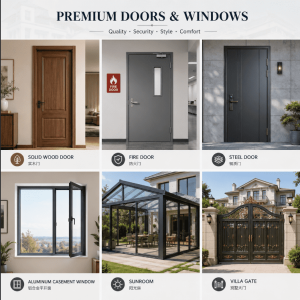
Beyond double wood doors entry, our product range includes thermal-break aluminum doors and windows, system windows, casement doors, sliding doors, custom villa doors and windows, sunrooms, and aluminum alloy entrance doors. This breadth allows us to serve as a single-source supplier for entire projects — simplifying your procurement process.
Whether you need OEM production, ODM design support, or private label branding, our team can adapt to your workflow.
—
Frequently Asked Questions
What is a double door entry called?
A double door entry is commonly referred to as double entry doors, French doors (when glazed), or twin doors. In architectural terminology, the pair consists of an active leaf (operable) and an inactive leaf (fixed with bolts). “Double wood doors entry” specifically refers to wood construction.
What is the standard size of a double door entry?
Standard double door entries measure 60″ (two 30″ leaves) to 72″ (two 36″ leaves) wide, with heights from 80″ to 96″. Custom sizes are common for luxury residential and commercial projects.
What are the best double entry doors?
The best double entry doors combine dimensional stability (engineered cores), weather resistance (proper sealing and finishes), and security hardware (multi-point locks). For exterior use, species like mahogany (Sapele), oak, or teak perform best in varying climates.
How much do custom double wood doors cost?
Costs vary widely based on wood species, glass, hardware, and size. Factory-direct sourcing typically reduces costs by 20–30% compared to distributor pricing. Bulk project orders can achieve further economies of scale.
Can double wood entry doors be customized for specific project sizes?
Yes. Reputable manufacturers offer full customization on width, height, profile design, glass type, and hardware. Always confirm the factory’s capability for non-standard sizes and lead time.
What documentation should I request from a wood door supplier?
Request test reports (air-tightness, water-tightness, wind load), material certifications (wood species, moisture content), and shipping documents (packing list, proforma invoice, certificate of origin). For international orders, confirm ISPM 15 packaging compliance.
—
Conclusion and Next Steps
Sourcing double wood doors entry requires attention to material science, performance standards, and supplier capability. A factory-direct partner can streamline this process — providing competitive pricing, quality control, and logistics support that distributors cannot match.
If you are planning a project that requires double wood entry doors — custom or bulk — our team can provide technical guidance and a competitive quote. We will work with your specifications, provide test documentation, and ensure your shipment arrives on time and to specification.
—
References
[1] U.S. Department of Energy. “Insulation Materials.” energy.gov. https://www.energy.gov/energysaver/insulation-materials
[2] ASTM International. “ASTM E90-09 Standard Test Method for Laboratory Measurement of Airborne Sound Transmission Loss of Building Partitions and Elements.” https://www.astm.org/e0090-09.html
[3] Architectural Woodwork Institute. “AWI Quality Standards.” https://www.awinet.org/quality-standards
[4] Efficient Windows Collaborative. “Low-E Coatings.” https://www.efficientwindows.org/graphics/low-e
[5] U.S. Consumer Product Safety Commission. “16 CFR Part 1201 Safety Standard for Architectural Glazing Materials.” https://www.ecfr.gov/current/title-16/chapter-II/subchapter-B/part-1201
[6] Soundproofing Company. “STC Ratings for Common Wall and Door Assemblies.” https://www.soundproofingcompany.com/solutions/stc-ratings
[7] International Plant Protection Convention. “ISPM 15 Regulation of Wood Packaging Material in International Trade.” https://www.ippc.int/en/publications/regulation-wood-packaging-material-international-trade/