What Is a Mahogany Door?
A mahogany door is a solid or engineered wood door made from mahogany or mahogany veneer. The standard interior door height is 80 inches, widths range from 24 to 36 inches in 2-inch increments, and thickness is typically 1¾ inches. Mahogany is specified for doors because of its dimensional stability, straight grain, and rich reddish-brown color that deepens with age.
The wood’s cellular structure gives it natural resistance to swelling and shrinking compared to many domestic hardwoods, which matters for door performance. A door that moves excessively with humidity changes can bind in the frame, crack at the joints, or pull away from the hinges. Mahogany’s stability reduces these risks, which is why it has been a preferred material for architectural millwork for over a century.
For buyers, the term “mahogany door” covers several distinct products. True mahogany refers to the Swietenia genus, but the commercial market also uses related species from Africa and the Philippines. Each has different density, grain character, and price points. The sourcing legality of these species varies considerably, a point we will return to later.
Standard Mahogany Door Sizes: A Quick Reference
Interior mahogany doors follow the same dimensional standards as other wood doors in the North American market. These measurements are set by industry conventions and building code requirements for egress, accessibility, and standard framing.
| Dimension | Standard Interior | Standard Exterior | Notes |
|---|---|---|---|
| Height | 80 inches (6’8″) | 80 inches (6’8″) | Custom heights up to 96 inches available |
| Width | 24, 28, 30, 32, 36 inches | 32, 36 inches | 30″ and 32″ most common for interior rooms |
| Thickness | 1¾ inches (solid core) | 1¾ inches | 1⅜” hollow core available for interior use |
| Rough opening | Width + 2″, Height + 2½” | Width + 2″, Height + 2½” | Accounts for jamb and shim space |
The 80-inch height is the default because it accommodates the standard 6-foot-8-inch rough opening used in residential and light commercial construction. Wider doors—up to 42 inches—are available for accessibility compliance or grander architectural statements, but they require heavier hinges and reinforced jambs.
Thickness matters more than most buyers realize. A 1¾-inch solid mahogany slab weighs roughly 70 to 90 pounds depending on width, which affects hinge selection, frame strength, and whether the door swings properly over time. Hollow-core mahogany doors reduce weight significantly but sacrifice sound transmission and impact resistance.
For commercial projects, fire ratings may dictate additional requirements. A solid mahogany door can achieve a 20-minute fire rating with the correct construction, but this must be verified against the manufacturer’s test data, not assumed from the species alone.
Solid vs. Engineered Mahogany: Which to Choose?
The distinction between solid and engineered mahogany doors is not a quality judgment—it is a performance specification. Each construction type serves different project requirements.
Solid mahogany doors are milled from a single piece of lumber or from staved cores with mahogany veneer faces. True solid construction uses one continuous slab, which is expensive and prone to seasonal movement across wide widths. Most “solid” doors you will encounter are actually staved-core: vertical mahogany staves glued together and veneered. This construction provides the heft and acoustic performance of solid wood while managing dimensional stability.
Engineered mahogany doors use a composite core—typically medium-density fiberboard (MDF) or a honeycomb structure—with a mahogany veneer face. The veneer is real mahogany, typically 1/40 to 1/20 inch thick, sliced from the same logs used for solid lumber.
| Property | Solid/Staved Core | Engineered Core |
|---|---|---|
| Weight | 70–100 lbs | 45–60 lbs |
| Sound insulation | Better | Moderate |
| Dimensional stability | Good with proper construction | Excellent |
| Cost | Higher | Lower |
| Veneer options | Limited to wood species | Any species available |
| Suitability for paint | Yes | Yes |
| Impact resistance | Higher | Lower |
For interior applications where acoustics matter—home offices, media rooms, bedrooms—the mass of a staved-core door provides meaningful sound attenuation. Engineered doors with honeycomb cores transmit more sound and feel less substantial when closed.
Cost drives many decisions. Solid mahogany doors typically run 40 to 60 percent higher than engineered equivalents at the same grade. The price gap narrows if you require fire-rated assemblies or acoustic certifications, since both constructions need additional engineering to meet those standards.
A hybrid option exists: engineered doors with a particleboard or MDF core and a thicker mahogany veneer. These provide most of the visual benefit at a moderate price premium over thin-veneer products. The trade-off is that thick veneers can telegraph core irregularities over time if the substrate is not dimensionally stable.
Mahogany Doors for Interior Spaces: Design and Function
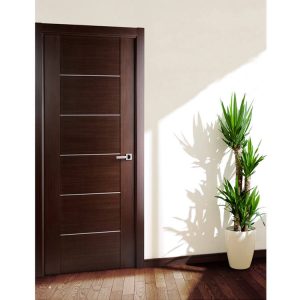
Mahogany doors interior applications span residential and commercial settings where the wood’s color and grain are assets. The deep reddish-brown tone works well in traditional and transitional interiors, and it pairs naturally with brass, bronze, or oil-rubbed bronze hardware.
The finish determines how mahogany performs visually over time. Clear finishes—lacquer, polyurethane, or conversion varnish—allow the wood to amber slightly with age, which most specifiers consider desirable. Stained finishes can shift the color toward lighter or darker tones, but they obscure the natural figure. For commercial durability, conversion varnish or a two-part polyurethane outperforms lacquer in abrasion resistance.
Mahogany accepts paint well, but painting over mahogany is generally a poor economic choice. You are paying for wood grain that will be hidden, and paint-grade doors in poplar or MDF achieve the same result at lower cost. If the design calls for painted doors, specify a paint-grade material and reserve mahogany for clear-finished applications.
Design considerations for interior mahogany doors:
- Sightlines and panel configuration — Five-panel and two-panel designs are the most common for mahogany interior doors. The panel count affects both the visual weight and the structural behavior of the door.
- Lite openings — Glass lites in mahogany doors are common for offices and studies. The glass must be specified with the door to ensure proper glazing details and weight calculations.
- Hardware compatibility — Mahogany holds screws well, but heavy doors need three hinges rather than the standard two. Confirm hinge counts with the manufacturer before ordering.
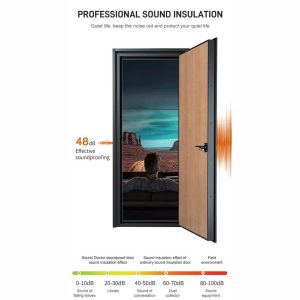
- Acoustic performance — If sound transmission is a concern, specify solid-core construction and ask for STC (Sound Transmission Class) ratings. Gasketed frames may be needed to achieve meaningful isolation.
For commercial interiors, mahogany doors are frequently specified for executive offices, boardrooms, and hospitality settings. The material signals permanence in a way that painted doors do not. However, the same projects often require fire-rated assemblies or accessibility compliance, so verify those requirements before selecting a construction type.
Frequently Asked Questions About Mahogany Doors
How do solid and engineered mahogany doors compare in cost?
Solid or staved-core mahogany doors typically cost 40 to 60 percent more than engineered alternatives with mahogany veneer. The final price depends on panel configuration, finish, hardware cutouts, and fire-rating requirements. Custom sizes and non-standard thicknesses add 15 to 30 percent to the base price.
What maintenance does a mahogany door require?
Interior mahogany doors need far less maintenance than exterior units. Dust with a soft cloth and clean with a damp cloth and mild soap when needed. Refinish when the clear coat shows wear—typically every 5 to 10 years for interior doors, depending on traffic and sunlight exposure. Avoid ammonia-based cleaners, which can soften and dull the finish.
How long does a mahogany door last?
With proper installation and reasonable maintenance, a solid mahogany interior door should last decades. The wood itself does not rot or decay in interior conditions. The limiting factor is usually the finish or the hardware, both of which are replaceable. Many 50-year-old mahogany doors remain in service with periodic refinishing.
Is mahogany a sustainable material choice?
This depends entirely on the species and its sourcing. Genuine mahogany (Swietenia macrophylla) is listed under CITES Appendix II, meaning international trade requires permits and documented legal sourcing. Several African species sold commercially as mahogany (such as Khaya spp.) are not CITES-listed and are more readily available. Responsible buyers should request species documentation and, where available, FSC certification from suppliers.
What finish works best on mahogany doors?
For interior doors, a satin or semi-gloss polyurethane or conversion varnish provides the best balance of durability and appearance. These finishes resist moisture, scuffs, and cleaning chemicals. Oil-based finishes penetrate deeper but offer less surface protection. Avoid wax-based finishes on doors that receive regular handling.
Related Considerations for Buyers
Door mahogany sourcing requires attention to species, grade, and legality. The term “mahogany” covers a spectrum of woods with different working characteristics and price points. When comparing quotes, ask suppliers for the botanical species name and country of origin. This information affects both compliance and long-term performance.
Species variations that matter:
- Swietenia macrophylla (Honduras/Central American mahogany) — The classic species. CITES-regulated, higher cost, excellent stability.
- Khaya spp. (African mahogany) — Readily available, similar appearance, slightly lower density. Not CITES-listed.
- Shorea spp. (Philippine mahogany/Lauan) — Not true mahogany. Lower cost, less stable, different grain pattern. Often used in budget doors.
For interior doors, the grade of the veneer or lumber determines the visual outcome. Clear grade means no knots or mineral streaks; select grade allows minor character marks; rustic grade embraces them. Specify the grade in your procurement documents to avoid mismatched expectations on delivery.
Moisture content and acclimation are quality factors that buyers often overlook. Doors should be manufactured to a moisture content of 6 to 9 percent for interior use, matching typical indoor conditions. If a door arrives with higher moisture content, it will shrink after installation, opening gaps at the joints. Reputable manufacturers dry their stock to specification and acclimate it before machining.
Fire-rated assemblies require special attention. A standard mahogany door is not automatically fire-rated. Fire-rated doors must be tested and labeled by the manufacturer, and the rating applies to the entire assembly—door, frame, and hardware. If your project requires fire ratings, specify this at the quotation stage rather than assuming the standard product qualifies.
Customization scope varies significantly between suppliers. Standard sizes are readily available from most manufacturers, but custom widths, heights, and panel configurations require a factory that can accommodate non-standard machining. Lead times for custom mahogany doors typically range from 4 to 8 weeks for domestic production, longer for overseas manufacturing with shipping.
How a Factory Partner Can Simplify Your Mahogany Door Sourcing
The procurement considerations above—species documentation, moisture content, fire ratings, custom sizing—are easier to manage when you work directly with a manufacturer rather than a distributor. As a factory producing solid wood and engineered doors, we handle these specifications daily.
Our approach to mahogany doors starts with confirming the exact requirements of your project. We provide species documentation and moisture content data with every shipment. If your project requires fire ratings or acoustic performance, we discuss those requirements before production begins so the door is built to meet them from the start.
Customization is where factory-direct sourcing offers the clearest advantage. Standard sizes are only the beginning. We manufacture doors to your specified dimensions, panel configurations, and veneer grades. For overseas buyers, we adjust profile structures and fittings to match local building codes in your target market, and we provide complete customs documentation with every order.
Quality control is built into our production process. Each door undergoes pre-shipment inspection covering dimensional accuracy, finish consistency, and hardware fit. This inspection is not a formality—it is the checkpoint that ensures the doors you receive match the specifications you approved.
If you are sourcing mahogany doors for a project and need clarity on specifications, compliance, or lead times, our team can provide the technical details you need.