Key Takeaways: Choosing the Right Frosted Glass Front Door
A frosted glass front door is the most effective way to balance natural light with visual privacy at your entryway. The glass is acid-etched, sandblasted, or textured to obscure visibility while allowing daylight to filter through. For most residential and light commercial applications, the best choices are:
- For maximum privacy with light transmission: One-way glass or heavy-frost etched glass
- For design flexibility and pattern options: Etched glass with custom designs
- For durability and safety compliance: Tempered or laminated frosted glass
- For traditional aesthetics: Lead glass with frosted panels
Your frame material matters as much as the glass. Steel and aluminum frames offer structural strength for larger glass panels, while iron provides a decorative, high-end look. The right combination depends on your climate, security requirements, and architectural style.
Types of Privacy Glass for Front Doors
The term “frosted glass” covers several distinct finishes, each with different properties, costs, and privacy levels. Understanding these differences is the first step in selecting the right front door.
Frosted Glass
Frosted glass is created by sandblasting or acid-etching one surface of clear glass, producing a uniform, translucent finish. It diffuses light effectively, creating a soft glow while obscuring shapes and details.
Privacy level: High. Frosted glass blurs objects beyond recognition, though silhouettes may be visible in strong backlighting conditions.
Best for: Homeowners who want consistent privacy without patterns or designs. It is the most cost-effective privacy option.
Etched Glass
Etched glass involves removing a thin layer of the glass surface to create designs, patterns, or images. Unlike frosted glass, which has a uniform finish, etched glass can feature intricate artwork, geometric patterns, or company logos.
Privacy level: Varies. Full-surface etching provides privacy similar to frosted glass. Partial etching—where only portions of the glass are treated—leaves clear areas that compromise privacy.
Best for: Custom designs, branding on commercial entrances, or homeowners who want decorative elements integrated into the door.
Textured Glass
Textured glass has a pattern pressed into the surface during manufacturing. Patterns range from subtle ripples to dramatic geometric shapes. The texture distorts images passing through, though the degree of distortion depends on the pattern depth.
Privacy level: Moderate to high. Deep textures obscure details effectively; shallow textures may only blur shapes.
Best for: Adding visual interest without the cost of custom etching. Textured glass is often more affordable than etched options.
One-Way Glass
One-way glass (also called mirrored glass) has a reflective coating that allows visibility from one side only. The reflective side faces outward, creating a mirror-like exterior while maintaining clear visibility from inside.
Privacy level: Depends on lighting conditions. During daylight, the reflective side provides excellent privacy. At night, when interior lighting is brighter than exterior lighting, the effect reverses—people outside can see in.
Best for: Daytime privacy in urban settings. Not recommended for entry doors unless paired with blinds or curtains for nighttime coverage.
Lead Glass
Lead glass features small glass pieces held together by lead canes, creating a traditional, decorative appearance. When frosted or textured glass pieces are used, the door gains both privacy and classic charm.
Privacy level: Varies by glass selection. Frosted lead glass provides good privacy; clear lead glass offers none.
Best for: Traditional, Victorian, or Craftsman-style homes where aesthetic authenticity matters.
Frame Materials: How They Affect Your Glass Door
The frame determines your door’s structural integrity, thermal performance, and overall appearance. Each material presents different trade-offs.
Steel Frames
Steel frames offer the highest strength-to-weight ratio among common door frame materials. They resist warping, twisting, and moisture damage better than wood.
Advantages:
- Excellent security with proper locking hardware
- Low maintenance—no painting required if galvanized or powder-coated
- Slim profile allows larger glass areas
Disadvantages:
- Poor thermal performance unless thermally broken
- Prone to rust if the protective coating is scratched
- Limited color options compared to aluminum
Best for: Security-conscious buyers in moderate climates where thermal bridging is less of a concern.
Iron Frames
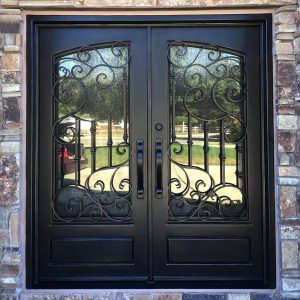
Wrought iron or cast iron frames provide a distinctive, upscale appearance. Iron can be forged into decorative scrolls, curves, and structural elements that complement glass panels beautifully.
Advantages:
- Exceptional durability and strength
- Unique aesthetic that elevates curb appeal
- Can support very large glass panels
Disadvantages:
- Heavy—requires reinforced framing and hinges
- High cost compared to steel or aluminum
- Requires periodic painting to prevent rust
Best for: High-end residential projects where appearance matters more than budget.
Aluminum Frames
Aluminum frames dominate the commercial market due to their corrosion resistance, lightweight nature, and thermal break capabilities.
Advantages:
- Excellent thermal performance with thermal break technology
- Corrosion-resistant—ideal for coastal environments
- Available in a wide range of powder-coated colors
- Lower maintenance than steel or iron
Disadvantages:
- Softer than steel—more susceptible to dents
- Less decorative than iron
- Higher cost than steel for equivalent strength
Best for: Modern architecture, coastal properties, and energy-efficient construction.
Wood Frames
Wood frames offer natural beauty and excellent insulation properties. However, they require ongoing maintenance and are less durable than metal alternatives.
Advantages:
- Superior thermal insulation
- Warm, natural appearance
- Can be painted or stained to match any interior
Disadvantages:
- Warps, cracks, and rots without proper sealing
- Requires regular refinishing
- Less secure than metal frames
Best for: Traditional interiors where aesthetic warmth takes priority over maintenance concerns.
Safety and Durability: Tempered Glass, Laminated Glass, and Building Codes
Glass in entry doors must meet specific safety standards. Building codes typically require safety glass in hazardous locations, which includes doors and areas within 24 inches of door openings.
Tempered Glass
Tempered glass undergoes controlled thermal treatment that makes it four to five times stronger than annealed glass of the same thickness. When broken, it shatters into small, rounded pieces rather than sharp shards.
Is tempered glass required for front entry doors? In most jurisdictions, yes. Building codes (including the International Building Code and International Residential Code) require tempered glass in doors, sidelights, and areas within 24 inches of door openings where the glass is less than 18 inches above the floor. Always verify local requirements, as codes vary by jurisdiction.
Laminated Glass
Laminated glass consists of two or more glass layers bonded with an interlayer (typically polyvinyl butyral). When broken, the glass fragments adhere to the interlayer, maintaining the door’s integrity.
Advantages over tempered glass:
- Provides resistance to forced entry
- Reduces noise transmission
- Blocks 99% of UV radiation
- Holds together when shattered
Disadvantages:
- Higher cost than tempered glass
- Heavier, requiring stronger hardware
For entry doors, laminated frosted glass offers the best combination of privacy, security, and safety. Many manufacturers now offer laminated glass as a standard option for exterior doors.
Energy Efficiency and Insulation
Glass is the weakest thermal point in any door assembly. Energy-efficient frosted glass front doors use:
- Double or triple glazing: Two or three glass layers with air or gas-filled spaces between them
- Low-E coatings: Microscopic metallic layers that reflect infrared radiation while allowing visible light through
- Thermally broken frames: Frames with a non-conductive material between interior and exterior metal sections
U-value measures heat transfer—lower values indicate better insulation. SHGC (Solar Heat Gain Coefficient) measures how much solar radiation passes through the glass—lower values mean less heat gain in summer.
For most climates, a double-glazed frosted glass door with a U-value below 0.30 and an SHGC between 0.25 and 0.40 provides good year-round performance. ENERGY STAR certification provides a reliable baseline for comparison.
Design Styles and Customization
Frosted glass front doors accommodate virtually any architectural style through glass selection, frame material, and hardware choices.
Modern Minimalist
- Full-surface frosted or one-way glass
- Slim aluminum or steel frames
- Minimal hardware—often a single lever handle
- Clean, straight lines
Traditional
- Lead glass with frosted or textured panels
- Wood or iron frames
- Decorative hinges and handles
- Symmetrical designs
Contemporary
- Etched glass with geometric patterns
- Thermally broken aluminum frames
- Mixed materials—wood and metal combinations
- Asymmetric designs
Customization Options
Can you customize the design of a frosted glass front door? Yes. Manufacturers offer:
- Custom sizes: Doors can be manufactured to fit non-standard openings
- Custom etching: Logos, monograms, or artwork can be etched into the glass
- Color options: Powder-coated frames in any RAL color
- Hardware selection: Handles, locks, hinges, and accessories from multiple manufacturers
- Glass combinations: Frosted and clear glass panels in the same door
When ordering custom doors, request a digital proof of the etching design before production. This prevents costly mistakes and ensures the final product matches your expectations.
Comparison Table: Frosted vs. Etched vs. Textured vs. One-Way Glass
| Property | Frosted Glass | Etched Glass | Textured Glass | One-Way Glass |
|---|---|---|---|---|
| Privacy Level | High | Varies by design | Moderate to high | High in daylight, low at night |
| Light Transmission | Diffuse, soft | Varies by etching density | Reduced by pattern depth | Reduced by reflective coating |
| Cost Range | Low to medium | Medium to high | Low to medium | Medium to high |
| Customization | Limited | Extensive | Limited | Limited |
| Maintenance | Easy | Moderate—patterns collect dirt | Easy | Easy |
| Durability | High with tempering | High with tempering | High with tempering | Coating may scratch |
| Aesthetic | Clean, uniform | Decorative, artistic | Textural, dimensional | Reflective, modern |
| Property | Steel Frame | Iron Frame | Aluminum Frame | |
| Strength | Excellent | Excellent | Good | |
| Thermal Performance | Poor without thermal break | Poor | Excellent with thermal break | |
| Corrosion Resistance | Moderate | Low | Excellent | |
| Maintenance | Low | High | Low | |
| Cost | Medium | High | Medium to high | |
| Aesthetic Options | Limited | Extensive decorative options | Wide color range | |
| Weight | Heavy | Heaviest | Lightest |
Buying Guide: What to Consider Before You Order
Cost Factors
The price of a frosted glass front door varies widely based on size, materials, glazing, and customization. Key cost drivers include:
- Glass type: Frosted glass is the most economical; custom etched glass costs significantly more
- Frame material: Aluminum and steel are comparable; iron commands a premium
- Glazing: Double glazing adds cost but improves energy efficiency
- Size: Larger doors require more material and heavier hardware
- Customization: Non-standard sizes and custom etching increase price
- Hardware quality: Multi-point locking systems and premium handles add cost
Expect to pay more for a complete door system (frame, glass, hardware) than for a slab alone. Installation costs add another layer, particularly for non-standard openings.
Security Considerations
Frosted glass doors are inherently less secure than solid doors, but several upgrades mitigate this:
- Laminated glass: Resists forced entry better than tempered glass
- Multi-point locking systems: Secure the door at multiple points along the frame
- Reinforced frames: Steel or aluminum frames resist forced entry better than wood
- Security film: Applied to the interior surface, this film holds glass together when shattered
Climate Considerations
- Coastal areas: Aluminum frames resist salt corrosion better than steel or iron
- Cold climates: Thermally broken aluminum or wood frames with double glazing prevent condensation and heat loss
- Hot climates: Low-SHG glass reduces cooling costs by blocking solar heat
Installation and Replacement
Can you install a frosted glass front door yourself? It is possible for experienced DIYers with proper tools, but professional installation is recommended for several reasons:
- Weight: Glass doors are heavy and require proper lifting equipment
- Alignment: Incorrect installation leads to air leaks, water infiltration, and hardware failure
- Building codes: Some jurisdictions require permits and inspections for door replacements
- Warranty: Self-installation may void manufacturer warranties
If replacing an existing door, measure the rough opening carefully. Standard sizes are readily available, but non-standard openings require custom manufacturing.
Maintenance and Cleaning
Frosted glass requires minimal maintenance, but proper cleaning preserves its appearance:
- Regular cleaning: Use a soft cloth with mild soap and water or a glass cleaner
- Avoid abrasive cleaners: These can scratch the frosted surface
- Clean etched patterns: Use a soft brush to remove dirt from etched crevices
- Check weatherstripping: Replace worn seals to maintain energy efficiency
- Lubricate hardware: Apply silicone lubricant to hinges and locks twice yearly
Frosted surfaces show fingerprints less than clear glass, but they do accumulate dust and grime in textured areas. Regular cleaning prevents buildup that is difficult to remove later.
Supplier Selection for B2B Buyers
When sourcing frosted glass front doors for commercial projects, evaluate suppliers on:
- Testing and compliance: Verify that doors meet local building codes and safety standards
- Pre-shipment inspection: Confirm that the manufacturer tests for air-tightness, water-tightness, and wind resistance
- Customization capability: Assess whether the supplier can handle non-standard sizes and custom etching
- Documentation: Ensure the supplier provides packing lists, proforma invoices, and customs documentation
- Shipping options: Confirm both FCL and LCL shipping availability
Frequently Asked Questions
What is the difference between frosted, etched, and textured glass for front doors?
Frosted glass has a uniform, sandblasted or acid-etched finish that diffuses light. Etched glass has designs or patterns removed from the surface, creating decorative elements. Textured glass has a pattern pressed into the surface during manufacturing. All three provide privacy, but etched glass offers the most design flexibility, while frosted glass provides the most consistent, uniform appearance.
What are the best privacy glass options for a front door?
For consistent privacy, full-surface frosted glass or deeply textured glass are the best choices. One-way glass provides excellent daytime privacy but requires additional coverage at night. If you want both privacy and decorative appeal, etched glass with full-surface coverage offers the best combination.
How do I choose between a steel, iron, or aluminum frame for a glass front door?
Choose steel for maximum security at a moderate cost. Choose iron for decorative, high-end aesthetics where budget is less of a concern. Choose aluminum for energy efficiency, corrosion resistance, and low maintenance. Your climate and architectural style should guide the final decision.
Can I customize the design of a frosted glass front door?
Yes. Manufacturers can customize door dimensions, glass patterns, etching designs, frame colors, and hardware. Custom etching allows you to incorporate logos, monograms, or artwork into the glass. Request a digital proof before production to verify the design.
How do I maintain and clean a frosted glass front door?
Clean frosted glass with a soft cloth and mild soap or glass cleaner. Avoid abrasive pads and harsh chemicals. For etched patterns, use a soft brush to remove dirt from crevices. Lubricate hinges and locks twice yearly and check weatherstripping for wear.
What is the cost range for frosted glass front doors?
Costs vary significantly based on size, frame material, glazing, and customization. Frosted glass with an aluminum frame is the most economical option. Iron frames with custom etched glass cost considerably more. Request quotes from multiple suppliers with your exact specifications for accurate pricing.
Are there energy-efficient options for glass front doors?
Yes. Double or triple glazing, Low-E coatings, and thermally broken frames significantly improve energy efficiency. Look for doors with low U-values and appropriate SHGC ratings for your climate. ENERGY STAR-certified doors meet established efficiency standards.
Is tempered glass required for front entry doors?
In most jurisdictions, building codes require tempered glass in doors and adjacent areas within 24 inches of door openings. Verify local requirements, as codes vary. Laminated glass meets safety requirements and provides additional security benefits.
How We Meet These Standards as a Manufacturer
As a factory-direct manufacturer of doors and windows, we understand that the standards discussed above are not optional considerations—they are baseline requirements for any entry door that will perform reliably over decades of use.
Our approach to frosted glass front doors starts with material selection. We offer thermal-break aluminum, steel, and wood frames, each engineered to meet local building codes in your target market. Our profile structures and fittings are adjustable to match regional requirements, whether that means specific wind-load ratings for coastal installations or particular thermal performance standards for cold climates.
On the glass side, we source tempered and laminated frosted glass that meets safety standards for entry door applications. Our pre-shipment inspection includes air-tightness, water-tightness, and wind resistance testing, so you know the door will perform before it arrives at your site.
For B2B buyers and construction projects, we provide full customization on size, color, glass patterns, and hardware. Our foreign trade experience means you receive complete documentation—packing lists, proforma invoices, and customs paperwork—with every order. We ship both FCL and LCL, delivering directly from our factory to your project location.
If you are comparing frosted glass front door options for a project, we can provide specifications, samples, and quotes tailored to your requirements.