Content Menu
● 1. French Doors Outside: A Factory Guide to Durability, Compliance, and Supply
● 2. Material Selection for Exterior French Doors: Thermal Break Aluminum vs. Solid Wood
● 3. Customization & Engineering: Matching Local Building Codes for Outdoor Installations
● 4. Quality Control: Pre-Shipment Testing for Worry-Free Exterior Performance
● 5. Logistics & Supply Chain: Direct Factory Shipping for Bulk Orders
● 6. Why Global B2B Clients Choose Jusen as Their Manufacturing Partner
13 min read
French Doors Outside: A Factory Guide to Durability, Compliance, and Supply
The email arrived on a Tuesday. A contractor in Melbourne had spent six weeks convincing a homeowner that French doors would transform their backyard entertaining area. The homeowner agreed. Then the contractor discovered the opening was 2,340 mm wide — 140 mm wider than any standard unit his local distributor stocked. He wrote to us asking a simple question: “Can your factory build this without making it look like a custom oddity?”
That question sits at the heart of every B2B order for exterior French doors. The architectural appeal is obvious — natural light, seamless indoor-outdoor flow, that classic symmetrical elegance. But for contractors, builders, and importers, “french doors outside” is not a catalog item. It is an engineering problem with specific dimensions, climate loads, and compliance requirements attached.
We have spent over a decade manufacturing thermal-break aluminum doors and windows and custom villa doors for international clients. This guide explains what our factory actually does when producing exterior French doors for global B2B partners — the material decisions, the testing protocols, the logistics, and the honest trade-offs you need to know before placing an order.
—
Material Selection for Exterior French Doors: Thermal Break Aluminum vs. Solid Wood
Let’s start with the decision that drives everything else: what the door is made of.
Solid wood French doors have undeniable aesthetic appeal. The grain, the warmth, the way they age — no aluminum profile replicates that. But here is the uncomfortable truth: exterior exposure is brutal. UV radiation breaks down finishes. Rain infiltrates joints. Temperature swings cause expansion and contraction that eventually compromises the seal.
Our solid wood doors line is excellent — for the right application. If the French doors open onto a fully covered patio, a pergola, or a veranda with significant roof overhang, wood performs beautifully. Direct weather exposure changes the calculation entirely.
The Thermal Break Advantage for Outdoor Use
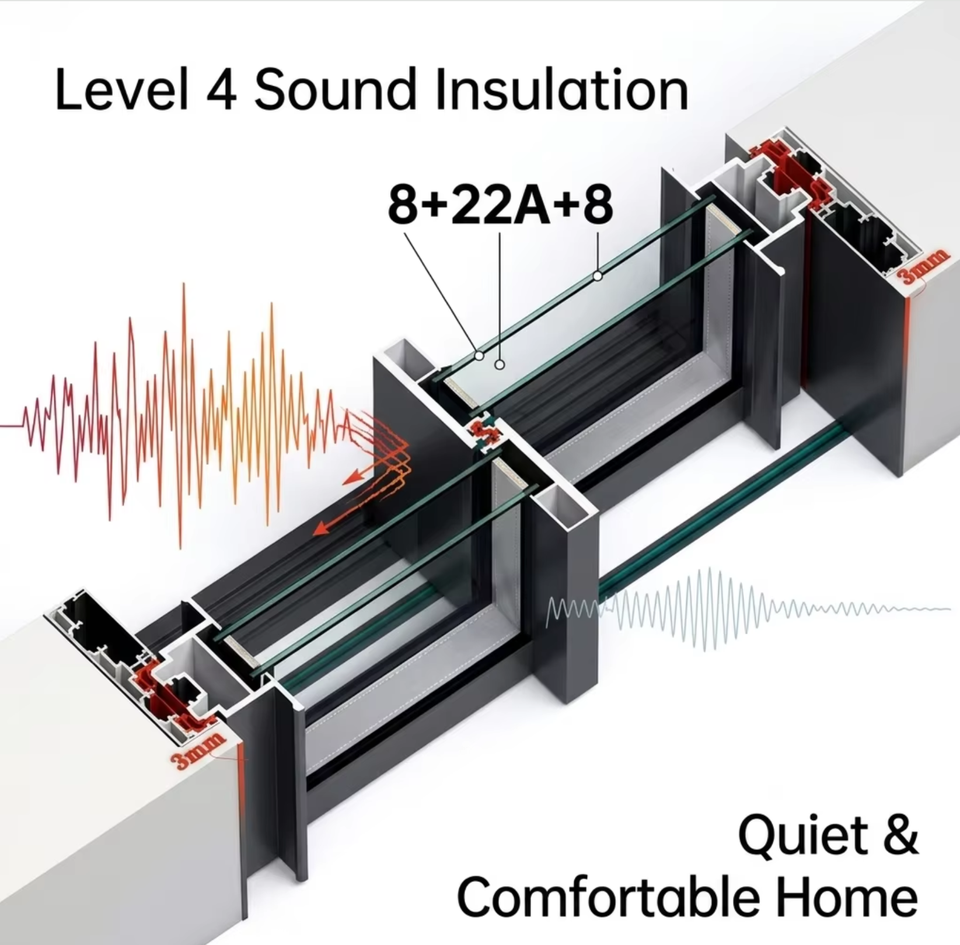
This is where our thermal-break aluminum profile becomes the workhorse product for exterior applications. The term “thermal break” refers to a polyamide strip that separates the interior and exterior aluminum sections of the frame. This barrier prevents thermal transfer — meaning the inside face of the door does not become freezing in winter or scorching in summer.
For French doors that lead directly outside, this matters for three reasons:
- Condensation control — without a thermal break, condensation forms on the interior frame surface, leading to mold and frame degradation.
- Energy efficiency — the door becomes a weak point in the building envelope if heat flows freely through the frame.
- Comfort — nobody wants to sit near a door that radiates cold or heat.
Our factory produces thermal-break aluminum profiles with adjustable profile structure and fittings. This is not a fixed design. When a client tells us their project is in a coastal area with high salt exposure, or a region with typhoon-level wind loads, we adjust the profile geometry accordingly. The frame is not just a frame — it is a engineered response to a specific climate.
Solid Wood Options for Covered Outdoor Spaces
For clients who insist on wood — and many do, particularly for heritage renovations or high-end residential work — we offer OEM and ODM services that allow specification of wood species, finish, and joinery details. European oak, American walnut, tropical hardwoods — the choice depends on the regional aesthetic and budget.
But we are direct about the limitations. Wood requires maintenance. A solid wood French door exposed to direct rain will need refinishing every 2–3 years, regardless of the quality of the initial finish. If your client is not prepared for that maintenance cycle, recommend aluminum.
Hardware That Survives the Elements
The frame is only half the equation. The hardware — hinges, locks, handles — takes the daily abuse of opening, closing, and locking. For exterior French doors, we recommend multi-point locking systems that engage at multiple points along the frame height. This provides better security and, critically, better weather sealing because the door is pulled evenly against the frame gasket.
We offer full customization on hardware accessories. This is essential for B2B clients because security requirements vary significantly by market. A lock that passes European standards may not meet Australian requirements, and vice versa. Our team works with clients to specify hardware that satisfies the destination country’s regulations.
—
Customization & Engineering: Matching Local Building Codes for Outdoor Installations
The biggest headache for B2B buyers is rarely the product itself. It is compliance.
A “standard” French door manufactured in China may not pass inspection in Canada, Germany, or Singapore. Wind load requirements differ. Air infiltration standards differ. Thermal performance targets differ. This is not a criticism of other factories — it is a structural reality of international trade.
Our approach is different. We do not manufacture a static design and hope it passes. We engineer each order to the destination market’s requirements.
Adjusting Profiles for Wind Load and Air-Tightness
When a client places an order, the first question our technical team asks is not “what size?” — it is “where is this installing?”
This determines:
- Profile wall thickness — higher wind zones require thicker aluminum sections.
- Reinforcement — steel or aluminum inserts within the frame for structural rigidity.
- Gasket configuration — the number and placement of weather seals.
We then conduct strict pre-shipment inspections including air-tightness, water-tightness, and wind resistance tests on these custom configurations. These are not random checks. Every exterior unit goes through this protocol before it is packed.
The testing equipment measures air leakage at specific pressure differentials, water penetration under simulated rain and wind, and structural deflection under load. The numbers matter. A door that passes a 2,000 Pa wind load test is fundamentally different from one rated at 1,200 Pa.
Custom Sizes and Glass Configurations
“French doors outside” are rarely standard size. Existing openings vary. Architects design non-standard dimensions. Renovations reveal structural quirks.
We offer full customization on size and glass. The glass specification is particularly important for exterior applications:
- Double glazing — standard for most climates, providing insulation and sound reduction.
- Laminated safety glass — required in some jurisdictions for doors, as it holds together when shattered.
- Low-E coatings — reduce solar heat gain, critical for west-facing installations in warm climates.
The frame and glass must be designed as a system. A thick, high-performance glass unit in a weak frame defeats the purpose. Our engineering team calculates the combined performance of the complete assembly.
Private Label Manufacturing
Many of our B2B clients do not sell “Jusen” doors. They sell under their own brand name. This is where Private Label manufacturing becomes valuable.
We produce the doors to the client’s specifications, apply their branding, and ship direct to their customers or distribution points. The client maintains their brand identity while leveraging our manufacturing capacity and quality control.
For clients who need a unique product line — a specific frame profile, a particular hardware package, a distinctive color — our ODM services allow us to develop a proprietary design exclusively for them. This is not a simple catalog modification. It involves tooling development, prototype testing, and production refinement.
—
Quality Control: Pre-Shipment Testing for Worry-Free Exterior Performance
Here is a question we hear constantly: “How do I know the doors will survive the shipping and perform once installed?”
The answer lies in what happens before the container is sealed.
For exterior doors, field failures are expensive. A leaking French door damages flooring, walls, and client relationships. A door that rattles in high winds creates a perception of poor quality that no warranty can fix.
The Three Pillars of Exterior Door Testing
Our pre-shipment inspection protocol focuses on three critical performance metrics:
Air-tightness — measured by pressurizing the closed door and measuring air leakage. Poor air-tightness means drafts, energy loss, and noise infiltration. It also indicates that the gaskets and seals are not functioning correctly.
Water-tightness — simulated rain and wind are applied to the exterior face. Water penetration at any point is a failure. This test reveals issues with drainage channels, gasket alignment, and corner joints.
Wind resistance — the door is subjected to increasing pressure to simulate storm conditions. The frame must not deflect excessively, and the door must return to its original shape after the load is removed.
These tests are not optional extras. They are standard procedure for every exterior unit leaving our factory.
Preventing “Invisible” Defects
Some defects are not visible in a simple visual inspection. A misaligned drainage channel in the frame, for example, will cause water to pool inside the profile and eventually leak into the building. A hinge that is slightly off-axis will cause the door to sag over time, compromising the seal.
Our inspectors check for these issues systematically. We examine:
- Frame corner joint integrity
- Drainage channel alignment and clearance
- Hardware torque specifications
- Gasket seating and compression
- Glass unit seal integrity
We have seen the results of poor quality control in other factories’ products — warped frames, failed seals, broken hardware. Our rich experience in foreign trade means we understand the quality standards expected in North American, European, and Australian markets. We have shipped to all of them, and we know where the bar sits.
—
Logistics & Supply Chain: Direct Factory Shipping for Bulk Orders
The product is ready. Testing is complete. Now the question becomes: how does it get to the client’s site or warehouse?
International logistics is where many good products fail. Poor packing leads to transit damage. Incomplete documentation leads to customs delays. Unexpected costs erode profit margins.
FCL and LCL Shipping Solutions
We support both FCL (Full Container Load) and LCL (Less than Container Load) shipment. This flexibility is important because not all B2B orders fill a 40-foot container.
A developer ordering doors for a single villa project might need only 8–10 units. An importer stocking for a year of projects might order 200 units. Both are viable orders for us.
We handle direct delivery from our China factory. There is no intermediary warehouse, no third-party consolidation point, no additional handling that could damage the product. The doors move from our production line to the container, sealed and documented.
Documentation and Customs Support
International shipping requires paperwork. A lot of it.
We provide a packing list, proforma invoice, and full customs documents with every shipment. This includes:
- Commercial invoice with correct HS codes
- Packing list with accurate weights and dimensions
- Bill of lading
- Certificates of origin where required
- Any specific documentation for the destination country’s customs authority
Our team has handled shipments to over 40 countries. We know which documents are required for each market, and we prepare them correctly the first time.
The competitive price without middleman markup is a direct result of our factory-direct business model. When you buy from us, you pay for the product, the materials, the labor, and the factory overhead. You do not pay for a trading company’s margin, a distributor’s markup, or a showroom’s rent.
Scaling from Projects to Bulk Supply
Our production capacity supports Construction Project Bulk Supply. Whether the order is for a single luxury villa or a residential development with 200 units, our production lines can handle the volume.
This scalability matters for B2B clients because it means one supplier can serve both small and large projects. A contractor who starts with a 10-door order can scale to a 100-door order without changing suppliers, re-validating quality, or renegotiating terms.
—
Why Global B2B Clients Choose Jusen as Their Manufacturing Partner
By now, the picture should be clear. But let’s summarize the value proposition for the decision-maker who is evaluating suppliers.
The Cost Advantage of Factory Direct
When you source from a trading company, you pay for their procurement costs, their overhead, and their profit margin. When you source from us, you pay for the product. That difference can be 15–30% depending on the product complexity and order volume.
For a B2B client bidding on projects, that cost advantage directly improves win rates and profit margins. It is not a small consideration.
A Partner, Not Just a Vendor
We are not a one-product factory. Our production lines include:
- System windows
- Casement doors
- Sliding doors
- Aluminum alloy entrance doors
- Sunrooms
- Custom villa doors and windows
This breadth means we understand how French doors interact with the rest of a building’s envelope. A French door installation is not isolated — it connects to windows, sliding doors, and other openings. Working with a factory that produces the full spectrum means consistent quality, consistent finish, and consistent performance across the entire project.
We also offer OEM, ODM, and Private Label services. We are not just selling a door; we are manufacturing a solution tailored to the client’s business model. Whether that means producing to the client’s exact specifications, developing a proprietary design, or branding the product as their own, we have the capability.
—
Frequently Asked Questions
Can you manufacture French doors in non-standard sizes for exterior openings?
Yes. We offer full customization on size. Our factory adjusts the profile structure and fittings to accommodate your specific opening dimensions while maintaining structural integrity. The engineering team calculates the required profile thickness and reinforcement based on the span and the wind load requirements of the installation site.
What is the difference between your thermal-break aluminum and solid wood French doors for outdoor use?
Thermal-break aluminum is ideal for direct exposure to weather and extreme temperatures due to its durability and energy efficiency. Solid wood is better suited for covered outdoor areas where aesthetics are the primary focus. We can provide both based on your project requirements. The honest answer is that aluminum is the lower-maintenance choice for most exterior applications, but wood delivers an aesthetic that aluminum cannot replicate.
How do you ensure the doors will pass our local building codes?
We have extensive experience in foreign trade. We adjust our profiles and fittings to match the building codes of your target market. Furthermore, we conduct strict pre-shipment inspections including air-tightness, water-tightness, and wind resistance tests. We also ask clients to share their local code requirements before production begins — this is not a request we make casually, but it is essential for compliance.
What are your shipping options for bulk orders?
We support both FCL (Full Container Load) and LCL (Less than Container Load). We handle direct delivery from our factory and provide all necessary customs documentation to facilitate a smooth import process. For large orders, we can schedule production to align with your project timeline and shipping schedule.
Can we put our own branding on the French doors?
Absolutely. We offer Private Label services. We can also work with you on ODM projects to develop a unique product line that fits your brand identity. This includes custom frame colors, hardware branding, and packaging design.
What is your minimum order quantity?
Our MOQ varies by product type and customization level. Standard thermal-break aluminum French doors have a lower MOQ than fully custom ODM projects. We recommend contacting our team with your specific requirements to get an accurate quote. We are flexible for B2B clients building long-term relationships.
—
The Decision Guide
Choosing between material options for your French doors outside project:
Choose thermal-break aluminum if:
- The doors face direct weather exposure (rain, sun, wind)
- Energy efficiency is a priority for the building’s certification
- The client wants minimal maintenance over the door’s lifespan
- The installation is in a region with extreme temperature swings
Choose solid wood if:
- The doors are in a covered or partially covered outdoor space
- The architectural style demands a natural wood aesthetic
- The client accepts the maintenance requirement (refinishing every 2–3 years)
- The project is a heritage renovation where material authenticity is required
Choose our factory if:
- You need custom sizes that standard catalogs cannot supply
- Your project must comply with specific local building codes
- You want direct factory pricing without middleman markups
- You need a partner who can scale from small orders to bulk supply
—
The process of sourcing French doors for exterior installations is not complicated when you work with a factory that understands the engineering, the compliance landscape, and the logistics. We have been doing this for over a decade. We know the questions to ask, the tests to run, and the documentation to prepare.
If you have a project in mind — whether it is a single villa or a multi-unit development — send us your specifications. We will respond with a detailed quote, including material options, engineering recommendations, and delivery timelines.
—
References
[1] American Architectural Manufacturers Association. “AAMA/WDMA/CSA 101/I.S.2/A440-17, North American Fenestration Standard/Specification for windows, doors, and skylights.” AAMA, 2017. https://aamanet.org/
[2] European Committee for Standardization. “EN 14351-1:2006+A2:2016, Windows and doors — Product standard, performance characteristics.” CEN, 2016. https://www.cencenelec.eu/
[3] National Fenestration Rating Council. “Certified Product Directory — Door Performance Data.” NFRC, 2023. https://www.nfrc.org/
[4] Standards Australia. “AS 2047-2014, Windows and external glazed doors in buildings.” Standards Australia, 2014. https://www.standards.org.au/
[5] Window & Door Manufacturers Association. “Thermal Break Technology in Aluminum Framing Systems.” WDMA Tech Bulletin, 2021. https://www.wdma.com/