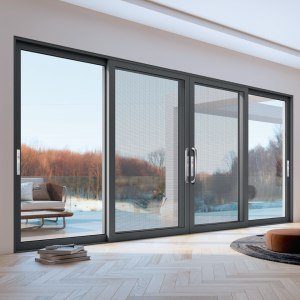
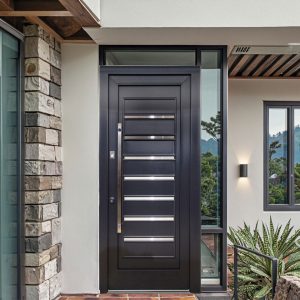
Fiberglass patio doors are used when a project wants a durable frame material with a different performance and appearance profile from vinyl or aluminum. They can be configured as sliding, hinged or larger multi-panel systems, depending on the manufacturer.
For wide openings, the important question is not simply whether fiberglass is available. The frame, panel arrangement, glass, hardware and opening dimensions must all be coordinated.
Why choose fiberglass for a patio door?
Fiberglass frames can offer dimensional stability and low routine maintenance. They can also be finished in different colors or paired with different interior and exterior appearance options.
The exact performance varies by product. For a B2B project, request manufacturer data rather than assuming all fiberglass profiles perform identically.
Sliding, hinged and folding configurations
A fiberglass patio door may be available as a conventional slider, hinged patio door or a larger multi-panel configuration.
Sliding systems are useful where interior swing clearance is limited. Hinged systems can provide a familiar door operation but need a clear swing area. Folding or multi-panel systems can create a wider opening, but they introduce additional hardware, tracks and structural coordination.
Choose the operating configuration before finalizing the frame specification.
Wide fiberglass patio doors
An 8-foot, 9-foot or wider patio opening requires more than a nominal width. Confirm:
- Overall frame dimensions
- Rough opening
- Clear opening
- Number of panels
- Fixed and active panels
- Stacking direction
- Panel weight
- Hardware capacity
- Sill and drainage
- Glass specification
A 9-foot-wide system can have a very different usable opening from another 9-foot system because the panel layout may differ.
Fiberglass versus other frame materials
Vinyl can be attractive for cost and low maintenance. Aluminum can provide slim profiles and strong frame construction. Wood can offer a traditional interior appearance but usually requires more finish maintenance.
Fiberglass should therefore be compared on the whole specification rather than on material name alone.
Glass selection
Large patio doors place substantial visual area into the opening, so glass selection matters.
Common options include clear insulated glass, low-E glass, privacy glass and other performance-oriented configurations. In locations where safety glazing is required, the correct safety construction must be selected for the opening.
For energy-focused projects, compare actual performance values instead of relying on labels such as “energy efficient.”
Ordering an extra-wide unit
For a large opening, request a dimensional drawing before production. The drawing should show panel movement, frame dimensions, sill configuration and hardware locations.
For commercial or repeated orders, assign an opening ID to each unit. This prevents different sizes or handing requirements from being mixed during production and installation.
Final takeaway
Fiberglass patio doors can be a strong choice for projects that value durability, low maintenance and flexible configurations. For 8-foot, 9-foot or wider openings, verify the complete system specification rather than selecting a product by nominal width alone.
8-foot and 9-foot patio-door openings
Large patio-door openings should be specified by both overall unit size and clear opening. A nominal 8-foot system can have different usable passage widths depending on the panel arrangement.
For a 9-foot or wider opening, ask the manufacturer to show the active panels, fixed panels and stacking direction on the drawing.
Folding and collapsing configurations
Folding patio doors use multiple leaves that move along a track. They can create a large open passage, but the system has more moving components than a conventional slider.
Track alignment, panel weight and structural support become increasingly important as the opening grows.
Swing patio doors
A swing configuration needs enough clearance for the door leaf. For an exterior application, check the patio, deck or walkway before selecting an inswing or outswing arrangement.
The frame, hinges and lock hardware should be selected for the actual leaf weight.
Fiberglass finish and appearance
Fiberglass patio doors can be available in several finishes and colors. A bronze appearance, for example, should be specified by the manufacturer's actual finish rather than by a generic color name.
For a multi-unit project, approve a sample before production.
Installation coordination
Large glazed patio doors should not be treated as ordinary interior openings. The rough opening, sill, flashing, drainage and structural support all need to be coordinated.
For replacement work, inspect the existing opening for water damage before finalizing the new dimensions.
Final buyer checklist
Before ordering a large fiberglass patio-door system, confirm the frame outside dimensions, rough opening, clear opening, panel configuration, glass, hardware, finish, screen and installation requirements.