The Short Version: How to Choose Entry Door Glass Inserts and Frames
For most residential and light commercial projects, fiberglass entry doors with factory-built glass inserts offer the best balance of durability, energy efficiency, and design flexibility. Steel doors with glass are the value pick for security and lower cost, while wood doors with glass remain the choice for premium aesthetics and historic renovations.
The frame material matters as much as the door skin. Aluminum frames are standard for thermal performance, wood frames suit traditional interiors, and composite frames offer maintenance-free performance. Your decision should hinge on three factors: climate zone, architectural style, and security requirements.
Material Comparison: Steel, Fiberglass, and Wood with Glass Inserts
Steel Entry Doors with Glass
Steel doors dominate the entry door market for a reason. The steel skin provides exceptional impact resistance and security. When paired with glass inserts, the door maintains its structural rigidity because the glass unit is typically factory-sealed into a reinforced frame.
The main trade-off with steel is thermal performance. Steel conducts heat readily, so the door’s insulation value depends heavily on the polyurethane foam core and the quality of the thermal break in the frame. In cold climates, a steel door with a large glass insert can create condensation issues on the interior surface.
Steel doors are also prone to dents. A shopping cart or a hard impact can leave a permanent mark. Surface scratches can rust if the galvanized coating is compromised. For coastal environments with salt air, steel requires more maintenance than fiberglass.
Best for: Security-conscious buyers, budget projects, and homes in moderate climates.
Fiberglass Entry Doors with Glass
Fiberglass doors have gained significant market share over the past decade. The material is dimensionally stable, meaning it doesn’t warp, swell, or shrink like wood. It also resists dents better than steel and handles temperature extremes without conducting heat or cold.
Fiberglass doors are typically molded to mimic wood grain. The texture is convincing enough that most buyers cannot tell the difference from a distance. They can be painted or stained, providing flexibility for future color changes.
The glass inserts in fiberglass doors are usually factory-glazed with dual-pane, low-E glass. The frames are often made from composite or aluminum with a thermal break. Because fiberglass expands and contracts less than steel, the seal around the glass remains tighter over time.
The cost is the main drawback. Fiberglass doors typically cost 30–50% more than comparable steel doors. However, the reduced maintenance and better thermal performance often justify the premium for homeowners planning to stay long-term.
Best for: Most buyers, especially in extreme climates or coastal areas.
Wood Entry Doors with Glass
Wood doors offer a warmth and craftsmanship that neither steel nor fiberglass can replicate. Solid wood doors, particularly those made from mahogany, oak, or walnut, are architectural statements. They can be custom-carved and finished to match any design vision.
Wood doors with glass inserts require more maintenance than any other option. The finish needs refinishing every 1–3 years depending on sun exposure and climate. Wood expands and contracts with humidity changes, which can stress the glass frame seals over time. Water intrusion at the bottom edge is the most common failure point.
For energy efficiency, wood is actually a decent insulator—better than steel but not as good as fiberglass with foam core. The glass insert is usually the weakest thermal point regardless of door material.
Best for: High-end residential projects, historic renovations, and designs where aesthetics take priority over maintenance.
Glass Insert Styles and Configurations
Single vs. Double Doors
Single doors with glass inserts are the most common configuration. A vertical glass lite or a mid-level panel provides natural light without compromising privacy. For narrow entryways, a single door with a tall, narrow glass insert maximizes light transmission.
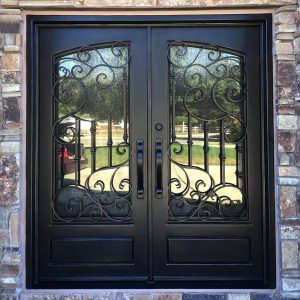
Double doors create a grand entrance. The glass inserts on each door should be symmetrical for a balanced appearance. French-style double doors with full-length glass panels are popular for backyard patios but less common for front entries due to privacy concerns.
Sidelights
Sidelights are narrow glass panels flanking one or both sides of the door. They add significant natural light and visually widen the entryway. A door with two sidelights creates a 5-foot-wide opening that feels more substantial than the actual door width.
The trade-off with sidelights is security. Each sidelight is a potential entry point. Tempered or laminated glass is essential. The frames must be anchored securely to the wall framing, not just to the door frame. Sidelights also add cost—each unit requires its own frame, weatherstripping, and installation labor.
Modern vs. Traditional Styles
Modern entry doors feature large, clean glass panels with minimal framing. Horizontal or vertical glass lites with narrow muntins create a contemporary look. Frosted or fritted glass patterns add privacy without sacrificing light.
Traditional styles use divided lites—multiple smaller glass panels separated by muntins. True divided lites are expensive; most manufacturers use simulated divided lites where the muntins are applied to the glass surface. This achieves the traditional look with better energy efficiency and easier cleaning.
Glass Types
Clear glass maximizes light but offers zero privacy. Frosted or etched glass obscures visibility while transmitting light. Low-E glass has a microscopically thin metallic coating that reflects heat while allowing visible light through. For energy efficiency, low-E glass with argon gas fill between the panes is the industry standard.
Tempered glass is required by code in most door applications. It shatters into small, rounded pieces rather than sharp shards. Laminated glass contains a plastic interlayer that holds the glass together when broken, providing better security and sound insulation.
Frame Materials for Glass Inserts
The frame that holds the glass insert is often overlooked, but it plays a critical role in performance.
Aluminum frames are the most common for modern entry doors. They are lightweight, corrosion-resistant, and can be powder-coated to match the door color. The key specification is the thermal break—a plastic or polyamide strip that separates the interior and exterior aluminum sections. Without a thermal break, aluminum frames conduct heat and create condensation.
Wood frames suit traditional doors. They can be stained to match the door or painted. The downside is maintenance—wood frames require the same refinishing schedule as wood doors.
Composite frames combine wood fibers with plastic resins. They offer the appearance of wood with better dimensional stability. They resist moisture and don’t require painting. Composite frames are often used in fiberglass and steel doors to bridge the gap between performance and aesthetics.
Steel frames are used in steel doors. They are strong but conduct heat. Look for doors with a foam-filled frame and a thermal break in the steel frame itself.
Energy Efficiency and Insulation
The U-factor measures how well a door assembly prevents heat transfer. Lower U-factors mean better insulation. ENERGY STAR certification requires different U-factors depending on your climate zone—northern zones require more insulation than southern zones.
For glass inserts, the critical specifications are:
- U-factor: The overall heat transfer coefficient. Look for 0.30 or lower for cold climates.
- SHGC (Solar Heat Gain Coefficient): Measures how much solar heat passes through the glass. Higher SHGC is beneficial in cold climates (free solar heat), lower SHGC is better in hot climates.
- Air leakage: The amount of air passing through the assembly. Look for 0.30 cfm/ft² or lower.
The frame’s thermal break is as important as the glass itself. A high-performance glass unit in a poorly designed frame will still underperform. Ask the manufacturer for the complete door assembly’s U-factor, not just the glass unit’s rating.
Security and Safety Considerations
All glass in entry doors should be tempered or laminated. Tempered glass meets building code requirements but shatters into pieces when broken. Laminated glass stays in one piece when broken, providing better resistance to forced entry.
The glass insert frame must be securely attached to the door. Factory-glazed units are typically crimped or mechanically fastened. Field-installed glass inserts—where a contractor cuts a hole in an existing door—are generally less secure because the frame is only surface-mounted.
For sidelights, consider laminated glass or security film. The frame anchoring is critical—sidelight frames should be through-bolted to the wall framing.
Prehung vs. Slab Installation
Prehung doors come with the door slab, frame, hinges, and weatherstripping factory-assembled. The entire unit is installed as one piece into the rough opening. This is the recommended approach for most projects because the frame alignment and weatherstripping are factory-set. Prehung units with glass inserts have the glass factory-installed, ensuring proper sealing.
Slab doors are just the door itself, without the frame. The existing frame is reused. Slab installation works when the existing frame is in good condition and the opening is square. However, replacing a slab door with a glass insert requires the glass to be field-installed, which introduces installation risk.
For most buyers, prehung is the better choice. The additional cost is offset by better performance and fewer installation issues.
Cost Factors
Entry door costs vary significantly based on material, glass type, size, and customization. Here is a general framework for what affects pricing:
| Component | Cost Influence | Notes |
|---|---|---|
| Door material | Steel < Fiberglass < Wood | Steel is the budget option; wood is premium |
| Glass type | Clear < Frosted < Low-E < Laminated | Low-E with argon is standard for energy efficiency |
| Glass configuration | Single lite < Divided lite < Custom patterns | More lites increase manufacturing cost |
| Sidelights | Add 40–60% to door cost | Each sidelight adds material and labor |
| Prehung vs. slab | Prehung adds 20–30% | Includes frame, hinges, and weatherstripping |
| Custom size | Add 15–25% | Non-standard widths and heights require custom manufacturing |
Labor costs for installation vary by region. A prehung door installation typically takes 4–6 hours for a professional contractor. Slab installation takes longer because the existing frame must be prepared and the door fitted.
Customization and Procurement Considerations
When sourcing entry doors with glass inserts for a project—whether residential or commercial—the procurement process matters as much as the product selection.
Building codes: Glass in doors adjacent to stairs, landings, or walkways may require tempered or laminated glass. Local codes can also mandate specific U-factor requirements. Verify your project’s requirements before ordering.
Lead times: Custom sizes and finishes typically require 2–4 weeks of manufacturing time. If your project has a tight schedule, confirm lead times before committing.
Warranty: Door warranties typically cover the door skin and structure for 5–10 years, with separate warranties for glass and hardware. Understand what is covered and what voids the warranty—installation errors are the most common cause of warranty claims.
Measurement: For prehung doors, measure the rough opening width and height at three points each. Use the smallest measurement. For slab replacements, measure the existing door and the frame opening separately.
As a manufacturer supplying entry doors and windows for international projects, our approach at Jusen Door and Windows focuses on matching the product to the project’s specific requirements. We offer direct factory supply with full customization on size, color, glass type, and hardware accessories. Our pre-shipment inspection includes air-tightness, water-tightness, and wind resistance testing—the same performance metrics that matter for your door’s long-term durability.
For buyers managing multiple units or construction projects, we provide full customs documentation, proforma invoices, and flexible FCL or LCL shipping options. Our profile structures and fittings can be adjusted to match local building codes in your target market, which is particularly important for energy efficiency and safety glass requirements. If you are working with specific performance specifications, our team can help you select the right glass insert configuration and frame system to meet them.
Contact our team to discuss your project requirements and get a detailed quote.
Maintenance and Durability by Material
| Material | Maintenance Frequency | Common Issues | Expected Lifespan |
|---|---|---|---|
| Steel | Annual inspection; touch-up paint as needed | Dents, rust at scratches, condensation in cold climates | 30+ years with proper maintenance |
| Fiberglass | Clean with mild soap; repaint every 10–15 years | Paint adhesion issues if not properly prepared | 40+ years |
| Wood | Refinish every 1–3 years | Water damage at bottom, finish degradation, seal failure | 25–50 years depending on exposure |
Decision Framework: Choosing the Right Entry Door Glass Insert
Choose steel with glass if: Your budget is tight, security is the top priority, and you live in a moderate climate. Steel offers the best security per dollar.
Choose fiberglass with glass if: You want low maintenance, good energy efficiency, and a product that performs well in any climate. This is the best all-around choice for most buyers.
Choose wood with glass if: Aesthetics are paramount, you are working on a historic property, or you are willing to invest in ongoing maintenance. Wood provides an irreplaceable warmth and character.
Add sidelights if: Your entryway feels dark, you want a more substantial street presence, and you are comfortable with the additional security and cost considerations.
Choose prehung over slab if: You are replacing the entire door unit, the existing frame is worn, or you want the best weather performance. Prehung is the safer choice for most installations.
Common Questions About Entry Door Glass Inserts
Can I install a glass insert in my existing door?
Yes, but it is generally not recommended. Field-installed inserts require cutting the door skin, which can compromise structural integrity. The frame is surface-mounted and less secure than factory-glazed units. If your door is in good condition and you want to add glass, a professional installation is essential. However, replacing the entire door with a factory-glazed unit is usually the better investment.
What is the most energy-efficient glass option for an entry door?
Dual-pane glass with low-E coating and argon gas fill is the current standard. For cold climates, look for a U-factor of 0.30 or lower. For hot climates, prioritize a lower SHGC to reduce solar heat gain. The frame’s thermal break is equally important—verify the entire assembly’s rating, not just the glass.
How do I measure for a replacement glass insert?
Measure the glass panel itself, not the frame. Remove the interior trim or stop molding to access the glass. Measure the width and height at three points and use the smallest dimensions. For prehung doors, measure the rough opening instead—width at top, middle, and bottom, and height from the floor to the header.
Are glass inserts secure?
Factory-glazed inserts with tempered or laminated glass are secure. Tempered glass resists impact but shatters into pieces when broken. Laminated glass stays intact when broken, making it more resistant to forced entry. The frame anchoring matters more than the glass itself—verify that the frame is mechanically fastened, not just glued.
How long does installation take?
A prehung door installation typically takes 4–6 hours for a professional contractor. This includes removing the old door, preparing the opening, installing the new unit, and finishing the trim. Slab installations can take longer because the existing frame must be prepared and fitted.
What is the cost range for entry door glass inserts and frames?
The range is wide. A basic steel door with a clear glass insert and aluminum frame starts at the lower end of the market. A fiberglass door with low-E glass, sidelights, and a composite frame falls in the mid-range. A custom wood door with divided lites and laminated glass sits at the premium end. Your final cost depends on material, glass type, size, and whether you choose prehung or slab.