Content Menu
● 1. What Are the Main Types of Door Glass Panels?
● 2. How Do You Measure Door Glass Panels Correctly?
● 3. What Quality Factors Matter Most for Door Glass Panels?
● 4. How to Evaluate Door Glass Panel Suppliers
● 5. What Industry Standards Apply to Door Glass Panels?
● 6. How Are Door Glass Panels Manufactured?
● 7. Customization and OEM/ODM Options
● 8. Ordering Process: MOQ, Lead Time, and Shipping
● 9. Why Factory Direct Matters: Meeting the Standards Discussed Above
12 min read
When a contractor in Rotterdam opens a sealed crate from a Chinese factory and finds a 2.4-meter aluminum door frame with a hairline crack in the corner of the glass unit, the cost of that mistake is not just the glass. It is the reorder lead time. It is the crane rental for the second visit. It is the client’s trust.
Most procurement failures with door glass panels do not happen because of bad glass. They happen because the buyer did not know what to specify, how to measure, or which factory tests actually matter.
This guide covers the technical specifications, quality indicators, and supplier evaluation frameworks that B2B buyers need before placing a bulk order.
What Are the Main Types of Door Glass Panels?
Door glass panels are factory-assembled glass units designed to fit within a door frame system. The three primary categories are tempered glass, laminated glass, and insulated glass units (IGUs). Each serves a distinct safety and performance function.
Tempered vs. Laminated Glass
Tempered glass is heat-treated to approximately 600-700°C, then rapidly cooled. This process creates surface compression that makes the glass 4-5 times stronger than annealed glass of the same thickness [1]. When it breaks, it shatters into small, pebble-like pieces that are less likely to cause severe injury. Most building codes mandate tempered glass for door panels because of this safety profile.
Laminated glass consists of two or more glass plies bonded together with a polyvinyl butyral (PVB) or ethylene-vinyl acetate (EVA) interlayer. When broken, the fragments adhere to the interlayer, maintaining the panel’s integrity. This makes it significantly harder to penetrate, which is why it is specified for ground-floor entrances, schools, and high-security areas [2].
Buyers should note: Tempered and laminated are not mutually exclusive. A panel can be both tempered and laminated—tempered for strength, laminated for security. This combination is common in commercial storefronts and luxury residential projects.
Insulated Glass Units (Double and Triple Glazing)
An insulated glass unit combines two or three glass panes separated by a spacer bar and sealed to create an air gap. The gap is typically filled with argon or krypton gas, which has lower thermal conductivity than air.
Key performance metrics:
- U-value (thermal transmittance): Lower is better. A double-glazed unit with Low-E coating and argon fill typically achieves a U-value of 1.0-1.5 W/m²K, compared to 5.8 W/m²K for a single pane [3].
- STC rating (sound transmission class): Double glazing with a 12mm air gap typically achieves an STC rating of 35-40, reducing outside noise by 35-40 decibels compared to a single pane.
For B2B buyers, the relevance is twofold. First, energy codes in the EU (EPBD) and US (IECC) increasingly require specific U-values for door assemblies. Second, the glass specification directly affects the aluminum frame design—heavier IGUs require stronger hinges and rollers.
Decorative vs. Functional Panels
Decorative options include frosted glass (acid-etched or sandblasted), patterned glass (rolled with texture), and fritted glass (ceramic ink fired onto the surface). These provide privacy while admitting light.
Functional options include:
- Solar control glass: Has a metallic coating that reflects infrared radiation, reducing solar heat gain. The Solar Heat Gain Coefficient (SHGC) for solar control glass typically ranges from 0.23-0.40, versus 0.70+ for clear glass [4].
- Self-cleaning glass: Coated with a photocatalytic titanium dioxide layer that breaks down organic dirt when exposed to UV light.
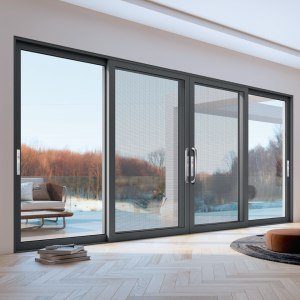
For aluminum alloy doors (casement, sliding, or folding), the glass panel integrates with the frame via a glazing bead or structural silicone. The compatibility of glass thickness with the frame’s glazing pocket is a critical specification—most aluminum systems accommodate 4mm to 10mm glass, but the exact range varies by profile series.
How Do You Measure Door Glass Panels Correctly?
The most common measurement error in door glass panel procurement is measuring the old glass instead of the frame opening. The correct reference is the Daylight Opening (DO) —the clear opening in the frame where the glass sits.
Step-by-Step Measurement Process
- Measure the daylight opening in three places horizontally (top, middle, bottom) and three places vertically (left, middle, right). Frames are rarely perfectly square, especially in older buildings.
- Use the smallest measurement in each direction as your baseline. This prevents the panel from being too large to fit.
- Subtract the tolerance gap. For most aluminum and wood door systems, allow 2-3mm (approximately 1/8 inch) per side for the rubber gasket and thermal expansion. A 600mm x 1200mm daylight opening would require a glass panel of approximately 594mm x 1194mm.
- Verify the glass thickness. Check the existing panel’s edge or the frame’s glazing pocket. Common thicknesses are 4mm, 5mm, 6mm, 8mm, and 10mm.
- Add a waste factor. For bulk orders, include a 5% breakage allowance in your total quantity. Glass panels can crack during transport or installation, and reordering a single panel is significantly more expensive than ordering one extra upfront.
Weight Calculation for Hardware Specification
The weight of a glass panel determines the hinge rating, roller capacity, and whether additional reinforcement is needed in the door frame.
Formula: Weight (kg) = Thickness (mm) × Area (m²) × 2.5 kg/m²/mm
For example, an 8mm panel measuring 0.8m × 2.1m (1.68 m²) would weigh:
8 × 1.68 × 2.5 = 33.6 kg
For sliding doors, this weight must be within the roller system’s rated capacity. For hinged doors, the hinge must be rated for at least 1.5 times the panel weight to account for dynamic load when the door is opened and closed.
What Quality Factors Matter Most for Door Glass Panels?
The two most common field failures in imported door glass panels are condensation inside the IGU and breakage during thermal expansion.
Air and Water Tightness
A door glass panel is only as good as its seal. For IGUs, the edge seal prevents moisture from entering the air gap. If the seal fails, the unit fogs up permanently—there is no repair, only replacement.
Buyers should request:
- ISO 9001:2015 quality management certification from the factory [5].
- EN 1279 compliance for IGUs (European standard for glass in building—thermal stress, moisture resistance, and gas leakage) [6].
- ASTM E2190 compliance for the US market (standard specification for insulating glass unit performance) [7].
Wind Load Resistance
For high-rise buildings or coastal areas, wind load is the dominant design factor. The glass panel must withstand the pressure differential between the building interior and exterior.
The factory should provide wind load test reports from an accredited laboratory, not just in-house calculations. Ask for the test method (e.g., EN 12211 or ASTM E330) and the maximum pressure rating achieved.
Thermal Stress Resistance
Glass expands and contracts with temperature changes. If the panel is installed too tightly in the frame, or if the glass has high thermal absorption (dark tinted or reflective), it can crack from thermal stress.
Mitigation factors:
- Proper edge clearance (the 2-3mm gap mentioned earlier)
- Heat-strengthened or fully tempered glass for panels with high solar absorption
- Edge deletion of Low-E coating (removing the coating near the edge to reduce stress concentration)
How to Evaluate Door Glass Panel Suppliers
Not all glass factories are created equal. The evaluation framework below separates suppliers who can handle bulk B2B orders from those who are essentially job shops.
Capability Filtering
Ask these five questions before requesting a quote:
- Can you handle custom sizes, or only stock sizes? A factory with flexible production lines can cut and fabricate to your exact dimensions. A stock-only supplier will force you to adapt your design to their inventory.
- Do you manufacture the glass in-house, or do you outsource? Some “factories” are actually assemblers who buy glass from third parties. In-house tempering and lamination lines mean better quality control and shorter lead times.
- What is your MOQ for custom sizes? Stock sizes typically have lower MOQs (50-100 pieces), while custom sizes may require 200+ pieces depending on the factory’s production planning.
- Can you provide test reports from accredited laboratories? This is non-negotiable for commercial projects. If the supplier hesitates, walk away.
- What is your production lead time? A realistic timeline for custom door glass panels is 2-4 weeks for production plus 2-5 weeks for sea freight, depending on the destination.
Red Flags: Avoid Suppliers Who…
- Cannot provide a factory audit report. If you cannot visit the factory, a third-party audit (SGS, Bureau Veritas, TÜV) is the minimum verification.
- Quote prices that are significantly below market average. Glass manufacturing has fixed costs—raw materials, energy for tempering furnaces, labor. A price 30% below competitors usually means thinner glass, lower-grade aluminum, or skipped testing.
- Only accept payment via unsecured methods. For container orders, a Letter of Credit (L/C) or a 30/70 payment split (30% deposit, 70% before shipment) is standard practice.
Choose A If… Choose B If…
Choose a full-service manufacturer if you need custom sizes, specific glass configurations, and the aluminum frame integrated with the glass panel. This is typical for villa projects, commercial storefronts, and system window installations.
Choose a specialized glass processor if you are only buying replacement glass panels for existing frames and do not need frame integration. These suppliers focus on glass fabrication and often have lower prices for standard sizes.
What Industry Standards Apply to Door Glass Panels?
The table below summarizes the key standards and their relevance:
| Standard | Region | Application | Key Requirement |
|---|---|---|---|
| EN 12150 | Europe | Tempered glass | Fragmentation test, surface compression ≥ 90 MPa |
| EN 14449 | Europe | Laminated glass | Impact resistance, interlayer adhesion |
| EN 1279 | Europe | IGUs | Moisture and gas leakage limits |
| ASTM C1036 | USA | Flat glass | Thickness tolerance, optical quality |
| ASTM E2190 | USA | IGUs | Accelerated weathering, dew point |
| ISO 9001:2015 | International | Quality management | Process control, documentation |
For aluminum doors and windows, the frame system also needs to comply with:
- EN 14351-1 (European standard for windows and doors—includes air permeability, water tightness, and wind load resistance)
- AAMA/WDMA/CSA 101/I.S.2/A440 (North American standard for windows, doors, and skylights)
How Are Door Glass Panels Manufactured?
Understanding the production process helps buyers evaluate whether a factory has the equipment to deliver consistent quality.
Step 1: Glass Cutting and Edge Processing
Raw glass sheets (typically 3.2m × 2.4m or larger) are cut to size using CNC cutting machines. The edges are then ground and polished to remove micro-cracks. This step is critical—edge defects are the most common cause of spontaneous glass breakage.
Step 2: Tempering or Lamination
For tempered glass, the cut panels are placed on a horizontal tempering furnace, heated to 600-700°C, then rapidly cooled with air jets. The process takes 3-5 minutes per batch. The furnace must be calibrated regularly to ensure consistent compression across the panel surface.
For laminated glass, the glass plies are assembled with a PVB interlayer and passed through a lamination line that applies heat (around 130°C) and pressure to bond the layers without bubbles.
Step 3: IGU Assembly
For insulated units, two or three glass panes are assembled with a spacer bar filled with desiccant (molecular sieve). The spacer is sealed with butyl rubber as the primary seal and polysulfide or silicone as the secondary seal. The unit is then filled with argon gas through a small hole, which is sealed afterward.
Step 4: Frame Integration
For door glass panels supplied with aluminum frames, the glass is installed into the frame profile with a glazing bead and EPDM rubber gaskets. The frame corners are sealed with structural silicone to prevent water ingress.
Step 5: Quality Inspection
Final inspection includes:
- Visual check for scratches, bubbles, or inclusions
- Thickness measurement using a caliper
- Dimensional check against the production drawing
- Air-tightness and water-tightness tests on a random sample
Customization and OEM/ODM Options
For B2B buyers, the ability to customize is often the deciding factor between suppliers.
What Can Be Customized?
- Glass size and thickness: From 4mm single panels to 10mm+ tempered or laminated units
- Glass configuration: Double or triple glazing, Low-E coatings, argon fill
- Frame profile: Aluminum alloy profiles can be adjusted to match local building codes (wind load requirements, thermal break specifications)
- Color and finish: Powder coating colors (e.g., RAL codes), anodized finishes, wood grain laminates
- Hardware: Hinges, locks, handles, and rollers from specified brands
OEM vs. ODM
- OEM (Original Equipment Manufacturing): The factory produces according to your drawings and specifications. Your brand is applied to the product.
- ODM (Original Design Manufacturing): The factory designs the product based on your requirements, offering their engineering expertise.
For buyers who need private labeling, OEM is the standard. For buyers who need help with product development, ODM adds value.
Ordering Process: MOQ, Lead Time, and Shipping
Minimum Order Quantity (MOQ)
MOQs vary by product complexity. Standard-size door glass panels (single or double glazing) typically have a MOQ of 50-100 pieces. Custom sizes with specific glass configurations may require 200+ pieces. A factory with flexible production lines can often accommodate smaller MOQs for prototyping or sample orders.
Lead Time
- Sample production: 7-15 days
- Bulk production: 2-4 weeks, depending on order size and complexity
- Sea freight: 2-5 weeks to most global destinations
Shipping: FCL vs. LCL
- FCL (Full Container Load): Cost-effective for large orders (typically >20 cubic meters). The container is sealed at the factory and not opened until destination.
- LCL (Less than Container Load): Suitable for smaller orders. Your goods are consolidated with other shipments. The risk of damage is slightly higher due to additional handling.
Packaging requirement: Door glass panels must be packed in wooden crates with foam or rubber dividers between panels. The crates must be marked with orientation arrows and fragile labels. This is not optional—improper packaging is the leading cause of transit breakage.
Why Factory Direct Matters: Meeting the Standards Discussed Above
Here is how the industry works. Most door glass panels sold in the market pass through at least one intermediary—a distributor, a trading company, or a regional importer. Each layer adds a markup of 15-30% to cover warehousing, handling, and profit.
As a manufacturer, our approach to this is straightforward. We supply door glass panels and complete door systems directly from our factory in China. By removing the middleman, you pay for the product, not the distribution chain.
Customization and Compliance
Different markets have different requirements. A project in Germany needs CE-marked products compliant with EN 14351-1. A project in Florida needs impact-resistant glass certified to ASTM E1886 and Miami-Dade County standards. Our engineering team adjusts the aluminum profile structure and fittings to match your local building codes. We offer full customization on size, color, and glass configuration—from 4mm to 10mm thickness—based on your project drawings.
Quality Control and Export Documentation
The top complaints in imported door glass panels are breakage during transit and condensation in IGUs. Our pre-shipment inspection includes air-tightness, water-tightness, and wind resistance tests on assembled doors. For export, we provide the full documentation package—packing list, proforma invoice, bill of lading, and certificates of origin—to ensure your LCL or FCL shipment clears customs without delays.
We have worked with distributors and construction companies across Europe, the Middle East, and Southeast Asia. One recent project involved supplying 1,200 custom aluminum sliding doors with triple-glazed IGUs for a residential complex in Dubai. The order was delivered in two FCL shipments over 6 weeks, with a breakage rate below 0.5%.
Making the Final Decision
Door glass panels are a specification decision, not a commodity purchase. The glass type affects energy performance, safety compliance, and acoustic comfort. The measurement affects installation time and waste. The supplier affects your project timeline and reputation.
Choose a full-service manufacturer if you need custom sizes, integrated aluminum frames, and compliance with local building codes. Choose a specialized glass processor if you are only buying replacement panels for existing frames.
Before placing an order, request samples, verify test reports, and audit the factory’s quality processes. A supplier who hesitates on documentation is a supplier who has something to hide.
If you are planning a bulk order and need a partner who can handle custom sizes and provide the necessary test reports, talk to our team. We respond to inquiries within 24 hours with a detailed quotation and production timeline.
—
References
[1] Glass for Europe. “Toughened and Laminated Glass: Technical Definitions.” https://www.glassforeurope.com/products/toughened-and-laminated-glass/
[2] Saint-Gobain Glass. “Laminated Glass: Safety and Security.” https://www.saint-gobain-glass.com/insights/laminated-glass
[3] Efficient Windows Collaborative. “U-Factor and SHGC.” https://www.efficientwindows.org/ufactor.php
[4] National Fenestration Rating Council. “Solar Heat Gain Coefficient.” https://www.nfrc.org/window-types/solar-heat-gain-coefficient/
[5] International Organization for Standardization. “ISO 9001:2015 Quality Management Systems.” https://www.iso.org/standard/62085.html
[6] European Committee for Standardization. “EN 1279: Glass in Building—Insulating Glass Units.” https://standards.cencenelec.eu/
[7] ASTM International. “ASTM E2190: Standard Specification for Insulating Glass Unit Performance.” https://www.astm.org/e2190-19.html