Content Menu
● 1. Why Choose Custom Double Doors? Design and Functional Benefits
● 2. Core Product Categories for Custom Double Doors
● 3. Customization Options: What Can Be Tailored?
● 4. Technical Specifications and Performance Standards
● 5. How Much Do Custom Double Doors Cost? A Pricing Framework
● 6. Custom Double Doors for B2B Buyers: Sourcing and Procurement Strategy
● 7. OEM, ODM, and Private Label: Working with a Manufacturing Partner
● 8. Logistics, Shipping, and Documentation
● 9. How Jusen Door and Windows Meets These Standards
● 10. Frequently Asked Questions
● 11. How to Evaluate Custom Double Door Suppliers: A Procurement Framework
● 12. Questions to Ask Before Ordering
18 min read
When a project calls for a 72-inch opening with a pair of doors that each weigh over 100 pounds, a buyer can’t just pick a product from a catalog. They need to understand how the door is constructed, what the thermal break actually does, and which test reports matter. This guide walks through those details from a manufacturing perspective — materials, glazing, hardware, pricing logic, and what to ask before placing a container order.
Why Choose Custom Double Doors? Design and Functional Benefits
Double doors create a wider clear opening than any single door — typically 48 to 72 inches total, compared to 36 inches for a standard single leaf. That extra width matters for moving furniture, hospital equipment, or handling high foot traffic in commercial settings. For residential projects, a double-door entry changes the entire visual scale of a facade. Architects specify them for symmetry; developers use them as a premium feature that justifies higher unit pricing.
The functional advantages go beyond aesthetics. Both leaves can swing fully open, creating cross-ventilation that single doors can’t match. When paired with sidelites or full-glass panels, double doors also increase daylight penetration. For coastal or windy regions, the ability to secure both leaves independently adds flexibility in controlling airflow.
What Do You Call a Front Door with Two Doors?
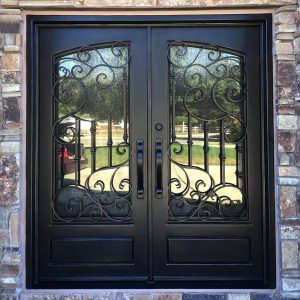
The industry uses several terms: double doors, double-leaf doors, hinged pairs, or French doors. The distinction matters. French doors typically refer to pairs with full-glass panels — each leaf is mostly glazing. Solid double doors have stile-and-rail or slab construction with limited or no glass. When both leaves are hinged and meet in the center, the seam is covered by an astragal — a vertical strip that seals the gap.
Buyers should use precise terminology when requesting quotes. Saying “French doors” when you mean solid double doors will generate the wrong specifications. Specify the leaf construction, glazing percentage, and swing direction to avoid miscommunication.
Are Double Front Doors a Good Idea?
The answer depends on the project context. For primary entrances in luxury residences, boutique hotels, or commercial storefronts, double doors deliver a strong return on investment. They increase perceived property value and provide practical access width.
The trade-offs are real. Double doors cost more — roughly 1.5 to 2 times a comparable single door. They have more hardware: two sets of hinges, two locks or one multi-point system, plus the astragal. Air sealing is harder because the center seam is a potential leak point. If the weatherstripping and astragal are poorly designed, you’ll feel drafts and hear wind noise.
Verdict: Double doors are a good choice when the opening justifies them — wide entryways, high-traffic commercial entrances, or projects where visual impact is a priority. For standard residential openings, a single door with sidelites may be more cost-effective.
Core Product Categories for Custom Double Doors
“Custom double doors” is not a single product. It’s a category spanning different base materials, each with distinct performance characteristics and cost structures. Buyers must select a system type before discussing customization.
Solid Wood Double Doors
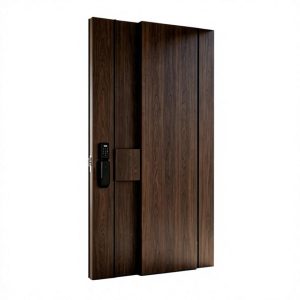
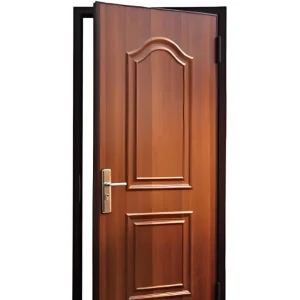
Wood species commonly used include oak, mahogany, walnut, teak, and Sapele. Construction methods vary: stile-and-rail (panels fitted into a frame) versus solid-core slab (laminated wood layers). Stile-and-rail is more dimensionally stable and allows for panel design flexibility. Solid-core slabs offer better sound insulation but are heavier.
Solid wood double doors are the premium choice for high-end residential and heritage projects. The downsides: moisture sensitivity, which causes warping in humid climates, and maintenance requirements — refinishing every 3–5 years depending on exposure. A solid oak double door set can weigh 150–250 pounds, requiring heavy-duty hinges and reinforced framing.
Thermal-Break Aluminum Double Doors
Thermal-break technology uses polyamide strips to separate the interior and exterior aluminum profiles. This interrupts the thermal bridge, reducing heat transfer through the frame. For exterior applications, this is a significant energy-efficiency improvement over standard aluminum.
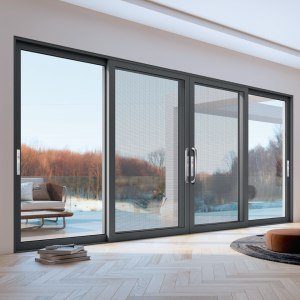
Performance benefits include corrosion resistance — critical for coastal installations — and low maintenance. Powder-coated finishes last 15–20 years without refinishing. Thermal-break aluminum double doors suit modern villa designs, commercial storefronts, and any project requiring high weather resistance. They’re also recyclable at end of life.
Aluminum-Clad and System Double Doors
Hybrid construction combines a wood interior (for aesthetic warmth) with an aluminum exterior cladding (for durability). System doors take this further with engineered profiles that integrate gaskets, multi-point locking, and concealed hardware into a single designed system.
These doors meet the most demanding performance requirements — U-values as low as 1.0 W/m²K with triple glazing, air-tightness classifications up to Class 4, and water-tightness up to Class 9A. For projects requiring both visual warmth and structural performance, aluminum-clad system doors are often the right answer.
Casement and Sliding Double Door Configurations
Casement double doors are the classic hinged pair, opening inward or outward. Outward-opening doors save interior space but require additional weather protection. Inward-opening doors are more common in residential settings.
Sliding double doors use a track system — one fixed leaf with one sliding leaf, or both leaves sliding on multi-track systems. Sliding configurations suit areas with limited swing clearance, such as narrow hallways or rooms where furniture placement blocks door swings. They’re also popular for patio and terrace access where wide openings are desired.
Customization Options: What Can Be Tailored?
Customization extends far beyond size. Buyers can specify profile geometry, color, glass type, hardware, and performance ratings. Understanding what’s adjustable helps you negotiate better pricing and avoid paying for features you don’t need.
Size and Configuration Flexibility
Standard double door widths: 48″, 60″, or 72″ total opening. Custom widths can extend to 96″ or beyond, though structural requirements change — wider doors need reinforced frames, additional hinges, or stiffer profiles. Heights typically range from 80″ standard to 84″, 96″, or floor-to-ceiling.
Configuration options include symmetrical pairs (both leaves equal), offset leaves (one wider than the other), or doors flanked by fixed sidelites. For commercial egress, consider the door’s swing direction and whether both leaves need to open for emergency exit.
Glass and Glazing Options
Double glazing — two panes with an insulating air gap — is standard for exterior doors. Low-E coatings reduce UV transmission and heat gain, improving energy efficiency. Tempered or laminated glass is required for safety in commercial and public buildings; some residential codes also mandate it for doors near stairs or in high-traffic areas.
Decorative options include frosted, tinted, patterned, or obscure glass for privacy. For double doors with full-glass panels, consider the weight — a 60″ x 80″ leaf with double glazing can add 40–60 pounds. This affects hinge selection and frame reinforcement.
Color and Finish Choices
Aluminum doors offer powder coating in any RAL color, anodized finishes, or wood-grain foil that mimics natural wood. Wood doors accept stains, paints, or natural oil finishes. A key customization: dual-color options — different finish on the interior vs. exterior. For example, wood grain outside to match the building facade, white inside to match the interior palette.
Hardware and Accessories
Hinges: heavy-duty ball-bearing hinges rated for the door’s weight. A 100-pound leaf needs at least three hinges, not the standard two. Locks: multi-point locking systems with 3–5 locking points, mortise locks, or smart locks with keypad or biometric access. Handles: lever, pull, or panic bars for commercial egress requirements. Door closers: surface-mounted or concealed closers for automatic closing — important for fire-rated doors or commercial entrances. Weatherstripping: dual or triple seals around the perimeter and at the astragal to achieve the air-tightness classifications discussed below.
Custom double doors require hardware coordination. The lock, hinges, and closer must be compatible with each other and with the door’s weight and size. A multi-point lock designed for a 36″ door won’t provide adequate security on a 72″ double-leaf system.
Technical Specifications and Performance Standards
Buyers who understand performance classifications can evaluate quotes objectively. Here are the standards that matter for exterior double doors.
Air Tightness, Water Tightness, and Wind Resistance
These three tests determine how well a door seals against the elements.
Air permeability measures air leakage through the closed door, expressed in m³/h·m² at a given pressure differential. European classifications range from Class 1 (highest leakage) to Class 4 (lowest leakage). For exterior doors in windy climates, Class 3 or 4 is recommended.
Water tightness tests the door under simulated rain and wind pressure. Classes range from 1A (lowest) to 9A (highest). A Class 7A door withstands 280 Pa of water pressure — equivalent to heavy rain with moderate wind. For coastal or storm-prone areas, Class 8 or 9 is advisable.
Wind load resistance measures structural deformation under extreme wind pressure. Class C5 (2,000 Pa) is the highest standard for residential and commercial exterior doors.
Buyers should request test reports before ordering, not after. A supplier that can’t provide third-party test documentation is a red flag.
Thermal Performance (U-Value)
U-value (W/m²K) measures heat transfer through the entire door assembly — frame, panels, and glazing. Lower is better. Typical ranges:
| Door Type | U-Value Range |
|---|---|
| Solid wood | 2.0 – 2.8 W/m²K |
| Thermal-break aluminum | 1.4 – 2.2 W/m²K |
| System doors with triple glazing | As low as 1.0 W/m²K |
Local building codes increasingly mandate maximum U-values for exterior doors. In colder climates, a U-value above 2.0 will fail energy code inspections. The glass specification drives most of the thermal performance — triple glazing with low-E coatings and argon gas fill achieves the lowest U-values.
Acoustic Performance
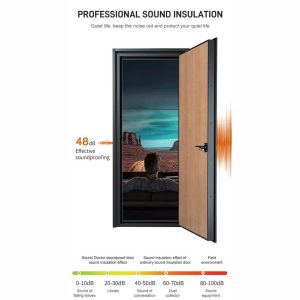
Sound insulation is measured in decibels (dB) of noise reduction. Standard exterior doors achieve 30–35 dB. High-performance acoustic doors reach 40–45 dB. For projects near airports, highways, or rail lines, specify acoustic glazing — thicker glass panes with wider air gaps and acoustic interlayers.
Compliance with Local Building Codes
There is no universal standard. North America uses ASTM and NFRC standards; Europe uses EN standards; Australia/New Zealand use AS/NZS. A door manufactured for the German market may not meet US hurricane codes, and vice versa. This is why buyers should verify that their supplier can adjust profile structures and fittings to match target-market requirements — not just offer a generic product.
How Much Do Custom Double Doors Cost? A Pricing Framework
Pricing depends on more variables than most buyers expect. Here’s the cost logic, not a price list.
Cost Drivers
Material choice: Solid wood costs more than aluminum. Exotic woods (mahogany, teak) cost 2–3 times domestic oak or Sapele. Size: Larger doors require more material, heavier frames, and additional reinforcement. Glass specification: Triple glazing or laminated safety glass adds 20–40% to glazing costs. Hardware quality: Multi-point locks and premium handles add 10–25% to total door cost. Finish: Custom RAL colors or wood-grain foil carry surcharges. Certification and testing: Doors meeting specific performance classes cost more because the manufacturing process is more controlled and the testing is expensive.
Price Range Benchmark
For B2B buyers ordering factory-direct, custom double doors typically range from $800 to $3,000+ per set, depending on material and specification. A basic thermal-break aluminum double door with double glazing might land around $800–$1,200. A solid mahogany double door with premium hardware could exceed $3,000. Bulk pricing, MOQ commitments, and long-term contracts significantly reduce unit costs.
Request a detailed quotation breakdown: material cost, hardware, finish, packaging, and freight. If a supplier gives a lump-sum quote, ask for the itemization. This reveals where costs are concentrated and helps you negotiate. Some buyers discover they’re overpaying for premium hardware they don’t need — switching to standard-grade multi-point locks can cut 15% from the total.
Total Cost of Ownership
The cheapest door isn’t always the most economical. Wood doors require periodic refinishing — budget for that. Aluminum doors are low-maintenance but may have lower thermal performance unless specified with thermal breaks. A well-made door lasts 20–30 years. Cheap alternatives fail in 5–7 years, requiring full replacement. When calculating cost per year of service, a quality door often wins.
Custom Double Doors for B2B Buyers: Sourcing and Procurement Strategy
The procurement process for custom double doors follows a structured path. Skipping steps creates problems downstream.
Defining Your Project Requirements
Create a specification sheet before contacting suppliers. Include: total opening width and height, leaf configuration (symmetrical or offset), material preference, glazing specification, hardware requirements, performance class targets (air, water, wind, U-value), color/finish, quantity, and target price. For installation context, note the wall type (concrete, drywall, timber frame), opening direction, and local climate conditions.
A complete spec sheet reduces quote turnaround time. Suppliers can respond within days rather than weeks, and you avoid the back-and-forth of clarifying missing details.
Evaluating Suppliers: Factory vs. Trading Company
Factory-direct: Lower cost — no middleman markup. Direct communication with production teams. Better control over quality and lead times. The trade-off: you handle more coordination yourself.
Trading company: Convenience — they handle language, logistics, and supplier management. But you pay a markup, and you have no direct control over manufacturing. Quality issues are harder to resolve through a middleman.
Verification tips: ask for factory photos and video calls. Request a third-party audit report if available. Check whether the supplier’s website shows actual production facilities or just stock photos. For critical orders, consider a physical factory inspection.
Requesting Samples and References
Always request a physical sample or detailed technical drawings before committing to a bulk order. A sample door — even a small cutaway showing profile construction — reveals more than any spec sheet. Ask for references from past B2B clients, especially in your region. Check whether the supplier has experience with projects similar to yours — coastal villas, high-rise apartments, commercial offices — because performance requirements differ significantly.
Understanding MOQ and Lead Times
Typical MOQ for custom double doors: 10–50 units depending on the manufacturer. Some factories accept smaller orders at higher per-unit prices. Lead times: 15–45 days for production, plus shipping time (20–40 days by sea). Plan orders around construction schedules. Ask about split shipments if you need partial deliveries to align with construction phases.
OEM, ODM, and Private Label: Working with a Manufacturing Partner
Manufacturing partnerships take several forms. Understanding the options helps you choose the right model for your business.
OEM (Original Equipment Manufacturing)
You provide the design and specification; the factory manufactures to your drawings. This model suits established brands with defined product lines. The factory produces exactly what you specify — no more, no less. You own the design and can switch manufacturers if needed.
ODM (Original Design Manufacturing)
The factory offers its own designs that you can customize with your branding. This is faster to market — no design phase required — and lower development cost. The trade-off: your product isn’t unique. Competitors may offer the same design under different branding.
Private Label
Manufacturing with your brand name, logo, and packaging. You build brand recognition without owning a factory. This works well for distributors and builders who want a branded product line without manufacturing overhead.
Bulk Supply for Construction Projects
For developers and general contractors, the priority is consistent quality across hundreds of units. This requires a supplier with documented quality control processes, not just a good sample. On-site technical support and documentation — packing list, proforma invoice, customs documents — become essential. Adjustable profile structures to meet project-specific building codes are a differentiator that many suppliers can’t offer.
Logistics, Shipping, and Documentation
International procurement involves more than production. Shipping logistics and export documentation affect timelines and costs.
FCL vs. LCL Shipping
FCL (Full Container Load): More cost-effective for large orders — you pay for the container, not just your share. Better protection against damage because your goods aren’t mixed with other cargo. Recommended for orders above 20–30 doors.
LCL (Less than Container Load): Flexible for smaller orders — you pay only for the space you use. But transit times are slower (consolidation adds days), and there’s a slightly higher risk of handling damage. For urgent small orders, LCL may be the only option.
Export Documentation
Expect a standard documentation package: packing list, proforma invoice, commercial invoice, bill of lading, and certificates of origin. Customs clearance delays can stall your entire project — missing documents mean containers sit at port accruing storage fees. Verify that your supplier can provide complete documentation before ordering.
Packaging Standards
Professional export packaging uses plywood crates, foam protection, and corner guards. Each door should be individually wrapped to prevent scratching and moisture damage during ocean transit. Poor packaging leads to damage claims — and damage claims lead to project delays.
How Jusen Door and Windows Meets These Standards
The industry standards described above are not theoretical. As a manufacturer, our approach to meeting them is straightforward: we build to spec, test before shipping, and provide the documentation buyers need to clear customs and pass inspections.
Factory-Direct Supply with Full Customization
We supply directly from our factory — there is no middleman markup. This keeps pricing competitive while maintaining control over quality. Every order is manufactured to the buyer’s specification: size, color, glass, and hardware accessories. We handle OEM (manufacturing to your drawings), ODM (adapting our designs), and private label (your branding on our products). For construction projects, we provide bulk supply with consistent quality across large orders.
Quality Control and Compliance
Before shipment, every order undergoes a strict inspection: air-tightness, water-tightness, and wind-resistance testing. We don’t just claim compliance — we test each batch and can provide the results. Our profile structures and fittings are adjustable to match local building codes in your target market. Whether you’re shipping to North America, Europe, Australia, or the Middle East, we adapt the door system to meet regional requirements.
Export Experience and Logistics Support
Our foreign trade experience means the documentation is handled correctly: packing lists, proforma invoices, and full customs paperwork. We ship by FCL or LCL, direct from our China factory. We can coordinate with your freight forwarder or ours — whichever is more convenient for your logistics plan.
What This Means for Your Project
You get a manufacturing partner who understands both production and international trade. You avoid intermediary costs while maintaining quality assurance and on-time delivery. The result: a reliable supply chain for custom double doors, from first sample to full container orders.
Frequently Asked Questions
Are double front doors a good idea?
Yes, for projects where visual impact, natural light, and wide access are priorities. They add architectural significance and practical clearance. The considerations are higher cost and the need for quality hardware — two sets of hinges, a robust astragal, and proper weatherstripping — to support the extra weight and maintain sealing.
What do you call a front door that has two doors?
Commonly called double doors, double-leaf doors, or a hinged pair. When both leaves are full-glass, they’re often called French doors. The center seam is covered by an astragal. Using precise terminology matters when requesting quotes — “French doors” and “solid double doors” generate very different specifications.
How much do new double front doors cost?
For B2B buyers, expect $800 to $3,000+ per set from a factory-direct supplier, before shipping and installation. The range depends on material, size, glazing, and hardware. Custom specifications and performance ratings push prices higher. Bulk pricing and MOQ commitments reduce unit costs.
What are the disadvantages of double doors?
Higher upfront cost, more moving parts (two sets of hinges, locks, and seals), and potentially more air leakage at the astragal if the weatherstripping isn’t well-designed. They also require more wall space for the wider opening. For standard residential openings, a single door with sidelites is often more practical.
Can double doors be made to custom sizes?
Yes. Most manufacturers produce double doors in custom widths and heights. Oversized doors — above 72″ wide or 96″ tall — require reinforced frames, additional hinges, and possibly tempered glass to meet safety standards. Confirm structural requirements with your supplier before specifying oversized dimensions.
What is the lead time for custom double doors?
Production typically takes 15–45 days depending on material and order volume. Ocean shipping adds 20–40 days. FCL shipments are generally faster and more cost-effective for bulk orders. Plan orders around construction schedules and ask about split shipments if needed.
Do you offer OEM or private label options?
Yes. We support OEM (manufacturing to your design), ODM (adapting our designs), and private label (your branding on our products). These models are common for distributors, builders, and door brands seeking to expand product lines without owning a factory.
—
How to Evaluate Custom Double Door Suppliers: A Procurement Framework
Phase 1 — Technical Verification: Request test reports for air-tightness, water-tightness, and wind resistance. Ask for U-value calculations. Verify certifications — ISO 9001:2015 for quality management systems, CE marking for European markets, or relevant local certifications. If a supplier can’t provide documentation, move on.
Phase 2 — Manufacturing Capability: Ask about production capacity, lead times, and whether they perform in-house testing or outsource it. Request factory photos or a video call. For critical orders, consider a third-party audit. A supplier with CNC machining capability and in-house surface treatment lines has better control over quality than one that subcontracts these steps.
Phase 3 — Commercial Terms: Request a detailed quotation breakdown: material, hardware, finish, packaging, freight. Compare item-by-item across suppliers. Verify MOQ and lead times. Check payment terms — typical is 30% deposit, 70% before shipment. Be wary of suppliers demanding full payment upfront.
Phase 4 — Logistics and Documentation: Confirm the supplier can provide complete export documentation: packing list, proforma invoice, commercial invoice, bill of lading, and certificates of origin. Ask about packaging standards — plywood crates, foam protection, individual wrapping. Clarify FCL vs. LCL options and who coordinates freight.
Questions to Ask Before Ordering
- Can you provide test reports for air-tightness, water-tightness, and wind resistance for this specific door model?
- What U-value will this door assembly achieve with the specified glazing?
- What is your MOQ for custom double doors?
- What is the production lead time, and what shipping options are available?
- Can you provide a detailed quotation breakdown by material, hardware, finish, and packaging?
- Do you adjust profile structures and fittings to meet local building codes in my target market?
- What is your pre-shipment inspection process, and can I see photos or video of the inspection?
- What export documentation will you provide?
Avoid Suppliers Who…
- Cannot provide third-party test reports or certification documentation
- Quote a lump-sum price without itemization
- Have no verifiable factory address or production facility
- Promise unlimited customization at no additional cost — custom always costs something
- Cannot explain their manufacturing process in technical detail
- Have no experience with international shipping or export documentation
Decision Guide: Choose A If… Choose B If…
Choose a factory-direct manufacturer if: You’re ordering 10+ units, you need competitive pricing, you want direct communication with production teams, and you’re comfortable coordinating logistics.
Choose a trading company if: You’re ordering small quantities, you need language support and convenience, and you’re willing to pay a markup for middleman services.
Choose solid wood double doors if: The project demands premium aesthetics, the location has controlled humidity, and a maintenance schedule is acceptable.
Choose thermal-break aluminum double doors if: The project requires low maintenance, weather resistance, and modern aesthetics — especially for coastal or high-humidity environments.
Choose OEM if: You have established designs and want a manufacturer to produce them. Choose ODM if: You want to market existing designs with your branding, with minimal development cost.
Choose FCL shipping if: Your order exceeds 20–30 doors. Choose LCL if: You need a smaller quantity and can wait for consolidation.
—
References
- European Committee for Standardization. “EN 14351-1:2006+A2:2016 — Windows and doors — Product standard, performance characteristics.” https://www.en-standard.eu
- International Organization for Standardization. “ISO 9001:2015 — Quality management systems — Requirements.” https://www.iso.org/standard/62085.html
- American Architectural Manufacturers Association. “AAMA/WDMA/CSA 101/I.S.2/A440 — Specification for windows, doors, and unit skylights.” https://www.aamanet.org
- National Fenestration Rating Council. “NFRC 100 — Procedure for Determining Fenestration Product U-factors.” https://www.nfrc.org
- European Committee for Standardization. “EN 10077-1 — Thermal performance of windows, doors and shutters.” https://www.en-standard.eu
—
Ready to source custom double doors for your next project? https://doorwoodendoors.com/contact-us/“>Contact our team with your specifications, and we’ll provide a detailed quotation with test documentation and shipping options.
https://doorwoodendoors.com/contact-us/” style=”display:inline-block;padding:12px 24px;background:#2563eb;color:#fff;text-decoration:none;border-radius:6px;font-weight:600″>Get a Free Quote