Last updated: September 19, 2026
Bifold Shaker Doors: Key Takeaways for Buyers
Bifold shaker doors are folding door systems in which each panel carries a shaker frame-and-panel profile — a flat recessed center surrounded by a clean, square-edged frame. The panels fold back on themselves along a track, so the door stores in a fraction of the opening width instead of swinging into the room. For B2B buyers, the appeal is straightforward: shaker geometry is simple to manufacture consistently, it reads as neutral across residential and hospitality projects, and it adapts to wood, MDF, aluminum, and glass builds.
The comparison that matters is not “which door looks best” but which construction matches the opening, the traffic, the environment, and the budget. A reach-in closet in a hotel corridor and a 3 m exterior opening onto a terrace are both bifold shaker doors, but almost nothing about their specification overlaps. Buyers who treat them as one product category usually end up overpaying on one and under-specifying the other.
Four decisions drive most of the outcome:
- Material and core — solid wood, engineered MDF, or aluminum frame; hollow-core versus solid-core panel.
- Size and configuration — panel count, leaf width, height, and whether the opening takes a single pair or a double pair.
- Finish and glazing — paint, stain, laminate, or factory-primed; clear, frosted, or no glass.
- Hardware and track — top-hung or floor-guided, pivot and guide quality, and how the system handles wide or tall openings.
Get those four right and the door performs. Get them wrong and no finish upgrade will compensate.
Types of Bifold Shaker Doors: Materials, Styles, and Configurations
What defines the shaker profile on a bifold
A shaker panel is a frame surrounding a recessed flat center. On a bifold, that profile repeats across two, three, four, or more leaves, and the leaves hinge in pairs. The profile itself is shallow — typically a simple step or a slight bevel where the frame meets the panel. That shallow geometry matters commercially: it paints cleanly, it does not collect dust in deep grooves, and it resists the cupping that deeper raised-panel profiles can develop as humidity swings.
There is a real trade-off in how the panel is built. A solid-core shaker panel resists impact and sound transmission better and holds hardware screws more securely, which matters on doors that fold and unfold daily. A hollow-core panel is lighter, cheaper, and easier to hang, but it dents more readily and can feel insubstantial in a high-end setting. For closets in rental or budget hospitality stock, hollow-core is often the rational choice. For hotel suites, executive offices, and any door a guest will touch repeatedly, solid-core is the specification that survives.
Wood and engineered wood
Solid wood — oak, ash, walnut, mahogany, and similar species — gives the most repairable surface and the most convincing grain, and it takes stain rather than only paint. Oak bifold doors are the common mid-to-high specification because the grain is stable under finishing and the species is widely available. The limitation is movement: solid wood responds to humidity, so interior wood bifolds need acclimation and a stable environment, and exterior wood bifolds need proper sealing and periodic maintenance.
Engineered MDF and HDF panels are dimensionally stable, take paint exceptionally well, and hold a crisp shaker edge without the grain-raising that solid wood can show under a sprayed finish. They are the workhorse for painted white and black bifold doors. The limitation is moisture: standard MDF swells if water reaches the core, so exterior or wet-area use requires moisture-resistant grades and full edge sealing.
Aluminum and aluminum-frame systems
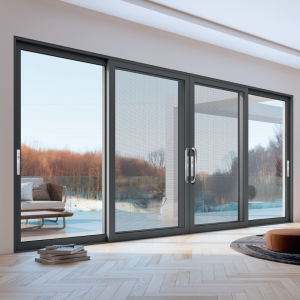
Exterior aluminium bifold doors use a thermal-break frame — an internal insulating barrier between the inner and outer aluminum sections — to limit heat transfer and condensation. This is the construction that makes large glazed bifold openings practical: aluminum carries wide leaves without the deflection you would get from a wood frame at the same span, and it does not rot, warp, or need repainting. Powder-coated finishes hold color well and are available in the full RAL range, which is why black and anthracite are so common on exterior aluminum bifolds.
The trade-off is thermal performance and cost. Aluminum is a conductor, so a thermal break is mandatory rather than optional in cold or hot climates, and the frame cost sits above painted MDF. For interior room dividers, aluminum is usually unnecessary unless the design intent is industrial or the environment is humid.
Glass configurations
Glass turns a bifold into a light-transmitting partition. Clear glass suits exterior openings and sunrooms where the view is the point. Frosted bifold doors — and bifold frosted glass doors generally — are the standard answer for interior privacy without losing light: closet doors, dressing areas, and office partitions where you want division but not darkness. Frosted glass is normally specified as acid-etched or sandblasted, and the finish should be consistent across all leaves so the panels read as one surface when closed.
A practical point buyers miss: on glazed bifolds, the glazing bead and seal quality determines whether the door rattles and whether water reaches the frame. On exterior units, ask how the glass is set and drained, not just what the glass is.
Interior versus exterior bifold doors
Interior and exterior bifolds are different products that happen to share a folding mechanism.
Interior bifolds — closet doors, wardrobe fronts, room dividers, laundry and pantry closures — are usually lighter, may be hollow- or solid-core, and are specified mainly for finish, panel proportion, and hardware smoothness. Fire and egress requirements for closet doors vary by jurisdiction, so confirm locally before finalizing.
Exterior bifolds are weather-rated assemblies. They need a thermal break, drained glazing, weather seals, wind-load resistance appropriate to the site, and hardware rated for exterior cycles. Bifold external doors are typically aluminum or aluminum-clad for this reason. Substituting an interior door into an exterior opening is one of the most expensive mistakes in this category.
Bifold Shaker Door Comparison Table
The table below compares the main configurations buyers actually specify. Price bands are directional and move with size, glazing, hardware, and order volume — treat them as a planning tool, not a quotation.
| Configuration | Typical use | Core / frame | Weight feel | Moisture resistance | Relative cost band | Key limitation |
|---|---|---|---|---|---|---|
| Painted MDF shaker, hollow-core | Closets, budget multi-unit | MDF face, hollow core | Light | Low | $ | Dents; not for wet areas |
| Painted MDF shaker, solid-core | Hotel suites, offices | MDF face, solid core | Medium-heavy | Low-medium | $$ | Heavier track load |
| Solid oak shaker | Mid-to-high residential | Solid oak stiles/rails | Heavy | Medium (sealed) | $$$ | Seasonal movement |
| Aluminum thermal-break, glazed | Exterior openings, sunrooms | Thermal-break aluminum | Heavy | High | $$$$ | Higher frame cost |
| Aluminum interior partition | Office dividers, humid interiors | Non-thermal aluminum | Medium | High | $$ | No thermal benefit needed |
| Frosted glass shaker | Closets, dressing, partitions | Frame + frosted glazing | Medium | Medium | $$-$$$ | Glass handling and packing |
Two patterns are worth noting. First, cost tracks core density and frame material more than it tracks finish — a painted solid-core MDF door often costs more than a stained hollow wood door, even though the wood “looks” more expensive. Second, exterior aluminum sits at the top of the band not because of the aluminum itself but because of everything that has to be added around it: thermal break, drainage, seals, and weather-rated hardware.
How to Choose the Right Bifold Shaker Doors for Your Project
Start with the opening, not the door
Measure the finished opening and decide the configuration before choosing a finish. Bifold sizing depends on panel count, and panel count is driven by opening width and how much clear access you need.
A single bifold pair covers roughly a 2 ft to 4 ft opening with two leaves. Wider openings take two pairs (four leaves) folding to both sides, or a multi-leaf system. Height matters just as much: tall bifold doors above roughly 8 ft need heavier tracks and often a stiffer panel core to resist bowing, and wide bifold doors need a track rated for the total leaf weight rather than the opening width.
Standard nominal sizes buyers ask for most often include 24×78 bifold doors, a 26 inch bifold door, 28×80, 20×80, and 36×96 bifold doors, plus metric equivalents such as 3m bifold doors and imperial 8ft bifold doors. Note the word nominal. Actual leaf dimensions, panel thickness, and the required rough opening vary by manufacturer and by hardware system, and nominal size rarely equals actual size. Always build the rough opening from the supplier’s published dimensions, not from the nominal label. For a fuller breakdown of paired-door dimensions and how they translate into rough openings, see this guide to double door sizes and configurations.
Clearance is the second half of the measurement. Bifolds need no swing space, but they do need stacking depth at the side of the opening and a clear floor path along the track. On a retrofit into an existing closet, the frame depth and the floor condition often decide whether a top-hung or floor-guided system is realistic.
Match material to environment
Use the environment as the filter, not the aesthetic:
- Dry interior, budget-sensitive: painted MDF, hollow-core, standard track.
- Dry interior, high traffic: painted or veneered MDF, solid-core, upgraded pivots.
- Humid interior or wet-adjacent: aluminum frame or moisture-resistant core with sealed edges.
- Exterior: thermal-break aluminum, drained glazing, weather-rated hardware, wind-load appropriate to site.
Decide finish and glazing early
Finish choice affects lead time and touch-up strategy, not just appearance. Bifold doors white in factory-applied paint are the most forgiving for multi-unit projects: consistent color, easy field touch-up, and no stain-matching risk between production batches. Black bifold doors — usually powder-coated aluminum or a sprayed MDF finish — hide handling marks better in high-traffic commercial settings but show dust and fingerprints more than white.
Oak bifold doors and other stained species introduce batch variation in grain and tone. If you are specifying stained wood across multiple rooms or phases, request a physical sample from the production batch and approve it before the run, not a catalog image.
Glazing follows the same logic. Clear glass for views and exterior openings; frosted for interior privacy. On any glazed bifold, confirm the glazing method and how the unit drains on exterior applications.
Compare quality on the parts you cannot see
High-end bifold doors are not distinguished by the shaker profile — that profile is easy to copy. They are distinguished by what is behind it:
- Core density and edge construction. Solid-core panels and properly banded edges hold screws and resist impact. Knock on the panel; a hollow-core door sounds hollow.
- Track and pivot hardware. Top-hung systems carry the leaf weight on a track and are generally smoother and more durable than floor-guided systems for heavy doors. Look at the track gauge, the roller or pivot material, and whether the guide is adjustable.
- Hinge and pivot cycles. The folding hinges take the most stress. Ask for the rated cycle count and the hinge material.
- Finish quality at the panel edges. Shaker panel edges and grooves are where paint fails first. A properly sealed, consistently sprayed edge is a reliable indicator of overall process control.
- Alignment adjustment. Floor and jamb alignment vary on real sites. Hardware with adjustable guides and pivots saves significant installation time on multi-unit projects.
For a broader look at how panel profiles and construction choices affect performance across door types, the panel wood door types guide covers 2- to 6-panel configurations and their trade-offs.
Cost drivers and how to compare quotes
When you compare quotes for bifold shaker doors, normalize them before comparing totals. The variables that move price most are core type, frame material, glazing, hardware grade, finish method, and order volume. A quote that looks 15% cheaper often reflects a hollow core, a lighter track, or a lower glazing specification rather than a better deal. Ask each supplier to state the core, the frame material, the hardware brand or grade, the finish system, and the packing method — then compare like for like. For a sense of how material and finish choices translate into delivered cost, this pricing overview on contemporary wood exterior doors is a useful reference point for the exterior side of the category.
Two scenarios that clarify the decision
Reach-in closet retrofit. Opening is around 24×78 to 28×80, dry interior, moderate traffic. The rational specification is a painted MDF shaker, solid-core if the budget allows, on a top-hung track with adjustable guides. Two leaves, opening to one side. The main risk is measuring the rough opening from the nominal size instead of the supplier’s actual dimensions, and the second risk is a floor-guided system on an uneven floor.
Wide wardrobe or room-divider opening. Opening is 6 ft to 3 m or more, interior, and the client wants light transmission. The rational specification is a four-leaf system in two pairs, solid-core or aluminum frame, with frosted glazing for privacy and a track rated for the total leaf weight. The main risks are underestimating the stacking depth at the sides and specifying a track sized to the opening rather than to the load.
Sourcing and Supplier Evaluation for Bifold Shaker Doors
Supplier selection is where most of the risk in this category actually sits, because the door is easy to draw and hard to make consistently at volume.
Start with capability, not price. A supplier who can only build one core type and one finish system will push your project toward that specification. A supplier with adjustable profile and fitting systems can match the building code, fire requirement, and size conventions of your target market rather than exporting a single domestic standard.
Then verify the things that are expensive to fix after shipment:
- Pre-shipment testing. Air-tightness, water-tightness, and wind-resistance testing on exterior units should be part of the production flow, not a special request. Ask what is tested, on what sample size, and what happens when a unit fails.
- Customization depth. Size, color, glass, and hardware should all be adjustable within the same order. If a supplier can customize color but not hardware, you will be managing two vendors.
- Documentation. For international procurement, confirm the supplier can issue a packing list, proforma invoice, and full customs documentation as standard. Missing paperwork delays clearance and erodes the price advantage.
- Shipping flexibility. Both FCL and LCL capability matters if your project phases in stages or mixes door types in one order.
- Sampling before the run. For stained or custom-colored doors, a physical pre-production sample is the only reliable control.
This is the point where it is fair to describe how we work, since it is the same set of criteria buyers should apply to any supplier. As a manufacturer, our approach to bifold shaker doors is factory-direct: we build to the buyer’s size, color, glass, and hardware specification rather than to a fixed catalog, and we adjust the profile structure and fittings to suit the building codes of the destination market. Exterior units go through air-tightness, water-tightness, and wind-resistance testing before shipment, and we handle the export documentation — packing list, proforma invoice, and customs papers — alongside both FCL and LCL shipments. Buyers comparing suppliers can use the same checklist on us: ask what core we would specify for your opening, what hardware grade we would pair with it, and what the tested sample looks like. If you want to run a specific opening or project scope past us, Talk to Our Team and we will come back with a specification and a quote.
Choosing between options
Choose painted MDF, hollow-core if the project is a dry interior, budget-driven, and the doors see light use — multi-unit closets, storage rooms, back-of-house.
Choose painted or veneered MDF, solid-core if the doors are in guest-facing or client-facing spaces and will be opened daily — hotel suites, offices, high-end residential.
Choose solid oak or other stained hardwood if the design intent is natural grain and the environment is stable and dry, and you can accept the maintenance and batch-matching discipline that comes with wood.
Choose thermal-break aluminum with glazing if the opening is exterior, the leaves are large, or the climate swings hard — exterior aluminium bifold doors are the only configuration that reliably handles all three.
Choose frosted glass in a shaker frame if you need light transmission with privacy — dressing areas, interior partitions, and closets where the door should read as a surface rather than a panel.
Whichever route you take, resolve core, frame, glazing, hardware, and documentation before you compare prices. Those five items decide whether the delivered door matches the one you specified.