Last updated: September 17, 2026
Key Takeaways: What B2B Buyers Need to Know First
The aluminum screen door category is not one product. It is a family of door systems that share an aluminum alloy frame and insect mesh but differ sharply in how they open, how they are rated, and what they are expected to survive. A buyer who treats “screen door” as a single line item will end up overpaying for light-duty units in some openings and under-specifying critical ones.
Four decisions drive almost every sourcing outcome:
- Configuration — swing, inswing, pull-across, frameless, storm, or security. This determines hardware, framing, and price more than any other variable.
- Size convention — nominal codes such as 36×96, 96×36, 78×36, 3-0, 8, and 4 mean different things depending on the market, and misreading them is the most common cause of rejected shipments.
- Finish and material system — brown, brown vinyl, mahogany, and mill-finish aluminum behave very differently in coastal, humid, and high-UV environments.
- Performance rating — a standard insect screen, a storm door, and a security screen door are not interchangeable, and only some are tested to withstand wind-driven rain or forced entry.
Everything below works through these four decisions in order, then closes with how to evaluate a screen door company and what to verify before a purchase order is issued.
Aluminum Screen Door Types and Configurations
Swing and inswing screen doors
Swing screen doors are hinged units that open outward or inward on a jamb-mounted frame. The distinction between a swing and an inswing screen door is directional: an inswing unit opens into the building, which matters for egress, for clearance behind the door, and for how the door interacts with a primary entry door.
For commercial and multifamily projects, inswing configurations are common where the screen door is paired with an existing entry door and the exterior face must stay flush. The trade-off is that inswing units need interior clearance and their hinges are more exposed to foot traffic. Outswing units handle wind pressure better because the frame backs against the jamb, but they can conflict with exterior steps or landings.
Pull-across screen doors
A pull-across screen door slides laterally across the opening rather than swinging. This configuration is useful where a hinged door would block a walkway, and it is common on patio and service openings. The mechanism relies on top and bottom tracks, so track quality and debris management determine service life more than frame gauge does. Buyers specifying pull-across units for high-traffic commercial openings should confirm the roller and track hardware grade, not just the frame.
Frameless screen doors
Frameless screen doors use mesh held under tension or captured in a minimal edge profile, with no full perimeter frame. They are specified where sightlines matter — storefronts, hospitality entries, and modern residential facades.
For commercial projects, frameless units are suitable but with conditions. They are generally not the right choice for openings that must meet forced-entry or impact requirements, because the absence of a rigid perimeter frame limits how much the assembly can resist deformation. Where a frameless look is required in a commercial setting, it usually belongs on interior or protected openings rather than exposed exterior entries.
Storm doors
A storm door is a secondary door installed outside a primary entry door, adding a layer of weather protection and, in many designs, a full-height glass panel with a screen insert. The 36×96 storm door size is a common tall format for full-height entries. Storm doors are tested for air infiltration, water penetration, and wind load in many markets, and their performance depends heavily on the closer, the sweep, and the weatherstripping — components that are frequently downgraded to hit a price point.
Security screen doors
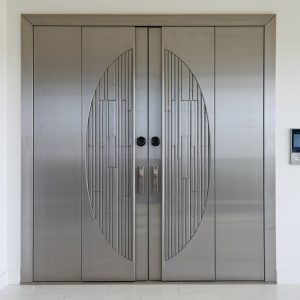
A security screen door looks similar to a storm door but is built to a different objective: resisting forced entry and, in some specifications, impact from wind-borne debris. Construction typically uses heavier frame walls, reinforced mesh or perforated plate, and multi-point locking. A 36×96 security screen door is a standard tall format for this category.
Security screen doors are rated under forced-entry and impact standards that vary by market, so buyers should require the specific test report for the destination country rather than accepting a general “security grade” claim.
Hurricane screen doors
Hurricane screen doors and hurricane storm doors are assemblies engineered for high-wind and wind-borne-debris exposure, typically in coastal jurisdictions. They differ from standard screen doors in three ways: heavier frame and anchorage, impact-rated glazing or mesh, and documented test evidence tied to a local building code. In the United States, coastal counties commonly reference impact-protection requirements in the building code, and buyers should confirm the exact protocol and rating required for the project’s jurisdiction before quoting.
Sizes, Dimensions, and Customization Options
Reading size codes correctly
Size codes are where most procurement errors originate, because the same numbers mean different things in different markets.
| Code format | Typical meaning | Notes for buyers |
|---|---|---|
| 36×96 | 36 in wide × 96 in high | Width-first convention, common in North America |
| 96×36 | 96 in × 36 in | Height-first convention; same door, reversed notation |
| 78×36 | 78 in high × 36 in wide | Height-first, common in metric-adjacent catalogs |
| 3-0 | 3 ft 0 in = 36 in nominal width | Door-leaf shorthand, width only |
| 8 | 8 ft = 96 in nominal height | Door-leaf shorthand, height only |
| 4 | 4 ft = 48 in nominal width | Door-leaf shorthand, width only |
The practical rule: confirm whether the supplier quotes nominal or actual dimensions, and whether the first number is width or height. A 36×96 screen door and a 96×36 screen door are the same product described two ways — but a supplier reading the code under the opposite convention will build the wrong unit.
Rough opening versus unit size
Screen doors are specified against a rough opening, and the unit is undersized to allow for shimming, framing, and clearance. Buyers should require the supplier to state both the rough opening range and the finished unit dimensions, plus the tolerance. A typical manufacturing tolerance on a framed aluminum screen door is small — on the order of a few millimeters per dimension — but installation clearance is a separate allowance and is usually larger. Confusing the two produces doors that fit the factory drawing and not the wall.
Custom sizing
Custom sizing is standard practice in this category rather than an exception. Non-standard widths for renovation openings, arched tops, sidelites, and paired units are all routine. The procurement question is not whether a supplier can customize but whether they can hold the same tolerances and hardware compatibility on a custom unit as on a catalog size. Buyers should ask for the shop drawing approval step in writing, and for a size guide that maps nominal codes to actual dimensions before releasing a bulk order.
Materials, Finishes, and Performance Ratings
Frame material and wall thickness
Aluminum alloy frames dominate this category because they do not rot, do not require painting, and hold dimensional stability in humid conditions. The variable that separates grades is wall thickness and alloy temper. Thin-wall frames reduce cost and weight but flex under wind load and strip at hinge screws. Buyers should specify minimum wall thickness and require it on the drawing, not just in a verbal quote.
Finish options: brown, brown vinyl, mahogany
Finish choice is a durability decision as much as a visual one.
- Brown screen door finishes in a baked powder coat or anodized finish are the workhorse specification. Powder coat gives a thicker, more uniform film and better edge coverage than a thin liquid paint. A brown screen door in powder coat is appropriate for most exterior applications.
- Brown vinyl screen doors use a vinyl-clad or vinyl-laminate surface over the aluminum or over a wood core. Vinyl resists moisture well and is common in humid markets, but it can chalk, fade, and become brittle under sustained high UV. It is a reasonable choice for moderate climates and a weaker one for intense sun exposure.
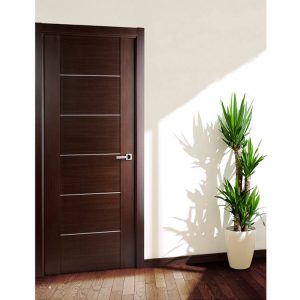
- Mahogany screen doors replicate a wood grain, usually through a wood-grain powder coat, a laminate film, or a real wood-veneer skin over aluminum. Mahogany screen doors are specified where the facade requires a wood appearance but the project cannot accept wood maintenance. Buyers should ask what substrate the grain sits on and how the finish is warranted at edges and cut lines, because that is where film finishes fail first.
Mesh and glazing
Mesh selection drives both insect exclusion and durability. Standard insect mesh is the baseline. Heavier mesh, stainless steel mesh, and perforated security plate are progressively more resistant to tearing and forced entry. For storm and hurricane applications, the glazing or panel specification — not the mesh — usually governs the rating.
Performance ratings that matter
Three performance families should be requested as documented test evidence rather than described verbally:
- Air, water, and wind resistance — relevant for storm and exterior screen doors.
- Forced-entry resistance — relevant for security screen doors.
- Impact resistance — relevant for hurricane screen doors and coastal projects.
Buyers should also confirm corrosion performance for coastal specifications, since salt exposure is the most common cause of premature finish and hardware failure.
Comparison Table: Aluminum Screen Doors by Type and Specification
| Type | Opening action | Typical sizes | Frame build | Primary application | Key limitation |
|---|---|---|---|---|---|
| Swing screen door | Hinged, outswing | 36×96, 3-0 widths | Standard wall aluminum | Residential entries, light commercial | Wind exposure on outswing |
| Inswing screen door | Hinged, inswing | 36×96, custom | Standard to medium wall | Entries paired with primary door | Interior clearance required |
| Pull-across screen door | Lateral slide | Custom widths | Standard wall, track-mounted | Patios, service openings | Track wear and debris |
| Frameless screen door | Fixed or minimal frame | Custom | Tensioned mesh, minimal edge | Storefronts, protected openings | Not for forced-entry specs |
| Storm door | Hinged, secondary | 36×96 storm door | Medium wall, glazed panel | Weather protection over entry | Closer and sweep quality |
| Security screen door | Hinged, reinforced | 36×96 security screen door | Heavy wall, multi-point lock | Security-sensitive entries | Cost and weight |
| Hurricane screen door | Hinged or fixed, impact-rated | Project-specific | Heavy wall, tested anchorage | Coastal high-wind zones | Jurisdiction-specific rating |
How to Evaluate Screen Door Suppliers
Supplier evaluation in this category comes down to whether the manufacturer can hold a specification across a production run and document it. The criteria below are the ones that separate a reliable screen door company from a trading intermediary.
Drawing and tolerance discipline. Ask for a shop drawing with nominal and actual dimensions, tolerances, and hardware schedule before production. A supplier who cannot produce this will not resolve a fit dispute later.
Test documentation. Request the specific test reports for air-tightness, water-tightness, wind resistance, forced entry, or impact, matched to the destination market’s requirements. A general quality claim is not a substitute.
Material traceability. Confirm alloy, temper, wall thickness, finish system, and mesh specification in writing. These are the variables most often substituted between quotation and shipment.
Hardware and component quality. Hinges, closers, rollers, locks, and weatherstripping are where cost is most easily removed without changing the frame’s appearance. Specify brands or minimum grades.
Customization capability. Confirm the supplier can adjust profile structure and fittings to match local building codes in the target market — this is a manufacturing capability, not a sales promise.
Export documentation. For international procurement, confirm the supplier can issue packing lists, proforma invoices, and full customs documents, and can ship both FCL and LCL.
Pre-shipment inspection. Insist on documented performance checks before the container leaves, not after arrival.
Procurement and Installation Considerations
Compatibility with the primary door
For inswing and swing configurations, the screen door must be compatible with the existing or specified primary door in three respects: swing direction, handle and lock position, and clearance between the two leaves. On paired entry systems, the screen door hardware must not conflict with the primary door’s lockset or closer arm. This is a drawing-stage check, not a site fix.
Egress and accessibility
Screen doors can affect egress path width and door operation. Buyers should verify that the screen door does not reduce the clear opening below what the applicable code requires, and that hardware operation is compatible with accessibility requirements where those apply. Local permit requirements for exterior door replacement also vary, and the project’s authority having jurisdiction is the final reference.
Climate-specific specification
- Coastal and salt-exposed sites: specify corrosion-resistant finish and stainless hardware; vinyl-clad finishes should be evaluated carefully.
- Humid climates: aluminum frames and stainless fasteners outperform wood-core assemblies; drainage paths in the frame matter.
- High-wind zones: hurricane screen doors with documented impact ratings, plus anchorage designed for the site’s wind load.
Packaging and logistics
Screen doors are large, thin, and easily damaged in transit. Confirm corner protection, edge banding, and stacking method, and confirm whether the shipment will move as FCL or LCL — LCL consolidation increases handling and damage risk, which should be reflected in packaging specification.
Sourcing Aluminum Screen Doors: How We Meet These Standards
The criteria above describe how the industry expects screen door procurement to work. As a manufacturer, our approach is built around the same checkpoints.
We supply directly from our factory, which removes middleman markup and keeps the specification conversation between the buyer and the people who build the door. Full customization is available on size, color, glass, and hardware accessories, and because our profile structure and fittings are adjustable, we can align a door system with the building codes of the target market rather than forcing a catalog unit into a non-conforming opening.
Before shipment, units go through air-tightness, water-tightness, and wind resistance testing. For international buyers, we handle the export side as well: packing lists, proforma invoices, and full customs documents, with both FCL and LCL shipment available and direct delivery from our factory in China.
If you are comparing specifications for an upcoming project, Talk to Our Team with your opening schedule and destination market, and we will confirm which configuration, size convention, and rating apply.
Frequently Asked Questions
What are the different types of aluminum screen doors?
The main types are swing, inswing, pull-across, frameless, storm, and security screen doors, with hurricane-rated versions of storm and security doors for coastal high-wind zones. They differ in opening action, frame build, and the performance standards they are tested against.
What do size codes like 36×96, 78×36, and 3-0 mean?
36×96 is 36 in wide by 96 in high in width-first notation; 96×36 is the same door written height-first. 78×36 is 78 in high by 36 in wide. 3-0 is door-leaf shorthand for a 36 in nominal width, and 8 and 4 refer to 8 ft (96 in) height and 4 ft (48 in) width. Always confirm whether a supplier quotes nominal or actual dimensions and which number comes first.
What is the difference between a storm door and a security screen door?
A storm door is a secondary door that adds weather protection and typically carries a full-height glass panel with a screen insert. A security screen door is built to resist forced entry, using heavier frame walls, reinforced mesh or plate, and multi-point locking. They are tested to different standards and are not interchangeable.
How do I choose between brown, brown vinyl, and mahogany finishes?
Choose a brown powder-coated finish for general exterior durability and edge coverage. Brown vinyl is suitable for humid climates but can fade or become brittle under intense UV. Mahogany finishes are chosen where a wood appearance is required without wood maintenance — confirm the substrate and how the finish is warranted at edges and cut lines.
What should B2B buyers look for in a screen door company?
Shop drawings with stated tolerances, test reports matched to the destination market, written material and hardware specifications, proven customization to local building codes, export documentation capability, and a documented pre-shipment inspection step.
Are frameless screen doors suitable for commercial projects?
Yes, for storefronts, hospitality entries, and protected or interior openings where sightlines matter. They are generally not appropriate where forced-entry or impact ratings are required, because the minimal perimeter frame limits resistance to deformation.
How do hurricane screen doors differ from standard screen doors?
Hurricane screen doors use heavier frames and anchorage, impact-rated glazing or mesh, and documented test evidence tied to the local building code. Standard screen doors are not tested to those protocols, so they should not be substituted in coastal high-wind jurisdictions.