Last updated: September 17, 2026
Key Takeaways: What Matters Most in a 36 x 80 Storm Door
A 36 x 80 storm door is an exterior secondary door unit measuring 36 inches wide by 80 inches high, mounted outside a primary entry door to provide weather protection, ventilation, and an extra layer of security. For B2B buyers, the sourcing decision rarely hinges on the nominal size alone — 36 x 80 is a standard North American entry dimension, so the real differentiation sits in frame configuration, material grade, glass and screen setup, finish, and how well the supplier can match local building codes.
Three points decide most bulk orders:
- Nominal size is not the cut size. A “36 x 80” storm door is a trade label. The actual door slab, the frame, and the required rough opening are three different measurements, and they vary by manufacturer and by whether the unit ships with a mounting frame.
- Frame choice drives installation cost. A door with frame installs as a complete unit and tolerates less precise openings; a door without frame (slab or surface-mount) is cheaper to buy but demands a square, correctly sized opening and more on-site labor.
- Material sets the performance ceiling. Aluminum, steel, fiberglass, and wood-core units differ in corrosion resistance, dent resistance, thermal behavior, and price — and the right choice depends on climate and building code, not on a single “best” material.
The sections below work through sizing and frame options, material and configuration trade-offs, a comparison table across 36 x 80 and adjacent sizes, and a procurement checklist for bulk orders.
Sizing and Frame Options: 36 x 80, With Frame, and Rough Openings
Nominal vs actual dimensions
When a buyer specifies a 36 x 80 storm door, they are naming the door’s design size, not a measured dimension. In practice, a nominal 36 x 80 unit is manufactured slightly smaller than 36 x 80 so it can sit within a frame and still operate freely. Actual slab and frame dimensions vary by manufacturer, so the only reliable figure is the supplier’s own published drawing or spec sheet — never assume a competitor’s numbers transfer.
The practical rule for buyers: treat 36 x 80 as the ordering category, then confirm the actual width, actual height, and frame depth against the supplier’s technical data before releasing a purchase order. This is where most sourcing errors originate, because a buyer who orders on the nominal figure alone may receive a unit that will not fit the intended opening.
Rough opening requirements
A rough opening is the framed gap in the wall that receives the door and its frame. For a 36 x 80 storm door supplied with frame, the rough opening must be larger than the nominal size to allow for the frame, shimming, and adjustment. Suppliers typically publish a rough-opening tolerance — often stated as a range rather than a single number — and buyers should build that tolerance into the architectural opening schedule.
Two variables affect the required rough opening:
- Frame depth. Storm door frames sit at different depths depending on the profile and whether the unit is designed to clear an existing entry door and its trim. Frame depth must match the wall condition and the primary door’s projection.
- Adjustment allowance. Frames with integral adjustment (jamb extensions or adjustable profile structure) absorb small opening variations; fixed frames do not.
With frame vs without frame
This is the single most consequential specification for a 36 x 80 storm door, and the two options serve different project types.
A 36 x 80 storm door with frame arrives as a complete assembly: door, frame, hinges, closer, and hardware. It installs as one unit into a prepared rough opening. This is the standard choice for new construction, multi-unit residential projects, and any job where the opening is being built to the door rather than the door fitted to an existing opening. It reduces on-site labor and lowers the risk of installation error.
A door without frame — a slab or surface-mounted unit — is fastened directly to the existing door frame or wall. It suits retrofit work where the existing opening is sound and square. The trade-off is clear: lower unit cost, but the opening must be measured precisely and the installer must handle alignment, hinge placement, and closer mounting on site.
For B2B buyers, the decision usually comes down to project type rather than price. New-build and bulk residential work favors framed units for speed and consistency; renovation and replacement work may favor unframed units where the existing frame is being retained.
Hinge side and swing direction
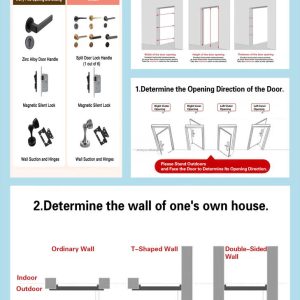
Hinge side and swing direction must be confirmed on every order, because a storm door is handed. The door hinges on the same side as the primary entry door in most residential configurations, and the closer mounts on the opposite side. A buyer who does not specify handing will receive a default, which may be wrong for half the units in a mixed project. For bulk orders, build handing into the line-item specification: width, height, frame type, hinge side, and swing.
Material and Configuration Comparison: Aluminum, Steel, Fiberglass, and Screen
Aluminum
Aluminum is the most common material for storm doors because it resists corrosion, stays light, and holds a finish well. Extruded aluminum frames can be produced with a thermal break — a non-conductive separator between the inner and outer profile — which reduces heat transfer and helps control condensation on the interior face in cold climates. For buyers sourcing for cold-weather markets, thermal break construction is a specification worth confirming in writing, because not all aluminum storm doors include it.
Aluminum’s limitation is dent resistance. A thin aluminum skin can deform under impact, which matters in high-traffic entries or where impact-rated assemblies are required by code.
Steel
Steel storm doors offer high strength and dent resistance at a moderate cost, and they accept paint and powder-coat finishes well. The trade-off is weight and corrosion risk: steel requires a protective coating, and any breach in that coating — a scratch, a cut edge, a fastener point — becomes a corrosion site. In coastal or high-humidity markets, steel is usually the wrong choice unless the coating system is specified for the environment.
Fiberglass
Fiberglass storm doors resist dents, corrosion, and temperature movement better than either aluminum or steel, and they can be molded with a wood-grain texture. They cost more per unit, which matters at bulk volume. Fiberglass is typically specified where appearance retention and impact resistance justify the premium — higher-end residential projects and coastal installations.
Wood-core
Wood-core storm doors combine a wood substrate with a protective skin. They offer the most traditional appearance and take stain and paint finishes well, but they demand more maintenance and are more sensitive to moisture. In B2B sourcing, wood-core units are usually a niche specification for restoration and premium residential work rather than a volume product.
Glass and screen configurations
Configuration determines how the door performs in service, and it is specified separately from material.
- Full-view: a single large glass panel, maximizing daylight. Common in entries where light is a priority.
- Mid-view and high-view: glass in the upper portion with a solid lower panel. Mid-view is the most common residential configuration; high-view places more glass higher on the door.
- Interchangeable glass and screen: a self-storing or removable panel system that lets the occupant swap between glass (weather protection, insulation) and screen (ventilation). This is the configuration most buyers mean by an 80 x 36 screen door setup — the same nominal 36 x 80 unit, configured with a screen panel for ventilation.
- Retractable screen: a screen that rolls into a housing when not in use. Availability in 36 x 80 depends on the supplier’s profile system, so it must be confirmed per product line rather than assumed.
For bulk orders, specify the glass type (tempered, laminated, low-E), the screen mesh, and whether panels are self-storing or removable. These choices affect unit cost, weight, and shipping volume.
Finish and color options
Standard finishes for aluminum and steel storm doors include factory-applied powder coat in white, beige, bronze, and black. A brown storm door 36 x 80 is a common specification for projects matching wood-tone entry doors and trim, and brown is typically offered in several shades — from a light tan to a deep bronze-brown. Finish consistency across a bulk order matters: buyers should request a color sample or a controlled color reference, because batch-to-batch variation in powder coat is a real sourcing issue on large orders. For wood-core and fiberglass units, finishes may be stain-ready or pre-finished, which changes both cost and lead time.
Comparison Table: 36 x 80 Storm Doors vs Adjacent Sizes
The table below compares the primary 36 x 80 specification against adjacent sizes buyers commonly evaluate in the same project. Dimensions are nominal; actual and rough-opening figures must come from the supplier’s spec sheet.
| Specification | 29 x 80 | 36 x 80 (primary) | 42 x 80 |
|---|---|---|---|
| Nominal width | 29 in | 36 in | 42 in |
| Nominal height | 80 in | 80 in | 80 in |
| Typical application | Single secondary entry, utility, narrow openings | Standard residential entry | Wide or double entry, accessible openings |
| Frame options | With frame / without frame | With frame / without frame | With frame / without frame |
| Common materials | Aluminum, steel | Aluminum, steel, fiberglass, wood-core | Aluminum, steel, fiberglass |
| Glass/screen config | Full-view, mid-view, screen | Full-view, mid-view, high-view, screen, retractable | Full-view, mid-view, screen |
| Finish range | White, beige, bronze | White, beige, bronze, brown, black | White, beige, bronze, brown |
| Relative unit cost | Lower | Baseline | Higher |
| Handing required | Yes | Yes | Yes |
Two adjacent sizes deserve a note. A 29 x 80 storm door fits narrow secondary entries, utility doors, and some older homes where the entry opening was built to a non-standard width. A 42 x 80 storm door is specified for wider entries and where clear opening width matters for accessibility or traffic flow. Neither substitutes for the other — the opening dimension, not preference, decides the size.
Buying Recommendations for B2B Sourcing
Start with the opening, not the door
The most reliable procurement sequence is: measure the rough opening and the existing primary door, confirm the frame depth available, then select the storm door specification that fits. Buyers who start with a product and work backward to the opening create rework. For projects with mixed openings, build a schedule that lists every opening with its measured width, height, frame condition, and handing before any supplier is contacted.
Match material to climate and code
Material selection should follow two inputs: the climate the door will serve and the local building code. Cold climates favor thermal-break aluminum or fiberglass to limit condensation and heat loss. Coastal and high-humidity markets favor aluminum or fiberglass over steel. Where local codes govern egress, impact resistance, or energy performance, those requirements set the minimum specification, and the supplier must be able to confirm that the product line meets them.
Confirm the specification in writing
Before ordering, confirm in writing: nominal size, actual slab and frame dimensions, rough-opening requirement, frame depth, handing, material, glass type, screen type, finish reference, and hardware. These are the line items that cause disputes when they are left to assumption.
Compare suppliers on documentation and logistics, not price alone
For bulk 36 x 80 storm door orders, the supplier’s ability to provide complete export documentation, consistent quality control, and flexible shipping terms is as important as the unit price. A low unit price that arrives with incomplete customs paperwork or inconsistent finish matching is not a lower total cost.
As a manufacturer, our approach to this is straightforward: we supply directly from our factory, which removes middleman markup from the price, and we build each order to the buyer’s specification — size, color, glass, and hardware — rather than forcing a catalog item to fit. Because profile structure and fittings can be adjusted, we can align a storm door line with the building code requirements of the target market instead of exporting a single fixed configuration.
On the quality side, we run pre-shipment inspection on air-tightness, water-tightness, and wind resistance, so the performance claims on the spec sheet are verified before the container leaves. For buyers new to importing from China, we handle the commercial and customs side: packing list, proforma invoice, and full customs documents, with both FCL and LCL shipment options depending on order volume. If you are comparing suppliers for a 36 x 80 storm door program, Talk to Our Team with your opening schedule and target specification, and we will quote against it.
For reference, our size guide covers the dimension conventions we use across door and window lines, and our pricing page explains how specification choices affect unit cost.
FAQ: Common Questions Before Ordering 36 x 80 Storm Doors
What are the actual dimensions of a 36 x 80 storm door?
The 36 x 80 figure is nominal. Actual slab and frame dimensions are slightly smaller and vary by manufacturer, so the only reliable source is the supplier’s spec sheet. Confirm actual width, actual height, and frame depth before ordering, and treat 36 x 80 as the ordering category rather than a measured size.
Should I choose a 36 x 80 storm door with frame or without?
Choose with frame for new construction, multi-unit projects, and any job where the opening is built to the door — it installs as a complete unit and reduces on-site labor. Choose without frame for retrofit work where the existing opening is sound and square, accepting lower unit cost in exchange for more precise on-site fitting.
What is the difference between a 36 x 80 storm door and an 80 x 36 screen door?
They describe the same nominal unit. “36 x 80” states width first; “80 x 36 screen door” states height first and emphasizes the screen configuration. Both refer to a 36-inch-wide, 80-inch-high storm door, typically with an interchangeable glass and screen panel for ventilation.
When would a 29 x 80 or 42 x 80 storm door be needed?
A 29 x 80 fits narrow secondary entries, utility doors, and older openings built to a non-standard width. A 42 x 80 is specified for wider entries and where clear opening width matters. The opening dimension decides the size — neither is a substitute for the other.
What materials are available for 36 x 80 storm doors?
Aluminum, steel, fiberglass, and wood-core. Aluminum is light and corrosion-resistant and can be built with a thermal break for cold climates. Steel is strong and dent-resistant but needs a protective coating. Fiberglass resists dents and corrosion at a higher cost. Wood-core offers traditional appearance with more maintenance.
How do I compare suppliers for bulk 36 x 80 storm door orders?
Compare on four axes: specification flexibility (can the supplier adjust profile and fittings to your market’s codes), quality verification (pre-shipment performance testing), documentation (packing list, proforma invoice, customs paperwork), and logistics (FCL and LCL options). Unit price is one input, not the decision.
Additional Considerations: 29 x 80, 42 x 80, Brown Finishes, and Screen Doors
A few specification details are easy to overlook when a buyer is focused on the headline size.
Handing and swing. Every 36 x 80 storm door order should state hinge side and swing direction. In a mixed project, unspecified handing is a common cause of on-site rework, because a door hinged on the wrong side cannot simply be flipped.
Frame depth and projection. The storm door frame must clear the primary door and its trim. Where the primary door projects further than expected, frame depth becomes the limiting dimension — confirm it against the wall condition, not against the nominal size.
Finish matching across a bulk order. For a brown storm door 36 x 80 specification, request a color reference and confirm the supplier’s batch control. Powder-coat variation across a large order is visible on an elevation, and it is difficult to correct after delivery.
Screen and ventilation configuration. If ventilation is a project requirement, specify the screen setup explicitly — self-storing, removable, or retractable — and confirm availability in the 36 x 80 size for the chosen product line. Retractable screens are not offered across every profile system.
Adjacent sizes in the same project. Projects frequently mix 29 x 80, 36 x 80, and 42 x 80 units. Ordering all sizes from one supplier keeps handing conventions, finish references, and hardware consistent across the elevation, which simplifies both installation and future replacement.
Documentation and shipping terms. For import orders, confirm Incoterms, packaging method, and container loading plan up front. FCL shipment suits full container volumes; LCL shipment suits smaller or mixed orders. Both are workable, but the packaging specification should match the shipping method, because LCL cargo is handled more times in transit.
When you are ready to move from comparison to quotation, send your opening schedule, target specification, and required quantity. Get a Free Quote