Content Menu
● 1. What Are the Main Types of Wooden Doors Inside?
● 2. Which Wood Species Work Best for Interior Doors?
● 3. How Much Do Wooden Interior Doors Cost?
● 4. What Are the Current Design Trends for Interior Wooden Doors?
● 5. How Should Buyers Evaluate Wooden Door Suppliers?
● 6. What Quality Indicators Matter Most for Interior Wooden Doors?
● 7. What Standards Apply to Interior Wooden Doors?
● 8. The Production Process: From Raw Lumber to Finished Door
● 9. How Do OEM and Customization Options Work?
● 10. MOQ, Lead Times, and Shipping Logistics
● 11. Quality Control: What Does a Reliable Inspection Process Look Like?
● 12. How Does Factory-Direct Sourcing Compare to Using a Middleman?
13 min read
The first container of interior doors arrives at a job site. The contractor opens the crate, pulls out a sample, and holds it next to the approved mock-up from six months ago. The color is slightly off. The edge profile isn’t crisp. The hinge cutouts don’t align with the hardware spec. This scene plays out more often than most buyers admit.
Interior doors look simple. They are not. Beneath the surface lie material science decisions, moisture management strategies, and factory quality control protocols that determine whether a door lasts five years or thirty. For B2B buyers—contractors, developers, architects, and distributors—understanding what happens inside a wooden door is the difference between a smooth project and a costly rework.
This guide covers the anatomy of wooden doors inside, what drives pricing, how to evaluate suppliers, and what quality indicators matter most for bulk orders.
What Are the Main Types of Wooden Doors Inside?
Wooden doors inside a building fall into three structural categories: solid wood, engineered wood, and hollow core. Each serves a different application, and each carries distinct performance trade-offs.
Solid wood doors are milled from a single timber species. They offer the highest acoustic insulation and the most prestigious appearance. But they are heavy, expensive, and prone to expansion or contraction in humid environments. A solid oak door in a dry climate can develop cracks within two years.
Engineered wood doors use a composite core—typically plywood or medium-density fibreboard (MDF)—with a wood veneer on the surface. This construction resists warping better than solid wood because the cross-laminated layers counteract natural timber movement. For most commercial and residential projects, engineered doors represent the optimal balance of stability, appearance, and cost.
Hollow core doors feature a lightweight internal frame with a honeycomb cardboard or foam filling. They are inexpensive and easy to install, but they offer poor sound insulation and feel insubstantial. Use them only for closets, utility rooms, or budget-driven multi-family developments where acoustic performance is not a priority.
Core Construction and Performance
The core determines more than weight. It drives acoustic performance, fire resistance, and hardware holding power.
| Core Type | STC Rating | Weight (approx.) | Fire Rating Potential | Best Application |
|---|---|---|---|---|
| Honeycomb | 20–25 | 15–25 lbs | None | Closets, storage |
| Particleboard | 25–30 | 40–60 lbs | Up to 20 min | Residential interiors |
| Solid timber | 30–40 | 60–100 lbs | Up to 60 min | Hospitality, offices |
| Mineral core | 35–45 | 70–110 lbs | Up to 90 min | Commercial, fire-rated |
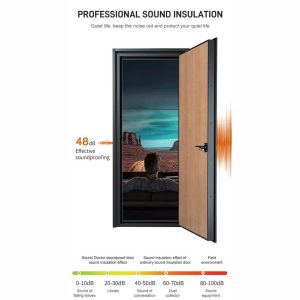
Sound Transmission Class (STC) ratings matter for offices, hotels, and multi-family residential projects. A door with a honeycomb core lets conversations pass through. A solid timber core blocks them. If your project requires privacy, specify the core density in the procurement documents—do not leave it to the supplier’s discretion.
Which Wood Species Work Best for Interior Doors?
The “best” wood depends on the finish, the environment, and the budget. No single species wins across all criteria.
Oak dominates the industry. White oak and red oak offer visible grain, high durability, and consistent staining behavior. Engineered oak doors with a plywood core provide the stability needed for large panels while maintaining the aesthetic of natural wood. Oak accepts both light and dark finishes well, making it a versatile choice for developers who want a single door style across multiple units.
Walnut delivers a rich, dark appearance that reads as luxury. It is softer than oak and more expensive, but for high-end residential or boutique hospitality projects, the visual impact justifies the cost. Walnut veneers on engineered cores mitigate the cost while retaining the look.
Maple and cherry suit painted or light natural finishes. Maple’s tight grain takes paint exceptionally well. Cherry darkens with age, a characteristic that can be a feature or a problem depending on the client’s expectations.
MDF is not a wood species but deserves mention because it is the standard substrate for flush doors and high-gloss painted finishes. MDF has no grain, which means no telegraphing through paint. It machines cleanly for fluted or grooved designs. For modern minimalist interiors, MDF-faced doors with a painted finish are often the most practical choice.
One honest caveat: solid wood doors are not always the right answer. In coastal regions or buildings without central climate control, the humidity swings will cause solid panels to move. Engineered construction handles these conditions better. Buyers should prioritize environmental suitability over material prestige.
How Much Do Wooden Interior Doors Cost?
Pricing for wooden doors inside a project varies dramatically by tier. For bulk B2B orders, the numbers differ from retail prices by 20–40%.
Entry-level hollow core doors run $30–$60 per unit. These are builder-grade products for cost-sensitive projects. They have no acoustic value and limited design flexibility.
Mid-range engineered doors with wood veneer cost $80–$200 per unit. This is the sweet spot for most commercial and residential projects. Buyers get the appearance of solid wood with better dimensional stability and a reasonable price point.
Premium solid wood doors start around $250 and can exceed $600 for exotic species or complex designs. These belong in luxury residences, high-end hotels, and heritage renovation projects.
Hidden Cost Drivers
The door slab is only part of the cost. Several factors inflate the final price:
- Pre-finishing: Factory-applied finishes cost more upfront but save significant field labor. A pre-finished door eliminates sanding, staining, and sealing on site.
- Hardware: Soft-close hinges, quality locksets, and concealed mechanisms add $20–$80 per door. Cheap hardware undermines an expensive door.
- Glass and louvers: Cut-outs require additional labor and materials. Tempered glass panels add $30–$100 depending on size.
- Fire rating: A 20-minute fire-rated door costs 30–50% more than a non-rated door. The intumescent seals, mineral cores, and certified frames add up.
For a 200-unit apartment project, the difference between entry-level and mid-range doors could be $20,000–$30,000. That is a meaningful budget line. Buyers should calculate the total installed cost—not just the slab price—when comparing quotes.
What Are the Current Design Trends for Interior Wooden Doors?
Interior door design has shifted toward minimalism. The ornate paneled doors of previous decades have given way to clean, flat surfaces and subtle texture.
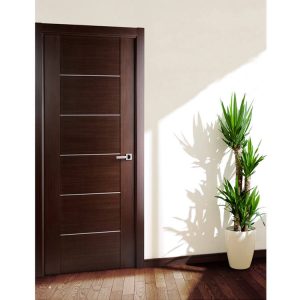
Flush doors dominate modern residential and commercial projects. A smooth, flat face in white or natural oak reads as contemporary and works with almost any interior style. The simplicity also reduces manufacturing costs, which benefits project budgets.
Fluted doors—vertical grooves machined into the surface—have gained significant traction. The texture adds visual interest without the heaviness of traditional paneling. Fluted designs work well in both wood veneer and painted MDF.
Shaker-style doors remain the safest choice for timeless design. The clean lines of a 2-panel or 3-panel shaker door suit traditional, transitional, and modern interiors. Square-top profiles have largely replaced arched designs in new construction.
The Emerging Trends
Floor-to-ceiling doors are the most visible trend in high-end projects. Standard 80-inch doors feel dated; 96-inch or taller doors create a sense of luxury and make ceilings feel higher. This trend requires careful coordination with framing and hardware, and not all factories can accommodate oversized panels.
Pocket doors continue to gain popularity for space efficiency. They disappear into the wall, freeing floor space in tight layouts. The hardware cost is higher, but the space savings justify it in urban developments.
Mixed-material doors—wood combined with black metal frames or glass panels—offer an industrial aesthetic popular in loft conversions and commercial spaces. These require specialized manufacturing capabilities.
How Should Buyers Evaluate Wooden Door Suppliers?
Supplier evaluation is the most critical step in the procurement process. A beautiful sample means nothing if the factory cannot replicate it at scale.
Start with production capacity. Ask about monthly output, the number of production lines, and current capacity utilization. A factory running at 95% capacity will struggle to meet your timeline. One running at 60% may be desperate for orders—which can be good for pricing but risky for consistency.
Verify quality control protocols. The supplier should have documented inspection procedures at multiple stages: incoming lumber inspection, machining tolerances, veneer quality checks, and final assembly verification. Ask for their quality manual. A professional factory will share it without hesitation.
Check moisture management. Wood moves with humidity. A reliable factory kiln-dries lumber to 8–12% moisture content and controls humidity in the production area. If the factory cannot articulate their moisture control process, walk away.
Assess communication responsiveness. The pre-sales experience predicts the post-sales experience. A supplier who takes three days to answer a simple question will take three weeks to resolve a quality dispute.
Red Flags to Avoid
Several warning signs indicate an unreliable supplier:
- Vague answers about lead times or production capacity
- Reluctance to provide references or existing client names
- No clear quality inspection process
- Prices significantly below market rates (this usually means material shortcuts)
- Inability to provide customs documentation or packing lists
- No knowledge of international building codes or standards
Questions to Ask Before Ordering
- What is your current monthly production capacity for this door style?
- What is your moisture control process for incoming lumber?
- Can you provide a pre-shipment inspection report?
- How do you handle defective units in a shipped container?
- What is your lead time for a container-load order?
- Can you adjust hardware to meet our local building codes?
What Quality Indicators Matter Most for Interior Wooden Doors?
Several technical parameters determine whether a door performs well over its lifespan.
Moisture content should be 8–12% at the time of shipment. Above 12%, the door risks warping or cracking as it acclimates to the destination climate. Below 8%, the wood may split in humid environments.
Dimensional tolerance matters for installation. Door slab thickness should not vary by more than 1mm across the panel. Width and height tolerances should be within 2mm. Poor tolerances create installation problems that ripple through the entire project.
Surface quality includes veneer consistency, absence of blisters or bubbles, and uniform color matching across units. For stained finishes, the factory should use lumber from the same batch to ensure color consistency.
Edge profiling must be crisp and consistent. Sloppy edges indicate poor machining quality and will be visible after installation.
Hardware compatibility is often overlooked. The hinge pockets and lock bore must align precisely with the specified hardware. Mismatches cause field modifications that add cost and delay.
What Standards Apply to Interior Wooden Doors?
International projects require compliance with multiple standards. The specific requirements vary by market.
ANSI/WDMA I.S. 1A is the North American standard for wood doors. It covers performance requirements for dimensional stability, finish durability, and hardware compatibility.
EN 12519 is the European standard for windows and pedestrian doors. It defines terminology and classification systems used across EU member states.
BS 476-22 covers fire resistance for UK projects. Fire-rated doors must be tested as complete assemblies—the door, frame, hinges, and seals work together.
ADA (Americans with Disabilities Act) requirements affect door width, hardware height, and operating force. A compliant door must open with minimal force and accommodate wheelchair access.
Buyers should confirm which standards apply to their target market and ensure the supplier can adjust production accordingly. A factory experienced in international trade will ask about local code requirements before manufacturing.
The Production Process: From Raw Lumber to Finished Door
Understanding the manufacturing process helps buyers identify quality signals and realistic lead times.
Step 1: Lumber selection and kiln drying. Raw timber arrives with varying moisture content. The factory kiln-dries it to 8–12% over 7–14 days. This step prevents future warping and cracking.
Step 2: Machining and core assembly. For engineered doors, the core layers are glued and pressed. The cross-laminated structure provides dimensional stability. For solid doors, the timber is jointed and planed to size.
Step 3: Veneering (for engineered doors). Thin slices of the selected wood species are applied to the core using heat and pressure. The veneer thickness typically ranges from 0.6mm to 1.0mm.
Step 4: Profiling and sanding. The door is cut to final dimensions, the edge profile is machined, and the surface is sanded to a smooth finish. Multiple sanding passes with progressively finer grits achieve the smoothness required for quality finishes.
Step 5: Finishing. Doors are either shipped raw (for field finishing) or pre-finished in the factory. Factory finishing includes staining, sealing, and topcoating in controlled conditions that are impossible to replicate on a job site.
Step 6: Hardware installation and packing. Hinges, locks, and other hardware are installed or precut. Doors are wrapped, crated, and prepared for container loading.
The entire process takes 3–6 weeks depending on order size and customization requirements.
How Do OEM and Customization Options Work?
Most reputable factories offer OEM and ODM services, but the level of flexibility varies.
OEM (Original Equipment Manufacturing) means the factory produces doors to the buyer’s specifications. The buyer provides drawings, material specifications, and finish requirements. The factory handles production. The buyer’s brand is applied to the product.
ODM (Original Design Manufacturing) means the factory provides design input. The buyer shares performance requirements and aesthetic direction; the factory develops the product. This option suits buyers who need a distinctive product but lack in-house design resources.
Customization covers size, color, glass, and hardware. A capable factory can produce doors from 600mm to 1200mm in width and up to 3000mm in height. Custom colors require a Pantone or wood sample reference. Glass options include clear, frosted, tinted, and decorative patterns.
The key question is whether the factory truly manufactures or merely assembles. A genuine manufacturer controls the entire process from lumber selection to final finishing. An assembler buys components and puts them together. The difference shows up in quality consistency and customization flexibility.
MOQ, Lead Times, and Shipping Logistics
Bulk orders follow different rules than single-door purchases.
Minimum Order Quantity (MOQ) for factory-direct orders typically starts at one container load. A 40-foot container holds approximately 150–250 interior doors depending on size and packing density. Some factories accept less-than-container-load (LCL) orders, but the per-unit price is higher due to shared shipping costs.
Lead times range from 3–8 weeks. Standard styles with in-stock materials ship fastest. Custom colors, glass options, and fire-rated constructions extend the timeline. Buyers should factor in 2–4 weeks for production and 3–6 weeks for ocean freight.
Shipping is either FCL (full container load) or LCL (less than container load). FCL offers lower per-unit costs and reduced handling risk. LCL suits smaller orders but requires consolidation at the origin port.
Documentation matters more than most buyers expect. A professional supplier provides packing lists, proforma invoices, and full customs documents. Incomplete paperwork causes port delays, storage fees, and missed installation deadlines.
Quality Control: What Does a Reliable Inspection Process Look Like?
Quality control should happen before shipment, not after arrival. A robust inspection process covers multiple stages:
Incoming material inspection verifies lumber grade, moisture content, and veneer quality. Substandard raw materials cannot produce quality finished doors.
In-process inspection checks machining accuracy, glue joint integrity, and surface quality at each production stage. Defects caught early are cheap to fix.
Pre-shipment inspection covers the finished product against the buyer’s specifications. Dimensions, finish, hardware, and packing are verified. For doors shipped to demanding markets, air-tightness, water-tightness, and wind resistance tests may be included.
Buyers should ask for photos or video of the pre-shipment inspection. A transparent factory shares this documentation willingly.
How Does Factory-Direct Sourcing Compare to Using a Middleman?
The supply chain for wooden doors inside a project can include multiple intermediaries. Each layer adds cost and reduces control.
Trading companies act as brokers between buyers and factories. They handle communication and logistics but do not control production. Quality issues require going through the trading company, which may or may not have leverage with the factory.
Agents in the buyer’s country can facilitate sourcing but add their own margin. They may also lack technical knowledge about manufacturing processes.
Factory-direct sourcing eliminates the middlemen. The buyer communicates directly with the production team. Pricing reflects factory economics, not broker margins. Customization requests go straight to the people who can implement them.
The trade-off is that factory-direct requires more buyer involvement. You must manage the relationship, verify quality, and handle logistics. For buyers who know what they want and need competitive pricing, the effort pays off.
Our Manufacturing Capabilities
As a factory with direct supply capabilities, we understand what bulk buyers need from a production partner. Our approach aligns with the standards discussed throughout this guide.
Full customization on size, color, glass, and hardware accessories means we can match your architectural drawings and design specifications. Whether you need a fluted oak door for a boutique hotel or a 3-panel shaker style with a custom stain for a residential development, our production lines adapt to your requirements.
Strict pre-shipment inspection covers air-tightness, water-tightness, and wind resistance tests. We verify moisture content, dimensional tolerances, and surface quality before any door enters a container. Our foreign trade experience ensures your shipment includes packing lists, proforma invoices, and full customs documentation—so your cargo clears the port without delays.
Adjustable profile structure and fittings allow us to match local building codes in your target market. Whether you need ADA-compliant hardware, EN-rated fire doors, or specific dimensional standards, we adjust our production processes accordingly.
FCL and LCL shipment options accommodate both large developments and smaller projects. Direct delivery from our factory eliminates middleman markup, giving you competitive factory pricing without compromising quality.
Conclusion
Choosing the right wooden doors inside a project requires balancing aesthetics, physics, and economics. The material selection affects stability. The core construction affects acoustics and fire safety. The supplier selection affects everything else.
Buyers who understand these technical factors can negotiate from a position of knowledge. They can evaluate factories on substance rather than sales presentation. They can specify what they need with confidence.
When you are ready to discuss your project requirements, working directly with a manufacturer ensures you get the custom specifications you need without the middleman markup.
References
- ANSI/WDMA I.S. 1A — American Architectural Manufacturers Association. https://www.wdma.com
- EN 12519:2004 — European Committee for Standardization. https://www.cen.eu
- BS 476-22:1987 — British Standards Institution. https://www.bsigroup.com
- Americans with Disabilities Act Standards. https://www.ada.gov
- Wood Handbook — Wood as an Engineering Material. USDA Forest Products Laboratory. https://www.fpl.fs.usda.gov