Content Menu
● 1. What Is a Wooden Door with Glass Panels? Types and Applications
● 2. What Determines the Quality of a Wooden Door with Glass Panels?
● 3. Why Are Some Wooden Doors Filled with Glass?
● 4. What Color Door Means Your House Is Paid Off?
● 5. Can You Replace Only the Glass on a Wooden Door?
● 6. How Expensive Is a Wooden Door with Glass Panels?
● 7. How to Evaluate a Wooden Door with Glass Panels Supplier
● 8. The Production Process: From Raw Timber to Finished Door
● 9. Our Manufacturing Capabilities: Meeting the Standards Above
● 10. Ordering Process and After-Sales Support
● 11. Technical Specifications Buyers Should Request
12 min read
The first time a contractor opens a crate from an overseas supplier, the question is rarely about aesthetics. It is about whether the door in their hands matches the sample they approved eight weeks earlier. The wood grain should align. The glass seal should be clean. The weight should feel right. For a wooden door with glass panels, that scrutiny doubles — because you are not just buying a slab of timber. You are buying a composite assembly where wood movement, glass tolerance, and sealant chemistry must all work together.
This guide breaks down what actually goes into a wooden door with glass panels, how to evaluate suppliers against measurable standards, and where the real costs hide. If you are sourcing for a villa project, a hotel renovation, or a distribution line, the information below gives you a procurement framework that works across markets.
What Is a Wooden Door with Glass Panels? Types and Applications
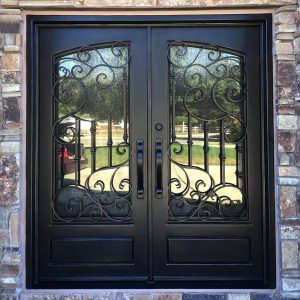
A wooden door with glass panels is a door unit where one or more sections of the solid wood surface are replaced with glass, framed by wood stiles, rails, and muntins. The glass can range from a single small vision lite to full-length panels covering 80% of the door face.
The applications split into three broad categories:
- Exterior entry doors — Typically use double-pane, Low-E coated glass for thermal performance. Wood species like oak, mahogany, or walnut provide structural rigidity and curb appeal.
- Interior partition doors — Often use single-pane tempered glass with frosted or textured finishes. Lighter wood species like pine or hemlock are common to reduce cost and weight.
- Commercial and hospitality doors — Frequently require fire ratings, acoustic insulation, or impact resistance. These doors use laminated glass and engineered wood cores to meet code requirements.
The type of glass and wood you choose is not an aesthetic decision. It is a performance specification that determines whether the door will last five years or twenty-five.
What Determines the Quality of a Wooden Door with Glass Panels?
Quality in this product category comes down to four interacting components: the wood core, the glass unit, the interface between them, and the finish.
Wood Core and Frame Construction
Solid wood doors are not always solid. Many manufacturers use engineered wood — laminated veneer lumber (LVL) or finger-jointed stiles — because it resists warping better than a single piece of timber. A door slab that moves 3–5 mm across its width with humidity changes will eventually crack the glass seal if the frame is not engineered to accommodate that movement.
The joinery matters more than the wood species. Mortise-and-tenon joints, where the stile and rail interlock mechanically, hold up under stress. Dowel joints are cheaper but weaker. CNC-routed joints can be excellent if the tolerances are tight — within 0.5 mm. Buyers should ask which joinery method is used and whether the frame is kiln-dried to an 8–12% moisture content range.
Glass Panel Types and Coatings
Building codes in most jurisdictions require tempered or laminated glass for door glazing. Tempered glass breaks into small granules rather than sharp shards. Laminated glass holds together when shattered, which matters for security and hurricane-prone regions.
For thermal performance, double-pane glass with a Low-E coating and argon gas fill is the industry baseline for exterior doors. The U-factor — a measure of heat transfer — should be below 0.30 for cold climates. Ask suppliers for the specific U-factor and Solar Heat Gain Coefficient (SHGC) ratings of their glass units.
The Wood-to-Glass Interface
This is where most quality problems originate. The junction between wood and glass must accommodate three different materials expanding at different rates. Poor sealing leads to condensation inside the glass unit, which is the most common warranty claim in this product category.
Quality manufacturers use:
- EPDM or silicone gaskets rather than cheap foam tape
- Warm-edge spacers in double-pane units to reduce heat loss at the glass edge
- Drainage channels in the frame to allow trapped moisture to escape
Finish and Coating
A factory-applied UV-resistant finish protects the wood from sun damage and moisture ingress. Painted doors need a high-quality primer and topcoat system. Stained doors require a sealer that does not trap moisture. Buyers should ask whether the finish is applied by hand or in a controlled spray booth — the latter gives more consistent coverage.
Why Are Some Wooden Doors Filled with Glass?
A door with glass panels is not just a stylistic choice. It changes how a building performs.
Natural light — A glass door in a corridor or entryway reduces the need for artificial lighting during daytime hours. In commercial buildings, this contributes to LEED certification points.
Spatial perception — Glass panels make a narrow entryway feel wider and a low-ceilinged corridor feel taller. This is why architects specify them for apartment buildings and hotels where square footage is tight.
Privacy control — Frosted, textured, or seeded glass allows light transmission while obscuring visibility. This is the standard choice for office conference rooms and residential front doors.
Historical precedent — Craftsman-style doors with multiple small panes were originally designed to make doors lighter and cheaper while using smaller, more affordable pieces of glass. Modern single-pane designs inverted that logic — they use oversized glass to create a minimalist statement.
What Color Door Means Your House Is Paid Off?
This question comes from a 2019 Zillow analysis that found homes with black or charcoal front doors sold for up to $6,449 more than similar homes with other colors. The “paid off” association is a cultural shortcut — darker doors signal permanence and quality.
For B2B buyers, the relevance is different. Offering pre-finished doors in neutral dark tones (black, charcoal, navy) aligns with market trends that drive perceived property value. The glass panels interact with this trend in a specific way: bronze or gray-tinted glass changes how a painted wood finish reads. A black door with clear glass looks sharp. A black door with bronze glass looks warmer but darker. Ask your supplier for physical samples in different glass tints before committing to a color line.
Can You Replace Only the Glass on a Wooden Door?
In most cases, yes — if the frame is structurally sound. The process involves removing the interior stops (the trim pieces holding the glass), extracting the old unit, and installing a new one. It is a job that takes a skilled carpenter 2–3 hours per door.
The limitations are practical:
- Non-standard glass sizes are expensive to custom order
- If the frame has warped, new glass may crack during installation
- Sealed units have a lifespan of 10–15 years before the seal fails and condensation appears
For B2B buyers, the critical procurement question is: “Do you supply replacement glass units for your door models?” Standardized cassette sizes — where the glass unit dimensions are fixed per door model — make future replacements simple. Suppliers who offer this are planning for the product lifecycle, not just the initial sale.
How Expensive Is a Wooden Door with Glass Panels?
Prices vary wildly based on three variables: wood species, glass configuration, and hardware. Here is a practical cost breakdown:
| Component | Economy | Mid-Range | Premium |
|---|---|---|---|
| Wood species | Pine, hemlock | Oak, ash | Walnut, mahogany |
| Glass type | Single-pane clear | Double-pane Low-E | Double-pane Low-E, argon, laminated |
| Hardware | Generic hinges/locks | Mid-tier brands (e.g., Schlage) | Premium brands (e.g., Assa Abloy, Hafele) |
| Typical unit price (retail) | $400–$700 | $700–$1,200 | $1,200–$3,500+ |
The glass configuration alone can add 20–40% to the base door cost. Double-pane Low-E glass with argon gas is roughly 1.5–2x the cost of single-pane clear glass.
For B2B buyers, volume pricing tiers typically kick in at:
- 50+ units — 10–15% discount from list price
- 100+ units — 15–25% discount
- 500+ units (construction projects) — Custom pricing, often 30%+ below retail
The total cost of ownership matters more than the purchase price. A $1,000 door with double-pane Low-E glass will save $50–150 per year in heating and cooling costs compared to a $600 door with single-pane glass. Over a 10-year horizon, the more expensive door is often cheaper. Factory-direct sourcing removes distributor margins, which typically add 20–40% to door prices.
How to Evaluate a Wooden Door with Glass Panels Supplier
The evaluation framework below applies to any manufacturer, regardless of location. Work through it systematically.
Manufacturing Capability and Capacity
Ask for specifics, not promises. “What is your monthly output for this door type?” A factory producing 500 doors per month cannot handle a 2,000-door order without subcontracting or extending lead times.
Look for:
- In-house CNC machining (indicates precision and consistency)
- Automated finishing lines (more consistent coating than hand-spraying)
- Dedicated glass processing (or a documented partnership with a glass supplier)
Quality Control Protocols
Quality control is not a single inspection. It is a system that starts with raw materials and ends with pre-shipment checks.
Request documentation for:
- Moisture content checks on wood (should be 8–12%)
- Glass seal integrity tests — ask how they verify the seal on double-pane units
- Pre-shipment inspection — air-tightness, water-tightness, and wind resistance testing per EN 12207, EN 12208, and EN 12210 standards
Customization and OEM/ODM Flexibility
Determine whether the supplier can handle your specific requirements. A supplier that only offers standard sizes is fine for a distribution line but useless for a custom villa project.
Questions to ask:
- “Can you match a specific RAL color?”
- “What glass patterns and tints do you offer?”
- “Can you integrate our specified hinges and locksets?”
- “What is the lead time for a pre-production sample?”
Red Flags to Avoid
- No test reports — If a supplier cannot provide performance test data, assume the product does not meet the claimed standards.
- Unwillingness to customize — A factory that insists on standard sizes only is a distributor, not a manufacturer.
- Vague lead times — “We will ship when ready” is not a production schedule. Get dates in writing.
- No replacement parts — If they cannot supply replacement glass or hardware, your clients will be stuck with unrepairable doors.
Choose A If… Choose B If…
- Choose a local supplier if your project volume is under 20 units or you need delivery in under 3 weeks.
- Choose a factory-direct supplier if you are ordering 50+ units, need custom specifications, or want pricing that reflects manufacturing cost rather than distributor markup.
The Production Process: From Raw Timber to Finished Door
Understanding the manufacturing sequence helps you spot where quality is built in — or skipped.
- Timber selection and kiln drying — Wood is dried to 8–12% moisture content to minimize post-installation movement.
- Cutting and machining — Stiles, rails, and muntins are cut to size. CNC routers create the joinery and glass rabbets.
- Frame assembly — Joints are glued and clamped. The frame is squared and checked for dimensional accuracy.
- Glass preparation — Glass is cut, tempered or laminated, and assembled into sealed units with spacers and desiccant.
- Glass installation — The glass unit is set into the frame with gaskets or sealant. This step requires precision — an uneven seal will fail within months.
- Finishing — The assembled door is sanded, primed, and painted or stained in a controlled environment.
- Hardware installation — Hinges, locksets, and handles are installed and adjusted.
- Final inspection — The door is checked against the order spec, including glass type, dimensions, and finish color.
Each step has a quality checkpoint. A supplier who skips the moisture content check will deliver doors that warp. A supplier who skips the glass seal test will deliver doors that fog up.
Our Manufacturing Capabilities: Meeting the Standards Above
Here is how the industry works — and how our factory meets these standards.
As a manufacturer of solid wood doors, thermal-break aluminum doors, and windows, we apply the same engineering rigor to our wooden door with glass panels line. Our factory-direct model eliminates distributor margins, which allows us to offer competitive pricing on bulk orders. When you order 50 units or 500 units, you are paying for manufacturing cost plus a fair margin — not a supply chain with three intermediaries.
Customization is standard practice, not a premium service. We offer full customization on size, color, glass type, and hardware accessories. Whether you need OEM production to your exact drawings or ODM support where we handle the design, our production team works from your specifications. Our adjustable profile structures and fittings can be modified to match the building codes of your target market — we do not ship a one-size-fits-all product.
Every order undergoes pre-shipment inspection covering air-tightness, water-tightness, and wind resistance. These tests align with the ASTM and EN standards discussed in Section 7.2. We provide the test documentation with your shipment. Our foreign trade experience means you receive packing lists, proforma invoices, and full customs documentation without chasing us for paperwork.
Logistics are flexible. We ship FCL and LCL from our China factory directly to your project site or warehouse. For a typical door order, you can expect production lead times of 15–30 days for standard sizes and 30–45 days for custom configurations. Our typical MOQ for custom doors is 20–50 units, depending on configuration.
Ordering Process and After-Sales Support
When you work with us, the process is transparent from start to finish:
- Inquiry and specification review — Share your drawings, samples, or technical requirements.
- Quotation and sampling — We provide a detailed quote and produce a pre-production sample for your approval.
- Bulk production — In-process QC checkpoints monitor wood moisture, glass seal integrity, and dimensional accuracy.
- Pre-shipment inspection — Your order is tested and documented before it leaves the factory.
- Shipping and after-sales support — We coordinate logistics and remain available after delivery.
Our warranty covers structural integrity, glass seal failure, and hardware defects. Replacement parts — including matching glass panels for the repair scenario discussed in Section 5 — are available for the lifespan of the door model. This is not a “trust us” statement; it is a documented commitment that supports your long-term business relationship with your own customers.
For a detailed quotation or to discuss your project’s technical requirements, contact our team with your drawings or specifications.
Technical Specifications Buyers Should Request
Before you place an order, request these documents from any supplier:
- Test reports for air-tightness (EN 12207 or ASTM E283), water-tightness (EN 12208 or ASTM E547), and wind resistance (EN 12210)
- Glass certification — tempering or lamination certificates
- Moisture content readings for the wood batch
- Finish specifications — coating type, application method, and expected lifespan
- Hardware brand and model — confirm what is included in the price
Frequently Asked Questions
What type of glass is best for a wooden door with glass panels?
Tempered or laminated glass for safety, with Low-E coating and double-pane construction for thermal efficiency. Building codes (IBC/IRC) require safety glass in doors, and double-pane Low-E glass is the baseline for exterior applications.
Can a wooden door with glass panels be energy efficient?
Yes, if the glass unit is properly sealed and the frame uses weatherstripping. Review the U-factor and SHGC ratings before purchase. A U-factor below 0.30 is a reasonable target for exterior doors in most climates.
How do I prevent condensation on the glass?
Use double-pane glass with a warm-edge spacer, ensure the frame has drainage channels, and verify proper installation with a vapor barrier. Condensation inside the glass unit indicates a failed seal — this is a warranty issue.
What is the typical lead time for a custom wooden door with glass panels?
For factory-direct orders, expect 15–45 days depending on size, glass complexity, and order volume. Always request a production schedule in writing before placing the order.
Do you offer samples before bulk orders?
Yes. Pre-production samples are standard for custom orders. The sample cost is usually deducted from the final order total. Ask about sample lead time and shipping method when requesting your quote.
What are the payment terms for international B2B orders?
Common terms are T/T (30% deposit, 70% before shipment) or L/C at sight. Confirm payment terms and documentation requirements before production begins.
References
- Zillow Research. “Paint Colors That Sell: The Impact of Front Door Color on Home Value.” 2019. https://www.zillow.com/research/paint-colors-sell-2019-24473/
- Window & Door Manufacturers Association (WDMA). “Hallmark Certification Program.” https://www.wdma.com/
- European Committee for Standardization. “EN 12207: Windows and doors — Air permeability — Classification.” https://www.cen.eu/
- ASTM International. “E283-19: Standard Test Method for Determining Rate of Air Leakage Through Exterior Windows, Skylights, and Doors.” https://www.astm.org/e0283-19.html
- International Code Council. “International Building Code (IBC) — Chapter 24: Glass and Glazing.” https://www.iccsafe.org/
https://doorwoodendoors.com/contact-us/” style=”display:inline-block;padding:12px 24px;background:#2563eb;color:#fff;text-decoration:none;border-radius:6px;font-weight:600″>Get a Free Quote