13 min read
How to Choose Aluminum Doors for Commercial & Residential Projects
Walk through any modern villa development or commercial high-rise, and you will see the same design language: slim aluminum frames, expansive glass panels, and clean sightlines that maximize natural light. As a manufacturer that has spent over two decades producing both solid wood entry doors and aluminum windows, we have watched this material rise to dominance in architectural specification. And while the aesthetic appeal is obvious, the technical decisions behind a high-performance aluminum door are anything but simple.
For B2B buyers — contractors, architects, interior designers, and real estate developers — the challenge is not just finding a door that looks good on a render. It is about specifying the correct alloy grade, understanding thermal break technology, selecting the right glass package, and most critically, partnering with a factory that can execute your exact requirements without compromising on quality or delivery timelines.
At Jusen Doors & Windows Manufacturing Co., Ltd., our team has guided hundreds of global clients through this selection process. Our integrated workshops for wood processing, spray finishing, and aluminum fabrication give us a unique vantage point: we see how every component — from the raw billet to the final hardware installation — impacts the finished product. In this guide, we break down the technical specifications, manufacturing processes, and procurement considerations you need to evaluate before placing your next bulk order.
Why Aluminum is the Superior Choice for Modern Architecture
Before diving into the selection criteria, it is worth understanding why aluminum has become the default framing material for contemporary construction. Unlike uPVC or steel, aluminum offers a balance of properties that align perfectly with modern architectural demands: it is lightweight yet strong, corrosion-resistant, and infinitely recyclable. But the real advantage lies in what we can engineer it to do.
Structural Strength vs. Slim Profiles
The perception that aluminum doors are “thin” or “flimsy” comes from outdated residential products. Modern aluminum alloys, particularly the 6063 series, allow us to achieve remarkable structural performance with minimal visual bulk. The key is the extrusion process — by designing hollow profiles with internal reinforcement chambers, we create door frames that can span large openings without deflection.
This is where our in-house design and engineering team becomes your asset. When a client approaches us with a coastal villa project requiring doors that withstand typhoon-level wind loads, or a commercial lobby demanding floor-to-ceiling panels, our engineers calculate the required profile dimensions and reinforcement placement. We do not simply pull a standard catalog product; we adjust the profile geometry to meet the specific structural requirements of your project’s location and exposure [1].
Thermal Break Technology and Energy Efficiency
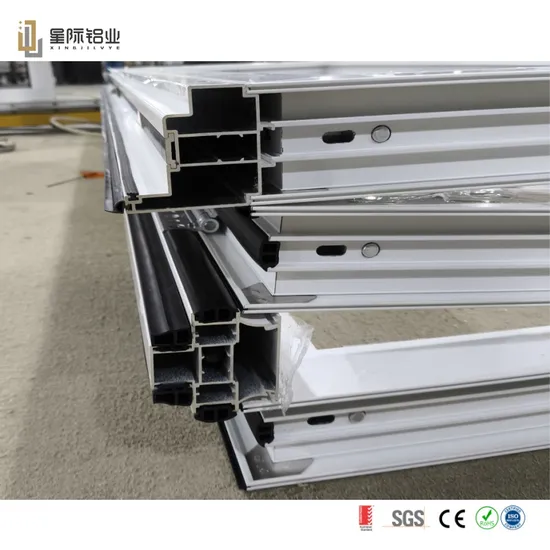
A bare aluminum frame is a thermal nightmare — it conducts heat and cold efficiently, creating condensation and energy loss. The solution is the thermal break: a polyamide strip inserted between the interior and exterior aluminum sections, interrupting the heat transfer path.
In our factory, we integrate polyamide thermal break strips during the assembly process, not as an afterthought. This ensures proper alignment, consistent pressure, and a sealed thermal barrier that meets international energy codes. For projects in extreme climates — whether the scorching heat of the Middle East or the freezing winters of Northern Europe — this technology is non-negotiable. When you order from Jusen, you are not just buying a door; you are buying a thermally engineered system designed to reduce HVAC loads and prevent condensation issues for the lifetime of the building [2].
How to Choose Aluminum Doors: Evaluating Alloy Grade and Wall Thickness
The first technical decision you will face is the alloy grade and wall thickness. These two factors determine the door’s structural integrity, durability, and price point. Understanding them will help you avoid both under-specification (which leads to sagging or twisting) and over-specification (which wastes budget).
Understanding Alloy Composition (6063-T5 vs. T6)
For architectural aluminum, the 6063 alloy is the industry standard. It offers excellent extrudability, a smooth surface finish, and good corrosion resistance. The temper designation — T5 or T6 — indicates how the material has been heat-treated to achieve specific mechanical properties.
- 6063-T5: Cooled from an elevated temperature and artificially aged. It offers good strength and is suitable for most residential and light commercial applications.
- 6063-T6: Solution heat-treated and artificially aged. It provides higher tensile strength and yield strength, making it ideal for large-span structures, high-rise buildings, and areas with high wind loads.
When you work with us, you do not need to be an expert in metallurgy. Our aluminum processing workshops handle the material selection for you. We procure billets from certified mills and verify the alloy composition before we begin cutting and machining. This raw material control is a critical step that many smaller fabricators skip — they buy pre-extruded profiles from third parties and cannot guarantee the alloy grade. Because we control the processing, we can certify what you are getting [3].
Why Standard Wall Thickness Matters (1.4mm vs. 2.0mm)
The wall thickness of the aluminum profile directly correlates to its load-bearing capacity. Most national standards (such as the Chinese GB standard) require a minimum of 1.4mm for exterior doors. However, this is a baseline, not a recommendation.
- 1.4mm – 1.6mm: Suitable for standard residential doors and interior applications where wind loads are minimal.
- 1.8mm – 2.0mm: Recommended for commercial entrances, large-format doors, and high-wind zones. The thicker wall provides greater rigidity, better screw-holding power for hardware, and reduces the risk of frame distortion over time.
Our approach is project-specific. As a manufacturer offering custom size and design services, we do not force a one-size-fits-all solution. If your project involves a 3-meter-tall entrance door in a high-rise, we will recommend a 2.0mm profile. If you are building a standard villa, we will suggest a cost-effective 1.4mm or 1.6mm option. This flexibility ensures you are paying for exactly the performance you need — nothing more, nothing less.
The Hidden Complexity of Aluminum Door Hardware and Accessories
A door frame is just the skeleton. The hardware — hinges, locks, handles, and sealing systems — determines how the door functions daily. This is often where cheap aluminum doors fail, and it is an area where our integrated manufacturing approach gives us a distinct advantage.
Choosing the Right Hinges and Locksets
The hinge is the most stressed component of any door. For aluminum doors, you have two primary options: surface-mounted hinges (visible) and concealed hinges (hidden within the frame). Concealed hinges offer a cleaner aesthetic and better security, as they cannot be easily removed from the outside. However, they require precise alignment during installation — a task that demands a factory that understands tolerances.
Similarly, the locking system is critical. For exterior aluminum doors, a multi-point locking system is essential. It engages multiple bolts along the door height, preventing warping and providing superior security compared to a single-point latch. At Jusen, we supply supporting hardware accessories alongside our doors. This means the hinges, locks, and handles are not sourced from random suppliers; they are specified, tested, and matched to the door’s weight, size, and usage patterns in our own workshops. This compatibility testing prevents the common problem of hardware failure caused by mismatched components [4].
Gaskets and Sealing Systems (EPDM vs. Silicone)
The sealing system is your first line of defense against water, air, and noise infiltration. The two main materials are:
- EPDM (Ethylene Propylene Diene Monomer): Excellent weather resistance, UV stability, and flexibility across a wide temperature range. It is the preferred choice for exterior doors.
- Silicone: Good temperature resistance but generally lower tear strength and abrasion resistance compared to EPDM.
The quality of the gasket matters as much as the material. A poorly designed gasket will compress over time, allowing drafts and water ingress. Our strict quality control from raw materials to final production ensures the EPDM seals we use are UV-stable, correctly sized, and properly seated in the frame grooves. We test our assembled doors for air permeability and water tightness before they leave the factory, giving you confidence that the door will perform in real-world conditions.
Glass Selection: Insulated, Tempered, or Laminated?
The glass is often the largest surface area of an aluminum door, and it significantly impacts both aesthetics and performance. Choosing the right glass package is essential for safety, energy efficiency, and acoustic comfort.
Safety Standards for Commercial and Residential Use
Building codes typically mandate safety glass in doors and sidelites. The two relevant types are:
- Tempered Glass: Heat-treated to be four to five times stronger than annealed glass. When broken, it shatters into small, relatively harmless pebbles. It is required for door panels and areas where human impact is likely.
- Laminated Glass: Composed of two or more glass layers bonded with an interlayer (usually PVB). When broken, the shards adhere to the interlayer, preventing dangerous fallout. It also provides superior acoustic insulation and some UV protection.
For high-traffic commercial entrances, laminated glass is often preferred for its security and safety profile. For residential villas, tempered insulated glass is the standard.
Low-E Coatings and Argon Gas Filling
Energy efficiency is determined by the glass’s U-value (how well it insulates). To achieve low U-values, we use:
- Low-E (Low-Emissivity) Coatings: A microscopic metallic coating applied to the glass surface that reflects heat back to its source. In winter, it keeps heat inside; in summer, it reflects solar heat away.
- Argon Gas Filling: An inert gas heavier than air, injected between the glass panes in an insulated glass unit (IGU). It reduces heat transfer through the airspace, improving insulation by 10-15% compared to air-filled units.
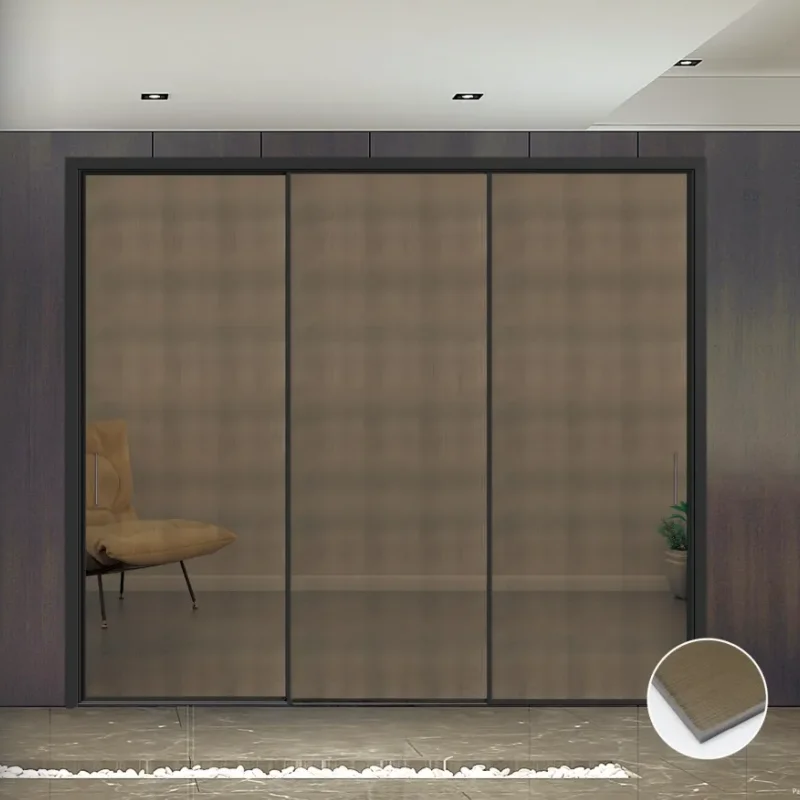
As a one-stop OEM supplier, we manage the glass sourcing and fabrication coordination for you. This means you do not have to deal with a separate glass supplier, a separate frame supplier, and a separate hardware supplier. You provide the specifications, and we deliver a complete door system from a single point of contact. This simplifies your logistics, reduces the risk of miscommunication, and ensures the glass is correctly incorporated into the frame with proper setting blocks and sealant [5].
Surface Finishing: Anodized vs. Powder Coating vs. Wood Grain
The finish determines the door’s appearance, corrosion resistance, and maintenance requirements. The three primary options each offer distinct advantages.
Durability of Anodized Finishes
Anodizing is an electrochemical process that thickens the natural oxide layer on the aluminum surface. This creates a hard, corrosion-resistant, and scratch-resistant finish that is integral to the metal. Anodized finishes have a distinct metallic sheen and are highly durable in coastal environments. They are available in a range of bronze, black, and silver tones.
The downside is limited color options and potential for color variation between batches. However, for architects seeking a premium, metallic aesthetic, anodized finishes are unmatched.
The Aesthetic Appeal of Wood Grain Aluminum
One of the most requested finishes in our factory is wood grain. This is achieved through a sublimation process where a wood pattern is printed onto the aluminum surface, creating a realistic wood texture that is as durable as the aluminum itself.
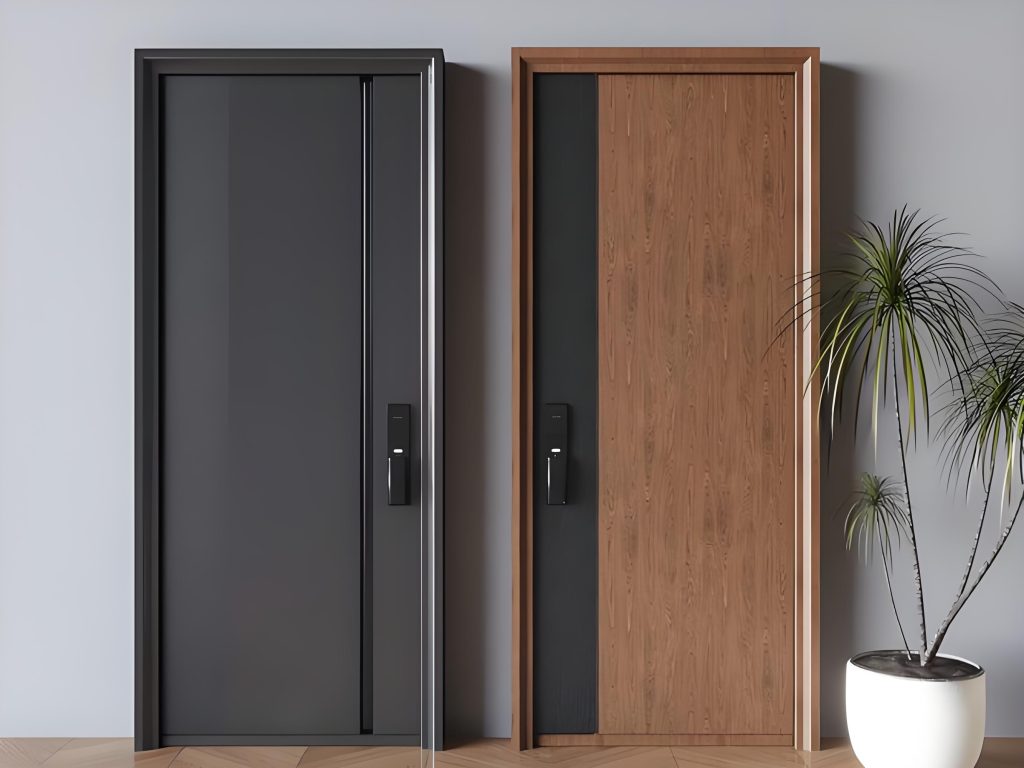
Here is where our background becomes uniquely valuable. As a manufacturer that is also a solid wood door producer, we understand the nuances of wood grain aesthetics better than most aluminum-only factories. We can perfectly match the wood grain aluminum doors and windows to our solid wood entry doors, creating a cohesive facade for luxury villas. The entry door might be solid mahogany, while the windows and sliding doors are wood grain aluminum — the visual language is unified, but the performance and maintenance requirements are optimized for each application.
Powder Coating: Versatility and Color Consistency
Powder coating is the most common finish due to its versatility. A dry powder is electrostatically applied and then cured under heat, creating a thick, uniform, and durable coating. It offers the widest range of colors (including RAL standards) and is available in matte, gloss, and textured finishes. For large projects where color consistency across hundreds of units is critical, powder coating is the most reliable choice.
The B2B Buying Guide: Why Sourcing from a Factory Matters
The product specifications are only half the equation. The other half is the supplier you choose. When you source from a trading company or a stockist, you are adding layers of cost, communication delays, and quality uncertainty. When you source directly from a manufacturing factory like Jusen, you gain control and transparency.
The Importance of OEM & ODM Capabilities
For any non-standard project, you need a partner who can do more than sell you a catalog product. You need a partner who can execute custom sizes, custom profiles, and custom finishes.
- OEM (Original Equipment Manufacturing): We manufacture products to your exact specifications, using your designs or our existing profiles, and can apply your private label.
- ODM (Original Design Manufacturing): We leverage our in-house design team to develop new products for you, from concept to production.
When you send us your requirements, our engineering support team begins working on customized shop drawings immediately. We can provide you with detailed shop drawings and formal quotations within 24 hours. This speed allows you to stay on schedule with your project timelines and make informed decisions quickly.
Managing Lead Times and MOQs
One of the biggest pain points in international sourcing is inflexible minimum order quantities (MOQs) and unpredictable lead times. We understand that not every project is a massive development. A designer might need doors for a single luxury villa; a contractor might be building a small commercial complex.
We pride ourselves on flexible MOQs. While bulk orders are always welcome, we work with contractors and designers to accommodate project-specific quantities. Our production planning is designed to handle both large-scale and smaller custom orders efficiently. Our fast production lead times ensure that your project does not stall waiting for materials.
Quality Control During Mass Production
When you order hundreds of doors, consistency is everything. The first door must be identical to the last door in terms of dimensions, finish, and hardware functionality. Achieving this requires rigorous quality control at every stage.
Because we operate our own wood drying, spray finishing, and aluminum processing workshops, we control the entire production chain. We do not outsource critical steps to third parties where quality can drift. Our quality control team inspects raw materials upon arrival, monitors in-process production, and performs final inspections before packaging. For every order, we maintain detailed records, allowing us to trace any issue back to its source and prevent recurrence.
This vertical integration is our answer to the question of “how to choose aluminum doors” — you choose a manufacturer that treats quality as a system, not an afterthought.
How to Choose Aluminum Doors: A Practical Decision Guide
Based on our two decades of manufacturing experience, here is a simplified decision framework to guide your specification:
Choose an aluminum door with a 6063-T5 alloy and 1.4mm wall thickness if:
- You are working on a standard residential project with moderate wind loads.
- Budget optimization is a priority.
- The door size does not exceed 2.4 meters in height.
Choose a 6063-T6 alloy and 1.8mm – 2.0mm wall thickness if:
- You are working on a commercial project or a high-end villa with large-format doors.
- The project is located in a high-wind or coastal area.
- You require enhanced thermal performance and structural rigidity.
Choose a wood grain finish if:
- You are designing a traditional or transitional style home.
- You want to coordinate aluminum windows with solid wood entry doors.
Choose an anodized or powder-coated finish if:
- You are designing a modern or minimalist building.
- You require a specific RAL color or a highly durable metallic finish.
Choose a single-point lock if:
- You are installing an interior door or a low-security exterior door.
Choose a multi-point locking system if:
- The door is a primary exterior entrance.
- Security is a top priority for the client.
Choose tempered glass if:
- You need compliance with basic safety codes for doors.
Choose laminated glass if:
- You need enhanced security, acoustic insulation, or hurricane resistance.
Why Partner with Jusen?
When you choose Jusen Doors & Windows Manufacturing Co., Ltd., you are not just purchasing a product; you are engaging a manufacturing partner.
- 20+ Years of Experience: Our team has spent over two decades mastering the complexities of both solid wood processing and aluminum window and door manufacturing.
- In-House Engineering: Our design and engineering team provides customized shop drawings and formal quotations within 24 hours.
- Full Customization: We offer OEM & ODM services, private labeling, and custom sizes and designs tailored to your project.
- Vertical Integration: Our own wood drying, spray finishing, and aluminum processing workshops ensure strict quality control from raw materials to final production.
- Logistics Support: We provide comprehensive after-sales support, including shipping damage protection, and use reinforced packing suited for sea freight to ensure your products arrive intact.
We welcome global distributors, builders, architects, and project partners to collaborate with us. Whether you need a single custom door or a bulk supply for a large development, our team is ready to support you.
—
References
[1] American Architectural Manufacturers Association (AAMA). “AAMA 101: Voluntary Specification for Aluminum Prime Windows and Sliding Glass Doors.” AAMA, 2020. https://www.aamanet.org/
[2] European Aluminium. “Thermal Break Technology: Improving Energy Efficiency in Aluminum Windows and Doors.” European Aluminium, 2021. https://www.european-aluminium.eu/
[3] The Aluminum Association. “International Alloy Designations and Chemical Composition Limits for Wrought Aluminum and Wrought Aluminum Alloys.” The Aluminum Association, 2022. https://www.aluminum.org/
[4] Builders Hardware Manufacturers Association (BHMA). “ANSI/BHMA A156.1: American National Standard for Butts and Hinges.” BHMA, 2021. https://www.buildershardware.com/
[5] National Fenestration Rating Council (NFRC). “Understanding U-Factor, Solar Heat Gain Coefficient, and Visible Transmittance.” NFRC, 2022. https://www.nfrc.org/
—
Ready to source high-quality, custom aluminum doors for your next project? https://doorwoodendoors.com/contact-us“>Talk to our team today to discuss your specifications or visit our contact page to request a formal quotation.
https://doorwoodendoors.com/contact-us” style=”display:inline-block;padding:12px 24px;background:#2563eb;color:#fff;text-decoration:none;border-radius:6px;font-weight:600″>Get a Free Custom Quote