
Content Menu
● 1. Defining “Wood Grain Doors” – Veneer vs. Solid Wood Construction
● 2. Manufacturing Mastery – How We Craft Premium Wood Grain Textures
● 3. Customization & OEM: Tailoring Wood Grain Doors to Your Project Specs
● 4. Why Global Contractors Choose JuSen for Wood Grain Door Supply
● 5. Frequently Asked Questions for B2B Buyers
10 min read
When a developer in Vancouver sends us a facade drawing with floor-to-ceiling oak entry doors, they are not asking for a product. They are asking for certainty — that the grain will match across 40 units, that the doors will not warp after installation, and that the container arrives without a single cracked panel.
That is the real job of a wood grain door manufacturer. Not just cutting wood, but engineering stability into something that nature originally grew crooked.
We have spent over 20 years in solid wood processing and aluminum window manufacturing at Jusen Doors & Windows. This guide explains what actually goes into wood grain doors — the construction types, the finishing science, and the customization workflow — so you can source with confidence.
—
Defining “Wood Grain Doors” – Veneer vs. Solid Wood Construction
The term “wood grain doors” covers three distinct product categories. Each has different structural behavior, price points, and appropriate applications. Knowing which one fits your project prevents costly specification errors.
The Authenticity of Natural Solid Wood Doors
Solid wood entry doors are the benchmark for luxury residential work. A 45mm thick solid oak slab carries visual weight that nothing else replicates. The grain runs continuously through the entire thickness — you can see it on the edge profiles, the panel grooves, and the machined lock blocks.
But solid wood moves. It expands across the grain in humid summers and contracts in dry winters. A door that fits perfectly in September can bind by February.
Our in-house wood drying workshop is where this problem gets solved — or prevented. We kiln-dry every board to a moisture content of 8–12%, depending on the destination climate. That process takes weeks, not days. Skipping it produces doors that telegraph every seasonal shift. We have seen competitor products fail this way, and it is why we maintain our own drying chambers rather than outsourcing to a third party who might rush the schedule.
Engineered Wood Veneer Doors (The Best of Both Worlds)
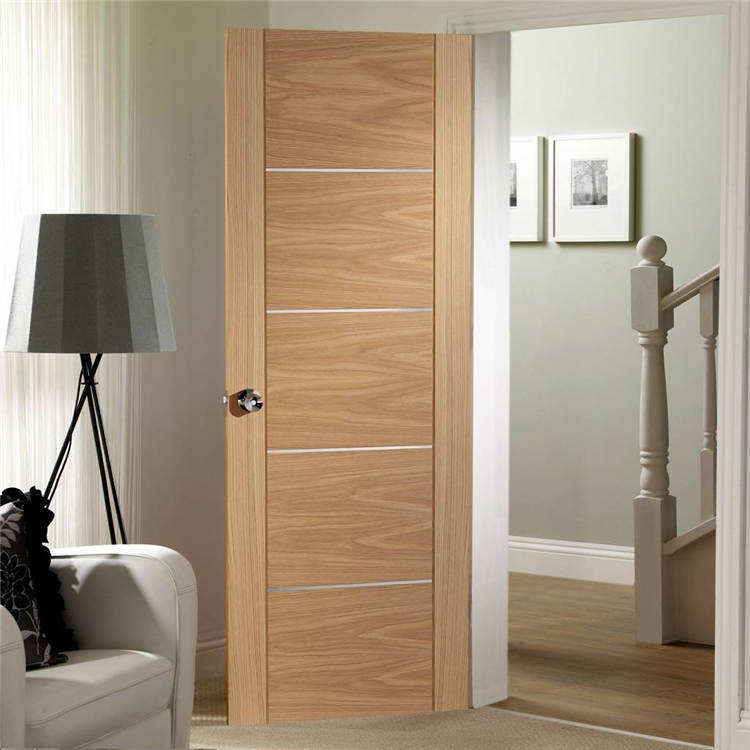
For interior doors and large villa projects, engineered construction offers superior dimensional stability at a lower cost. The core is typically laminated timber or a honeycomb structure, faced with a sliced natural wood veneer — usually 0.6mm to 1.2mm thick.
The visual result is nearly identical to solid wood. The structural result is more predictable. An engineered wood grain door will not cup or twist the way a solid slab might, especially when used with underfloor heating or in climates with dramatic humidity swings.
This is our most common specification for interior wooden doors in hotel and residential tower projects. It delivers the aesthetic architects demand without the warranty risk of solid construction.
Laminate & Painted Wood Grain Finishes
There is a third option that often gets overlooked: high-pressure laminate (HPL) or painted finishes that replicate wood grain patterns. These are not “fake wood” in a derogatory sense — they are engineered surfaces with specific advantages.
HPL doors resist moisture, scratches, and UV fading better than natural veneer. For coastal projects, bathroom doors, or high-traffic commercial corridors, they are frequently the smarter choice. The grain pattern repeats, which purists notice, but the maintenance cost drops dramatically.
We supply all three categories — solid wood entry doors, engineered veneer doors, and laminate-finished doors. We also manufacture aluminum alloy windows with wood grain foil finishes. That means a project partner can source the entry door, the interior doors, and the windows from one factory with coordinated aesthetics. One vendor, one quality standard, one shipping schedule.
—
Manufacturing Mastery – How We Craft Premium Wood Grain Textures
The difference between a good wood grain door and a poor one is rarely visible in a showroom photo. It appears after installation, after the first heating season, after the third year of sun exposure.
The Science of Wood Drying & Stability
Moisture content is the single most important technical specification in wood door manufacturing. Wood that is dried to 6% in the factory will absorb moisture from humid air during transit and expand. Wood dried to 14% will shrink and crack in a dry, heated interior.
Our drying schedule uses progressive kilns with humidity-controlled chambers. We do not fast-dry, because fast-drying creates case hardening — a condition where the outer shell is dry but the inner core retains moisture. The door looks fine at the factory. Six months later, it splits.
Every board that enters our production line passes through moisture meters at multiple checkpoints. This is not a single test at intake; it is an ongoing verification at rough milling, after veneering, and before final finishing.
Spray Finishing & Grain Highlighting Techniques
The finish is where the grain becomes visible — or gets buried. Two primary approaches exist:
- Closed-pore finish: A smooth surface where the grain is visible but not tactile. This is the standard for modern interiors and easier to clean.
- Open-pore finish: The grain texture remains raised, giving a natural, matte, “raw wood” feel. This is popular in luxury residential work but requires more careful maintenance.
Our spray finishing workshop applies UV-resistant lacquers in multiple layers — typically a sealer, a stain or toner, and a topcoat. The stain is where the grain gets its depth. We use anilox roller staining for veneers to ensure even color absorption, because hand-wiping produces inconsistent results across large batches.
For exterior doors, the topcoat includes UV absorbers. Without these, the wood grain fades to a grey, weathered tone within two years of direct sun exposure. That is not a defect — it is chemistry. Choosing the right finish system prevents it.
Precision Engineering for Door Frames & Aluminum Integration
A door leaf is only half the system. The frame must accommodate the door’s weight, the sealing requirements, and the architectural style.
Our aluminum processing workshops produce matching window frames and door frames with wood grain finishes that harmonize with the timber doors. This is a significant advantage for facade projects where the exterior windows and entry doors must present a unified appearance.
The aluminum frames are powder-coated or foil-laminated with wood grain patterns that closely match the veneer on the doors. We maintain a library of grain patterns and color standards so the match is consistent across production batches.
—
Customization & OEM: Tailoring Wood Grain Doors to Your Project Specs
Standard sizes are a myth in high-end construction. Every project has different wall thicknesses, different opening heights, and different design intent.
Design Flexibility for Architectural Visions
Our in-house design and engineering team works directly with architects and contractors. When you send us blueprints, we translate them into manufacturable shop drawings — typically within 24 hours. Those drawings include hinge locations, lock prep, glass lite dimensions, and section details.
Custom sizes are not a problem. We adjust panel configurations, add or remove mullions, and design for non-standard wall conditions. The engineering team flags potential issues before production, not after — which saves everyone time and money.
Material Selection & Hardware Compatibility
Oak is the default choice for many projects because of its prominent grain and durability. Walnut offers a darker, more dramatic appearance. Ash has a subtle, straight grain that takes paint well.
The veneer species affects not just appearance but also cost and stability. Oak veneer is widely available. Exotic species like Santos Mahogany have longer lead times and price volatility.
Hardware is another consideration. Solid wood doors are heavy — a 45mm oak slab can weigh 80kg or more. Standard hinges will fail. We pair our doors with heavy-duty bearings hinges and recommend appropriate locking hardware. For engineered doors, the hardware selection differs because the core material has different screw-holding characteristics.
Private Label & Bulk Supply for Developers
Retail dealers and distributors often want their own branding on the product. Our private label service applies your logo, your packaging design, and your warranty documentation to every door unit.
For developers managing large construction projects, we offer dedicated production slots. Flexible MOQs mean a boutique interior designer can order 20 doors for a single residence, while a real estate developer can order 2,000 units for a tower complex. The quality control process is identical regardless of order size.
—
Why Global Contractors Choose JuSen for Wood Grain Door Supply
Sourcing doors from overseas involves risk. The question is not whether a factory can produce a good sample — it is whether they can reproduce that sample consistently across a full container order.
Rigorous Quality Control from Raw Material to Finish
Because we operate our own wood drying, spray finishing, and aluminum processing workshops, we control every step of the supply chain. There is no external vendor whose delays or quality failures we must manage. This vertical integration is unusual in the industry.
Our QC checkpoints include:
- Moisture content verification at raw material intake
- Veneer inspection for grain consistency and defects
- Paint thickness measurement using calibrated gauges
- Dimensional checks after machining
- Final assembly inspection including hardware fit and door alignment
Each door unit is individually inspected before packaging. We do not rely on spot checks or statistical sampling for premium products.
Fast Lead Times & Shipping Protection
Production lead times for custom wood grain doors typically range from 25 to 45 days, depending on the complexity and finish type. This is faster than many competitors because we are not waiting on external suppliers.
Shipping damage is a legitimate concern. A container that sits on a dock for three weeks in tropical heat can expose doors to condensation damage. Our packaging uses moisture-barrier wrapping, edge protectors, and corner boards. We also provide comprehensive after-sales support specifically including shipping damage protection — if a door arrives damaged, we replace it.
Engineering Support for Installation
Installation errors cause more door failures than manufacturing defects. A door that is hung incorrectly — with the hinges not properly aligned, or the frame not plumb — will bind and wear unevenly.
We provide detailed installation guides and technical documentation with every order. Our engineering team is available for consultation during the installation phase. For large projects, we can participate in pre-installation meetings to review the drawings and address site conditions.
—
Frequently Asked Questions for B2B Buyers
What is the difference between a solid wood door and a wood grain door?
“Wood grain” describes the aesthetic, not the construction. A solid wood door uses solid timber throughout. A wood grain door can also be engineered with a veneered surface over a stable core. We offer both, and the right choice depends on your budget, climate, and structural requirements. For exterior entry doors, solid wood is often preferred. For interior doors, engineered construction is more stable and economical.
Can you match the wood grain of the doors to the aluminum windows?
Yes. Because we manufacture both timber doors and aluminum alloy windows, we coordinate wood grain finishes across both product lines. The aluminum frames use foil lamination or powder coating with grain patterns that complement the door veneers. This is particularly valuable for facades where visual continuity matters.
What are your MOQs for custom-sized wood grain doors?
Our MOQs are flexible. We supply boutique interior design projects with small quantities and large real estate developments with bulk orders. The production process scales without compromising quality control. For standard sizes, MOQs can be lower than for fully custom dimensions.
How do you ensure the doors do not warp during sea freight?
Warping is prevented at the drying stage, not the shipping stage. Our kiln-drying process reduces moisture content to the optimal level for the destination climate. During transit, we use moisture-barrier packaging that prevents condensation from affecting the wood. The combination of correct drying and proper packaging minimizes dimensional movement.
Can you provide custom shop drawings for our architect’s approval?
Yes. Our engineering team prepares detailed shop drawings and formal quotations within 24 hours of receiving your project specifications. These drawings include all necessary details — dimensions, hinge locations, lock prep, glazing details, and finishing specifications.
—
Making the Sourcing Decision
Wood grain doors are not a single product. They are a category with meaningful technical differences.
Choose solid wood doors if: your project demands the authenticity of full timber, you are working on a premium residential or hospitality project, and you have a climate where wood movement can be managed.
Choose engineered veneer doors if: you need the appearance of wood with better dimensional stability, you are working on a large multi-unit project with budget constraints, or you need to coordinate with underfloor heating systems.
Choose laminate or painted wood grain finishes if: the doors will be installed in high-moisture areas, coastal environments, or high-traffic commercial spaces where scratch resistance matters more than authentic grain.
Choose JuSen if: you want a single factory that controls the entire production process — drying, veneering, finishing, and aluminum integration — with OEM and ODM support, flexible MOQs, and comprehensive after-sales protection.
The best sourcing decision is based on data, not samples. Send us your project specifications, and our engineering team will provide shop drawings and a formal quotation within 24 hours.
—
References
- Wood Products Council. “Moisture Content and Wood Movement.” WoodWorks. https://www.woodworks.org/
- Forest Products Laboratory. “Wood Handbook: Wood as an Engineering Material.” USDA. https://www.fpl.fs.usda.gov/
- American Architectural Manufacturers Association. “AAMA/WDMA/CSA 101/I.S.2/A440: Window and Door Standard.” https://www.aamanet.org/
- Decorative Hardwoods Association. “Veneer Species Guide.” https://www.decorativehardwoods.org/
- National Wood Flooring Association. “Moisture Control Guidelines.” https://www.nwfa.org/





