Key Takeaways: What to Know Before Buying a Wood Front Door with Sidelights
A wood front door with sidelights is a significant investment in both curb appeal and home value. Before comparing specific styles, understand these core facts:
- Wood species determines durability and cost. Oak, mahogany, and walnut offer superior rot resistance and hardness, while pine and fir are budget-friendly but require more maintenance.
- Solid wood and solid core are different products. Solid wood means the entire slab is one species; solid core means a wood veneer over an engineered interior (often a better value for exterior use).
- Sidelights dramatically affect energy efficiency. More glass means more heat transfer. Look for double-pane, low-E glass with warm-edge spacers to mitigate this.
- Customization is standard, not premium. Reputable manufacturers offer virtually unlimited size, color, glass, and hardware options without a drastic price jump.
- The manufacturer matters as much as the door. Pre-shipment testing for air, water, and wind resistance separates reliable factories from inconsistent ones.
Wood Front Door Styles: From Modern to Farmhouse
The style of your door and sidelights should complement your home’s architecture, not fight it. Here is how the main categories break down.
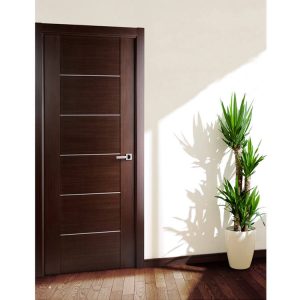
Modern and Contemporary: These doors favor clean lines, minimal ornamentation, and often use horizontal or vertical grain patterns. Sidelights are typically narrow, floor-to-ceiling panels with clear or frosted glass in minimal frames. Hardware is usually brushed nickel or matte black. A modern wood front door with sidelights often uses flat-panel construction with a smooth finish.
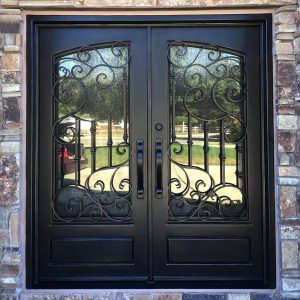
Traditional and Colonial: Symmetry is key here. Expect raised panels, classic proportions, and sidelights that mirror the door’s paneling. Oak or mahogany in rich, darker stains are common. Hardware tends toward brass or oil-rubbed bronze. The sidelights are often divided into smaller lites (muntins) for a classic look.
Rustic and Farmhouse: This category favors natural textures, distressed finishes, and substantial hardware. A farmhouse wood front door might feature a solid plank design, visible wood grain, and sidelights with divided lites or a single, large pane. Pine, cedar, or reclaimed wood are popular. The finish is often matte or lightly stained to keep the wood’s character visible.
Craftsman and Arts & Crafts: Characterized by thick frames, square or slightly tapered columns, and an emphasis on the wood itself. Sidelights often feature a single, wide pane with a decorative header. Oak is the traditional choice here.
When choosing, look at the roofline, window style, and exterior materials of your home. A modern door on a Victorian home will look out of place, just as a farmhouse door on a minimalist box will.
Solid Wood vs. Solid Core: Which Construction Is Right?
This is the most important structural decision you will make. Both have legitimate uses, but they are not interchangeable.
Solid Wood Construction
A solid wood door is milled from a single species, like mahogany or oak. The entire slab is wood.
- Pros: Authentic material, can be refinished many times over its life, feels substantial, and has a unique grain pattern. High-end homes and historic renovations often demand it.
- Cons: Expensive. More susceptible to warping, cupping, and seasonal movement than engineered products. Requires a professional finish and ongoing maintenance. A large solid wood front door with sidelights can be very heavy, requiring heavy-duty hinges and careful installation.
Solid Core Construction
A solid core door has a wood veneer over an engineered core, typically made of laminated veneer lumber, medium-density fiberboard (MDF), or a moisture-resistant composite.
- Pros: Dimensionally stable, meaning it resists warping and twisting far better than solid wood. It is an excellent insulator. Costs less than solid wood. The veneer is real wood, so it looks identical to a solid door.
- Cons: Cannot be refinished as many times as solid wood because the veneer has a finite thickness. If the veneer is damaged, repair is more difficult.
The Verdict for Exterior Use:
For most homes, a solid core door is the better engineering choice. Its stability is a massive advantage against the elements. It provides better insulation and is less likely to develop air gaps around the seals over time. Choose solid wood when the authentic material is a non-negotiable aesthetic requirement and you are prepared for the maintenance.
Choosing the Best Wood for Your Front Door
The “best” wood balances hardness, rot resistance, stability, and cost. Here is how the common species compare.
Oak (Red and White):
A classic choice. White oak is naturally rot-resistant due to its closed-cell structure; red oak is more porous and less resistant to moisture. Oak has a pronounced, open grain that takes stain well. It is hard and durable, but it can be heavy and will move with humidity changes.
Mahogany (Genuine and African):
Often considered the premium exterior door wood. It is naturally rot-resistant, dimensionally stable, and has a rich, reddish-brown color. Genuine mahogany is expensive and increasingly scarce. African mahogany is a more affordable alternative with similar working properties, though it is slightly less stable.
Pine and Fir:
These are the budget options. They are soft, lightweight, and easy to work with. They are not naturally rot-resistant and require a high-quality paint or solid stain system to protect them. A pine wood front door will dent and scratch more easily and will need more frequent refinishing. It is a fine choice for a covered porch in a mild climate, but it is not ideal for direct exposure.
Walnut:
Beautiful, rich chocolate color, but it is a softer hardwood. It is not as rot-resistant as oak or mahogany and is best used on a covered entry. It is a premium aesthetic choice, but a practical compromise.
Cedar:
Naturally rot-resistant and lightweight, but soft. It is more common for rustic or farmhouse styles. It takes paint well but can be prone to dents.
| Wood Species | Relative Cost | Rot Resistance | Hardness | Best For |
|---|---|---|---|---|
| Mahogany | High | Excellent | High | Premium, traditional, and modern doors |
| White Oak | Medium-High | Good | High | Traditional, modern, and high-traffic entries |
| Walnut | High | Fair | Medium | Covered entries, interior-facing aesthetics |
| Cedar | Medium | Excellent | Low | Rustic, farmhouse, and covered applications |
| Pine / Fir | Low | Poor | Low | Budget projects, covered entries, paint-grade use |
Glass and Sidelight Options: Balancing Light, Privacy, and Efficiency
The glass is where you lose energy efficiency and gain visual appeal. Every choice is a trade-off.
Glass Types:
- Clear Glass: Offers the most natural light and an unobstructed view. Zero privacy.
- Frosted or Obscured Glass: Diffuses light while blocking the view. Good for privacy in entryways that face the street directly.
- Decorative Glass: Includes beveled, seeded, or patterned glass. These add character but can be harder to clean and may reduce light transmission.
- Low-E (Low-Emissivity) Glass: This is non-negotiable. A low-E coating reflects heat back to its source, keeping your home warmer in winter and cooler in summer. It is a microscopic, virtually invisible metallic layer.
- Double vs. Triple Pane: Double-pane is standard. Triple-pane is for extreme climates and adds significant weight and cost. For sidelights, double-pane with low-E is the rational choice for most projects.
Sidelight Configurations:
The configuration affects both appearance and structural integrity.
- Single Sidelight: One panel on one side of the door. Asymmetrical and modern.
- Double Sidelights: One panel on each side. Symmetrical and classic.
- Fixed vs. Operable Sidelights: Most sidelights are fixed (non-opening). Operable sidelights (awning or casement style) are rare and expensive but provide ventilation. They also introduce more moving parts and potential failure points.
- Solid Sidelights: A “front door with solid sidelights” means the sidelight panels are made of wood, not glass. This is a stylistic choice for maximum privacy or a specific architectural look, but it defeats the primary purpose of adding light.
Energy Efficiency and U-Factor:
The U-factor measures how well a window or door prevents heat from escaping. The lower the U-factor, the better the insulation. For sidelights, look for a U-factor of 0.30 or lower in most climates. The frame material and the spacer system between the glass panes matter as much as the glass itself. Warm-edge spacers (stainless steel or foam) reduce heat loss at the edge of the glass, which is a common weak point.
Comparison Table: Wood Types, Construction, and Styles at a Glance
This table summarizes the key decision points. Use it as a quick reference when talking to a manufacturer.
| Feature | Option A | Option B | Option C | Key Trade-off |
|---|---|---|---|---|
| Construction | Solid Wood | Solid Core | — | Solid wood = authentic, more maintenance. Solid core = stable, better insulation. |
| Wood Species | Mahogany | White Oak | Pine / Fir | Mahogany = premium cost, premium durability. Oak = excellent balance. Pine = budget, high maintenance. |
| Sidelight Glass | Clear, Double-Pane Low-E | Frosted, Double-Pane Low-E | Decorative, Single-Pane | Clear = max light. Frosted = privacy. Decorative = style, less efficiency. |
| Sidelight Config. | Double Sidelights | Single Sidelight | Solid Sidelights | Double = classic symmetry. Single = modern asymmetry. Solid = privacy, no light. |
| Style | Modern / Contemporary | Traditional / Colonial | Rustic / Farmhouse | Modern = clean lines. Traditional = raised panels. Rustic = natural texture. |
| Cost Range | High | Medium | Low | Reflects material, labor, and customization level. |
Buying Guide: How to Select a Manufacturer and Get the Best Value
The door is only as good as the factory that builds it. Here is a framework for evaluating suppliers, especially when importing.
1. Verify Testing and Compliance.
Do not take a manufacturer’s word on quality. Ask for test reports. A reliable factory will have documented results for:
- Air-Tightness: How much air leaks through the closed door and frame.
- Water-Tightness: How well the assembly resists water penetration under wind-driven rain.
- Wind Load Resistance: How much pressure the door and sidelights can withstand without structural failure.
These tests are critical. If a manufacturer cannot provide them, or is vague about the standards they meet, that is a red flag.
2. Confirm Customization Capabilities.
Your project will likely require non-standard dimensions or specific hardware. Ask directly:
- Can they adjust the profile structure to meet your local building codes?
- Can they match a specific color or finish?
- Can they use your specified glass or hardware brand?
A factory that only offers fixed sizes is a limitation you should know about upfront.
3. Understand the Logistics.
If you are buying overseas, the logistics are part of the product. A competent exporter should provide:
- A detailed packing list.
- A proforma invoice.
- Full customs documentation.
- Options for FCL (Full Container Load) and LCL (Less than Container Load) shipping.
4. Evaluate the Cost Structure.
The price per door is only one number. The final cost includes finishing, hardware, shipping, customs, and installation. A factory-direct price eliminates middleman markup, which is often substantial. However, be wary of prices that seem too low—they often reflect thinner material, lower-grade glass, or a lack of testing.
Here is how we meet these standards.
As a manufacturer, our approach is built around direct factory supply and full customization. We do not work through distributors, which allows us to control the entire production process and offer competitive pricing without a middleman markup. Our factory handles custom sizes, colors, glass, and hardware accessories as standard practice, not as a premium service. Every order is subject to a strict pre-shipment inspection covering air-tightness, water-tightness, and wind resistance—the same tests we mentioned above. With our experience in foreign trade, we provide the full documentation package required for customs clearance and can arrange both FCL and LCL shipments directly to your site. We also adjust our profile structures and fittings to match local building codes in your target market. If you are comparing suppliers, that combination of direct pricing, testing, and export experience is the benchmark we hold ourselves to.
Frequently Asked Questions About Wood Front Doors with Sidelights
What is the best wood for a front door with sidelights?
For most exterior applications, mahogany and white oak are the best choices. Mahogany offers superior rot resistance and stability, while white oak is a slightly more affordable alternative with excellent hardness. Pine and fir are acceptable only for budget projects with full weather protection.
What are the differences between solid wood and solid core front doors?
A solid wood door is milled entirely from one species. A solid core door has a real wood veneer over an engineered composite core. Solid core is more dimensionally stable, insulates better, and costs less, but it cannot be refinished as many times. Solid wood is authentic but requires more maintenance and is prone to seasonal movement.
What styles are available for wood front doors with sidelights?
The main categories are modern/contemporary, traditional/colonial, rustic/farmhouse, and craftsman. The right choice depends on your home’s architecture. Sidelight configurations range from a single panel to double panels, with varying glass patterns.
Can I customize the size, glass, and hardware of a wood front door with sidelights?
Yes. Customization is standard in this industry. You can specify the door dimensions, sidelight configuration, glass type (clear, frosted, low-E), wood species, finish color, and hardware brand. The key is to confirm the manufacturer’s capability to handle your specific requirements.
How do I choose a reliable manufacturer for wood front doors with sidelights?
Verify their test reports for air, water, and wind resistance. Ask for references and check their export documentation capabilities. Confirm they can handle custom specifications and understand your local building codes. If importing, ensure they can manage FCL/LCL shipping and provide a full customs packet.
What are the cost considerations for wood front doors with sidelights?
Cost is driven by wood species (mahogany is premium, pine is budget), construction (solid wood costs more than solid core), glass type (low-E double-pane is standard), and sidelight configuration (double sidelights add cost and complexity). Shipping, customs, and installation are additional factors. Factory-direct pricing can reduce the base cost significantly.