Content Menu
● 1. What Is a Wood Front Door Double? Types and Applications
● 2. What Are the Key Quality and Performance Factors for Double Wood Doors?
● 3. How to Evaluate Wood Front Door Double Suppliers
● 4. What Industry Standards Apply to Double Wood Doors?
● 5. How We Meet These Standards: Our Manufacturing Approach
● 6. What Does the Production Process Look Like for Double Wood Doors?
● 7. Our Multi-Stage Inspection Process
● 8. Customization and OEM/ODM Options
● 9. Ordering Process: MOQ, Lead Time, and Shipping
● 10. Frequently Asked Questions
14 min read
A contractor in Minnesota once ordered 60 double wood entry doors. The price and samples looked right. Then the first container arrived with 11 units warped at the bottom rail and finish fading on another 8. The job site went quiet for two weeks while replacements were rushed.
That is the reality of sourcing double wood front doors at scale. The product looks simple—two panels, some glass, hinges. But the engineering behind a stable, code-compliant double door unit is where most procurement mistakes happen.
This guide covers the technical specifications that matter, the cost drivers that survive project budgeting, and the supplier evaluation framework that prevents the scenario above.
What Is a Wood Front Door Double? Types and Applications
A wood front door double unit consists of two adjacent door panels installed in a single frame, where at least one panel (the “active” door) opens for regular entry, and the other (the “passive” door) operates as a secondary opening. Standard widths are 5’0″ (60 inches), 5’6″ (66 inches), and 6’0″ (72 inches), with heights of 6’8″ or 8’0″ common in residential and light-commercial projects.
Double Door vs. French Door Configurations
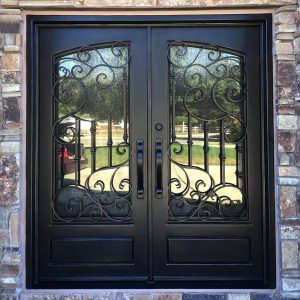
The term “double door” is often used interchangeably with “French door,” but they are not the same specification. A French door is a subtype of double door where both panels are predominantly glass, divided by narrow stiles and rails—typically 10-lite or 15-lite configurations. A standard double door may have solid wood lower panels, partial glass lites above, or full glass.
For procurement documents, this distinction matters. If you write “double wood front door” without specifying “French-style,” a supplier may quote a solid-panel unit when you needed full-lite glass.
Construction Types: Solid Wood vs. Engineered Core
“Solid wood” in the door industry does not mean a single piece of timber. It means stile-and-rail construction—vertical stiles and horizontal rails joined around panels or glass. The best exterior doors use engineered cores (laminated veneer lumber or medium-density fiberboard) beneath the wood veneer. This prevents the warping and splitting that solid timber slabs experience across seasonal humidity changes.
Common species include:
- Mahogany – dimensional stability, rot resistance, premium stain appearance
- Oak – hard, durable, prominent grain pattern
- Walnut – rich dark tone, softer than oak, higher cost
- Hemlock – stable, paintable, economical
- Pine – lowest cost, suitable for primed paint-grade applications
Application Suitability
Double wood front doors fit projects where single 36-inch entries are insufficient: luxury residential entries, villa entrances, churches, civic buildings, and light-commercial storefronts requiring wide egress. The 6’0″ width is increasingly common in high-end residential specifications because it accommodates furniture moving and creates a ceremonial entry aesthetic.
What Are the Key Quality and Performance Factors for Double Wood Doors?
Quality in double wood doors comes down to four measurable factors: core stability, glass seal integrity, hardware load capacity, and finish durability. A door that fails any of these will generate callbacks within 12–24 months.
Core Construction and Stability
The frame must resist twist and sag across a 6-foot span. Look for:
- Kiln-dried lumber at 8–12% moisture content
- Mortise-and-tenon joinery with waterproof adhesive (not staple-and-glue assembly)
- Reinforced hinge areas with solid blocking or laminated inserts
A simple test: press on the corner of the active panel. If the joint flexes visibly, the door will sag within a year. The passive panel carries half the door’s weight on its hinges—if the hinge stile is not reinforced, the door will drag on the threshold.
Glass and Glazing Standards
Double-glazed low-E glass is the baseline for energy code compliance in most North American and European markets. Key specifications to request:
| Glass Specification | Typical Value | Why It Matters |
|---|---|---|
| U-factor | ≤ 0.30 (double-glazed low-E) | Heat loss through the door |
| SHGC (Solar Heat Gain Coefficient) | 0.25–0.40 | Solar heat management |
| Spacer type | Warm-edge (stainless steel or silicone foam) | Prevents condensation and seal failure |
| Glass thickness | 3mm–6mm per pane | Structural integrity for large lites |
The edge spacer is the most overlooked component. Aluminum spacers conduct heat and cause condensation at the glass edge. Warm-edge spacers cost slightly more but prevent the fogging failure that appears 3–5 years after installation.
Hardware and Hinge Load
Double doors are heavy. A 6’0″ x 8’0″ pair with full-lite glass can weigh 200–300 pounds. Standard residential hinges (3 per panel) are often insufficient. For wide or glass-heavy units, specify:
- 4 hinges per panel for doors over 100 lbs
- Multi-point locking systems (single-point locks are vulnerable to forced entry at the center seam)
- Door coordinators for commercial applications—they force the passive panel to close before the active panel, preventing damage to the astragal
Finish Durability
Exterior wood doors require UV-resistant finishes. For stain-grade doors, expect to re-coat every 2–3 years. Painted doors last longer between maintenance cycles but hide the wood grain. A quality factory applies 5–7 coats of finish, including primer, sealer, and topcoat, with sanding between each coat.
One imperfect insight buyers should know: wood double doors are not always the right choice. In coastal environments with salt spray or in high-humidity tropical climates, fiberglass double doors with wood-grain texture outperform wood on maintenance and longevity.
How to Evaluate Wood Front Door Double Suppliers
Supplier evaluation for double wood doors requires verification of four areas: manufacturing capability, quality control process, documentation readiness, and logistics experience. A supplier that fails any one of these will create project risk.
Manufacturing Capability Verification
Ask for specifics:
- CNC machining capacity – Are stiles and rails cut on CNC routers for precision, or manual saws?
- Kiln capacity – Can the factory dry lumber in-house, or do they buy pre-dried stock?
- Finishing line – Is the finish applied in a spray booth with controlled temperature and humidity, or outdoors?
- Production output – What is the monthly capacity for double door units? A factory producing 500 singles a month may not handle 100 double units with custom glass.
The best verification is a video call showing the production floor. If the factory refuses or shows only the showroom, that is a red flag.
Quality Control Process
A reliable supplier follows a multi-stage inspection:
- Incoming material inspection – Lumber moisture content, glass quality, hardware batch verification
- In-process checks – Frame squareness, joint integrity, glass seal application
- Pre-shipment inspection – Air-tightness, water-tightness, and wind resistance testing on sample units from each batch
Ask which standards they test against. ASTM E547 for water penetration and ASTM E330 for structural performance are common benchmarks. For European markets, EN 1027 and EN 12211 apply.
Documentation and Compliance
International buyers need:
- Packing list with per-carton dimensions and weights
- Proforma invoice for customs declaration
- Certificate of origin (for preferential tariff treatment)
- Test reports matching the target market’s building codes
A supplier with foreign trade experience will provide these without being asked. A supplier that hesitates on customs documentation will cause port delays.
Red Flags to Avoid
- “Unlimited customization” with no engineering review – custom sizes require structural verification, not just cutting wood differently
- No test reports available – if they cannot show air/water/wind test data, they have not tested
- MOQ below 10 units – a factory willing to produce 5 custom double doors is likely a workshop, not a manufacturer with quality systems
- “We will handle everything” – no single supplier handles everything; ask who manufactures the glass, the hardware, and the finish
What Industry Standards Apply to Double Wood Doors?
Three standards frameworks govern double wood door performance in major markets. Your supplier should be able to produce test reports for the ones relevant to your project location.
North American Standards
- ASTM E283 – Air leakage testing (max 0.3 CFM/ft² at 1.57 psf for most residential applications)
- ASTM E547 – Water penetration testing (no water penetration at 5 psf for 15 minutes)
- ASTM E330 – Structural performance (no permanent deformation at 1.5x design wind load)
- NFRC 100 – U-factor certification for energy code compliance
European Standards
- EN 1027 – Water tightness classification (Class 7A–9A for exterior doors)
- EN 12207 – Air permeability classification (Class 2–4)
- EN 12211 – Wind load resistance classification (Class A1–C5)
- CE marking – Mandatory for doors sold in the EU, requiring factory production control
Chinese Manufacturing Standards
- GB/T 29498-2013 – Wood doors and windows general specification
- GB/T 20909-2007 – Steel and wood composite doors (if applicable)
Fire-Rated Double Doors
For commercial applications, fire-rated double doors must meet UL 10C (North America) or EN 1634-1 (Europe). A wood double door fire-rated for 60 or 90 minutes requires special intumescent seals, reinforced frames, and specific glass. Not all wood door factories produce fire-rated units—verify this capability before specifying it.
How We Meet These Standards: Our Manufacturing Approach
At Jusen Door and Windows Manufacturing Co., Ltd., we operate as a direct factory supplier of solid wood doors, thermal-break aluminum doors and windows, and custom villa entry systems. Our approach to double wood front doors is built around the procurement concerns that matter to B2B buyers: consistency, compliance, and communication.
Factory-Direct Pricing with Full Customization
Because we manufacture, not resell, our quotes reflect factory floor costs—not distributor margins. For double wood front doors, we offer:
- Custom sizing – including 8’0″ heights and non-standard widths for grand entrances
- Glass options – clear, low-E, tinted, frosted, tempered, and laminated configurations
- Hardware selection – multi-point locks, hinges, handles, and astragals from specified brands
- Color matching – custom stain colors or primed-only options for on-site painting
Pre-Shipment Quality Control
Every batch of double wood doors undergoes air-tightness, water-tightness, and wind resistance testing before leaving our factory. We test against the standards relevant to your target market—ASTM for North America, EN for Europe, GB/T for domestic Chinese projects. Our quality control team documents each test with photos and data, which we share with you before shipment.
Foreign Trade Documentation
Our team handles the paperwork that international buyers need: packing lists, proforma invoices, certificates of origin, and full customs documentation. For buyers importing to North America or Europe, we adjust profile structures and fittings to match local building codes—we do not ship a one-size-fits-all product.
Shipping Flexibility
We ship both FCL (full container load) and LCL (less than container load) directly from our China factory. For standard double door sizes, a 40HQ container holds approximately 60–80 units depending on door thickness and packaging configuration.
What Does the Production Process Look Like for Double Wood Doors?
Understanding the production process helps you evaluate lead times and identify quality indicators. A standard double wood door takes 3–5 weeks to produce, with custom units taking 5–8 weeks.
Stage 1: Lumber Selection and Preparation
Kiln-dried lumber is inspected for moisture content (8–12%) and defects. For stain-grade doors, the wood must be free of knots and color variation. For paint-grade, minor defects are acceptable—they will be hidden by the primer.
Stage 2: CNC Machining of Stile and Rail Components
Stiles and rails are cut to specification on CNC routers. This ensures precise mortise-and-tenon joints. The tolerance for a quality joint is ±0.5mm. Manual cutting produces wide variance, which leads to joint failure over time.
Stage 3: Frame Assembly and Gluing
Components are assembled with waterproof adhesive and clamped under pressure. The assembled frame must be perfectly square—a diagonal measurement difference of more than 2mm will cause the door to bind in the frame.
Stage 4: Glass Installation
Glass lites are installed with glazing tape and bead molding. For double-glazed units, the seal between panes must be airtight. A failure here causes fogging, which cannot be repaired—the entire glass unit must be replaced.
Stage 5: Sanding and Finishing
The door is sanded progressively to 150–220 grit. Finish is applied in multiple coats: primer, sealer, and topcoat, with sanding between each. The final coat must cure for 24–48 hours before the door is handled.
Stage 6: Hardware Installation and Final Inspection
Hinges, locks, and handles are installed. The door is hung on a test frame to verify operation—it should swing freely without binding. Air, water, and wind tests are conducted on sample units from each production batch.
Our Multi-Stage Inspection Process
Quality control is not a single checkpoint—it is embedded throughout production. Our inspection process follows these stages:
Incoming Material Inspection
- Lumber moisture content verified with a pin meter
- Glass checked for chips, scratches, and seal integrity
- Hardware batch-tested for function
In-Process Checks
- Frame squareness measured after assembly
- Joint integrity checked by tapping—hollow sounds indicate voids in adhesive
- Glass seal verified with a visual inspection and pressure test
Pre-Shipment Inspection
- Air-tightness test per ASTM E283 or EN 12207
- Water-tightness test per ASTM E547 or EN 1027
- Wind resistance test per ASTM E330 or EN 12211
- Final visual inspection for finish defects, scratches, and hardware alignment
Each door is individually wrapped with protective film, corner guards, and wooden crating for container shipment. We photograph the packaging before sealing the container, which prevents shipping damage disputes.
Customization and OEM/ODM Options
B2B buyers work with us in three partnership models:
OEM (Private Label) Production
We manufacture double wood doors to your exact specifications and brand them under your label. This is ideal for distributors and importers who want a proprietary product line without investing in their own factory. You control the pricing, the branding, and the market positioning.
ODM (Design and Manufacturing) Partnership
We handle design, engineering, and production based on your market’s requirements. If you need a new door model that meets specific local building codes, our engineering team develops the profile structure and fittings. You approve the design, and we produce.
Bulk Project Supply (Construction and Development)
For developers and contractors, we supply large quantities of doors with consistent quality and scheduled delivery. Our production planning accommodates staged deliveries if your site requires phased installation. We understand that construction delays cost money—our lead times are quoted with buffer, not optimism.
Choose A if… Choose B if…
- Choose OEM if you have an established brand and want to expand your product line without factory investment.
- Choose ODM if you need a specialist partner to develop new door models or adapt existing designs to local codes.
- Choose Bulk Project Supply if you are a developer or contractor who needs consistent quality across a large project with fixed deadlines.
Ordering Process: MOQ, Lead Time, and Shipping
Minimum Order Quantity (MOQ)
MOQ depends on the level of customization:
- Standard sizes, standard glass: 10–20 units
- Custom sizes, custom glass and hardware: 30–50 units
Lower MOQs are possible for sample orders—we understand that you need to verify quality before committing to volume. Sample lead time is 2–3 weeks.
Lead Times
| Order Type | Production Time | Shipping Time | Total Lead Time |
|---|---|---|---|
| Standard sizes, standard finish | 3–5 weeks | 2–4 weeks | 5–9 weeks |
| Custom sizes, custom glass | 5–8 weeks | 2–4 weeks | 7–12 weeks |
| Sample orders | 2–3 weeks | 2–4 weeks | 4–7 weeks |
Shipping Options
- FCL: Best for orders over 40–50 doors. Lower per-unit freight cost and less handling damage.
- LCL: Viable for smaller orders. Higher per-unit cost and higher risk of damage from multiple handling points.
A 40HQ container holds approximately 60–80 double door units depending on thickness and packaging. We coordinate container loading to maximize space utilization and minimize damage risk.
Payment Terms
Standard terms are 30% deposit with the order and 70% balance before shipment. For established relationships, we can discuss letter of credit terms.
Frequently Asked Questions
How much do wood French doors cost?
For B2B bulk pricing, primed pine French double doors typically range from $800–$1,500 per unit (5’0″ x 6’8″). Stain-grade mahogany or oak ranges from $1,500–$3,000+ depending on glass configuration and hardware. Custom sizes and premium wood species increase cost further. Get a Quote for current bulk pricing.
What is the difference between a double door and a French door?
A double door is any two-panel entry system. A French door is a specific subtype where both panels are predominantly glass, divided by narrow stiles—typically 10 or 15 lites. French doors maximize light but require more structural reinforcement and cost more per square foot.
Are wooden French doors good?
Yes, when properly constructed with engineered cores and quality finishes. Solid wood stile-and-rail construction offers durability, repairability, and premium aesthetics. The key is specifying the right wood species, glass, and hardware for your climate and security requirements. In coastal or high-humidity environments, fiberglass may be a better lifecycle choice.
Can French doors be solid wood?
Yes. “Solid wood” in the industry means solid stile-and-rail construction—not hollow core or veneer over MDF. French doors can be built with solid wood frames around the glass lites. This is the standard for premium exterior French doors.
What is the standard size for a double front door?
Common widths are 5’0″ (60″), 5’6″ (66″), and 6’0″ (72″), with 6’8″ being the standard height. For grand entrances, 8’0″ tall units are increasingly specified. Custom sizes are available from manufacturers with flexible production lines.
What is the MOQ for custom double doors?
MOQ depends on the level of customization. Standard sizes with standard glass: 10–20 units. Fully custom sizes with custom glass and hardware: 30–50 units. Contact our team to discuss your specific requirements.
How do I verify a supplier’s quality control claims?
Request test reports that match your target market’s building codes. Ask for a video call showing the production floor. Request photos of packaging standards before shipping. Verify the factory’s capacity—a factory producing 500 singles a month may not handle 100 custom double units.
Sourcing Checklist for Wood Front Double Doors
Before placing an order, verify:
- [ ] Wood species and grade – specify clear, select, or knotty grade for stain applications
- [ ] Glass specification – low-E, double-glazed, warm-edge spacers, tempered if required
- [ ] Hardware load capacity – 4 hinges per panel for doors over 100 lbs
- [ ] Multi-point locking – required for security on double doors
- [ ] Test reports – air, water, and wind resistance data for your market
- [ ] Customs documentation – packing list, proforma invoice, certificate of origin
- [ ] Packaging standards – individual wrapping, corner guards, crating
- [ ] Lead time buffer – add 2 weeks to quoted lead time for customs and port delays
Why Work With Us
We are a direct factory, not a trading company. Our double wood front doors are manufactured in our own facility, which means:
- Competitive pricing – no middleman markup between our factory floor and your project
- Full customization – size, color, glass, and hardware all adjustable to your spec
- Strict quality control – air-tightness, water-tightness, and wind resistance tests on every batch
- Export documentation – packing lists, proforma invoices, and full customs paperwork
- Flexible shipping – FCL and LCL, direct from our China factory
- Code compliance – adjustable profile structures and fittings to match local building codes
We have supplied double wood doors to projects across North America, Europe, and Australia. Our foreign trade team handles the logistics, documentation, and communication so you can focus on your project.
If you are planning a project that requires wood front double doors—whether standard or fully custom—we invite you to discuss your specifications with our team.
References
- ASTM International. “ASTM E283 – Standard Test Method for Determining Rate of Air Leakage Through Exterior Windows, Skylights, Curtain Walls, and Doors Under Specified Pressure Differences Across the Specimen.” https://www.astm.org/e0283-19.html
- ASTM International. “ASTM E547 – Standard Test Method for Water Penetration of Exterior Windows, Skylights, Doors, and Curtain Walls by Cyclic Static Air Pressure Difference.” https://www.astm.org/e0547-00r16.html
- ASTM International. “ASTM E330 – Standard Test Method for Structural Performance of Exterior Windows, Skylights, Doors and Curtain Walls by Uniform Static Air Pressure Difference.” https://www.astm.org/e0330-14.html
- European Committee for Standardization. “EN 1027 – Windows and doors – Water tightness – Test method.” https://www.en-standard.eu/bs-en-1027-2016-windows-and-doors-water-tightness-test-method/
- National Fenestration Rating Council. “NFRC 100 – Procedure for Determining Fenestration Product U-factors.” https://www.nfrc.org/standards/
- Underwriters Laboratories. “UL 10C – Positive Pressure Fire Tests of Door Assemblies.” https://www.ul.com/resources/bulletins/ul-10c-positive-pressure-fire-tests-door-assemblies