Content Menu
● 1. What Is a Wood French Door? Types and Applications
● 2. Wood French Door Quality and Performance Factors
● 3. How to Evaluate Wood French Door Suppliers
● 4. Key Quality Indicators for Wood French Door Buyers
● 5. Relevant Industry Standards and Certifications
● 6. Our Door Manufacturing Capabilities
● 7. How to Choose Between Sourcing Models
14 min read
The first container order is where most procurement relationships either solidify or fracture. Buyers who have been through it know the drill: samples looked great, the price was right, and then the production run arrived with warped stiles and glass that didn’t match the spec sheet. This guide exists to help you avoid that scenario. It covers wood French doors from a procurement perspective—material science, cost drivers, testing protocols, and what to demand from a supplier before you sign a PO.
Wood French doors hold a distinct position in residential and light commercial projects. They deliver natural light, visual openness, and a classic aesthetic that solid panels cannot replicate. But their performance hinges on factors that are invisible at first glance: moisture content of the timber, glass type, hinge load ratings, and the quality of the factory’s sealing process. This guide addresses those technical details so you can source with confidence.
—
What Is a Wood French Door? Types and Applications
A wood French door is a door panel where glazing (called “lites”) occupies the majority of the surface area, typically spanning nearly the full height of the door. Unlike a standard door with a small window, a French door’s defining characteristic is the extensive glass area divided by vertical muntins or a single large pane. They are commonly installed in pairs, though single units exist for narrower openings.
The distinction between a French door and a regular double door matters for specification accuracy. A French door has full-length glazing; a double door may have solid panels, partial glazing, or a mix. When you write a specification, using the wrong term can result in incorrect pricing, wrong building code interpretation, and delivery of a product that does not match the architectural intent. The term “French door” specifically refers to the glazing configuration, not the number of panels.
Common Lite Configurations in the Market
The lite pattern affects both aesthetics and price. More muntins means more labor, more material, and a higher cost. Here are the configurations you will encounter most frequently:
- Full-lite: One large pane of glass with no vertical divisions. Maximum light transmission and unobstructed views. Common in modern and contemporary designs.
- 6-lite (3 over 3): Two rows of three rectangular panes. A balanced, traditional look suitable for both interior and exterior applications.
- 10-lite (5 over 5): Two rows of five panes. A more detailed appearance, often specified for craftsman or colonial-style homes.
- 15-lite (5 over 5 over 5): Three rows of five panes. The most intricate common pattern, typically reserved for formal interiors.
In North American distribution channels, stock sizes like 4’0″ x 6’8″ 10-lite and 5’0″ x 6’8″ 15-lite prehung units are widely available. For B2B buyers, the lite count directly impacts lead time. A factory that produces 500 full-lite units per week may only produce 150 fifteen-lite units in the same period because each muntin joint requires precise cutting and assembly.
Solid Wood vs. Engineered Wood vs. Fiberglass
French doors can be manufactured from solid wood, engineered wood, or fiberglass—and each material carries a specific trade-off.
| Material | Appearance | Dimensional Stability | Typical Application | Relative Cost |
|---|---|---|---|---|
| Solid Wood (Oak, Mahogany, Pine) | Premium, natural grain | Lower—expands/contracts with humidity | Interior, climate-controlled spaces | $$$ |
| Engineered Wood (LVL, Veneer Core) | Good—real wood veneer | Higher—resists warping | Interior and exterior | $$ |
| Fiberglass | Simulated wood grain | Very high—minimal movement | Exterior, harsh climates | $$$ |
Solid wood French doors are undeniably beautiful. The grain depth and texture of oak or mahogany cannot be replicated. However, solid wood panels are prone to expansion and contraction as humidity changes. A 36-inch-wide solid door can move several millimeters across seasons. If the factory does not properly kiln-dry the timber to a moisture content of 8–12% and apply a quality sealant, warping is almost guaranteed within the first year.
Engineered wood cores with wood veneers offer better dimensional stability. The core is typically constructed from laminated veneer lumber (LVL) or medium-density fiberboard (MDF), which resists the expansion that plagues solid timber. The visible surface is a real wood veneer, so the aesthetic remains intact. For exterior installations, engineered wood is often the smarter choice.
Fiberglass is a different category entirely—it is not wood at all. But it appears in almost every comparison because it dominates the exterior door market. Fiberglass doors resist moisture, do not warp, and can be manufactured to mimic wood grain. They are heavier and more expensive than basic wood units. If the project demands zero maintenance and high insulation values, fiberglass is a legitimate alternative. But the question “Can French doors be solid wood?” has a direct answer: yes, they can, as long as the buyer understands the maintenance requirements.
—
Wood French Door Quality and Performance Factors
The performance of a wood French door depends on factors that are not visible in a product photo. Moisture content, glass specification, and hardware ratings determine whether the door will function properly in five years or fail within eighteen months.
Wood Moisture Content and Stability
Wood is a hygroscopic material—it absorbs and releases moisture from the air. The equilibrium moisture content (EMC) varies by region. In a dry climate like Arizona, the EMC may be 6%; in humid Florida, it may reach 14%. A door manufactured to the wrong moisture content will warp, twist, or crack when installed in a different environment.
Buyers should request the kiln-drying specifications from any supplier. The industry standard for interior doors is 8–12% moisture content. For exterior doors, the target is often lower, around 8–10%, because the door will face more extreme conditions. A reputable factory will document the moisture content of every batch and use moisture meters at multiple stages of production.
Glass and Glazing Options
The glass specification is a major cost driver and a critical performance factor. The options are straightforward:
- Clear glass: The baseline. Low cost, maximum visibility. No energy performance benefits.
- Low-e glass: A microscopically thin metallic coating that reflects infrared radiation. Low-e coatings reduce heat transfer, lower U-factor, and improve compliance with energy codes. Typically adds 15–25% to the glazing cost for exterior doors.
- Tempered glass: Heat-treated to be four to five times stronger than annealed glass. When broken, it shatters into small, relatively harmless pebbles. Building codes in most jurisdictions require tempered glass in doors and adjacent sidelights.
- Insulated glass units (IGUs): Two panes of glass separated by a spacer and sealed to create an air gap. Standard for exterior doors. The air gap (typically ½ inch) provides thermal insulation. Argon or krypton gas fills can improve performance further.
For B2B buyers, the key question is whether the glass is certified to the relevant standard. In the US, look for NFRC labels. In Europe, CE marking is required. A supplier that cannot provide glass certification documents should be treated with caution.
Hardware and Hinge Load Capacity
Full-lite French doors are heavy. A pair of 3’0″ x 6’8″ solid wood French doors with full-lite glass can weigh 150–200 pounds. Standard residential hinges are rated for 80–100 pounds per pair. If the spec does not account for the actual door weight, the hinges will sag, the door will drag on the threshold, and the warranty will be void.
The correct hardware specification for a wood French door:
- Interior doors: Three 4″ x 4″ ball-bearing hinges per door. Ball-bearing hinges reduce friction and wear.
- Exterior doors: Three or four 5″ or 6″ heavy-duty hinges, rated for the specific door weight. Stainless steel pins are preferred for corrosion resistance.
- Multi-point locking systems: For exterior French doors, a multi-point lock engages at the top, middle, and bottom of the door leaf. This provides better security and a tighter seal against air and water infiltration.
—
How to Evaluate Wood French Door Suppliers
Evaluating a door factory is not the same as evaluating a product. The product can be perfect in a sample, and the production run can still fail. The supplier evaluation process must assess the factory’s processes, quality controls, and export experience.
A Procurement Checklist for B2B Buyers
- Manufacturing capability: Is the door manufactured in-house or outsourced? Factories that produce everything under one roof have better quality control than those that assemble components from multiple sub-suppliers.
- Quality control processes: Ask for the factory’s inspection protocol. What percentage of units are inspected? What tests are performed? A good factory has a documented QC process that covers dimensions, glass, hardware, and finish.
- Export experience: Request a list of past exports and destination countries. A factory that regularly ships to North America or Europe understands the documentation requirements and packaging standards for those markets.
- Customization flexibility: Can the factory produce non-standard sizes, custom lite configurations, and alternative hardware? If you need 8’0″ tall doors, confirm this before placing an order.
- Communication and responsiveness: When you send an inquiry, how long does it take to receive a detailed response? Do they answer technical questions or defer to generic sales language? The pre-sale communication quality is usually a reliable indicator of post-sale service.
- Pricing transparency: A detailed quotation should break down material costs, glass costs, hardware costs, and shipping costs separately. Vague pricing often hides margin padding that will surface later.
Red Flags to Avoid
- Suppliers who cannot provide test reports. If a factory claims its doors meet air-tightness standards but cannot produce the actual test data sheet, the claim is unverified.
- Vague answers on MOQ and lead time. A reputable factory knows its capacity. If the supplier says “it depends” without providing specifics, they may be a trading company, not a manufacturer.
- No verifiable export history. Ask for references or shipment records. A factory that has never exported to your market will face an unpredictable learning curve.
- Unusually low pricing. If a quotation is 30% below the market average, the factory is likely cutting corners on wood quality, glass thickness, or finishing.
—
Key Quality Indicators for Wood French Door Buyers
Quality indicators are the measurable, verifiable data points that separate a well-manufactured door from a problematic one. These are the metrics to request from any supplier before committing to a production run.
Dimensional Tolerances
Doors are not perfectly square in reality. The industry standard for door manufacturing is a tolerance of ±1/16 inch on width and height, and ±1/8 inch on diagonal measurements. If a door arrives with a diagonal difference greater than 1/8 inch, installation will be difficult, and the door may bind or leave gaps.
Surface Finish Quality
Factory-applied finishes are superior to site-applied finishes because they are applied in controlled conditions. Look for UV-cured finishes that are resistant to scratching, moisture, and UV degradation. The finish should be uniform across the entire surface, with no runs, sags, or dry spots.
Test Reports for Air, Water, and Wind Resistance
For exterior doors, the critical performance tests are:
| Test Standard | What It Measures | Typical Threshold for Residential |
|---|---|---|
| ASTM E283 | Air leakage through the door assembly | ≤ 0.3 cfm/ft² |
| ASTM E547 | Water penetration under static pressure | No water penetration at 2.86 psf |
| ASTM E330 | Structural performance under wind load | No permanent deformation at design pressure |
These are North American standards. In Europe, the relevant standards are EN 1026 (air permeability), EN 1027 (water tightness), and EN 12211 (wind load resistance). In China, the standard is GB/T 7106, which covers all three performance categories. When dealing with an Asian supplier, request the GB/T 7106 test report—it is the equivalent of the ASTM standards and covers the same parameters.
—
Relevant Industry Standards and Certifications
Standards and certifications are the language of trust in international trade. Here are the key ones to know when sourcing wood French doors.
ISO 9001:2015
The international standard for quality management systems. A factory with ISO 9001 certification has documented processes for quality control, traceability, and continuous improvement. It is not a product certification—it certifies the factory’s management system. But it is a baseline requirement for serious manufacturers.
FSC Certification
The Forest Stewardship Council certifies that wood products come from responsibly managed forests. For projects targeting LEED certification or green building standards, FSC-certified wood is often required. If sustainability is a project priority, confirm the supplier’s FSC status.
CE Marking
Required for construction products sold in the European Economic Area. Door manufacturers must comply with the Construction Products Regulation (CPR) and declare the product’s performance characteristics. A CE-marked door has documented performance data for fire resistance, thermal transmittance, and acoustic performance.
NFRC Certification
The National Fenestration Rating Council certifies the energy performance of windows, doors, and skylights in the US. NFRC labels provide U-factor, Solar Heat Gain Coefficient (SHGC), and Visible Transmittance (VT) ratings. If a project requires energy code compliance, NFRC-certified products simplify the approval process.
—
Our Door Manufacturing Capabilities
Here is how the industry standards translate into actual manufacturing practice. As a factory-direct manufacturer, we operate under a straightforward principle: the specifications we quote are the specifications we deliver. That requires precise control over every stage of production, from timber selection to final inspection.
Production Process: From Raw Material to Finished Door
The production process for a wood French door at our facility follows a documented sequence:
- Timber selection and conditioning: Wood is sourced from certified suppliers and kiln-dried to 8–12% moisture content. Each batch is tested with a moisture meter before entering production.
- CNC machining: Door frames, stiles, and rails are cut on CNC routers. The machining tolerances are ±0.5mm, ensuring precise joints and consistent dimensions across the entire production run.
- Frame assembly: Components are assembled with waterproof adhesives and dowel joints. The assembly is clamped and cured under controlled pressure and temperature.
- Surface treatment: Doors are sanded, primed, and finished with UV-cured coatings. The finish is applied in a dust-free spray booth to ensure uniformity.
- Glass installation: Glass units (clear, low-e, tempered, or insulated) are installed with structural sealant and glazing beads.
- Hardware installation: Hinges, locks, and handles are fitted. For exterior doors, multi-point locking systems are installed and tested.
- Final inspection: Every door is inspected for dimensions, glass integrity, hardware function, and finish quality before packaging.
Quality Control: Our Multi-Stage Inspection Process
Quality control is not a single checkpoint—it is integrated at every stage. We perform in-process inspections after machining, after assembly, and after finishing. The final pre-shipment inspection includes:
- Air-tightness testing: Doors are tested for air leakage according to GB/T 7106, the Chinese equivalent of ASTM E283.
- Water-tightness testing: The door assembly is subjected to water spray under pressure to verify no water penetration.
- Wind resistance testing: The door structure is tested under simulated wind load to confirm there is no permanent deformation.
Every test produces a data sheet that is included in the shipment documentation. Buyers receive the test results for their specific production batch, not a generic claim of compliance.
Customization and OEM/ODM Options
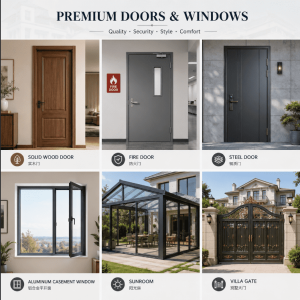
We manufacture wood French doors, thermal-break aluminum doors and windows, system windows, and custom villa doors. Our OEM and ODM services allow buyers to specify:
- Dimensions: Non-standard heights (including 8’0″ tall units) and widths are available.
- Lite configurations: Full-lite, 6-lite, 10-lite, 15-lite, or custom patterns.
- Glass options: Clear, low-e, tempered, frosted, or decorative glass.
- Hardware: Handle sets, hinges, locks, and multi-point locking systems from approved brands.
- Finish: Factory-applied primer, stain, or UV-cured finish in custom colors.
Ordering Process: MOQ, Lead Time, and Shipping
The ordering process follows a clear timeline to eliminate ambiguity:
| Order Type | MOQ | Lead Time | Shipping |
|---|---|---|---|
| Stock items (standard sizes) | 5–10 units | 1–2 weeks | FCL or LCL |
| Semi-custom (size/finish changes) | 20 units | 3–4 weeks | FCL or LCL |
| Full custom OEM (unique specs) | 50 units | 6–10 weeks | FCL or LCL |
We support both FCL (Full Container Load) and LCL (Less than Container Load) shipments, with direct delivery from our factory in China. Our export documentation includes packing lists, proforma invoices, and full customs declarations. If a buyer needs an 8’0″ tall full-lite unit with low-e glass, we can produce it. If a buyer needs 500 units of a standard size for a distribution channel, we can deliver them on schedule.
—
How to Choose Between Sourcing Models
Not every project requires the same sourcing approach. The decision depends on volume, timeline, and how much control you need over the final product.
Choose OEM (Original Equipment Manufacturing) if:
- You have a detailed specification that must be met exactly.
- Your project volume justifies a dedicated production run.
- You need custom dimensions, glass, or hardware that stock items do not offer.
Choose ODM (Original Design Manufacturing) if:
- You want to leverage the factory’s existing designs.
- You need to customize color, finish, or branding on a proven product.
- Your volume is moderate and you want faster lead times than full custom production.
Choose Stock/Ready-to-Ship if:
- You need standard sizes immediately.
- You are a distributor testing demand for a new product line.
- Your budget is tight and you are willing to trade customization for lower cost.
—
Frequently Asked Questions
How much do wood French doors cost?
Interior pine prehung units typically range from $400–$900 per pair in standard sizes. Solid wood custom units (oak, mahogany) range from $1,200–$3,500+ per pair. Exterior units with low-e glass and fiberglass construction range from $1,500–$4,000+ per pair. Final pricing depends on wood species, glass type, size, and hardware. For a precise estimate, request a quotation with your exact specifications.
What’s the difference between a double door and a French door?
A French door is a double door where the panels have full-length glazing (lites). A standard double door may have solid panels or partial glazing. French doors maximize natural light and offer a classic aesthetic; solid double doors provide more privacy and insulation.
Are wooden French doors good?
Yes, when properly manufactured. Wood French doors offer excellent aesthetics and natural insulation. Performance depends on wood quality (moisture content), sealing, and glass type. Engineered wood or properly kiln-dried solid wood with factory-applied finishes performs best. Always verify test reports for air and water tightness.
Can French doors be solid wood?
Yes. However, solid wood expands and contracts with humidity changes, which can cause warping. Many manufacturers use engineered wood cores with wood veneers for better dimensional stability, especially for large panels. Discuss your project’s climate conditions with your supplier before specifying solid wood.
What is the typical lead time for custom wood French doors?
Stock sizes may ship in 1–2 weeks. Semi-custom orders with size or finish changes typically take 3–4 weeks. Fully custom OEM orders with unique dimensions, glass, and hardware may require 6–10 weeks. Confirm lead times in writing before placing a purchase order.
—
References
- ASTM E283 Standard Test Method for Determining Rate of Air Leakage Through Exterior Windows, Skylights, Curtain Walls, and Doors. https://www.astm.org/e0283-19.html
- ASTM E547 Standard Test Method for Water Penetration of Exterior Windows, Skylights, Doors, and Curtain Walls by Uniform Static Air Pressure Difference. https://www.astm.org/e0547-00r16.html
- ASTM E330 Standard Test Method for Structural Performance of Exterior Windows, Skylights, Doors, and Curtain Walls by Uniform Static Air Pressure Difference. https://www.astm.org/e0330-21.html
- ISO 9001:2015 Quality Management Systems. https://www.iso.org/standard/62085.html
- Forest Stewardship Council. https://fsc.org/
- National Fenestration Rating Council. https://www.nfrc.org/
- GB/T 7106 Performance Test Standard for Building Exterior Windows, Doors, and Curtain Walls. https://www.chinesestandard.net/PDF/English.aspx/GBT7106-2019
Whether you’re specifying wood French doors for a villa project or stocking prehung units for distribution, the right factory partner makes the difference between a smooth rollout and a logistics headache. Our team can walk you through material options, customization limits, and shipping timelines. Contact our team to discuss your project requirements and receive a detailed quotation.